
0 ITEMS

What Is a 3-Statement Model?

A 3-statement financial model is a key tool for understanding a company’s financial health by linking income, balance sheet, and cash flow statements.
- It helps forecast profits, analyze scenarios, and manage working capital more accurately.
- Businesses like startups, banks, and financial analysts rely on it for decision-making and strategic planning.
- The model ensures all statements reflect true financial performance by maintaining data consistency across reports.
- It supports building advanced models such as DCF, LBO, and M&A analysis.
Continuing, this article highlights the core components and practical uses of a 3-statement financial model.
What Is a 3-Statement Financial Model?
A 3-statement financial model uses three key reports: the income statement, balance sheet, and cash flow statement.
- Income Statement shows how much money a business earns and spends over a set time to reveal its profit or loss.
- Balance Sheet gives a snapshot of what a company owns, owes, and the value left for owners at a specific moment.
- Cash Flow Statement tracks the money coming in and going out to show how well a business manages its
So, what is a 3-statement model? A 3-statement financial model shows how much a company earns, what it owns and owes, and how it manages cash. Each statement gives a different view of business health. Together, they create a full picture of financial performance. The 3-statement model template links all three main financial statements using formulas. Changes in one report flow through the others. For example, net income from the income statement affects the balance sheet’s cash flow and retained earnings. The model ensures all statements work in sync and reflect accurate results. A 3-statement model is essential for planning and decision-making. It helps forecast profits, track funding needs, and measure financial strength. Investors and managers use it to test scenarios and spot risks. This tool gives a clear path to smarter business choices.

How Do the Three Statements Connect?
In a 3-statement model template, the income statement starts by calculating net income. Net income drives everything—it flows from the income statement to the cash flow statement and balance sheet.
- That net income moves to the cash flow statement, where it’s adjusted for non-cash items like depreciation and changes in working capital. At the same time, the net income also affects retained earnings under equity on the balance sheet.
- Depreciation and amortization lower net income but don’t reduce cash, adding them back in cash flow. The result is the net change in cash. This cash figure updates the balance sheet’s cash account. Depreciation appears on all three: as an expense on the income statement, added back on the cash flow statement, and as a reduced asset value on the balance sheet.
- Changes in working capital show how shifts in assets and liabilities affect cash, connecting all three statements. These links ensure that all statements stay in sync and reflect the business’s financial position.
- Capital expenditure (CAPEX) reduces cash and increases assets, linking the cash flow and balance sheet.
- Financing activities like loans or dividends change cash and liabilities or equity.
- The ending cash balance ties it together, showing how every move impacts cash and flows back to the balance sheet.










































Who Uses a 3-Statement Model Template?
A 3-statement model template is a must-have tool for anyone who needs a clear view of a business’s financial health. It connects the income statement, balance sheet, and cash flow statement into one streamlined model. This makes it easier to understand how decisions simultaneously affect profit, cash, and assets. This tool brings structure and accuracy to financial planning, from forecasting growth to testing scenarios. Whether making sense of past results or mapping the future, it helps keep numbers honest and strategies grounded.
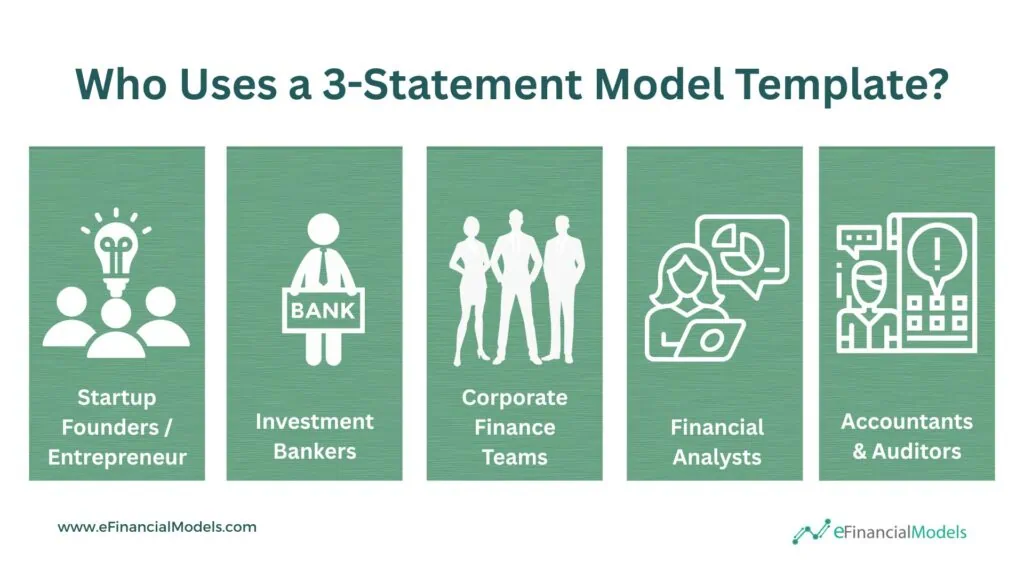
- Startup Founders and Entrepreneurs depend on the model to stay grounded while chasing growth and to understand how their cash position will evolve over time. It helps them see how costs, revenue, and cash flow fit together and their impact on the available cash to the company.. With it, they can plan better, pitch with clarity, and guide their business with more control to ensure the business remains liquid at all times.
- Investment Bankers need the model to evaluate deals with precision. It helps them see how mergers & acquisitions or fundraising moves affect a company’s financials and anticipate potentials issues with capital provides by analyzing the projected financial ratios.
- Corporate Finance Teams use the model to track how changes in strategy affect financial performance. They count on it to test plans, manage budgets, and measure results. It helps them spot risks early and make smarter decisions that strengthen the business.
- Financial Analysts use the model to understand a company’s real value. They use it to connect financial performance with market trends and future expectations. This helps them back up their insights with solid numbers and create reliable forecasts.
- Accountants and Auditors in some cases might also use a 3-statement model template to verify that the cash reconciles with the reported financials or to identify potentials flaws or cash leakages. They rely on it to ensure that reports match and numbers stay consistent across all three statements. This gives them confidence that the data tells a true financial story and meets financial reporting standards.
Why Is the 3-Statement Financial Model Important?
A 3-statement financial model shows how a business works beneath the surface. It connects profit, assets, and cash into one clear picture. This link helps decision-makers see the true impact of every move. From small shifts in costs to big changes in strategy, it shows how everything flows together. With this model, you don’t just guess—you plan with confidence and act with clarity.
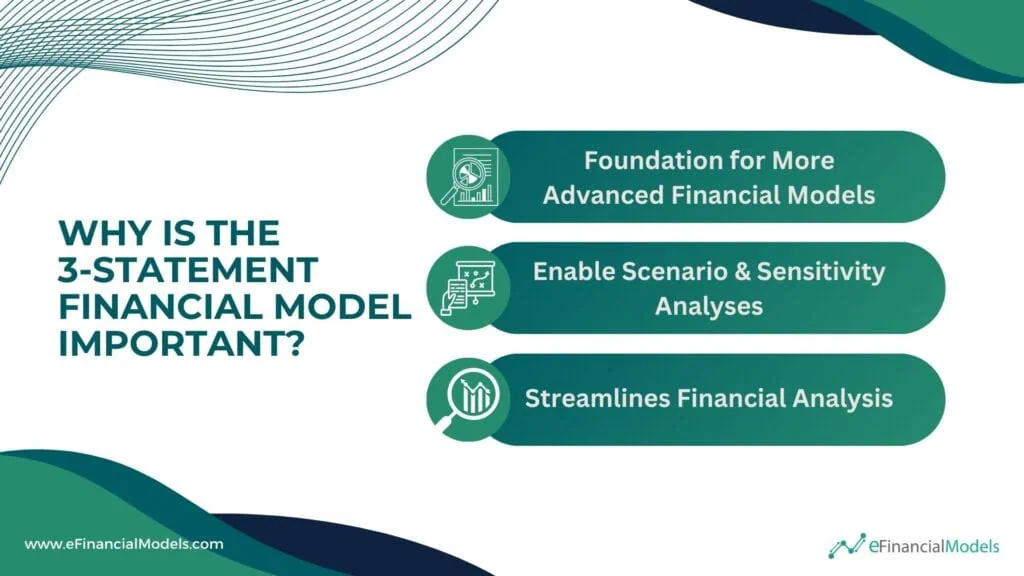
- Foundation for More Advanced Financial Models: The 3-statement model links the income, balance, and cash flow statements. This foundation helps build more complex models like DCFs, LBOs, or M&A models. With a 3-statement financial model, you can see how each part works together. It ensures numbers flow logically and accurately, which is key when layering new assumptions.
- Enable Scenario and Sensitivity Analyses: A 3-statement model lets you change key assumptions and instantly see the impact. Want to know how higher costs or lower revenue affect profits and cash flow? Adjust a few inputs and the model updates. It’s perfect for testing best-case, worst-case, and base-case plans, helping businesses prepare smart strategies.
- Streamlines Financial Analysis: Instead of juggling separate reports, the 3-statement model gives a full financial picture in one place. You can track profit, debt, cash, and equity simultaneously. This saves time and reduces mistakes. It’s a fast, clear way to understand a company’s health and make better decisions.
Our 3-Statement Model Example
Our 3-statement Model example shows how the income statement, balance sheet, and cash flow statement work together. It’s a clear, easy-to-follow snapshot of how money flows through a business. This example helps you understand core financial connections quickly. Whether you’re building your first model or reviewing one, it’s a great starting point. Use our 3-statement model template to streamline your financial analysis.

The income statement in our 3-statement model example reveals how revenue growth drives profitability step by step. It highlights solid revenue gains, rising gross profit margins, and stable EBITDA performance. Operating costs are tracked, showing their effect on cash flow and earnings. You can see how depreciation, interest, and taxes shape the final net income.

The balance sheet from our 3-statement model example shows strong asset growth driven by rising cash, inventory, and fixed assets. It reflects a healthy balance between short-term assets and liabilities, helping ensure liquidity. Financial debt steadily drops while equity rises year over year—signaling improved financial strength. This snapshot helps users track how the business funds its growth and manages its resources. It’s a simple way to understand the company’s financial position.
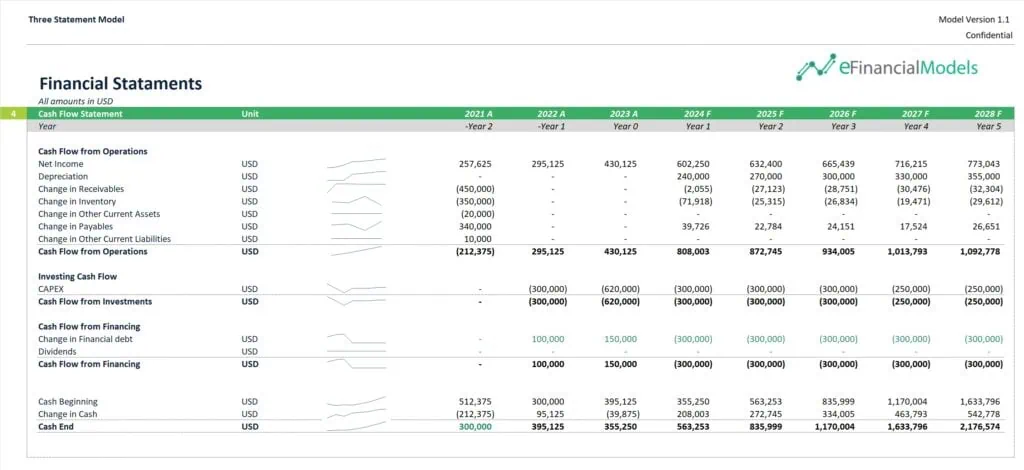
The cash flow statement in our 3-statement model example shows how cash moves in and out of the business. Strong operating cash flow grows steadily, driven by higher net income and efficient working capital management. Investing cash flow stays negative due to consistent capital spending, showing reinvestment in assets. Financing cash flow reflects a shift from raising debt to repaying it. Overall, the cash position improves yearly—highlighting solid financial health and strong cash generation.
Why Financial Modeling Starts with Three Statements?
The 3-statement model brings clarity, structure, and insight to financial planning. It links profit, cash flow, and the balance sheet into one smart system that shows how each decision affects the whole business. Whether you’re forecasting revenue, testing assumptions, or preparing for investment, this tool helps you plan precisely and act confidently. Our 3-statement model example makes it easy to see the big picture and stay aligned with your goals. It’s a powerful way to turn financial data into a smart strategy.
Financial modeling starts with three statements because they give a full view of a company’s health. The income statement shows a profit, the balance sheet tracks assets and debts, and the cash flow statement explains how money moves. Together, they form a clear picture of performance. A 3-statement model template keeps all reports in sync, so changes in one area flow through the others. This helps users test plans, spot risks, and confidently make smart decisions.
Start building smarter financial models today. Explore our ready-to-use 3-statement model template and other expert tools at eFinancialModels—your trusted source for professional financial modeling templates. Get clarity. Gain control. Make better decisions.










You might also like:
- 10 Tips to Develop a First Class Business Valuation Report
- 10 Main Elements of a Business Plan
- 12 Funding Sources for Businesses and Startups
- Cash Flow Statement: Streamline Financial Success
- Understanding the Debt Service Coverage Ratio: An Essential Metric for Financial Analysis
- How to Prepare a Financial Feasibility Study?
- Master the Free Cash Flow Formula for Smarter Financial Decisions
- Understanding What is Yield to Maturity and Why It Matters
- Financial Planning for Small Business Owners – Taking an SBA Loan
- Financial Model Templates Easy to Use
- Three Statement Model | Three Financial Statements
- 5 Steps to Create a Drop Down List Using Data Validation in Excel
- Financial Ratios Analysis and Its Importance
- How to Do Cohort Analysis in Excel
- Achieve Financial Success By Knowing Your Business Plan Model
- Financial Statements – Definition, Uses, Contents and Templates
- Understanding the Levelized Cost of Energy Formula
- Financial Modeling for Startups and Small Businesses
- Financial Modeling using Excel
- 10-Step Financial Planning Checklist for Smart Executives