
0 ITEMS

How to Use Inflation Projection to Your Advantage

Inflation influences many aspects of business and finance, impacting everything from pricing to investment decisions.
- Understanding inflation projections helps companies anticipate future costs and adjust budgets accordingly.
- Different methods like CPI analysis, scenario planning, and time series forecasting offer ways to estimate future inflation rates.
- Accurate inflation forecasts support strategic decisions on pricing, interest rates, and wage adjustments.
- Regularly updating inflation projections is essential to stay aligned with changing economic conditions.
- Using these tools enables businesses to protect assets, optimize investments, and maintain long-term financial stability.
Continuing with this information, you can better navigate inflation’s effects on your financial planning.
The Concept of Inflation Projections
Inflation projections among businesses refer to the expectations and forecasts companies and organizations make regarding the future inflation rate. Inflation is the rate at which the general price level of goods and services rises over time, decreasing the purchasing power of money. It’s an essential economic indicator that affects businesses, consumers, and overall economic conditions.
Business inflation projections estimate how they expect the general price levels to change. These projections are crucial for informed financial decision-making pricing, budgeting, and overall financial planning decisions. They closely monitor inflation projections, significantly impacting their operations, financial decision-making, and planning.
Inflation projections can come from various sources, including economic research organizations, financial institutions, and government agencies. Businesses may also conduct financial forecasting based on historical data, market trends, and scenario analysis. It’s important to note that they are not always accurate, as they depend on numerous variables and external factors. Consequently, businesses must regularly review and update their forecasts to adapt to changing economic conditions.
How Inflation Projection Affects Businesses
Budgeting & Planning: Businesses must consider inflation in financial decision-making on budgeting and financial planning. Inflation can increase the cost of raw materials, labor, and other inputs required for production. Due to exchange rate fluctuations, businesses that rely heavily on imported goods or commodities may experience even higher cost increases. These rising costs can directly impact a company’s profitability and cash flow, making it essential for businesses to factor in inflation projections when budgeting for expenses.
Pricing Strategies: Inflation projections influence how businesses set their prices. If they anticipate higher inflation, they may adjust their pricing strategies to account for increased production costs and maintain profit margins. Businesses may need to adjust their pricing strategies to maintain profit margins and cover rising costs. However, it’s crucial to balance passing on increased costs to customers and remaining competitive in the market. Inflation projections can help businesses anticipate the need for price adjustments and plan accordingly.
Interest Rates & Borrowing: Central banks often adjust interest rates in response to inflation. When inflation is expected to rise, central banks may raise interest rates to curb spending and reduce inflationary pressures. It can directly impact businesses with loans or credit, as borrowing costs may increase. Planning for potential changes in interest rates can help businesses make informed financing decisions and plan their debt management strategies accordingly.
Investment Decisions: Inflation projections can significantly influence financial decision-making due to their potential impact on the purchasing power of money and the overall economy. Inflation can impact corporate earnings and valuations. Inflation projections may lead investors to focus on companies that can pass on increased costs to consumers or have pricing power, as they may be better positioned to maintain profitability during inflationary periods. Inflation projections can influence the time horizon of investments. If high inflation is anticipated, investors may opt for shorter-term investments to have more flexibility in adapting to changing economic conditions.
Wage & Labor Costs: Inflation can also affect employee wages and salaries. Higher inflation may lead to increased labor costs as employees may demand higher wages to keep up with the rising cost of living. Businesses may need to increase wages to retain talent and keep pace with the rising cost of living. Incorporating inflation projections into human resources planning can help companies plan for salary adjustments and budget for workforce costs effectively.














































Common Ways to Calculate Projected Inflation Rate
Projection of inflation rates involves estimating the future movement of prices based on historical data, economic indicators, and other relevant factors. Performing inflation rate projections is essential for individuals, businesses, and policymakers to make informed decisions and plan for the future. The most common ways to calculate the projected inflation rate are by analyzing the consumer price index, scenario analysis, and time series analysis.

Analyzing Consumer Price Index (CPI)
Analyzing the Consumer Price Index is commonly used to perform inflation rate projections. The CPI is a key indicator of inflation and measures the changes in the prices of a basket of goods and services consumed by the average urban household. Economists and policymakers can gain insights into an economy’s current and future inflation trends by analyzing the CPI.
Here’s a step-by-step guide on how to use CPI analysis for inflation rate projection:
- Acquaint yourself with the concept of CPI and how it is calculated. The CPI is usually based on a representative basket of goods and services weighted according to their importance in household spending. The percentage change in the CPI over a specific period represents the inflation rate for that period.
- Collect historical CPI data for the time frame you want to analyze. The more data points you have, the better your projections will likely be. Historical data can typically be obtained from central banks or government agencies responsible for economic statistics.
- Compute the inflation rates for each period using the CPI data. Inflation rates are typically expressed as a percentage change over a specific period, often monthly or yearly.
- Identify the patterns and trends of your computed historical inflation rates. Look for periods of high and low inflation, and try to understand the factors contributing to these fluctuations. In some cases, CPI data may exhibit seasonal variations. If this is the case, consider applying seasonal adjustments to the data to obtain a more accurate inflation rate projection.
- Consider external factors that may have influenced inflation in the past, such as changes in monetary policy, fiscal policy, international economic conditions, commodity prices, and other relevant economic indicators.
- Find the inflation rate projection based on the trends and patterns observed in the historical CPI data. Considering the external factors, make projections for future inflation rates. These projections can be short-term (e.g., next few months) or long-term (e.g., next few years). Assess the accuracy of your inflation rate projections by comparing them to actual inflation rates as new data becomes available. It will help you refine your methodology and make more accurate projections in the future.

Scenario Analysis
Scenario analysis is a technique used in various fields, including finance, business, risk management, and strategic planning, to evaluate the potential outcomes of different future events or situations. It involves constructing and examining multiple hypothetical scenarios to understand how a particular decision or strategy might perform under various conditions. Calculating the projected inflation rate through scenario analysis involves assessing different economic scenarios and their potential impact on inflation. Scenario analysis helps you understand how inflation might evolve under various conditions, allowing you to make more informed decisions.
Here’s a step-by-step guide to performing scenario analysis for projecting inflation rates:
- Start by gaining a comprehensive understanding of the current economic environment. Analyze factors such as GDP growth, unemployment rates, fiscal and monetary policies, international trade dynamics, and commodity prices. They will serve as the baseline for your scenario analysis.
- Collect historical data for the chosen economic variables under each scenario. You’ll need this historical data to build financial forecasting models and estimate the relationship between these variables and inflation.
- Based on historical analysis, build financial forecasting models to project inflation rates under each scenario. These financial forecasting models will estimate how inflation responds to changes in the economic variables for each scenario.
- Apply the financial projection models to the specific economic conditions defined in each scenario. It will provide you with projected inflation rates for each scenario. Sum up these values to calculate the weighted average projected inflation rate. Furthermore, perform sensitivity analysis to evaluate how changes in the probabilities of different scenarios or adjustments to key economic variables impact the overall projected inflation rate. It will provide insights into the robustness of your projections.


























Time Series Analysis Forecasting
Time series analysis forecasting is a statistical technique to predict future values based on historical data. In this approach, data points are collected regularly over time, forming a sequence of observations. These observations are analyzed to identify patterns, trends, and seasonality within the data, which can be used to create forecasts for future time points. In the context of inflation rate projection, time series analysis can be a valuable tool to model and forecast future inflation rates based on historical data.
The inflation rate is the percentage change in the general price level of goods and services in an economy over a specified period, typically measured monthly, quarterly, or yearly. Time series analysis allows economists, policymakers, and businesses to study the patterns, trends, and seasonality of inflation rates over time, enabling them to make informed projections about future inflation.
There are several key steps involved in using time series analysis for inflation rate projection:
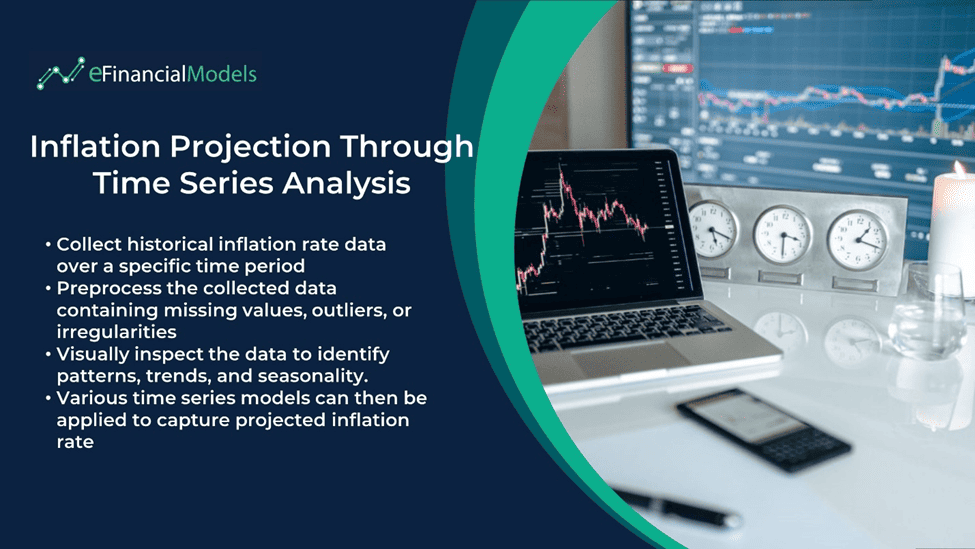
- Collect historical inflation rate data over a specific time period. The data should be consistent, reliable, and cover a sufficient number of observations.
- Preprocess the collected data containing missing values, outliers, or irregularities. Preprocessing involves cleaning the data, handling missing values, and addressing outliers to ensure data integrity.
- Visually inspect the data to identify patterns, trends, and seasonality. This step helps in gaining insights into the behavior of the inflation rate over time.
- Various time series models can then be applied to the data to capture underlying patterns and relationships. Some common time series models used for inflation rate projection include Autoregressive Integrated Moving Average (ARIMA), Seasonal Autoregressive Integrated Moving-Average (SARIMA), and Vector Autoregression (VAR) models. The most suitable model is selected based on its ability to fit the historical data and capture the relevant features of inflation rate fluctuations.
Harnessing Inflation Projection for Financial Success
Harnessing inflation projection is crucial to achieving financial success in an ever-changing economic landscape. By understanding the concept of inflation projection, individuals and businesses can make informed decisions that mitigate the adverse effects of rising prices and optimize their financial planning. Accurate inflation projection relies on various methodologies such as Consumer Price Index (CPI) analysis, Scenario analysis, and Time Series analysis. Each approach provides valuable insights into different aspects of inflation, enabling a comprehensive understanding of potential future trends.
Furthermore, incorporating financial projection models to expedite inflation projections can significantly enhance decision-making processes. These models can process vast amounts of data and simulate various scenarios, allowing for a more dynamic and adaptive approach to inflation forecasting. Ultimately, by staying informed about inflation trends and incorporating inflation projections into financial planning, businesses can develop proactive strategies to safeguard their assets, optimize investments, and maintain long-term financial stability.






You might also like:
- 10 Ideas to Increase Average Revenue Per User
- How to Use Excel for Financial Analysis?
- Financial Modeling for Startups and Small Businesses
- How to Write a Killer Mobile App Business Plan
- The Purpose of a Financial Model
- Financial Services
- Budgeting
- Financial Planning
- How to Create a Budget Plan – Using the Best Excel Budget Template
- Breaking down Microbrewery Startup Costs
- Top-Down vs. Bottom-Up Financial Planning: What’s the Difference?
- Financial Projections
- Renewable Energy
- Fundraising
- 5 Practical Tips to Help Raise Funds For Startups
- Understanding Insurance Policies: A Beginner’s Guide
- Venture Capital vs. Private Equity: Which is Right for You
- Free Budget Planner Template in Excel for Services Businesses
- How to Make Smart Decisions with 6 Key Financial Metrics?
- Financial Ratios Analysis and Its Importance