
0 ITEMS

What Are 3 Basic Financial Model Types You Should Know?

Financial models are essential tools for making informed business decisions and project planning.
- The Three-Statement Model links income, balance sheet, and cash flow to provide a full financial overview.
- Discounted Cash Flow (DCF) models estimate a company’s value based on future cash flows, useful for investment and valuation.
- Startup Financial Models help founders determine funding needs, forecast growth, and show potential investor returns like IRR.
- Core components such as assumptions, financial metrics, and scenario analysis enable accurate planning and risk assessment.
- These models support strategic decisions, from budgeting to fundraising, by translating complex data into clear financial insights.
Understanding and applying these models improves decision-making and drives better financial results for your business.
What is a Financial Model?
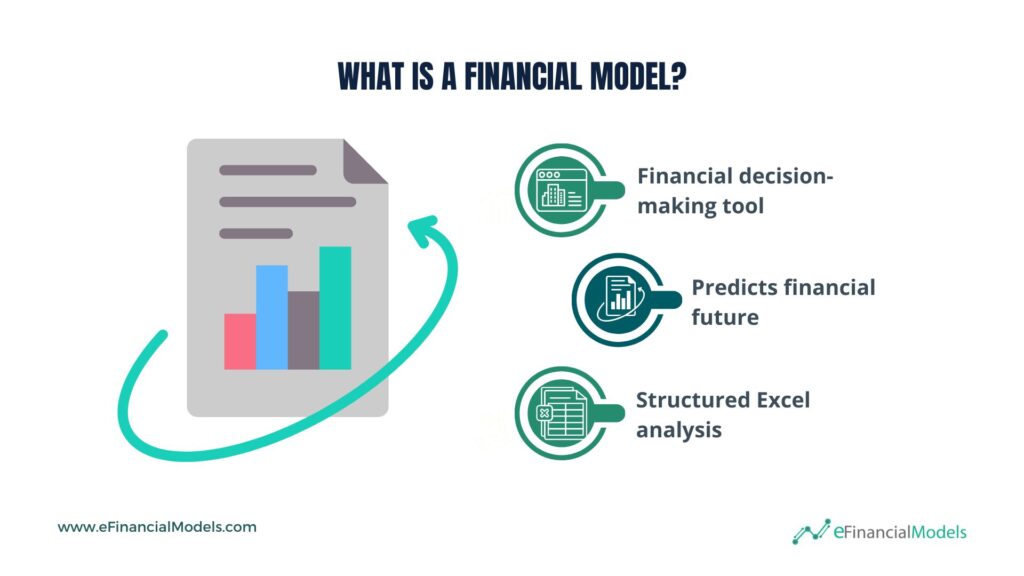
A financial model is a tool used to make smart business decisions. It helps predict how a company will perform based on different assumptions. With it, businesses can test ideas, plan budgets, and forecast profits or losses. It’s often built in Excel and uses formulas to simulate real scenarios. Investors and founders rely on it to understand risks, returns, and growth opportunities. It simplifies complex data into clear financial stories that guide strategy.
What is a Financial Model? A financial model is a number-based plan that shows where a business might go. It lays out income, costs, and cash flow over time. By changing inputs, users can see different outcomes. It’s like a forecast, helping prepare for both success and setbacks. This blueprint gives clarity, helping teams align their goals with expected results.
What is a financial model is often built in Excel using rows and columns of data. It organizes revenue, expenses, assets, and liabilities. Each part links with formulas to keep calculations accurate. This setup lets users test different business cases quickly. The structure makes it easy to update and share with others, keeping everyone on the same page financially.
What Are the Key Components of a Financial Model?
Basic financial models help you see the full picture of a business through numbers. They turn plans into forecasts and show how money flows in and out. These models reveal the health and potential of a company in a simple, structured way. Understanding how basic financial models work gives you the power to make smarter, faster decisions.
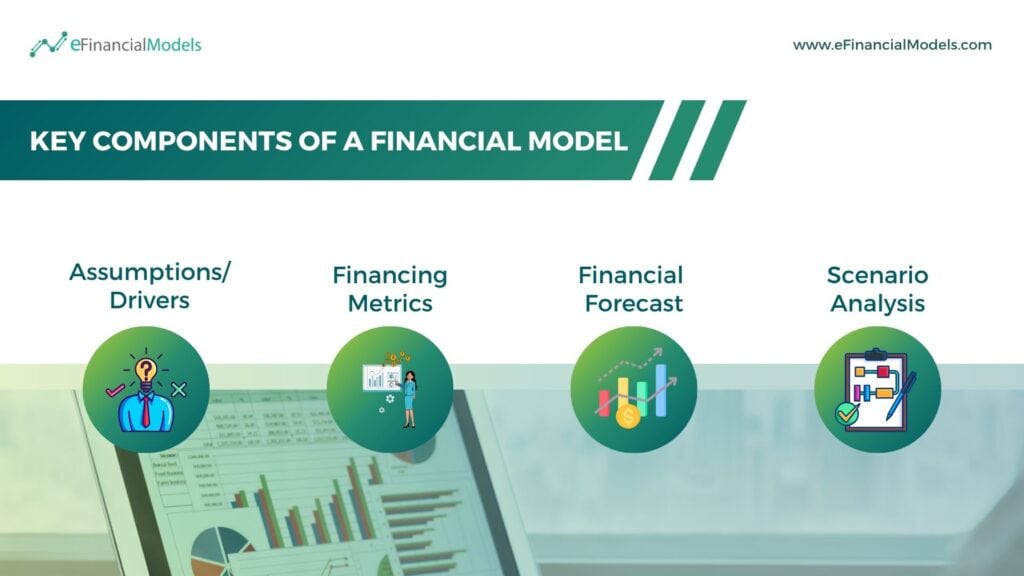
- Assumptions/Drivers: Assumptions and drivers power the entire model. These are inputs like sales growth or cost changes that shape all results. Clear, realistic drivers make basic financial models more accurate and useful.
- Financing Metrics: Financial metrics, such as the IRR, NPV, Payback Period or DCF Valuation help you quickly understand the result of your financial models. These metrics will form the basis to for your financial decision-making when you need to understand the valuation of a company, an asset or the profitability of a proposed investment project.
- Financial Forecast: The financial forecast outlines the expected financial performance based on a set of assumptions. The forecast can be a simple direct Free Cash Flow Forecast or a more sophisticated financial statement forecast
- Scenario Analysis: The model should have the capabilities to simulate scenarios. The simplest way to do this is to change the assumptions and see the forecast and financial metrics change. More sophisticated scenario analysis models set of assumptions, including worst, base, and best case, to see how those can affect results. Even more sophisticated models analyze the impact of each assumption on key financial metrics by using sensitivity analyses and comparing the impacts in a Tornado Diagram.
Three Basic Financial Models
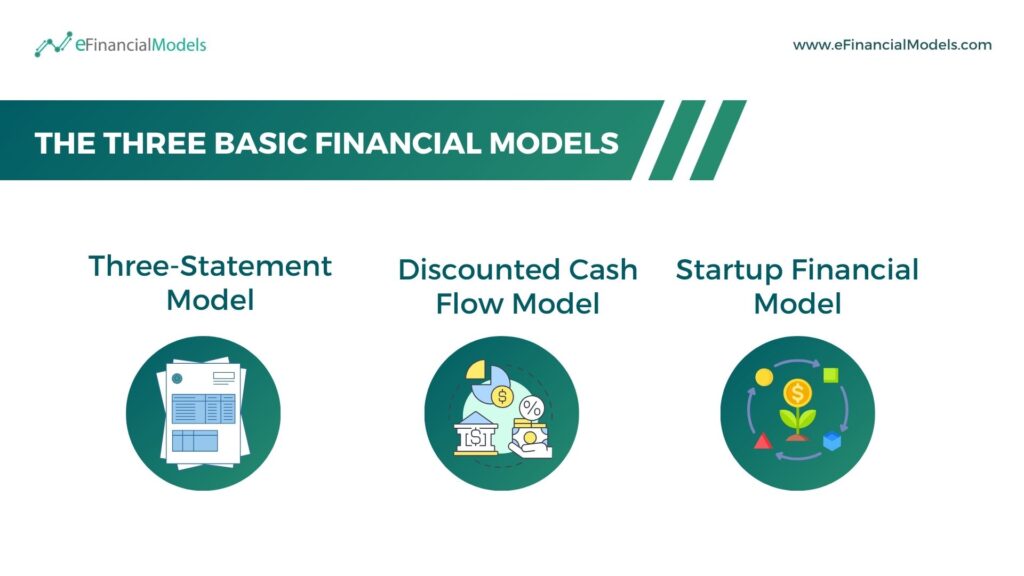
The basic financial models are called “basic” because they form the financial analysis foundation. These core models are essential tools every finance professional learns first. Each model offers a different view: the Three-Statement Model connects the income statement, balance sheet, and cash flow; the DCF values a business based on future cash flows; and a Startup Financial Model projects a startup’s performance, calculates the Internal Rate of Return (IRR), determines how much fundraising is required, and supports investor decision-making during fundraising rounds.
Three-Statement Model
The Three-Statement Model links a company’s income, balance, and cash flow statements into one dynamic financial tool. It shows how profits flow into retained earnings, how assets and liabilities change, and how cash moves through the business. This model helps you forecast financial performance, understand how decisions impact each part of the business, and test different scenarios. It’s the foundation of most financial models because it ties everything together.
- Income Statement: The income statement shows how much a business earns and spends over time. It tracks revenue, costs, and profit. Basic financial models use this to measure performance and spot trends in earnings.
- Balance Sheet: The balance sheet gives a snapshot of what a company owns and owes at a time. It shows assets, liabilities, and equity. This helps users understand the company’s financial strength and stability.
- Cash Flow Statement: The cash flow statement explains how money moves in and out of the business. It separates operations, investing, and financing activities. This tells you if a company can pay bills and fund growth.
- Financial Ratios – to understand a three statement model, you also need a to understand the projected financial ratios. The whole purpose of building a three statement model is that you can understand the financial raitos.
The Three-Statement Model lets you plan, track, and adjust your business strategy with real data. You can build budgets, spot cash shortfalls, and test how changes in sales or costs affect your bottom line. It helps with loan planning, investor pitches, and decision-making. You see how one move simultaneously impacts profits, cash, and the balance sheet.
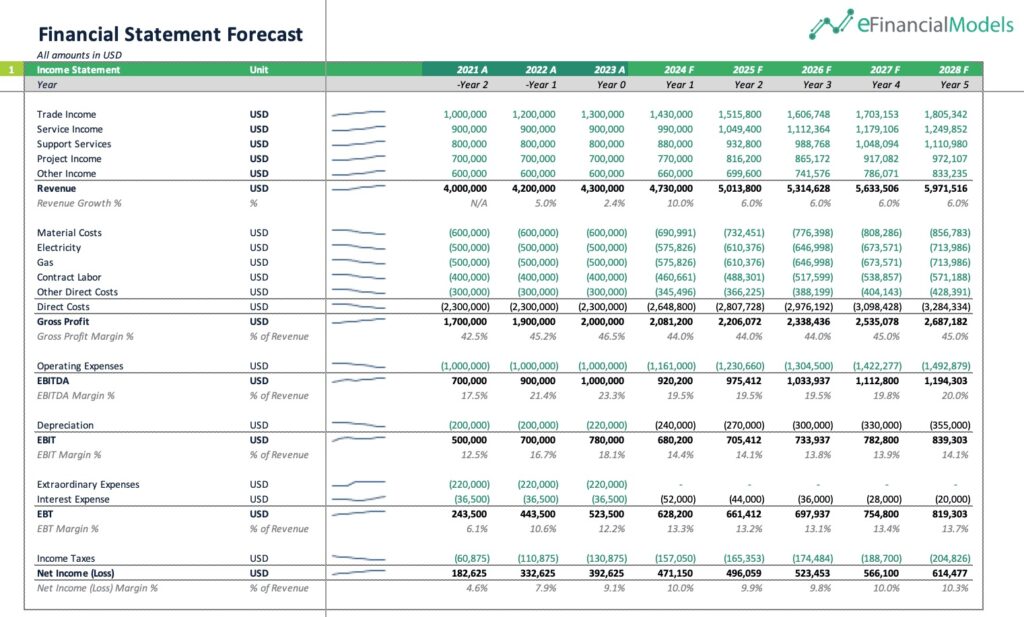
The above income statement from our Three-Statement Financial Model shows a clear forecast of the company’s financial performance from 2021 to 2028. It outlines revenues from multiple income streams like trade, service, and project income, followed by direct costs, operating expenses, and profits. Key metrics such as gross profit, EBITDA, EBIT, and net income are calculated annually to highlight profitability trends. As revenues steadily grow, margins stay healthy, and net income rises consistently, the model gives a snapshot of a scalable business with strong earnings potential over time.
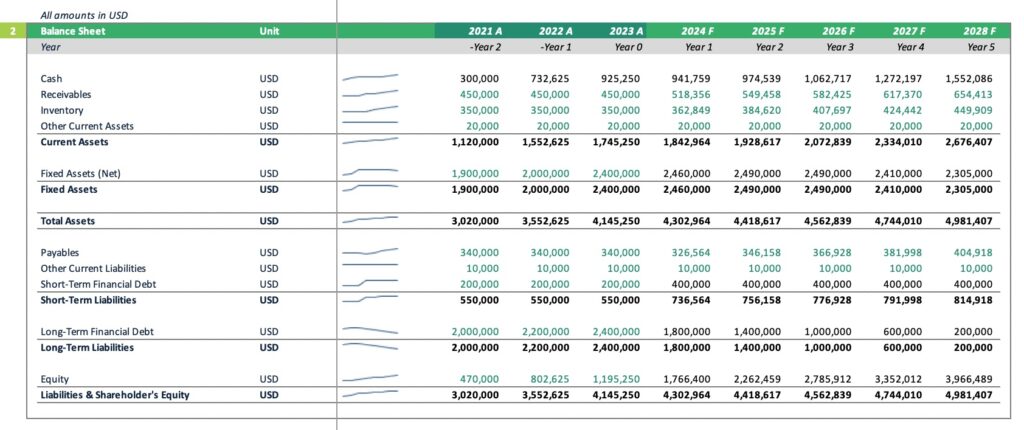
The above balance sheet from our Three-Statement Financial Model shows the company’s financial position from 2021 to 2028. It tracks how cash, receivables, and fixed assets steadily grow, signaling expansion. It also outlines liabilities, including short- and long-term debt, and shows a declining debt load year over year. Equity strengthens consistently, reflecting increasing retained earnings and solid capital structure. Overall, it offers a snapshot of a business that’s becoming more financially stable and well-capitalized as it grows.
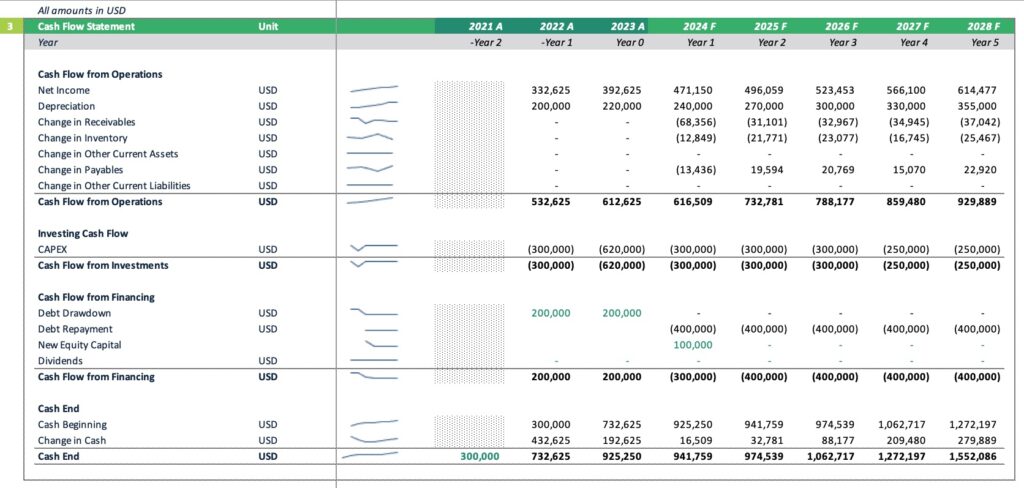
The above cash flow statement from our Three-Statement Financial Model shows how cash moves in and out of the business from 2021 to 2028. It highlights strong cash flow from operations, driven by rising net income and steady adjustments like depreciation. The model also shows ongoing investments through CAPEX and a gradual reduction in financing activities such as debt repayments and limited equity funding. Despite these outflows, cash continues to grow yearly, ending in 2028 with a solid cash reserve—evidence of a well-managed and cash-positive business.
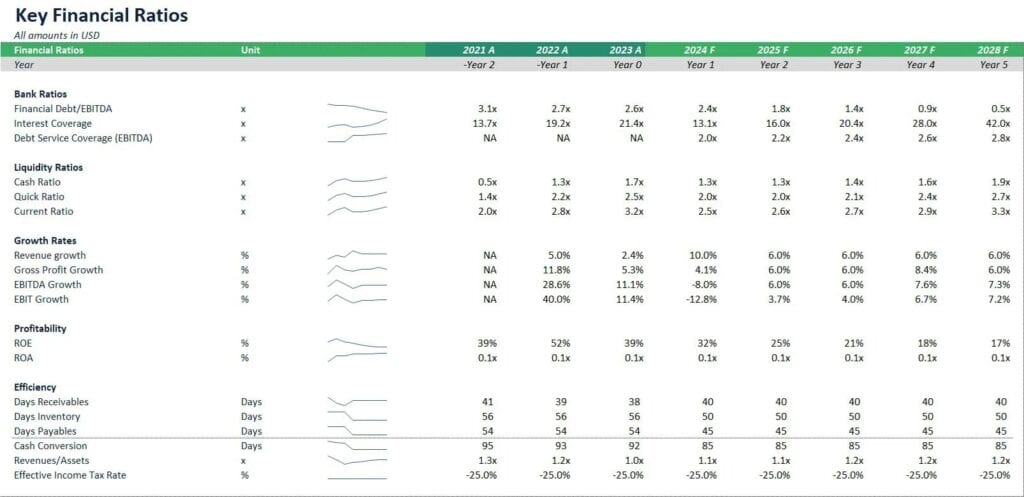
The above financial ratio analysis shows how the company’s performance shifts from 2021 to 2028. Debt and interest coverage ratios drop, showing lower leverage and improved debt handling. Liquidity steadily improves, with the cash ratio rising from 0.5x to 1.9x. Revenue and profit growth are modest but stable, with EBITDA and EBIT bouncing back after a dip in 2024. ROE falls over time, signaling shrinking returns. Efficiency stays tight—inventory and receivables hold steady, while the cash conversion cycle shortens slightly. The business becomes more liquid and efficient, but with slower growth and profitability.
Discounted Cash Flow Model
The Discounted Cash Flow (DCF) model estimates a business’s value by predicting its future cash flows and reducing them to today’s value using a discount rate. It shows how much those future earnings are worth in present terms. This useful model focuses on a company’s earning power, not just current profits or market trends. Investors use it to decide if an investment is worth the risk. As one of the three basic financial models, DCF helps show the link between cash flow, time, and value.
The Discounted Cash Flow (DCF) model helps investors and business owners decide if a project or company is worth the money. They use it to compare the value of future cash flows with what they’re spending today. It’s often used to price startups, value stocks, or plan big investments. Lenders also use it to check if a business can repay debt over time. By focusing on cash, not just profits, the DCF model gives a clear view of real value and long-term potential.
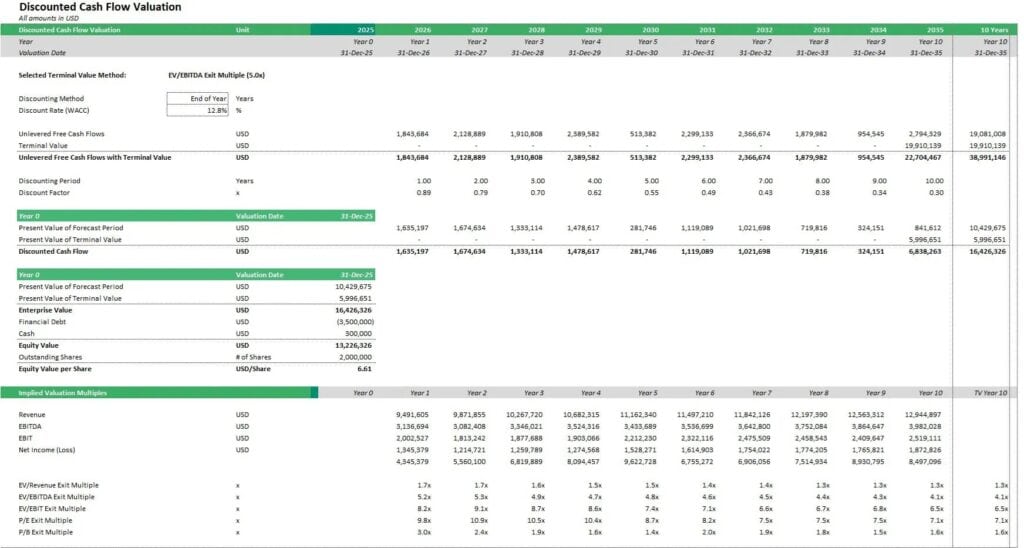
The table above is from our Advanced Discounted Cash Flow (DCF) Valuation Model Template. It shows a detailed forecast of free cash flows over 10 years and calculates what those future cash flows are worth today. It uses a 12.8% discount rate and an EV/EBITDA exit multiple of 5.0x to estimate the terminal value. The model breaks down the present value of forecasted cash flows and terminal value, adds them to find the enterprise value, and then adjusts for debt and cash to arrive at equity value and share price. It also includes key valuation multiples like EV/EBITDA and Price to Earnings to give a broader view of the company’s worth.
Startup Financial Model
A Startup Financial Model helps new businesses plan and test their financial future. It shows how much money they need, when they might break even, and how fast they could grow. Startups use it to estimate revenue, costs, and profits over time. It also supports fundraising by showing investors returns like IRR and payback period. This model is essential for turning ideas into numbers and making smart business decisions from day one.
A Startup Financial Model gives founders a clear picture of how much funding they need and when they’ll need it. It shows investors potential returns through key metrics like IRR, helping them gauge risk and reward. The model highlights the startup’s payback timeline and expected profits, making it easier to justify investment. Mapping out costs, cash flow, and fundraising needs becomes a vital tool to plan smarter, pitch stronger, and confidently raise funds.
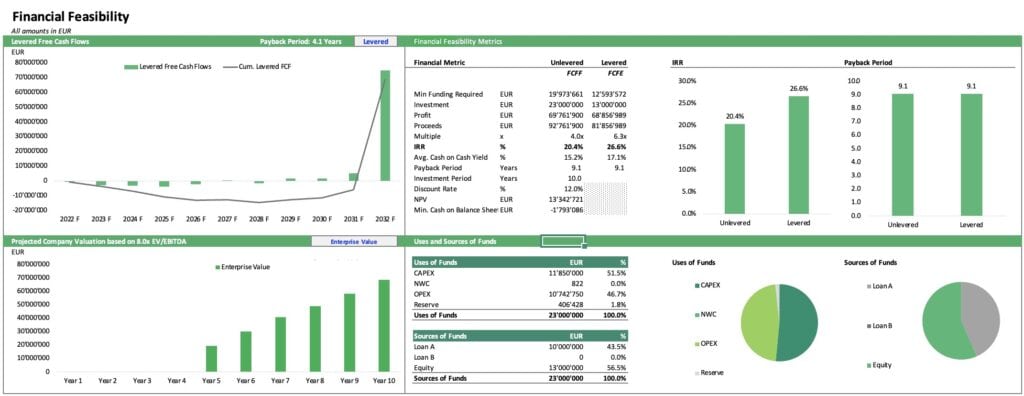
The financial feasibility table above is from our Manufacturing Startup Feasibility Model. It offers powerful insights to support fundraising. It shows that the Internal Rate of Return (IRR) has improved from 20.4% (unleveraged) to 26.6% (levered), which is a strong signal of investment attractiveness. It also calculates the minimum funding needed at EUR 12.6M, helping founders identify how much to raise. The payback period is 4.1 years for levered free cash flows, showing when investors start seeing returns. With these metrics, the model demonstrates profitability, efficient capital use, and strong growth potential, which are key to convincing investors to fund the startup.
Turn Data into Direction with Financial Models
The three basic financial models—Three-Statement, Discounted Cash Flow (DCF), and Startup Financial Model—help you understand, value, and compare businesses. The three-statement model links income, balance sheet, and cash flow for a full financial view. The DCF model values a business based on future cash flows. The startup model focuses on raising funds, calculating returns like IRR, and showing how much capital is needed. Together, these models cover the essentials—reporting, valuation, and planning—giving businesses the tools to grow with clarity and control.
Financial models turn numbers into clear choices. They help you see trends, spot risks, and plan for growth. You can set targets, test ideas, and shape better strategies with solid data. Whether you’re raising capital, valuing a business, or forecasting results, these models guide your decisions.

















































You might also like:
- 10 Tips to Develop a First Class Business Valuation Report
- 10 Main Elements of a Business Plan
- 10 Awesome Excel Formulas To Use For Your Next Financial Model In Excel
- How to Write a Killer Mobile App Business Plan
- Creating a Business Plan for your Food Truck Business
- How to Build a Capitalization Table
- Financial Model Templates Easy to Use
- Financial Modeling for Startups and Small Businesses
- Finding a Valuation Model for Your Business
- Key Financial Ratios
- Mastering the Art of IRR Calculation: A Comprehensive Guide for Investors
- Business Valuation Service
- Business Plans
- Simple Fundraising Model
- Understanding the Debt Service Coverage Ratio: An Essential Metric for Financial Analysis
- How to Calculate Net Present Value (NPV)?
- Financial Planning for Small Business Owners – Taking an SBA Loan
- Five Best Practices for Managing Days Receivables
- Startup Model Templates in Excel that can help your Business Grow
- How to Make Smart Decisions with 6 Key Financial Metrics?