
0 ITEMS

Minimize Your Net Working Capital With Invoice Factoring

Effective cash flow management is vital for business stability and growth, and invoice factoring offers a practical solution.
- Selling outstanding invoices to a factoring company provides immediate cash and improves liquidity.
- Factoring companies perform credit assessments and handle collections, easing administrative burdens.
- Advantage rates typically range from 70% to 90%, with fees between 1% and 5% of the invoice value.
- Choosing the right factoring partner involves evaluating experience, reputation, and contract terms.
- Not all invoices should be factored; selecting high-value, creditworthy receivables maximizes benefits.
Understanding how invoice factoring works and how to use it strategically can significantly enhance working capital—continue reading for detailed insights.
Cash Flow Boost: What Is Invoice Factoring?
Invoice factoring, also known as accounts receivable financing, is a strategy that helps businesses improve their cash flow. It involves selling outstanding invoices to an invoice factoring company in exchange for immediate cash to support business operations. Business invoice factoring is particularly suited for companies with substantial unpaid receivables. Due to the higher volume of transactions, these companies can negotiate better terms and lower fees. Furthermore, factoring companies perform credit assessments on the business’s customers. Companies with a substantial number of receivables typically deal with a diverse customer base, allowing factoring companies to spread and manage credit risk more effectively.
What is invoice factoring as a method? Invoice factoring is a form of alternative financing that involves selling your outstanding invoices to a third party, known as an invoice factoring company, in exchange for cash upfront. This method allows businesses to obtain immediate funds without waiting for their customers to pay their invoices. The invoice factoring company purchases the invoices at a discount and then collects the total amount from the customers when the invoices are due. This financing option is available to businesses that need to turn their outstanding invoices into cash quickly. By doing so, companies can maintain their cash flow and meet their immediate financial obligations. In exchange for this service, the invoice factoring company charges a fee, typically a percentage of the invoice amount.
What is invoice factoring as a tool for businesses? It is a versatile tool for businesses, allowing them to borrow money against the amounts due from customers. Instead of being tied to the payment terms, companies can access the value of their sales immediately. This helps businesses maintain a steady cash flow, meet short-term financial obligations, and invest in growth opportunities without waiting for customer payments. By leveraging their accounts receivable, companies can avoid taking on debt and improve their economic stability, making invoice factoring an attractive option for managing cash flow and supporting business operations.
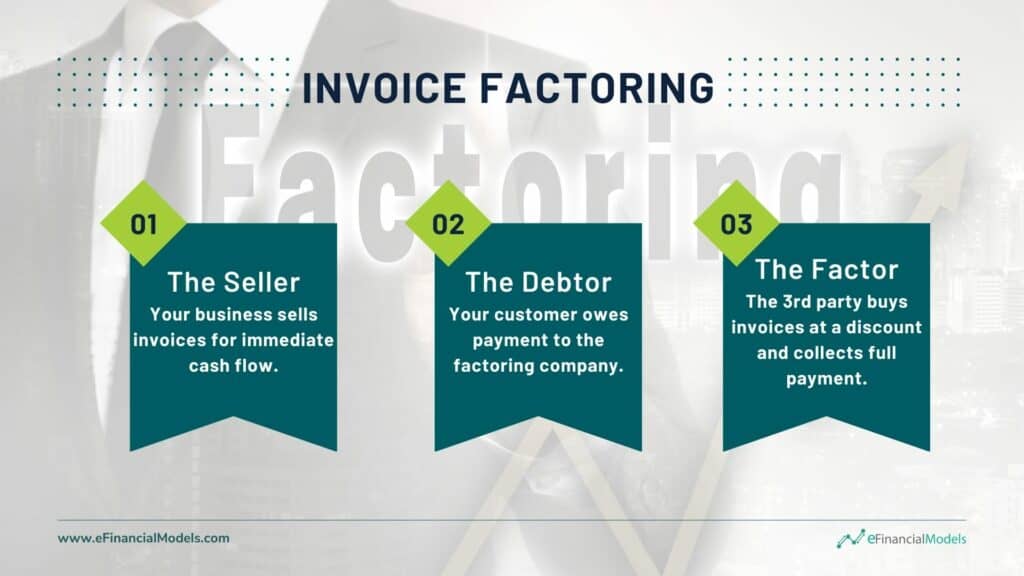
To better understand what invoice factoring, it is also essential to note the three parties involved in the process:
- The Seller: Your business sells outstanding invoices to obtain immediate cash flow.
- The Debtor: Your business’s customer owes payment on the invoices sold to the invoice factoring company.
- The Factor, or the invoice factoring company, is the third party involved in the process. They purchase the invoices at a discount and collect the full payment from the debtor, your business’s customer.
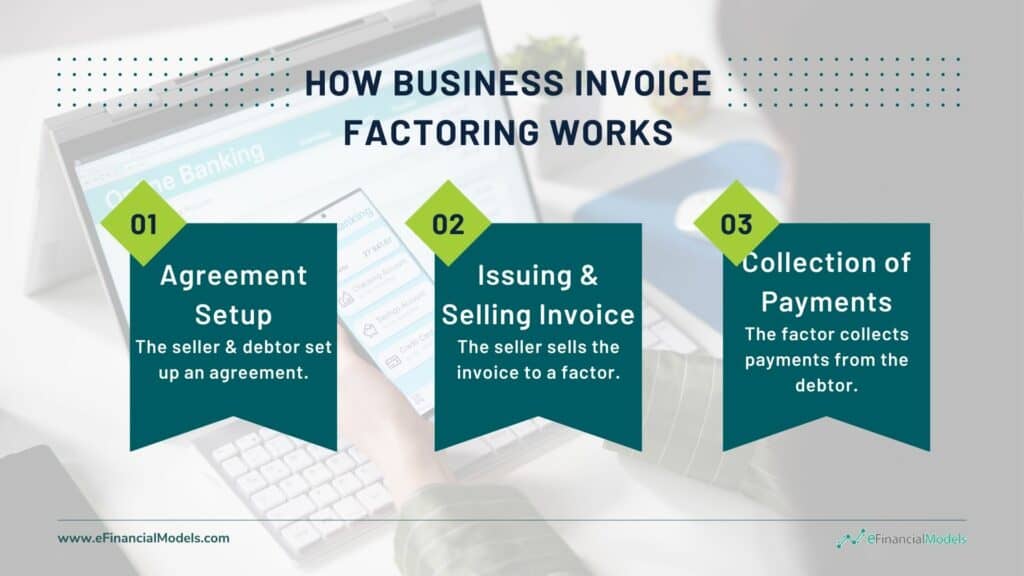
How Business Invoice Factoring Works
Business invoice factoring is a financial process in which a company sells its unpaid invoices to a third-party factor to obtain immediate cash flow. It allows the business to receive funds quickly, improving its cash flow and managing operations more effectively without waiting for customer payments. Here’s how business invoice factoring works:
- Agreement Setup: The seller and factor first set up the business invoice factoring agreement. It is a detailed negotiation between the seller and the factor, covering essential aspects. The Advance Rate is the percentage of the invoice value that the factor advances to the seller upfront, usually ranging from 70% to 90%. The Reserve is the remaining percentage of the invoice the factor holds until the debtor pays the invoice. Invoice Factoring Rates are the fees charged by the factor. It can be a percentage of the invoice value and may vary based on the time it takes to collect the payment and the creditworthiness of the client’s customers. Factoring companies typically charge a monthly invoice factoring rate of 1% to 5% of the invoice value. Two types of financing are available: Recourse and Non-Recourse. In recourse financing, the seller is responsible for buying back the invoice if the debtor fails to pay. On the other hand,
- Issuing & Selling Invoices: After setting up the business invoice factoring agreement, the seller continues to provide goods or services to its customers as usual and issues invoices for the completed work. Instead of waiting for the payment terms (30, 60, or 90 days), the invoices are sold to the factor. The factor typically advances a percentage of the invoice value immediately (usually around 70-90%). Such advance payment gives the business immediate access to working capital.
- Collection of Payments: The factor takes over the responsibility of collecting payments from the debtor, the seller’s client. These debtors are typically notified to make the payments directly to the factor. Once the factor collects the full amount of the invoice, it deducts its fees and the advance payment. The reserve or remaining balance is then paid to the seller.


















































Invoice Factoring and Invoice Discounting : Your Guide to Better Cash Flow
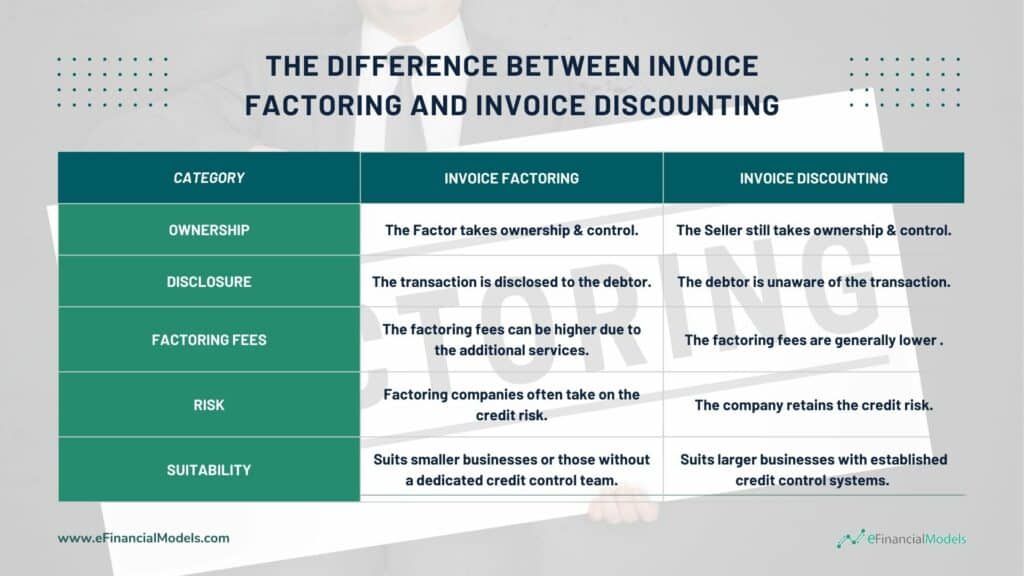
Invoice factoring and invoice discounting are two financial solutions businesses use to improve cash flow by leveraging their accounts receivable. Both methods involve advancing funds based on outstanding invoices but differ significantly in ownership, disclosure, fees, risk, and suitability. Understanding these differences is crucial for businesses to choose the most appropriate option for their financial and operational needs.
- Ownership: Invoice factoring involves the factoring company purchasing the invoices, thus taking ownership of them. It means that the factoring company not only provides an advance on the invoice value but also takes over the credit control and collection process. In contrast, under invoice discounting, the business retains ownership of the invoices. The company continues to manage its sales ledger and is responsible for collecting customer payments and maintaining complete control over the process.
- Disclosure: invoice factoring and invoice discounting also differ when it comes to transaction disclosure. In the case of factoring, it is usually disclosed to the debtor that they need to deal directly with the factoring company for payments. This transparency is necessary as the factoring company collects the invoice payments. On the other hand, invoice discounting is typically a confidential arrangement. The debtor is unaware that a third party is involved, and they continue to make payments directly to the business as usual.
- Factoring Rate: With factoring, the factoring company advances a percentage of the invoice value, typically ranging from 70% to 90%. The factoring fees can be higher due to the additional services, such as credit control and collections. Invoice discounting also offers similar advance rates of around 70% to 90%. However, the factoring fees are generally lower than factoring since the business handles its credit control and collections, reducing service costs.
- Risk: Depending on the agreement, factoring companies often take on the credit risk associated with the invoices. This means the business may be less responsible for unpaid invoices if the factor assumes the credit risk. In contrast, with invoice discounting, the company retains the credit risk for unpaid invoices. The business remains responsible for collecting payments and managing any bad debts that arise.
- Suitability: Invoice factoring suits smaller businesses or those without a dedicated credit control team. These businesses can benefit from the factoring company’s expertise in managing credit control and collections. Conversely, invoice discounting suits larger businesses with established credit control systems. These businesses typically have the infrastructure and resources to manage their own sales ledger and collections, making the lower cost of invoice discounting more attractive.
How to Best Use Business Invoice Factoring to Minimize Working Capital
Business invoice factoring can be a powerful tool for businesses looking to minimize their working capital and maintain a healthy cash flow. By selling outstanding invoices to a factoring company, businesses can receive immediate cash without waiting for customer payments.
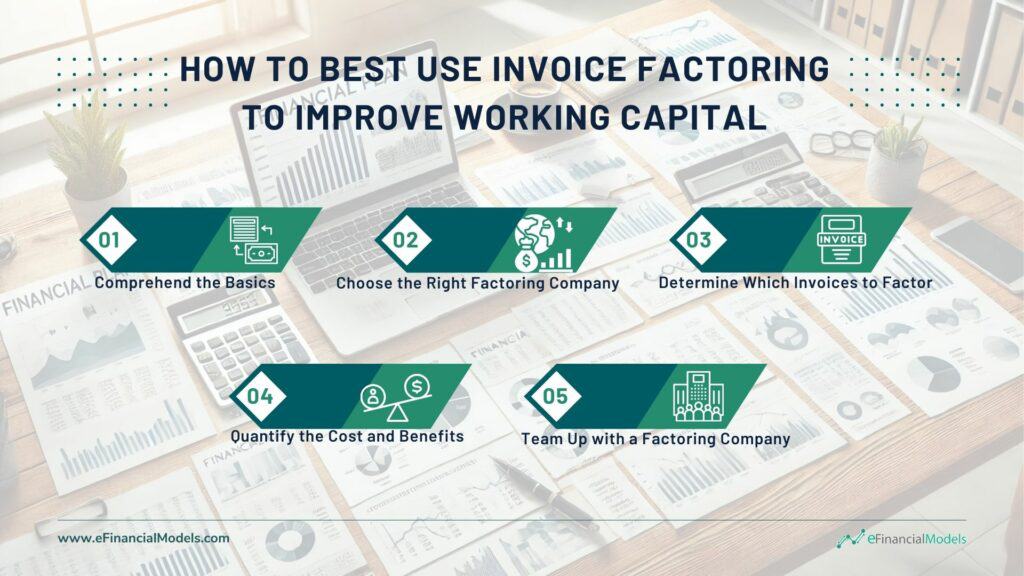
Comprehend the Basics
To comprehend the basics of business invoice factoring, start by understanding what is invoice factoring – that it involves selling your outstanding invoices to a company in exchange for immediate cash, improving your cash flow. Learn about the key terms, such as advance rate, invoice factoring rate, and recourse vs. non-recourse factoring, to grasp how the costs and risks are managed. Study the steps involved, including submitting invoices, receiving a cash advance, and the collection process handled by the factoring company. Additionally, it explores real-world examples and case studies to see how different businesses use factoring to their advantage. Engaging with industry resources, such as articles, webinars, and consulting with financial experts, can further deepen your understanding and application of invoice factoring in improving working capital.
Comprehending the basics of business invoice factoring is crucial for minimizing working capital because it enables you to convert outstanding invoices into immediate cash, thus optimizing cash flow and ensuring you have funds for operational expenses and growth opportunities. By understanding this process, you can transfer credit risk to the factoring company, manage and mitigate non-payment risks, and streamline your accounts receivable, freeing up resources for core business activities. This knowledge also allows you to leverage factoring as a scalable financing option, maintain better supplier relationships through timely payments, and make informed financial decisions, ultimately enhancing your working capital management.
Choose the Right Factoring Company
Choosing the right factoring company involves several key considerations. Start by evaluating the company’s experience and reputation in your industry, ensuring they understand your business’s specific needs. Review the terms of their contracts carefully, focusing on rates, fees, and the flexibility of their services. Assess their customer service quality, looking for responsive and knowledgeable support. Also, check if they offer non-recourse factoring, protecting you from bad debts. Lastly, read customer reviews and seek recommendations to gauge the company’s reliability and performance from other clients. By thoroughly vetting these aspects, you can find a factoring company that aligns well with your financial and operational requirements.
Selecting a reputable factoring company is crucial to minimizing working capital because it ensures reliable and efficient access to funds, enhancing cash flow stability. A reputable company provides transparent terms and fair rates, minimizing the risk of hidden fees and unfavorable conditions that could strain your finances. Their experience and industry knowledge enable them to tailor solutions to your business needs, promoting smoother operations. Moreover, reputable factoring companies offer robust customer support and non-recourse options, which protect you from bad debt, ultimately fostering a secure and beneficial financial partnership that bolsters your working capital effectively.
Determine Which Invoices to Factor
Not all invoices need to be factored. Start by identifying those with the longest payment terms and highest value, as these will free up the most cash when factored. Prioritize invoices from reliable, creditworthy customers to minimize non-payment risk and ensure smoother transactions. Additionally, consider factoring invoices critical to your immediate cash flow needs, helping cover essential expenses like payroll and operational costs. Evaluate the cost-benefit ratio of factoring each invoice, factoring only those that will significantly enhance liquidity without incurring excessive fees. By strategically selecting invoices, you can maximize the positive impact on your working capital.
Determining which invoices to factor is essential for improving working capital because it ensures you maximize the financial benefits while minimizing costs and risks. By selectively factoring invoices from reliable customers with longer payment terms, you can convert outstanding receivables into immediate cash, enhancing liquidity to meet operational needs. This strategic approach helps maintain a steady cash flow, covering crucial expenses like payroll, inventory, and expansion projects without incurring excessive fees from factoring less advantageous invoices. Careful selection also prevents over-reliance on factoring, balancing immediate financial relief and long-term health. Thus, it is a pivotal practice for efficiently sustaining and improving working capital.
Quantify the Cost and Benefits
Quantifying the cost and benefits of business invoice factoring involves a detailed analysis of several financial metrics. Start by calculating the invoice factoring rate, which typically ranges from 1% to 5% of the invoice value, including additional charges such as setup or maintenance costs. Compare these costs to the immediate cash flow improvement achieved by converting receivables into cash. Assess the impact on your business operations, such as the ability to pay suppliers promptly, take advantage of early payment discounts, and fund growth initiatives. It’s also crucial to consider the time saved on collections and the reduction in bad debt risk if non-recourse factoring is used, as these factors add significant value to the factoring process. By weighing these costs against the enhanced liquidity and operational efficiencies, you can determine the net financial benefit of factoring for your business.
The strategy provides a clear financial picture, enabling informed decision-making. By understanding the exact fees involved and weighing them against the cash flow benefits, businesses can ensure that factoring is a cost-effective solution. This analysis helps determine whether the improved liquidity will sufficiently cover operational needs, reduce financial stress, and support growth objectives. Moreover, it allows businesses to choose which invoices to factor in strategically, optimizing the balance between immediate cash availability and long-term financial health. Ultimately, this quantification ensures that factoring enhances working capital without undermining profitability.
Team Up with an Invoice Factoring Company
Teaming up with an invoice factoring company improves working capital by providing immediate cash flow and alleviating the burden of managing receivables. Instead of waiting for customer payments, businesses receive a significant portion of the invoice value upfront, enhancing liquidity and enabling timely reinvestment in operations. The factoring company handles payment collections, reducing administrative tasks and mitigating the risk of bad debts. This partnership streamlines cash flow management and supports business growth by ensuring consistent access to funds necessary for covering expenses, seizing opportunities, and maintaining financial stability.
First, research and choose a reputable invoice factoring company that offers competitive rates and understands your industry. Ensure clear communication about terms and fees, and submit your invoices promptly to maximize cash flow and reduce administrative burdens. This collaboration enhances your cash flow, allowing you to reinvest in your business, manage expenses more effectively, and reduce the administrative burden of chasing payments.
Accounts Receivable Factoring Example
Here’s an accounts receivable factoring example to demonstrate the flexibility in managing expenses that comes with teaming up with an invoice factoring company. Your company has $100,000 accounts receivable (AR) due in 30 days. Instead of being tied down for 30 days, you can sell these receivables at a 5% invoice factoring rate to a factoring company. This means you receive $95,000 immediately, giving you the power to allocate these funds for operational expenses, investments, or other needs as you see fit. The cost of factoring is the 5% invoice factoring rate, which, in this case, amounts to $5,000. It is the price you pay in exchange for immediate cash flow and risk transfer. If you had waited 30 days and collected the receivables, you would have a total of $100,000. However, you might risk some receivables turning rancid and incur the cost of managing collections. Besides, if your company needs cash urgently to take advantage of an investment opportunity, pay off debts, or maintain operations, the accounts receivable factoring example can be highly beneficial.
Leverage Financial Modeling for Effective Business Invoice Factoring
Maximizing working capital through business invoice factoring involves selling a company’s outstanding invoices to an invoice factoring company at a discount, which provides immediate cash flow. What is invoice factoring means that the financial strategy allows businesses to convert their receivables into liquid assets without waiting for the payment terms. By doing so, companies can efficiently manage their cash flow, meet operational needs, and invest in growth opportunities without incurring additional debt. Invoice factoring also reduces the burden of accounts receivable management, as the factoring company takes on the responsibility of collecting payments from clients, thus enhancing the business’s financial stability and operational efficiency.
Leveraging financial modeling for effective business invoice factoring enables companies to make informed decisions by forecasting the impact of factoring on cash flow, profitability, and overall economic health. By creating detailed financial models, businesses can assess the cost-benefit ratio of different factoring options, anticipate potential risks, and plan for various scenarios. This proactive approach ensures that the selected factoring strategy aligns with the company’s financial goals and operational needs. Financial modeling thus provides a robust framework for optimizing working capital management, allowing businesses to capitalize on immediate liquidity and maintain a competitive edge in the market.
Boost Your Liquidity Today!

































You might also like:
- 10 Main Elements of a Business Plan
- 10 Tips to Develop a First Class Business Valuation Report
- 5 Best Practices for Managing Days Receivables
- 5 Practical Tips to Help Raise Funds For Startups
- Cash Flow Analysis in Excel
- Calculating Revenue Growth Rate: A Key Metric for Business Success
- How to Make Smart Decisions with 6 Key Financial Metrics?
- Understanding the Debt Service Coverage Ratio: An Essential Metric for Financial Analysis
- Real Estate Financial Modeling in Excel
- 10-Step Financial Planning Checklist for Smart Executives
- 12 Funding Sources for Businesses and Startups
- Accounts Receivable
- Accounts Payable
- Business Valuation
- Financial Model Templates Easy to Use
- Scenario Analysis
- Fundraising Project Plan Template in Excel
- Financial Ratios Analysis and Its Importance
- Average Revenue per User (ARPU)
- Simple Budget Planner Template