
0 ITEMS

How to Calculate Debt Capacity?

Understanding your business’s debt capacity is essential for sustainable growth and financial stability.
- Debt capacity indicates how much debt a business can handle without risking insolvency, based on cash flow and assets.
- Using an EBITDA multiple helps estimate maximum borrowing power quickly and effectively.
- Calculating the debt-to-EBITDA ratio provides insight into how long it would take to repay debt, reflecting risk levels.
- A debt repayment schedule shows when and how much you need to pay, aiding in cash flow management.
- Running “what-if” scenarios ensures your borrowing aligns with future sales, interest rates, and market conditions.
This article covers straightforward methods and real-world examples to help you evaluate and optimize your business’s debt capacity.
Can your business handle more debt without sinking? You must know your debt capacity before chasing new funding or scaling operations. It’s not about how much you want but how much you can manage. This guide clearly shows you how to calculate it to raise smart, not risky.
Learn how to calculate your business’s debt capacity in a very simple way with our step-by-step guide. In this article, we will tackle:
- Debt Capacity is the amount of debt a business can bear without going under
- We use an EV/EBITDA multiple so that we can quickly estimate our debt capacity
- We shortly check our financial plan to validate that we can repay our debt by looking at our debt schedule
A deeper dive into this topic would involve precisely calculating the Debt Service Coverage Ratios—a powerful tool for evaluating a company’s ability to meet its debt obligations. But that’s a story for another day.
- Example debt capacity scenarios
What Is Debt Capacity?
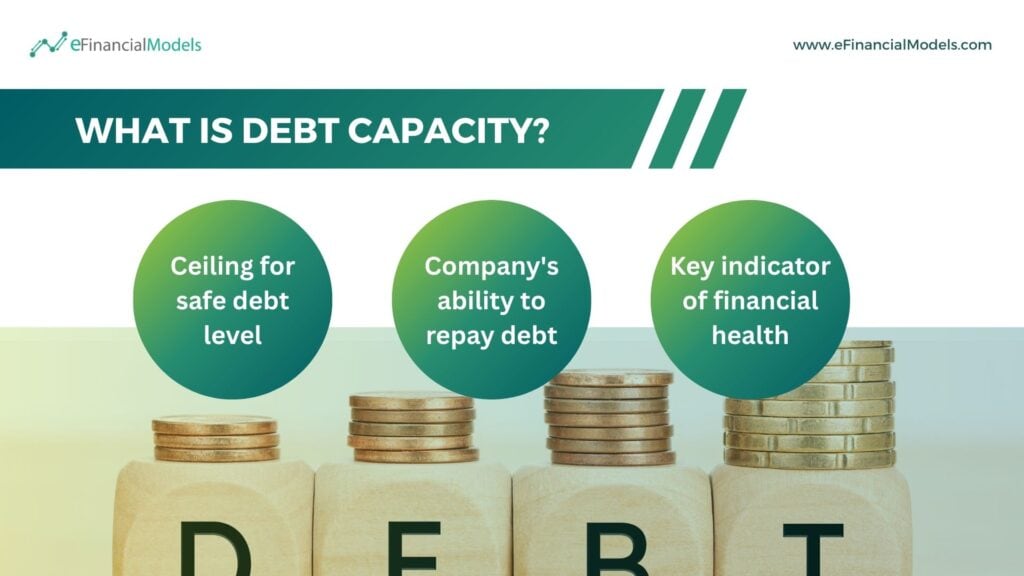
Debt capacity refers to the maximum amount of debt a company can comfortably take on and manage without jeopardizing its financial stability. It’s essentially the limit of how much debt the business can borrow and still be able to repay according to the terms of the debt agreement. It helps prevent financial stress, missed payments, or bankruptcy. Staying within this limit protects long-term stability and keeps borrowing under control.
Debt capacity is a company’s ability to take on and repay debt without hurting its financial health. It shows how much debt the company can handle based on its cash flow, assets, and current obligations. Lenders look at this to decide how much they’re willing to lend. A high debt capacity means the company can borrow more with less risk. A low one signals financial strain. Managing debt capacity well helps keep credit strong, and supports long-term growth. It’s a key measure for smart financial planning and decision-making.
Debt capacity reveals whether the business can meet its loan payments and run smoothly. It reflects the company’s ability to meet financial obligations while investing in growth. This balance supports steady performance, builds trust with lenders, and helps the company prepare for future needs. That’s why debt capacity is a key signal of financial health.
Why Debt Capacity Analysis Matters?
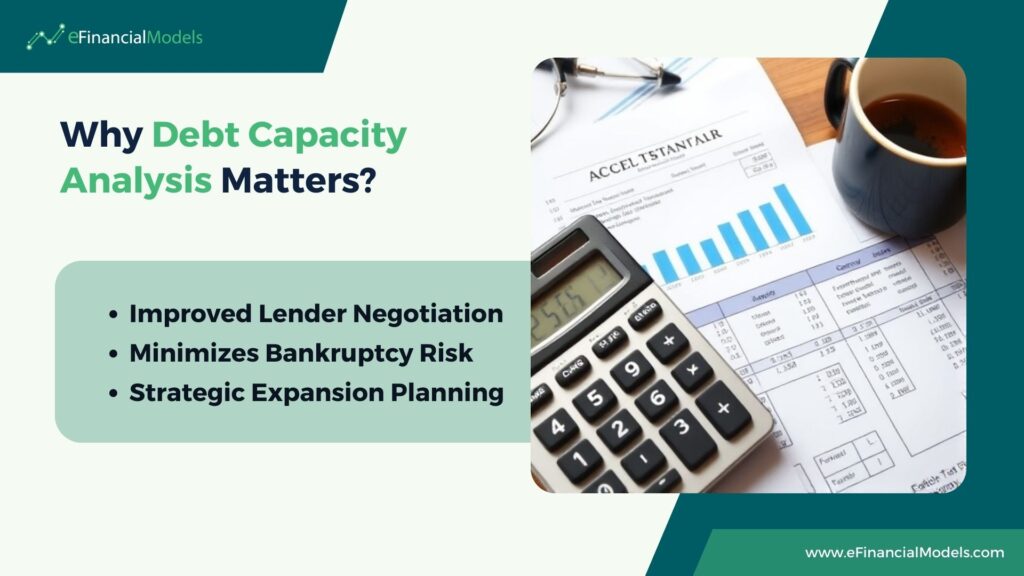
Debt capacity analysis matters because it helps companies understand how much debt they can manage without harming their finances. It guides smart borrowing and supports long-term goals. Businesses can avoid surprises and make confident financial decisions by looking closely at income, expenses, and obligations. Debt capacity analysis builds a strong foundation for growth, stability, and trust with lenders. Below are the top three reasons debt capacity analysis plays a vital role in financial planning and decision-making.
- Improved Lender Negotiation: When a company understands its debt capacity, it enters loan talks with clear numbers and strong confidence. For example, a manufacturing firm needing new equipment can present solid financial projections showing it can repay the loan without strain. This builds trust with lenders, often leading to better loan terms, lower interest rates, and more flexible repayment options.
- Minimizes Bankruptcy Risk: Debt capacity analysis helps companies avoid borrowing beyond what they can repay. Imagine a retail business facing seasonal slowdowns—it knows its cash flow patterns and avoids taking on loans that would strain its finances during slow months. This foresight prevents missed payments, protects credit ratings, and reduces the chance of financial collapse.
- Strategic Expansion Planning: When planning to grow, a business must know how much extra debt it can handle. A tech startup eyeing a new product launch can use debt capacity analysis to check if it can fund development through loans. This ensures the expansion is sustainable, avoids overleveraging, and supports long-term success.
Debt Capacity Formula Explained
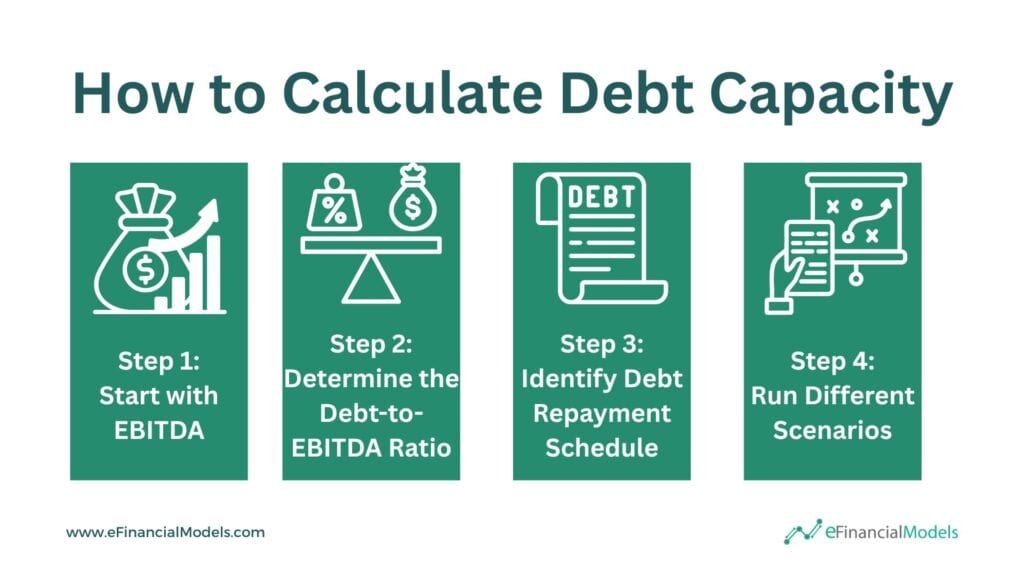
The most common debt capacity formula expresses it as a multiple of the Earnings Before Interest, Taxes, Depreciation, and Amortization (EBITDA). The EBITDA reflects the company’s core profitability before financial and accounting costs. Lenders often use it to assess risk and decide how much they will lend. This method gives a clear view of what a business can manage without stretching too far.
Step 1: Start with EBITDA
The EBITDA shows how much money a business makes before paying interest, taxes, depreciation, and amortization. Lenders use this number to measure how much debt a company can afford. The higher the EBITDA, the more borrowing power the business has. EBITDA usually increases year after year as a business scales. Growth in sales, better cost control, and higher efficiency drive this upward trend. Strong management and smart investments also help boost EBITDA. Companies often aim for steady EBITDA growth to show financial health and attract investors. This rise signals that a business is becoming more profitable over time.
The ideal number of years of EBITDA needed depends on industry standards, lender expectations, and risk profile. Lenders typically use 3 to 5 years of EBITDA to accurately calculate a company’s debt capacity. This range helps lenders gauge sustainable earnings and predict future cash flow reliability. If a business has stable earnings, 3 years may be enough. It gives a solid snapshot of recent performance. If a business has volatile earnings, using a longer period smooths out anomalies. It adds stability and accounts for business cycles. It ensures the EBITDA trend is not a short-term spike or dip.
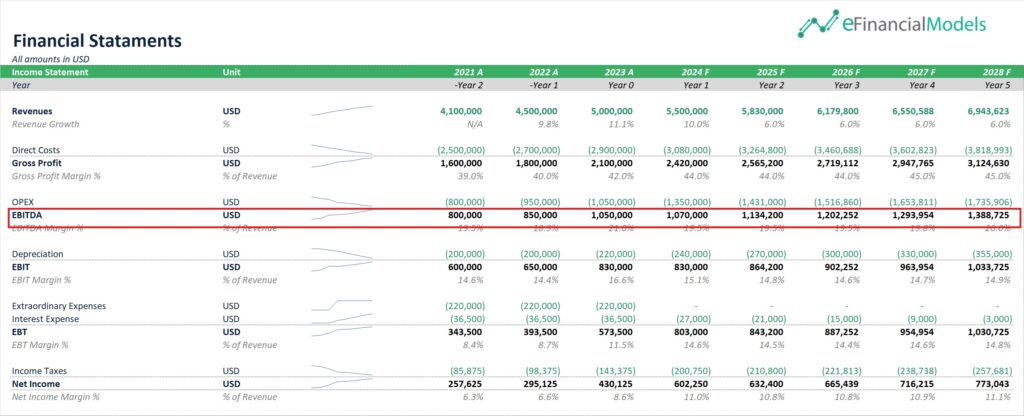
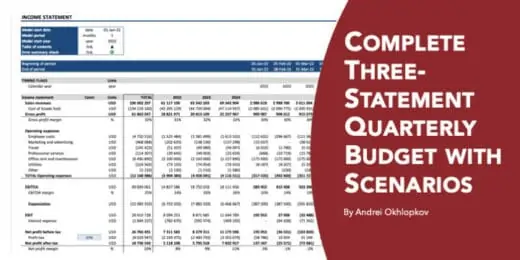
You can find historical EBITDA in the income statement section of a company’s financial statements (as shown above), especially in annual (10-K) or quarterly (10-Q) reports available on their investor relations websites or the SEC’s EDGAR database. Financial platforms like Yahoo Finance, Google Finance, and Macrotrends also provide EBITDA history. Premium tools like Bloomberg, Capital IQ, or FactSet are ideal for deeper data. If not listed directly, you can calculate EBITDA by adding depreciation and amortization to operating income.













































Step 2: Determine the Debt-to-EBITDA Ratio
The debt capacity formula uses the debt-to-EBITDA ratio to measure how much debt a company can handle based on earnings. You divide the maximum debt by EBITDA to see how many years of earnings it would take to repay the debt. Maximum debt is a company’s total financial obligations that must be repaid, typically including both short-term and long-term interest-bearing debt. This often consists of:
- Bank loans
- Bonds payable
- Lines of credit
- Mortgages
- Other forms of borrowing
We convert the debt-to-EBITDA ratio into a multiple because it gives investors and lenders a quick way to compare risk across businesses. A lower multiple means the company can pay off debt faster, showing stronger financial health. A higher multiple signals more risk, as it would take longer to repay what’s owed.
Lenders and analysts use a debt-to-EBITDA ratio or multiple to gauge how much debt a business can handle. The safer the business, the higher the debt it can take. Low-risk industries like utilities often handle up to 4x EBITDA. Medium-risk sectors, such as manufacturing or retail, fall between 3x to 4.5x. High-risk businesses like startups or cyclical industries stay lower, around 1.5x to 3x. This means a company can carry debt equal to 1.5 to 6 years of earnings, depending on its stability and creditworthiness.

Step 3: Identify Debt Repayment Schedule
A debt repayment schedule shows how and when you’ll repay a loan. It includes the loan amount, interest rate, payment frequency, maturity, and total cost. For example, borrowing $100,000 over 5 years at 5% lets you map yearly payments and manage cash flow. The debt repayment schedule helps spot if payments are too tight. It also tracks existing debt and keeps surprises away. You can see your current debt obligations once you list your debt repayment schedule. These include loans, credit lines, and bonds already in place. Knowing this helps you measure how much new debt you can afford without straining your finances.
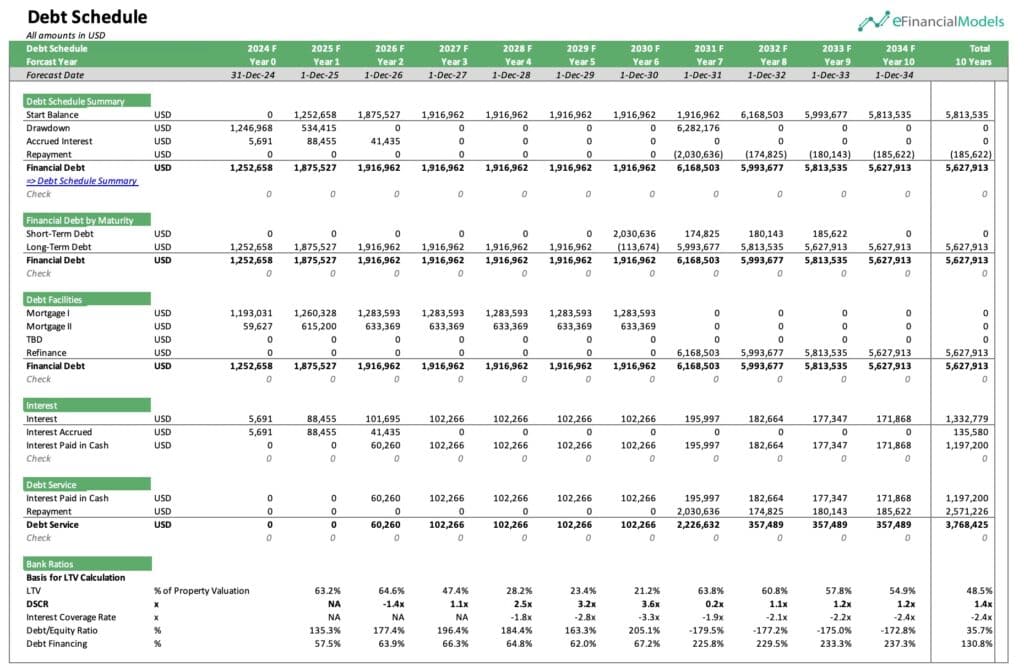
The debt repayment schedule above is from our Mini Storage Financial Model Template. It helps pinpoint when and how much debt needs to be paid, making applying the debt capacity formula easier. Showing exact repayment amounts—like the $2.03M in 2031 or the $174K in 2032—provides clear visibility into future cash outflows. This detail ensures you don’t overestimate how much new debt your business can handle. It also reflects actual timing and structure of payments, which are critical for calculating how much capacity remains for new borrowing without risking default.
Step 4: Run Different Scenarios
Running “what if” scenarios is key to using the debt capacity formula wisely. Ask simple questions: What if sales fall? What if interest rates rise? A drop in sales lowers EBITDA, shrinking the debt you can support. Higher rates increase payments, making debt harder to manage. These “what ifs” help you see limits and risks before borrowing. They protect you from debt overload when business slows or financing gets expensive.
Here are two examples of debt capacity calculation:
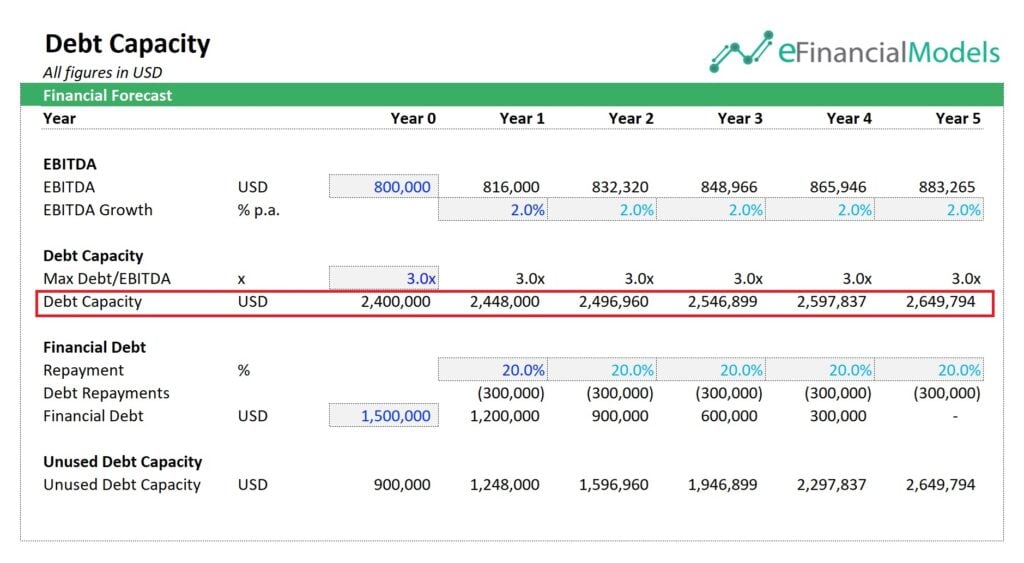
This debt capacity scenario above reflects a healthy financial position for the business. Starting with an EBITDA of $800,000, growing steadily at 2% per year, and maintaining a max debt/EBITDA ratio of 3x, the company’s debt capacity increases annually. Even with consistent 20% yearly debt repayments, financial debt declines from $1.5M in Year 0 to zero by Year 5. Meanwhile, the gap between total debt capacity and actual financial debt grows significantly, resulting in unused debt capacity rising from $900K to nearly $2.65M. This shows the business is becoming less leveraged over time, signaling strong financial discipline and improved borrowing power — a positive scenario.
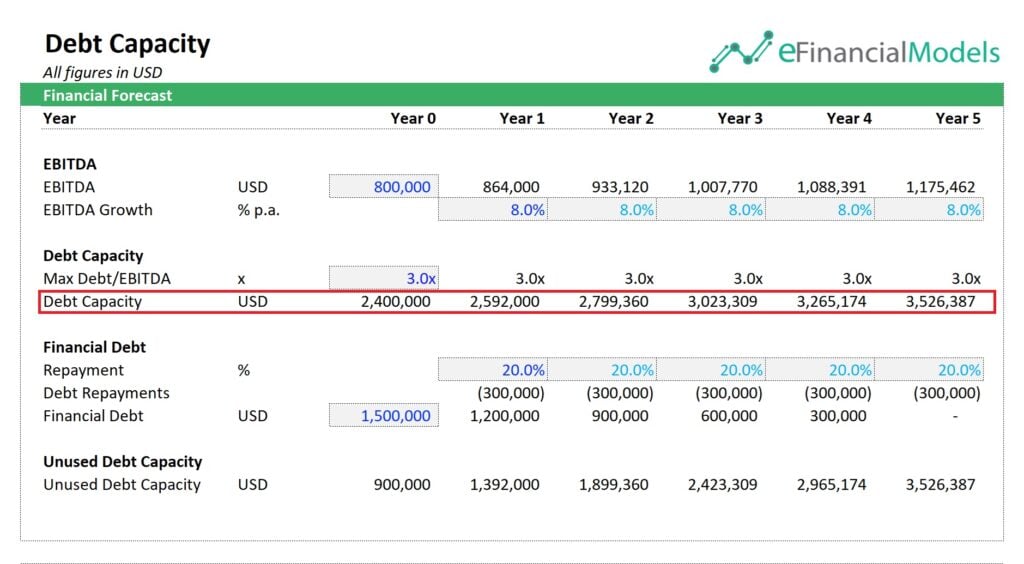
This example shows how stronger EBITDA growth—8% annually—directly boosts a company’s debt capacity over time. Starting at $800K in Year 0, EBITDA climbs steadily to $1.17M by Year 5. AA’s consistent 3.0x debt/EBITDA multiple results in a rising debt capacity from $2.4M to $3.5M. Compared to slower-growing examples (like the one with just 2% EBITDA growth), this version unlocks much more financing potential. It highlights a simple truth: higher profits lead to more borrowing power.
The quickest way to estimate debt capacity is multiplying EBITDA by a fixed ratio. It’s fast and useful—but only tells part of the story. In real-world analysis, we dig deeper by checking the Debt Service Coverage Ratio (DSCR) to ensure the company can afford the debt repayments. That’s when we fully understand how much debt is truly sustainable.
Borrow Smarter with a Clear Debt Capacity Plan
To calculate your business’s debt capacity, start with EBITDA—your profit engine. Multiply it by a safe debt-to-EBITDA ratio based on your industry’s risk. Subtract what you already owe. Then, lay out your repayment schedule to check if the new debt fits your cash flow. Finally, run “what-if” scenarios to see how changes in sales or interest rates affect your ability to repay. This simple 4-step method helps you borrow confidently, avoid financial strain, and keep growth on track. Debt capacity isn’t just a number—it’s your safety net for smart expansion and financial health.

Financial modeling makes your debt capacity plan smarter and sharper. It turns guesses into clear forecasts by showing how your earnings, debt, and payments move over time. With a model, you can test different scenarios, spot cash flow gaps, and plan repayments with precision. It helps you see how much debt fits without stretching too far. Lenders trust solid numbers, and a well-built model gives them proof you can repay. So, when you use financial modeling, you borrow with confidence—and build a safer path to grow.





































You might also like:
- Understanding the Debt Service Coverage Ratio: An Essential Metric for Financial Analysis
- How to Calculate Net Present Value (NPV)?
- Financial Planning for Small Business Owners – Taking an SBA Loan
- 5 Best Practices for Managing Days Receivables
- How to Calculate SaaS Monthly Recurring Revenue?
- How Do Startup Funding Rounds Work?
- Debt Amortization
- 5 Practical Tips to Help Raise Funds For Startups
- How to Raise Series A Funding?
- Achieve Financial Success By Knowing Your Business Plan Model
- Understanding Debt Sizing & Project Finance Ratios
- 10 Main Elements of a Business Plan
- Understanding the Levelized Cost of Energy Formula
- Commercial Real Estate Valuation Methods: Helping Investors in Taking Informed Decisions
- Business Consulting Services
- Understanding What is Yield to Maturity and Why It Matters
- Financial Ratios Analysis and Its Importance
- Strategic Insights to Secure Series B Financing
- Calculate Order Value for Increased Profitability
- Debt Service Coverage
Tags: Fundraising