
0 ITEMS

How Do Companies Manage Financial Risk?

Financial risk management is essential for maintaining business stability and growth amidst market uncertainties.
- Companies face various financial risks, including credit, market, liquidity, and operational risks, which can threaten cash flow and profitability.
- Differentiating between financial risk and business risk helps develop targeted strategies for operational and financial stability.
- Effective risk mitigation involves financial planning, revenue diversification, cost control, natural hedging, and scenario analysis.
- Utilizing financial models and sensitivity analysis enables businesses to anticipate risks and make informed decisions.
- Proactively managing financial risks prepares companies for potential shocks and supports long-term resilience.
Keep reading to see how these strategies can safeguard and strengthen your business’s financial health.
What is Financial Risk?
Companies encounter various types of risks. However, financial risks are often the most significant because they directly impact cash flow, profitability, and long-term survival. If unmanaged, they can lead to reduced liquidity, higher debt costs, or even bankruptcy. Financial risks demand constant monitoring and quick decision-making since market changes can be sudden. A single financial misstep can ripple across the business, affecting investments, growth, and stakeholder confidence. Therefore, managing financial risk is crucial to maintaining stability and achieving sustainable success.
So, what is financial risk? Financial risk is the possibility of losing money or facing financial instability due to uncertain factors. It occurs when a company’s profits, cash flow, or ability to meet obligations is threatened. What is financial risk? It can arise from changes in market conditions, poor financial decisions, or unexpected economic shifts. Businesses face financial risk when they borrow money, invest in volatile assets, or operate in competitive markets. Managing this risk requires careful financial planning and continuous monitoring to protect financial health and avoid disruptions. Ultimately, what is financial risk reflects the uncertainty that comes with every financial commitment or investment decision.

Financial Risk vs. Business Risk
Understanding financial risk vs. business risk is crucial for entrepreneurs, investors, and finance professionals seeking to build resilient businesses. Financial risk relates to the decisions around funding and capital structure, while business risk focuses on operational uncertainties that impact revenue and expenses. Differentiating between these risks helps organizations develop targeted strategies to manage financial obligations and adapt to market challenges effectively.
- Financial risk vs. business risk differs in their origin. Financial risk arises from a company’s financing decisions, such as using debt to fund growth. In contrast, business risk is tied to operational factors like market demand, competition, or production costs. In short, financial risk stems from how the business is funded, while business risk is shaped by how the company performs daily.
- Earnings stability is affected differently in financial risk vs. business risk scenarios. Financial risk can increase fluctuations in net income due to fixed interest payments. Meanwhile, business risk affects operating income regardless of debt levels. For example, a drop in sales can reduce profitability, even if the company has no debt. Financial risk amplifies outcomes; business risk drives core performance.
- In terms of control, financial risk vs. business risk are distinct. Financial risk is often more manageable through decisions like refinancing debt or adjusting capital structure. Business risk, however, depends on external factors like customer preferences or economic changes, which can be harder to control. Companies can mitigate financial risk with strategic funding, but managing business risk requires operational excellence and adaptability.

The Major Types of Financial Risks for a Business
Every business faces financial risks that can impact its stability and growth. The major types of financial risks for a business include credit, market, liquidity, and operational risks. Understanding these risks helps businesses develop strategies to protect their financial health and stay resilient in changing market conditions.
Credit Risks
Credit risks arise when customers or counterparties fail to meet their financial obligations. It can occur when loans are not repaid, or invoices remain overdue. Businesses face potential losses when partners default on payments. To mitigate these types of financial risks for a business, companies often conduct credit checks, diversify client portfolios, and establish clear payment terms.
Market Risks
Market risks stem from changes in market factors that affect a business’s financial performance. These fluctuations can result from shifting stock prices, currency values, or interest rates. Companies exposed to volatile markets must continuously monitor trends and adjust strategies to minimize potential financial losses.
- Equity risk involves losses due to declining stock prices. Businesses holding equity investments or issuing shares may experience reduced asset values. For these types of financial risks, a business often uses hedging strategies and monitors market performance.
- Interest rate risk arises when changes in interest rates impact loan costs or investment returns. Rising rates can increase borrowing expenses, while falling rates may reduce yields. Companies can limit exposure by using fixed-rate loans or interest rate swaps.
- Currency risk occurs when exchange rate fluctuations affect international transactions. Companies involved in global operations may experience losses when foreign currencies weaken. Mitigating this risk involves using forward contracts and maintaining diverse currency reserves.
- Commodity risk pertains to price changes in raw materials or goods. Due to price shifts, businesses relying on commodities may face higher costs or lower revenues. Hedging through futures contracts or supplier agreements can help stabilize costs.
Liquidity Risks
Liquidity risks arise when a business cannot quickly convert assets to cash without significant loss. These types of financial risks for a business can lead to cash flow shortages, affecting daily operations and obligations.
- Asset liquidity risk occurs when an asset, such as real estate or inventory, cannot be sold quickly at its fair market value. It creates delays in securing needed funds. Companies often avoid this risk by holding a balance of highly liquid assets.
- Funding liquidity risk happens when a business struggles to meet short-term financial obligations due to limited access to funding. Businesses manage this by maintaining cash reserves and securing diverse funding sources.
Operational Risks
Operational risks relate to failures in internal processes, people, and systems. These types of financial risks for a business can disrupt operations, leading to financial and reputational harm. Strong governance and internal controls help reduce these risks.
- Fraud risk involves financial losses from dishonest activities, either internally or externally. Companies can combat this by implementing fraud detection systems and enforcing ethical standards.
- Legal risk emerges when businesses face lawsuits, regulatory fines, or compliance failures. This can result from unclear contracts, regulatory breaches, or disputes. Regular legal reviews and adherence to regulations can minimize this risk.
- Model risk occurs when financial models produce inaccurate results due to flawed assumptions or data errors. This can lead to poor decision-making. Ensuring robust model validation and regular updates helps avoid this risk.
- People risk arises when employee errors, misconduct, or turnover disrupt operations. This can affect productivity and service quality. Effective training, clear communication, and a strong workplace culture can mitigate this risk.

















































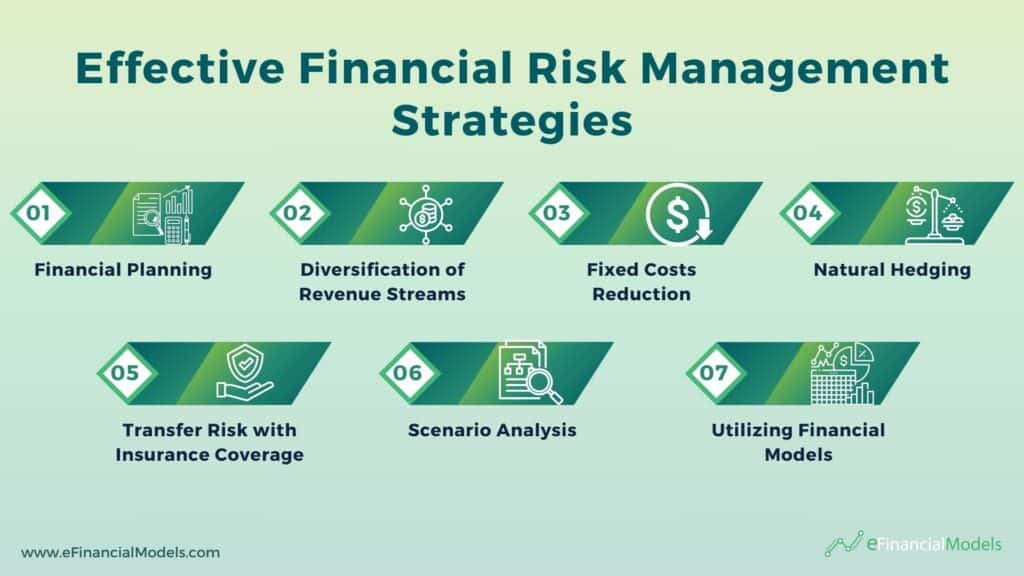
Effective Financial Risk Management Strategies
Managing financial risk requires clear strategies to safeguard business stability. Companies must evaluate potential risks, establish risk tolerance, and develop plans to mitigate financial losses. Effective financial risk management strategies help companies stay resilient during market fluctuations and economic downturns. A proactive approach ensures that risks are identified early and handled with minimal disruptions.
Financial Planning
Effective financial risk management starts with proactive financial planning. Businesses can identify potential shortfalls by mapping out income, expenses, and cash flow. Creating a detailed budget helps set realistic financial goals and allocate resources wisely. This process also includes building contingency funds to handle unexpected events. By planning, companies can anticipate risks, such as market changes or economic downturns, and take preventive actions. Financial planning isn’t just about numbers—it’s about making informed decisions to strengthen stability and ensure long-term growth. When risks are anticipated, businesses can adapt confidently rather than react in panic.
Diversification of Revenue Streams
One of the most effective financial risk management strategies involves diversifying revenue streams to reduce dependency on a single source of income. Companies can spread financial risk and strengthen long-term resilience by expanding into new markets, products, or services. For example, Apple grew beyond computers by entering the smartphone, wearable tech, and subscription service markets. Similarly, Google diversified from search engines into cloud computing, hardware, and digital advertising, while Amazon evolved from online retail to cloud services and media streaming. These expansions help mitigate market-specific risks, stabilize cash flow, and create more growth opportunities. Diversification cushions against downturns and drives innovation and a competitive edge.
Fixed Costs Reduction
An effective financial risk management strategy focuses on reducing fixed costs by shifting to variable costs whenever possible. This approach ensures that expenses only arise when revenue is generated, making the business more agile and less exposed during slow periods. For example, outsourcing tasks or using pay-per-use services helps avoid large, recurring overhead costs. By aligning expenses with income, companies can better manage cash flow, avoid debt buildup, and stay resilient during market changes. Lowering fixed costs creates a flexible cost structure that naturally reduces financial risk and supports sustainable growth.
Natural Hedging
An effective financial risk management strategy involves natural hedging by matching the currency of costs with the currency of revenues. Earning revenue in USD helps avoid losses from currency fluctuations if your costs are in USD. This alignment stabilizes financial performance and simplifies cash flow management. For example, a company sourcing materials in USD can reduce exchange rate risks by selling its products in markets that pay in USD. Natural hedging minimizes the need for complex financial instruments and lowers transaction costs. By keeping costs and revenues in the same currency, businesses can safeguard profits and operate more predictably across global markets.
Transfer Risk with Insurance Coverage
Risk transfer shifts financial responsibility for potential losses to another party, often through insurance or contractual agreements. This strategy helps businesses avoid absorbing the full impact of unforeseen events, such as natural disasters, lawsuits, or supply chain disruptions. Companies can protect their financial health by paying premiums or setting clear contract terms while focusing on their core operations. Effective risk transfer ensures that risks are managed by entities better equipped to handle them. Risk transfer shifts the burden of potential losses to another party, usually through insurance or contracts. By paying premiums or defining clear terms, businesses can avoid bearing the full cost of unexpected events like lawsuits or supply chain disruptions. For example, a retailer can use insurance to cover damages from natural disasters, ensuring operations continue smoothly. This approach allows companies to focus on growth while experts handle the risks, safeguarding financial stability.
Scenario Analysis
Scenario analysis prepares businesses for potential financial outcomes. Companies can assess how various situations affect their financial performance by modeling best-case, worst-case, and likely scenarios. This process helps decision-makers develop contingency plans and respond effectively to economic changes or market disruptions. Scenario analysis helps businesses navigate financial uncertainty by modeling different outcomes. Companies can see how key events impact cash flow and profits by preparing for best-case, worst-case, and likely scenarios. For example, a retailer might plan for a sales surge and a slowdown during the holiday season. This approach helps leaders create backup strategies and make faster decisions when market conditions shift, ensuring the business stays resilient.
Utilizing Financial Models
Financial models help predict outcomes and guide decision-making. These tools simulate different financial scenarios using historical data and key variables. By relying on accurate financial models, businesses can forecast cash flow, assess risks, and make informed strategic choices. Strong financial modeling enhances transparency and builds investor confidence. Financial models help identify and manage risks by simulating various financial scenarios. Key inputs, such as revenue and cost assumptions, predict potential economic changes. Sensitivity analysis tests these assumptions to reveal risk exposure and pinpoint thresholds where operations may falter. By running simulations with stressed inputs, businesses can identify new risks and determine when contingency plans should be activated. This approach enables informed decisions that strengthen financial resilience under different market conditions.
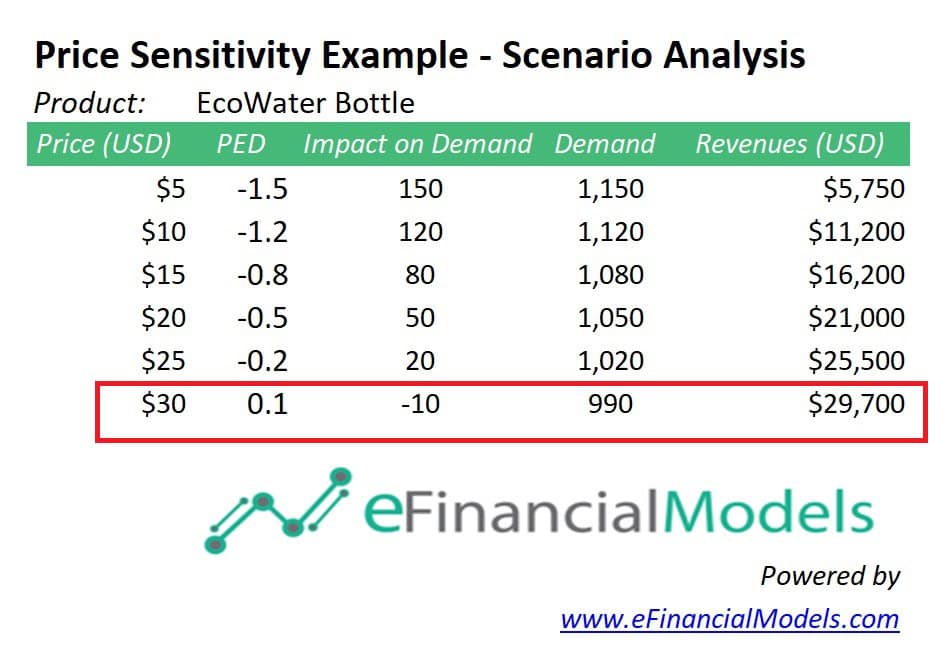
The price sensitivity analysis model above helps manage financial risk by showing how changes in price impact demand and revenue. By tracking the price elasticity of demand (PED) and simulating different price points, businesses can identify the optimal pricing strategy that balances demand and revenue. Based on the price sensitivity analysis model, the best price is $30. Demand slightly decreases to 990 units at this price point, but total revenue reaches $29,700—the highest across all scenarios. This proactive approach supports better planning and minimizes financial losses by testing various pricing scenarios before implementation.
Embracing Financial Risk for Better Decision-Making
Companies manage financial risk effectively by implementing smart strategies that strengthen stability and resilience. Financial planning ensures they anticipate challenges and maintain healthy cash flow. Diversifying revenue streams reduces dependence on a single income source, minimizing vulnerability. Cutting fixed costs helps lower operational risks and improves flexibility during downturns. Natural hedging balances revenues and expenses in the same currency to avoid currency-related losses. Transferring risk through insurance coverage protects against unexpected events, such as damages or liability claims. These strategies empower businesses to navigate uncertainties and safeguard their financial health.
Embracing financial risk through financial modeling empowers businesses to make smarter, data-driven decisions. Companies can anticipate potential challenges, optimize their strategies, and strengthen financial resilience by simulating different scenarios. Financial models provide valuable insights into cash flow, pricing, and risk exposure, helping leaders make confident choices even in uncertain markets. Proactive financial planning reduces surprises and builds a strong foundation for sustainable growth.
Take charge of your financial future—leverage accurate financial models to navigate uncertainty and drive your business forward.










































You might also like:
- 10 Tips to Develop a First Class Business Valuation Report
- 10 Main Elements of a Business Plan
- 5 Best Practices for Managing Days Receivables
- Top 10 Mistakes in DCF Valuation Models
- How to Build a Capitalization Table
- Understanding the Debt Service Coverage Ratio: An Essential Metric for Financial Analysis
- Financial Planning for Small Business Owners – Taking an SBA Loan
- How to Make Smart Decisions with 6 Key Financial Metrics?
- How to Prepare a Financial Feasibility Study?
- Cash Flow Analysis in Excel
- Business Valuation Service
- Financial Model
- Startup Model Templates in Excel that can help your Business Grow
- Understanding the Levelized Cost of Energy Formula
- The Purpose of a Financial Model
- How to Value a Business Using a Discounted Cash Flow Model
- Understanding What is Yield to Maturity and Why It Matters
- Goals of a Financial Model
- A Step-By-Step Guide to Economic Profit Calculation
- Master the Free Cash Flow Formula for Smarter Financial Decisions