
0 ITEMS

How Does the Control Premium Affect M&A Transactions?

Control premium valuation plays a key role in mergers and acquisitions, reflecting the additional value paid for ownership influence.
- It is typically paid when acquiring more than 50% of voting shares to steer company decisions.
- The median control premium ranges from 10% to 70%, varying widely by industry and market conditions.
- Calculating the premium involves comparing the market price per share with the unaffected share price before acquisition.
- Financial models like DCF and comparable analysis help determine a justified control premium.
Understanding how control premiums function can improve negotiation strategies and valuation accuracy in M&A deals.
What is a Control Premium?
A control premium is an extra amount paid in a merger or acquisition when one business wants to buy a majority stake in another. It reflects the buyer’s willingness to pay more than the current stock price, representing the company’s market valuation. The essence of what is a control premium is the price of gaining control and driving the business in a new direction. As mentioned, what is a control premium occurs in mergers and acquisitions when a business offers to buy a majority stake in another. Sometimes, the target company is publicly traded, and the buyer agrees to pay more than the current stock price, which reflects the company’s market valuation. It is also called takeover premium or premium for control. It reflects the added value of controlling the company’s operations and decision-making.
What is a control premium in company valuations plays a crucial role in mergers and acquisitions by reflecting the extra value a buyer is willing to pay to acquire a controlling interest in a company. This premium is offered to gain majority control, allowing the buyer to influence decisions, drive business synergies, and potentially increase the company’s value. It is a key factor in negotiations, as it can significantly affect the purchase price and is typically based on the perceived benefits of controlling the target company.
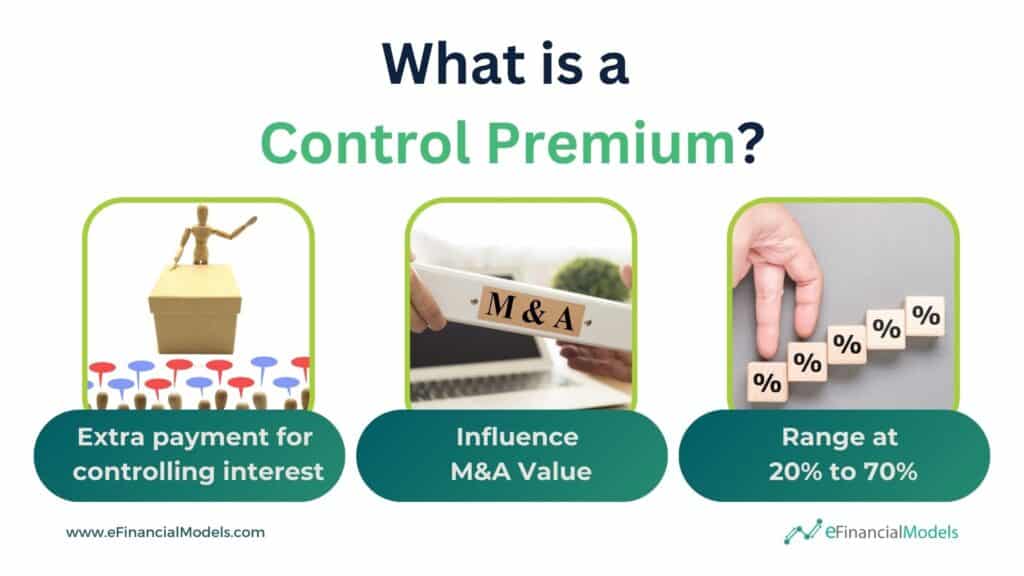
According to several studies, the median premium for control in M&A transactions typically ranges from 10% to 70% of the current stock market price, depending on the current valuation of stocks. The premium for control varies widely across industries because each sector has unique characteristics that impact business value. Factors like growth potential, market competition, and profitability influence how much extra a buyer is willing to pay for controlling interest.
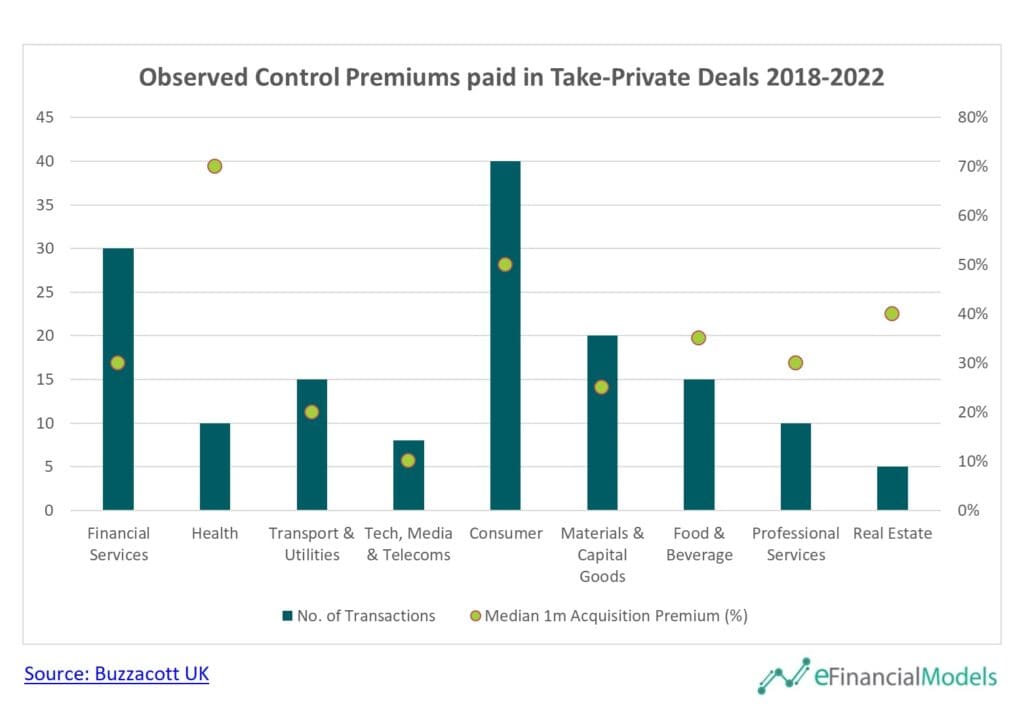
The chart above shows the UK’s Buzzacott Observed Control Premiums paid in Take-Private Deals 2018-2022. It shows the “Median 1-month Acquisition Premium” (yellow dots) alongside the “Number of Transactions” (teal bars). Consumer and Financial Services lead in transaction volumes, while sectors like Food & Beverage and Materials & Capital Goods display higher acquisition premiums, reflecting greater market valuations. In contrast, Real Estate has the lowest premiums and transaction activity. This data underscores varying sector attractiveness and valuation dynamics, offering insights into market trends and acquisition strategies.
Controlling Interest Definition
The controlling interest definition in an M&A situation refers to owning enough company shares to influence or make key decisions, typically more than 50% of voting shares. The buyer can steer the company’s operations, strategy, and direction. The control premium is the additional amount a buyer is willing to pay above the market value to acquire this level of controlling interest definition. It reflects the added value of having the power to influence the company’s future.
In private companies, the premium for control is often higher due to the lack of liquidity and the ability to influence the company’s direction more directly. In contrast, public companies usually have a lower control premium in valuation because of the greater transparency, liquidity, and the established market value of shares. Understanding this difference helps buyers and investors assess the value of a controlling interest more accurately.
How to Calculate the Premium for Control?
Calculating the premium for control is essential in every M&A deal. It helps buyers and sellers negotiate a fair price. It offers buyers a competitive edge by allowing them to bid a price that secures the deal. For sellers, knowing the premium ensures they get the best price. If the premium is too low, the seller won’t fully benefit. Analyzing the premium for control can also provide insights into market trends and business valuations. The formula to calculate the premium for control is:
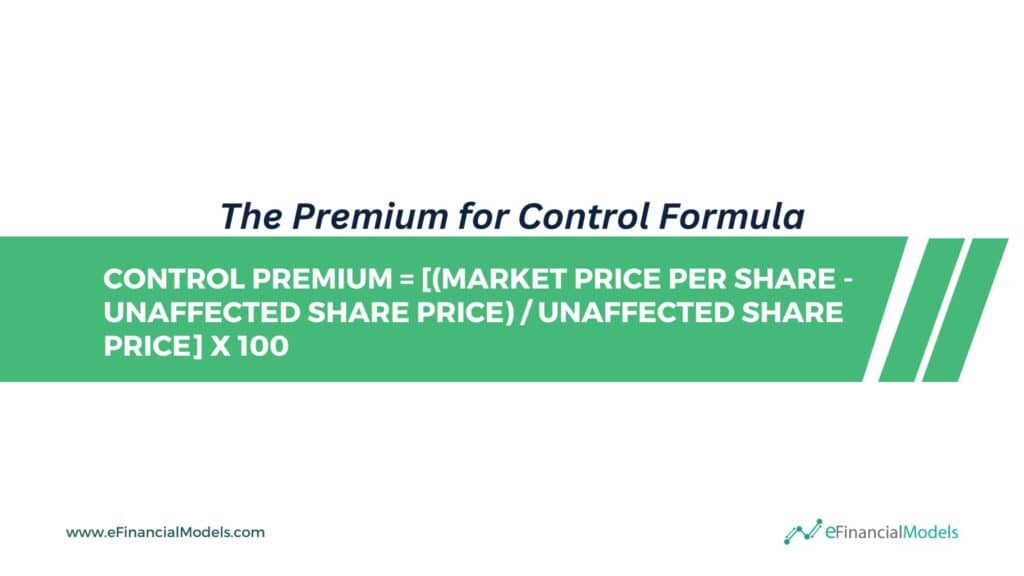
Where:
- Market Price per Share refers to the price at which shares are currently trading in the market.
- Unaffected Share Price is the price of shares before any acquisition or merger announcement, reflecting the company’s value without control changes.
In the above formula, the control premium is a percentage to standardize the extra value a buyer pays for control. It allows for easy comparison across different companies and deals, providing insight into the perceived value of control. It helps investors assess whether the premium is justified based on the deal’s specifics.



































Example Control Premium Calculation
In an M&A (Merger & Acquisition) scenario, the formula for the Control Premium can help establish a fair deal by assessing the price difference between the market price of the target company’s shares and its unaffected share price (typically, the share price before an acquisition offer).
For example, Company A (Acquirer) is interested in acquiring Company B (Target). Company B’s market price per share is currently trading at $50 on the stock market, reflecting their “unaffected share price,” which is the price before the acquisition offer. Company A offers to buy all Company B’s shares at $70 per share, a premium over the unaffected share price.
Using the formula to calculate the premium for control:
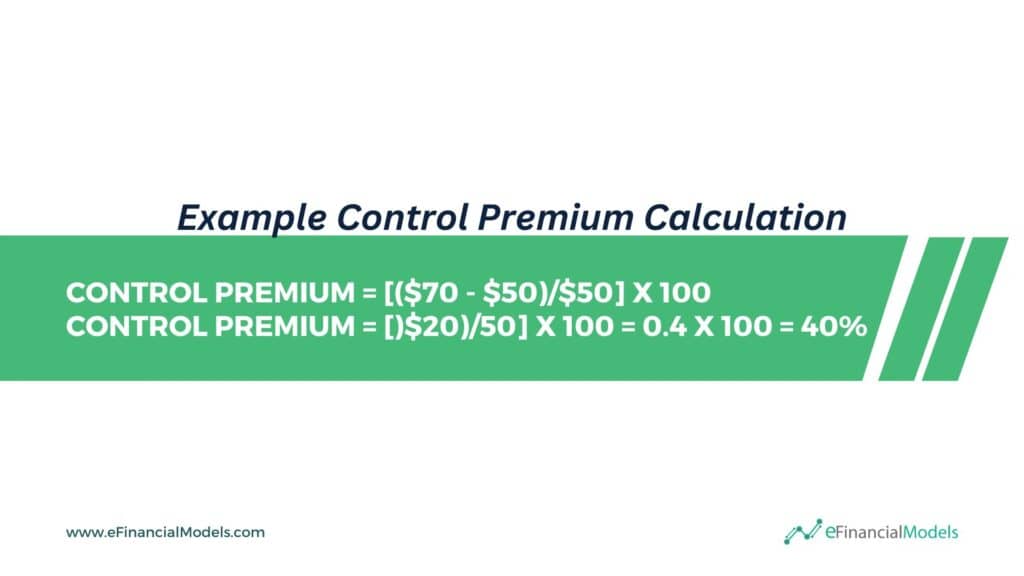
The control premium, in this case, is 40%, meaning that Company A is offering 40% more than the unaffected share price to acquire Company B. It can help seal a fair deal by ensuring that shareholders of Company B are adequately compensated for the loss of control and the opportunity to benefit from the company’s future growth. The control premium also justifies the acquirer’s higher offer price, making it more appealing for shareholders to accept the deal, as it provides a return above the current market value.
The Role of Control Premium in Mergers and Acquisitions
Mergers and acquisitions (M&A) are processes where one company buys or merges with another. A control premium isn’t always necessary in these deals. However, it is typically required when the buyer seeks to gain controlling interest in the target company. It is often paid when the acquiring company seeks to influence or change the target company’s management, operations, or strategy. It helps reflect the added value of ownership control.
The Value of Control
A strategic reason why buyers pay control premiums is to expand market share. When buyers acquire brands, customers, and distribution channels, they broaden their reach and increase their competitive advantage in the market. It helps them capture a larger portion of the market, leading to higher sales and growth potential. A control premium in mergers and acquisitions reflects the additional value a buyer will pay to gain control of a target company. This premium is typically added to the company’s market value to account for decision-making power, operational control, and strategic direction advantages. Investors believe that controlling a business allows them to improve efficiency, unlock growth potential, and maximize returns, which justifies paying more than the current market price. The control premium helps indicate the true value of owning and influencing the direction of a company.
In 2012, Instagram was valued at about $500 million. Facebook (now Meta) saw significant value in gaining full control over the platform’s future growth and market influence. It aligned with Facebook’s goal to expand its reach in the mobile photo-sharing space. To outbid Twitter, Facebook acquired Instagram for $1 billion, a premium for control of 100%. The premium paid indicated the added value of owning the platform and the ability to integrate it into Facebook’s larger ecosystem. It reflected its belief in Instagram’s long-term value to its business, while Twitter may not have been able to offer the same level of resources or integration potential.
The Buyer Perspective: Sharing Synergy Value With the Sellers
Buyers pay control premiums to gain operational synergies. Buyers can streamline operations, reduce costs, and improve efficiencies by integrating the target company into existing business units. For instance, they may eliminate duplicate functions or leverage shared resources, leading to higher profitability. A control premium reflects the expected synergy and the potential benefit of combining the companies. Synergy refers to the combined value and performance of two companies working together, exceeding the sum of their individual contributions. It can result from cost savings, increased revenue, or operational efficiencies. The buyer anticipates owning a controlling stake will unlock these advantages, making the acquisition more valuable than simply buying the company’s market value. Thus, the control premium helps quantify the expected future benefits of the deal. When a buyer pays a control premium, he often has to consider the value of Synergies to justify paying this premium. In reality, he shares parts of the value of synergies with the sellers. When Disney acquired Pixar in 2006, Disney paid a control premium above Pixar’s market value, reflecting the expected synergy between their brands. Disney anticipated significant benefits from Pixar’s creative content and technology, which could enhance Disney’s animation capabilities and boost its movie production. The control premium represented the value Disney placed on these future advantages. The synergy between the two companies boosted Disney’s animation division, revitalized its creative output, and significantly increased revenue.
From a valuation perspective, the control premium cannot exceed the measurable value of the advantages gained by having control. These advantages include making key decisions, accessing synergies, and influencing profits. Control must translate into real, tangible benefits to justify a premium. Overpaying for control risks undermining the deal’s value. Buyers should focus on the specific gains control will bring and ensure these benefits outweigh the added cost. A well-calculated control premium aligns with the actual financial improvements control delivers.
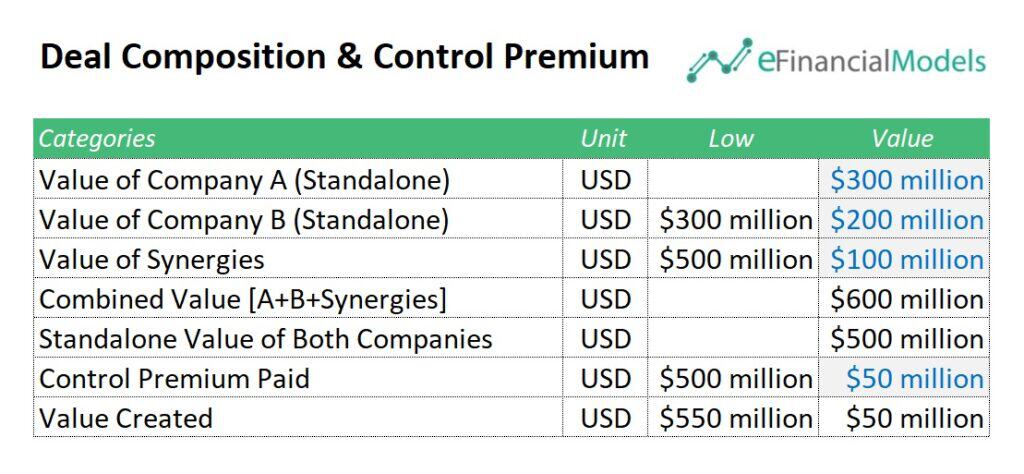
See this example of a Waterfall Chart for Deal Composition & Control Premium.
From a valuation perspective, the control premium cannot exceed the measurable value of the advantages gained by having control. These advantages include making key decisions, accessing synergies, and influencing profits. Control must translate into real, tangible benefits to justify a premium. Overpaying for control risks undermining the deal’s value. Buyers should focus on the specific gains control will bring and ensure these benefits outweigh the added cost. A well-calculated control premium aligns with the actual financial improvements control delivers.
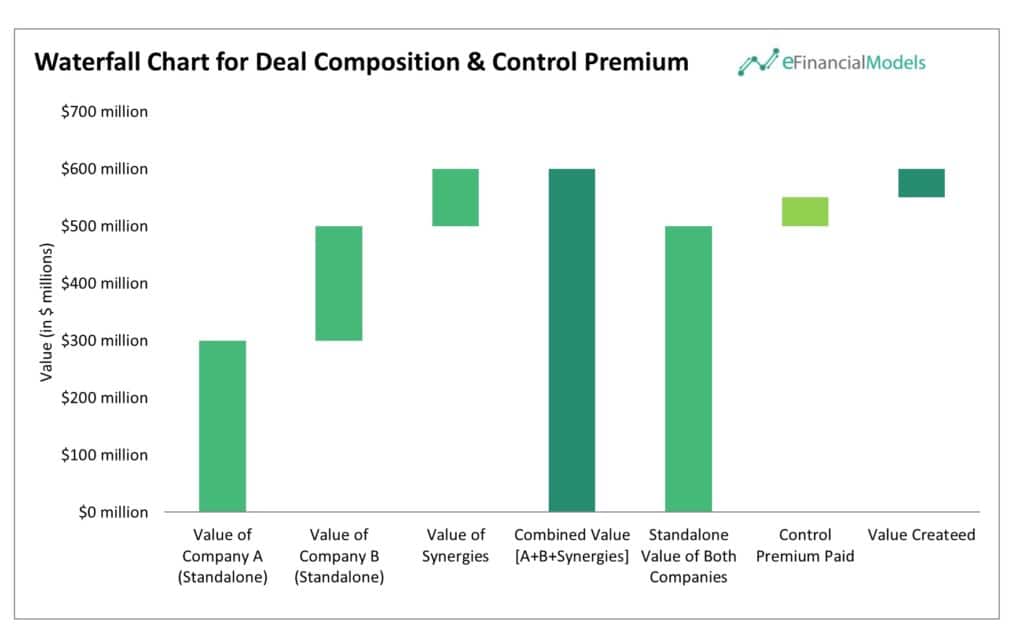
The waterfall chart above breaks down the deal composition and the role of the control premium. It starts with the standalone values of Company A and Company B, then adds the value of expected synergies, leading to the combined value of both companies. The control premium is the portion paid above the standalone value of the two companies, reflecting a share of the synergies offered to the seller. Typically, this premium ranges from 20% to 40% of the total value created, ensuring the buyer retains enough value for themselves. However, this depends on forward-looking assumptions and associated risks, making careful valuation critical to avoid overpayment.
How Financial Models Drive Control Premium in Valuation Success
Control premium in valuation is the extra amount paid to acquire a controlling interest in a company. It matters in M&A because it reflects the added value of decision-making power and strategic influence. Buyers are willing to pay a premium for the added value of controlling a company, which includes gaining operational synergies, expanding market share, or accessing valuable technologies.
Financial models are key to the success of a control premium in valuation. An M&A financial model is pivotal in assessing and quantifying the control premium to ensure buyers do not overpay for the controlling interest. By using methods like Comparable Company Analysis, Discounted Cash Flow (DCF), and Precedent Transactions, these models provide a clear picture of a company’s worth. They help assess the impact of owning a controlling stake versus a minority one. Sensitivity analysis adds value by testing how changes in key assumptions affect the valuation. Together, these tools enable more accurate and strategic decision-making, ensuring that control premiums are set based on solid financial data and realistic projections. Unlock accurate control premium in valuation today—start now!

































You might also like:
- 10 Step Financial Planning Checklist for Smart Executives
- 10 Tips to Develop a First Class Business Valuation Report
- 12 BUSINESS VALUATION METHODS
- A Step-By-Step Guide to the Merger and Acquisition Process
- Capitalized Earnings: Key to Understanding Business Valuation
- Understanding the Debt Service Coverage Ratio: An Essential Metric for Financial Analysis
- Commercial Real Estate Valuation Methods: Helping Investors in Taking Informed Decisions
- How to Calculate Net Present Value (NPV)?
- Financial Modeling using Excel
- Importance of Cash Flow Analysis in a Merger
- Different Ways House Flippers Track ROI
- Understanding Capital Structure: Key to M&A
- How to Valuate a Company for M&A
- 10 Ideas to Increase Average Revenue Per User
- Finding a Valuation Model for Your Business
- Financial Ratios Analysis and Its Importance
- Forestry Financial Model
- Understanding What is Yield to Maturity and Why It Matters
- 10 Main Elements of a Business Plan