
0 ITEMS

Steps to Securing Series C Financing

Understanding how to secure Series C funding is crucial for expanding a growing business and reaching new markets.
- Series C rounds help startups scale operations and prepare for IPO or acquisitions, often raising $50 million to over $100 million.
- Investors evaluate key metrics like revenue growth, customer retention, and financial health before committing capital.
- Preparing detailed term sheets and financial models increases transparency and attracts strategic investors.
- Building relationships with leading Series C investors, including banks, hedge funds, and private equity, can unlock funding opportunities.
- Optimizing business metrics and demonstrating a solid growth plan are essential for successfully closing Series C funding.
Continuing with practical strategies, this article highlights the key steps to secure Series C financing and fuel business growth.
What is a Series C Funding?
Funding rounds enable startups to expand their operations by securing external investment. These investors provide capital in return for equity or partial company ownership. Analysts conduct a valuation before these startup funding rounds that assesses factors such as the company’s market size, risk, management team, and track record. Each series of fundraising corresponds to different stages of the company’s maturity.
So, what is a Seriec C funding? Series C funding is a stage of investment for companies that are no longer startups but have become well-established entities in their final stages of development. At this point, the company has successfully navigated through earlier funding rounds and stands out among its competitors. What is a Series C funding is for new opportunities in sight, such as opening new offices, expanding their teams, and preparing for an initial public offering (IPO). This round of funding aims to scale the business further and ensure it is ready for the following significant milestones in its growth journey.
Furthermore, what is a Series C funding also provides the monetary resources required for forging strategic partnerships and pursuing mergers or acquisitions. Collaborations with complementary businesses can expand a company’s capabilities, allowing for a more comprehensive and robust service or product offering. These partnerships can facilitate entry into new markets, enhance technological competencies, and provide access to diverse customer bases.
How Long Does Series C Funding Last?
The ideal perspective on the duration of Series C funding is that it should sustain the company indefinitely or at least long enough to secure additional funding. Generally, it should last until you and your team can:
- Achieve the product and revenue milestones attracting future Series D investors or appealing to public-market investors.
- Gain enough market share across your markets, you can position your company to become profitable and sustain growth at a steady rate. This growth potential can be harnessed using profits, without needing to raise more funds while staying private.
Given the increased costs and slower growth targets at this stage, Series C funding typically provides 24-36 months of operating cash flow (burn rate) before running out of funds (runway). If your company generates more revenue than it spends (default alive), you are in a flexible position to determine your next steps.
The Benefits of Series C Financing
For many businesses, Series C financing is not just a step, but a leap towards securing long-term growth. The capital raised during this stage is a powerful tool, typically utilized for research and development, acquisitions, or expansion into new markets, paving the way for a brighter future for your business.
Accelerating Growth through Acquisitions
Series C financing can be utilized to acquire other companies and promote rapid expansion and market consolidation. These acquisitions allow the purchasing company to swiftly scale operations, gain valuable assets and technologies, and diminish or eliminate competitive threats. By using Series C capital for mergers and acquisitions, businesses can more effectively navigate the competitive landscape and expedite their journey to market leadership.
Maximizing Sale Price Potential
Businesses can appeal to buyers and negotiate a higher sale price by showcasing strong growth potential and a solid financial plan. Series C financing can significantly maximize the sale price potential of a startup by providing the necessary capital to scale operations, enter new markets, and enhance product development. This funding stage often involves substantial investment from venture capitalists and private equity firms, which can propel the startup into market dominance. Furthermore, Series C financing typically signals to potential buyers and investors that the startup has achieved maturity and stability, reducing perceived risks and increasing its valuation.
Supporting Strategic Expansion
Series C financing can support the strategic expansion potential of a startup by providing the substantial capital needed to fuel growth initiatives and enter new markets. This funding enables the startup to invest in advanced technologies, enhance its product offerings, and scale its operations to meet increasing demand. Additionally, with Series C funds, the startup can attract top-tier talent, build robust infrastructure, and establish strategic partnerships that drive competitive advantage. This phase of financing also opens opportunities for international expansion, allowing the startup to diversify its market presence and revenue streams. By leveraging Series C capital, the startup can execute its long-term vision more effectively, positioning itself for sustained growth and industry leadership.
Understanding Stock Valuation Methods
Series C financing can aid in understanding the stock valuation methods of a startup by providing the financial resources necessary for comprehensive market analysis and expert consultation. With the capital from this funding round, the startup can hire financial analysts and experts applying advanced valuation models, such as discounted cash flow (DCF), comparable company analysis, and precedent transactions. Additionally, Series C financing can facilitate gathering critical financial data and market intelligence, helping to refine assumptions and projections used in valuation methods. The infusion of funds also enhances the startup’s ability to improve corporate governance, financial reporting, and transparency, which are essential in accurately determining stock value. By leveraging these resources, the startup can better understand its actual market worth, aiding in strategic decision-making and positioning itself favorably for future investment rounds or an exit strategy.
















































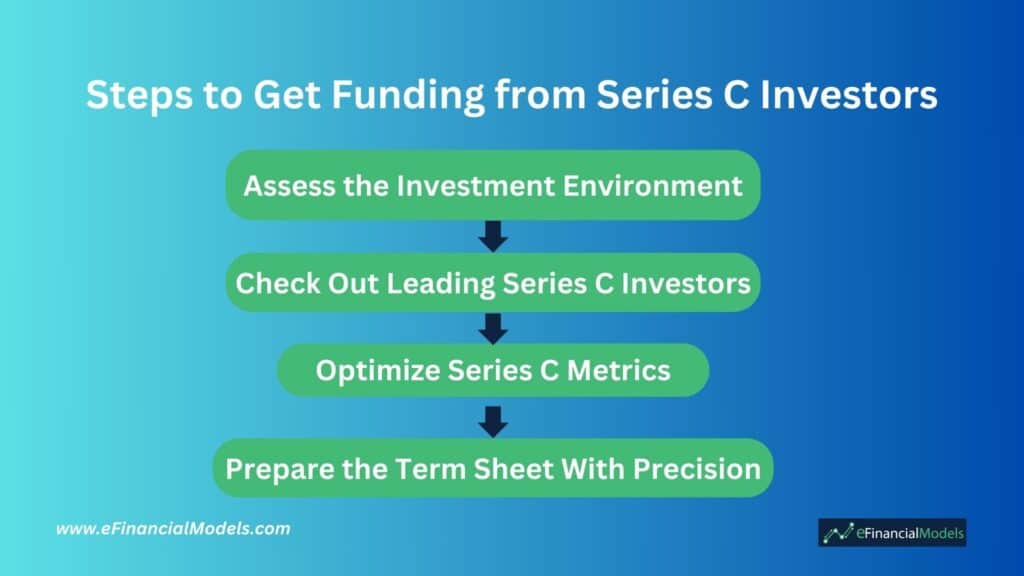
How to Get Funding from Series C Investors?
Securing funding from Series C investors is a pivotal step for any growing business. At this stage, your company has likely established a solid market presence, demonstrated consistent revenue streams, and showcased a scalable business model. It is essential to present a compelling narrative highlighting your proven track record, future growth potential, and the strategic use of the new capital to attract Series C investors. By meticulously preparing your pitch and aligning it with the expectations and interests of Series C investors, you can secure the necessary funding to propel your business to the next level.
Step 1 – Assess the Investment Environment
Assessing the investment environment is crucial when seeking funding from Series C investors because these investors are typically looking for established companies with proven business models and significant growth potential. Understanding the current market conditions, competitive landscape, and economic factors allows a company to present a compelling case highlighting its ability to scale and achieve a profitable exit. By demonstrating a thorough grasp of industry trends, regulatory impacts, and potential risks, the company can build Series C investor confidence and justify the valuation it seeks.
Start by conducting a detailed market analysis to understand your industry’s current trends, growth opportunities, and competitive landscape. Evaluate economic indicators and their potential impacts on your business, such as interest rates, inflation, and consumer spending patterns. Additionally, perform a SWOT analysis (Strengths, Weaknesses, Opportunities, Threats) to identify internal capabilities and external challenges. Finally, benchmark your company against successful peers and predecessors to highlight your competitive edge and readiness for the next growth phase. This thorough assessment will help you craft a compelling narrative that resonates with Series C investors.
Step 2 – Check Out the Leading Series C Investors
Understanding the role of leading Series C investors is crucial, as they not only inject capital but also offer invaluable industry knowledge, strategic direction, and extensive networks that can propel a company’s development. Their support can bolster credibility and attract additional investments from other respected sources.
Among the common Series C Investors are:
- Banks: Banks typically participate in Series C funding by offering debt financing or loans, leveraging their financial stability and lending expertise to support established companies looking to scale. They provide structured financial products that help companies manage growth and operational costs.
- Hedge Funds: Hedge funds participate in Series C rounds with a strategic focus on diversifying their portfolios and seeking high returns. They often bring substantial capital and a keen interest in maximizing short- to medium-term financial performance. Their involvement can provide liquidity and strategic financial planning to support rapid expansion.
- Institutional Investors: Institutional investors, including entities like pension funds and endowments, participate in Series C funding to achieve stable, long-term returns. They offer large pools of capital and often look for companies with proven business models and substantial growth potential.
- Private Equity: Private equity firms invest in Series C rounds to acquire significant stakes in promising companies, aiming to enhance value through strategic direction and operational improvements. They bring extensive industry experience and resources to drive growth and profitability.
- Venture Capitalists: Venture capitalists continue investing in Series C funding to support companies they believe can achieve large-scale success, providing capital and mentorship. They leverage their networks and expertise to help companies navigate growth challenges and expand market reach.
Check out the leading Series C investors and research online databases and platforms like Crunchbase, PitchBook, and CB Insights, which provide detailed information on investors and funding rounds. Look for reports and rankings of top investors in Series C funding, often published by financial news outlets and industry analysts. Networking within industry events, conferences, and venture capital forums can provide insights and direct introductions. Examining successful companies in your sector and identifying their Series C investors can reveal active and reputable firms. Finally, leveraging professional networks, advisors, and mentors can offer personalized recommendations and insights into potential investors.

Step 3 – Optimize Series C Metrics
To secure Series A, you need a functioning product; for Series B, you need a strong leadership team; for Series C, you need a thriving business and optimized financial metrics. What is a series c funding round involves assessing a startup’s overall viability. This evaluation isn’t just a rudimentary check but a comprehensive analysis encompassing financial, operational, and market dimensions. Conducting financial due diligence is the bedrock of this assessment. Investors meticulously examine balance sheets, income statements, and cash flow reports to determine the company’s financial health. The following metrics show the company’s capacity to manage growth without compromising financial stability.
High Company Valuation
Clear distinctions emerge when comparing Series C to earlier funding stages, such as Seed, Series A, and Series B. Seed rounds are primarily oriented toward getting a startup off the ground. Series A funding is about scaling the product and gaining a foothold in the market. In contrast, Series B is geared around building the business on a larger operational scale. Series C, on the other hand, is often aligned with a company that is ready to scale its business substantially, aiming for expansion into new markets, potential acquisitions, and preparing for an eventual IPO. Typical funding amounts in Series C can range from $50 million to $100 million, depending on the company’s valuation and growth potential, with some high-growth startups even crossing the billion-dollar mark in raised capital. Currently, the average valuation to qualify for a Series C financing round is between $70 million to $120 million.
Customer Retention Rates
A high customer retention rate (CRR) indicates that customers are satisfied with the product or service and see continuous value, suggesting a healthy, sustainable business model. Retained customers provide a predictable revenue stream, crucial for long-term financial planning and attracting investors. They also contribute more to the overall customer lifetime value (CLV), leading to higher profitability. An acceptable customer retention rate for Series C funding varies by industry. SaaS companies should aim for an annual retention rate of 90% or higher, while e-commerce businesses should target 70-80%. Consumer subscription services are expected to maintain 80-90% monthly retention.
Employee Retention Rate
Employee retention rate is a vital Series C metric, indicating the company’s ability to maintain a stable and satisfied workforce, which is crucial for sustaining growth and operational continuity. A high retention rate suggests employees are engaged, motivated, and committed to the company’s mission, reducing recruitment and training costs and preserving institutional knowledge. Investors at this stage look for companies with strong employee retention as it reflects a positive work culture and effective management, both essential for scaling the business successfully and achieving long-term objectives. An acceptable employee retention rate for Series C funding generally falls between 85-90% annually, depending on the industry and market conditions. This range indicates a stable workforce with minimal turnover, crucial for maintaining productivity and preserving company knowledge during a critical growth phase.
Productivity Costs
Productivity costs, as a Series C metric, refer to the financial implications of lost productivity within a company, often due to employee absenteeism, turnover, or suboptimal performance. This metric becomes particularly significant at the Series C stage, where companies typically scale rapidly and aim to optimize operational efficiency. Measuring productivity costs helps identify areas where the company can improve workforce management, streamline processes, and enhance overall productivity. By understanding and mitigating these costs, businesses can maintain better control over expenses, improve employee engagement, and drive sustainable growth, which is crucial for attracting investors and achieving long-term success. As a Series C metric, acceptable productivity costs can vary widely depending on the industry, company size, and specific operational context. However, a general benchmark aims for productivity costs to be less than 5% of total revenue. This percentage indicates that the company is efficiently managing its workforce and minimizing losses due to absenteeism, turnover, and other factors that impede productivity.
Revenue Growth
Revenue growth is a critical metric for companies at the Series C stage, reflecting the increase in sales or income generated from business activities over a specific period. High revenue growth indicates successful market penetration, effective sales strategies, and robust customer demand. It also demonstrates the company’s potential for future profitability and sustainability, essential for attracting additional investment and support from venture capitalists and other investors. Consistent and substantial revenue growth reassures stakeholders that the company is on a solid upward trajectory and can deliver significant returns on investment. Acceptable revenue growth for a Series C company generally ranges between 50% to 100% year-over-year. This rate indicates that the company is successfully scaling its operations and expanding its market presence. At the Series C stage, investors expect substantial growth as the company leverages previous investments to drive higher sales and market penetration.
Sales Efficiency
The Sales Efficiency Ratio indicates how many dollars of new revenue are generated for every dollar spent on sales and marketing. As a Series C metric, it evaluates how effectively a company converts its sales and marketing investments into revenue. This metric is crucial at the Series C stage because it helps assess the return on investment (ROI) for sales efforts, ensuring that the company is scaling efficiently. An acceptable Sales Efficiency Ratio (SER) for a Series C company typically ranges from 0.5 to 1.5. This range indicates that the company effectively converts its sales and marketing expenditures into revenue.

Step 4 – Prepare Term Sheets With Precision
A Series C Term Sheet outlines the terms and conditions of what is a Series C funding round for a specific startup. It includes vital details such as the company’s valuation, the amount of capital to be raised, the type of securities offered, investor rights, and governance provisions. The term sheet serves as a preliminary agreement guiding the negotiation and finalization of the investment.
To prepare a Series C Term Sheet with precision:
- Start by clearly defining the company’s current valuation and the amount of capital to be raised.
- Detail the type of securities to be issued, such as preferred stock, and specify the conversion terms, dividends, and liquidation preferences.
- Outline investor rights, including board representation, voting rights, and anti-dilution provisions.
- Address key governance issues, like founder vesting schedules and future fundraising plans.
- Ensure all legal and financial terms comply with industry standards and regulatory requirements.
- Collaborate with legal and financial advisors to draft a comprehensive, unambiguous document that aligns with the company’s strategic objectives and attracts potential investors.
Preparing a Series C term sheet with precision helps secure substantial investment and propel your company’s growth to new heights.
Unlock Series C Funds with Financial Modeling
Getting ready for Series C funding can seem like an overwhelming task list, but it might be the critical turning point your business needs. As your company undergoes significant changes and you embark on new professional ventures, you’ll encounter unique challenges and risks. This stage of funding is crucial as it often determines whether a company can scale successfully, expand into new markets, and solidify its position in the industry. The rigorous preparation, from refining your business model to ensuring legal and financial compliance, sets the foundation for sustained growth and attracts the right investors.
Financial modeling plays a pivotal role in unlocking Series C funding. Developing comprehensive and robust financial models gives potential investors a clear picture of your company’s current performance and future potential. These models demonstrate how additional capital will be used to drive growth, showing detailed revenue, expenses, and cash flow projections. They help quantify risks and returns, build investor confidence, and facilitate informed decision-making, ultimately making your company a more attractive investment opportunity.
Related Readings:
- How Do Startup Funding Rounds Work?
- How to Secure Seed Financing
- How to Raise Series A Funding
- Strategic Insights to Secure Series B Financing














You might also like:
- Steps to Securing Series C Financing
- How to Raise Series A Funding?
- 5 Tips to Develop a First Class Business Valuation Report
- 10 Main Elements of a Business Plan
- Bootstrapping vs. Venture Capital Funding: Which is Better?
- How Contribution Margin Analysis Can Drive Your Business to Financial Success
- How to Make Smart Decisions with 6 Key Financial Metrics?
- Financial Modeling for Startups and Small Businesses
- 10 Ideas to Increase Average Revenue Per User
- Understanding What is Yield to Maturity and Why It Matters
- How to Calculate Net Present Value (NPV)?
- Calculating Revenue Growth Rate: A Key Metric for Business Success
- Financial Ratios Analysis and Its Importance
- Monthly Google Sheets Budget (with Financial Statements)
- How to Do Cohort Analysis in Excel
- Scenario Analysis
- Understanding Debt Sizing & Project Finance Ratios
- Pros and Cons of Equity Financing
- The Purpose of a Financial Model
- How to Write a Business Plan Step-by-Step