0 ITEMS

How to Raise Bank Financing for Businesses?
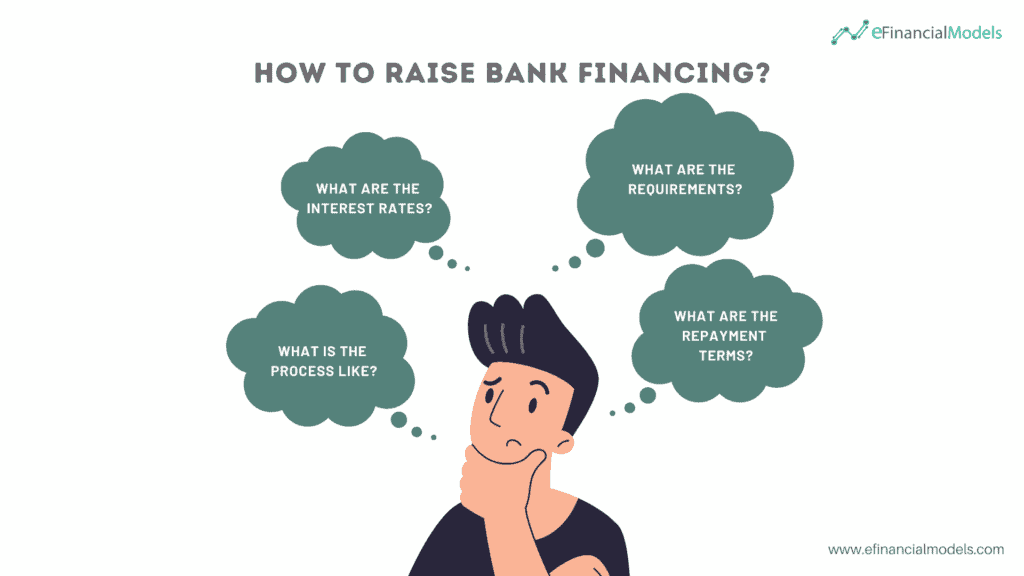
Raising capital is a critical milestone for any business, whether you’re a startup founder or a seasoned entrepreneur. Did you know that according to a U.S. Bank study, 82% of businesses that fail do so because of cash flow problems? This statistic underscores the importance of meticulous financial planning for beginners. In this comprehensive guide, we’ll delve into the key components of financial planning and strategy that can make or break your quest for bank financing.
Importance of Financial Modeling
Financial modeling is not just a buzzword; it’s the backbone of sound business finance and decision-making. It serves as a virtual simulation of your business’s financial performance, providing a forward-looking view that aids in planning, budgeting, and forecasting. For investors and lenders, a well-crafted financial model acts as a confidence booster, showcasing your understanding of the business and its financial intricacies. It’s akin to a roadmap that not only guides you but also convinces the bank that your business is a worthy investment.
Key Components:
1. Cash Flow Projections:
Cash is king, especially when you’re trying to secure bank financing for business. Cash flow projections offer a snapshot of how cash moves in and out of your business over a specific period. These projections are pivotal for demonstrating your ability to generate positive cash flow, thereby assuring the bank that you can meet your loan obligations. A well-structured cash flow model will include revenue forecasts, operating expenses, and capital expenditures, providing a holistic view of your financial health.
2. Profit and Loss Statements:
Also known as income statements, Profit and Loss (P&L) statements provide a summary of your revenues, costs, and expenses over a period. Banks scrutinize your P&L to assess profitability trends and operating efficiency. A profitable business is generally seen as less risky, making it easier to secure bank loans for starting a business. Your P&L statement should be detailed yet straightforward, highlighting key metrics like gross profit, operating profit, and net profit.
3. Balance Sheet:
Your balance sheet is a financial snapshot that reveals what your business owns (assets) and owes (liabilities), along with its equity at a specific point in time. Banks use this document to evaluate your business’s liquidity, solvency, and overall financial stability. A strong balance sheet with healthy ratios of assets to liabilities can be a compelling indicator of your business’s creditworthiness.
4. Debt Service Coverage Ratio (DSCR):
DSCR is a critical metric that banks use to evaluate your ability to service your debt with your operating income. It is calculated by dividing your net operating income by your total debt service (principal and interest payments). A DSCR of greater than 1 indicates that the business generates sufficient income to pay off its debts, making it a less risky proposition for the bank.
Steps to Raise Bank Financing

You’ve got a great business idea, a solid financial model, and a burning desire to succeed. What’s next? Securing the financial backing to turn your vision into reality. Getting bank financing can seem like a difficult endeavor, but it is completely doable with the correct strategy and planning. In this guide, we’ll walk you through the essential steps to successfully secure bank financing for your business.
Step 1: Identify Which Banks to Ask for Financing
A. Find Which Type of Bank Might Work Best for You
- Development Banks: These are often government-backed institutions focused on funding businesses that contribute to economic development. If your business has a social or economic impact, a development bank might be your best bet.
- Commercial Banks: These are your traditional banks that offer various types of business loans. They are generally more stringent in their lending criteria but are also more accessible.
- Private Lenders: These could be non-banking financial companies or private entities that offer loans. They are often more flexible but may charge higher interest rates.
B. Clarify Lending Requirements
- Understand the Maximum LTV: Loan-to-Value (LTV) ratio is a critical metric that banks use to assess the risk associated with the loan. Make sure you know the maximum LTV the bank is willing to grant.
- Interest Rates: Interest rates can significantly impact your loan’s affordability. Make sure you understand the rate structure, whether it’s fixed or variable, and how it will affect your monthly payments.
- Debt Covenants: Banks often set covenants like Debt/EBITDA or Debt Service Coverage Ratios (DSCR). Make sure you understand these requirements as they can trigger defaults if breached.
- Know What the Bank is Looking For: Different banks have different criteria. Some may focus on your business’s profitability, while others may emphasize your industry experience. Make sure you know what your chosen bank values most.
Step 2: Prepare a Business Plan and Financial Model
Prepare Financial Projections for Your Business (Multi-Year): A multi-year financial projection will give the bank a long-term view of your business’s viability. This should align with your business plan and include income statements, balance sheets, and cash flow statements.
Prepare Cash Flow Projections: Cash flow is the lifeblood of any business. Your cash flow projections should be realistic and consider all possible revenue streams and expenditures. This will not only help the bank but also provide you with valuable insights into your business’s financial health.
Step 3: Conduct Financial Analysis
Determine the Debt Capacity
- For Real Estate Properties: Maximum LTV Ratio: If you’re in the real estate sector, the Loan-to-Value (LTV) ratio will be a key determinant of how much you can borrow. This ratio is calculated by dividing the loan amount by the property’s appraised value. Knowing the maximum LTV ratio, the bank is willing to offer can guide you in deciding how much to ask for.
- For Businesses: Scenario Based on Maximum Debt/EBITDA Ratio: For other types of businesses, the Debt/EBITDA ratio is often used to assess debt capacity. Prepare a scenario that shows your business can sustain a certain level of debt relative to its earnings before interest, taxes, depreciation, and amortization (EBITDA).
- Repayment Plan: Clearly define your debt repayment strategy. Over what period do you plan to repay the debt, and when will the repayments start? This shows the bank that you’ve thought about the loan’s impact on your cash flow.
Forecasted Debt Service Coverage Ratio (DSCR): DSCR is a crucial metric that compares your business’s cash flow to its debt obligations. A DSCR of at least 1.25x or 1.5x (depending on the bank’s requirements) indicates that your business generates enough cash to cover the debt service.
Step 4: Prepare A suggested Debt Schedule
Preparing a Debt Schedule allows to clearly define and explain your debt repayment strategy to the bank. Over what period do you plan to repay the debt, and when will the repayments start? This shows the bank that you’ve thought about the loan’s impact on your cash flow. Please refer to an example debt schedule below prepared for a Solar Park producing electricity.

Identify Collateral
Securities or Collateral: Banks often require collateral as a safety net in case of default. What assets can you offer as collateral? This could be real estate, equipment, or even accounts receivable. Make sure the value of the collateral aligns with the loan amount you’re seeking.
Stress-Test Your Financials
Run a Stress-Test Scenario: Life is unpredictable, and so is business. Conduct a stress test to see how your business would fare under less-than-ideal conditions. Can you still service the debt if revenue drops by 20%? What if interest rates rise? Presenting this to the bank shows that you’re prepared for various scenarios, enhancing your credibility.
Step 5: Prepare Term Sheet and Proposal
At this stage, you’ll need to prepare a term sheet and a formal loan proposal. The term sheet outlines the key terms and conditions of the loan, such as the amount, interest rate, repayment schedule, and any covenants or guarantees. Your proposal should encapsulate all the work you’ve done so far, from your business plan to your financial model and analysis. Make it compelling but concise; this is your final pitch to the bank, so make it count.
Step 6: Presentation and Pre-Approval
Present Your Proposal to Multiple Banks
Don’t put all your eggs in one basket. Present your proposal to multiple banks to gauge different offers. This not only increases your chances of securing a loan but also gives you leverage to negotiate better terms.
Seek Pre-Approval
Once you’ve presented your proposal, the next step is to seek pre-approval. This is an initial nod from the bank that indicates they are interested in lending to you, based on your presentation and the documents submitted. Pre-approval is not a guarantee, but it’s a significant step forward.
Step 7: Document Submission and Approval
After receiving pre-approval and deciding which bank offer suits you best, it’s time to submit the formal loan application. This will include all the documents the bank requires, which could range from financial statements to business licenses. Once submitted, the bank will conduct a final review. If all goes well, you’ll receive the final loan approval and can proceed to the loan disbursement stage.
The Art of Securing Bank Financing—Preparation, Presentation, and Financial Modeling
The journey to secure bank financing is akin to a well-choreographed dance. Every step, from identifying suitable banks to presenting your proposal and navigating the approval process, requires meticulous preparation. Unlike casual conversations, discussions with banks are formal and data-driven. Your preparation will not only instill confidence in the lender but also equip you with the insights needed to negotiate better terms.
It’s crucial to understand that banks and investors are driven by different motivations. While investors may be interested in your business’s growth potential and market opportunities, banks have a more focused concern—will you be able to repay the loan? Their primary interest lies in the safety of their capital. Your task is to assure them that their money is not just safe but is being allocated in a venture that has been thoroughly vetted for financial stability.
A well-crafted financial model is more than just a spreadsheet; it’s your business plan translated into numbers. It provides a comprehensive view of your business’s financial landscape, from cash flows and profit and loss statements to debt service coverage ratios. A robust financial model serves as the backbone of your loan application, substantiating your claims and providing the bank with the quantitative data they need to assess risk and viability.
Feel free also to check out our full list of industry-specific templates that includes the Banking here: