
0 ITEMS

How Can You Make Your Startup Successful?

Starting a startup involves turning an innovative idea into a successful business but requires careful planning and execution.
- Developing a startup idea starts with identifying a real problem and testing if your solution is viable and market-ready.
- Understanding your target niche and audience is critical, focusing on underserved segments with growth potential.
- Financial analysis, including creating detailed projections and using financial models, helps attract investors and plan for growth.
- Securing funding options like bootstrapping, angel investors, and crowdfunding supports scaling efforts.
- Building the right team and effectively launching and marketing your startup are key steps to gaining traction.
This article covers practical strategies and essential financial tools to guide you through each stage of startup development.
Facts About Startups
The true definition of a startup can vary depending on context and individual perspectives. Some may define a startup based on age, revenue, or funding status, while others may focus on its disruptive potential or growth trajectory. Still, generally, a startup refers to a young, dynamic, and innovative company in the early stages of its development. They were founded by one or more business owners who desire to bring a unique product, service, or technology.
While no universally accepted definition of a startup exists, certain characteristics are often associated with such companies. These include:
- Innovation: Startups are known for their focus on innovation, whether it be in terms of technology, product development, or business processes. They strive to solve problems in creative and unconventional ways.
- Novelty: Startups often introduce new ideas, technologies, or business models that differentiate them from existing solutions in the market.
- Entrepreneurial Culture: Startups are characterized by their entrepreneurial spirit – adaptability, risk-taking, and willingness to experiment and learn from failures.
- High Growth Potential: Startups typically have ambitious growth goals and aim to scale rapidly, often leveraging technology and innovation to achieve exponential growth.
- Uncertainty: Startups operate in an environment of uncertainty, with limited resources and unproven business models. They face challenges such as market validation, acquiring customers, and securing funding.
While the definition of a startup is open-ended, it most usually refers to high-tech businesses that develop products that use technology to deliver something new or to carry out an established task in a creative way. Because of this, many of these companies are referred to as “disruptors” in their respective industries. Think of Facebook, Amazon, Apple, Netflix, and Google – they were once tech startups.














































The 10 Highest-Valued Startups in the World (2023)
CB Insights, a business analytics platform, refers to startups with a valuation of over $1 Billion as unicorns. Recently, it published a list of 1,215 unicorns globally. Among the 10 highest-valued startups are:
- ByteDance, a Chinese internet technology company
- SpaceX, an American spacecraft manufacturer
- SHEIN, a global e-retailer of fashion & lifestyle items
- Stripe, an Irish-American online payment platform
- Canva, an Australian global graphic design platform
- Revolut, a British fintech and neo-bank company
- Epic Games, an American video games platform
- Databricks, an American enterprise software company
- Fanatics, an American sportswear & sports collectibles retailer
- OpenAI, an American AI research laboratory

A Guide to Building a Startup Company
As an entrepreneur with a vision, you have an idea that could change the world. Now it’s time to make that idea a reality and build your startup. Turning an idea into a functioning business is challenging but rewarding. With hard work and persistence, you can navigate the obstacles, learn from mistakes, and ultimately launch your company.
The path will sometimes be unclear or easy, but with passion for your vision, you can turn your powerful idea into a thriving business. Stay determined and keep your eyes on the final destination. With the right drive and dedication, your vision can change the world.
Step 1 – Develop Your Million-Dollar Startup Idea
To develop a million-dollar startup idea, you must identify a problem that needs solving and determine if you have a viable solution. Start by researching issues in industries you understand or are passionate about. Look for difficulties that persist and disrupt people or businesses. Ask colleagues or conduct customer interviews to discover pain points.
Once you spot a good problem, check if you can solve it. A winning startup idea should be innovative yet realistic. It needs to be something you can build and for which customers will pay. Consider your skills, resources, and competitive landscape. Flesh out solutions and test their financial feasibility.
When you land on a concept with potential, confirm your assumptions. Create a basic prototype or pitch deck to show prospective customers and get feedback. See if people understand the issue you want to address and if they would use your solution. Pivot as needed based on responses.
Step 2 – Discover Your Target Market and Identify Your Niche
You must identify the right niche market and target audience to build a successful startup. It is the foundation for everything else, so take your time to get this right.
Study your industry and competitors to spot potential niches. Look for underserved segments of customers with needs that aren’t being fully met. Once you find a few possibilities, evaluate them based on criteria like growth opportunities, potential market size, and your ability to reach them.
Get specific on what business model you will adopt. It would be best to learn more about B2C versus B2B companies. The more precise you can be with your market and target audience, the better. Test them through surveys, interviews, focus groups, or small-scale product launches. See how people respond and be willing to adapt. Once you’ve identified the best opportunities, you’ll have a roadmap to build a startup poised for success.
Step 3 – Execute Financial Analysis and Planning
To get your startup off the ground, you need a solid financial plan to show investors you’ve got what it takes to succeed. So, financial analysis and planning are essential. It involves developing a solid financial strategy and financial projection for a startup.
Start by collecting all the necessary financial data for your startup, including a plan for fundraising, pricing strategy, customer acquisition costs, legal requirements, and operating expenses. Several startup financial model templates can help you structure your financial analysis.
These startup financial model templates should include the three-statement financial model that integrates income statements, balance sheets, and cash flow statements. It should also incorporate financial ratio analysis, such as key financial metrics – calculation of net present value, internal rate of return calculation, etc.
Financial modeling for startups and small businesses can help create an accurate financial projection for a startup. It shows how much money you need to launch and maintain your business. It estimates costs like office space, equipment, employee salaries, marketing – you name it. It also predicts how much revenue you can generate and when you’ll become profitable.
Step 4 – Explore Funding Options
Once you have an accurate financial projection for a startup, determine how much you can contribute, how much you can get from other sources, and how much outside funding you will need. Meet with potential investors and be prepared to explain your business and financial plan.
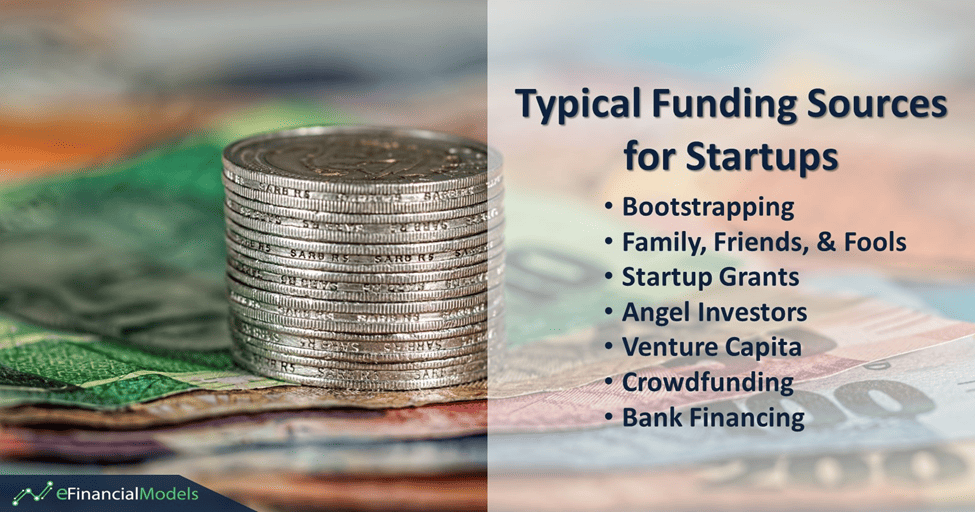
You can explore the following funding sources for businesses and startups:
- Bootstrapping
- Family, Friends, & Fools
- Startup Grants
- Angel Investors
- Venture Capita
- Crowdfunding
- Bank Financing
The key is determining what combination of these funding sources is right for your needs and being prepared to make your best pitch to investors and lenders. Do your homework by knowing your numbers through financial ratio analysis, such as the calculation of net present value and internal rate of return calculation. These tools for financial planning can help you determine how much your business is worth.
Step 5 – Form the Right Team
As an entrepreneur, you cannot do everything yourself. To build a successful startup, assembling the right team is crucial. When hiring your first employees, look for people with a growth mindset, passion for your vision, and skills that complement your own. Don’t just hire your friends — find people who will challenge you and improve the company.
Evaluate candidates on their ability to learn and adapt. Technical skills can be taught, but work ethic and critical thinking take more work. Look for passion and enthusiasm. Early startup employees need to be self-motivated and dedicated to overcoming obstacles.
Once you have the right people on board, give them opportunities to shine. Early startup employees often have valuable ideas to take the company to the next level. Your startup’s culture will determine its success or failure more than any other factor. Spend time cultivating the environment and values you want to see — an open, transparent culture where people feel empowered to share ideas leads to innovation.
Step 6 – Launch and Market Your Startup
Launching your startup begins with building your minimum viable product (MVP), a basic version of your product or service that allows you to validate your idea and start building an audience. Focus on the essential features that solve your customers’ main problems. Keep your MVP as simple as possible to minimize cost and time. You can always add more features later based on customer feedback.
The next step is to establish your business legally by choosing a business structure and obtaining proper licenses and permits. Open a business bank account and accounting system to keep your personal and business finances separate.
Promote your startup through social media, email marketing, search engine optimization, content creation, partnerships, sponsorships, and word-of-mouth. Encourage customer reviews and testimonials to build social proof. Focus on your target customers and the channels they frequent. Provide discounts and promotions to drive early sales and get people talking about your new business.
Pay close attention to customer feedback and reviews after launching. Look for ways to enhance your product or service and add your customers’ desired features. Make ongoing improvements to increase satisfaction and retention.
If demand grows quickly, you may need additional funding to scale your operations while maintaining high quality. Expand into new markets and channels over time to boost growth. You can build your startup into a thriving company with hard work and perseverance.













Get Your Startup Off the Ground Using Startup Financial Model Templates
You’ll need solid financial modeling and planning to get your startup off the ground. The following startup financial model templates can help you grow your business:
Fundraising Template
A simple fundraising template can help you determine the required funding. It will also allow you to allocate the equity stake percentages for each new investor. It can be done through the internal rate of return calculation to know how much profit and return you can expect.
Financial Plan
What is a Financial Plan? A financial plan is required to learn more about a company’s potential financial status over five years or longer. Both large and small firms need those plans. Financial analysis and planning transform the business strategy into quantifiable projected results.
Revenue & Expense Model
A three-statement financial model is a revenue & expense model showing how your business will make money. It consists of three parts: the balance sheet, cash flow statement, and income statement).
- The balance sheet provides a snapshot of the startup’s financial position at a given point in time. It presents the company’s assets, liabilities, and shareholders’ equity, allowing entrepreneurs to understand the overall value of their business. By analyzing the balance sheet, startups can evaluate their liquidity, solvency, and financial stability. It helps assess the company’s ability to meet short-term obligations, determine the need for additional funding or working capital, and identify the availability of resources.
- The cash flow statement provides insights into the inflow and outflow of cash within the startup. It helps entrepreneurs monitor and manage their cash position effectively, ensuring enough liquidity to meet operational expenses, investment needs, and debt obligations. By estimating cash inflows and outflows, entrepreneurs can anticipate periods of cash surplus or deficit, plan for contingencies, and make informed decisions regarding investment, expansion, or cost-cutting measures.
- The income statement summarizes a startup’s revenues, expenses, and net profit or loss over a specific period. It enables entrepreneurs to analyze their revenue sources, assess cost structure, and evaluate profitability. By monitoring and optimizing revenue streams and managing expenses, startups can work towards achieving sustainable profitability.
Key Financial Ratios Template
Establishing key metrics, milestones, and timelines to track your progress is necessary for a startup’s success. A solid financial modeling strategy is crucial to realizing your startup dreams.
- First, it is important to check when you are breaking through your break-even point, the time you will start earning a profit.
- Second, conduct a business valuation and financial feasibility study occasionally to see how your startup performs. You can use a business valuation calculator to value your startup through a discounted cash flow calculation.
- Adopting strategies for successful risk management in financial planning is essential to prevent potential losses and unlock growth opportunities.
While it requires effort and diligence, strong financial modeling can give you the insight and confidence to take that first big leap toward entrepreneurship. Keep your models basic to start, and refine them over time as you gain more clarity about your business and market.

Summary
So there, you have the key ingredients to launch your startup and find your niche. Identify an untapped market, get your financial ducks in a row, build a solid plan to achieve profitability, and surround yourself with people who share your vision. Do that, and you’ll be well on your way to startup success.
Of course, the road is long, but stay focused on your goals, adapt as needed, and never stop learning. Before you know it, you’ll have found your niche, built something great, and be on to the next challenge. The road ahead is long but keep putting one foot before the other using startup financial model templates!














You might also like:
- 10 Main Elements of a Business Plan
- 5 Practical Tips to Help Raise Funds For Startups
- Financial Modeling for Startups and Small Businesses
- 10 Tips to Develop a First Class Business Valuation Report
- How to Write a Business Plan Step-by-Step
- How Do Startup Funding Rounds Work?
- Calculating Revenue Growth Rate: A Key Metric for Business Success
- How to Secure Seed Financing?
- Financial Model Templates Easy to Use
- How to Prepare a Financial Feasibility Study?
- Business Plan Models – Using Business Models as Examples
- Funding Sources
- Startup Financial Models
- Financial Modeling for Project Finance
- Financial Forecasting Models by eFinancialModels
- Financial Ratios Analysis and Its Importance
- How to Make a Startup Financial Plan for Fundraising?
- 8 Tips for Creating a Successful Fundraising Strategy
- 10 Ideas to Increase Average Revenue Per User
- 5 Steps to Create a Drop Down List Using Data Validation in Excel