
0 ITEMS

How Do Startup Funding Rounds Work?
Table of Content
Startup funding rounds are essential steps in turning an idea into a growing business.
- The initial phase, pre-seed, focuses on validating the concept with minimal resources from founders and close contacts.
- Seed funding helps develop a prototype, test the market, and build the core team, often raising $500,000 to $2 million from angels or micro-VCs.
- Series A aims to scale a proven business model, with venture capital investments typically between $2 million and $15 million.
- Series B and C rounds support rapid growth, market expansion, new product development, and preparing for IPO or acquisition, with funding amounts increasing significantly.
- Considering the right funding sources and preparing compelling financial models can improve chances of securing capital at each stage.
Understanding these phases helps entrepreneurs navigate the fundraising process effectively and accelerate their startup’s success.
An Introduction to Startup Funding Rounds
Startup funding refers to the financial resources entrepreneurs and business owners seek to launch, grow, or scale their new ventures. This funding is crucial for startups as it provides the necessary capital to develop products, hire talent, expand operations, and, ultimately, achieve market penetration and profitability. With adequate funding, startups can sustain operations or compete in the fast-paced business environment. Therefore, understanding the dynamics of startup funding is crucial for any entrepreneur aiming to create a thriving business.
The role of funding in startups is about more than just financial backing. It’s a validation of the startup’s potential from investors’ perspectives. Securing funding at various stages helps businesses validate their business model, scale infrastructure, and create a foothold in their respective industries. Moreover, funding is often a prerequisite for attracting further investment, making it a critical component of a startup’s growth strategy.
Startup funding typically occurs in multiple phases, each serving a distinct purpose and involving different types of investors who typically invest equity capital into the business. Using debt financing to start a business is not a great idea, as the business will need to reinvest its profits to growth and normally cannot afford to repay the debt from the start.
When starting a business, we differentiate the following financing rounds:
- Pre-Seed: The pre-seed round is the earliest stage of funding to develop the initial concept and conduct early market research. This phase helps the business create a minimum viable product (MVP) and validate its business model.
- Seed: The seed round focuses on raising funds to develop the product further, conduct more extensive market research, and build the initial team.
- Series A: The Series A round aims to optimize the product, expand the user base, and establish a scalable business model.
- Series B: The Series B round is geared towards scaling the business, increasing market reach, and expanding the team and infrastructure.
- Series C: The Series C round supports the business in achieving large-scale expansion, entering new markets, and possibly preparing for an initial public offering (IPO) or acquisition.

Understanding Startup Funding Phases
Understanding startup funding phases is crucial for any budding entrepreneur. Startups typically undergo several funding phases to secure the necessary capital for growth, development, and scalability. Each phase of funding addresses specific needs, from initial product development and market entry to scaling operations and expanding market reach. This structured approach ensures that startups can strategically manage their resources, validate their business models, and demonstrate growth potential to attract further investment. By progressing through these stages, startups can build a solid financial foundation, mitigate risks, and enhance their likelihood of achieving sustained success in a competitive market.
Pre-Seed Funding
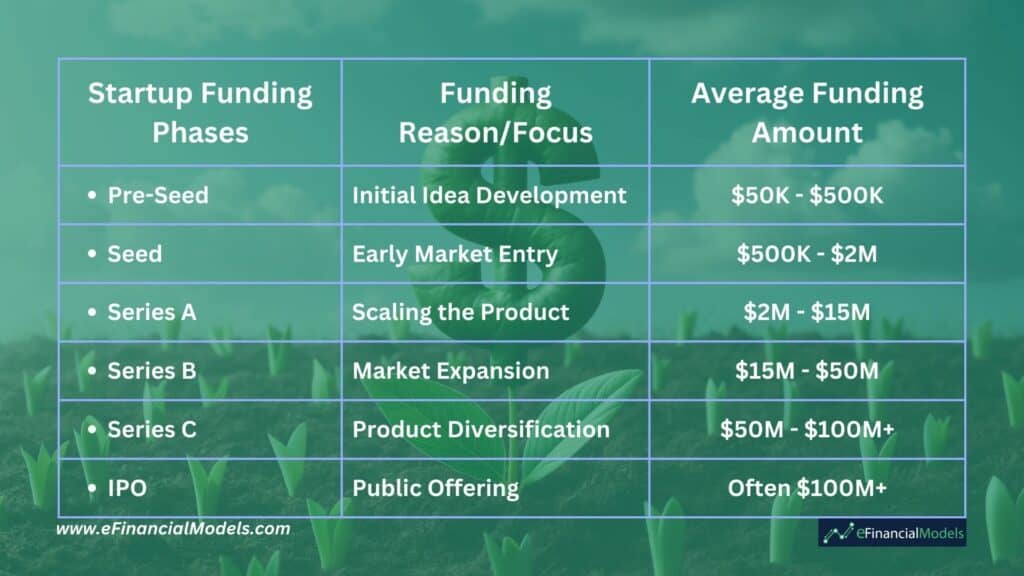
Pre-seed funding is the earliest among the startup funding phases. It typically involves a small amount of capital provided to entrepreneurs to help them turn an idea into a viable product or service. This phase often precedes the establishment of a formal business entity and is used to cover the initial expenses associated with research and development, market research, and building a prototype. Pre-seed funding typically comes from the founders and their friends and family who believe in the idea’s potential. The amounts raised during this stage are relatively modest compared to later funding rounds. Pre-seed funding typically ranges from $50,000 to $500,000.
During the pre-seed phase, the primary focus is validating the business concept and demonstrating its feasibility. Entrepreneurs use this funding to conduct market research, refine their business model, and develop a minimum viable product (MVP) to attract further investment. Success at this stage is measured by presenting a compelling case to potential investors, showcasing market needs, product-market fit, and a clear path to scalability. This stage is essential for establishing the foundation for future funding rounds., where more significant sums of money are sought to accelerate growth and expand operations.
Seed Funding
The seed funding round is often the first formal equity funding stage in the lifecycle of a startup. It is a crucial phase where nascent businesses secure the initial capital to kickstart their operations, develop a prototype, or prove their business concept. The term “seed” is quite fitting; it signifies planting the first seeds of the business with the hope that they will eventually grow into a thriving enterprise. Seed funding covers basic operational costs, including product development, market research, and initial marketing efforts. Furthermore, it provides the critical funding needed to conduct trials, iterate on the product or service, and position the startup for the next stages of growth.
The amount raised during a seed funding round can vary significantly, usually ranging from $500,000 to $2 million. The sources of seed funding are diverse and can include angel investors and micro-venture capital firms. These investors are mainly active at this stage, bringing financial support, invaluable expertise, and mentorship. These investors often seek startups with innovative ideas, a solid founding team, and the potential for significant growth. Unlike later funding rounds, the seed stage is marked by high levels of risk and uncertainty, making it imperative for startups to present a compelling vision and business plan to attract investors.
The seed funding process is a delicate dance of presenting a compelling narrative, backed by initial data and a robust business strategy, to convince investors that their seed capital will yield substantial returns in the future.
Further Readings: How to Secure Seed Financing
Series A Funding
Series A funding is a pivotal milestone in the startup funding phases. It represents the first significant round of venture capital financing that typically follows seed funding. Unlike seed funding, primarily to validate a business idea and achieve initial traction, Series A funding aims to scale a proven business model and optimize product-market fit. By this stage, startups are expected to have a coherent business strategy, measurable user engagement, and clear monetization pathways. The capital raised during Series A is often used to expand the team, enhance technology infrastructure, and implement robust marketing and sales strategies to accelerate growth.
The transition from seed to Series A funding signifies a shift from exploration to execution. While seed funding might come from angel investors, family, or friends, Series A rounds typically involve venture capital firms specializing in early-stage investments. The investment amounts in Series A rounds are substantially higher, usually between $2 million and $15 million, although this can vary depending on the industry and geographical location. These funds are not merely for survival but for scaling operations, entering new markets, and solidifying the startup’s presence within its industry. Investor expectations also rise at this stage; they demand comprehensive financial metrics, detailed financial projections, and a demonstrable return on investment. Due diligence becomes more rigorous, thoroughly examining the startup’s economic health, market potential, competitive landscape, and the founding team’s capabilities.
Investors in a Series A round are looking for more than just an interesting idea; they seek startups with a solid foundation and a clear potential for exponential growth. This involves an in-depth due diligence process where the startup’s business model, revenue streams, customer acquisition costs, and retention rates are scrutinized.
Further Readings: How to Raise Series A Funding
Series B Funding
Series B funding represents a critical juncture for a startup, marking the transition from early-stage ventures towards scaling and maturation. Among startup funding phases, it signals to investors that the business model has been validated and that the company is ready to expand its market reach. During the Series B round, the primary objective is to accelerate growth by scaling up operations, enhancing product offerings, and capturing a larger market share. Consequently, Series B investments are often more significant than those in the Series A round, with venture capital firms and larger institutional investors making substantial commitments.
Scaling up operations with Series B funding is often characterized by significant organizational changes. Startups may use the capital to hire additional talent, expand into new markets, and invest in marketing and sales efforts. This phase often involves the development of more robust systems and processes to support a growing customer base and increased operational complexity. The focus shifts from proving the viability of the product or service to establishing a competitive advantage and increasing market penetration. A Series B funding round typically ranges from $15 million to $50 million, though amounts can vary significantly based on the company’s industry, growth stage, and investor interest.
Startups gearing up for a Series B funding round must address several key considerations to attract investors and ensure the successful deployment of capital. Investors will scrutinize financial metrics and operational performance to assess the startup’s potential for sustainable growth. Detailed financial models and projections can convey a compelling narrative about future performance. Developing a solid expansion strategy is another critical step. It includes identifying new markets, potential partnerships, and customer acquisition strategies. Also, maintaining a solid and cohesive company culture can help with employee retention, vital during rapid growth.
Further Readings: Strategic Insights to Secure Series B Financing

















































Series C Funding and Beyond
As startups progress through their growth cycles, they often reach the more advanced funding stages known as Series C and beyond. Series C funding typically occurs when a company has proven its business model, achieved significant milestones, and demonstrated the potential for continued expansion. This round often attracts more substantial investments from venture capital firms, private equity firms, hedge funds, and institutional investors eager to participate in a more mature, lower-risk investment opportunity than earlier rounds.
One of the primary aims of Series C funding is to fuel large-scale expansion. It could involve:
- Entering new markets
- Developing new products or services
- Acquiring smaller firms to enhance capabilities
- Preparing for an initial public offering (IPO)
During Series C and subsequent funding rounds, startups must exhibit robust financial health, sustainable revenue streams, and clear pathways to profitability. Investor due diligence becomes even more rigorous, with a strong focus on the company’s market position, competitive advantages, and long-term growth prospects. A Series C funding round typically ranges from $50 to $100 million, depending on the company’s growth, market potential, and investor interest.
Series C funding often sets the stage for transformative initiatives. For instance, companies may channel these funds into large-scale marketing campaigns, international market entry, or the development of new technology platforms. This round is also a strategic time to consider acquisitions that can complement the company’s existing capabilities, eliminate competition, or enhance its market share. Preparing for an IPO is another significant objective during this stage. The influx of capital can help bolster the company’s financial stability, strengthen its market visibility, and make it a more compelling candidate for public investors.
Further Readings: Steps to Securing Series C Financing
Initial Public Offering (IPO)
An Initial Public Offering (IPO) represents a crucial turning point in a startup’s development, shifting from a privately held organization to a publicly traded corporation. This process involves offering company shares to the public for the first time, typically on a stock exchange. The primary motivation for a startup to go public is to raise substantial capital, which can be used to fuel growth, expand operations, pay off debt, or invest in research and development. By offering shares to the public, the company can tap into a broader base of investors, increasing its financial resources significantly compared to private funding rounds. The influx of capital can also enhance the company’s credibility, attract top talent, and improve its visibility and market presence.
The average funding raised through an Initial Public Offering (IPO) can vary widely depending on the startup’s size and industry, market conditions, and investor interest. However, it is common for startups to raise substantial amounts of capital, often ranging from $100 million to $200 million. Tech startups and companies with high growth potential might raise significantly more, sometimes exceeding $1 billion in high-profile IPOs. It’s essential to keep in mind that these numbers can vary due to market trends and economic conditions. In bullish markets, investor enthusiasm can drive up valuations and raise capital. Conversely, during bearish market periods or economic downturns, IPO activity may slow, and the amounts raised may be lower. The specific amount a startup can raise also depends on its stage of development, financial health, growth prospects, and how well it can market itself to potential investors. Therefore, while averages provide a helpful benchmark, each IPO is unique, and the actual funding amount can vary widely.
However, an IPO is a complex and rigorous process that requires thorough preparation and compliance with stringent regulatory requirements. The company must file a detailed prospectus with the relevant securities commission, disclosing its financial performance, business model, risks, and future plans. Additionally, going public subjects the company to ongoing scrutiny from regulators, shareholders, and the market, which demands high levels of corporate governance and accountability.
As startups progress to later funding rounds, managing relationships with investors becomes increasingly critical. Effective communication and transparency are essential to maintaining investor confidence. Companies must regularly update financial performance, strategic initiatives, and critical milestones. In later funding rounds such as Series C, D, and beyond, the dynamics of investor relationships often shift from mere financial support to strategic partnerships.
How to Get Funding for Your Startup
Knowing how to get funding for your startup is the key to turning your ideas into reality. Funding provides the necessary financial resources to develop your product or service and helps you scale your operations, attract top talent, and gain a competitive edge in the market. Understanding the various funding options allows you to choose the best strategy that aligns with your business goals and growth plans. Moreover, being well-prepared to pitch to investors and demonstrate a clear path to profitability can significantly increase your chances of securing the necessary capital to bring your vision to life.
Here are the basic steps on how to get funding for your startup:
Assess Your Funding Needs
The first step in how to get funding for your startup is to understand how much capital you need clearly. Start by evaluating your startup’s expenses, including initial setup costs, operational expenses, marketing, salaries, and contingency funds. Break down your needs into short-term and long-term categories to identify immediate and future financial requirements. This assessment helps determine the funding needed and ensures you raise only a little.
Create Your Business Plan
A comprehensive business plan is essential for attracting investors. Detail how your business will make money, the milestones you plan to achieve, and how the funding will reach these goals. A startup seeking seed funding must meet several criteria to appeal to potential investors. Primarily, the startup must have a clear and scalable business plan. Founders must demonstrate a deep understanding of their market and the problem their product or service aims to solve. Additionally, early traction—such as customer interest or initial sales—can significantly bolster a startup’s attractiveness to investors. The team behind the startup is also a critical factor; investors look for passionate and capable founders who exhibit resilience and adaptability. Clear communication of the startup’s vision.
Prepare a Pitch Deck
A pitch deck is your first impression of potential investors, and it can make or break a fundraising round. Therefore, creating a compelling pitch deck is paramount for startups seeking funding. A well-constructed pitch deck should include a concise and persuasive overview of your business—covering the problem you are solving, your solution, market size, business model, traction, financial projections, and the team behind the startup. Each slide should be visually engaging and contain just enough information to pique the interest of investors without overwhelming them. When designing your pitch deck, consider the primary concerns of the investors. They want to know that your startup addresses a genuine market need with a scalable solution. Ensure that unique selling points and competitive advantages set your startup apart are highlighted.
Review Funding Types
Various types of funding are available for startups, including bootstrapping, friends and family, angel investors, venture capital, crowdfunding, and loans. Each type has pros and cons; the right choice depends on your business stage, industry, and growth potential. Research each option thoroughly to understand what they entail, the level of control you’ll retain, the repayment obligations, and the investors’ expectations. You can also read our article about the “12 Funding Sources for Businesses and Startups” to learn more.
By carefully following these steps, you will be equipped with enough knowledge on how to get funding for your startup. You will also be able to launch and grow your startup successfully.

























The Problem with Debt Financing Among Startups
Using debt financing in startup funding should generally be avoided when starting a business, as the profits generated in the early stages of a startup should be reinvested to foster growth rather than used to repay debt. Startups require significant capital to develop their products, expand their market presence, and improve their operations.
Allocating profits to service debt can hinder these essential growth activities, potentially stunting the company’s development and reducing its competitive edge. Instead, entrepreneurs should consider equity financing or other funding sources that do not impose immediate repayment obligations. Debt financing should be reserved for situations where the business has predictable and stable cash flows that can reliably service the debt, such as financing a solar park, where the energy generated provides a steady revenue stream.
Moreover, banks typically hesitate to lend to startups due to the high risk associated with new ventures. Startups often need a proven track record, substantial collateral, and consistent revenue streams, making them unattractive to traditional lenders. The inherent uncertainties and potential for failure in the early stages of a business heighten the risk for banks, which prefer lending to established companies with stable financial histories. Consequently, startups should consider alternative funding methods that align better with their growth-oriented financial strategies.
How Many Rounds of Funding Can a Startup Take?
A startup can take multiple rounds of funding, generally categorized as Seed, Series A, Series B, Series C, and so on, depending on its growth stage and capital needs. The Seed round is often the first external funding a startup seeks, usually aimed at developing a minimum viable product (MVP) and proving initial market traction. Once the startup demonstrates potential and needs capital to scale operations, it may pursue a Series A round. This round is generally larger and intended to optimize the product, expand the team, and enhance marketing efforts. As the company grows and requires more substantial resources to penetrate the market, increase production, or enter new regions, it may seek Series B and Series C funding. These later rounds involve significant investments to accelerate growth and solidify the company’s market position. There is no strict limit to the number of funding rounds a startup can undertake. The decision to pursue additional rounds depends on various factors, including the company’s growth trajectory, evolving market opportunities, financial health, and ongoing investor interest. Each round represents a strategic step to secure the necessary capital to achieve specific milestones and drive the startup toward long-term success.
Fuel Your Startup’s Success Through Financial Modeling to Navigate Funding Rounds
Understanding the intricacies of different startup funding rounds is crucial for any entrepreneur or startup founder aiming to secure the necessary capital for growth and sustainability. Each fundraising stage comes with its own set of expectations, investor criteria, and strategic considerations. Mastering these phases helps attract the right kind of investors and solidifies the startup’s financial foundation, paving the way for long-term success.
Strategic financial planning and robust investor relations must be balanced. Each funding round requires meticulous preparation, a compelling pitch, and an acute awareness of the investors’ expectations and market conditions. Financial modeling is the backbone of your strategic planning. It allows you to create detailed projections of your startup’s future financial performance, helping you understand potential outcomes and make informed decisions. You can anticipate challenges and opportunities by modeling different scenarios, ensuring you are well-prepared for each funding round.
Moreover, financial modeling helps you tailor your pitch to meet investors’ expectations. You can effectively communicate your startup’s growth potential and market positioning by highlighting key metrics and financial projections. This targeted approach increases your chances of securing the necessary funding.
Model Your Future, Secure Funding with Confidence!
You might also like:
- 10 Ideas to Increase Average Revenue Per User
- 12 Funding Sources for Businesses and Startups
- Bootstrapping vs. Venture Capital Funding: Which is Better?
- How to Make a Startup Financial Plan for Fundraising?
- How to Raise Series A Funding?
- Startup Model Templates in Excel that can help your Business Grow
- 10 Tips to Develop a First Class Business Valuation Report
- 5 Practical Tips to Help Raise Funds For Startups
- Financial Planning for Startups and Small Businesses
- Cash Flow Analysis in Excel
- Business Plans
- Startup Financial Models
- Startup Restaurant Business Plan: Flavors Redefined
- Financial Modeling for Startups and Small Businesses
- Scenario Analysis
- Funding Sources
- Investment Proposal Template
- Cash Flow Projections
- Funding
- Business Valuation Service
Tags: funding sources