
0 ITEMS

The EV/EBITDA Multiple – The Preferred Choice for Professional Investors

The EV/EBITDA multiple is a key valuation tool used by investors to assess a company’s worth based on its core operational profitability.
- It compares enterprise value (EV) to earnings before interest, taxes, depreciation, and amortization (EBITDA), offering a clearer view of operational efficiency.
- The multiple accounts for both debt and equity, making it useful for cross-industry comparisons and mergers and acquisitions.
- A higher EV/EBITDA indicates a potentially overvalued company or expected growth, while a lower ratio may suggest undervaluation.
- It helps normalize differences in capital structure, industry norms, and accounting practices across businesses.
- Using this metric allows investors to identify undervalued opportunities and make more informed strategic decisions.
Understanding these core insights can improve valuation accuracy and investment results.
Understanding the Enterprise Value to EBITDA Multiple
The Enterprise Value to EBITDA Multiple is a key valuation metric in finance. It represents the ratio of a company’s total value (including debt) to its earnings before interest, taxes, depreciation, and amortization (EBITDA). This multiple is often preferred over the EV/Sales Multiple because it considers a company’s profitability. A company with a higher profit margin increases its valuation with Enterprise Value to EBITDA Multiple, while EV/Sales doesn’t capture that nuance.
There are two main sources for estimating the Enterprise Value to EBITDA Multiple. First, you can compare implied multiples of publicly traded companies within the same industry. Second, you can analyze implied multiples from recent transactions of similar businesses. Both methods provide a sense of what investors are willing to pay relative to EBITDA. However, using EV/EBITDA multiples from comparable companies is crucial. Factors such as business model, industry, market, and size must align for the comparison to be valid. Without these similarities, applying the multiple might lead to inaccurate valuations. Let’s take the case of automotive suppliers. These businesses often face high capital expenditures, fluctuating market conditions, and competitive pressures. The EV/EBITDA multiple allows investors to compare operational performance across this industry accurately. It normalizes differences in capital structures and tax environments, making it easier for stakeholders to assess automotive suppliers’ profitability and growth potential, irrespective of size or regional nuances.

The 2024 EV/EBITDA multiples of key automotive suppliers (sourced from Seeking Alpha) provide insight into how professional investors value these companies. The chart shows a range from 4.06x to 7.18x, with an average of 5.43x. Investors prefer using the EV/EBITDA multiple as it considers debt and equity, making it reliable for comparing company performance. It helps assess the value of suppliers like Magna and Aptiv by focusing on their ability to generate earnings before interest, taxes, depreciation, and amortization. This simple and effective metric remains preferred for investors seeking value within the automotive sector.
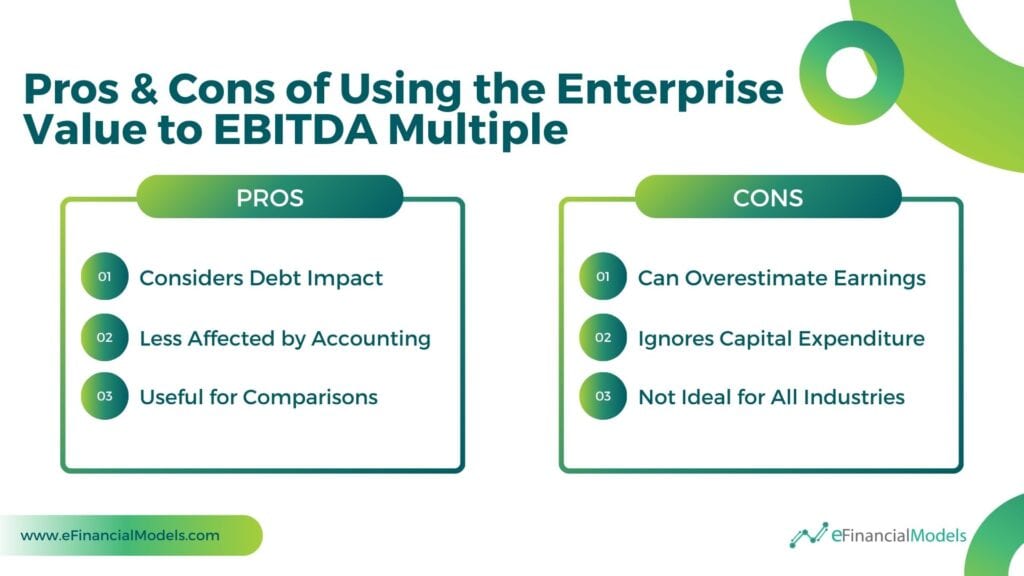
Pros & Cons of Using the Enterprise Value to EBITDA Multiple
Pros
- Considers Debt Impact: Enterprise Value to EBITDA factors aims to estimate a company’s enterprise value regardless of how much debt financing a company is using. Excluding the effect of financial leverage gives a clearer view of the true value of a business. By including debt, it helps investors understand how leveraged the company is.
- Less Affected by Accounting: EBITDA excludes non-cash expenses like depreciation and amortization. It makes the multiple less influenced by different accounting practices. Investors get a cleaner look at operating performance without the noise of accounting choices.
- Useful for Comparisons: Enterprise Value to EBITDA compares similar businesses well. It removes some of the inconsistencies that arise from different tax rates or capital structures. This makes it easier to benchmark a company against its peers. Investors can quickly spot if a company is over- or undervalued compared to others in its industry.
Cons
- Can Overestimate Earnings: EBITDA doesn’t account for key expenses like interest, taxes, depreciation, and amortization. It can give a false sense of profitability, especially for companies with significant debt or depreciation costs. Investors may assume a company is more profitable than it is, leading to misleading valuations.
- Ignores Capital Expenditures: EV/EBITDA ignores capital expenditures (CapEx), which are crucial for maintaining and growing a business. CapEx reflects how much a company spends on assets that generate future income. Ignoring these costs can paint an unrealistic picture of a company’s financial health, especially for businesses with large infrastructure or equipment needs.
- Not Ideal for All Industries: The Enterprise Value to EBITDA Multiple is only ideal for some industries. It works best for companies with stable earnings and low capital needs. However, it is less reliable for industries with high CapEx requirements. Differences in capital structure and industry norms can make this multiple a poor fit for comparing companies across different sectors.
The Enterprise Value to EBITDA Formula Simplified
Calculating the EV to EBITDA multiple is relatively straightforward. It compares the enterprise value (EV) to the earnings before interest, taxes, depreciation, and amortization (EBITDA). However, understanding the components of the Enterprise Value to EBITDA Formula is key to deriving accurate insights.
Enterprise Value
Enterprise Value (EV) represents the total value of a company, reflecting its market value along with its debt and cash holdings. It shows a company’s worth, particularly for mergers, acquisitions, or comparisons. EV is crucial for comparing companies with different capital structures, as it captures both equity and debt components.
- To calculate EV, start with the company’s market capitalization. It is the value of the company’s equity.
- Then, add total debt, minority interest, and preferred shares. Total debt includes all loans and financial obligations the company must repay. Minority interest represents ownership held by outside investors in a subsidiary. Preferred shares are a type of stock with fixed dividends, giving shareholders priority over common stockholders for payouts.
- Finally, subtract cash and cash equivalents. Cash and cash equivalents are the funds a company can quickly use. It includes physical cash and assets easily turned into cash, like short-term investments. They provide liquidity to cover expenses or emergencies immediately.

EBITDA
EBITDA helps determine a company’s profitability based on its core operations, excluding the impact of financing decisions (interest), government policies (taxes), and non-cash items (depreciation and amortization). It stands for Earnings Before Interest, Taxes, Depreciation, and Amortization. It measures a company’s profitability before accounting for non-operational expenses. You can find EBITDA on a company’s income statement, usually in the financial summary. Alternatively, you can calculate EBITDA in two common ways:
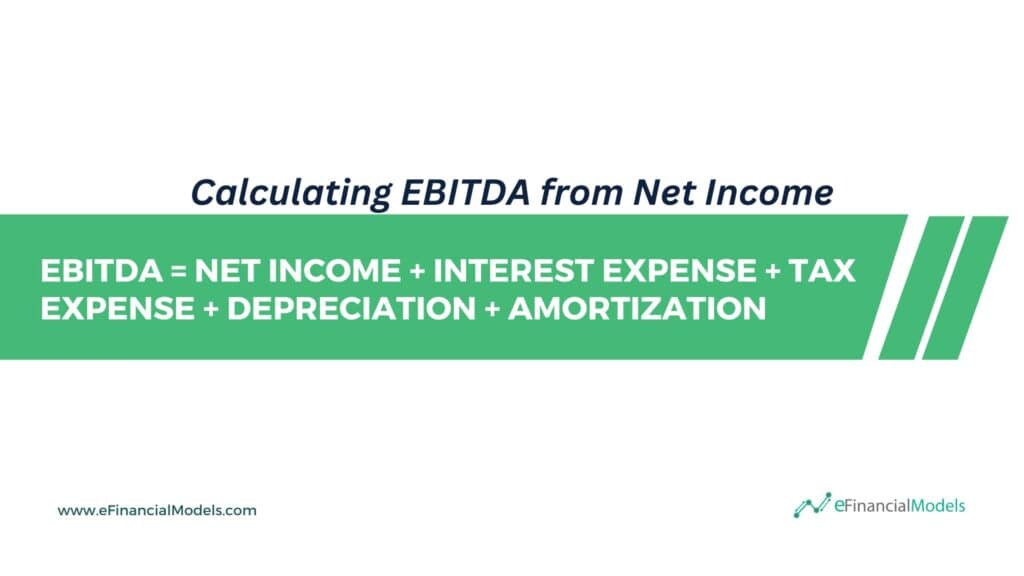
- Calculating EBITDA from Net Income: Begin with Net Income, then add the interest and tax expenses shown on the income statement. Next, add depreciation and amortization costs, often found in the cash flow statement or notes to financials. This calculation gives you EBITDA, which reflects core profitability by excluding the effects of financing, accounting, and tax environments.
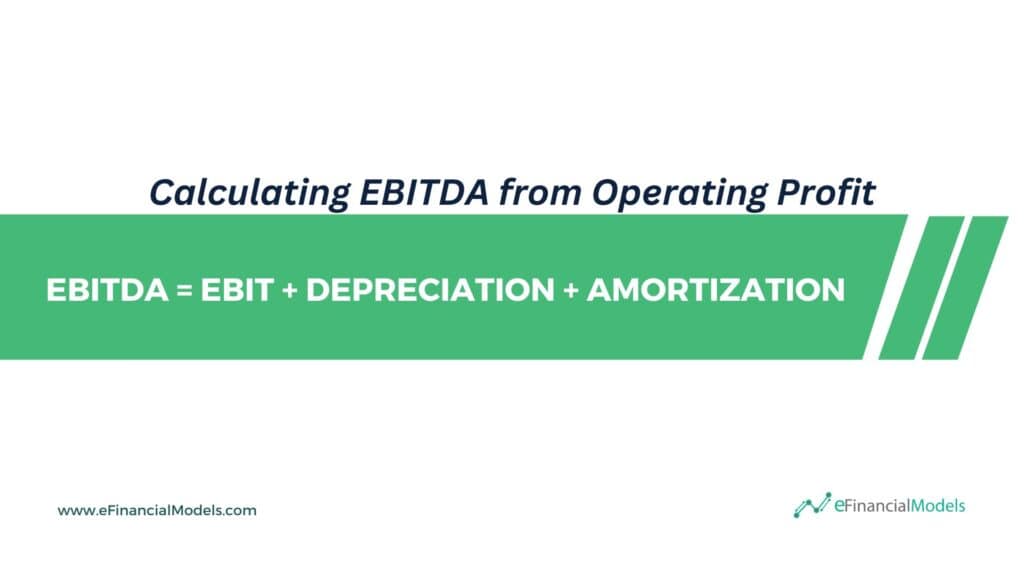
- Calculating EBITDA from Operating Profit: EBITDA is calculated by taking Operating Profit, also known as EBIT, and adding back depreciation and amortization expenses. Start with EBIT, which represents your earnings before interest and taxes. Then, add the non-cash expenses of depreciation and amortization. These expenses reflect the cost of using assets like equipment or patents but don’t involve actual cash outflows. By adding them back, you get EBITDA, which shows earnings before accounting for interest, taxes, depreciation, and amortization, giving a clearer picture of your company’s operating performance.





















































Sample EV to EBITDA Multiple
Here’s a sample EV to EBITDA Multiple from a Manufacturing Company Financial Model:

The EV/EBITDA multiple, shown in the Manufacturing Company Financial Model, is 4.2x at entry and 6.0x at exit. It is a crucial metric in M&A valuation. The Enterprise Value to EBITDA Formula helps determine the relationship between the company’s enterprise value and its EBITDA, providing insight into valuation relative to profitability. In mergers and acquisitions, a higher exit multiple compared to the entry multiple implies the potential for value creation, indicating that the company could be sold at a higher valuation multiple, thus benefiting investors. Such insights are essential for assessing the feasibility of investments, forecasting returns, and comparing valuation across potential targets in the industry.
Why Do Professional Investors Prefer the EV to EBITDA Multiple?
Professional investors often favor the EV to EBITDA multiple because it gives a clear picture of a company’s value. By using enterprise value (EV), which includes both equity and debt, and EBITDA, which shows operational profitability, this multiple captures the true earning potential of a business. Unlike other metrics that overlook debt or cash levels, this multiple captures both equity and debt, offering a clearer picture of operational performance. By focusing on core profitability while ignoring the effects of financing and accounting policies,
EV to EBITDA delivers a straightforward measure of how efficiently a company generates earnings, making it an essential tool for valuation. Understanding a company’s core value is key to mergers and acquisitions (M&A), and the multiple provides this simply and reliably. Most professional investors, like private equity firms, prefer it, as it captures the company’s cash costs.
Capital Structure Neutrality
The EV/EBITDA multiple is neutral to capital structure. Companies with different debt levels or equity financing can be compared equally. It creates a fair basis for assessing valuation regardless of how they are funded. This neutrality is particularly important for professional investors. The EV to EBITDA multiple is ideal if an acquirer wants the target company’s valuation to reflect its specific financing choices, like high debt or significant cash reserves. Since EV includes all capital sources, it provides a complete view of the company’s value, unaffected by whether it’s financed through debt or equity.
Capital structure neutrality also allows investors to compare companies with different leverage levels more effectively. For instance, in the case of two companies, A, with significant leverage (high debt), and Company B, which is largely equity-financed—their net income might differ substantially due to different interest payments. However, using the EV to EBITDA Multiple avoids the influence of those financing costs, allowing a more apples-to-apples comparison of the core profitability of both companies. Thus, an acquirer can objectively assess operational performance and make an informed valuation decision without affecting the company’s financial engineering or leverage levels.
Comparable Valuation
The EV to EBITDA Multiple is frequently favored in deal structuring, particularly in comparable valuation analysis, due to its ability to provide a more standardized measure of a company’s value. Unlike equity multiples such as the Price-to-Earnings (P/E) ratio, EV to EBITDA considers debt and equity, a holistic reflection of a company’s enterprise value. This approach is particularly useful when investors must assess the entire value of a target company, including its obligations.
Consider a potential acquirer evaluating two similar retail companies: A and B. Company A has significant debt, while Company B is mostly equity-financed, resulting in differences in net income due to varying interest expenses and tax rates. Using the P/E ratio for valuation would lead to a skewed comparison, as Company A’s higher debt lowers its net income, while Company B’s lower interest burden inflates its net income. To avoid these discrepancies, the acquirer uses the EV/EBITDA multiple, which provides a fairer reflection of operational performance by excluding debt and tax effects. This approach allows a more accurate comparison of both companies’ earning potential, leading to a better-informed acquisition decision.
Comprehensive Enterprise Value
The EV to EBITDA multiple provides a more complete picture of a company’s value. It considers both debt and equity, unlike the price-to-earnings ratio. For prospective investors, this comprehensive view is essential in understanding the real worth of a company. Understanding the total value is crucial because the acquirer is not just purchasing equity but also taking on the liabilities. Using the EBITDA metric as the denominator allows analysts to gauge operational profitability by excluding non-cash expenses like depreciation and amortization, which vary across industries based on capital intensity.
For instance, consider a hypothetical M&A scenario between Company A, a manufacturing firm with significant fixed assets, and Company B, a service-based firm with minimal capital expenditure. The EV to EBITDA multiple levels the playing field. It helps determine the operational cash flow yield on their entire investment, including debt, giving a realistic perspective on the investment’s true potential return and value.
Reflects Operating Performance
EBITDA highlights core operating profitability. It offers a clear view of operating performance by excluding non-operating expenses and accounting decisions that may vary across firms. It makes it easier to focus on the efficiency and profitability of the business itself, giving acquirers a clear view of operational performance. This makes it particularly useful in evaluating the pure earning power of the business without being influenced by variations in capital structure or accounting policies.
Consider two similar manufacturing companies: Company A with significant debt and Company B with minimal debt. Company A may seem less attractive if an acquirer uses the P/E ratio due to lower net earnings from high-interest expenses. In contrast, the EV to EBITDA multiple disregards interest costs and focuses on core profitability, comparing operational efficiency fairly. Excluding depreciation and amortization also standardizes comparisons across companies, making it particularly effective for evaluating capital-intensive industries based on their ability to generate core cash flow.
Supports Due Diligence
EBITDA serves as a proxy for a company’s cash-generating ability. During due diligence, the EV to EBITDA gives insights into the cash flow potential of a target company. It helps acquirers determine if the company can sustain operations, pay off debt, and generate returns post-acquisition. It ensures that the acquirer can accurately compare potential targets within the same industry.
For instance, consider a private equity firm evaluating two potential acquisition targets in the manufacturing sector: Company A and Company B. Company A has significantly higher debt, while Company B is more equity-financed. If one only uses a price-to-earnings (P/E) ratio, the assessment would be skewed because of the difference in capital structures. The EV to EBITDA approach ensures a more apples-to-apples comparison, making it easier to determine which company has the stronger operational performance and is thus a better acquisition target.

Unlock the True Value of Your Business with Effective Financial Modeling
The EV/EBITDA multiple is a powerful tool for investors seeking to understand a company’s true value. Its focus on operational earnings and a neutral stance on capital structure make it highly effective for cross-industry comparisons and assessing potential acquisitions. By effectively using this metric, investors can identify undervalued opportunities, ensure fair valuations, and make informed, strategic decisions.
Unlocking the value of your business starts with understanding the numbers that matter. Effective financial modeling helps you see your business’s real value. Using tools like the EV/EBITDA multiple gives you a clear view of operational performance and makes smarter investment decisions. This approach can uncover opportunities, support strategic growth, and ensure that solid numbers back your business decisions. Take action today—use financial modeling to drive your business forward confidently.


































You might also like:
- 10 Main Elements of a Business Plan
- 10 Tips to Develop a First Class Business Valuation Report
- 12 Funding Sources for Businesses and Startups
- 5 Best Practices for Managing Days Receivables
- How Are Valuation Multiples Determined
- Financial Statements – Definition, Uses, Contents and Templates
- How to Write a Business Plan Step-by-Step
- Finding a Valuation Model for Your Business
- Value Your Business With the EV/Revenue Multiple
- Commercial Real Estate Valuation Methods: Helping Investors in Taking Informed Decisions
- Financial Forecasting Models by eFinancialModels
- Understanding the Debt Service Coverage Ratio: An Essential Metric for Financial Analysis
- Cash Flow Analysis in Excel
- Financial Ratios Analysis and Its Importance
- Free Business Model Canvas for Financial Modeling
- Accounting
- Business Valuation
- Financial Modeling for Startups and Small Businesses
- Financial Model – Valuation of Tax Loss Carryforwards
- The Benefits of Managing Days Inventory Outstanding Efficiently
Tags: business valuation