
0 ITEMS

A Deep Dive Into Understanding 10K Reports

In financial reporting, few documents are as significant as the 10K reports. A cornerstone of transparency and accountability, the 10K financial report is a comprehensive summary of a company’s financial performance. It is meticulously analyzed by investors, regulators, and stakeholders alike. Its comprehensive nature ensures it encapsulates a wealth of information that can illuminate an enterprise’s past performance, current standing, and future prospects, thereby promoting transparency and accountability in the business world.
The importance of a 10K financial report cannot be overstated. For investors, these documents provide a detailed account of financial data, risks, and management’s perspective, all essential for performing in-depth due diligence. Regulators, particularly the Securities and Exchange Commission (SEC), rely on these reports to ensure companies adhere to stringent disclosure requirements, promoting transparency and protecting investors from fraudulent activities. By encapsulating crucial financial details and offering an honest look at a business’s risks and opportunities, SEC 10K annual reports form the bedrock upon which capital allocation and investment strategies are built.
- These reports are comprehensive annual disclosures filed with the SEC that summarize financial performance, risks, and governance.
- They include detailed financial statements like the balance sheet, income statement, and cash flow statement.
- Key sections such as management’s discussion, risk factors, and internal controls provide deeper insights into operational and strategic risks.
- The structured format allows investors to benchmark performance and assess long-term viability.
This article delves into the structure, components, and practical applications of 10K reports, offering a guide for investors and stakeholders keen on extracting valuable insights from these indispensable documents.
What are 10K Reports?
A 10K financial report is a comprehensive annual financial disclosure providing a detailed summary of a company’s financial performance, including audited financial statements, corporate governance, management analysis, and risk factors. Publicly traded companies in the United States must prepare 10-K reports for submission to the Securities and Exchange Commission (SEC).

One of the pivotal functions of the 10-K financial report is to serve as a standardized document that investors and regulators can rely on to evaluate a company’s viability and investment potential. The SEC mandates this disclosure to prevent fraudulent activities and protect investors by providing adequate information to make informed investment decisions. The structured format of the report, which includes detailed financial statements, management analysis, and information on risks and market conditions, enables a comprehensive review of the company’s performance and prospects. This form of mandatory disclosure fosters trust among investors by ensuring that all pertinent information is publicly available and obliges companies to adhere to rigorous accounting and reporting standards, thereby safeguarding market integrity.
The deadlines for filing SEC 10K annual reports depend on the company’s size. According to the SEC, companies with a public float of $700 million must submit their 10K reports within 60 days after their fiscal year ends. Those with a float between $75 million and $700 million have 75 days, while companies with a float below $75 million have 90 days to file. Savvy investors understand that 10K forms can be accessed via the company search feature on the SEC’s EDGAR database.
Why Is It Called 10K Report?
The name “10K” is derived from the SEC’s naming convention for its forms. It reflects the report’s role as a vital tool, empowering investors to assess a company’s financial health and business practices with confidence and knowledge. In response to the stock market crash of 1929 and the ensuing Great Depression, the U.S. Securities Exchange Act of 1934 was established. This government agency introduced various forms to standardize the reporting and disclosure of financial information by publicly traded companies, enhancing transparency and protecting investors. Sec 10k Annual Reports were designed as a comprehensive annual report, encapsulating all critical aspects of a company’s financial performance and operations. Over time, the term “10K” became synonymous with this detailed annual filing, emphasizing its importance in providing a thorough and reliable overview of a company’s financial health to investors and regulators alike.
Unveiling the 10k and Annual Report Difference
Understanding the 10k and annual report difference is crucial for analysts, investors, and anyone involved in corporate finance. These documents, while both essential for providing insights into a company’s financial health and performance, serve different purposes and audiences. This understanding helps you to focus on your specific role and responsibilities. Despite the 10k and annual report differences, both play a pivotal role in corporate disclosure and investor relations.
- Audience: The 10k and annual report difference among audiences concerns its purpose. Primarily aimed at regulators, analysts, and institutional investors, a 10k financial report focuses on compliance and detailed financial disclosure. On the other hand, annual reports are aimed at a broader audience, including shareholders, potential investors, and the general public. They’re more of a marketing tool designed to present the company in a positive light.
- Content and Structure: A 10k financial report is highly detailed and follows a specific structure mandated by the SEC. It is generally text-heavy and formatted in a straightforward, no-frills manner to meet regulatory standards. An annual report is more flexible in format and presentation. It is more visually appealing with design elements such as images, infographics, and a glossy finish to attract and retain the reader’s interest.
- Detailed Disclosure: The main 10k and annual report difference is about detailed disclosure. SEC 10k annual reports include extensive footnotes and explanations, particularly in the financial statements section. At the same time, annual reports are more digestible and have less detailed formats, providing a summary of financial information.
- Frequency and Filing: SEC 10k annual reports are filed once a year, typically within 60 to 90 days after the end of the fiscal year. They are comprehensive reports filed annually by public companies about their financial performance. Annual reports are also produced annually, but their timing can be more flexible. They’re usually released around the same time as the 10-K but can be timed to coincide with the annual shareholder meeting.
- Management Discussion: The MD&A section in the 10-K financial report is very detailed, providing an in-depth analysis of the company’s changes in financial condition and results of operations. While an annual report includes management’s discussion, it’s often more high-level and designed to positively highlight the company’s achievements and future outlook.
Legal Compliance: The MD&A section in the 10-K financial report is very detailed, providing an in-depth analysis of the company’s changes in financial condition and results of operations. While an annual report includes management’s discussion, it’s often more high-level and designed to positively highlight the company’s achievements and future outlook.















































What Is the Purpose of a 10K Financial Report?
The 10-K report is a crucial annual filing required by the SEC that provides a comprehensive overview of a publicly traded company’s financial health and operations. This detailed document ensures transparency and accountability, allowing investors and regulators to make informed decisions based on accurate and reliable information.
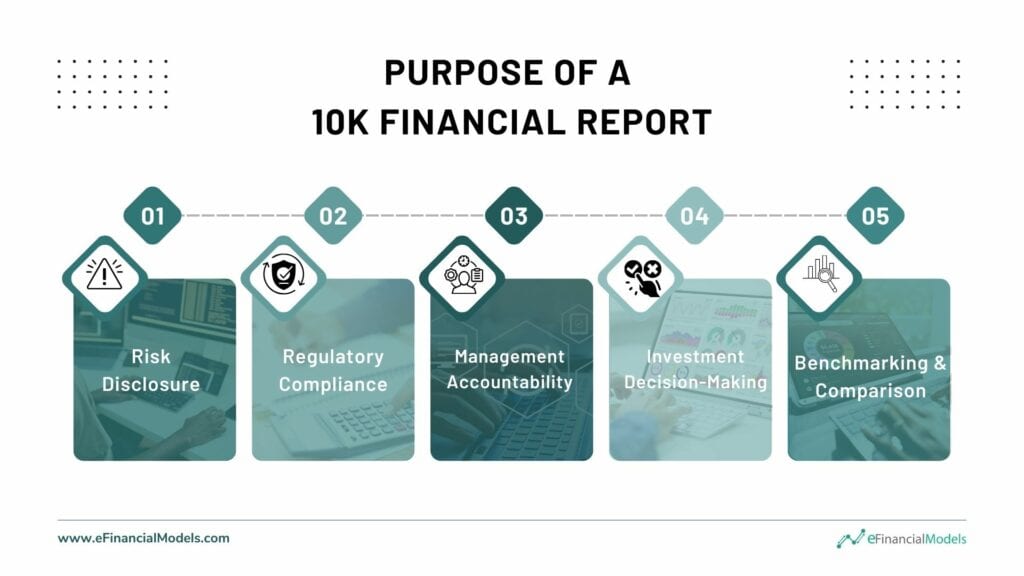
- Risk Disclosure: As part of a company’s transparency, a 10k financial report helps investors and stakeholders understand the potential downsides and uncertainties associated with investing in the company. A section of the 10k financial report includes the company’s potential risks, which could impact its financial performance and operational stability. It details various types of risks, such as market, credit, operational, and legal risks, among others. By providing this information, the company ensures transparency and helps investors make informed decisions,
- Regulatory Compliance: A 10K financial report demonstrates the company’s adherence to laws, regulations, and industry standards. It ensures that the company operates within the legal framework of regulatory bodies like the Securities and Exchange Commission (SEC). It covers financial reporting standards, environmental regulations, and labor laws. By including this information, the company fulfills its legal obligations and builds trust with investors and the public by showing its commitment to ethical and lawful business practices.
- Management Accountability: A 10K financial report includes a section that focuses on the responsibilities and performance of the company’s management team. It provides insights into the governance structure, executive compensation, and managerial decision-making processes. It also includes information about the board of directors, their qualifications, and their roles in overseeing the company’s strategic direction and operational execution. These allow shareholders to evaluate the effectiveness and integrity of the company’s leadership and hold them accountable for the company’s performance and strategic decisions.
- Investment Decision-Making: Detailed financial statements and analysis, including income statements, balance sheets, and cash flow statements. It provides a comprehensive view of the company’s financial health, profitability, and growth potential. This information helps investors assess the company’s performance, compare it with industry peers, and make informed decisions about buying, holding, or selling its stock. It also includes management’s discussion and analysis (MD&A), offering context and explanations for financial results and future projections.
- Benchmarking & Comparison: Benchmarking and comparison enable investors and analysts to compare the company’s performance against industry standards and competitors. A 10K financial report provides key financial ratios, performance metrics, and historical data that facilitate comparisons. By analyzing these benchmarks, stakeholders can evaluate the company’s relative performance, identify strengths and weaknesses, and understand its market position. This comparative analysis is essential for making strategic investment decisions and assessing the company’s competitive advantage in its industry.
Key Components of SEC 10K Annual Reports
The SEC 10K Annual Report is a comprehensive document that publicly traded companies in the United States must file annually with the Securities and Exchange Commission (SEC). Understanding the key components of the 10-K report is essential for making informed investment decisions and assessing the company’s long-term viability.
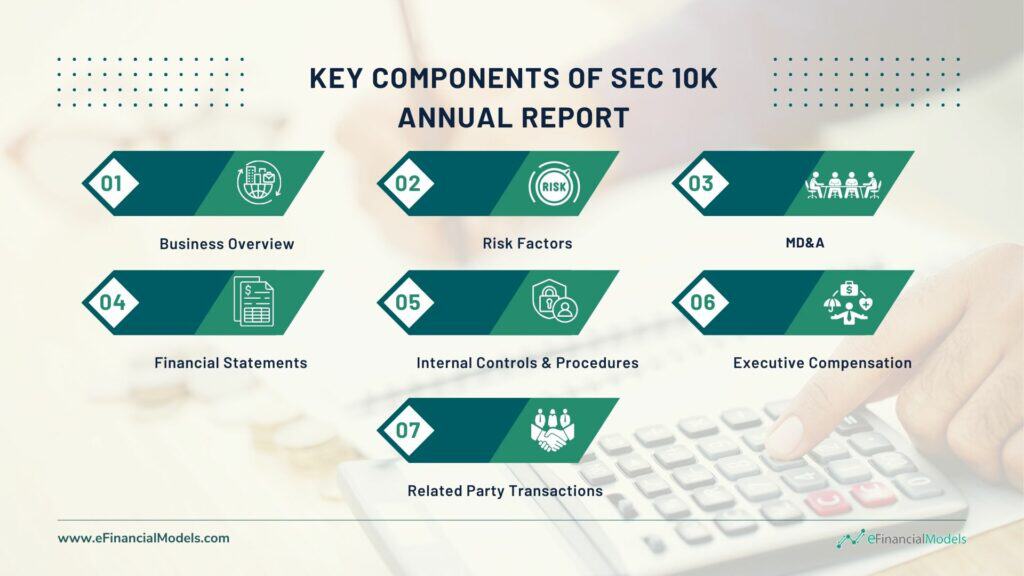
Business Overview
The SEC 10-K Annual Reports Business Overview section comprehensively summarizes the company’s core operations. It outlines the nature of the business, including its main products or services, key markets, and significant customers. This section also covers the company’s history, mission, and strategic objectives. Investors and stakeholders can gain insight into the company’s competitive landscape, market positioning, and overall business model. This foundational information sets the context for the rest of the report, helping readers understand the company’s primary activities and business environment.
The Business Overview section typically includes the following key elements:
- Company Background: This includes a brief history of the company, its founding, significant milestones, and an overview of its evolution.
- Principal Products and Services: A detailed description of the leading products and services offered by the company. It includes the key features and benefits, target markets, and any significant changes or innovations in the product or service line during the reporting period.
- Business Strategy: An outline of the company’s strategic objectives and plans. This section discusses how the company intends to compete in the market, grow its business, and achieve its long-term goals.
- Markets and Competition: Information about the primary markets in which the company operates, including geographic locations and market segments. It also includes an analysis of the competitive landscape, identifying key competitors and the company’s competitive advantages.
- Revenue Streams: An explanation of the company’s sources of revenue, including significant customers and contracts. This section often breaks down revenue by product line, geographic region, or customer type.
- Research and Development: Details on significant R&D activities, including new product developments, ongoing projects, and expenditures. This section highlights the company’s commitment to innovation and future growth.
- Regulatory Environment: Discuss the laws and regulations that affect the company’s business. It includes industry-specific regulations, environmental laws, and other legal requirements impacting operations.
- Employees: Information about the company’s workforce, including the number of employees, employee relations, and any significant changes in workforce strategy or employment policies.
- Properties: A summary of the company’s principal properties, such as manufacturing plants, offices, and significant real estate holdings. This section often includes information on property leases, ownership, and any substantial changes in property holdings.
- Seasonality: If applicable, a discussion of how seasonal variations impact the company’s business, sales, and operations.
Risk Factors
The Risk Factors section identifies and discusses the potential risks that could materially impact the company’s financial performance or operations. These risks can be related to market conditions, regulatory changes, competition, technological advancements, or other external and internal factors. Each risk is typically explained in detail, including how it might affect the business and the measures the company takes to mitigate these risks. This section is crucial for investors as it highlights the company’s uncertainties and challenges, aiding in making informed investment decisions.
Here are the key elements that should be included in the Risk Factor section of SEC 10K Annual Reports:
- Environmental and Social Risks: Risks associated with environmental sustainability, climate change, and social responsibility, including potential impacts on operations and regulatory compliance.
- Financial Risks: Risks related to economic performance, including liquidity risks, credit risks, market risks (e.g., interest rate fluctuations, foreign exchange risks), and risks related to financial reporting and compliance.
- Industry Risks: Risks related to industry-specific factors, such as market competition, technological changes, regulatory changes, and market demand.
- Market and Economic Risks: Risks arising from macroeconomic conditions, such as economic downturns, inflation, and changes in consumer spending. These may also include global health crises, pandemics, and disruptions to business operations and supply chains.
- Operational Risks: Risks associated with the company’s internal operations, including supply chain disruptions, production issues, and labor disputes.
- Regulatory and Legal Risks: Risks arising from changes in laws and regulations, potential legal proceedings, compliance with environmental regulations, and other legal liabilities.
- Reputational Risks: Risks that could affect the company’s reputation, including public perception, customer satisfaction, and media coverage.
- Strategic Risks: Risks related to strategic decisions, such as mergers and acquisitions, market expansion, and product development.
- Technology Risks: Risks related to data breaches, cyber-attacks, technology failures, and the security of information systems.
- Trade and Geopolitical Risks: Risks related to political instability, trade tensions, international conflicts, and other geopolitical factors that could impact the business.
Management’s Discussion and Analysis (MD&A)
The Management’s Discussion and Analysis (MD&A) section offers a detailed analysis of the company’s financial performance from the perspective of its management. This narrative includes discussions on the results of operations, financial condition, and cash flows. It provides context to the numbers presented in the financial statements, explaining trends, significant events, and management’s expectations for future performance. The MD&A aims to give investors a deeper understanding of the company’s financial health, strategic initiatives, and management’s outlook on the company’s prospects.
Key elements to include under the MD&A are:
- Comparative Analysis: Year-over-year comparison of the company’s financial performance, highlighting key metrics such as revenue, expenses, net income, and earnings per share.
- Critical Accounting Policies: Explanation of the accounting policies that are most important to the company’s financial statements and how they are applied. Discuss management’s significant judgments and estimates in preparing the financial statements and their impact on the reported results.
- Off-Balance Sheet Arrangements: Disclosures: Information about any off-balance sheet arrangements that have or are reasonably likely to have a material effect on the company’s financial condition.
- Segment Analysis: This breakdown of performance by business segments, if applicable, is a key element that provides valuable insights into which areas are driving growth or facing challenges within the company.
Financial Statements
These statements provide a quantitative overview of the company’s financial position, performance, and cash flows over the reporting period. Accompanied by notes that explain accounting policies and significant transactions, this section offers a detailed and standardized financial summary, enabling investors to assess the company’s financial stability, profitability, and liquidity.
The Financial Statements section comprises the company’s core financial reports:
- The Balance Sheet provides a snapshot of a company’s financial position at a specific time. It details the company’s assets, liabilities, and shareholders’ equity, presenting a clear picture of what it owns and owes. Assets include current assets like cash, accounts receivable, inventory, and long-term assets such as property, plant, and equipment. Liabilities cover current obligations like accounts payable and long-term debts like bonds payable. Shareholders’ equity represents the owners’ residual interest in the company after liabilities are deducted from assets. The balance sheet is structured to show that the total assets are equal to the sum of total liabilities and shareholders’ equity.
- The Income Statement summarizes the company’s financial performance over a specific period, typically a quarter or a year. It shows how revenue is transformed into net income or profit. The statement starts with sales or revenue and subtracts the cost of goods sold (COGS) to determine gross profit. Operating expenses, including selling, general, and administrative fees, are deducted from gross profit to arrive at operating income. Further adjustments for non-operating income and expenses, taxes, and interest lead to the net income. This report helps stakeholders understand the company’s operational efficiency and profitability.
- The Statement of Cash Flows provides a detailed account of the company’s cash inflows and outflows. It is divided into three sections: operating, investing, and financing. Operating activities include cash transactions related to net income, adjusting for changes in working capital, and non-cash items like depreciation. Investing activities cover cash used for and generated from buying or selling long-term assets and investments. Financing activities outline cash flows from borrowing, repaying debts, issuing stock, and paying dividends. This statement is crucial for assessing the company’s liquidity, financial flexibility, and overall cash management.
- The Statement of Shareholders’ Equity outlines changes in the equity portion of the balance sheet over a specific period. It details how components, such as common stock, preferred stock, retained earnings, and other comprehensive income, have evolved. This report starts with the beginning balance of shareholders’ equity, adds net income, and subtracts dividends paid to shareholders. It also includes changes due to stock issuance, repurchase of shares, and adjustments for unrealized gains or losses on investments. By reviewing this statement, stakeholders can understand how the company’s retained earnings are being utilized and how changes in equity impact the company’s financial health.




















Internal Controls and Procedures
The Internal Controls and Procedures section discusses the company’s framework for ensuring accurate and reliable financial reporting. It includes the company’s assessment of its internal control over financial reporting and any identified weaknesses or deficiencies. The section may also describe management’s steps to improve controls and ensure compliance with regulatory requirements. Effective internal controls are vital for maintaining investor confidence and ensuring the integrity of financial disclosures.
The Internal Controls and Procedures section of SEC 10-K Annual Reports, a crucial aspect that should not be overlooked, should comprehensively cover the following elements:
- Overview of Internal Controls: This section should provide a clear and comprehensive understanding of internal controls and their importance to the organization. It should outline the primary objectives of internal controls, which typically include ensuring the accuracy and reliability of financial reporting, compliance with applicable laws and regulations, and promoting efficient and effective operations. This clarity sets the stage for a deeper understanding of the internal control framework within the company.
- Management’s Responsibility: This section details management’s responsibility for establishing and maintaining adequate internal control over financial reporting (ICFR). Management is accountable for ensuring these controls are in place and functioning effectively to provide reasonable assurance about the reliability of financial reporting. This section reinforces management’s accountability and role in the internal control process.
- Changes in Internal Control Over Management: The company should describe any changes made to its internal control over financial reporting during the last fiscal quarter that have materially affected or are reasonably likely to affect the company’s internal control over financial reporting. This disclosure is crucial for stakeholders to understand recent developments or adjustments in the company’s control mechanisms.
- Disclosure Controls and Procedures: This section should describe the company’s disclosure controls and procedures, which are designed to ensure that information required to be disclosed in the reports filed or submitted under the SEC’s regulations is recorded, processed, summarized, and reported within the periods specified. It highlights the mechanisms to ensure timely and accurate financial and other significant information disclosure.
- Report of Independent Registered Public Accounting Firm: This section should include the report from the company’s independent auditor. If such a report is required, this critical document attests to the effectiveness of the company’s internal controls over financial reporting. This independent verification provides an external perspective on the reliability and effectiveness of the internal controls, reassuring stakeholders.
Executive Compensation
The Executive Compensation section details the remuneration provided to the company’s top executives and directors. It includes salaries, bonuses, stock options, and other financial and non-financial benefits. The section explains the company’s compensation policies, the rationale behind compensation decisions, and the alignment of executive rewards with company performance and shareholder interests. Transparency helps investors understand how the company incentivizes its leadership and aligns their interests with the shareholders.
The following elements are typically included in the Executive Compensation section of SEC 10K Annual Reports :
- A summary compensation table outlines the total compensation for the CEO, CFO, and the three highest-paid executives over the last three fiscal years. It includes salary, bonuses, stock awards, option awards, non-equity incentive plan compensation, change in pension value, nonqualified deferred compensation earnings, and all other compensation.
- A pension benefits table provides details about the pension plan benefits accrued by the executives, including the number of years of credited service and the present value of accumulated benefits.
- An outstanding equity awards at fiscal year-end table lists all equity awards held by the named executives at the end of the fiscal year. It provides information on the number of shares or units of stock that have not been vested and their market value.
- An option exercises and stock vested table shows the number of shares acquired and the value realized by the executives from the exercise of stock options and the vesting of stock awards during the last fiscal year.
- The nonqualified deferred compensation table outlines the contributions, earnings, withdrawals, and balance of the executives’ nonqualified deferred compensation plans.
- The grants of plan-based awards table details the equity and non-equity incentive plan awards granted to the executives during the last fiscal year. It includes information on the grant date, the estimated future payouts under non-equity and equity incentive plans, and the exercise or base price of the option awards.
- The director compensation table is similar to the summary compensation table but for the company’s board members. It includes fees, stock awards, option awards, non-equity incentive plan compensation, and all other compensation.
- The compensation discussion and analysis narratively explains the company’s compensation policies and practices, including the rationale behind compensation decisions. It discusses how executive pay aligns with the company’s performance, the role of the compensation committee, and the use of performance metrics and benchmarks.
Related Party Transactions
The Related Party Transactions section discloses any transactions or relationships between the company and its executives, directors, major shareholders, or immediate family members. These transactions may include loans, sales, or other financial dealings. This section is essential for identifying potential conflicts of interest and ensuring such transactions are conducted fairly. Transparency in related party transactions helps maintain investor trust and ensures that the company’s dealings are in the best interest of all shareholders.
Key elements that should be included are:
- Definition of Related Parties: Identification of individuals or entities considered related parties. It typically includes executives, directors, significant shareholders, and their immediate family members, as well as entities in which these individuals have significant influence or control.
- Nature of the Transactions: A clear description of the types of transactions with related parties. It could include sales or purchases of goods and services, leases, loans, guarantees, and other financial arrangements.
- Rationale and Benefits: An explanation of the justification for entering into these transactions and how they benefit the company. It helps investors understand the business reasons and potential advantages of these transactions.
- Terms of the Transactions: Specific details about the terms and conditions of these transactions. It includes pricing, payment terms, interest rates, and special conditions that differ from those available to unrelated third parties.
- Approval Process: Information on the company’s policies and procedures for reviewing and approving related party transactions. It includes details on the role of the board of directors or audit committee in overseeing these transactions to ensure they are conducted fairly and in the best interest of the company and its shareholders.
Master the Art of Decoding Your 10K Report Guide
Reading and analyzing a 10k financial report is crucial for investors to understand its financial health, performance, and prospects. This comprehensive annual filing with the U.S. Securities and Exchange Commission (SEC) provides a wealth of information that can inform investment decisions.
To better read and analyze 10k financial reports, you must first understand its essential components and structure. Then, evaluating critical financial metrics is vital to understanding the company’s performance and potential. Some crucial metrics to analyze include revenue growth, profit margins, liquidity ratios, and cash flow movements. While financial metrics are vital, it is also essential to consider non-financial factors impacting your company’s long-term success. Some of the most common are the management team’s experience, track record, and vision. Understanding the competitive landscape, industry trends, and regulatory environment can help identify opportunities and risks. Lastly, seek financial and professional guidance to navigate the intricate details and nuances of SEC 10k financial reports.
Approach every 10k financial report as an opportunity to make more informed investment decisions. Let each component motivate you to keep enhancing your financial analysis skills. The knowledge you gain will prove invaluable in assessing both risks and rewards before investing. With patience and practice, you can master the art of decoding your 10k report!
You might also like:
- How to Effectively Read a Company’s Annual Report
- 10 Tips to Develop a First Class Business Valuation Report
- Financial Projections Templates – The Easy Way
- Understanding the Debt Service Coverage Ratio: An Essential Metric for Financial Analysis
- Calculating Revenue Growth Rate: A Key Metric for Business Success
- Business Valuation
- Finding a Valuation Model for Your Business
- Accounting
- The Valuation of a Business
- Financial Analysis
- Top 10 Mistakes in DCF Valuation Models
- 10-year Financial Projections
- How to Create a Business Plan Step-by-Step
- Real Estate
- Understanding What is Yield to Maturity and Why It Matters
- Financial Services
- Financial Modeling for Startups and Small Businesses
- Cash Flow Analysis
- Boost Your Business’s Financial Management with this Excel Budget Template
- Simple Budget Planner Template