
0 ITEMS

What Is the Formula to Calculate Days of Cash on Hand?

Understanding how long your business can operate with existing cash is crucial during economic downturns or unpredictable markets.
- Days of Cash on Hand indicates how many days a company can cover expenses using only available cash.
- It helps businesses plan for emergencies by assessing liquidity and financial stability.
- A healthy cash reserve of 90 to 180 days can prevent disruptions during sales drops or delays in payments.
- Calculating this metric involves dividing current cash by daily operating expenses, adjusted for non-cash costs.
- Using financial models simplifies ongoing tracking and supports proactive decision-making.
This article explains the key concepts and practical steps to effectively measure and manage your cash runway.
What Is Days of Cash On Hand?
Days of Cash on Hand shows how many days a business can keep running using only its available cash. It tells you how long you can pay for daily rent, salaries, and supplies if no money comes in. This number helps owners and investors see how prepared a company is for a crisis. A higher number means more time to survive without income. It’s a key measure of financial health and emergency readiness.
Knowing your Days of Cash on Hand helps you act fast in tough times. It clearly shows how long your business can stay open if sales drop or stop. This insight lets you plan better, cut costs early, or seek funding before it’s too late. It’s not just a number—it’s a warning system. In uncertain markets or during crises like the pandemic, this financial metric can mean the difference between survival and shutdown.

How Many Days of Cash on Hand Should You Keep as a Business?
Every business should aim to keep at least 90 to 180 days of cash on hand. This buffer helps cover rent, payroll, and other critical costs when sales slow or emergencies hit. The exact number depends on your industry, risk level, and how steady your income is. Aim for the higher end if you run a seasonal or high-risk business. Enough cash means you stay in control, confidently make decisions, and avoid costly loans or missed opportunities.
Keeping enough cash on hand protects your business from surprises. Sales might drop, bills can spike, or clients may pay late. With cash ready, you stay calm, cover expenses, and avoid panic decisions. It gives you time to adjust, plan, and keep the business running. Without it, even a small setback can cause big trouble. Cash on hand keeps you safe, stable, and ready for whatever comes next.
Days of Cash on Hand is most commonly tracked in the healthcare industry, especially by hospitals, to ensure they can cover daily costs despite delays in payments. It’s also used by nonprofits, schools, governments, and utilities to manage cash flow and maintain financial stability when revenue is seasonal, delayed, or restricted.
How to Calculate Days of Cash on Hand?
How to calculate days of cash on hand means figuring out how many days your business can keep running using only its available cash, without needing more income. The formula on how to calculate days of cash on hand is:
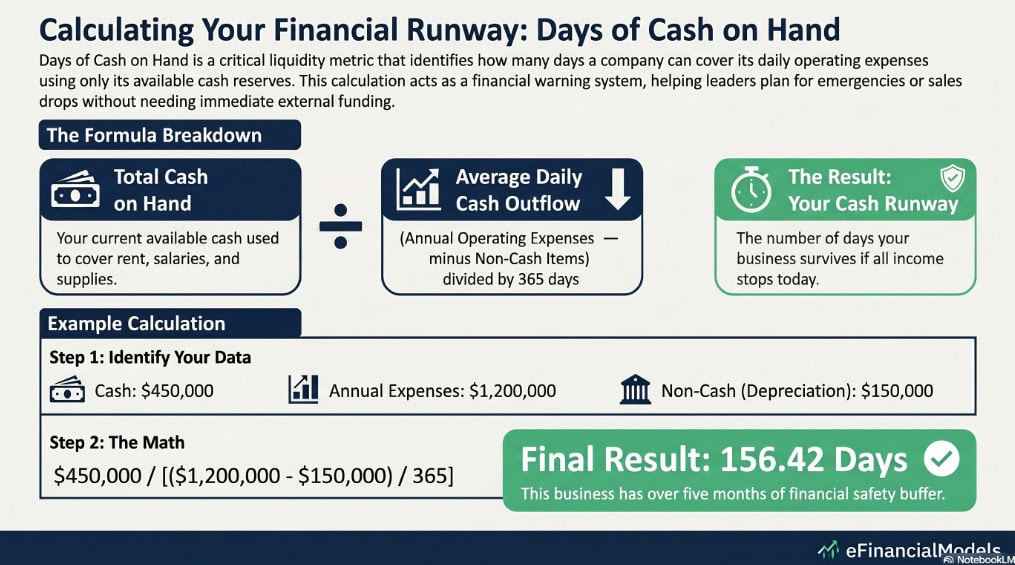
Where:
- Annual Operating Expense is the total money you spend to keep your business running in a year. It includes rent, salaries, utilities, and supplies. It shows how much you need to keep your business open over 12 months.
- Non-cash items are expenses like depreciation or amortization that don’t use real cash. You subtract them from total expenses because they don’t affect your cash balance. Removing them gives a clearer picture of cash needs.
- You divide the numbers by 365 to turn yearly costs into daily costs. This helps you see how many days your cash can cover. It makes the “days of cash on hand” calculation possible.
How to calculate days of cash on hand tells you how many days your business can keep running using only the current cash without needing more income.
Example Calculation
Let’s assume the following:
- Cash on Hand = $450,000
- Annual Operating Expense = $1,200,000
- Non-Cash Items (e.g., depreciation) = $150,000
Now plug these values into the formula:
Days of Cash on Hand = $450,000 / [($1,200,000 – $150,0000) ÷ 365 days]
= $450,000 / )$1,050,000 ÷ 365 days)
= $450,000 / $2,876.71 days = 156.42 days
How to calculate days of cash on hand can be tricky and time-consuming because it involves tracking daily expenses and available cash with precision. A financial model makes this easier by organizing all the needed data in one place and automating the math. It gives a clear, up-to-date view of how long your cash will last. This helps you avoid manual errors and make smarter decisions faster. With a solid model, you can update inputs and get instant results—no complex spreadsheets or guesswork needed.
In strategic financial models, free cash flow (FCF) forecasts help project how much cash a business will generate or burn over time. By linking this to the days of cash on hand, management can assess how long the business can operate without raising additional funds.
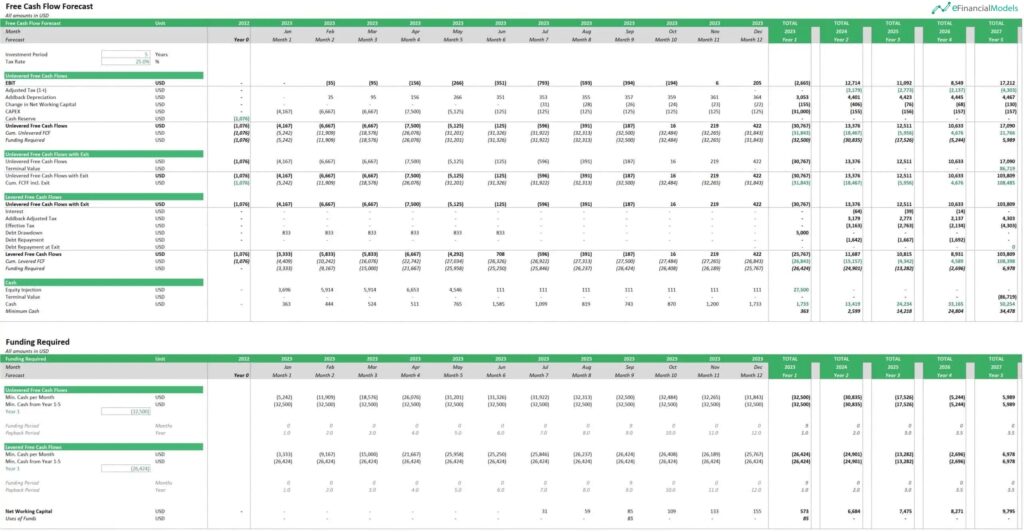
The free cash flow forecast above is from our Water Refilling Station Business Financial Model. The table helps calculate days of cash on hand by showing monthly ending cash balances alongside detailed free cash flow projections. As cash inflows and outflows are forecasted clearly, you can divide the ending cash for any month by that month’s average daily operating expenses to estimate how many days the business can keep running without new income. This allows a small water refilling station to track how long its current cash will last, spot potential shortfalls early, and plan funding or cost-saving moves.
Use Financial Models to turn Days of Cash on Hand into Actionable Insights

Days of Cash on Hand is a powerful metric that tells you how long your business can operate using only its current cash. The formula divides available cash by average daily operating expenses (excluding non-cash costs like depreciation). It’s a vital financial lifeline in uncertain times, helping businesses plan, manage liquidity, and avoid surprises. Whether you run a startup, nonprofit, or hospital, knowing this number gives you control—and time—to respond wisely when income stalls.
A financial model turns your Days of Cash on Hand calculation from static data into a decision-making tool. It tracks changes in cash flow, forecasts expenses, and highlights when your business might run out of funds. Updating real-time inputs gives you a clear view of your cash runway. This insight lets you act early—cut costs, delay spending, or raise capital—before a crisis hits. Financial models don’t just show the number; they help you use it.






















































You might also like:
- 5 Best Practices for Managing Days Receivables
- 10 Tips to Develop a First Class Business Valuation Report
- 10 Main Elements of a Business Plan
- Cash Flow Statement: Streamline Financial Success
- Improving Days Payable Outstanding for Better Cash Flow
- Master the Free Cash Flow Formula for Smarter Financial Decisions
- Financial Planning for Small Business Owners – Taking an SBA Loan
- Understanding the Debt Service Coverage Ratio: An Essential Metric for Financial Analysis
- Budgeting
- Cash Flow Analysis
- Business Valuation
- Financial Planning
- Financial Modeling for Startups and Small Businesses
- Financial Ratios Analysis and Its Importance
- Real Estate Financial Modeling in Excel
- Financial Spreadsheet – A Key Tool for Entrepreneurs
- Cash Flow Projections
- Fundraising
- Personal Finance
- Investing