
0 ITEMS

SaaS Business Financial Model
The SaaS Business financial model offers valuable assistance in preparing a budget and multi-year financial plan for a Software as a Service (SaaS) business that acquires new subscribers via its website. The model focuses on modeling B2C Subscription Businesses where users are assumed to sign up to 4 different pricing tiers and can choose between two payment plans (monthly and yearly).
The Excel model collects all the relevant assumptions and then prepares a comprehensive budget and multi-year financial forecast, which can be used to raise funding from equity investors. This Excel spreadsheet template calculates all the relevant key metrics for SaaS Businesses and Startups, such as the required funding, the Internal Rate of Return (IRR), Net Present Value (NPV), Monthly Recurring Revenue (MRR), Average Revenue per User (ARPU) Projections, Customer Acquisition Costs, Customer Lifetime Value and many other important metrics.
The spreadsheet is essential for obtaining deep insights into SaaS Subscription Business economics and quickly understanding its value drivers while developing a comprehensive financial plan that serves as a basis for discussions with capital providers when raising new funding.


Important: This SaaS Business Financial Model Template has been recently updated to Model Version 8.2. Customers who bought Model Version 7.0 or higher are entitled to a 30% Upgrade Discount. Contact us if you don’t see it applied to your carts upon login.
The SaaS Business Financial Model Template prepares a monthly budget and multi-year financial plan (5-10 year forecast period depending on the model version) for mainly a B2C Software as a Service (SaaS) Business or a Startup Venture. The Excel model uses a bottom-up approach to estimate the number of new sign-ups from 5 different traffic sources (direct, organic, paid ads, referrals from word of mouth and affiliate partners), trial users, the conversion to paying subscribers, and subscription revenues obtained from four different price tiers and by using either monthly or yearly payment plans. The model calculates the monthly and annual financial statement forecast and all relevant metrics to evaluate the financial feasibility of the SaaS Business Startup.
The objective of the financial model is to assist entrepreneurs with preparing a solid financial plan for their business and offer deep insights into the economics of a company’s financial prospects. The financial plan can then serve as a basis for investors and stakeholders to understand the financial prospects of the SaaS Venture.
Assumptions are marked in blue for easy reference, and the model offers many charts and graphs. The following video provides a walkthrough of the SaaS Business financial model template in Excel:
Modeling Recurring Revenues from B2C Subscription Businesses with Ease
The highlights of this Excel model template are the following:
1. Subscriber Acquisitions by Traffic Source:
- The SaaS Business template models new user acquisition from 5 traffic sources – Direct, Organic, Paid Ads, Referrals from Word-of-Mouth, and Affiliate Partners.
- The allocated advertisement budget drives new users from paid ads, while referrals depend on assumptions regarding the expected Word-of-Mouth referrals and Affiliate Partners.
2. Customer Acquisition Costs:
- The model offers profound insights into the resulting Customer Acquisition Costs from paid ads, which can vary over time. It provides a variety of charts to understand such things and compares them to understand customer acquisition costs vs. customer lifetime value.
- Customer Acquisition Costs are separated in the company’s Income Statement from Direct Costs, making the relationship between Gross Profit and Acquisition Costs easy to understand.
3. Trial Users, Conversion to Paying Subscribers, and Churn Rates:
- When preparing the financial forecast, the template allows trial users and a time lag (in months) from trial to paying users.
- Conversion rate assumptions will calculate how many trial users will be converted to paying customers.
- Annualized Churn Rates (the counterpart to Retention Rates) assumptions model the number expected to renew subscriptions at the end of their term.
These assumptions can vary year-by-year, offering the possibility of assuming expected operational improvements over time.
4. Four Pricing Tiers and Two Payment Plans:
- The Excel spreadsheet separates subscribers into four different price tiers – Basic, Pro, Premium, and Platinum. The price tier labels can be changed.
- Subscriptions can be split into 2 payment plans – monthly and yearly.
- The model offers the option to record revenues from yearly upfront payments received in the month of payment or allocate its revenue equally to each month of the annual subscription period purchased.
5. Customer Lifetime Value:
- The SaaS model provides a Customer Lifetime Value analysis of paying users and is split by monthly, yearly, or average subscribers.
- Various charts provide deep insights into how Customer Lifetime Value is expected to evolve and how the multiple referral programs and their corresponding commission schemes affect its value.
6. Monthly Budget and Multi-Year Financial Planning:
- The SaaS Business Financial Model Template turns a set of assumptions into a monthly plan whose results then get aggregated into a solid multi-year financial plan.
- This allows users to obtain a budget for the first year and a multi-year financial plan simultaneously. The forecast horizon is 5 to 10 years (10 years for the Premium model version) and can form the basis for a SaaS business plan.
7. Comprehensive Financial Statement and Free Cash Flow Forecasting:
- The model prepares a three-statement forecast on a monthly and annual basis: an Income Statement, Balance Sheet, Cash Flow Statement, and Free Cash Flow Forecast.
- From these tables, an extensive number of financial ratios are being calculated that can be used to analyze and better understand the business case and its financial prospects over the foreseeable future.
8. Business Valuation Forecast that Shows the Business Potential:
- There are 3 available different multiples (EV/Revenues, EV/EBITDA, or EV/Subscriber) to forecast the business value into the future.
- This feature shows the full valuation potential and models the expected exit value upon investor exit.
9. Key Performance Indicators (KPIs) and Financial Metrics Indicate the Business’ Prospects:
This SaaS Financial Model Template calculates all the relevant Key Performance Indicators of SaaS businesses. They include:
- Monthly Recurring Revenues (MRR),
- Annual Recurring Revenues (ARR),
- Average Revenue per User (ARPU),
- Churn and Retention Rates,
- Customer Acquisition Costs and
- Customer Lifetime Value.
In addition, the model calculates financial feasibility metrics such as the funding required, Internal Rate of Return (IRR), Payback Period, and Cash on Cash Yield for new Startups. The Premium Model Version also includes a Break-Even Analysis for prices and volumes for a specified forecast year.
The aim is to provide sophisticated investors with a comprehensive set of relevant metrics so they can quickly understand the financial attractiveness of SaaS Subscription Businesses.
10. Multiple Funding Rounds – From Seed To Series A,B,C:
- The template offers the option to plan multiple funding rounds (depending on the model version) from Equity Investors.
- This feature allows users to split the required financing requirements into funding phases such as Seed, Series A, Series B, and Series C and understand their effects on the implied Pre- and Post-Money Valuations, Dilution of Equity Shareholders, and anticipated returns of investors.
- The model also calculates expected investor returns based on a cash flow forecast at the investor level (Only Premium Model Version).
11. The VC Valuation Method can be used to substantiate the Investment Propositions:
- The results of the post-money valuations can be checked using the venture capital (VC) valuation method (Premium version) only. The VC Valuation Method uses the Equity value at the expected exit of investors and derives the pro-forma Equity Value today by using the investor’s anticipated annual target return.
- This method allows users to obtain additional insights into the range within which a Post-Money Valuation might need to be acceptable to investors based on the underlying financial plan scenario.
12. Rich Features Throughout this Model:
- The model offers many rich features for measuring employee costs, operating expenditures, capital expenditures, and investments in intangible assets.
- It also includes a debt schedule for several layers of financial debt.
- Other assumptions offered in the model address Net Working Capital Requirements, Depreciation and Amortization periods for fixed assets, interest rates, and cost inflation assumptions.
13. Scenario Analysis:
An Executive Summary offers a range of scenario parameters (NEW All Model Versions) that allow quickly simulating essential changes in key assumptions and directly seeing the effect on the resulting financial plan and its key metrics.
This allows users to simulate a nearly limitless number of scenarios to better understand the range of outcomes.
14. Summaries with Charts and Tables for Presentation Slides:
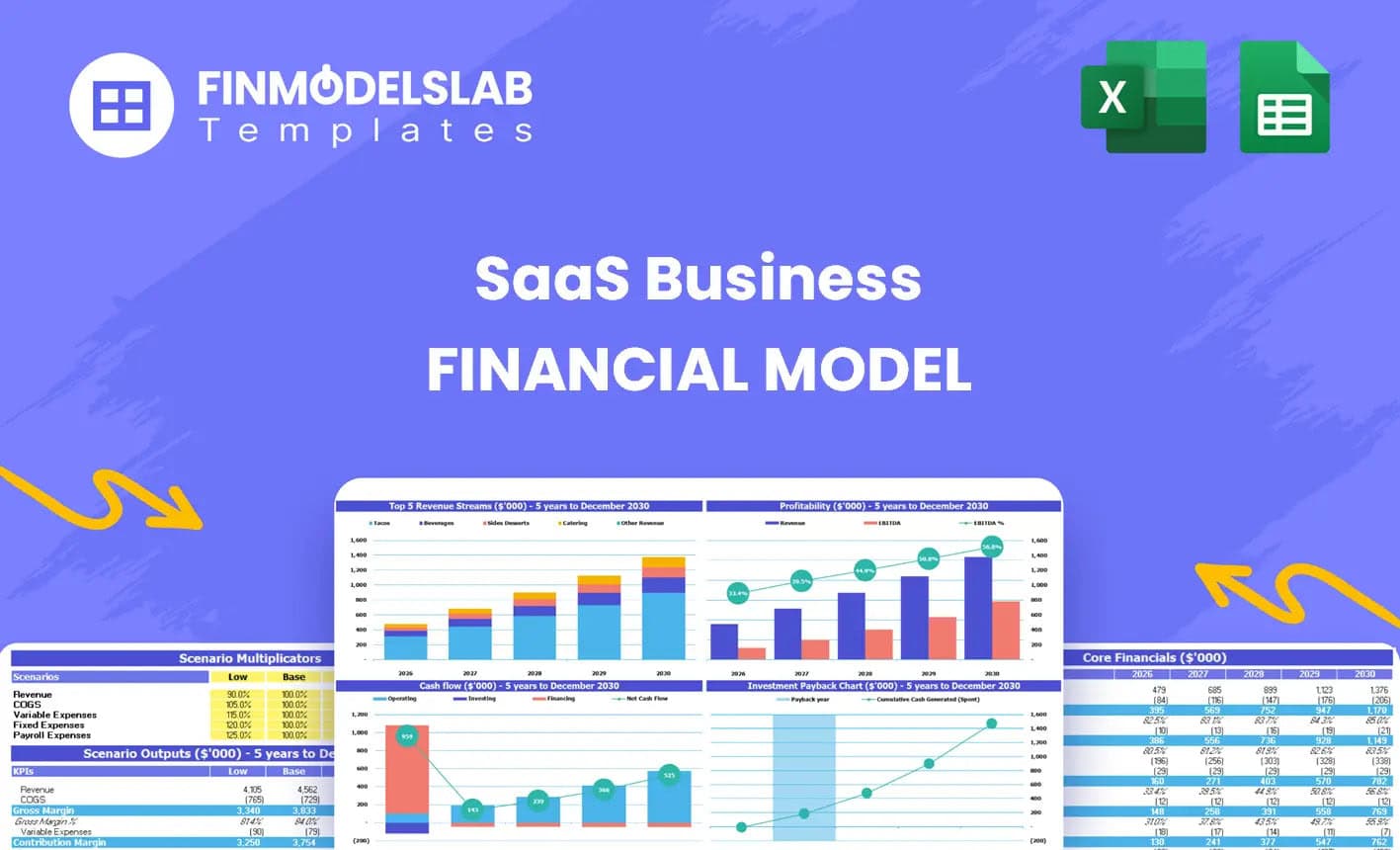
The SaaS Business Model spreadsheet templates come with detailed and condensed summaries to quickly grasp the key financial metrics of SaaS Businesses and offer the ability to drill down into their determinants.
This offers transparency and a deep understanding of all aspects of the logic of Subscription and Service-as-a-Software Business. The Premium Model Version provides tables for presentation slides.
Robust Model to Understand the Economics of a B2C Software-as-a-Service (SaaS) Business
This Excel spreadsheet template focuses on modeling B2C SaaS Subscription businesses that obtain subscribers via sign-up on their website and convert them into recurring subscribers. The SaaS financial model then offers the relevant assumptions to calculate a comprehensive economic forecast and derive all the appropriate metrics.
The robust SaaS business model comes in three different versions, each as a fully editable Excel file.
| PREMIUM | PRO | BASIC | |
| Forecast Period | 10-Years Monthly | 5-Years Monthly | 5-Years Monthly |
| Presentation Slide Summaries | YES | NO | NO |
| Scenarios Parameters | YES | YES | YES |
| Funding Rounds | Up to 4 | Only 1 | Only 1 |
| Investors | YES | YES | NO |
| VC Valuation | YES | NO | NO |
| Pre and Post Money Valuation | YES | NO | NO |
| Break-Even Analysis | YES | NO | NO |
| Customer Lifetime Value | YES | YES | NO |
| Commissions from One-time Sale | YES | YES | YES |
| Lifetime Commissions | YES | YES | NO |
| New Users from Affiliate Partners | YES | YES | NO |
The financial model template comes pre-filled with an example forecast of a SaaS business to illustrate clearly how the spreadsheet works. The forecast can be easily changed by altering the assumptions in blue and light blue font color.
The fully editable Excel model versions are currently in version 8.2. The file type .xlsb offers some performance advantages. For that reason, we provide Excel versions in .xlsb format in Excel. A free downloadable PDF demo version is available to help you understand the model structure.
File Types:
.xlsb (MS Excel)
.pdf (Adobe Acrobat Reader)
Our meticulously crafted financial model will give you a competitive advantage in your new SaaS Startup Business or existing Subscription business. Navigate the intricacies of SaaS financial planning and unleash your business’s full. Empower your investment decisions with precise forecasts and data-driven insights to ensure your venture thrives.
In Need of a Financial Model for Irregular Subscription Renewal?
For businesses with irregular renewal patterns, it is important to note that the standard SaaS Business Financial Model does not account for varying subscription renewal intervals. To effectively model scenarios where subscriptions are not renewed according to the plan duration but instead follow an average interval with idle periods in between, you must refer to the SaaS B2C Financial Model for Irregular Subscription Renewal. This specialized version of the financial model incorporates all the features outlined above. Still, it adjusts key assumptions and projections to handle the unpredictability of renewal cycles, allowing for a more accurate representation of recurring revenue, customer retention, and financial performance in such cases.
Similar ProductsOther customers were also interested in...


 eFinancialModels
Online Businesses Financial Model Bundle
This is a collection of financial model templates for businesses in the Information technology Indus... Read more
 Giorgos
Software as a Service (SaaS) – 10 Year Finan...
Advanced 10-year financial model for a Software as a Service (SaaS) business providing a solid finan... Read more
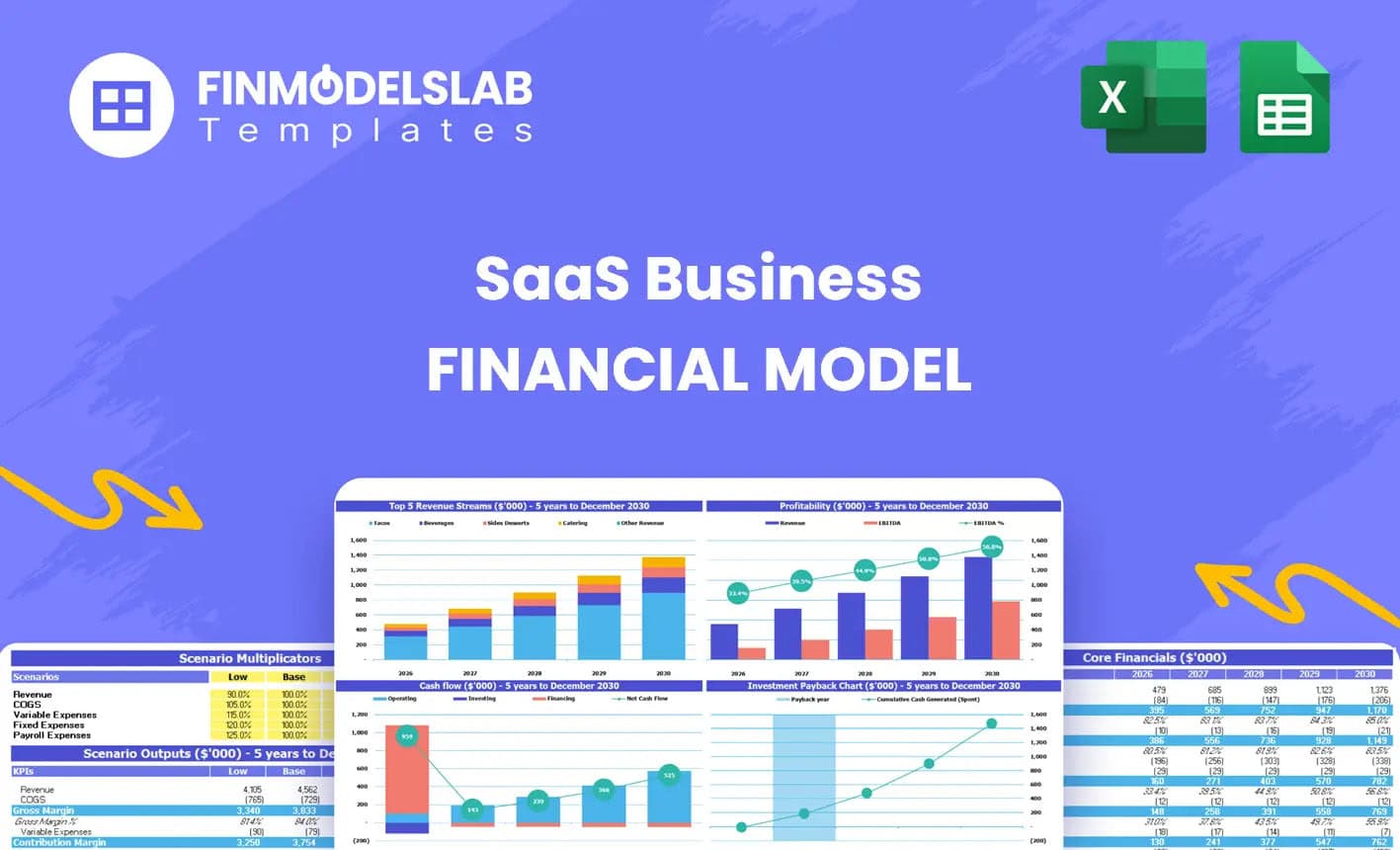
 HenrySheykin
Monthly Recurring Revenue SaaS Financial Model Exc...
The SaaS Business Financial Model helps founders, entrepreneurs, consultants, analysts, and business... Read more
Subscription Business – 10 Year Financial Model
Financial Model providing a 10-year financial plan for a startup or operating Subscription Business.... Read more
 Jason Varner
Website / App Financial Model (Recurring Revenue S...
A great tool to model out any recurring revenue service that acquires users through a website or app... Read more
SaaS Application Freetrial Financial Model Excel T...
The SaaS Business Financial Model helps founders, entrepreneurs, consultants, analysts, and business... Read more
5-Year Enterprise SaaS Financial Model – 3 C...
A dynamic financial model to forecast monthly and annual customers/revenues/expenses for a SaaS comp... Read more
SaaS Financial Model Bundle
This is a bundle of Financial Model Templates for SaaS businesses and their related sectors such as ... Read more
SaaS Freemium Financial Model Excel Template
The SaaS Business Financial Model helps founders, entrepreneurs, consultants, analysts, and business... Read more
Reviews
 Excellent and useful financial models
 SAAS Model Good Job
I was in need of SAAS model and hasn’t got a time to build from scratch. Been searching online a good version of model and found a SAAS Financial model from eFinancialmodel very detail oriented and have more metrics to track also breakeven and sensitivity analysis makes this top SAAS model in my list, would definitely recommend.
2820 of 5521 people found this review helpful.
Help other customers find the most helpful reviews
Did you find this review helpful?
 Review title? wtf
The excel is fine bur wouldve liked to have more info on how to fill each of the cells. I am doing a business model for school so im no expert. I woulve wanted to have someone explain me how to fill the model step by step.
3188 of 6243 people found this review helpful.
Help other customers find the most helpful reviews
Did you find this review helpful?
-

Hi there. We understand your predicament but please keep in mind that we only sell financial model templates and provide custom financial modeling services/assistance. Our financial modelers are occupied with projects, as such, we could not conduct a one on one lesson on how to fill up the model template. We do, however, accept any email inquiries to understand the template and answer your questions. There is also a video in the description above to help you familiarize yourself with the template and instructions within the template.
If you have any further questions, please feel free to email us at [email protected] and we’d gladly assist you. Cheers!
2836 of 5622 people found this review helpful.
Help other customers find the most helpful reviews
Did you find this review helpful?
-
The model update to version 7.0 should address this as instructions are included now.
2790 of 5524 people found this review helpful.
Help other customers find the most helpful reviews
Did you find this review helpful?
-


You must log in to submit a review.