
0 ITEMS

SaaS B2C Financial Model for Irregular Subscription Renewal
The SaaS B2C Business Financial Model for Irregular Renewal Periods is designed to help SaaS companies accurately forecast revenue despite unpredictable subscription cycles. Unlike standard models with fixed monthly or annual renewals, this tool accommodates real-world scenarios where customers renew at varying intervals due to seasonality or fluctuating engagement.
It tracks subscriber acquisition, customer acquisition costs (CAC), and customer lifetime value (CLV), ensuring financial clarity even with irregular renewals.
The model includes flexible pricing tiers, financial statements, and scenario analysis to simulate the impact of renewal variations on key metrics in cash flows and profitability.
Ideal for SaaS businesses with non-standard renewal patterns, this Excel-based tool allows for precise financial planning and is fully editable for unique business needs.


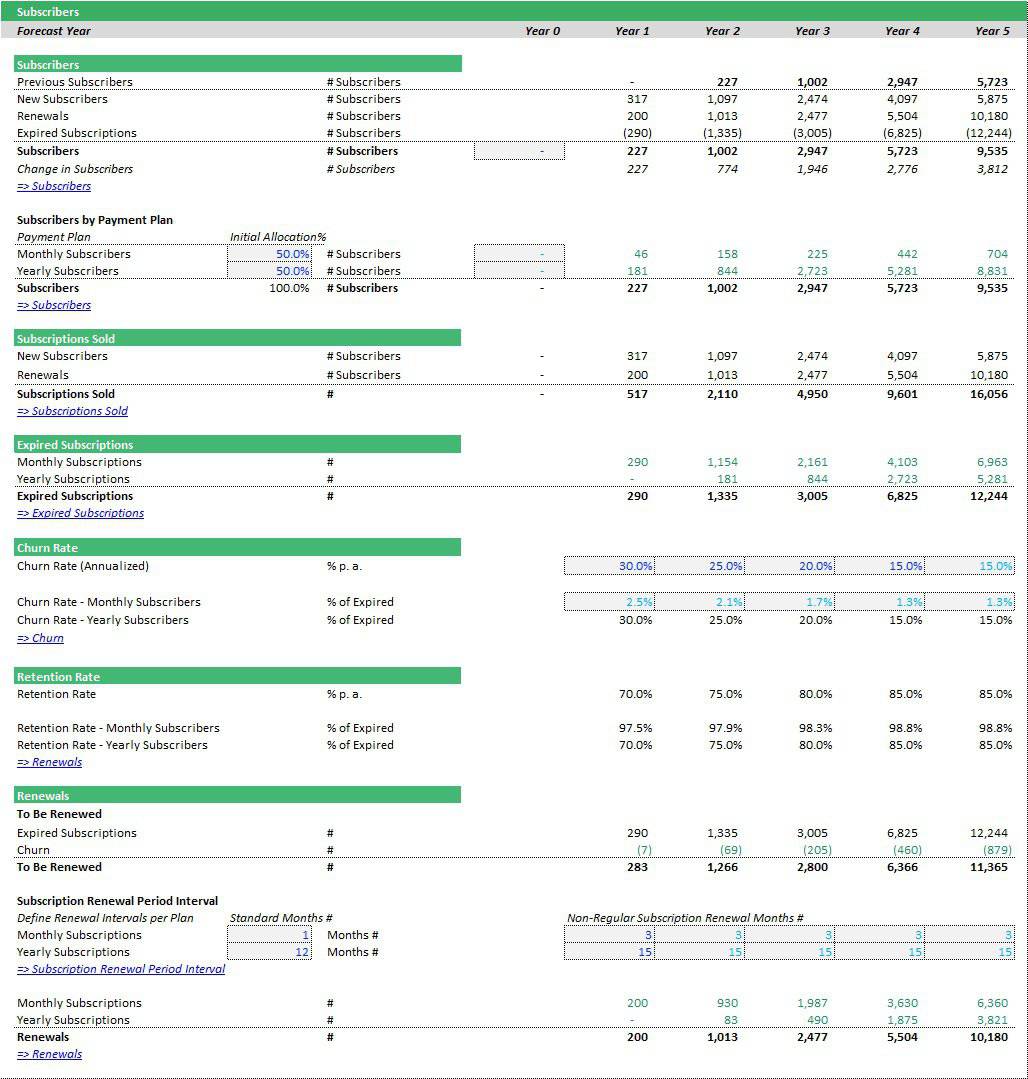


The SaaS B2C for Irregular Renewal Periods financial model builds on the standard SaaS financial framework with one key enhancement: it accommodates flexible subscription renewal intervals.
Unlike the typical SaaS Financial Model, where renewals align strictly with contract plan durations (monthly or annually), this version accounts for real-world scenarios where customers may renew their subscriptions at varying intervals, resulting in idle periods between renewals.
This feature is essential for SaaS businesses where user behavior doesn’t always conform to standard renewal cycles, such as seasonal usage or fluctuating engagement.
Why Irregular Renewal Periods Matter
For many SaaS B2C companies, especially those catering to niche markets or offering non-essential services, subscribers may only sometimes follow a strict renewal schedule. This model addresses that reality, making it ideal for businesses where:
- Seasonality or sporadic usage patterns affect when customers renew (e.g., software for travel planning, event management, or educational tools).
- Subscribers may pause or delay their renewals due to budget cycles or personal use cases, creating gaps in the subscription lifecycle.
- Retention strategies are more complex, requiring a nuanced subscription management and revenue forecasting approach.
This model accurately reflects business performance, ensuring your financial forecast remains reliable despite unpredictable renewal patterns.
Modeling Recurring Revenues from SaaS B2C Subscription Businesses with Irregular Renewal Periods
The key highlights of this modified Excel model template for SaaS B2C businesses, where subscription renewals are irregular, are as follows:
- Subscriber Acquisitions by Traffic Source: The model accounts for new user acquisition from five sources: Direct, Organic, Paid Ads, Word-of-Mouth Referrals, and Affiliate Partners. It factors in advertisement budgets for paid traffic and assumptions for referrals, making it easy to project new subscribers.
- Customer Acquisition Costs: This model analyzes Customer Acquisition Costs (CAC), which vary over time, especially when dealing with irregular renewals. Charts compare CAC against Customer Lifetime Value (CLV) to assess efficiency. CAC is separated from direct costs in the Income Statement to give clear insights into gross profit and acquisition costs.
- Trial Users, Conversion Rates, and Irregular Renewal Patterns: Users can model trial-to-paying subscriber conversion rates with the option to introduce time lags and irregular renewal intervals. This feature also accounts for the fact that renewals may not occur strictly according to subscription plans but after an average renewal interval, capturing periods of inactivity or churn recovery.
- Four Pricing Tiers and Two Payment Plans: The model splits customers into four pricing tiers – Basic, Pro, Premium, and Platinum. Two payment plans (monthly and yearly) are available. For yearly plans, users can choose to recognize revenue at the point of payment or spread it out over the year. The irregular renewal option allows for more nuanced forecasting.
- Customer Lifetime Value with Irregular Renewals: The CLV calculation is tailored to reflect irregular renewal periods. It offers insights by monthly, yearly, or average subscribers, showing how variations in renewal frequency affect lifetime value. The impact of referral programs and affiliate commissions on CLV is also detailed.
- Monthly Budget and Multi-Year Financial Planning: A robust financial forecast turns assumptions into a detailed monthly and multi-year plan. It accommodates up to 10 years, allowing businesses to adjust for irregular renewal periods and generate reliable long-term projections.
- Comprehensive Financial Statement and Free Cash Flow Forecasting: The template includes a full three-statement financial model (Income Statement, Balance Sheet, Cash Flow) and free cash flow forecast. These statements automatically adjust for the timing of irregular renewals, providing a more accurate picture of the business’s cash flow and profitability.
- Business Valuation Forecast: Three valuation methods—EV/Revenue, EV/EBITDA, and EV/Subscriber—allow users to assess the business’s future value. This is especially useful for businesses with irregular renewals, as it captures fluctuations in revenue and subscriber growth over time.
- Key Performance Indicators (KPIs) and Financial Metrics: The model tracks key SaaS KPIs like Monthly Recurring Revenue (MRR), Annual Recurring Revenue (ARR), Average Revenue per User (ARPU), churn, retention rates, and CAC. The model also projects the impact on cash flow, IRR, and break-even points for businesses with irregular renewal periods.
- Multiple Funding Rounds from Seed to Series A, B, C: The model includes planning for multiple funding rounds and adjusting financial forecasts to reflect investor dilution, equity valuation, and anticipated returns. This is crucial for businesses expecting volatility due to irregular renewals.
- VC Valuation Method: The venture capital (VC) valuation method is available to substantiate investment propositions. It helps users forecast investor returns by accounting for irregular revenue patterns.
- Rich Features for Costs and Investments: The model includes comprehensive features for measuring employee costs, operating expenditures, capital expenditures, intangible asset investments, and debt schedules. Assumptions like working capital, depreciation, and interest rates adjust for irregular revenue flows.
- Scenario Analysis: The model includes scenario analysis options, allowing users to simulate the impact of irregular renewal periods on key metrics like MRR, CAC, and CLV, helping visualize a range of possible business outcomes.
- Presentation-Ready Summaries: The SaaS Business Model template offers summarized charts and tables designed for presentation. These highlight key financial metrics and clarify irregular renewals’ dynamics.
This model is ideal for SaaS B2C businesses without strict subscription renewal timelines. It offers flexibility to account for idle periods between renewals and creates a more accurate financial forecast.
Ideal for:
- SaaS companies with seasonal demand or intermittent user engagement.
- Businesses where user retention and renewal cycles vary beyond standard monthly or annual terms.
- Startups and established SaaS companies need flexible financial forecasting for irregular subscription renewals.
Equip your business with this comprehensive model to ensure your financial forecasts accurately reflect your revenue streams, no matter how unpredictable your subscription renewals are.
By integrating the flexibility of irregular subscription renewals, this SaaS financial model ensures that you can more accurately forecast your business’s revenue, optimize your subscription management, and create data-driven strategies that align with your customers’ purchasing behaviors.
The financial model template includes a pre-filled example forecast for a SaaS business, demonstrating how the spreadsheet functions. You can easily customize the forecast by modifying the assumptions highlighted in blue and light blue.
The fully editable Excel model is available in version 8.2 and comes in .xlsb format, offering enhanced performance. A free downloadable PDF demo is available to help you explore and understand the model’s structure.
File Types:
- .xlsb (MS Excel)
- .pdf (Adobe Acrobat Reader)
Empower your SaaS business to manage irregular renewals more effectively with this powerful financial modeling tool, designed to enhance precision in forecasting and decision-making.
Similar ProductsOther customers were also interested in...



 eFinancialModels
Electric Vehicle (EV) Charging Station Financial M...
With this comprehensive 5- or 10-year monthly tool, investors can assess the viability of setting up... Read more

Financial Model for Mobile App | Mobile App Busine...
The Mobile App Financial Plan Template in Excel allows you to develop financial projections when lau... Read more

 HenrySheykin
Food Truck Financial Model Excel Template
The Food Truck Financial Model helps entrepreneurs, founders, business owners, consultants, and anal... Read more

Green Hydrogen Production from Wind Energy Financi...
The Green Hydrogen from Wind Financial Model aims to comprehensively forecast a horizon of 40 years ... Read more

Simple Mutual Non-Disclosure Agreement Template
Protect your business secrets with ease using our Simple Mutual Non-Disclosure Agreement Template. S... Read more

Solar Energy Financial Model
The Solar Energy Financial Model Spreadsheet Template in Excel assists you in preparing a sophistica... Read more

 Peter Graf
The Customer-Centric Financial Model for Restauran...
Starting a restaurant without a financial plan is like driving a car blindfolded. You wouldn´t do i... Read more
You must log in to submit a review.