
0 ITEMS

Churn
Customer churn shows how many people stop using your product or service over time. It's a clear signal that something might be wrong—maybe your prices are too high, your service is weak, or competitors are improving. Calculating churn helps you spot these problems early. The sooner you know, the faster you can act to keep your customers happy and loyal. Without tracking churn, your business could quietly bleed revenue and lose growth potential.
Churn rate isn't just a number—it's a key piece of your financial puzzle. When you build a financial model, churn shows how fast your revenue could drop if customers leave. It helps predict cash flow, lifetime value, and how much you need to spend on marketing to replace lost users. With churn rate in your model, you can plan smarter, spot risks earlier, and make decisions that protect your bottom line.
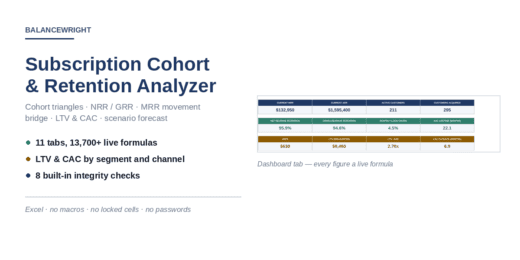

Give this workbook one row per customer per month and…
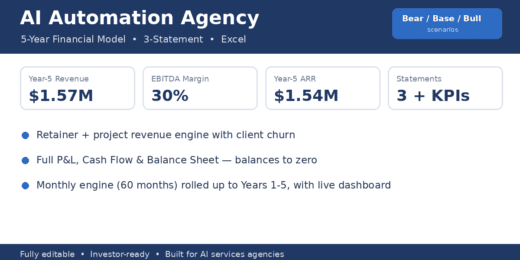

A 5-year, fully editable Excel model built specifically for AI…


🚀 Premium Creator Economy Multi-Platform Revenue Financial Model, A professional…

🚀 AI GPU-as-a-Service / AI Compute Data Center Financial Model…


This fully unlocked 5 Year, 12-tab institutional-grade Excel template is…

Professional Vertical AI SaaS Financial Model Template for B2B businesses…


Comprehensive 8 year telecoms financial model forecasting income, cash flow…


Excel-based tool to analyse customer base development, churn and retention,…

A premium, investor-ready SaaS Financial Model (Excel) built for founders,…

A polished, investor-ready E-commerce Financial Model for DTC and marketplace…
A professional, investor-ready Mobile App Financial Model with monthly-to-annual projections…


The ultimate 5-year SaaS financial model for startups. Build a…


A comprehensive editable, 5-year 3 statement MS Excel spreadsheet for…

A comprehensive, editable, 5-year 3 statement MS Excel spreadsheet for…


A simple startup model for agent-based SaaS businesses. Includes fundraising…


This dynamic Early Stage Startup SaaS Financial Model, built by…
Tailored for SaaS (Software-as-a-Service) business, this dynamic financial model streamlines…



The Data Center Financial Model with a 10-Year DCF (Discounted…

A comprehensive editable 20-year 3-statement, MS Excel spreadsheet for tracking…

A comprehensive editable, MS Excel spreadsheet for tracking an EV…
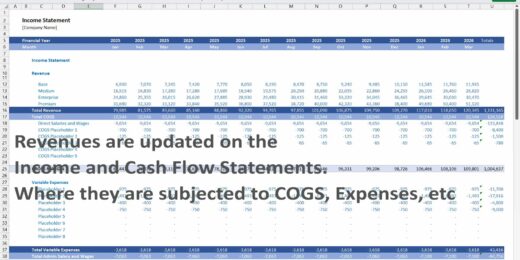
A comprehensive editable, 5-year 3 statement MS Excel spreadsheet for…

A comprehensive editable, 5-year 3 statement MS Excel spreadsheet for…

Comprehensive editable, 5-year 3 statement MS Excel spreadsheets for tracking…

Comprehensive editable financial models for tracking 3D Printing Manufacturer finances.…

A comprehensive editable, 5-year 3 statement MS Excel spreadsheet for…



This 10-year monthly Gym Fitness Center financial model is designed…
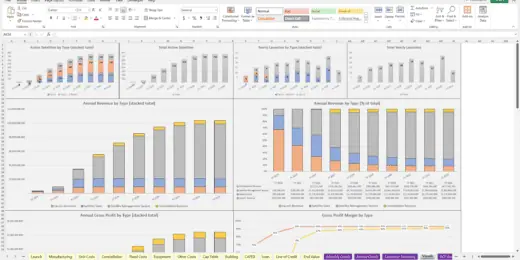
A 10-year financial model to account for the startup costs…


This Childcare Center Financial Model Template has been built for…
The SaaS B2C Business Financial Model for Irregular Renewal Periods…


The Mobile App Financial Model Template is a comprehensive tool…
The P2P Equipment Rental Platform Financial Model with a 10+…

This YouTube Channel Financial Model Template has been built for…

A financial model framework designed for an AI platform that…
Human Resource Management (HR / HRM) SaaS Financial Model Template…

This Payment Gateway and Billing Solutions SaaS Financial Model Template…

This Communication Platform SaaS Financial Model Template has been built…
This Content Management System (CMS) SaaS Financial Model Template has…
This Customer Relationship Management (CRM) SaaS Financial Model Template has…
This Enterprise Resource Planning (ERP) SaaS Financial Model Template has…

A comprehensive editable, MS Excel spreadsheet for tracking Dog Grooming…

Subscription-Based B2C SaaS Financial Model Template has been built for…
This SaaS Startup Financial Model Template (Income Statement, Balance Sheet,…

This Project Management SaaS Financial Model Template has been built…


The Drone Delivery Services Financial Model with a 10+ Years…

Comprehensive editable, MS Excel spreadsheets for tracking consulting firm finances.…
The Subscription Box Business Financial Model with 10+ Years DCF…

A comprehensive editable, MS Excel spreadsheet for tracking Mobile App…

Provides a comprehensive analysis of the financial viability and potential…


A comprehensive editable, MS Excel spreadsheet for tracking Indoor Golf…

A comprehensive editable, 5-year 3 statement MS Excel spreadsheet for…

A comprehensive editable, MS Excel spreadsheet for tracking private Medical…
How to Calculate Customer Churn Rate?
Losing customers hurts: Churn is a red flag any business can't ignore. It quietly drains revenue, stalls growth, and signals deeper issues. That's why smart entrepreneurs and sharp investors always ask the same thing—what's our churn rate? In this guide, we'll show you how to calculate it fast and why it matters more than you think. We will focus on the following key points:
- What Is Customer Churn Rate? Customer churn rate is the percentage of customers who stop doing business with a company during a specific period.
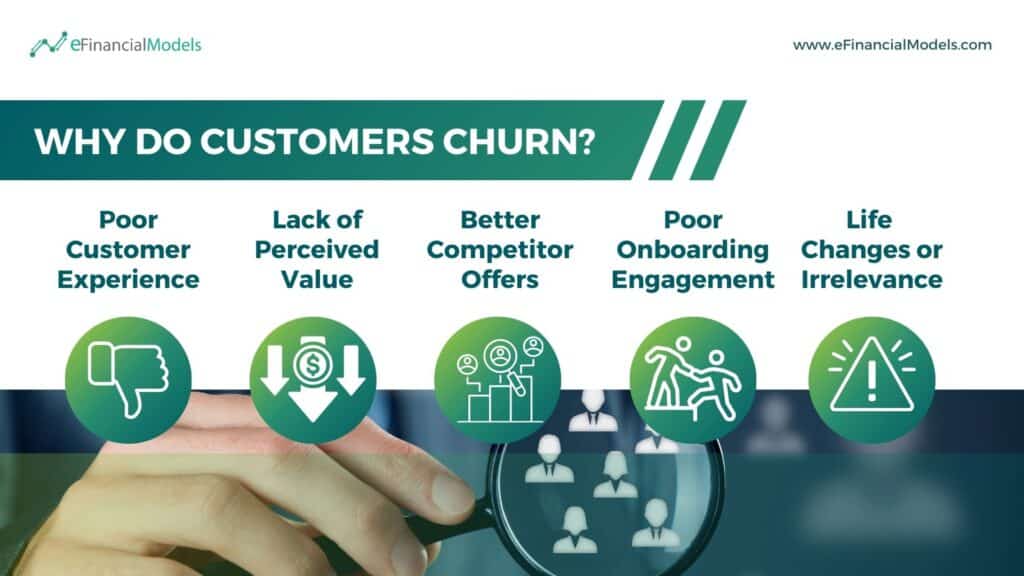
- Why Do Customers Churn? Customers churn due to poor experiences, lack of perceived value, better competitor offers, ineffective onboarding, or changing personal needs.
- What is the Customer Churn Rate Formula? The customer churn rate formula is: (Lost Customers ÷ Total Customers at Start of Period) × 100.
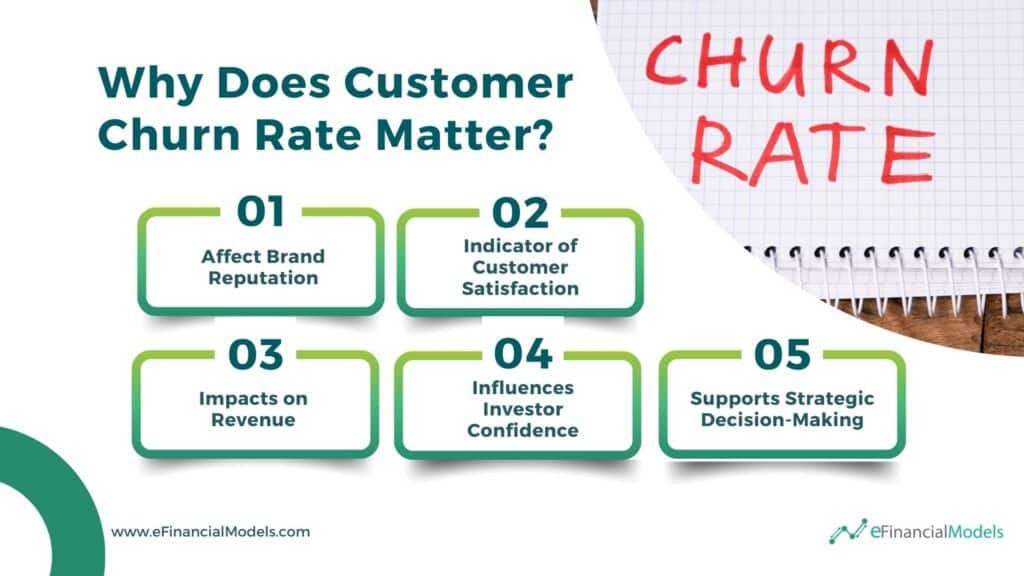
- Why Does Customer Churn Rate Matter? Churn rate matters because it affects brand reputation, customer satisfaction, profitability, securing funds, and strategic investment decisions.
Ready to take control? Dive into the guide to learn how to spot churn early, fix what's broken, and keep your customers returning!
What Is Customer Churn Rate?
Customer churn rate, often referred to as customer attrition, is a critical metric that reflects the percentage of customers who discontinue their service or relationship with a company over a specific period. Among businesses, what is customer churn rate shows how many customers stop doing business over a certain period.What is customer churn rate is a simple way to track loss. If 100 customers used your service last month and 5 of them left, your churn rate is 5% (5/100 x 100). This number tells you how well you're keeping customers. A low churn rate means people are happy and staying. It means customers like what you offer and choose to stay. A high rate? That's a warning sign. It signals a problem—it shows people are leaving, and fast.
The opposite of the churn rate is the customer retention rate. While churn tracks how many customers leave, retention shows how many stay. A high retention rate means customers use your product or service over time. It reflects loyalty and satisfaction. Instead of losing users, you’re keeping them engaged. This is key for growth, especially in subscription-based businesses.
Why Do Customers Churn?
Understanding why customers churn is essential for improving customer retention, boosting revenue, and strengthening brand loyalty. Here are the top 4 reasons customers typically churn:- Poor Customer Experience: If customers encounter slow response times, rude support, inconsistent service, or confusing interfaces, they will likely leave. A single frustrating experience can outweigh years of loyalty. Even minor usability issues can cause customers to explore alternatives in industries like SaaS and telecom.
- Lack of Perceived Value: When customers feel that the product or service no longer justifies its cost—whether due to pricing, outdated features, or competitors offering more—they churn. This is often tied to a misalignment between expectations and delivered outcomes.
- Better Offers from Competitors: In highly competitive markets, it's common for customers to jump ship when a better deal or more innovative product becomes available. If your value proposition isn't regularly refreshed, you'll risk losing customers to fresher options.
- Poor Onboarding Engagement: If customers don't see early wins or don't know how to fully use the product, they disengage quickly. Effective onboarding, helpful content, and proactive outreach are crucial in reducing early churn, especially for subscription-based services.
- Life Changes or Irrelevance: Sometimes, churn happens for reasons beyond your control—like a customer changing jobs, moving to a new location, or simply no longer needing the service. However, companies can still reduce voluntary churn by staying relevant and adaptable.
The Customer Churn Rate Formula Explained
Losing customers is a part of doing business—but knowing how fast they leave is key. That's where the customer churn rate comes in. How to calculate customer churn rate shows how many customers stop using your product or service over some time. This metric helps companies spot problems, improve retention, and boost profits. The customer churn rate formula shows how many customers a business loses in a set time.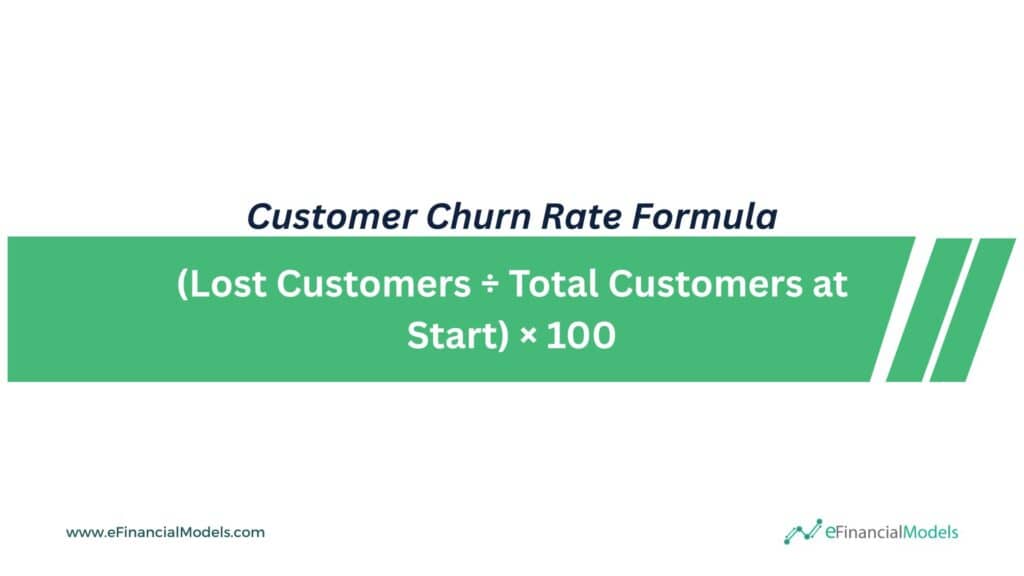
Where:
- Lost Customers are the people who stop buying or using your service during a set time. They cancel, leave, or don't return. Tracking them helps you see if your product or support needs work. Every lost customer is a missed chance to grow, so this number matters.
- Total Customers at Start is the number of active customers you had at the beginning of the period you're measuring. It gives context to how many you lost. Without it, you can't tell if the drop is big or small. It's the starting point of the customer churn rate formula.
- We multiply by 100 to turn the result into a percentage. A percentage makes the churn rate easier to understand and compare. It tells you clearly what part of your customer base walked away.
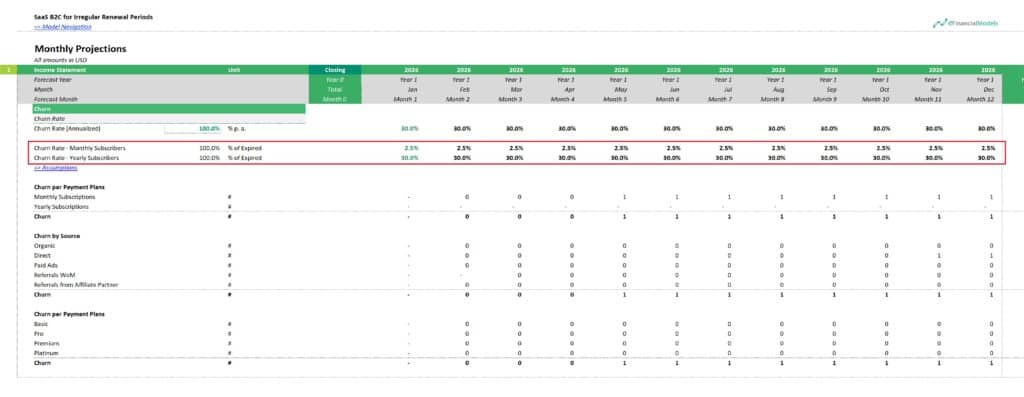
The above chart is from our SaaS B2C Financial Model for Irregular Subscription Renewal. It tracks monthly and yearly subscribers separately. The churn rates are expressed as a percentage of expired subscriptions. Monthly subscribers have a 2.5% churn rate, meaning 2.5 out of every 100 leaves each month. Yearly subscribers show a 30% churn rate, which is applied as they hit renewal. These steady rates help track how fast customers drop off and guide retention planning. A steady yearly churn might signal normal contract cycles or the need for renewal incentives.
Why Does Customer Churn Rate Matter?
How to calculate customer churn rate matters because it shows how well a business keeps its customers. A high churn rate signals a problem—people are leaving, which costs money. Conversely, a low churn rate means customers are sticking around, which is good for steady growth. That's why tracking churn isn't just a number—it tells a bigger story about your business's strength.- Affect Brand Reputation: A high customer churn rate can severely affect a company's brand reputation, signaling to the market that the business may not meet customer expectations or deliver consistent value. In today's review-driven, socially connected world, dissatisfied customers are more likely to share negative experiences online, which can erode trust and deter potential new customers.
- Direct Indicator of Customer Satisfaction: Churn is often the result of unmet expectations, poor customer service, or lack of product value. A high churn rate usually signals that customers are dissatisfied and seeking alternatives. Businesses can identify pain points in the customer journey by monitoring churn and making data-driven improvements.
- Impacts on Profitability: Losing customers means losing recurring revenue. For SaaS or membership-based businesses, even a small increase in churn can lead to significant revenue loss over time. Lower churn translates to higher customer lifetime value (CLV), boosting long-term profitability without constantly acquiring new customers.
- Influences Investor Confidence: For startups and growing companies, churn is a critical metric for investors. A high churn rate raises red flags about product-market fit and scalability, while a low churn rate demonstrates strong customer loyalty and revenue predictability—key for securing funding.
- Supports Strategic Decision-Making: Understanding why customers leave helps organizations make better decisions about pricing models, product enhancements, onboarding processes, and retention strategies. For instance, high churn in a specific segment may indicate a need for targeted support or different messaging.
Financial Modeling: Turns Customer Loss into Strategic Insights
Customer churn rate reveals how many customers stop using your service—and why that matters. It’s more than a metric; it’s a warning signal for deeper issues like weak onboarding, poor customer experience, or better competitor offers. By calculating churn, you track losses, spot trends, and sharpen your business decisions. A high churn rate means you’re leaking revenue; a low one means customers are happy and sticking around. Knowing your churn rate helps protect growth, boost retention, and build a stronger business that keeps customers returning.The customer churn rate formula is: (Lost Customers ÷ Total Customers at Start) × 100. This simple equation on how to calculate customer churn rate does more than show losses—it reveals where your business might be slipping. When used in financial modeling, it helps you understand how churn affects revenue over time. Financial modeling turns customer loss into a clear roadmap for action. It shows how churn impacts revenue, cash flow, and growth. By adding churn data into your model, you see the real cost of losing customers—and what it takes to win them back. This helps you plan better, adjust budgets, and fine-tune your strategy. With churn insights, your model becomes more than numbers—a tool to drive smarter, faster decisions.
You might also like:
- 10 Main Elements of a Business Plan
- 10 Tips to Develop a First Class Business Valuation Report
- Financial Modeling for Startups and Small Businesses
- Churn
- Cash Flow Analysis
- Customer Lifetime Value
- Business Valuation
- Scenario Analysis
- Top 5 Risks of Wind Energy Parks
- How to Build a Capitalization Table
- Understanding Insurance Policies: A Beginner’s Guide
- 10 Ideas to Increase Average Revenue Per User
- Top 10 Mistakes in DCF Valuation Models
- Annual Recurring Revenue (ARR)
- Financial Ratios Analysis and Its Importance
- 5 Smart Ways To Manage Personal Finances In A Pandemic
- Financial Plan for the Startup of a University and School
- 5 Best Practices for Managing Days Receivables
- 12 Funding Sources for Businesses and Startups
- Customer Acquisition Costs (CAC)