0 ITEMS

The Ultimate Guide on How to Value Your Brand

Are you aware of how much your brand is worth? Brand valuation may be complex and tricky because it is an intangible asset. Yet knowing its worth can help you make better business decisions and marketing strategies. Read on to learn how to value your brand. Use the insights below to comprehend your brand’s value and how to leverage its power correctly.
What is a Brand?
It is easy to measure tangible assets like profits and sales. But it may be challenging to determine what are the intangible assets of a company and their worth. A brand is one of those elusive factors. Yet it is necessary and possible to quantify.
A brand can be defined as a combination of a unique name, symbol, design, reputation, and other factors that distinguish a particular product or service from others in the market. It is the identity of a company or organization, and it encompasses the company’s values, beliefs, and personality, as well as the emotions and experiences associated with its products or services.
A brand represents a company’s promise to its customers, and it helps create and maintain a loyal customer base. A strong brand can also be a valuable asset for a company, as it can increase its market share, profitability, and overall success.
A great brand inspires loyalty and instigates trust. It results in repeat purchases and influences every consumer’s willingness to pay. In other words, a brand value proposition is necessary to encourage clients to buy again and pay more.
The Value of a Brand
What is business value during the 1950s and today’s business values are very different. Back then, success is measured by product quality. As advertising boomed in the 1960s, the public started valuing a business through its brand.
Brand value refers to the perceived worth of a brand in the eyes of consumers. A brand’s monetary value to a company’s overall cost is based on reputation, recognition, customer loyalty, and other intangible assets associated with the brand.
In financial modeling, brand value is its worth to management and shareholders. It is often measured by financial metrics such as brand equity, brand loyalty, and brand awareness, which can help determine the brand’s impact on a company’s revenue, market share, and profitability.
A substantial brand value can help a company to differentiate itself from its competitors, attract and retain customers, and increase its overall market value. As a result, it’s easier to imagine getting sales with a brand coming into the play. Coca-Cola, Apple, Google, Microsoft, and Facebook are some of the most influential global brands worth billions of dollars.
The Importance of Brand Valuation
Brands are recognized as assets on a company’s balance sheet, and their value can significantly impact a company’s financial performance. A brand valuation can help companies accurately report the value of their brands for financial reporting purposes.
Brand valuation means calculating the amount of money another company or party may be interested in paying for a brand. There are various instances when a company may need to know its brand value. These may include:
- Budget Allocations
- Brand Reviews
- Financing
- Licensing
- Mergers and Acquisitions

Brand Reviews
Do you want to assess the brand’s strengths, weaknesses, opportunities, and threats? Brand valuation is an excellent way to gauge the return on investment for a portfolio of brands. Comparing benchmarks and providing strict measures, i.e., market shares and sales, can help develop better investment strategies. It can be essential for businesses looking to expand into new markets or product lines. By identifying opportunities to leverage an existing brand, a company can increase its revenue potential and strengthen its competitive position.
Budget Allocations
Business owners, entrepreneurs, and marketers may use brand valuation to make better and more informed decisions in budgeting. It is an essential element of market mix modeling (MMM). Through brand valuation, it is easy to determine how specific marketing spending affects sales. So, businesses can maximize capital, funds, and resources. By understanding the financial value of a brand, companies can evaluate the effectiveness of their marketing activities. This information can inform budget allocation decisions by directing resources toward marketing activities with a higher return on investment (ROI).
Financing
Banks, investors, and lenders recognize a brand value as a financial asset of the company. That is why solid brands typically obtain better financing terms than poor ones. As brand valuation shows how brands can contribute to shareholders’ value, it can be an acceptable security asset for financing. Brand valuation is essential to a company’s ability to obtain funding. It provides a quantitative measure of the financial value of a brand. This information can be used to demonstrate to potential lenders or investors that the brand is a valuable asset.
Licensing
A brand valuation can help determine the right length and pricing for licensing. It can be termed a franchising or royalty agreement where the licensee and licensor benefit from the arrangement. The licensor obtains a new revenue source while the licensee saves on advertising and customer acquisition costs. Businesses can use the quantitative measure of a brand’s financial value to negotiate higher royalty rates, better contract terms, and other concessions. A brand with a higher valuation can command higher prices for franchising fees. In comparison, a brand with a lower valuation may need to accept lower costs to attract licensees or franchisees.
Mergers and Acquisitions
Rarely will a company acquire or merge with another company by simply paying book value. It first estimates a brand’s value to determine the premium price over book value. A brand valuation shows the intangible assets and their importance to a business. It can help companies decide the best mergers and acquisitions they should abide. This information can be used to determine the overall value of the target company, which is vital in negotiating the terms of the deal. It can help identify potential risks and opportunities associated with the acquisition and inform the integration strategy.
Key Drivers of Brand Value
Building a brand typically involves investing significant resources, including marketing dollars, to enhance the perceived image of a product or company. It can involve a range of tactics, such as advertising, public relations, social media, events, and sponsorships, among others. Ultimately, it requires a long-term commitment and ongoing investment, as brands must evolve and adapt to changing market conditions and consumer preferences.
Brand value is created by a combination of factors that contribute to the overall perception and reputation of a brand in the minds of consumers. Eventually, it will allow a company to sell its products or services at a premium price compared to similar no-name products, as consumers are willing to pay more for a strong brand’s perceived value and quality.
The essential key drivers of brand value include:
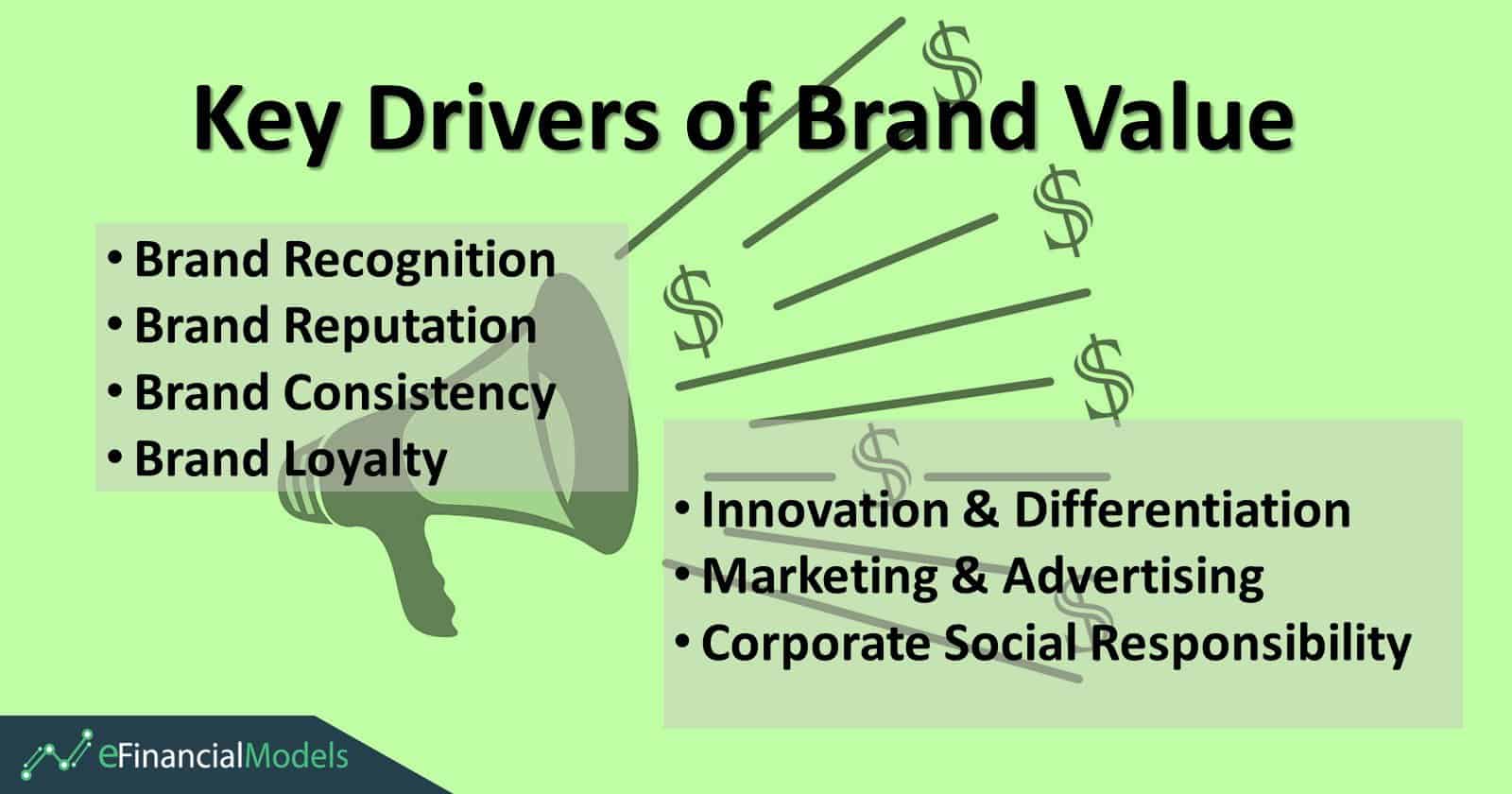
- Brand recognition: A strong brand should be easily recognizable and memorable, which helps to build awareness and familiarity with consumers.
- Brand reputation: A brand’s reputation is crucial in building trust and credibility with consumers, leading to increased loyalty and repeat business.
- Brand consistency: Consistency in branding, messaging, and customer experience can help to reinforce the brand’s identity and values and build a solid emotional connection with consumers.
- Brand loyalty: When customers feel a strong affinity for a brand, they are more likely to become repeat customers and recommend the brand to others.
- Innovation and differentiation: Brands that innovate and differentiate themselves from their competitors can create a unique value proposition for consumers, leading to increased brand value.
- Marketing and advertising: Effective marketing and advertising campaigns can help to build awareness, increase brand recognition, and reinforce the brand’s message and values.
- Corporate social responsibility: Brands perceived as socially responsible and environmentally conscious can create a positive image and build goodwill with consumers, contributing to brand value.
Determining the Cost of Maintaining a Brand
A strong brand can create a perception of superiority, uniqueness, and exclusivity in the minds of consumers, which can lead to increased demand and a willingness to pay more for the brand’s products or services. Consumers are likelier to choose a familiar and trusted brand over an unknown or lesser-known option, even if the latter is priced lower. It can contribute to increased sales and profitability for the company, as well as long-term customer relationships and brand advocacy.
However, companies need to maintain the quality and consistency of their products or services and the overall brand experience to uphold the perceived value and trust associated with the brand. Otherwise, the brand’s value may diminish, and customers may be less willing to pay a premium for its products or services.
Maintaining a brand can involve high costs, requiring ongoing investment in various areas to ensure the brand remains relevant and competitive. Some of the essential costs associated with maintaining a brand include:
- Marketing and advertising: Companies must continue investing in marketing and advertising to build brand awareness, reinforce the brand’s messaging and values, and stay in mind with consumers.
- Research and development: Brands must innovate and evolve to remain competitive, which requires ongoing investment in research and development to create new products or services and improve existing ones.
- Customer experience: Customer experience is a critical component of brand value, and companies must invest in delivering a consistent and positive experience across all touchpoints with customers, which may involve training, technology, and infrastructure investments.
- Brand management: Managing a brand requires ongoing efforts to monitor and protect the brand’s reputation and ensure that the brand remains relevant and aligned with evolving market trends and consumer preferences.
- Corporate social responsibility: Many brands are expected to be socially and environmentally conscious and may need to invest in initiatives supporting these values to maintain a positive image and build customer loyalty.
Overall, the cost of maintaining a brand will depend on the size and complexity of the company, the competitive landscape, and the consumers’ expectations and preferences. However, brand maintenance is typically considered a worthwhile investment, as it can lead to increased market share, customer loyalty, and long-term profitability.

Methods to Measure Brand Value
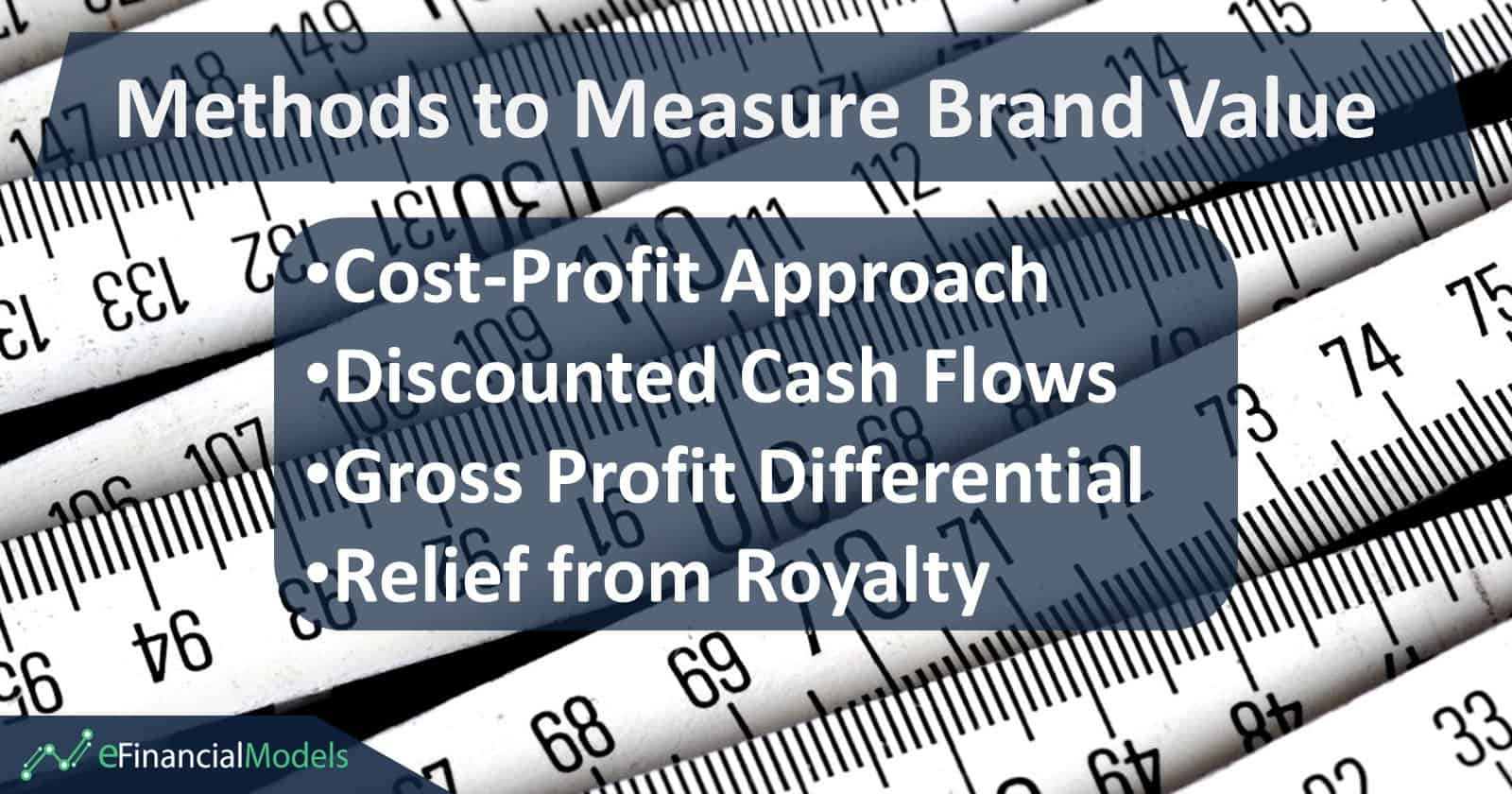
Several techniques are applied to determine the monetary value of brands. These all prove the potential financial gain of brand ownership, considering the market value and brand-specific risks. The most commonly used brand valuation models are:
- Cost-Profit Approach
- Discounted Cash Flows
- Gross Profit Differential
- Relief from Royalty
Cost-Profit Approach
The cost-profit approach estimates the value of a brand based on its expected future profits. The basic idea is that the value of a brand is equal to the net present value of the future profits it is expected to generate. That means deducting all your costs related to brand building.
Such a brand valuation method starts with estimating the future profits the brand will generate over a given period. Determining the cost of capital or discount rate follows. It should be used to calculate the present value of future profits. Then, calculate the present value of the future earnings by discounting the estimated future profits back to their current value using the chosen discount rate.
The cost-profit approach is often combined with other methods to provide a more comprehensive view of a brand’s value. However, it can be a valuable tool for estimating the value of a brand based on its expected future profits, particularly in situations with limited market data or comparable transactions available for comparison.
Discounted Cash Flows
The discounted cash flow (DCF) model is one of the most popular business valuation methods. It considers projected net cash flows and applies a discount rate to them. It allows you to determine a brand’s or business’s value today by referencing future expected cash flows.
To account for future risks and uncertainties, anticipated cash flows must be discounted. Such an approach is income-based. So, enough data on cash inflows and risk factors must be compiled, and the correct assumptions must be determined before data modeling occurs. While it’s tricky to land on a number, it’s a helpful frame for understanding brand value.
With this method, the brand value equals the estimated or real worth of income, cash flow, or cost savings attributable to the brand’s reputation or recognition.
Gross Profit Differential
Using the gross profit differential technique is the simplest way to assess brand value for some product brands. According to this method, the value of branded goods can be determined by subtracting the average price of comparable non-branded products from the product’s price. Its formula can be expressed as:
Brand Value = (p – n) x
Where:
- p = the price of a branded unit
- n = the average price of non-branded yet similar products
- x = the number of branded units sold
As a market-based valuation method, gross profit differential relies on market forces, including the demand for similar brands. Likewise, it might not give the correct value of a brand as time value isn’t considered. For instance, calculating a brand value based on the number of branded units sold for a year’s sales may underestimate it since you’ll continue to sell it.
Relief from Royalty
Relief from royalty is a valuation method where a royalty fee is used as a proxy for brand value. The royalty fee is calculated on an income percentage in return for the rights granted to use the brand name. Once ascertained, a DCF model variation is applied to determine a brand’s value.
Relief from the royalty valuation method involves identifying the applicable royalty rate. To find a brand’s relevant royalty rate, refer to several royalty rate database websites. Generally, royalty fees can range from 4% to 12% of gross sales, with an average percentage of around 6-8%. However, it’s important to note that royalty rates may be higher or lower depending on the brand’s popularity and reputation, the level of support and services the franchisor provides, and the franchise system’s overall profitability.
Some franchisors may also charge additional fees, such as marketing or advertising, typically based on a percentage of sales or a fixed amount. Franchisees should carefully review the terms of the franchise agreement and consult with a financial advisor to ensure they understand all of the costs associated with owning and operating a franchise.
In the restaurant industry, many established brands offered franchising to affect growth and increase brand awareness. A franchisee pays fixed royalty fees, typically a percentage of the monthly gross sale, in exchange for brand use and business support. These may include the franchise fee plus the marketing and advertising fees.
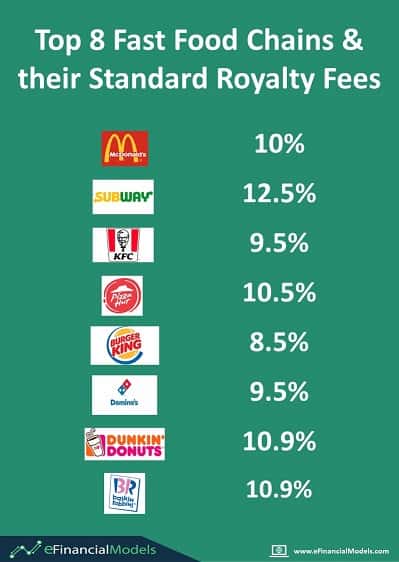
Here’s a sample of the top 8 fast food chains in the world today and their standard royalty fees:
- McDonald’s = 10% (5% franchise fee & 5% advertising fee)
- Subway = 12.5% (8% franchise fee & 4.5% advertising fee)
- KFC = 9.5% (5% franchise fee & 4.5% advertising fee)
- Pizza Hut = 10.5% (6% franchise fee & 4.5% advertising fee)
- Burger King = 8.5% (4.5% franchise fee & 4% advertising fee)
- Domino’s = 9.5% (5.5% franchise fee & 4% advertising fee)
- Dunkin’ Donuts = 10.9% (5.9% franchise fee & 5% advertising fee)
- Baskin-Robbins = 10.9% (5.9% franchise fee & 5% advertising fee)
Please note that Starbucks and Hunts Brothers Pizza are included in the list, although they no longer charge royalty fees due to some business transitions.
Comparing the Results of a Brand Valuation Template
You should look at the results of different valuation methods to triangulate a reasonable value for a brand. Ultimately, you must use your best judgment to decide which way to give more weight and primarily rely upon.
This Brand Valuation Template combines the relief from royalty and discounted cash flow method. It involves estimating the future cash flows the brand is expected to generate and discounting them to their present value using a discount rate that reflects the risk associated with the cash flows. As such, you can use it to make better investment decisions under the following scenarios.
Scenario No. 1 – Brand Review
Let us say you want to open an ice cream parlor and are looking for potential ice cream brands for the franchise. Two popular brands are on top of your mind – Baskin-Robbins and Fosters Freeze. Based on research, you will obtain the following data:
- Baskin-Robbins charges an annual royalty fee of 5.9% of the gross sales, with potential annual revenue of $316,815.
- Fosters Freeze charges an annual royalty fee of 4% of the gross sales, with potential annual revenue of $250,000.
Given that the Discount, Growth, and Income Tax rates are constant at 10%, 2.5%, and 25%, respectively, we can use the Brand Valuation Template to calculate the NPV and terminal value for both brands within 30 years.
Baskin-Robbins
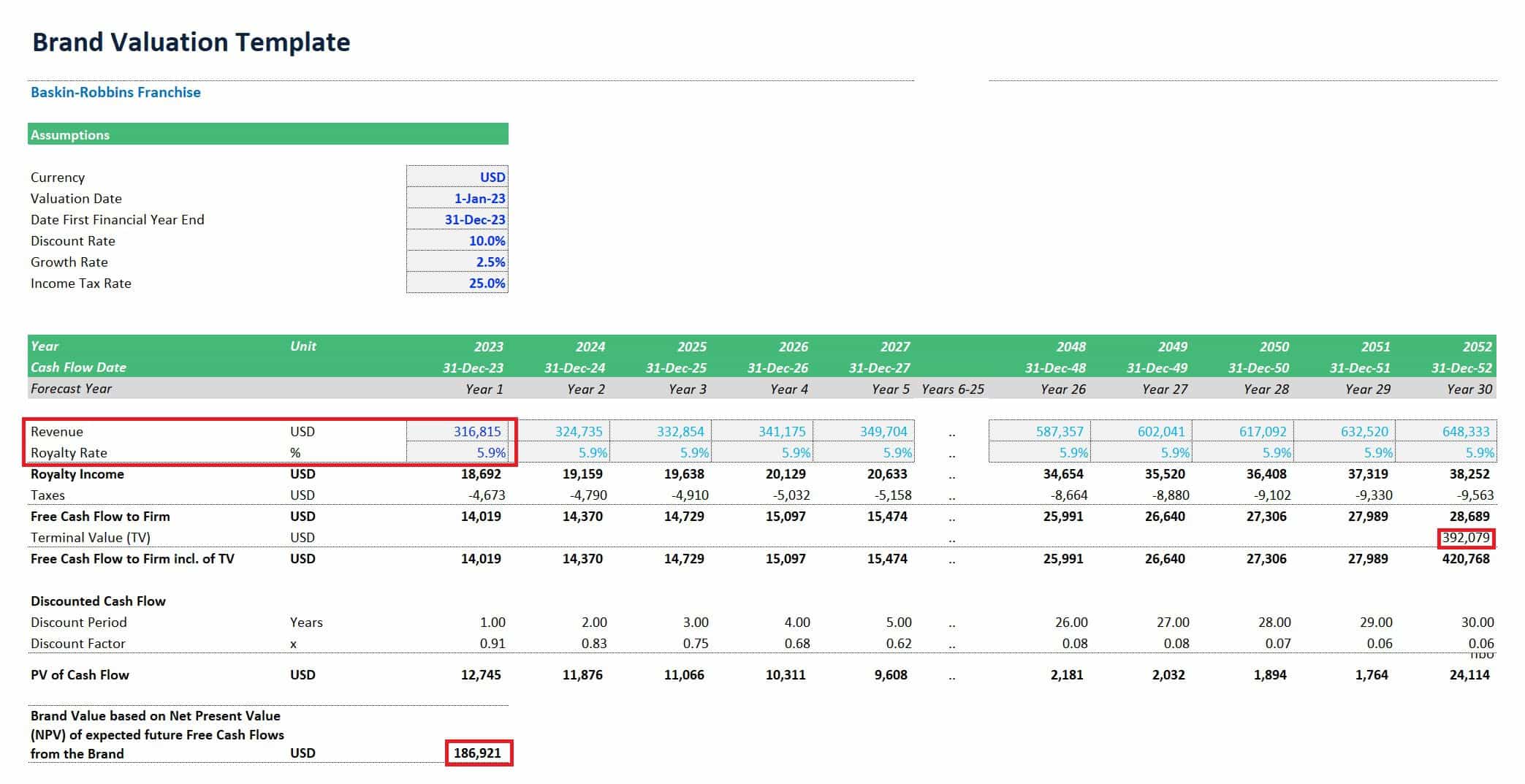
Getting a 30-year Baskin-Robbins franchise with an annual royalty fee of 5.9% of the gross sales and potential annual revenue of $316,815 will yield the following returns:
- Terminal Value = $392,079
- Brand Value based on Net Present Value (NPV) = $186,921
Fosters Freeze
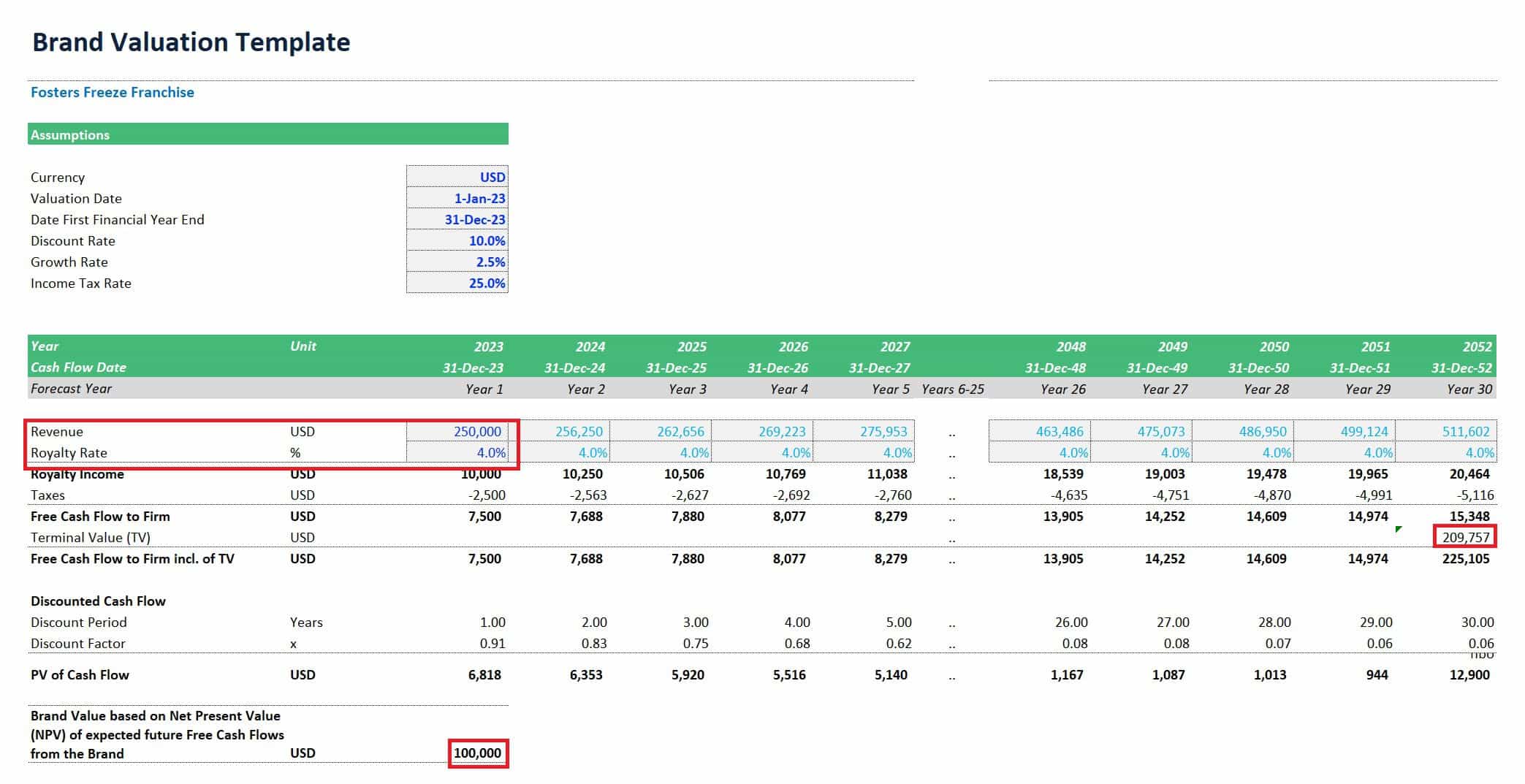
Getting a 30-year Fosters Freeze franchise with an annual royalty fee of 4% of the gross sales and potential annual revenue of $250,000 will yield the following returns:
- Terminal Value = $ 209,757
- Brand Value based on Net Present Value (NPV) = $100,000
Comparison
Baskin-Robbins and Fosters Freeze are both worthy franchise investments as they result in positive net present values and terminal values. But it is Baskin-Robbins if you want to prioritize which investment can give you the best returns. The Brand Valuation Template shows that Baskin-Robbins has a higher TV and NPV than Fosters Freeze, even if the latter charges a lower annual royalty fee.
Scenario No. 2 – Financing Option
Let us assume both brands offer third-party financing at a different discount rate. For example, Baskin- Robbins offers a discount rate of 18%, while Fosters Freeze provides a discount rate of 10%. Using the same assumptions, let us again use the Brand Valuation Template to calculate the TV and NPV.
Baskin-Robbins
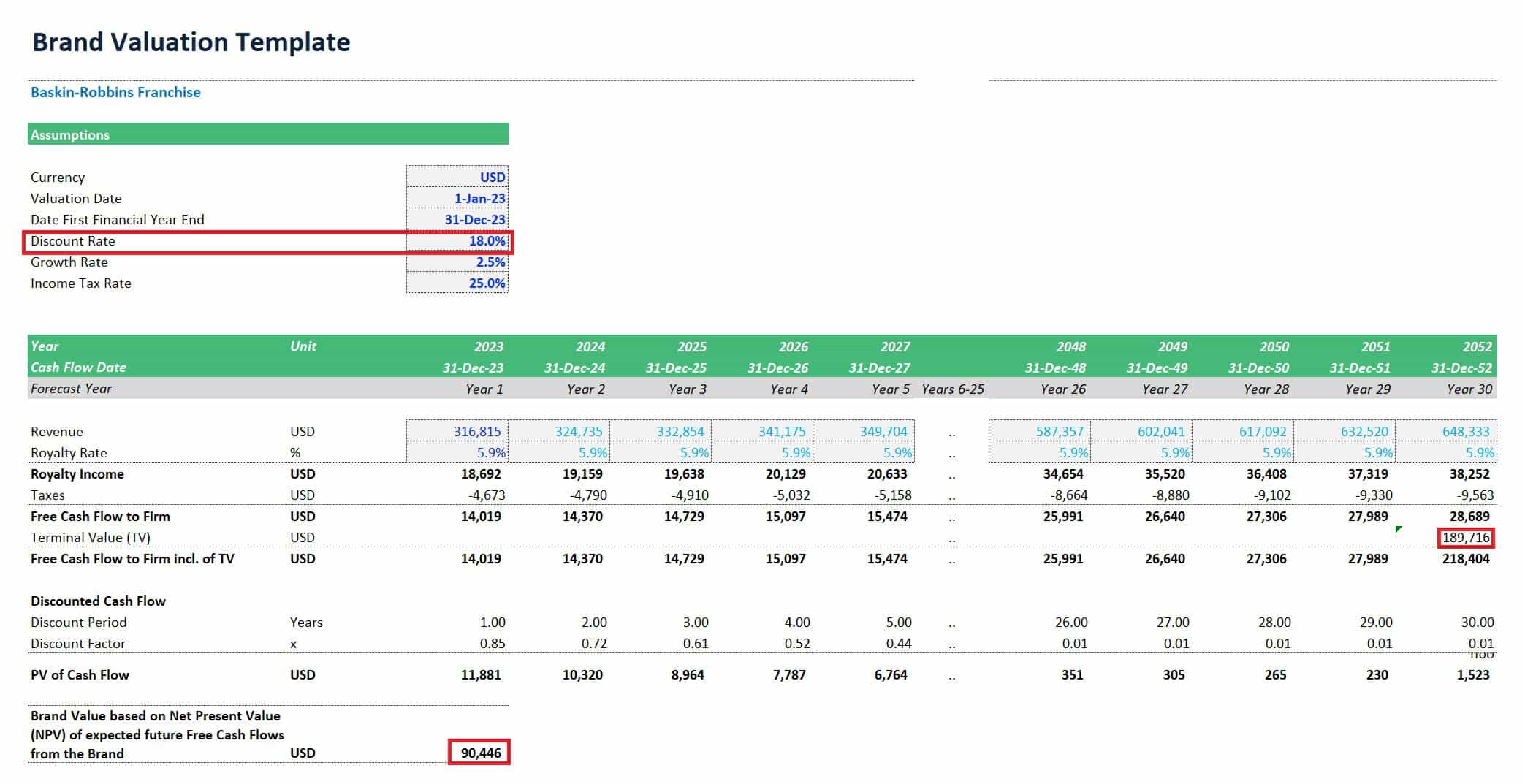
At an 18% discount rate, Baskin-Robbins will now have a TV equal to $189,716 and an NPV of $90,446.
Fosters Freeze
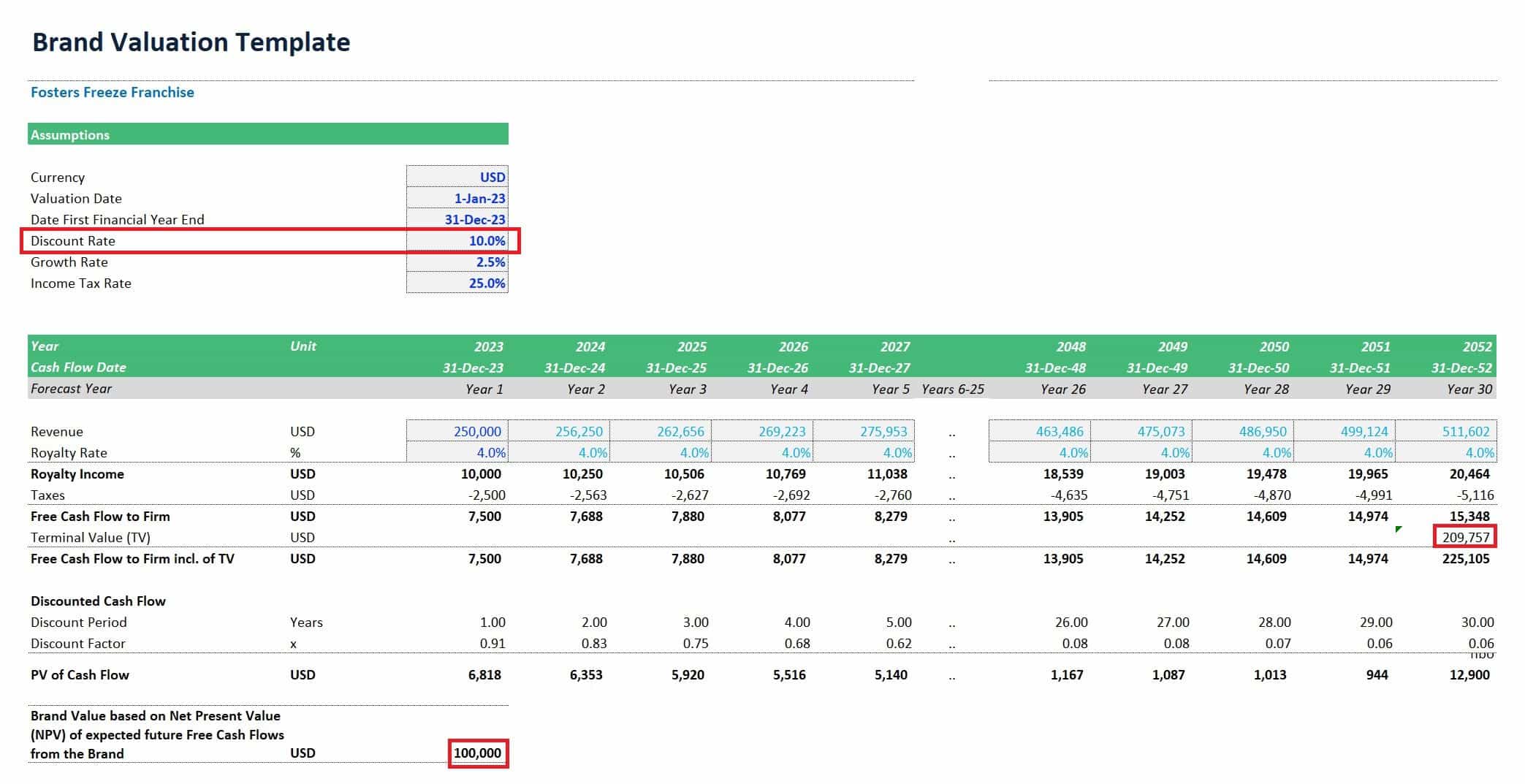
At a 10% discount rate, Fosters Freeze will have a TV equal to $209,757 and an NPV of $100,000.
Comparison
Because of the change in the discount rate, Fosters Freeze will be a better investment than Baskin Robbins, having a higher TV and NPV.
There are other ways you can use this Brand Valuation Template. All you need is to vary the assumption to determine your best investment.
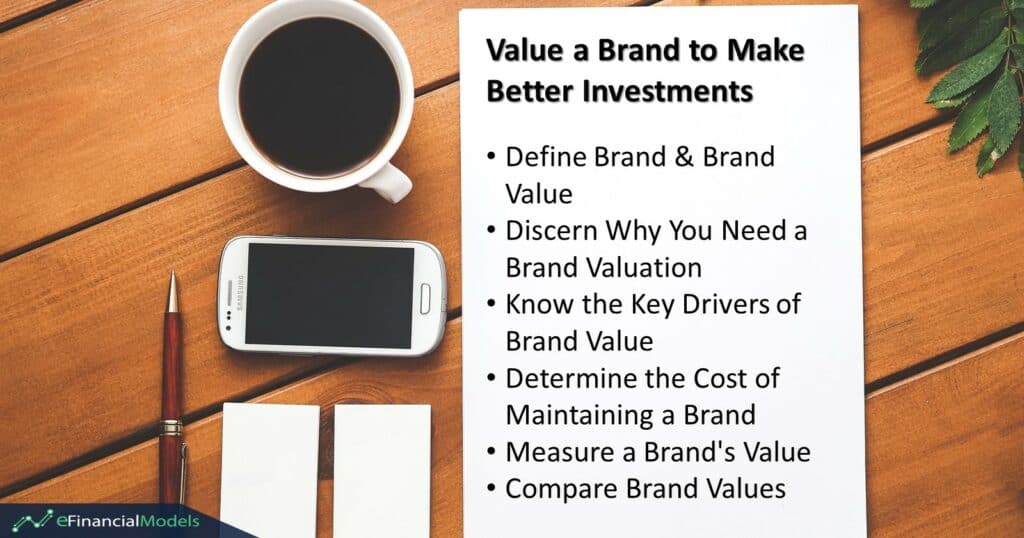
Value a Brand to Make Better Investments
A brand is an intangible asset that a business can create and is necessary to quantify. Brand value in financial modeling is its worth to management ad shareholders. There are various instances when a company may need to know its brand value. These may include budget allocations, brand reviews, financing, licensing, and mergers & acquisitions.
Many businesses use the cost-profit approach, discounted cash flow analysis, gross profit differential, or the relief from royalty technique to measure the value of a brand. Each method has its pros and cons. But in the end, what’s important is understanding the financial metrics in every brand valuation. They are readily available data to determine your brand’s worth.
Valuing your brand is an enormous task, particularly when considering the complex factors in the overall assessment. However, utilizing valuation templates can help you gain valuable insight into your brand’s current performance and ultimately arrive at a fair evaluation. Overall, brand valuation is an essential tool for companies to understand the value of their brands and make informed decisions about brand strategy, investment, and management.
Looking for financial model templates for Valuation? Feel free to browse our selection of Valuation Model Templates here: