
0 ITEMS

Canada MIC Financial Model: Mortgage Investment Corporation and Private Mortgage Fund with s.130.1 Compliance, OM Capital Raise, Loan Book, Credit Facility and Investor Returns
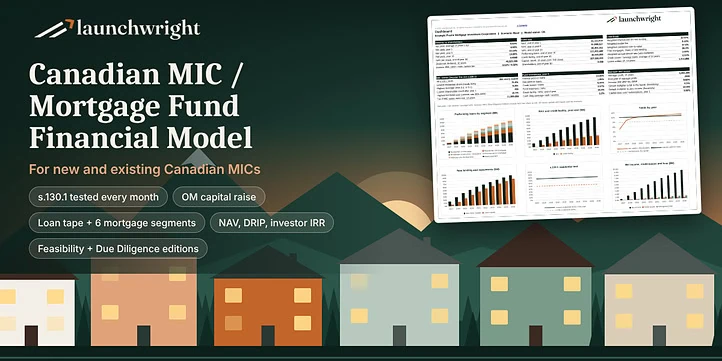
Monthly 10-year Excel model of a Canadian mortgage investment corporation, new or existing: capital raised under the offering memorandum exemption, a loan tape for an existing book, six mortgage segments with defaults and recoveries, a credit facility, 100% distribution, NAV per share and every Income Tax Act s.130.1 test checked monthly. Feasibility and Due Diligence editions, no macros, fully unlocked.
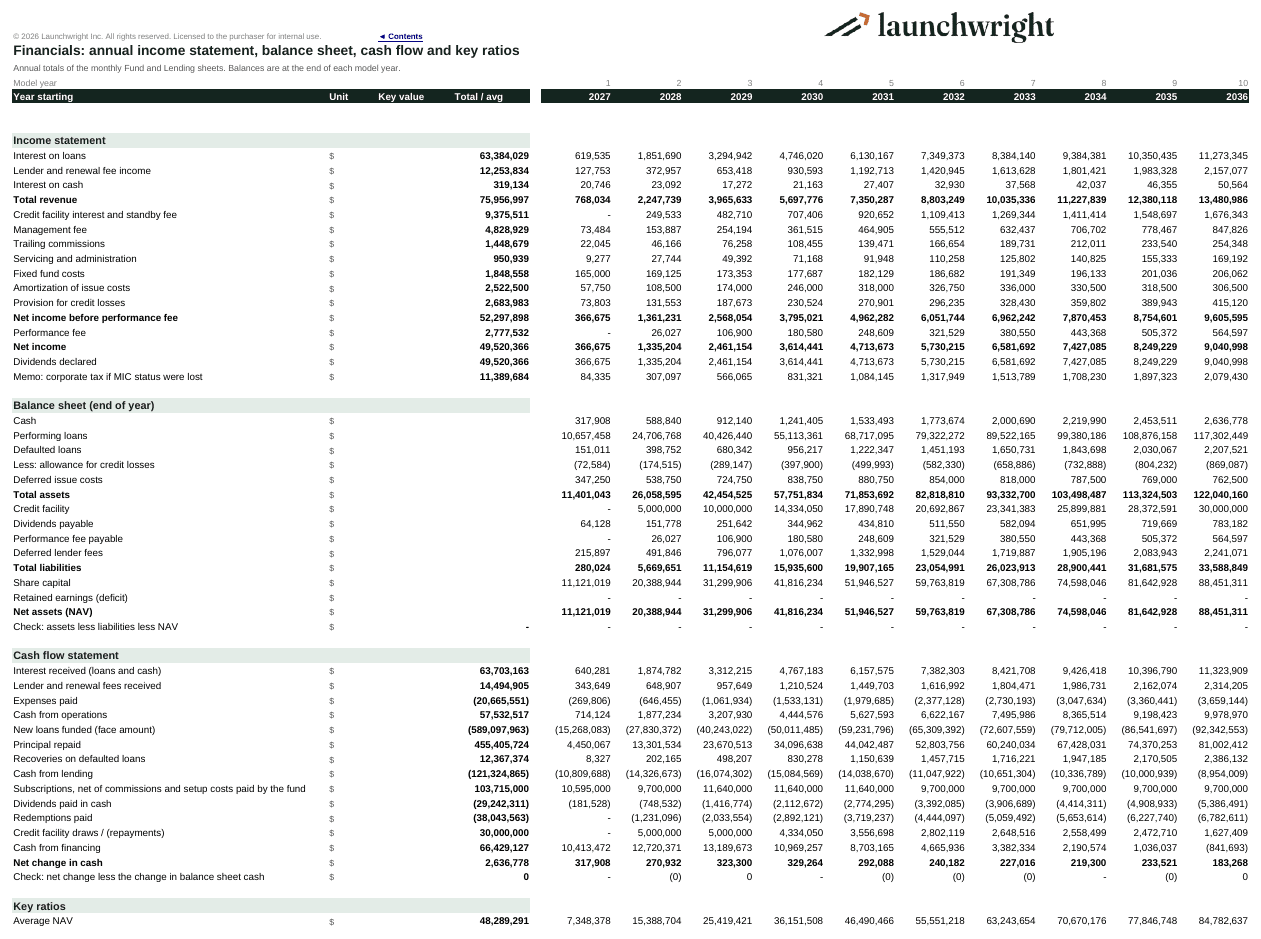
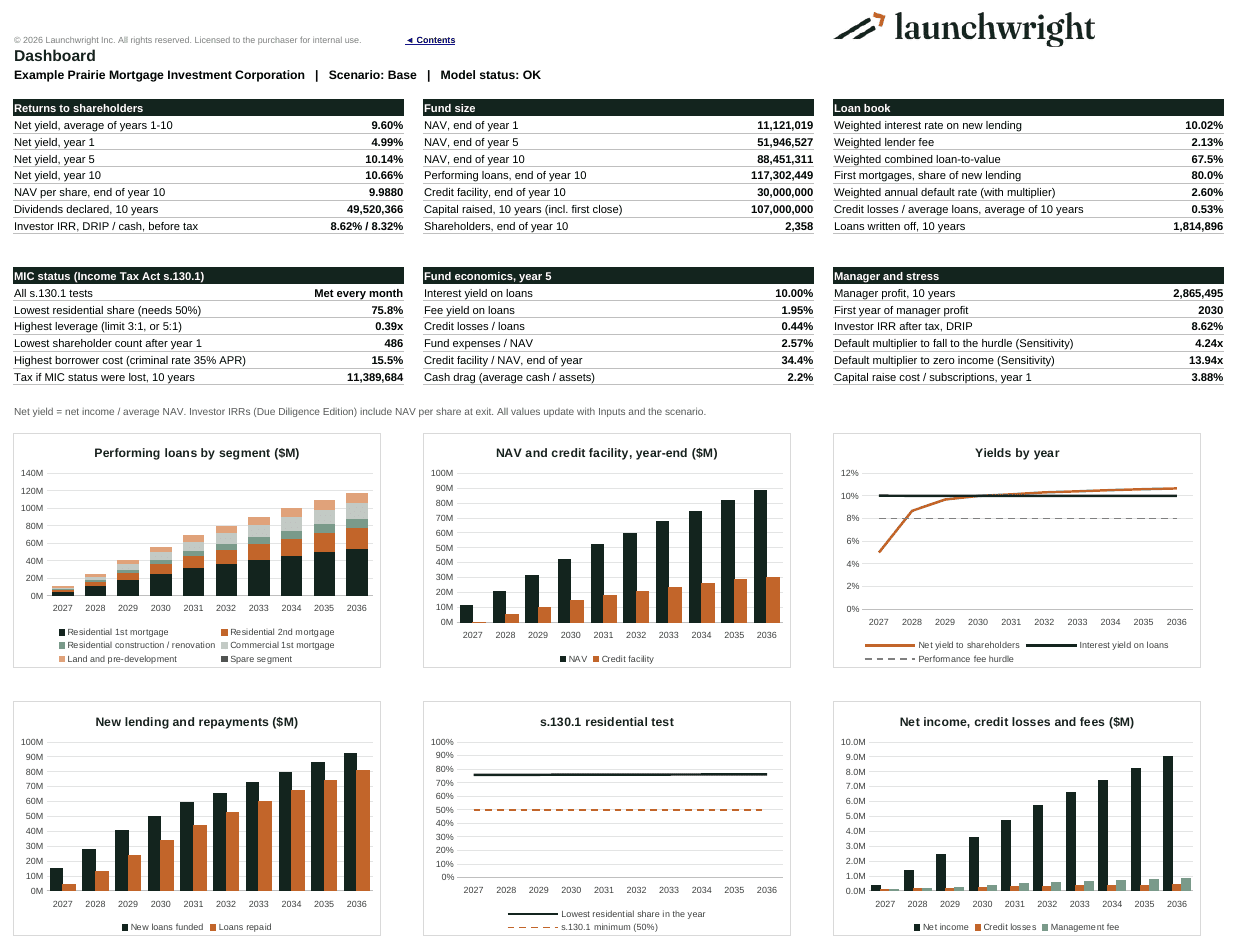
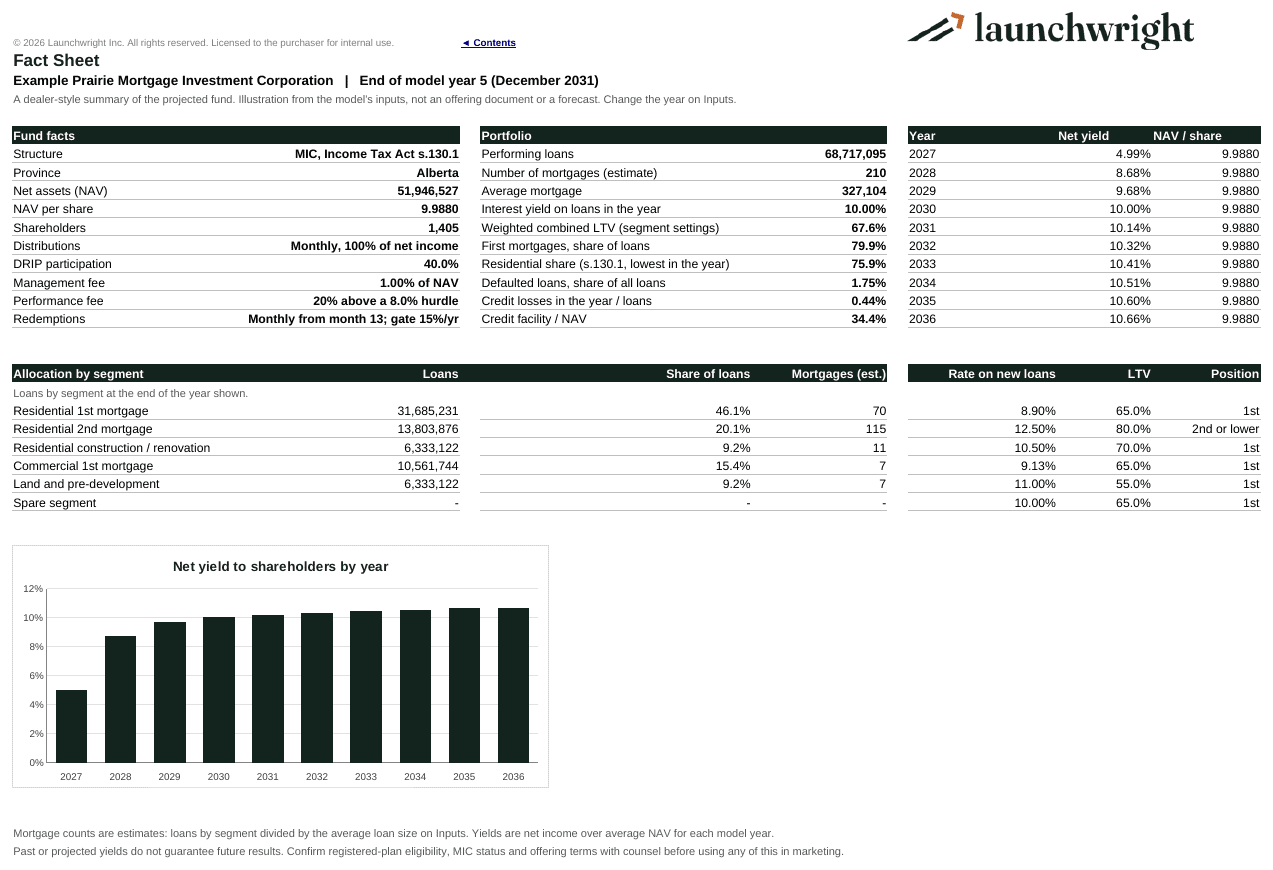
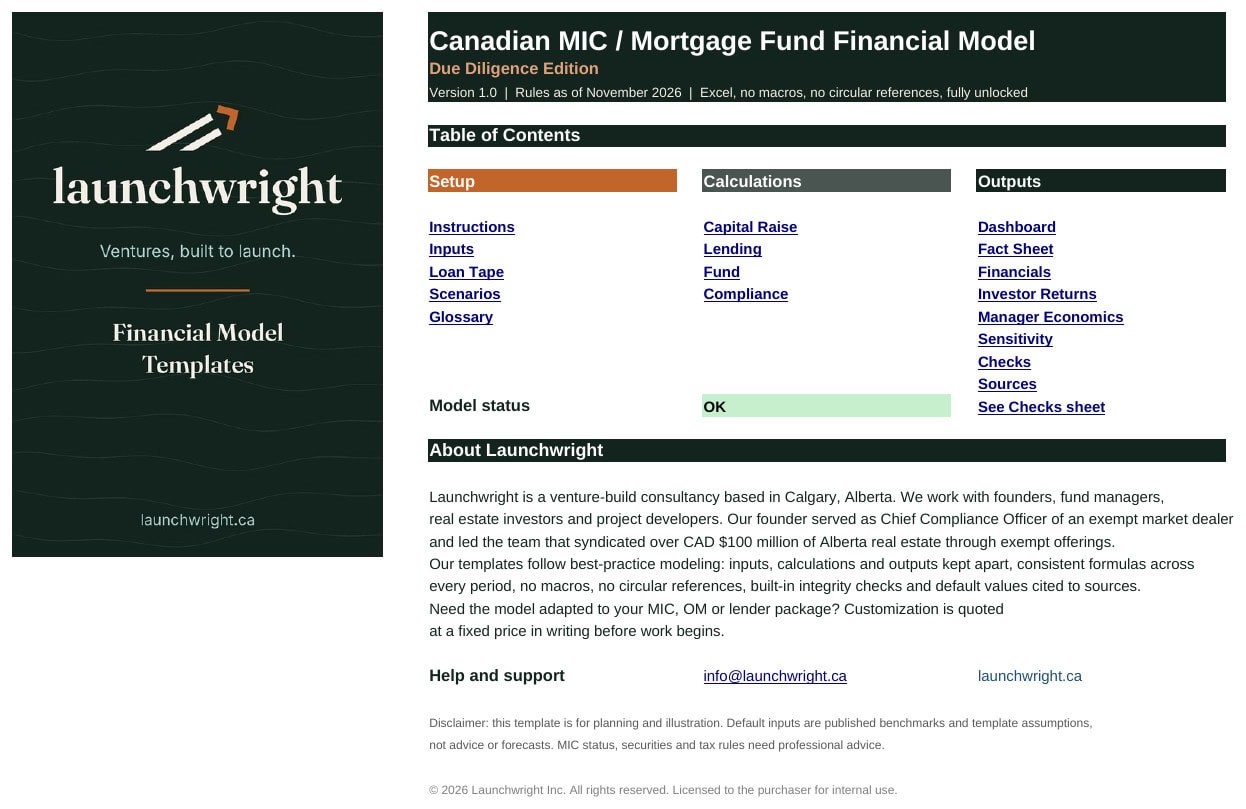
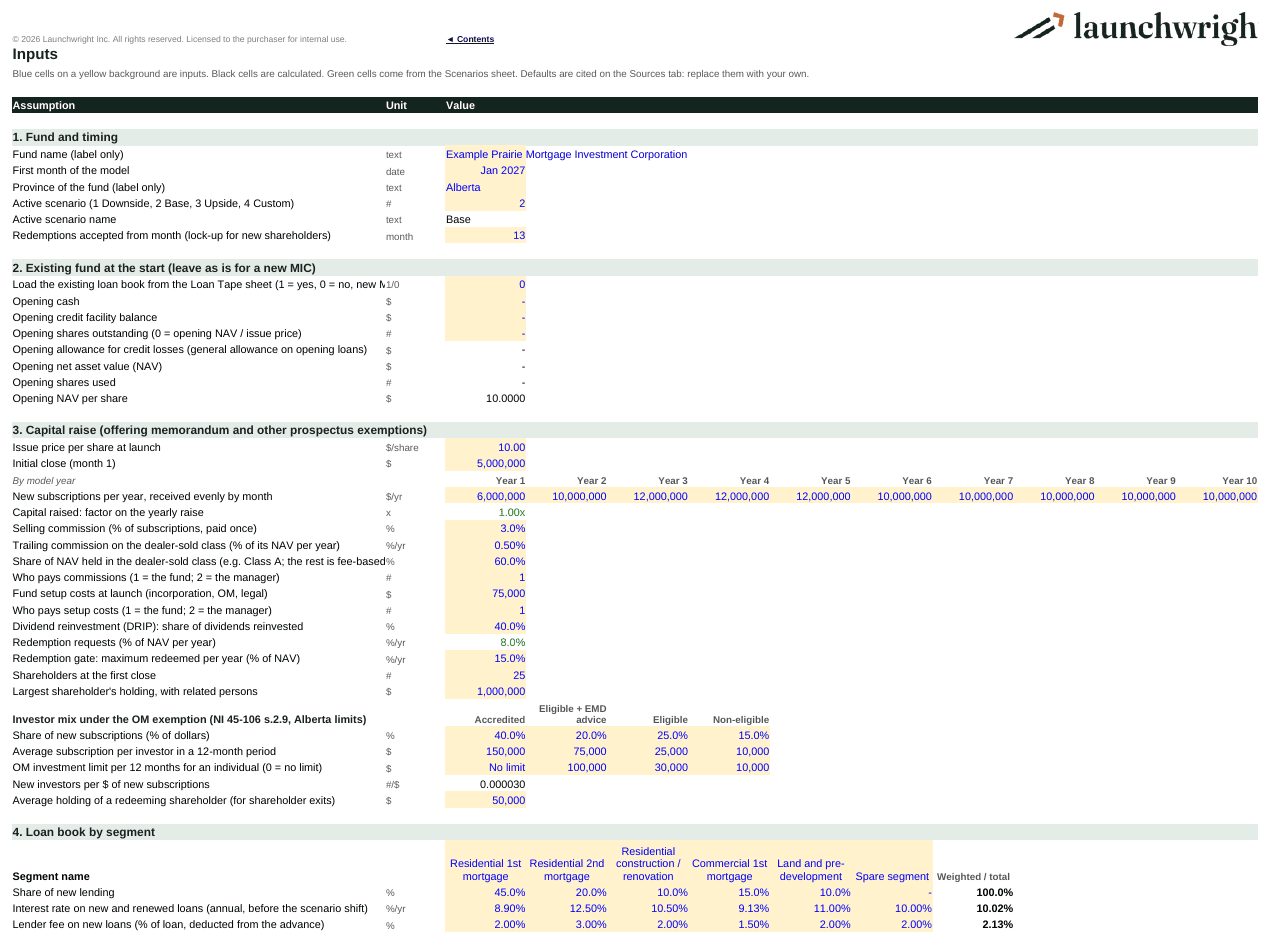
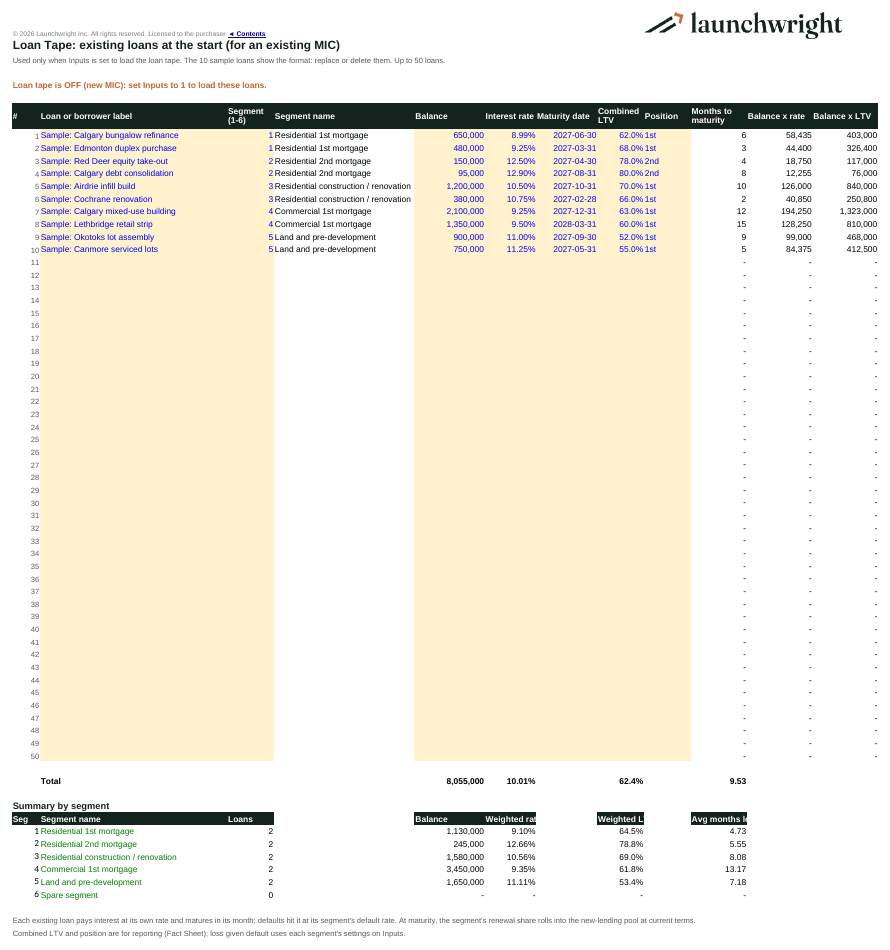

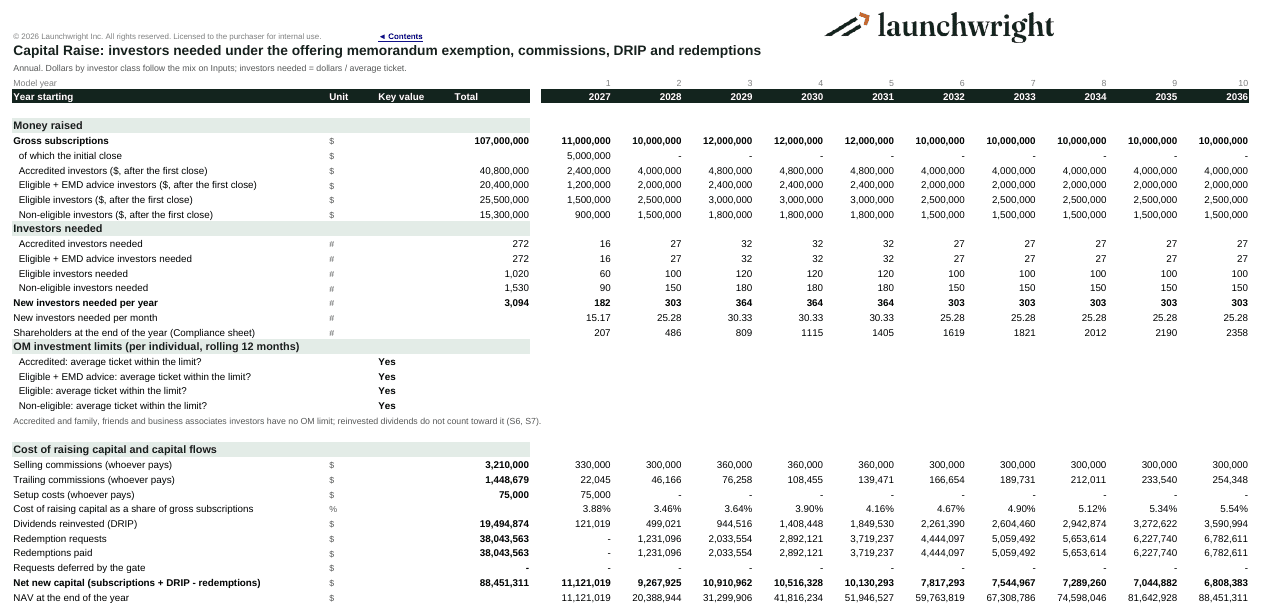
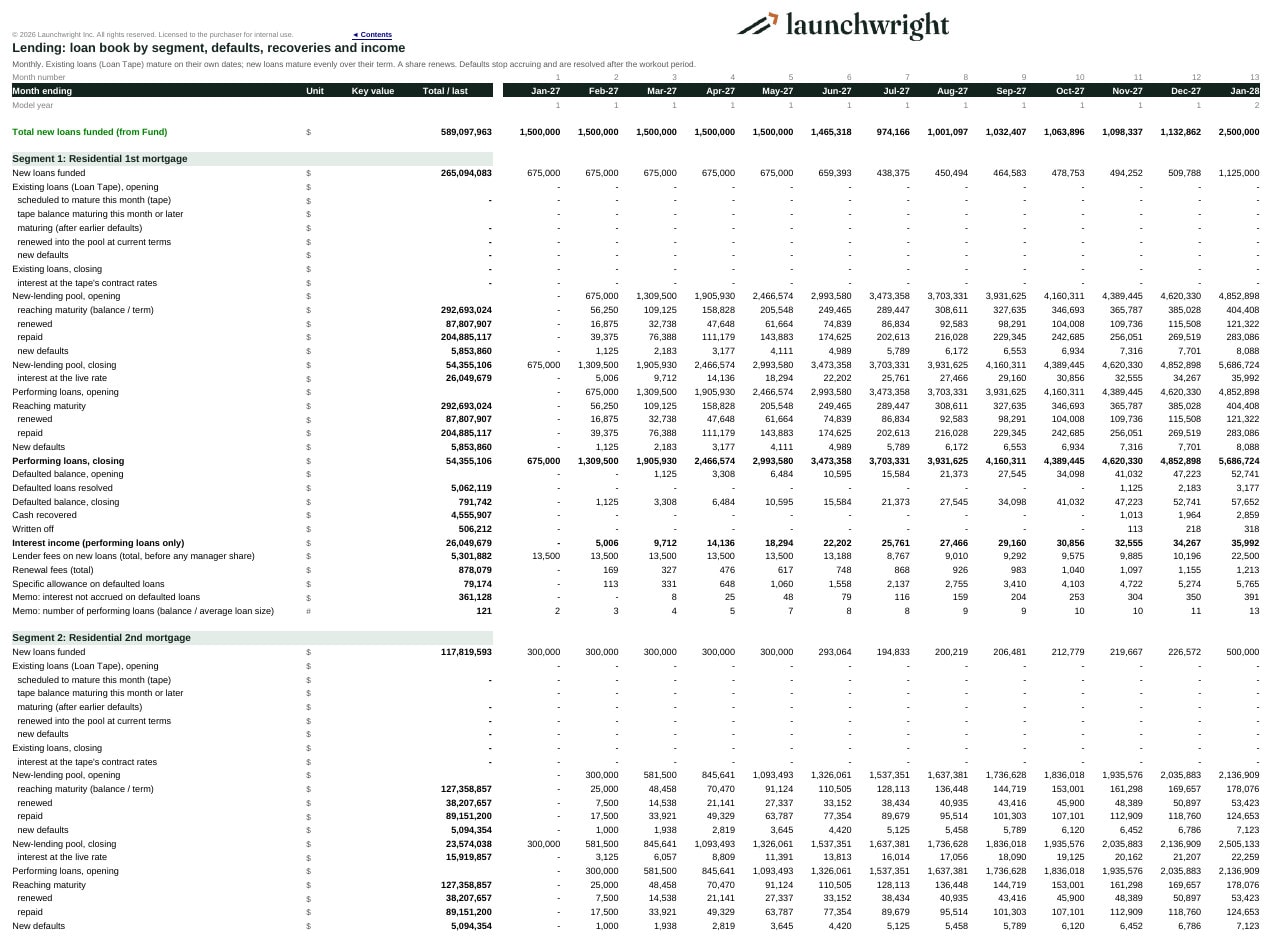
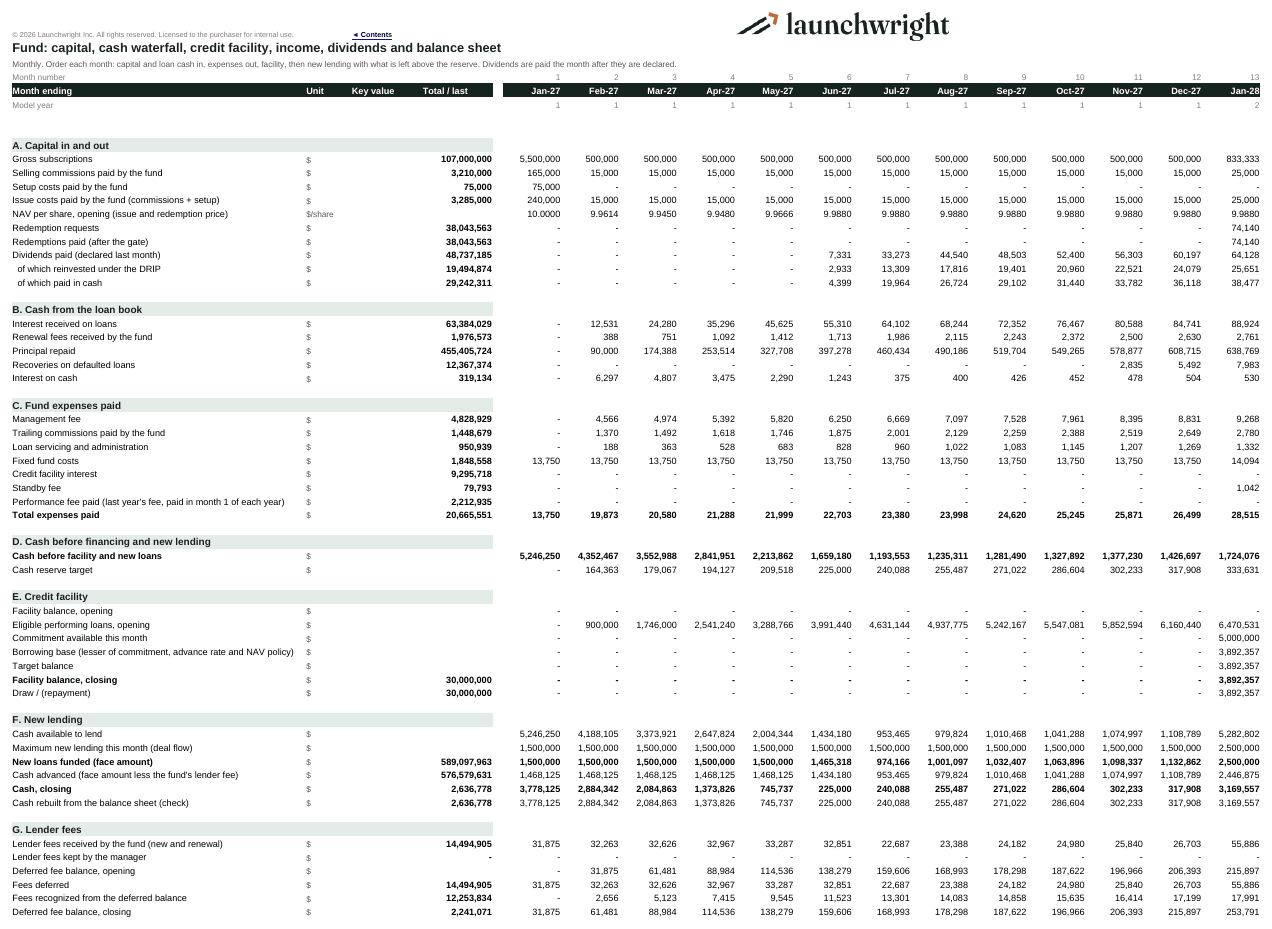
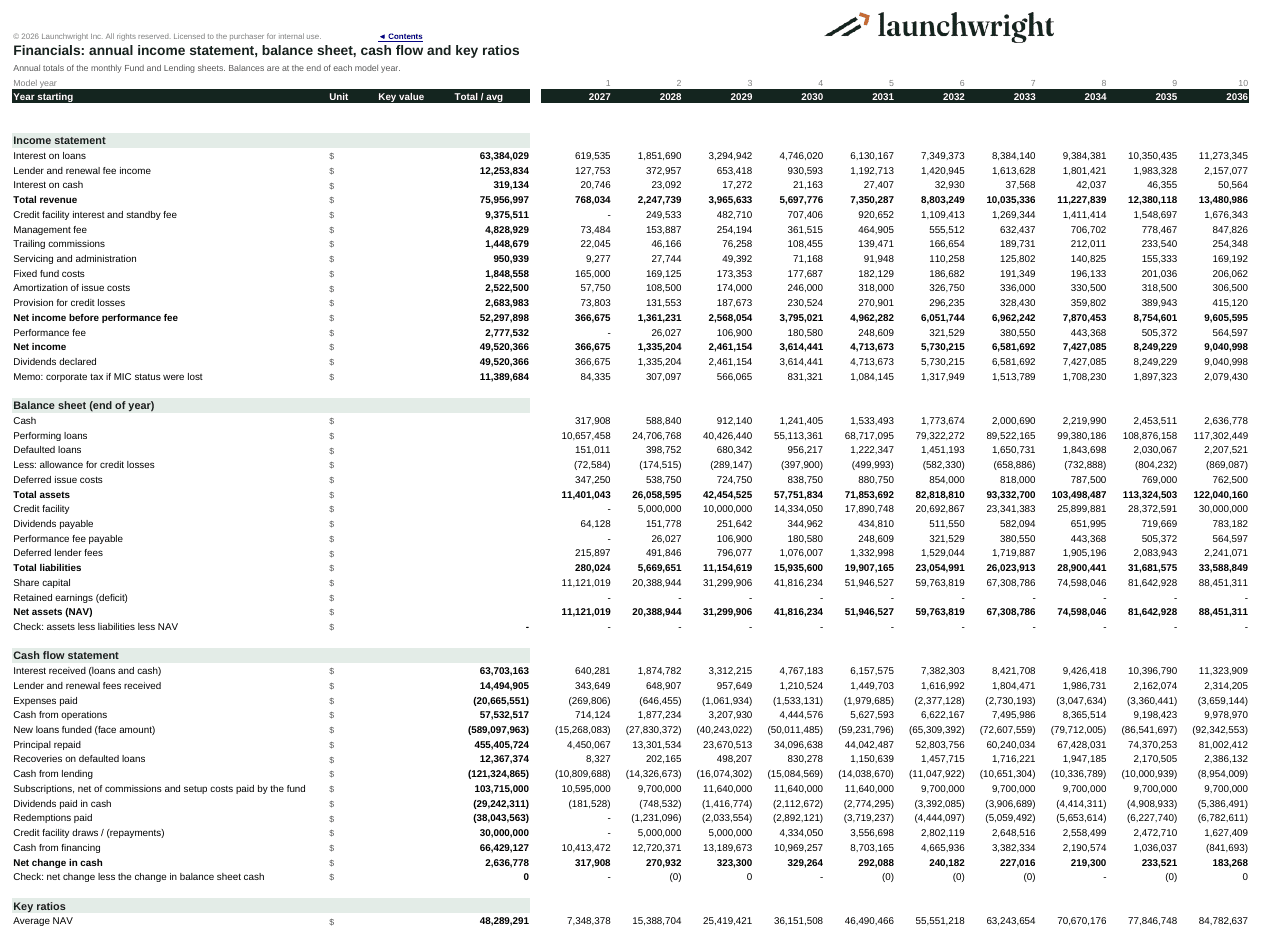
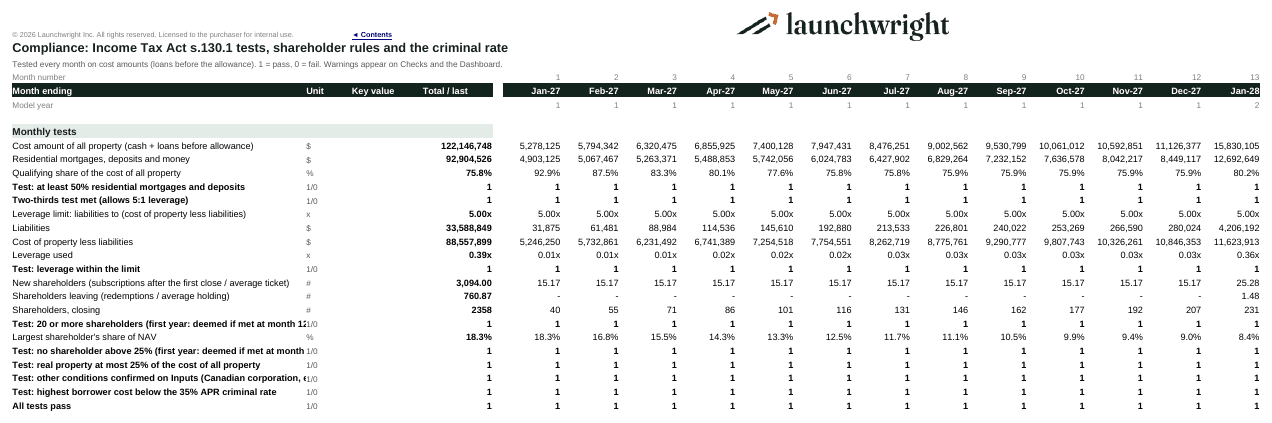

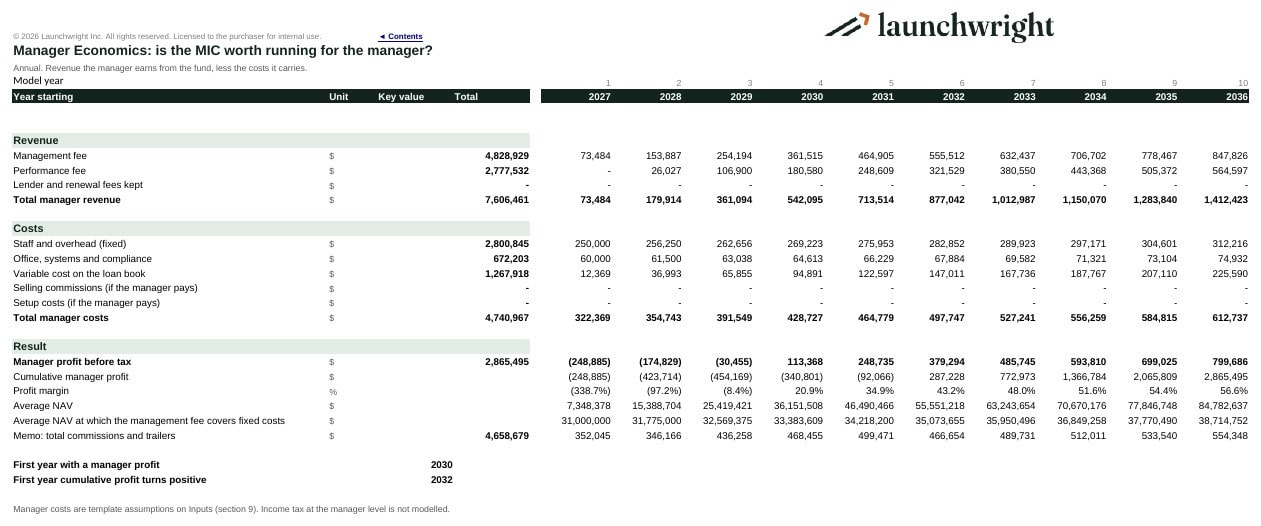
Launching or running a mortgage investment corporation in Canada? A MIC lets investors earn mortgage income with no corporate tax in the fund. It only works if the fund passes every test in section 130.1 of the Income Tax Act, all year, every year. It needs at least 20 shareholders and no holder above 25%. At least half its assets must be residential mortgages and deposits. Its borrowing must stay within 3:1, or 5:1 when two-thirds of assets qualify. At the same time it has to raise money within the offering memorandum limits, lend it out fast enough to avoid cash drag, and survive defaults. Generic debt fund templates cover none of this. This Excel model does.
Why this model
It runs the whole fund month by month for 10 years. Capital comes in from the initial close and yearly raise. It is lent across up to six mortgage segments, each with its own rate, fee, term, renewals, loan-to-value, position and default rate. The fund borrows on a credit facility against eligible loans and pays out 100% of its income. Losses are not a guess: each segment’s loss given default comes from its combined loan-to-value, its position behind any prior mortgage, the fall in property value at enforcement and the costs of selling. Every default value is cited on a Sources tab: the s.130.1 rules from McMillan and Miller Thomson, the Alberta OM limits from the Alberta Securities Commission, portfolio rates from Atrium and Firm Capital, prime from National Bank, and private-lender arrears from CMHC’s Fall 2026 report.
Canadian MIC rules built in
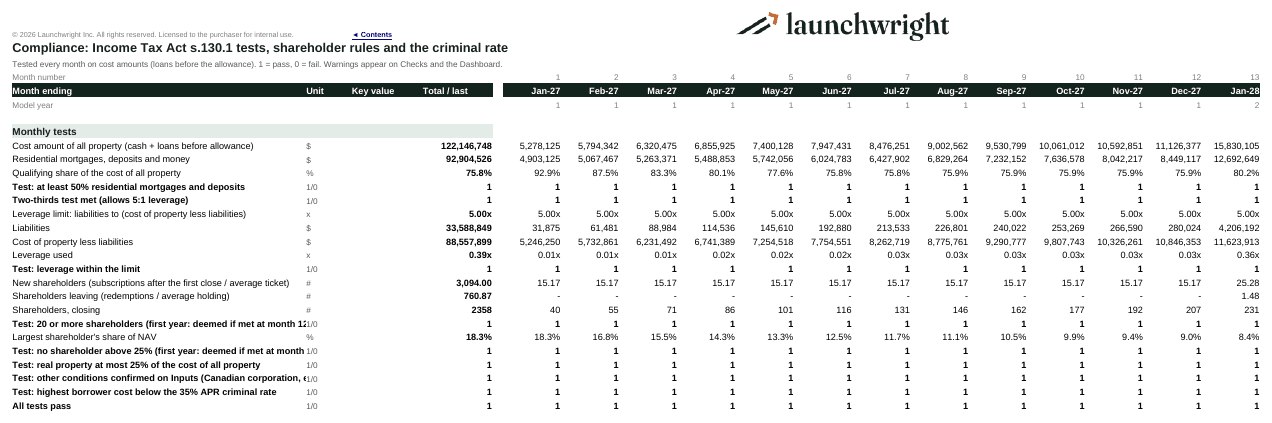
- Income Tax Act s.130.1 tested every month on cost amounts: the 50% residential mortgages and deposits test, the 3:1 or 5:1 leverage limit with the two-thirds test, 20 or more shareholders and the 25% holding limit (with the first-year deeming rule), real property and other conditions
- The tax the fund would pay if it lost MIC status (Alberta’s 23% general rate by default), shown so you can see what is at stake
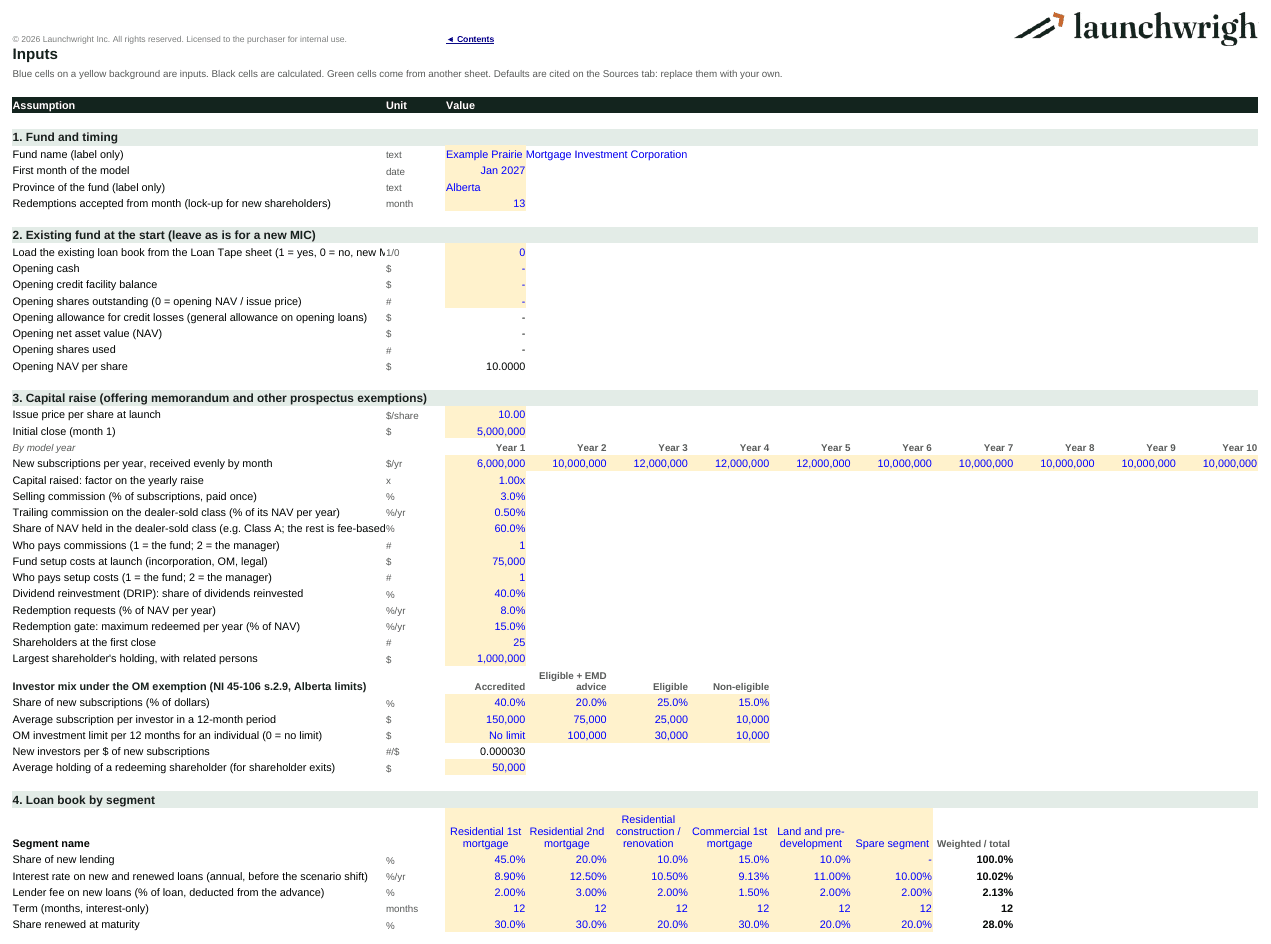
- The offering memorandum exemption: an investor mix of accredited, eligible with EMD advice, eligible and non-eligible investors, average tickets checked against the $10,000, $30,000 and $100,000 limits, and the number of new investors needed each year and month
- DRIP reinvestment, which does not count toward the OM limits, plus redemptions with a lock-up and an annual gate
- Share issue costs deducted over five years, as the Income Tax Act allows, or charged to share capital
- The 35% APR criminal interest rate checked against each segment’s rate and fee
Lending and fund engine
- Loan Tape for an existing MIC: up to 50 loans with balance, rate, maturity date, LTV and position. Each loan pays its own rate and matures in its own month, and renewals roll into new lending at current terms. Switch it off for a new fund
- Loan book by segment: residential first and second mortgages, construction and renovation, commercial, land and a spare segment; interest-only loans that mature over their term, with renewals and renewal fees
- Defaults by segment with a scenario multiplier; defaulted loans stop accruing and are resolved after a workout period, with cash recovered and write-offs; specific and general allowances and the provision for credit losses
- Lender fees deducted from the advance, recognized when received or spread over the term, with an option for the manager to keep a share
- A revolving credit facility from a chosen month: commitment by year, advance rate on eligible first mortgages, a NAV cap, prime plus a spread and a standby fee
- Deal flow limits on new lending by year, so cash drag appears when the raise outpaces your pipeline
- Management fee on NAV, total assets or the loan book; a performance fee calculated on the year’s income above a hurdle, accrued monthly and paid after year-end; trailing commissions on the dealer-sold share class only; servicing and fixed fund costs
Two editions
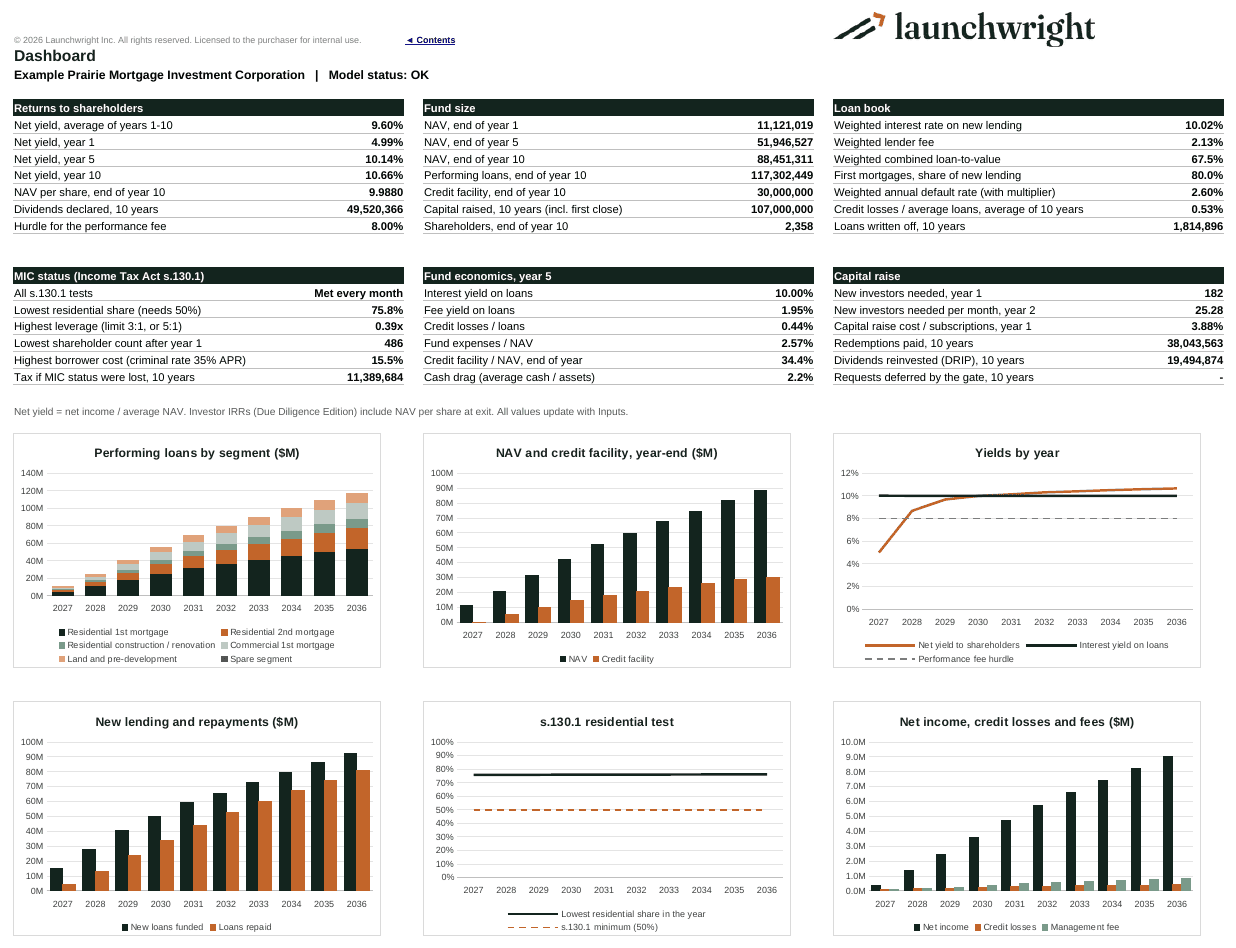
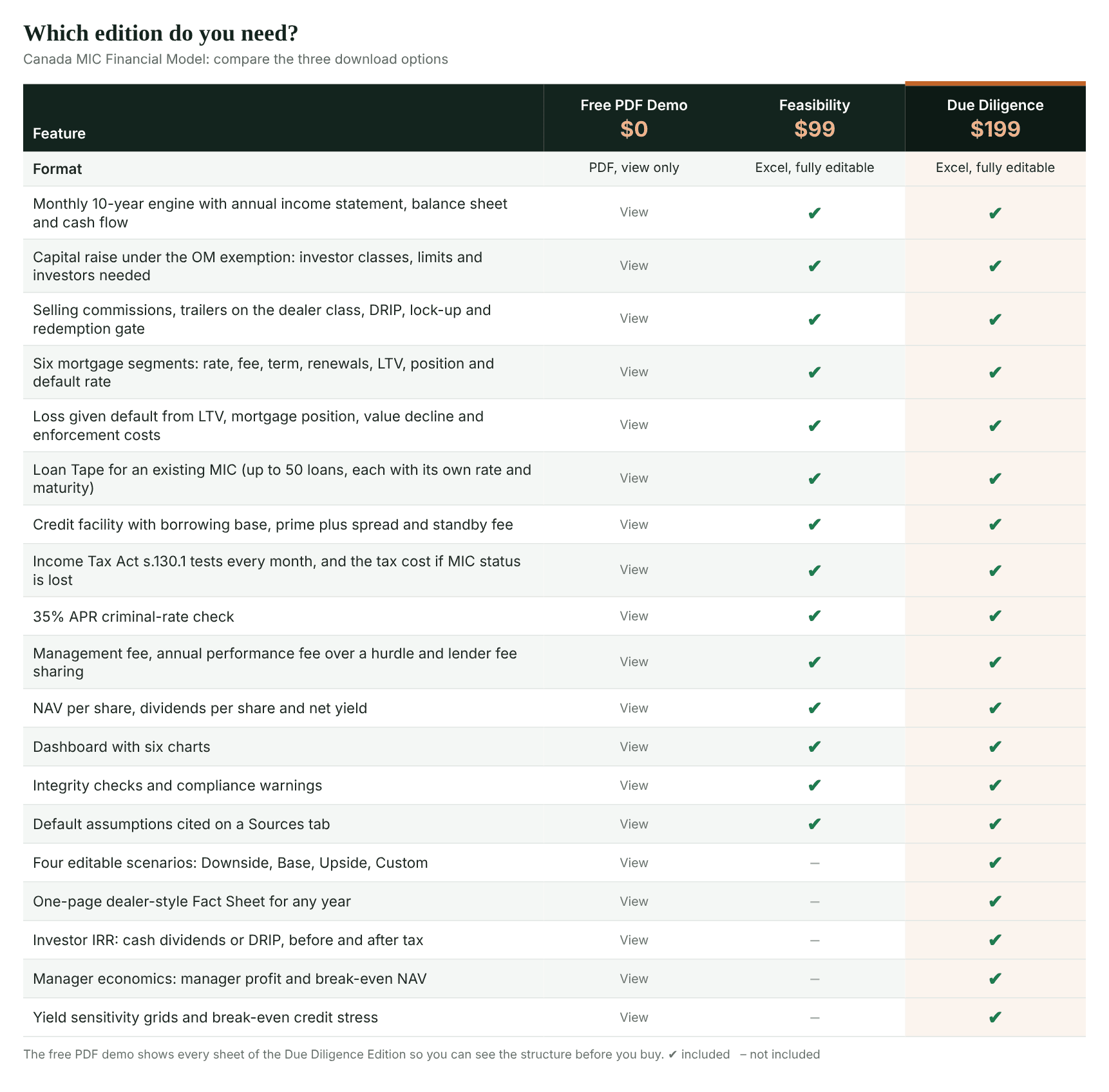
- Feasibility Edition: the full monthly engine, capital raise and OM limits, s.130.1 compliance, an annual income statement, balance sheet and cash flow, key ratios (net yield, NAV per share, interest and fee yield, credit loss ratio, expense ratio, leverage, cash drag), a dashboard with six charts and integrity checks.
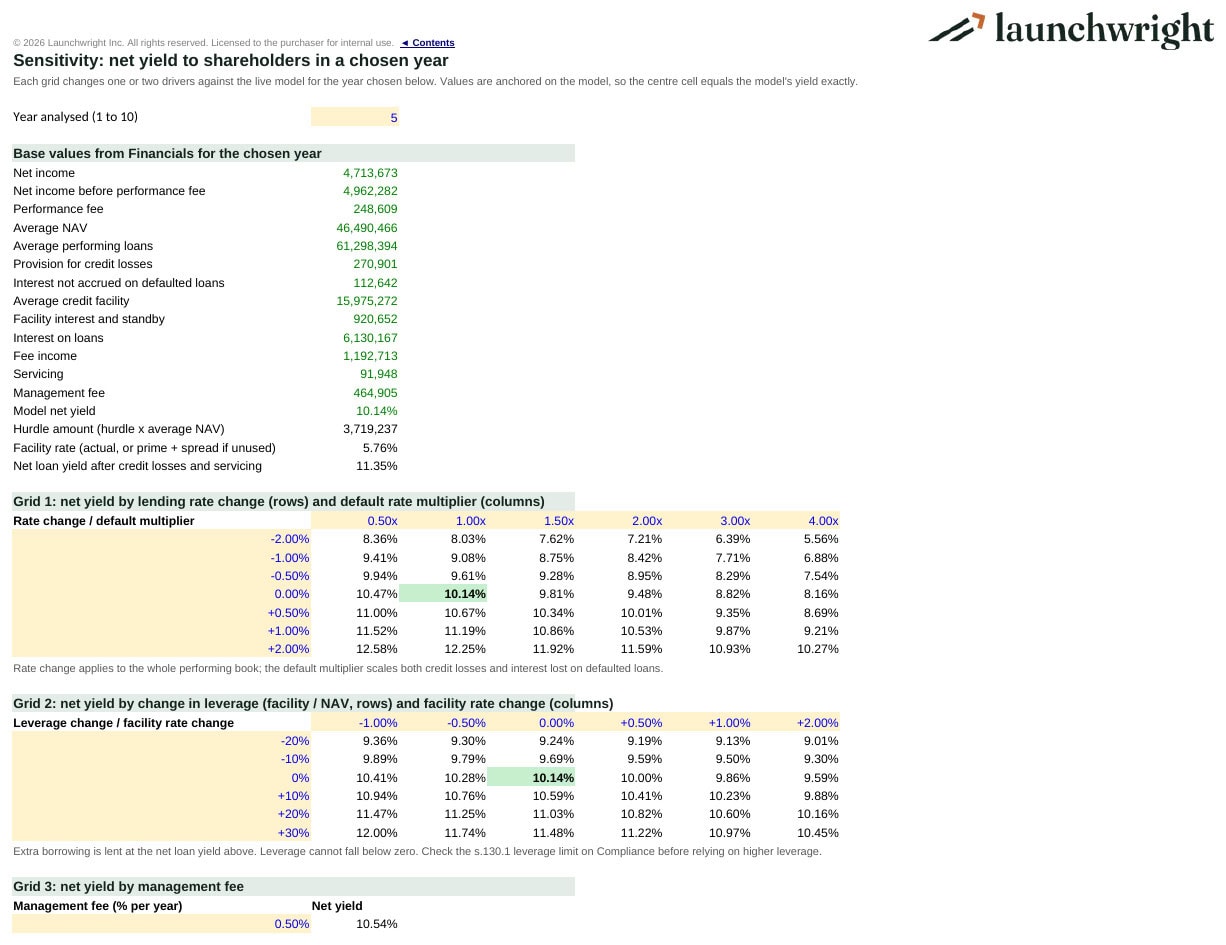
- Due Diligence Edition: everything in the Feasibility Edition, plus a one-page dealer-style Fact Sheet for any year (NAV, mortgages, average loan, LTV, first-mortgage share, allocation by segment, yield history), four editable scenarios (Downside, Base, Upside, Custom), one investor’s IRR with cash dividends or DRIP, before and after tax, the manager’s own profit and loss with a break-even NAV, and three yield sensitivity grids anchored on the model with break-even default multipliers.
Key outputs
- Net yield to shareholders by year, dividends per share, NAV per share and NAV
- Performing loans by segment, new lending against repayments, defaulted loans, write-offs and credit losses
- Credit facility balance, borrowing base and leverage; cash drag
- 130.1 compliance by month and by year, shareholder count and largest holding
- Estimated number of mortgages and average loan size by segment
- Investors needed under the OM limits and the cost of raising capital
- Due Diligence: investor IRR and money multiple, manager profit and first profitable year, yield grids and break-even credit stress
Built to modeling best practice
- Inputs, calculations and outputs on separate sheets; blue-on-yellow inputs, black formulas and green links
- One formula per row across 120 monthly columns, verified consistent in every period; annual sheets sum the months, so nothing is typed twice
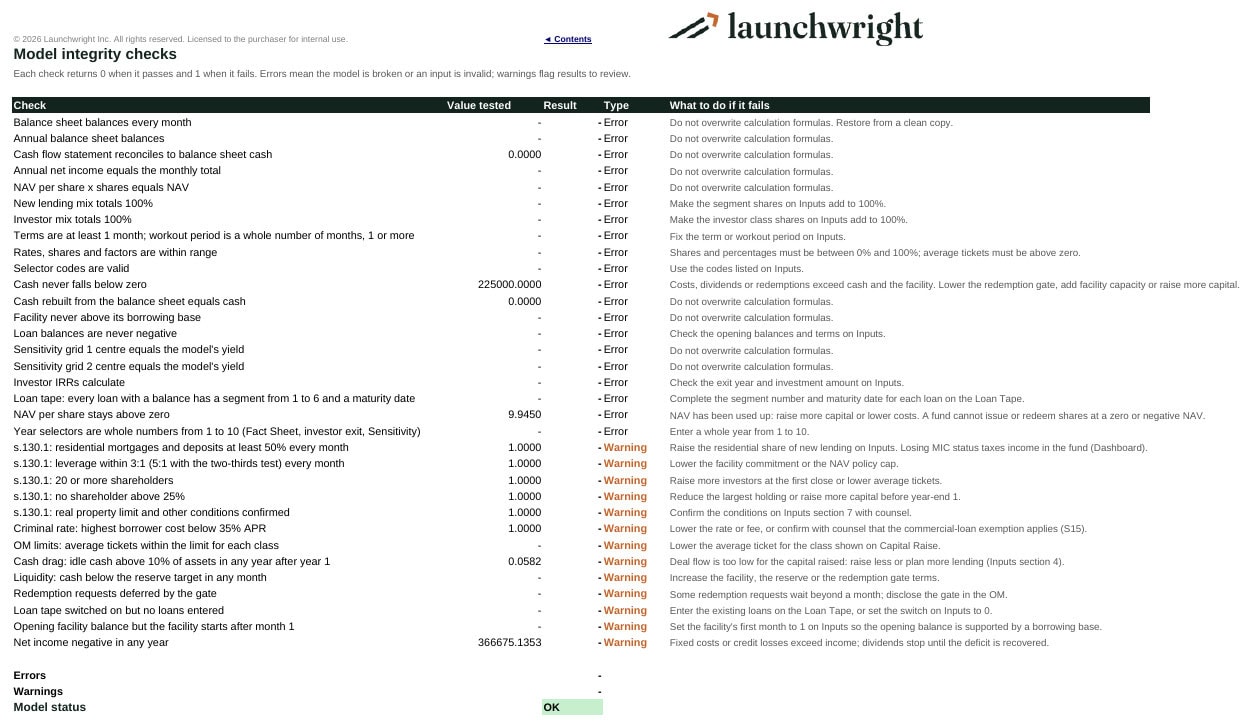
- The Checks sheet confirms the balance sheet balances every month, cash flow reconciles, NAV per share agrees, cash never goes negative and the facility stays within its base. It warns on any s.130.1 failure, the criminal rate, OM limits, cash drag, liquidity and gated redemptions
- No macros, no circular references, no hidden or protected sheets, no external links; Contents sheet with links, instructions, glossary and a full source list
Default assumptions
Defaults describe a new Alberta MIC launched in January 2027 with a $5,000,000 first close and $6 to $12 million raised each year. It lends 45% in residential first mortgages, 20% in second mortgages, 10% in residential construction, 15% in commercial first mortgages and 10% in land. The weighted rate is 10.02% with a 2.13% lender fee and a 67.5% combined loan-to-value. A credit facility at prime (4.70%) plus 1.00% opens in month 13, capped at 35% of NAV. In the Base case the fund reaches $88.5 million of NAV and $117.3 million of performing loans by year 10. The net yield to shareholders is 5.0% in year 1, while capital is deployed, then 10.1% in year 5 and 10.7% in year 10. Credit losses average 0.53% of loans a year. It passes every s.130.1 test every month, with a residential share of at least 75.8% and leverage of at most 0.39:1. An investor who puts in $100,000 at the first close and redeems after five years earns an IRR of 8.62% with DRIP, or 8.32% taking cash. The Downside scenario doubles defaults, deepens the property value decline, squeezes the lending margin and slows the raise; the year 5 yield then falls to 7.7%. Ten sample loans on the Loan Tape show the existing-fund mode with one switch. Fund costs, commissions and deal flow are template assumptions: replace them with your own.
Compare the editions
The free PDF demo, the Feasibility Edition ($99) and the Due Diligence Edition ($199) side by side:
What you get
- One Excel workbook (.xlsx) for the edition purchased, built only with functions available since Excel 2010 (no dynamic arrays, no macros)
- A free PDF demo showing the main sheets of the Due Diligence Edition
Support and customization
Questions about how the template works are answered by email. Launchwright can also adapt the model to your MIC, offering memorandum, lender package or existing loan book, quoted at a fixed price in writing before work begins. Contact details are inside the model.
Important
This template is for planning and illustration. It is not legal, tax, securities or investment advice. MIC status depends on detailed rules, including what counts as a house or housing project, that need a tax opinion. Offering memorandum requirements, filings and dealer registration are outside the model. The rules in this version are as published on November 1, 2026.
Similar ProductsOther customers were also interested in...







 eFinancialModels
Electric Vehicle (EV) Charging Station Financial M...
With this comprehensive 5- or 10-year monthly tool, investors can assess the viability of setting up... Read more
Financial Model for Mobile App | Mobile App Busine...
The Mobile App Financial Plan Template in Excel allows you to develop financial projections when lau... Read more
 HenrySheykin
Food Truck Financial Model Excel Template
The Food Truck Financial Model helps entrepreneurs, founders, business owners, consultants, and anal... Read more
Green Hydrogen Production from Wind Energy Financi...
The Green Hydrogen from Wind Financial Model aims to comprehensively forecast a horizon of 40 years ... Read more
Simple Mutual Non-Disclosure Agreement Template
Protect your business secrets with ease using our Simple Mutual Non-Disclosure Agreement Template. S... Read more
Solar Energy Financial Model
The Solar Energy Financial Model Spreadsheet Template in Excel assists you in preparing a sophistica... Read more
 Peter Graf
The Customer-Centric Financial Model for Restauran...
Starting a restaurant without a financial plan is like driving a car blindfolded. You wouldn´t do i... Read more
You must log in to submit a review.