
0 ITEMS

Sell Smart: Strategic Financial Plan for Selling Your Business
Table of Content
- Strategic Financial Plan: Key Selling Tool
- Two Key Reasons Why Existing Businesses Need a Financial Plan
- How to Create a Business Financial Plan for Existing Companies
- Essential Financial Plan Components for Successfully Selling Your Business
- Strategic Financial Plan: Maximize Your Sale Through Financial Modeling

Creating a solid financial plan is crucial for successfully selling your business and maximizing its value.
- A strategic financial plan details your company’s assets, liabilities, income, and long-term growth goals.
- It provides clear, measurable objectives that align with your business strategy, supporting better decision-making.
- Key components include cost analysis, debt assessment, detailed financial statements, and cash flow forecasts.
- A well-prepared valuation analysis and risk management plan can attract serious buyers and justify your asking price.
- Regular updates and thorough financial documentation help streamline the sales process and build buyer confidence.
Understanding and implementing these financial plan components ensures you’re positioned for a profitable sale.
Strategic Financial Plan: Key Selling Tool
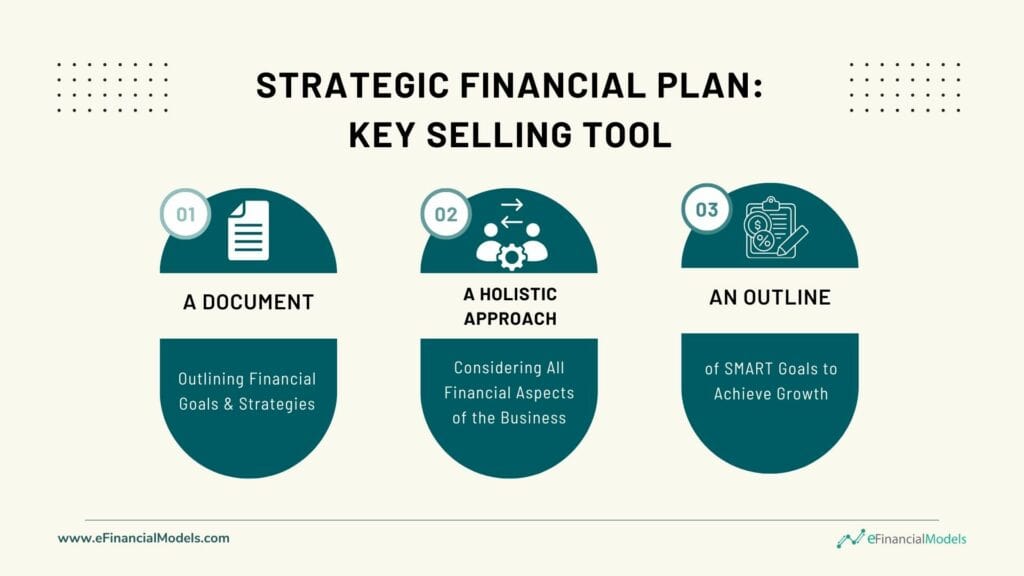
Now, here comes the question: What is a strategic financial plan? A strategic financial plan is a document that outlines a company’s current financial status, detailing assets, liabilities, income, and expenditures. It sets long-term financial goals, including growth targets, profitability objectives, and debt reduction plans. This plan provides strategies and actionable steps to achieve these goals, acting as a roadmap for the company’s financial future. As a key selling tool, it demonstrates to potential buyers a clear path to continued financial success and stability.
A strategic financial plan is also a holistic approach that considers every facet of a company’s financial life. It involves integrating all financial components, including assets (what the company owns), liabilities (what the company owes), taxes, income streams, and business operations. The interconnectedness of these elements is vital, ensuring that decisions in one area bolster and enhance the company’s overall financial health. As a key selling tool, it demonstrates a well-rounded and cohesive financial strategy to potential buyers, showcasing a clear path to sustained financial success.
What is a strategic financial plan beyond a document and a holistic approach? It outlines clear and measurable financial goals that are SMART (Specific, Measurable, Achievable, Relevant, and Time-Bound) and tailored to the company’s unique needs and aspirations. The plan outlines detailed strategies and steps to achieve these goals, including budget allocations, investment strategies, and risk management. Regularly monitoring and reviewing the plan is crucial, allowing for adjustments to ensure the company remains on track to meet its financial objectives. As a key selling tool, it demonstrates a well-defined and proactive path to sustained economic success and stability to potential buyers.
Key Differences Between the Business Plan and Financial Plan
When starting or managing a business, it’s essential to distinguish between the business plan and financial plan, as each serves a unique purpose.
A business plan lists the objective; the financial plan executes it. The business plan lists the organization’s objective goals, detailing what the business aims to achieve within a specified timeframe set by management. This includes a logical arrangement of goals and the paths to realize them in the real world. Once the organization’s objectives are outlined in the business plan, the planning process moves to the next phase, where financial planning becomes essential. Financial planning supports entrepreneurs by providing a structured approach to managing and allocating resources effectively, ensuring the set objectives are financially achievable. It involves creating detailed budgets, forecasting revenue and expenses, and establishing financial controls to monitor performance. Through financial planning, entrepreneurs can identify potential financial risks, explore funding options, and develop strategies to maintain cash flow and profitability. This meticulous financial groundwork helps turn strategic goals into actionable plans, enhancing the likelihood of business success and sustainability.
A business plan outlines your business strategy, while a financial plan projects financial statements over 3 to 5 years. A business plan provides a comprehensive overview of your business strategy, objectives, market analysis, and operational plans. It serves as a roadmap for how the business intends to achieve its goals. In contrast, a financial plan focuses specifically on the financial aspects of the business, projecting income statements, balance sheets, and cash flow statements over a 3- to 5-year period. This plan helps forecast future financial performance, guide budgeting, and ensure the business remains financially viable.
You often start a business idea with a business plan; you prove business profitability in a financial plan. Starting a business typically begins with a business plan outlining your idea, strategy, market analysis, and operational plans, serving as a roadmap for achieving your business goals. However, to demonstrate your business’s financial viability and potential profitability, you need a financial plan. It reassures investors and stakeholders that your business idea is strategically sound and financially profitable, showing how it will generate revenue, manage expenses, and sustain growth.

Businesses need both the business plan and financial plan to ensure comprehensive and strategic management. Together, the insight the business plan and financial plan provide aligns strategic goals with financial viability and guides businesses toward sustainable growth and success.
Two Key Reasons Why Existing Businesses Need a Financial Plan
A well-structured financial plan is crucial for existing businesses, primarily for two key reasons: raising funds and facilitating the sale of the company.
- Raising Funds: Firstly, a comprehensive financial plan demonstrates to potential investors and lenders that the business is well-managed and has a clear strategy for growth, thereby increasing the likelihood of securing the necessary capital. It provides potential lenders and investors with a detailed insight into the business’s current financial status, future revenue projections, and growth strategies. This transparency builds trust and demonstrates the business’s ability to manage its finances effectively, making it more attractive to financial backers.
- Selling the Business: Detailed financial projections, risk assessments, and cash flow analyses provide the transparency and confidence investors seek. Secondly, when selling a business, a robust financial plan highlights its profitability, sustainability, and growth potential, making it more attractive to prospective buyers. This detailed financial roadmap enhances the business’s market value and ensures a smoother transition, benefiting both the seller and the buyer.






















































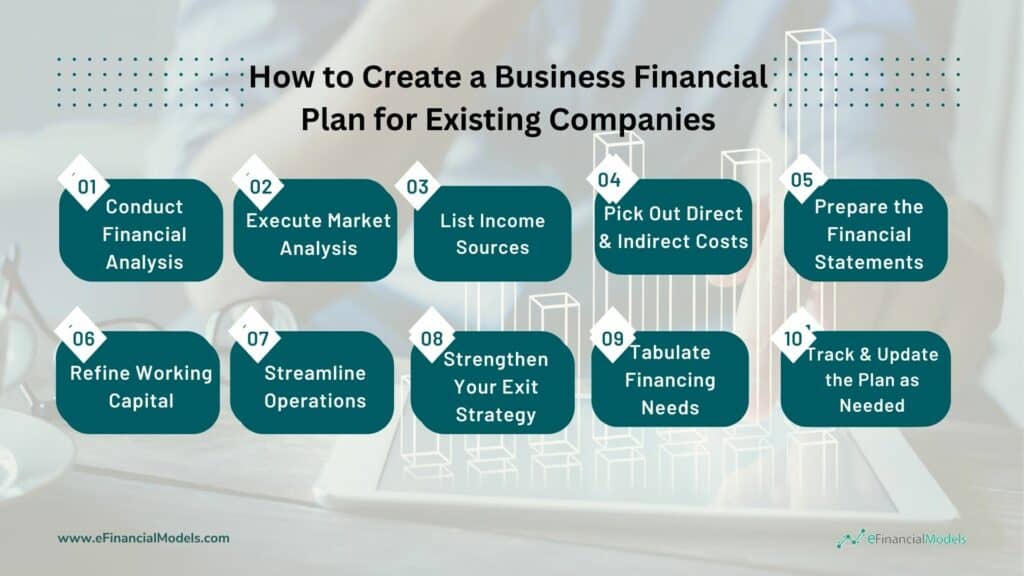
How to Create a Business Financial Plan for Existing Companies
The steps on how to create a business financial plan mainly depend on the goal and type of company. Understanding how to build a strategic financial plan is crucial, as it varies significantly between startups and existing businesses. Each type of company requires different approaches and considerations to address its unique needs and objectives effectively. For startups, the financial plan might focus on initial funding, projections for growth, and managing cash flow during the early stages. In contrast, established businesses may emphasize optimizing existing resources and growth strategies or making the company more attractive to prospective buyers. Tailoring these financial plan components to the business’s specific circumstances is essential for crafting a plan that supports its overall success and sustainability. Here are the crucial steps on how to create a business financial plan for existing companies:
- Conduct Financial Analysis: Unlike startups, existing businesses have historical financial data that can be analyzed to create a more accurate financial plan. When selling an existing business, you can leverage past income statements, balance sheets, and cash flow statements to craft a more precise business valuation. By thoroughly analyzing this historical data, you gain insights into the company’s performance over time, allowing you to build a realistic and credible financial plan to enhance the business’s appeal to potential buyers.
- Execute Market Analysis: Conducting a comprehensive market analysis is essential for selling your business. This step on how to create a business financial plan involves examining current market conditions, industry trends, and the competitive landscape to ensure that your financial expectations align with real-world dynamics. You can pinpoint opportunities and threats that impact your business’s value by evaluating your market share, target audience, and customer behavior. This insight lets you refine your financial plan and positioning, making your business more attractive to potential buyers and enhancing its market appeal.
- List Income Sources: When preparing to sell your business, it’s crucial to identify and list all income sources. It involves detailing your current revenue streams and exploring potential new ones. By analyzing the performance and sustainability of each revenue stream, you gain a thorough understanding of your business’s financial health. This clarity is essential for setting realistic revenue targets and presenting a comprehensive financial overview to potential buyers.
- Pick Out Direct & Indirect Costs: How to create a business financial plan also includes picking out all direct and indirect expenses. Direct costs are directly related to production, such as raw materials and labor, while indirect costs cover overheads like rent, utilities, and administrative salaries. This categorization is essential for accurate budgeting and financial planning, as it helps potential buyers understand where money is being spent and identifies areas where cost savings might be realized. This detailed expense breakdown can enhance the attractiveness of your business by demonstrating efficient financial management and potential for profitability improvements.
- Prepare the Financial Statements: Preparing the three main financial statements is crucial for a financial plan when selling a business because they provide a comprehensive view of the company’s financial health, which helps in accurately valuing the business and attracting potential buyers. To prepare these statements, gather and organize key financial documents, including income statements, balance sheets, and cash flow statements, for the past few years. Ensure these documents reflect accurate and up-to-date information by conducting a thorough review and, if necessary, adjusting for any anomalies or discrepancies. Clear, detailed financial statements enhance credibility and facilitate a smoother due diligence process, ultimately aiding in a successful sale.
- Refine Working Capital: Working capital is the difference between a company’s assets and liabilities, representing the funds available for day-to-day operations. It is essential to manage it efficiently to maintain business operations. Assessing your current working capital needs and identifying optimization opportunities are crucial when selling your business. It involves effectively managing inventory levels, accounts receivable, and accounts payable. Streamlining these elements enhances your business’s liquidity, ensuring it can meet short-term obligations and present a healthier financial picture to potential buyers. Efficient working capital management not only improves operational efficiency but also boosts the attractiveness and value of your business during the sale process.
- Streamline Operations: When preparing to sell your business, finding ways to streamline operations can significantly boost its appeal and value. It may involve adopting new technologies, optimizing supply chain management, or reorganizing your workforce. By improving efficiency and reducing costs, you enhance productivity and strengthen your bottom line, making your business more attractive to potential buyers. Efficient operations create a more compelling financial plan, showcasing a well-managed and profitable business.
- Strengthen Your Exit Strategy: An exit strategy is vital for long-term financial planning. Whether you plan to sell the business, pass it on to a successor or go public, having a clear exit strategy helps maximize your business’s value. How to create a business financial plan to strengthen your exit strategy means focusing on comprehensive preparation and strategic foresight. Begin by valuing your business accurately to set realistic expectations and optimize your asking price. Develop a clear and compelling narrative about the business’s growth potential to attract serious offers. Plan for tax implications and consult with financial and legal advisors to navigate complex regulations and maximize your net proceeds. Additionally, establish a timeline for the sale to align with market conditions and personal goals, ensuring a smooth transition and maximizing value.
- Tabulate Financing Needs: Tabulating financing needs is crucial on how to create a business financial plan. It provides a clear picture of the capital requirements for the transaction and the transition process. It involves identifying the costs of preparing the business for sale, including legal fees, valuation expenses, and any necessary operational adjustments. Additionally, it helps forecast the seller’s financial implications, such as tax liabilities and potential reinvestment needs. By systematically detailing these financing needs, sellers can ensure adequate resources to cover all aspects of the sale and maximize the financial outcome while making informed decisions about the best strategies to achieve their financial goals.
- Track & Update the Plan as Needed: Finally, continuously monitor your financial plan and make adjustments as necessary. Given that market conditions, economic factors, and internal business dynamics can fluctuate, keeping a close eye on your financial plan ensures it stays aligned with the current landscape and supports a successful sale. Consistent monitoring allows you to make timely adjustments, ensuring your strategy remains effective and maximizes the value and efficiency of the business sale.
By creating a strategic financial plan, existing businesses can better position themselves to navigate their financial landscape’s complexities. This approach instills confidence and reassurance, facilitating a successful sale.
Essential Financial Plan Components for Successfully Selling Your Business
Successfully selling your business involves more than just finding a buyer; it requires a well-crafted financial plan that ensures you maximize the value of your business and secure your financial future. The following essential financial plan components can help you navigate the complexities of the sale process with greater confidence and achieve a successful transaction.
Cost Analysis
Cost analysis is crucial for successfully selling a business because it provides a detailed understanding of the expenses associated with running the company, which is essential for setting a realistic and attractive selling price. By thoroughly evaluating costs, a seller can highlight the business’s profitability and efficiency, address potential buyer concerns about financial sustainability, and identify areas for cost reduction that could increase the business’s value. Moreover, a precise cost analysis helps prepare accurate financial statements and projections, build credibility with potential buyers, and facilitate a smoother negotiation process by showcasing a well-managed and financially sound operation.
To perform a cost analysis effectively when preparing to sell a business, identify and evaluate direct and indirect costs. Direct costs can be directly attributed to producing goods or services, such as raw materials and labor. Indirect costs, on the other hand, include overhead expenses like utilities, rent, and administrative salaries that support the overall operation but aren’t tied to specific products or services. By meticulously categorizing and analyzing these financial plan components, you can provide a comprehensive picture of the business’s financial health, identify potential areas for cost reduction, and present a more accurate and appealing valuation to prospective buyers. This detailed analysis enhances transparency and plays a crucial role in justifying the asking price, facilitating a smoother ownership transition.
Debt and Liability Assessment
Debt and liability assessment is one of the most crucial financial plan components for successfully selling a business. It provides a clear and comprehensive understanding of the company’s financial obligations, directly impacting its valuation and attractiveness to potential buyers. By accurately assessing and disclosing debts and liabilities, the seller ensures transparency, helping to build trust with prospective buyers. This process also aids in identifying and mitigating any financial risks that could deter buyers or reduce the sale price. Additionally, a thorough assessment allows the seller to negotiate more effectively, restructure debts to enhance appeal, and streamline the due diligence process, ultimately facilitating a smoother and more successful transaction.
Start by gathering all financial records and categorize each liability, including short-term debts, long-term debts, loans, leases, and contingent liabilities. Create a debt schedule that details each liability’s principal amount, interest rate, maturity date, and payment schedule. This schedule should also include any covenants or terms associated with the debts. Analyze the impact of these liabilities on cash flow and overall financial health. By compiling this comprehensive debt schedule, sellers can transparently present the company’s financial obligations, aiding buyers in their due diligence process, building trust, and enhancing the business’s attractiveness, thereby facilitating a successful sale.
Detailed Financial Statements
Detailed Financial Statements are financial plan components for successfully selling a business because they provide potential buyers with a clear, transparent, and comprehensive view of the business’s financial health and performance. The income statements, balance sheets, and cash flow statements help buyers assess profitability, financial stability, and growth potential. By offering a precise and honest depiction of the company’s finances, sellers can build trust and credibility with buyers, facilitate thorough due diligence, and justify the asking price. Detailed Financial Statements also highlight the business’s value and operational efficiency, making it easier to attract serious buyers and negotiate favorable terms.
First, gather all relevant financial data, including income, expenses, assets, liabilities, and equity. Ensure that this data is accurate and up-to-date by reconciling accounts and verifying transactions. Next, prepare the three main financial statements:
- The income statement shows profitability over a specific period.
- The balance sheet provides a snapshot of the company’s financial position at a given date.
- The cash flow statement tracks cash inflows and outflows.
Adhere to standard accounting principles and, if necessary, consult with a professional accountant to ensure accuracy and compliance. Finally, include explanatory notes and analyses to help potential buyers understand the context behind the numbers, such as significant changes or one-time expenses. This will provide a transparent and comprehensive financial picture that can instill confidence and facilitate the sale process.
Free Cash Flow Forecast
The Free Cash Flow Forecast clearly projects the company’s future cash generation capabilities, which is crucial for potential buyers to assess its financial health and profitability. It is one of the most essential financial plan components because it highlights the company’s ability to generate cash after accounting for capital expenditures, offering insight into the actual funds available for debt repayment, dividends, and expansion. By demonstrating predictable and positive cash flows, sellers can enhance the attractiveness of the business, justify the asking price, and negotiate better terms. Moreover, a well-prepared forecast can help identify potential financial issues early, allowing the seller to address them before the sale, thus ensuring a smoother transaction process.
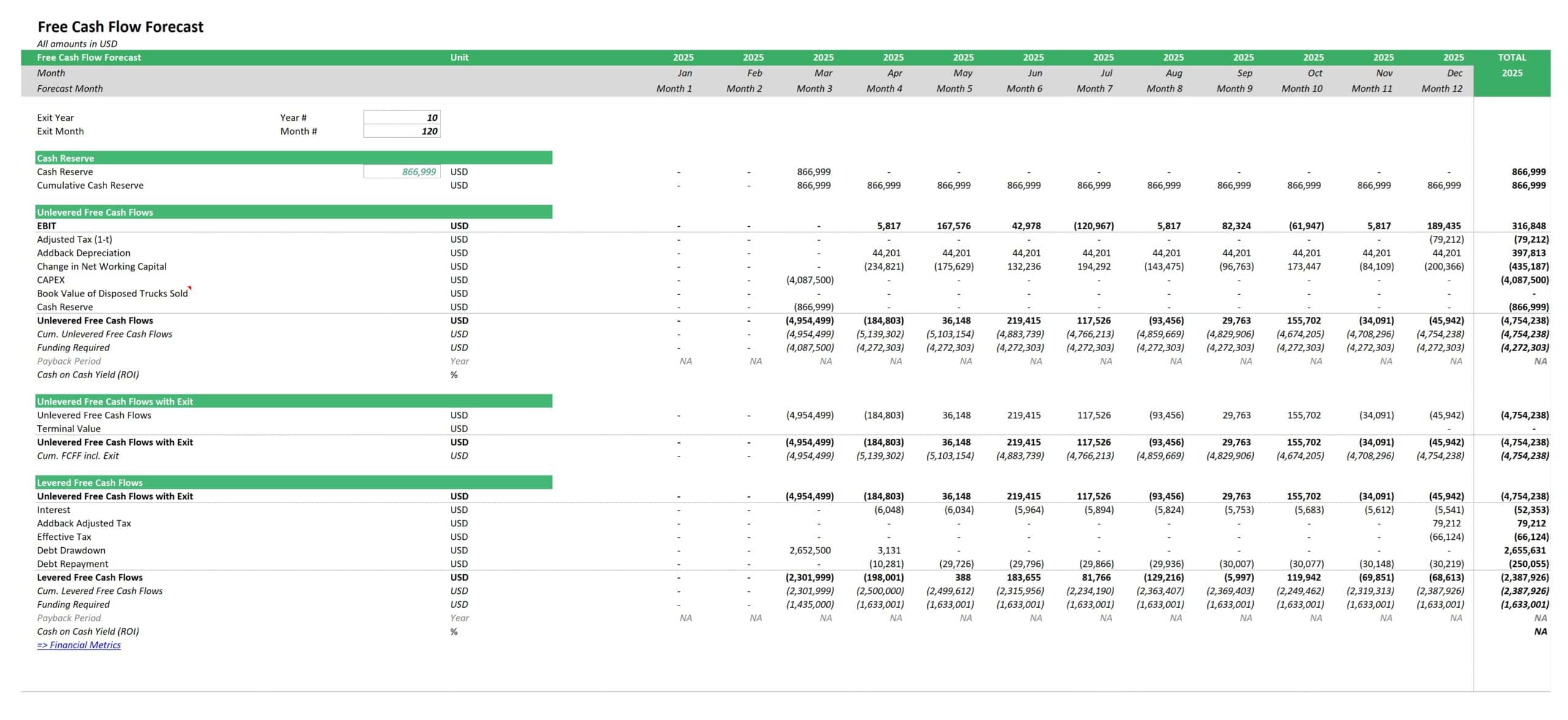
Start by determining the forecast period and specifying the exit year and month. Identify and input the initial cash reserve as a financial buffer. Project the Earnings Before Interest and Taxes (EBIT) and adjust for taxes, depreciation, and changes in net working capital. Include capital expenditures (CAPEX) and any proceeds from asset disposals, like trucks in this case. Deduct the cash reserve from these adjusted figures to calculate the Unlevered Free Cash Flows (UFCF). Add the terminal value to these cash flows to account for exit planning. For Levered Free Cash Flows, incorporate debt-related transactions such as interest, debt drawdowns, and repayments. Summarize these free cash flow projections to present a clear financial picture that potential buyers can rely on, ensuring that cumulative values and any funding required for a comprehensive financial outlook are highlighted.
Valuation Analysis
Valuation Analysis objectively assesses the business’s worth, which is essential for setting a fair and realistic asking price. It is one of the most critical financial plan components as it reduces the risk of undervaluing or overpricing the business. Valuation analysis considers market conditions, financial performance, assets, and future earning potential, ensuring that the seller can justify their price to potential buyers. A well-conducted valuation analysis also helps identify strengths and weaknesses within the business, offers opportunities for improvement before the sale, and aids in negotiations. This thorough understanding fosters transparency, builds buyer confidence, and ultimately facilitates a smoother transaction process, maximizing returns for the seller. To project financial metrics, determine the forecasted period, typically several years. First, calculate the EBITDA (Earnings Before Interest, Taxes, Depreciation, and Amortization) and adjust it by accounting for rental values if the business property is rented. Use the adjusted EBITDA to estimate the business value by applying an appropriate EV/EBITDA multiple. Next, the property value is assessed by determining the monthly rent and using a capitalization rate. Combine the business and property values to obtain the enterprise value. Subtract any financial debt and add cash reserves to derive the equity value, representing the business’s worth. This comprehensive approach ensures all vital financial aspects are considered, enabling a clear and justified valuation for potential buyers.
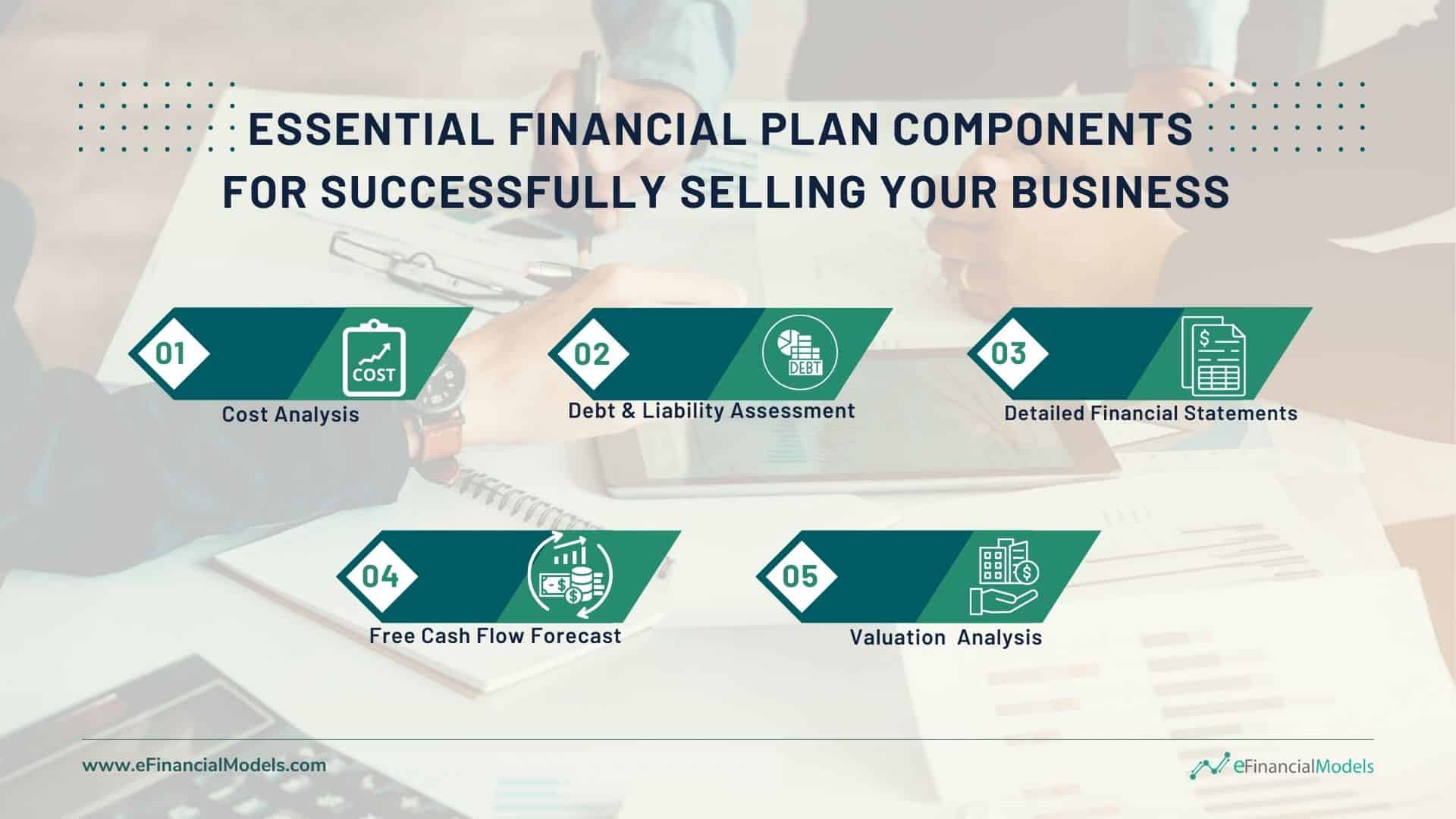
Together, these financial plan components create a solid foundation for a successful sale, ensuring you maximize the value of your business while attracting serious buyers.

















































Existing Business Financial Plan Example a Truck Rental Company
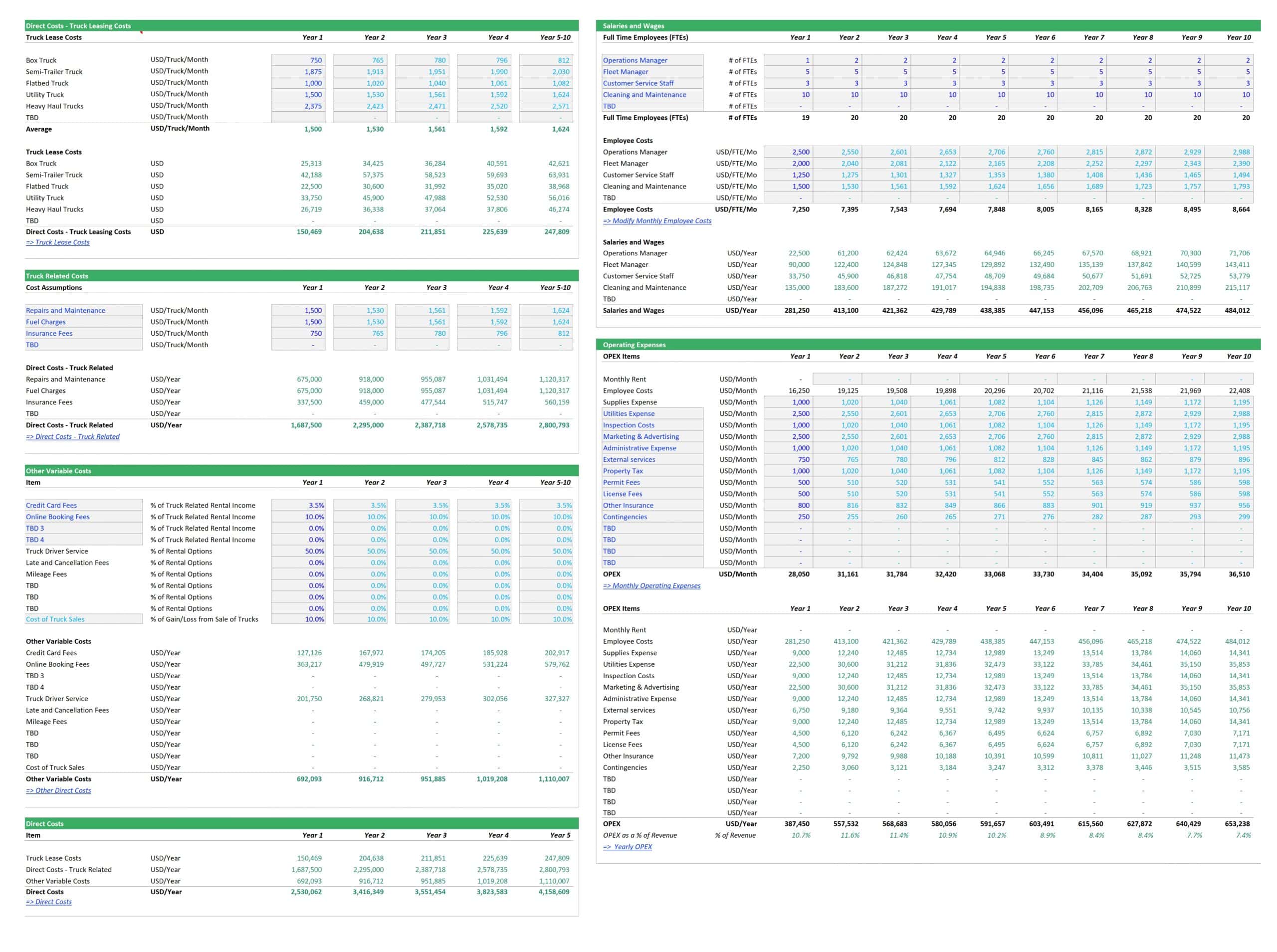
Valuing a truck rental company can be challenging due to fluctuating asset values, variable market conditions, and the need to account for tangible and intangible assets. Presenting our Truck Rental Company Financial Model—a business financial plan example that offers detailed projections, revenue forecasts, expense tracking, and profitability analysis. This business financial plan example is perfect for refining your financial strategies or preparing to sell your business. With this business financial plan example, you can confidently showcase your truck rental company’s financial health and growth potential to prospective buyers or investors. The direct and indirect cost summary in our truck rental business financial plan example is essential for conducting a thorough cost analysis, which is crucial when preparing to sell the business. It provides a detailed breakdown of cost components such as truck leasing, truck-related costs, employee salaries and wages, operating expenses, and other variable costs over ten years. This granular data allows potential buyers to understand the company’s financial health and operational efficiency. By analyzing these costs, buyers can assess profitability, identify cost-saving opportunities, and evaluate the scalability of the business. Clear visibility into direct and indirect costs also helps forecast future financial performance and justify the industry’s valuation, making the company more attractive to prospective buyers.
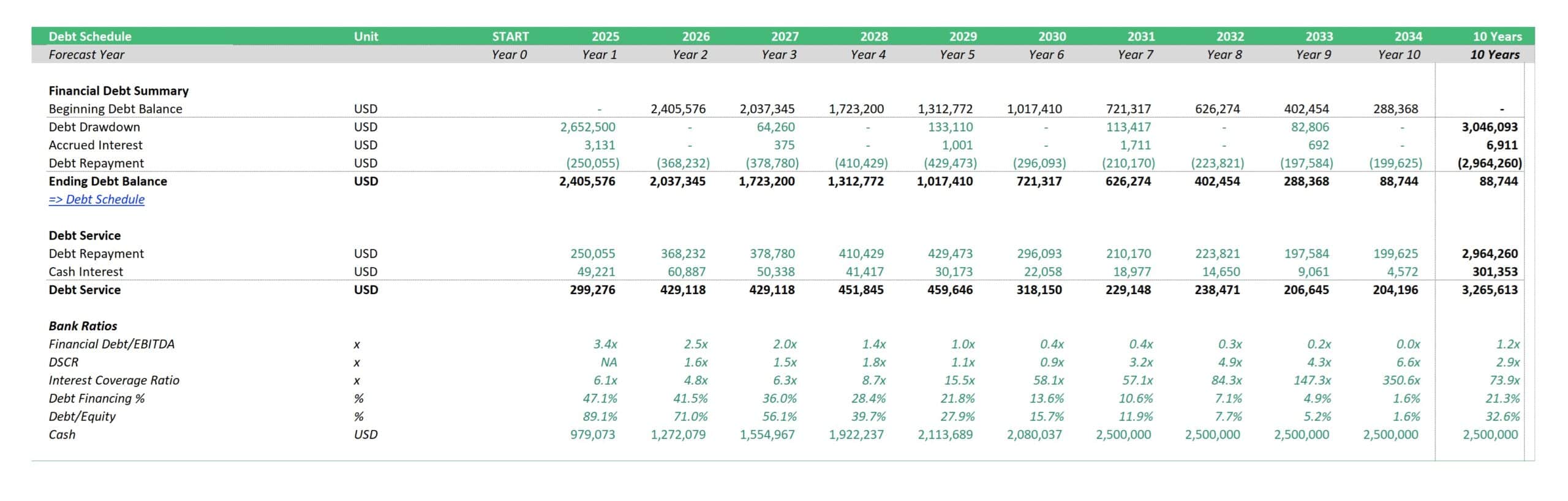
The debt schedule below comprehensively overviews the company’s obligations, including drawdowns, repayments, and accrued interest over ten years. Illustrating the debt balance and service costs (repayment and interest) annually allows potential buyers to assess the financial health and sustainability of the company. Key financial metrics such as the debt-service coverage ratio offer insights into the company’s ability to manage and repay its debt, which is crucial for evaluating risk. The debt financing percentage and debt-to-equity ratio also help understand the company’s capital structure. This detailed financial information aids in cost analysis and valuation, making it easier to demonstrate the company’s profitability, cash flow stability, and overall economic viability to prospective buyers, thus facilitating a successful sale.
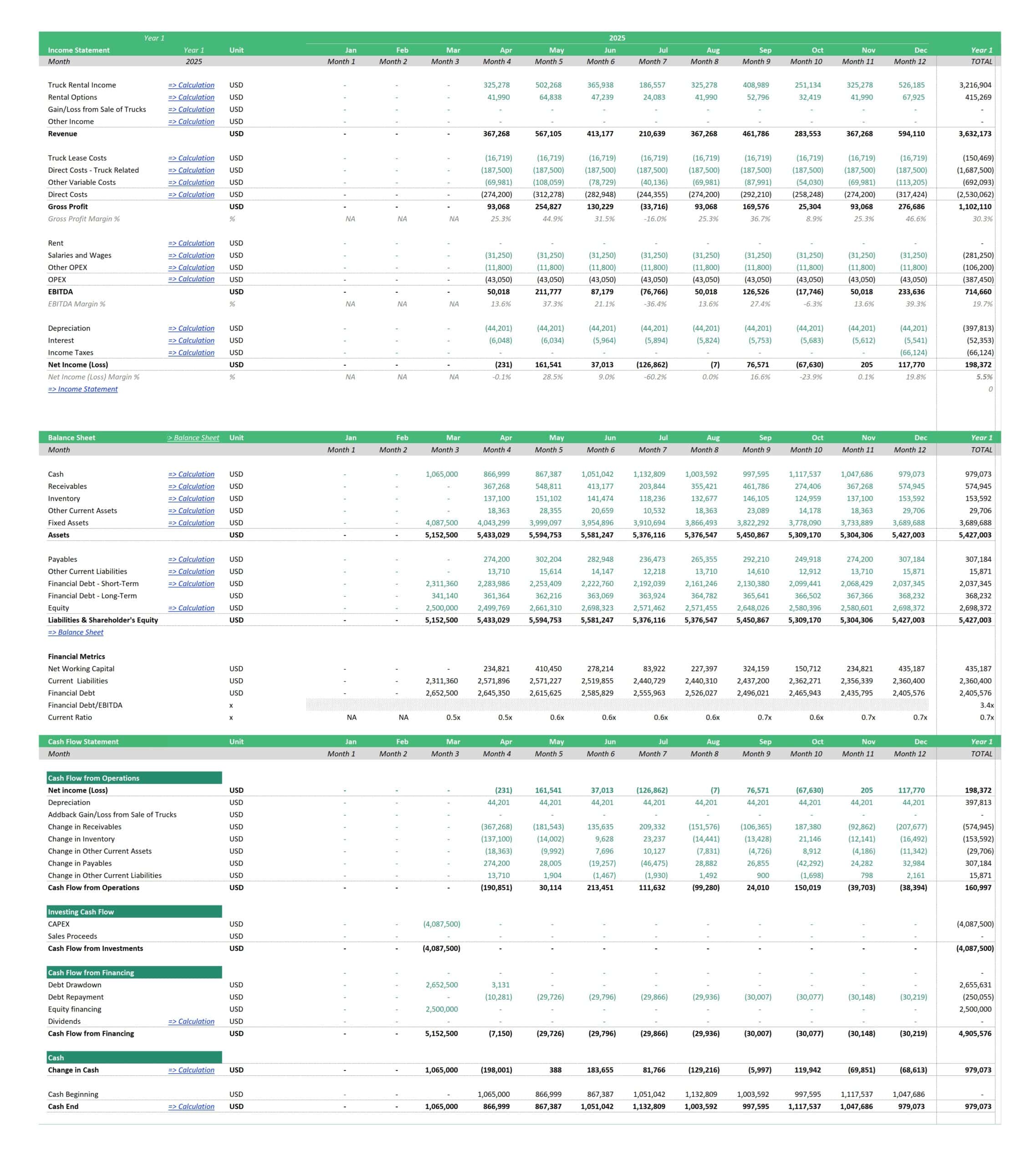
The detailed financial statements in our business financial plan example provide a comprehensive overview of the truck rental company’s financial health. Specifically, the income statement reveals revenue streams and cost structures, highlighting critical areas for cost optimization. The balance sheet showcases asset quality and liabilities, indicating the company’s net worth. Cash flow statements track liquidity and funding sources, which are essential for evaluating the company’s ability to sustain operations and manage debt. This detailed financial data supports transparent due diligence, enabling informed decision-making and valuation for a successful sale.
A detailed free cash flow (FCF) forecast in our business financial plan example includes essential components such as EBIT, adjusted taxes, depreciation, changes in working capital, capital expenditures, and cash reserves, collectively revealing the company’s profitability and efficiency in managing expenses and investments. This detailed view allows potential buyers to assess the sustainability and growth potential of the truck rental business, highlighting areas where cost management is effective and identifying potential savings or necessary adjustments. By presenting a clear and detailed projection of future cash flows, the forecast enhances the transparency and attractiveness of the business, helping to justify the asking price and facilitating a smoother negotiation process.
The forecasted valuation in our business financial plan example for a truck rental company aids in successful selling by providing detailed enterprise and equity value projections over ten years. The enterprise value, which includes business and property values, offers a comprehensive view of the company’s total worth, incorporating EBITDA and rental value adjustments. This figure reflects the company’s operational performance and asset value, making it a key indicator for potential buyers. Additionally, the equity value, derived by subtracting financial debt from the enterprise value and adding cash reserves, represents the owners’ stake in the company. By showcasing a clear trajectory of increasing enterprise and equity values, the forecast highlights the company’s growth potential and financial health, making it more attractive to buyers and justifying the asking price. This thorough financial analysis ensures transparency, builds buyer confidence and supports effective negotiations during the sale process.
Strategic Financial Plan: Maximize Your Sale Through Financial Modeling
A strategic financial plan encompassing several vital financial plan components is essential to successfully selling your business. This comprehensive plan provides a sense of security and reassurance. Begin with a comprehensive cost analysis to understand the expenses involved in the sale process. Next, a thorough debt and liability assessment should be conducted to identify any financial obligations that could impact the sale. Detailed financial statements are crucial, giving potential buyers a clear picture of the company’s financial health. A free cash flow forecast also helps project future earnings, making your business more attractive to buyers. Lastly, perform a meticulous valuation analysis to determine the business’s worth, ensuring you receive a fair price. These elements form the foundation for a successful business sale, attracting buyers and maximizing value.
Maximizing the sale of your business requires a strategic approach grounded in financial modeling and key financial plan components. You can gain valuable insights into your company’s financial health and future performance through detailed financial modeling, making it more appealing to potential buyers. Key financial plan components provide a comprehensive view of your business’s worth and profitability. By meticulously preparing these elements, you position your company for a successful sale, ensuring you attract serious buyers and secure the best possible price. This holistic approach not only enhances the attractiveness of your business but also instills confidence in buyers, ultimately leading to a successful and profitable sale.











You might also like:
- 10 Main Elements of a Business Plan
- 10 Tips to Develop a First Class Business Valuation Report
- 5 Steps to Create a Drop Down List Using Data Validation in Excel
- 5 Practical Tips to Help Raise Funds For Startups
- Business Plans
- How to Make a Startup Financial Plan for Fundraising?
- Finding a Valuation Model for Your Business
- Financial Ratios Analysis and Its Importance
- Financial Model Templates Easy to Use
- Financial Forecasting Models by eFinancialModels
- Startup Financial Models
- Financial Planning for Small Business Owners – Taking an SBA Loan
- Strategic Insights to Secure Series B Financing
- Real Estate
- 5 Best Practices for Managing Days Receivables
- How to Write a Business Plan Step-By-Step
- The Top 5 Frameworks for Making Investment Decisions
- Cash Flow Analysis in Excel
- Understanding What is Yield to Maturity and Why It Matters
- Financial Model for Mobile App | Mobile App Business Plan
Tags: financial planning