
0 ITEMS

Navigating the Liquidation Value of Assets

Understanding liquidation value is key for assessing a company’s worth during distress or asset sales.
- It estimates the amount a company could receive if all assets are sold quickly after ceasing operations.
- Asset liquidation values often differ from book values due to market conditions and sale urgency.
- Three main types are orderly, forced, and replacement liquidation values, each suited to different scenarios.
- Calculating liquidation value involves evaluating assets, liabilities, and potential costs with professional input when needed.
Using accurate models helps investors and business owners make informed decisions in liquidation or restructuring processes.
What is Liquidation Value?
Liquidation value is the estimated amount a company will receive if all its assets are sold after it ceases operations. It does not consider liabilities or costs associated with the liquidation process. Net liquidation value refines the above concept by subtracting any liabilities or expenses of liquidating from the total expected proceeds from asset sales. Net liquidation value offers a more accurate picture of the actual cash available to stakeholders (like shareholders or creditors) after the liquidation process.
Liquidation Value and Asset Book Value
Asset book value is derived from the balance sheet and represents the net value of assets (assets minus liabilities). In many cases, liquidation value is lower than asset book value because assets in a forced sale often fetch prices lower than recorded book values. This discrepancy arises due to market conditions, depreciation, or the urgent need to sell assets quickly.
Based on accounting principles, asset book value may not reflect current market conditions or the urgency of a sale, leading to a potentially inflated view of a company’s value. Net liquidation value is more reflective of the “real-world” cash that could be generated in a distressed sale. It is a more conservative estimate compared to asset book value.
Liquidation Value and Salvage Value
Salvage value is the estimated value of an asset at the end of its useful life. Liquidation value typically exceeds salvage value because it assumes the assets still have some immediate marketability or operational use, even if they’re not at their peak value.
Salvage value is more specific and limited, focusing on the residual value of an individual asset after its useful life, and does not account for liabilities or other assets. Net liquidation value is more comprehensive, including the current market value of all assets and subtracting liabilities and liquidation costs. It provides a broader view of what a company’s assets are worth in the current market.
It’s important to note that the estimation of liquidation and salvage values can be complex and may require professional appraisal depending on the nature and condition of the assets involved.
Three General Types of Liquidation Value
Understanding the different types of liquidation value is essential for financial professionals, investors, and business owners in various scenarios. Let’s expand on the three general types:
1. Orderly Liquidation Value (OLV)
Orderly liquidation value is the estimated gross amount that could be realized from the sale of the company’s assets over a reasonable period in an orderly manner. It means selling the assets in a non-pressured situation, allowing for a proper marketing period to find potential buyers. Orderly liquidation value is often used when a company is winding down operations without immediate financial stress to dispose of its assets. This method provides a more realistic value than forced liquidation since it considers the time necessary to find willing buyers. For instance, if a manufacturing company decides to cease operations gradually. It sells its machinery and equipment over several months, allowing it to secure buyers willing to pay a fair market value, reflecting the assets’ worth in regular business transactions.
2. Not-So-Orderly Liquidation Value (NSOLV)
Also called forced liquidation value, NSOLV is typically associated with the quick sale of assets, often under distressed conditions such as bankruptcy or severe financial hardship. Assets are sold quickly, often through auctions, resulting in lower prices. Forced liquidation value is applied when a company must rapidly liquidate assets to satisfy creditors or in urgent financial situations. The emphasis here is on speed rather than maximizing value, often leading to a significant discount on the assets’ value. For example, a company facing bankruptcy must immediately liquidate its inventory to pay creditors. It opts for an auction where buyers bid competitively, often at lower prices than what might be achieved in a non-distressed sale.
3. Replacement Value
This cost-value approach estimates what it would cost to replace the company’s assets with new ones at current market prices. It reflects the current cost to acquire equivalent assets, not necessarily what the company’s assets could be sold for. Replacement value or the cost-value approach is particularly relevant in insurance and investment scenarios. It helps assess the insurance coverage needed for assets and can be used by potential investors or buyers to understand the capital investment required to duplicate a business. For example, an investor evaluating a logistics company looks at the replacement value of its fleet of trucks and warehouses to understand how much it would cost to replicate the company’s operational capacity with brand-new assets.

Each of these liquidation values offers a different perspective and is used in various contexts depending on the specific circumstances and objectives of the analysis. Understanding these differences is crucial for financial professionals and business stakeholders in making informed decisions about asset valuation and disposition strategies.























































How to Calculate Liquidation Value
Calculating the liquidation value of a company is a crucial process in various financial analyses, especially when assessing the company’s worth under distressed or liquidation scenarios. This method is particularly relevant for those involved in business analysis, valuation, mergers and acquisitions, or restructuring. The general liquidation value formula is expressed as:

Here’s a detailed guide to help you understand how to calculate the liquidation value formula:
Step 1 – Prepare the Company Balance Sheet
Preparing the company’s balance sheet gives a clear and updated view of the company’s assets and liabilities. Ensure the balance sheet includes the following:
- All current and fixed assets.
- Current and long-term liabilities.
- Shareholders’ equity.
Step 2 – Calculate the Liquidation Value of Assets
Identify all assets, including cash, receivables, inventory, land, buildings, equipment, etc. Assess the current market value of these assets based on the standard asset recovery percentage:
- Cash & Bank Deposits: 100% (assumed to be fully recoverable).
- Land: 150% (indicating that land often has a higher value than book value).
- Accounts Receivables: 65 to 70% (considering potential bad debts or uncollectible amounts).
- Other Assets: Use industry standards or professional valuations. Typically, the assumed rate is 50%.
Furthermore, the process may require professional appraisals, especially for specialized equipment or property. Then, sum up the liquidation values of all assets.
Step 3 – Calculate the Liquidation Value of Liabilities
Identify all current and long-term liabilities. Assess the settlement value of these liabilities under liquidation conditions. Then, sum up the values of all liabilities.
Step 4 – Calculate Net Liquidation Value
To calculate the net liquidation value, use the liquidation value formula: Liquidation Value of Assets – Liquidation Value of Liabilities. Then, consider factoring in costs like legal fees, liquidation expenses, and other related costs. The net liquidation value is the value that would be left over for shareholders after paying off all liabilities and associated fees.
Sample Calculation
Let’s walk through a simplified example using a hypothetical company, ABC, and its balance sheet.
Sample Balance Sheet of Company ABC. To proceed, let’s assume the following simplified balance sheet for Company ABC:
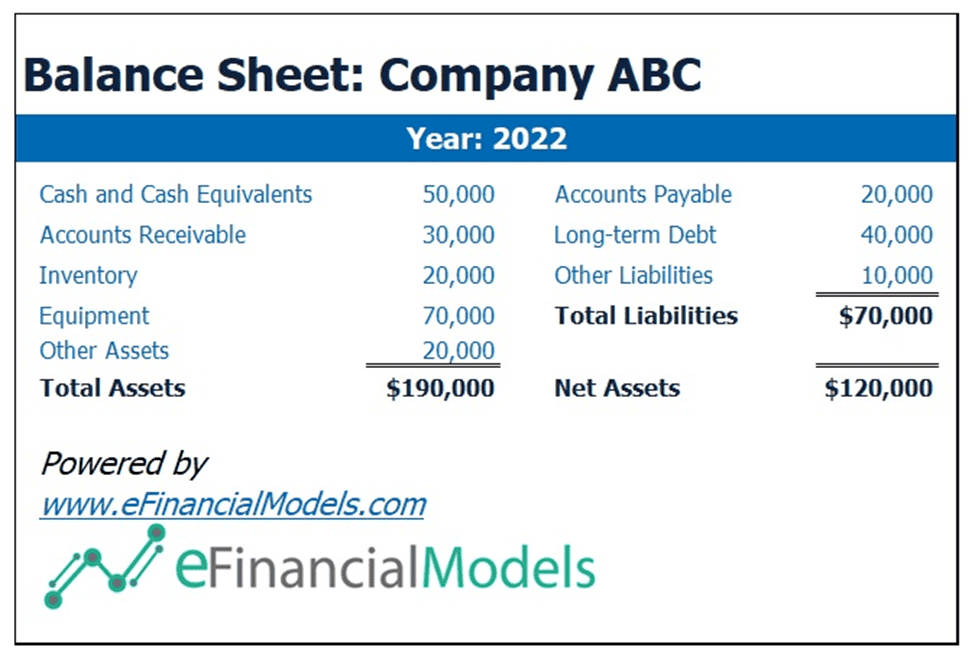
The next step is to estimate the liquidation value of each asset. This value is often lower than the book value because assets in a liquidation scenario are typically sold quickly and may need to fetch their total value. Let us use the standard asset recovery percentage.

The figure above shows that the liquidation value of assets for Company ABC is $144,000. Now, let’s compute the liquidation value of liabilities.
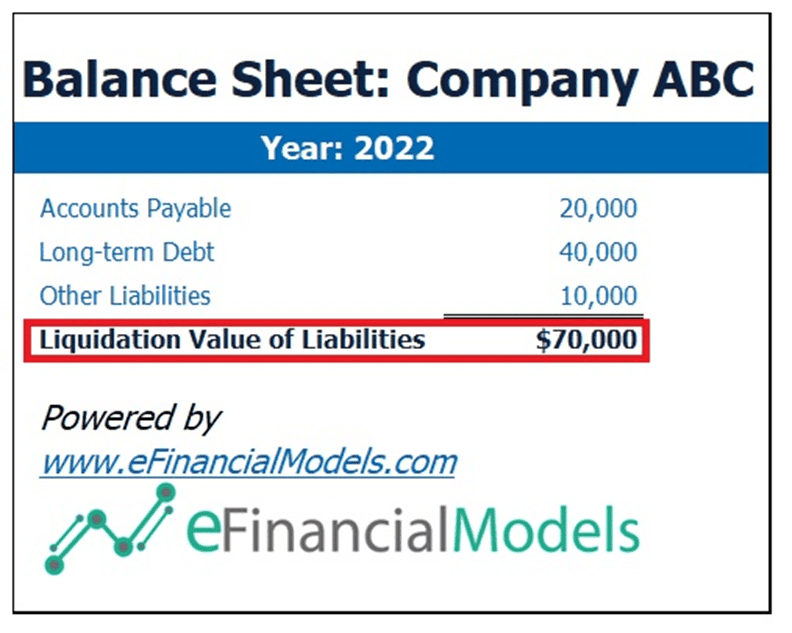
As you can see, the liquidation value of liabilities remains constant at $70,000. Unlike assets, liabilities do not have a “sale” value. They represent obligations that a company owes to external parties. These obligations must be met regardless of the company’s situation.
Assuming that the company has no other expenses and obligations, we can now calculate the net liquidation value using the liquidation value formula.

Based on Company ABC’s simplified balance sheet for 2022, its net liquidation value is $74,000. It represents the amount left over after selling all the assets at their estimated liquidation values and paying off all liabilities. As you can see, it is lower than the net asset book value on the balance sheet at $120,000.
Remember, these calculations are highly dependent on the accuracy of the liquidation value estimates of the assets and the actual amounts recoverable from liabilities. In real-world scenarios, these values can significantly differ from book values, and professional appraisals are often required to determine more accurate figures.






















Maximizing Returns with Liquidation Value Analysis
In summary, understanding the liquidation value of assets is crucial for businesses and investors seeking to evaluate the worst-case scenario asset valuation during forced sale conditions. This process involves a meticulous analysis of the market conditions, asset specificity, and potential buyers, ensuring a realistic and practical assessment of the asset’s worth. Accurate determination of liquidation value provides a safety net for financial planning and equips decision-makers with vital insights for strategic asset management and investment decisions.
Financial modeling plays a crucial role in maximizing returns through liquidation value analysis. By utilizing detailed and accurate financial models, professionals can gain a comprehensive understanding of a company’s assets and liabilities, enabling them to assess the liquidation value with precision.
Calculate Your Asset Worth Today!
You might also like:
- Finding Fair Market Value: A Quick Guide to Real Estate Valuation
- Replacement Cost Valuation: Striking the Balance to Build or Buy
- 10 Tips to Develop a First Class Business Valuation Report
- 12 BUSINESS VALUATION METHODS
- Mastering the Art of IRR Calculation: A Comprehensive Guide for Investors
- Understanding Insurance Policies: A Beginner’s Guide
- Understanding the Levelized Cost of Energy Formula
- Business Valuation
- Financial Valuation
- Real Estate
- Asset Management
- The Essential Guide to Calculating the Cap Rate for Real Estate Valuations
- The Valuation of a Business
- Business Valuation Service
- Why Should You Use Excel for Financial Modeling?
- IRR vs NPV in the Context of Financial Decision-Making
- Investment
- Tips for Valuing Your Business
- Financial Services
- Financial Ratios
Tags: business valuation