
0 ITEMS

The Cap Rate Formula for Real Estate Explained
Calculating a property’s cap rate provides a quick way to assess its earning potential and investment risk.
- The cap rate formula divides net operating income by the property’s market value to estimate return.
- Higher cap rates generally indicate greater risk but potentially higher returns.
- Comparing cap rates across properties helps evaluate performance and market conditions.
- The relationship between market value and cap rate is inverse—higher property values often mean lower caps.
- Using cap rates alongside other financial metrics leads to more informed real estate investment decisions.
Keep reading to understand how to analyze and apply cap rates effectively in real estate.
What Is the Market Capitalization Rate?
The market capitalization rate is a core financial metric in real estate investing that helps evaluate the potential return on an income-producing property. It gives investors a quick way to compare different properties and assess their income-generating potential. A higher rate suggests better returns, while a lower rate may indicate lower risk or a more stable investment opportunity. It’s a powerful tool for deciding whether a property is worth the investment. The market capitalization rate shows the percentage return a property earns based on its net operating income and market value or purchase price. It compares how much income a property generates to what it costs. For example, if a property earns $100,000 a year and is worth $1 million, the rate is 10%. This simple percentage helps investors judge if a deal makes sense or not.
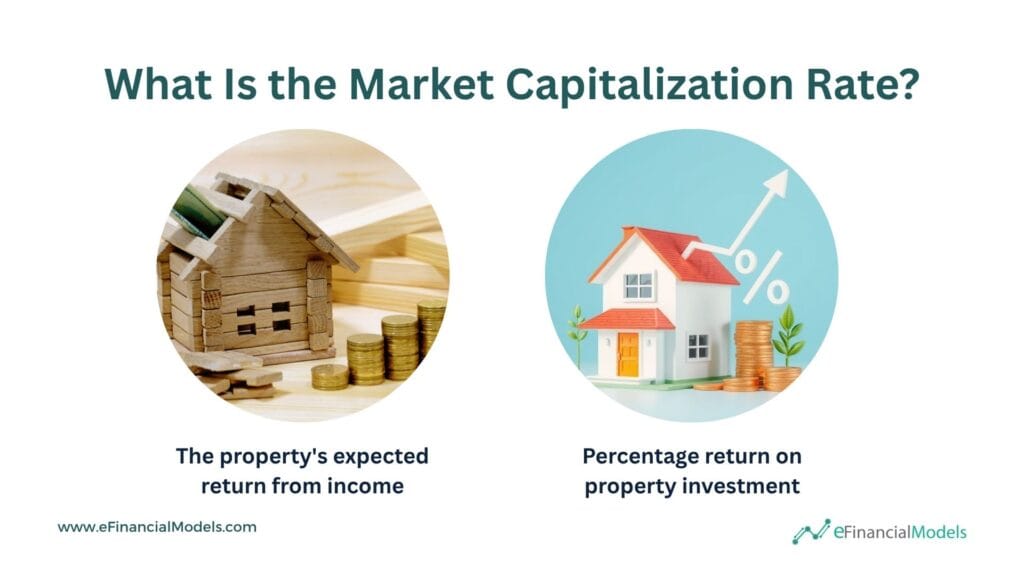
Two key cap rates guide property valuation. The Gross Capitalization Rate uses the property’s total income before any costs. In contrast, the Net Capitalization Rate relies on net income after subtracting operating expenses. The Gross Cap Rate gives a quick snapshot, but the Net Cap Rate shows a clearer picture of true returns by factoring in costs. This article focuses on using the net cap rate in the exit cap rate formula.
Why You Should Calculate Cap Rate in Real Estate?
Well, it serves as a valuable tool to compare different investment opportunities and determine the financial viability of a property.
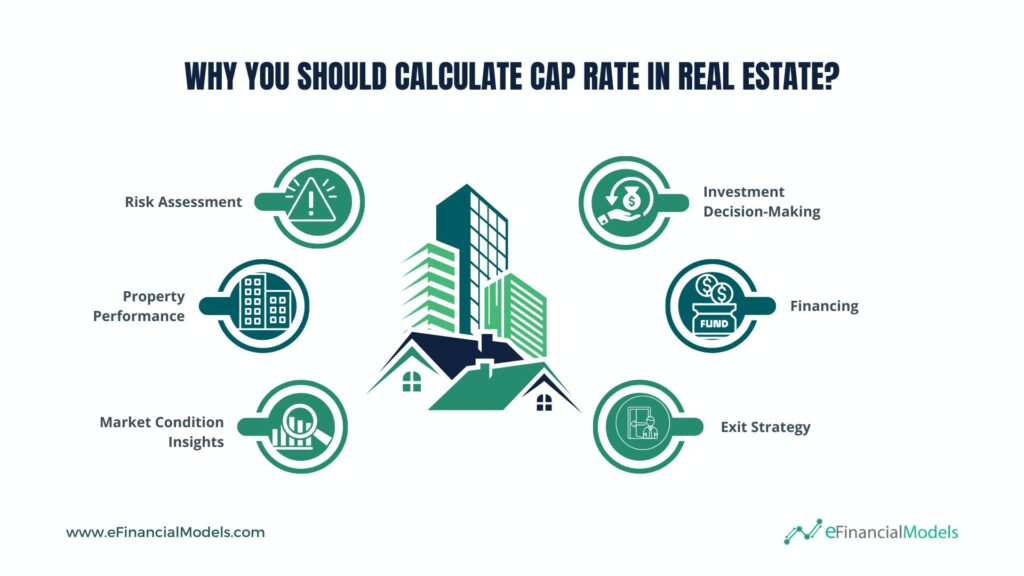
- Risk Assessment: Cap Rate helps investors gauge the level of risk associated with an investment property. A higher capitalization rate indicates a higher potential return but may also suggest higher risk. On the other hand, a lower capitalization rate implies a more stable investment but may yield lower returns. By analyzing the cap rate, investors can assess a real estate investment’s risk and potential reward.
- Property Performance Comparison: The capitalization rate allows investors to compare the performance of different investment properties, regardless of their size, location, or purchase price. By focusing on the cap rate, investors can quickly assess which properties have the potential for higher returns relative to their costs.
- Market Condition Insights: Cap Rate can provide insights into prevailing market conditions. If the capitalization rates in a particular area are declining, it might indicate increased demand for properties, possibly leading to rising property prices. Conversely, rising capitalization rates suggest a softer market or potential investment opportunities.
- Investment Decision-Making: The capitalization rate plays a crucial role in investment decision-making. It assists investors in identifying properties that align with their risk tolerance, return expectations, and investment strategy. Investors have different objectives, and the cap rate helps find properties that suit individual preferences.
- Financing: Lenders often use cap rate as a factor to evaluate a loan application’s viability. A higher capitalization rate may increase the likelihood of securing favorable financing terms as it shows the property’s ability to generate sufficient income to cover the mortgage payments.
- Exit Strategy: When investors plan to sell a property in the future, the capitalization rate can influence the property’s resale value. Higher cap rates attract more investors, potentially resulting in a higher selling price.
While capitalization rate is a valuable tool for initial property assessment, it is essential to consider other factors like local market trends, maintenance costs, property appreciation, and rental growth to make a well-rounded investment decision. It should be used hand-in-hand with financial due diligence and financial ratios analysis before investing in real estate.


























































How Does the Cap Rate Formula for Real Estate Work?
Understanding the cap rate formula for real estate starts with recognizing its power to measure potential returns. Whether you’re buying a small rental property or a commercial building, this simple concept helps you compare opportunities quickly. It gives you a snapshot of how much income a property could generate relative to its price. With this information in hand, investors can make sharper decisions, assess risk more effectively, and avoid overpaying. Think of it as a reality check—it strips away the hype and focuses purely on income and value.
The cap rate formula for real estate is a quick way to estimate a property’s potential return. It’s calculated as follows:
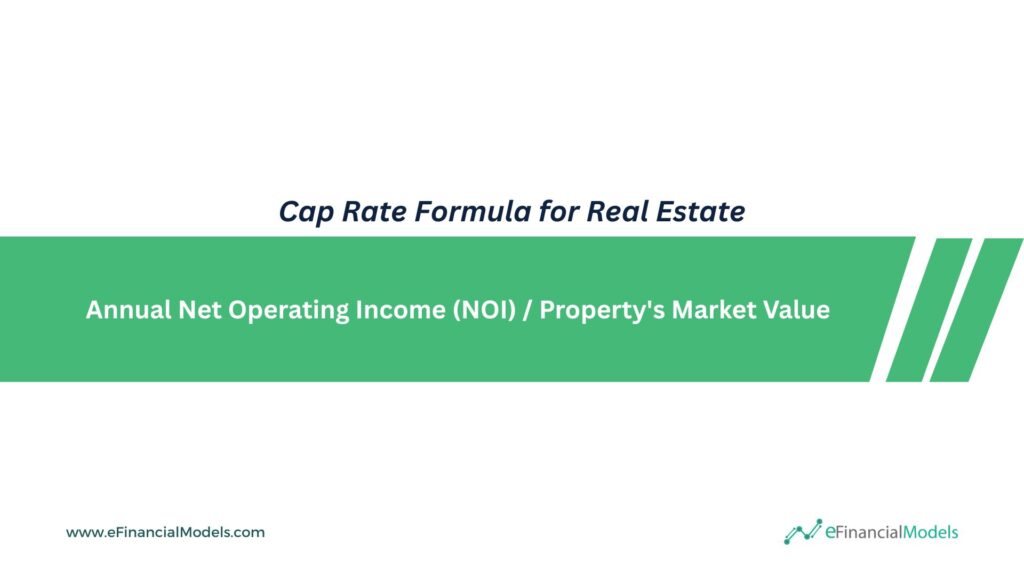
Where:
- Annual Net Operating Income (NOI) is the money a property makes in a year after paying for necessary expenses like maintenance, insurance, and property taxes—but before paying the mortgage. It’s a straightforward way to determine the actual income a property generates. A higher NOI typically indicates better cash flow, making it a crucial component of the cap rate formula for real estate.
- Rental Income: This includes the revenue generated from leasing t out the property to tenants. It encompasses both residential and commercial rents.
- Ancillary Income: Besides rental income, ancillary income sources may also contribute to the NOI. These sources can include additional fees, such as parking fees, laundry income, vending machines, pet fees, storage fees, etc.
- Miscellaneous Income: This includes any other income streams related to the property, such as income from billboards, cell tower leases, or any other non-rental income.
- Property’s Market Value is the current price someone would likely pay for the property today. It’s based on factors such as location, demand, and similar property sales. The value helps investors compare the income a property produces with its worth—essential for determining if the investment is sensible. The property’s market value can also be considered the purchase price, as it reflects what a buyer is willing to pay and what a seller is willing to accept at a given time.
Let us try some calculations to learn how to interpret the capitalization rate real estate formula using the following assumptions for two real estate properties in the same location.
| Property A: Market Value = $2,500,000 Rental Income = $200,000 Ancillary Income = $20,000 Miscellaneous Income = $10,000 Operating Expenses = $80,000 | Property B: Market Value = $2,000,000 Rental Income = $150,000 Ancillary Income = $15,000 Miscellaneous Income = $5,000 Operating Expenses = $80,000 |
Example No. 1

The final results show that Property A has a cap rate of 6.00%, and Property B has a cap rate of 4.50%. Property A has a higher cap rate than Property B. It indicates That it is a potentially more attractive investment opportunity because it suggests that the property’s net income is relatively high relative to its market value. Still, they might also involve higher risk, such as properties in less desirable locations or requiring significant maintenance and repairs.
Example No. 2
Now, let us assume a higher market value for Property A at $3,500,000 with the other assumptions the same as above.

The final results show that the cap rate of Property A decreases to 4.29%, making Property B a potentially more attractive investment opportunity. Furthermore, it indicates that capitalization rate and market value have an inverse relationship. As the market value increases, the cap rate decreases, and vice versa.
A higher cap rate implies a lower property value, and a lower cap rate suggests a higher property value. This relationship holds because the cap rate represents the expected return on investment, and investors typically demand a higher return for riskier or less desirable properties, leading to a higher cap rate and a lower market value.
Example No. 3
Now, let’s assume Property A and Property B have the same market value of $2,000,000 and different cap rates.
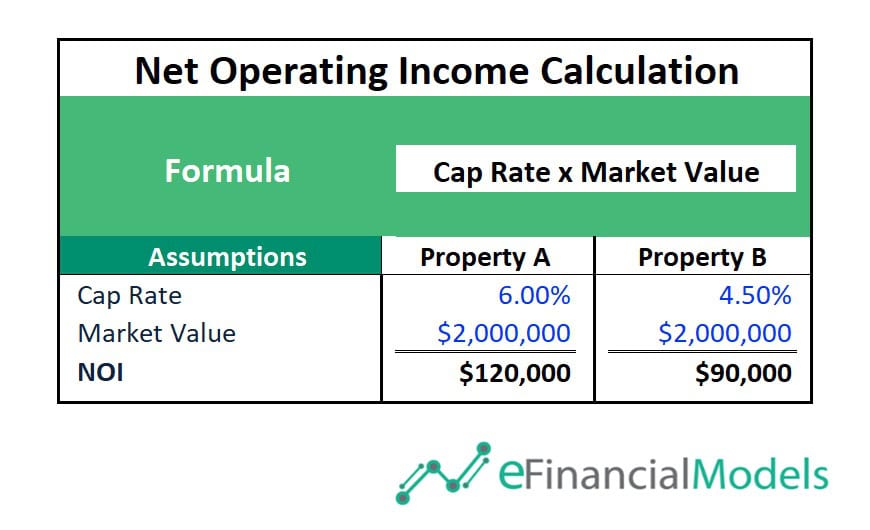
In this example, Property A has a higher cap rate (6%) than Property B (4.5%). At the same market value, Property A yields a higher net operating income of $120,000, and Property B yields a lower net operating income of $90,000.
As you can see when two properties have the same market value, a higher cap rate implies a higher net operating income for real estate, and a lower cap rate implies a lower net operating income for real estate. It is because the cap rate reflects the expected return on the investment, and if the cap rate is higher, it means the property’s income (NOI) relative to its value is higher. Conversely, if the cap rate is lower, the property’s income relative to its value is lower.
What is A Good Cap Rate for Real Estate Investment?
A good cap rate for real estate investment can vary depending on the investor’s objectives, risk tolerance, and specific market conditions. There is no one-size-fits-all answer, and investors must assess individual circumstances before deciding.
Here are some key points to consider:
- Risk and Returns: A higher cap rate generally indicates a riskier investment but may also offer potentially higher returns. On the other hand, a lower cap rate typically implies a more stable and less risky investment, though with potentially lower returns.
- Market Norms: Cap rates can differ significantly between different types of real estate and various locations. In some markets, a cap rate of 5% to 10% might be considered attractive, while in other high-demand areas, cap rates could be lower due to higher property values.
- Investment Strategy: Investors pursuing value-add opportunities or properties in emerging markets might look for higher cap rates to achieve more substantial returns. Meanwhile, those seeking stable, income-generating properties might accept lower cap rates for reduced risk.
- Exit Strategy: Investors should also think about their exit strategy. If the plan is to hold the property long-term, a lower cap rate might be acceptable for its stability and potential appreciation.
In conclusion, a “good” cap rate is subjective and dependent on various factors.
Refining Exit Strategy Valuations with Cap Rates
The market capitalization rate indicates the expected return from a property based on its income. It’s a quick way to compare investment options. The cap rate formula for real estate divides net operating income by the property’s purchase price. This provides a percentage that indicates how quickly you’ll recoup your investment. A good cap rate depends on your goals—higher rates often mean higher risk, while lower ones suggest more stability. Understanding this helps you choose smarter real estate deals.
Use cap rates to sharpen your exit strategy. A financial model enables you to test various exit cap rate scenarios and assess their impact on your property’s resale value. You can quickly compare the impact of higher or lower cap rates on your expected returns. This gives you a clear picture of when and how to sell. With better visibility, you make smarter decisions and reduce risk when planning your exit.
Ready to take control of your real estate investments?
Utilize our Real Estate Portfolio Financial Model to analyze cap rates, forecast returns, and develop informed exit strategies with confidence. Download now and make every property decision count.

















































You might also like:
- Finding Fair Market Value: A Quick Guide to Real Estate Valuation
- Best in Class Property Appraisal Methods and What to Look Out for
- Property Valuation
- Business Valuation
- The Valuation of a Business
- Commercial Real Estate Properties
- How to Calculate Net Present Value (NPV)?
- Understanding Insurance Policies: A Beginner’s Guide
- Mastering the Art of IRR Calculation: A Comprehensive Guide for Investors
- Commercial Real Estate Valuation Model Template
- Real Estate Valuation
- What Are the Main Drivers of Business Valuations?
- Financial Planning for Small Business Owners – Taking an SBA Loan
- How to Write a Killer Mobile App Business Plan
- Agriculture
- Understanding Debt Sizing & Project Finance Ratios
- 6 Elements of a Strong Real Estate Business Plan
- Residential Properties
- Scenario Analysis
Tags: business valuation