
0 ITEMS

Why Do You Need a Financial Model?

Financial models are essential tools for businesses to forecast performance, evaluate risks, and make informed decisions.
- They help simulate future revenue, expenses, and cash flows to assess financial viability.
- Different types of models, from basic to advanced, serve varying complexity and analysis needs.
- Financial modeling supports strategic planning, valuation, investment analysis, and scenario testing.
- Every business can benefit by quantifying assumptions, optimizing cash flow, and attracting investors.
- Using financial models effectively turns financial data into actionable insights for growth.
Keep reading to understand how financial modeling can strengthen your business planning and decision-making.
What is a Financial Model?
Let us now answer the question, “What is a financial model?” Built as dynamic spreadsheets, they simulate expected financial performance, helping stakeholders make informed decisions. Financial models organize various financial data points, assumptions, and projections. They allow businesses to understand potential outcomes, identify risks, and ultimately, make better decisions to drive growth and success.
At its core, a financial model is a sophisticated, dynamic spreadsheet that mirrors a company’s financial situation. Constructed using tools like Microsoft Excel or Google Sheets, it’s a web of interconnected inputs, formulas, and assumptions. This dynamic structure is key, as it allows the model to automatically update all relevant values when changes are made to key inputs. This adaptability makes it a potent tool for swiftly and effectively analyzing a range of financial scenarios.
Another answer to the question, “What is a financial model?” is that it is a simulation of a business’s expected financial performance. By projecting future revenue, expenses, cash flows, and profitability, a financial model can provide insight into the financial health of a company over time. This simulation often considers scenarios, such as best-case or worst-case situations, which help estimate how external factors like economic changes or market conditions could affect the company’s future performance.
Lastly, financial models are critical tools for decision-making in business. They enable stakeholders to evaluate the financial impact of strategic choices, such as launching a new product, entering a new market, or acquiring another company. By providing a quantified perspective of potential outcomes, financial models help decision-makers assess risks and rewards, supporting more informed and data-driven choices about strategically moving forward.

Financial Model Types
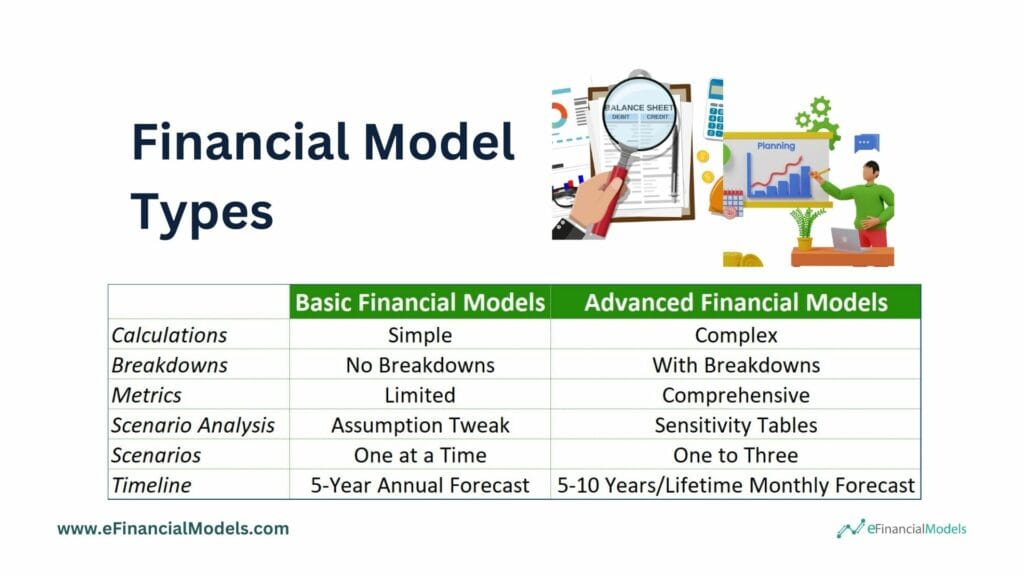
A financial model’s primary goal is to simulate different scenarios, forecast future performance, and aid decision-making by providing a structured approach to analyzing key financial metrics. Depending on the user’s needs, financial model types can maintain a straightforward structure for simpler calculations or expand into sophisticated, multifaceted simulations that tackle intricate financial analyses. Financial model types are often categorized into basic financial models and advanced financial models based on their scope and complexity. types of financial models serve different purposes depending on the financial analysis required.
Basic Financial Models
Basic financial models are straightforward tools used to estimate a business’s financial outlook with minimal complexity. These financial model types often involve simple calculations, focusing on core metrics such as direct cash flow forecasts without detailing underlying components. Basic financial models are characterized by their lack of breakdowns, concentrating mainly on profits or cash flows, which means they need to provide more insight into the sources or specifics of the figures.
Typically, the range of metrics tracked among basic financial models is limited, providing a high-level perspective rather than an in-depth analysis. One notable feature is the ability to quickly adjust key assumptions, allowing users to evaluate different scenarios easily ; however, only one scenario can be changed at a time. Basic financial models usually include a five-year timeline, with annual forecasts that offer a broad view of future performance without diving into granular detail.
Advanced Financial Models
Advanced financial models are sophisticated tools used to forecast a company’s financial performance by modeling complex calculations involving key elements such as volumes, growth rates, prices, and variable and fixed costs. These financial model types provide a detailed breakdown of the drivers behind revenues and expenses, making it easier to understand their impact on profitability.
Advanced financial models typically feature comprehensive metrics and numerous charts to illustrate the financial outcomes in a visually accessible way. A key feature of these models is scenario analysis, which involves using sensitivity tables to explore different cases—base, upside, and downside scenarios. This function is crucial as it prepares businesses for various future outcomes. These models can forecast over a range of 5 to 10 years or on a monthly basis for the lifetime of a business, giving a long-term view of potential financial paths.
Companies require advanced financial model types, particularly when dealing with intricate scenarios, industry-specific assumptions, or multi-year projections. By leveraging the expertise of eFinancialModels.com, companies can gain clarity, strategic insights, and the ability to present professional financial analyses to investors or stakeholders, ultimately leading to better financial management and business growth.
Our Top Financial Model Templates
Discover our financial model templates to simplify business planning and drive success! These are the best examples of both basic and advanced financial model types.
Example Basic Financial Models
Budget Plan Model
A budget model helps estimate expected revenues and expenses over a specific period to guide financial planning.
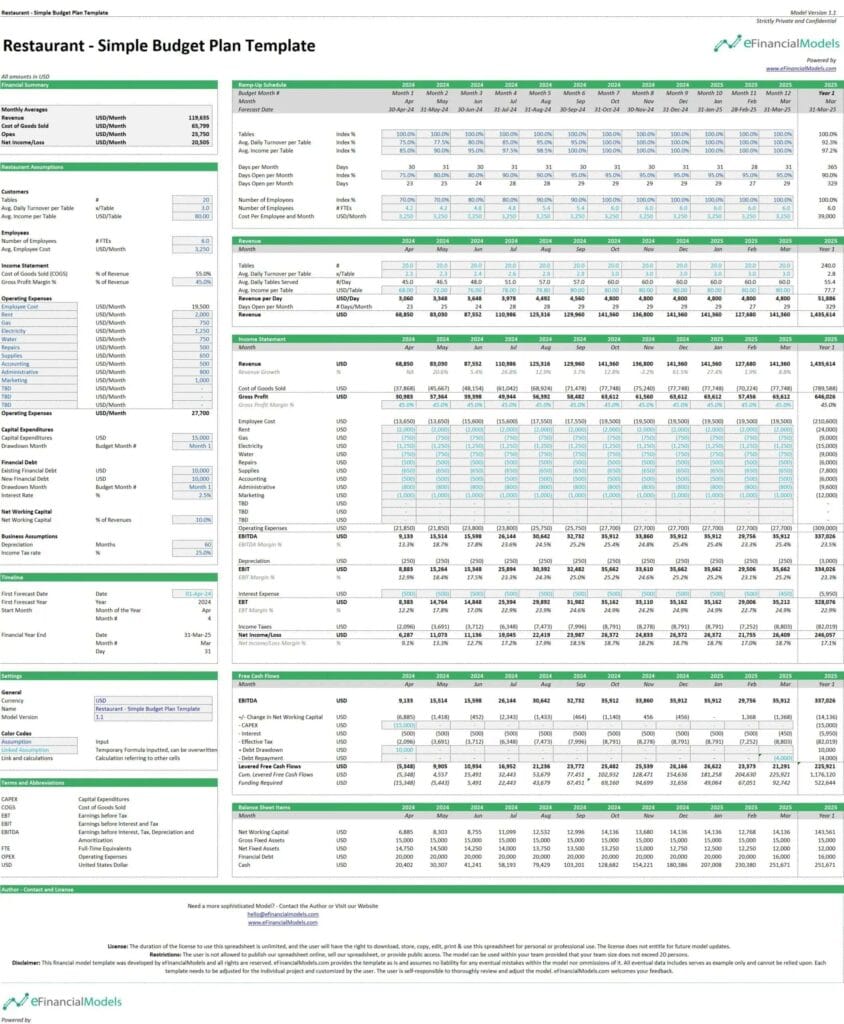
This simple Restaurant Budget Template is a basic financial model designed to help restaurant owners and managers plan and monitor their finances effectively. It includes key financial metrics such as revenue, costs of goods sold, operating expenses, and net income over a monthly and annual timeframe. The template is structured to provide an overview of essential restaurant financials, including revenue per table, labor expenses, and inventory costs, enabling users to set realistic financial targets and evaluate their profitability. Additionally, the budget template incorporates projections for cash flow, EBITDA, and other critical financial indicators, providing a comprehensive yet simplified tool for budgeting and financial planning.
Costing Sheet Model
A costing sheet model provides a detailed overview of all costs associated with producing a product or delivering a service.
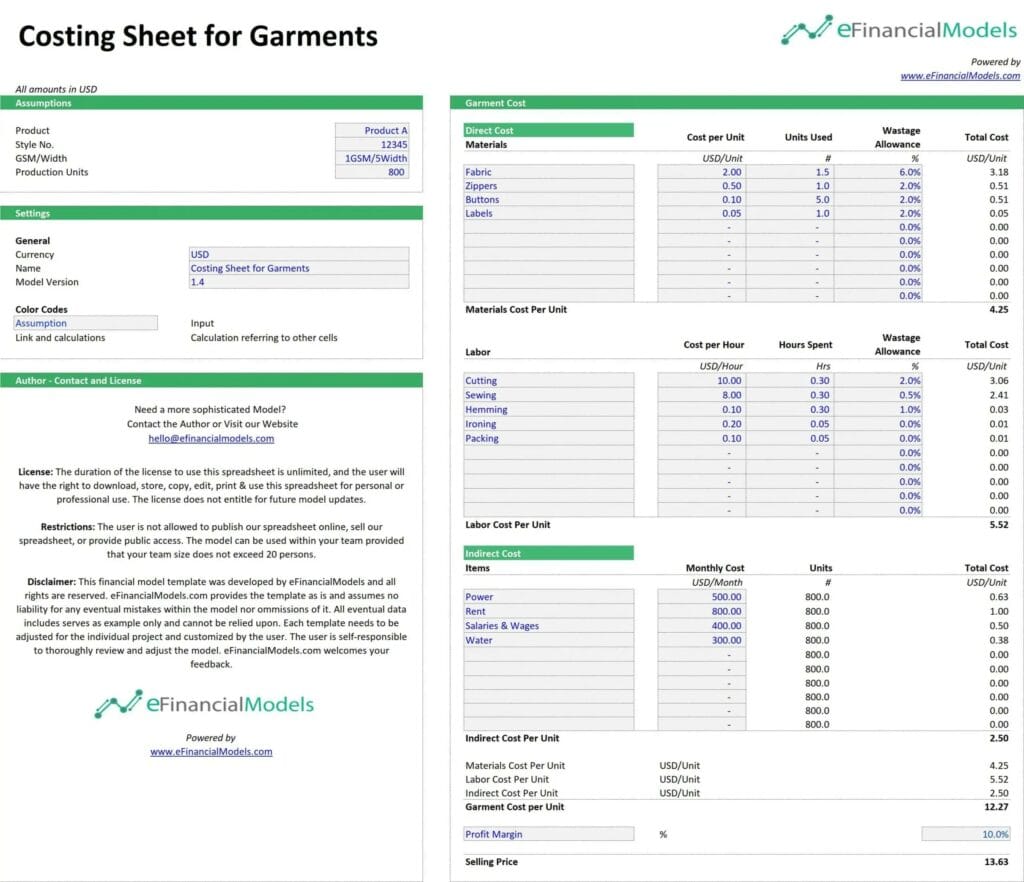
This Costing Sheet for Garments is a basic financial model designed to help garment manufacturers calculate the cost of producing each unit of clothing. It breaks down the total production cost into direct material costs (e.g., fabric, zippers, buttons), labor costs (e.g., cutting, sewing, ironing), and indirect costs (e.g., power, rent, salaries). Each section allows for detailed inputs on unit costs, wastage percentages, and production assumptions to derive the total cost per unit. The model calculates the overall garment cost per unit, adds a profit margin, and provides the final selling price. This simple yet effective tool helps manufacturers price their products accurately and ensure profitability by understanding all cost components.
Debt Amortization Table
The debt amortization table outlines the loan repayment schedule, showing principal and interest over time.
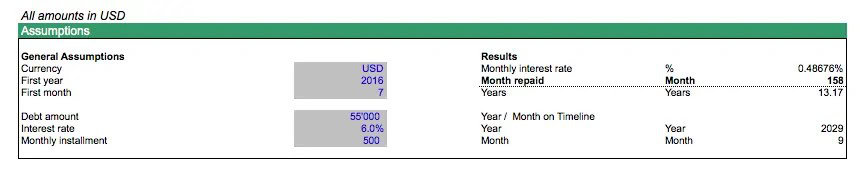
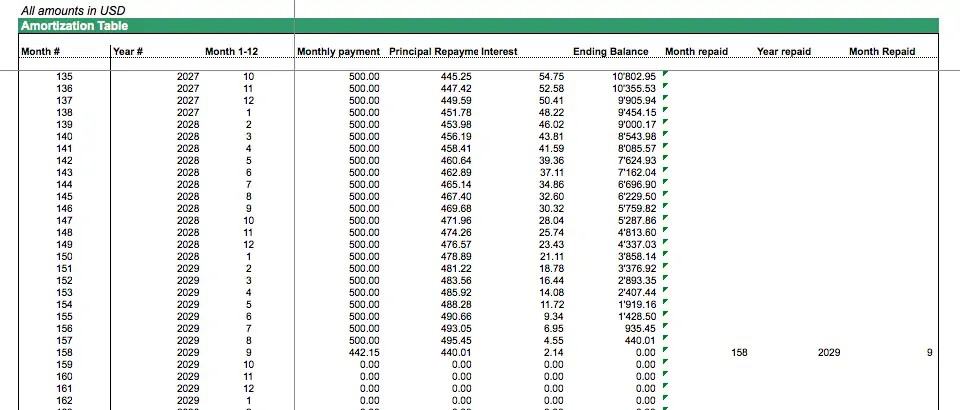
This Debt Amortization Table is a basic financial model used to calculate the schedule of loan repayments over time. It details a loan amount, interest rate, and monthly installment, breaking each payment into interest and principal components. The model starts with key assumptions, such as the loan amount of $55,000, an interest rate of 6%, and monthly payments of $500. The amortization table then shows the monthly progression of repayment, including principal repayment, interest paid, and the remaining loan balance after each installment. It provides a clear picture of how the debt decreases over time until it is fully paid off, allowing the borrower to understand the impact of regular payments on the outstanding balance and interest costs.
Simple Financial Plan
A simple financial plan outlines basic financial goals, income, and expenses to create a straightforward strategy for achieving financial objectives.
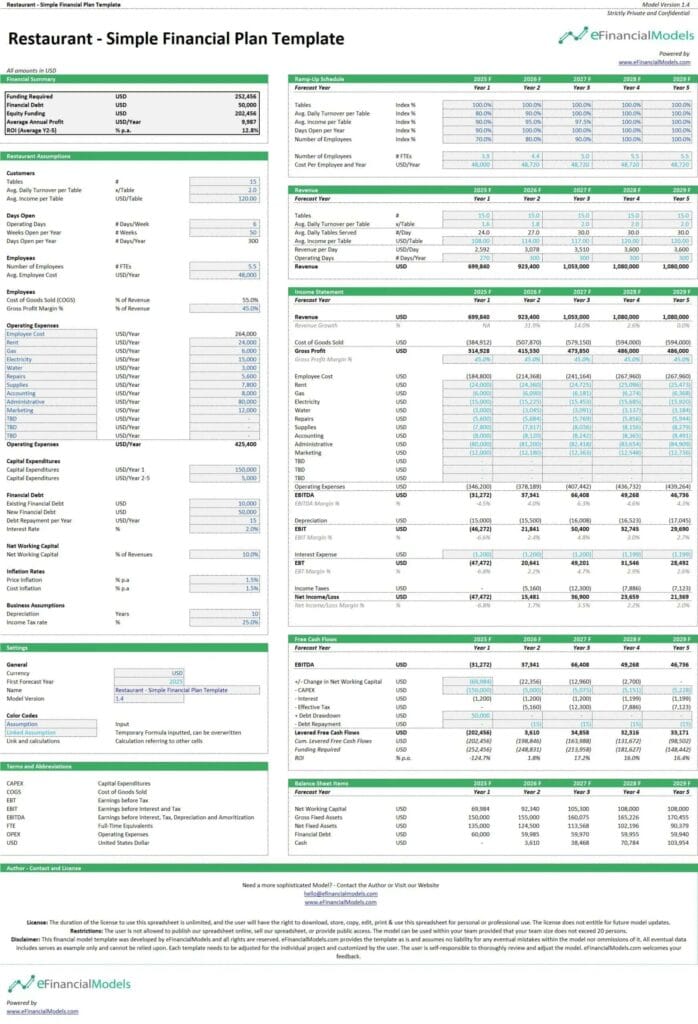
This Restaurant – Simple Financial Plan Template is a basic financial model that overviews a restaurant business’s economic performance and projections. It includes financial summaries such as funding requirements, projected revenue, operating expenses, and profitability over a five-year forecast period. The model helps understand revenue drivers, including daily turnover per table, operating days, and number of employees. It also includes an income statement, cash flow analysis, and balance sheet, offering a detailed view of the restaurant’s financial health. With key assumptions related to costs, funding, and business operations, the template enables restaurant owners to make informed financial decisions and plan effectively for future growth and sustainability.
Three-Statement Model
The three-statement model links the income statement, balance sheet, and cash flow statement to provide a comprehensive view of financial performance.
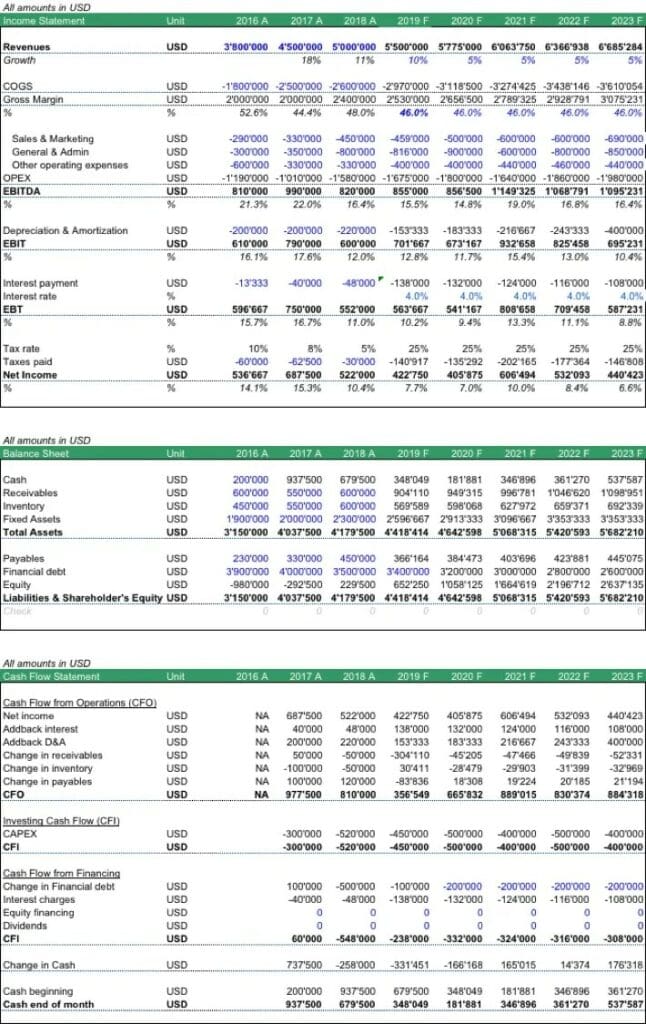
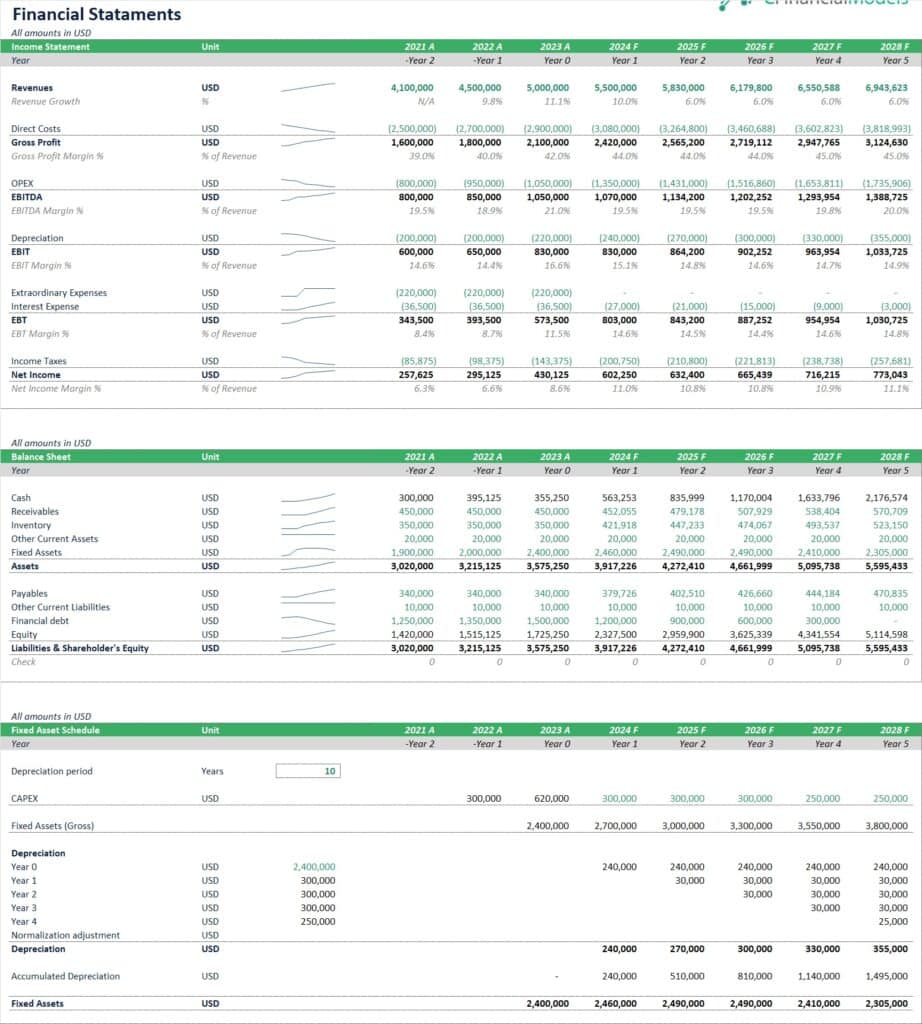
This Three Statement Model is a basic financial model that integrates the income statement, balance sheet, and cash flow statement to offer a comprehensive overview of a company’s financial performance. The income statement section presents the revenue, costs of goods sold (COGS), operating expenses (OPEX), and profitability metrics like EBITDA, EBIT, and net income. The balance sheet captures the company’s financial position by detailing assets, liabilities, and equity. The cash flow statement links net income to cash movements, breaking down cash flows from operations, investing, and financing activities. This model provides insights into the company’s profitability, liquidity, and financial stability, helping users analyze past performance and make informed forecasts.












































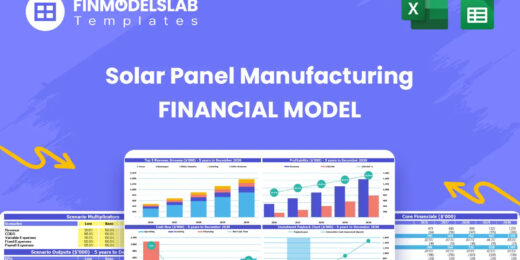
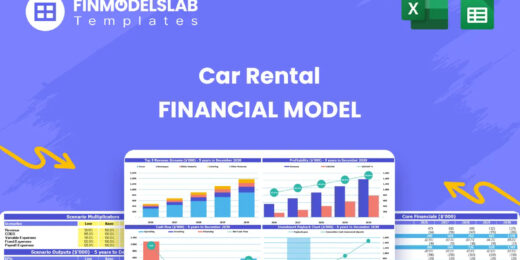
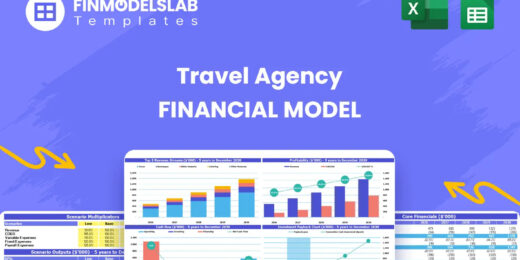
Example Advanced Financial Models
Comprehensive Financial Forecast
This forecast, which integrates components like operating models, debt schedules, and fixed asset schedules, provides a detailed, all-encompassing view of the company’s future financials. It is a crucial tool for understanding the financial impact of multiple interrelated factors, making it an essential part of financial planning.
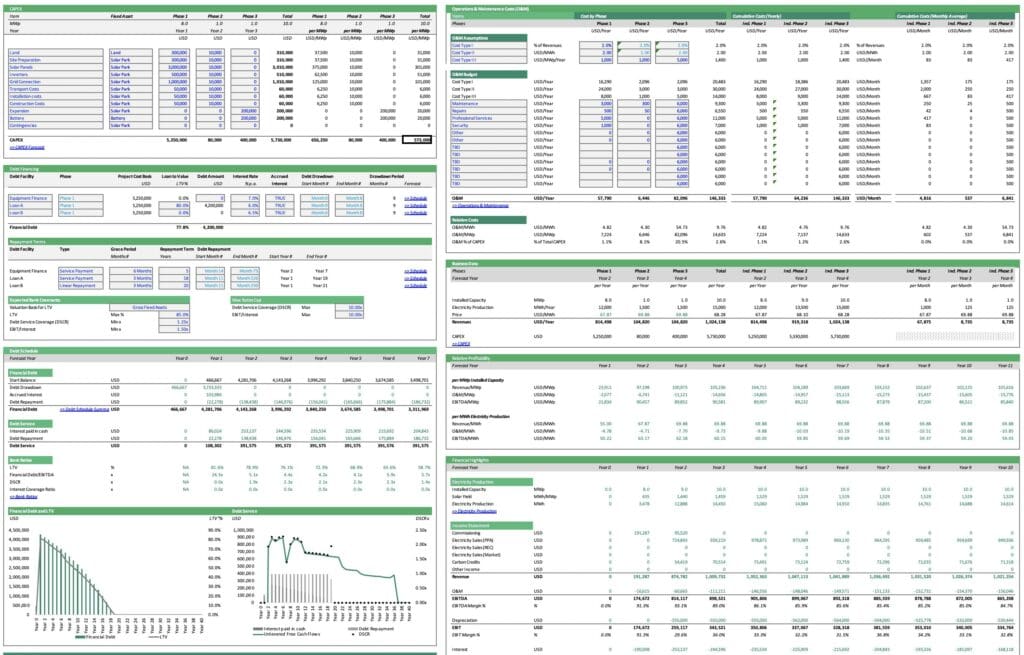
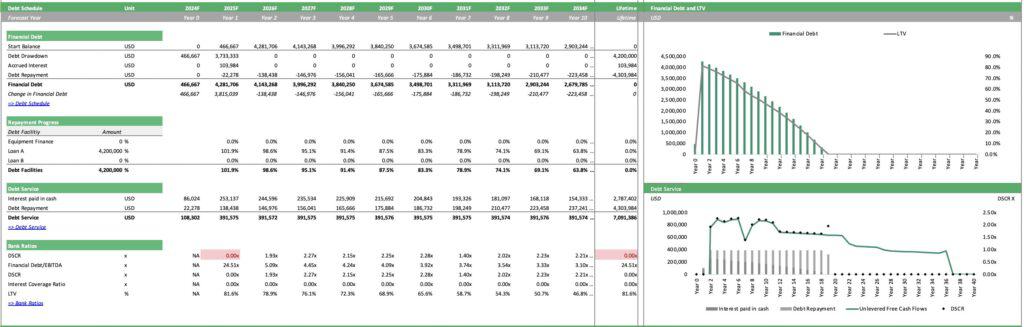
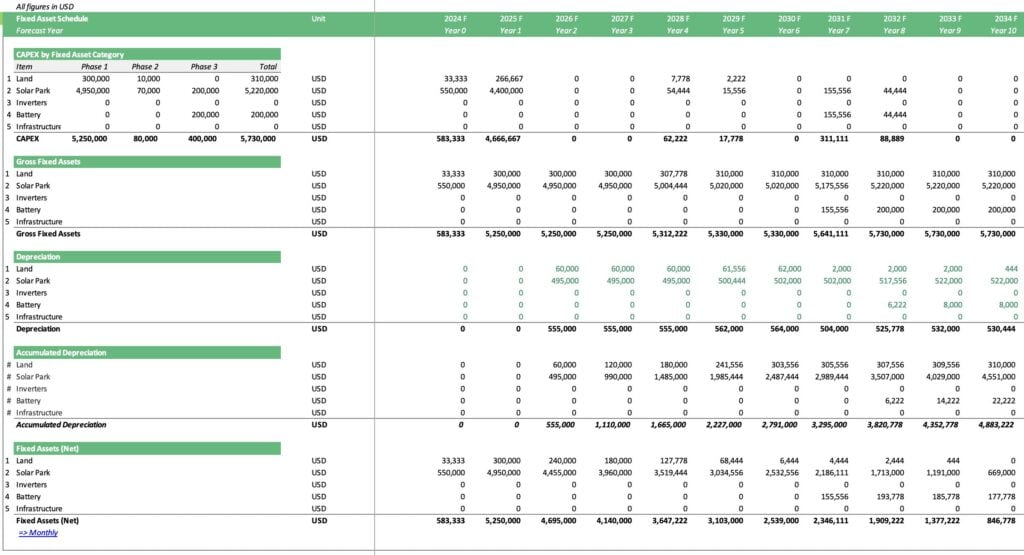
This Solar Energy Financial Model is an advanced financial planning tool designed to evaluate a solar energy project’s financial feasibility and profitability. This model includes comprehensive inputs for multiple project phases, cost structures, revenue estimations, and detailed financial metrics. It supports decision-making with key sections like cash flow projections, asset depreciation schedules, financial ratios, debt schedules, and sensitivity analyses to assess the impact of various scenarios. Additionally, the model provides visual graphs and tables to effectively communicate insights on project performance, return on investment (ROI), and sustainability metrics, making it an invaluable tool for investors and stakeholders in renewable energy projects.
Detailed Operating Model
A detailed operating model provides in-depth projections of production and sales volumes, breaking down each unit, batch, or production run. This level of detail is crucial for modeling certain businesses like manufacturing, where understanding production efficiency, capacity utilization, and variable costs is essential for accurate financial forecasting.
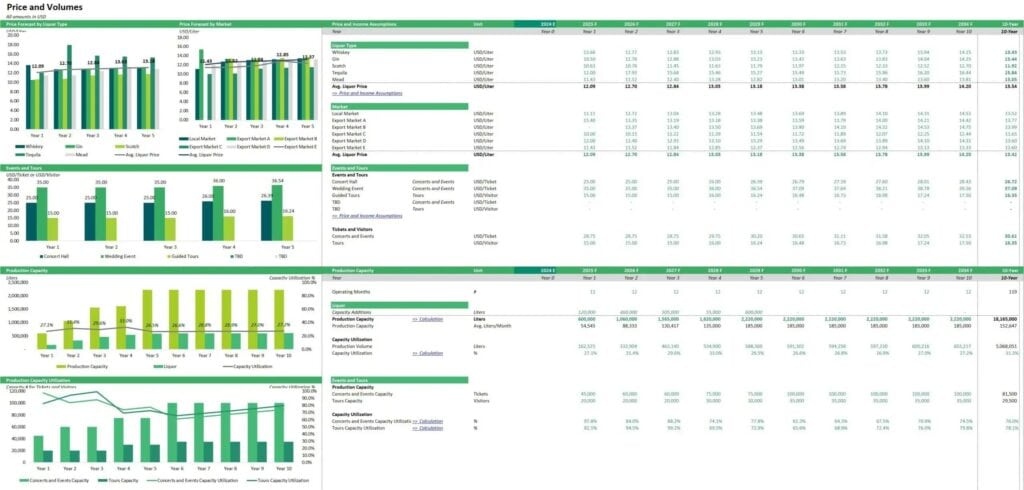
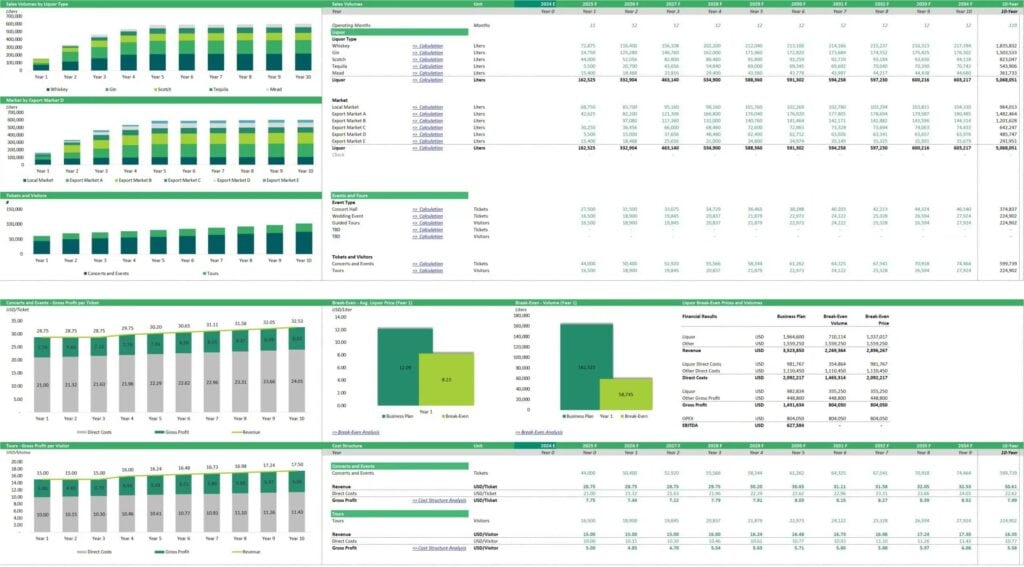
This Liquor Distillery Financial Plan is an advanced financial model tailored to assess the feasibility and profitability of a distillery business. It incorporates multiple components, including projected sales volumes by liquor type, market segmentation, and ticket sales for events and guided tours. The model breaks down revenue sources such as liquor sales, concerts, and tours while offering cost structure insights, including direct costs and gross profit per ticket or visitor. Detailed break-even analyses help identify pricing and sales volumes needed to cover costs and achieve profitability. Furthermore, the model presents key financial results, including operating expenses, EBITDA, and projected cash flows, enabling users to comprehensively evaluate financial health and identify growth opportunities in the liquor business.
Discounted Cash Flow (DCF) Model
This financial model template estimates the value of an investment based on its future cash flows, discounted back to present value using the cost of capital. It’s widely used to determine the intrinsic value of a company or project, helping in investment decisions.
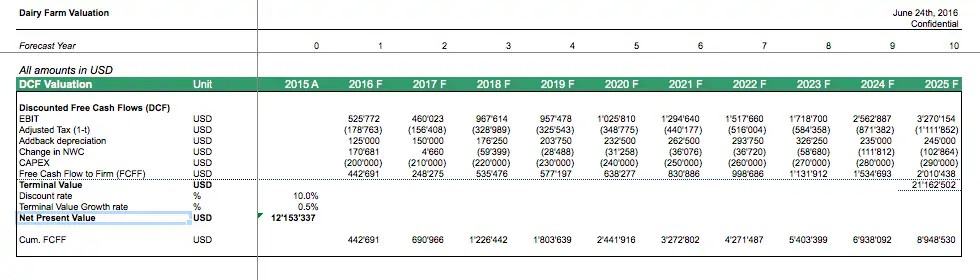
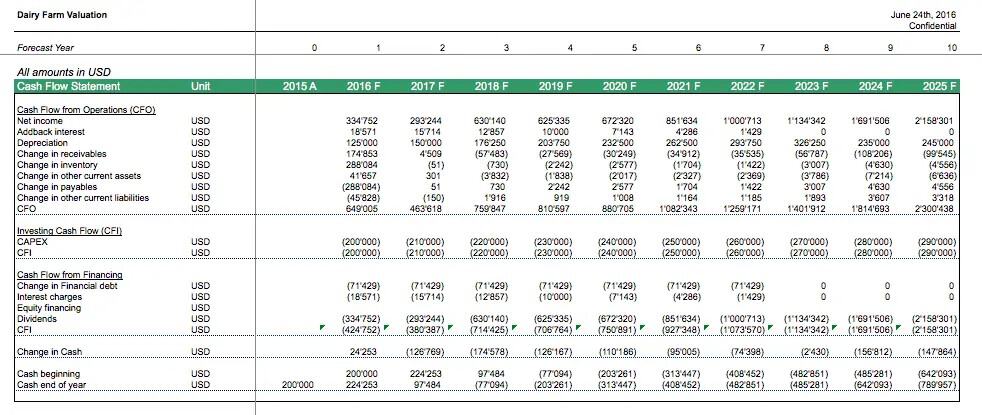
This Dairy Farm Valuation Model is an advanced financial tool designed to estimate the value of a dairy farm using discounted cash flow (DCF) analysis. It includes projections of key financial components such as EBIT, depreciation, capital expenditure (CAPEX), and changes in net working capital to derive Free Cash Flow to Firm (FCFF). The model also incorporates a terminal value calculation, which, along with a discount rate, helps determine future cash flows’ net present value (NPV). Additionally, the cash flow statement provides a detailed breakdown of cash inflows and outflows, categorized into operations, investing, and financing activities. This comprehensive approach allows investors to assess the dairy farm’s viability, profitability, and future financial health, making it a crucial tool for valuation and strategic decision-making.
When Do You Need a Financial Model?
A financial model is an essential tool that provides a clear and structured way to understand the financial impact of decisions in a business. It’s needed when assessing the viability of opportunities, planning for growth, or preparing for strategic moves such as funding or acquisitions. Forecasting financial outcomes, a well-prepared financial model clarifies complex scenarios, enabling informed decision-making. Whether it’s to understand the profitability of a new product, determine how much capital a startup needs, or evaluate the financial resilience of a business under different market conditions, financial models serve as the foundation upon which strategic business decisions are built.
- Fundraising: A financial model is crucial when raising funds because it provides a comprehensive projection of your business’s future performance, helping potential investors evaluate the viability and profitability of your venture. By demonstrating expected revenue growth, cash flow, costs, and key financial metrics, an economic model can give investors confidence in the value of your business and showcase how their capital will be effectively utilized. It also allows founders to assess different scenarios, ensuring they can present a solid plan for mitigating risks and maximizing returns. When raising funds, Key models like the Three-Statement Model, DCF Model, and Scenario Analysis help demonstrate revenue growth, cash flow, valuation, and resilience to risks, giving investors confidence in the effective use of their capital while enabling founders to present a solid, risk-mitigated plan.
- Business Planning: A financial model is essential when planning a business because it provides a structured representation of your business’s economic outlook. It allows you to project revenues, expenses, and cash flows, helping you understand your business’s viability and profitability. Financial models enable you to make informed decisions, identify risks, and test different scenarios by quantifying the impact of various variables, such as pricing changes or cost adjustments. Key models like the three-statement, DCF, and break-even analysis help make informed decisions evaluate risks, and test scenarios, forming a solid foundation for effective planning.
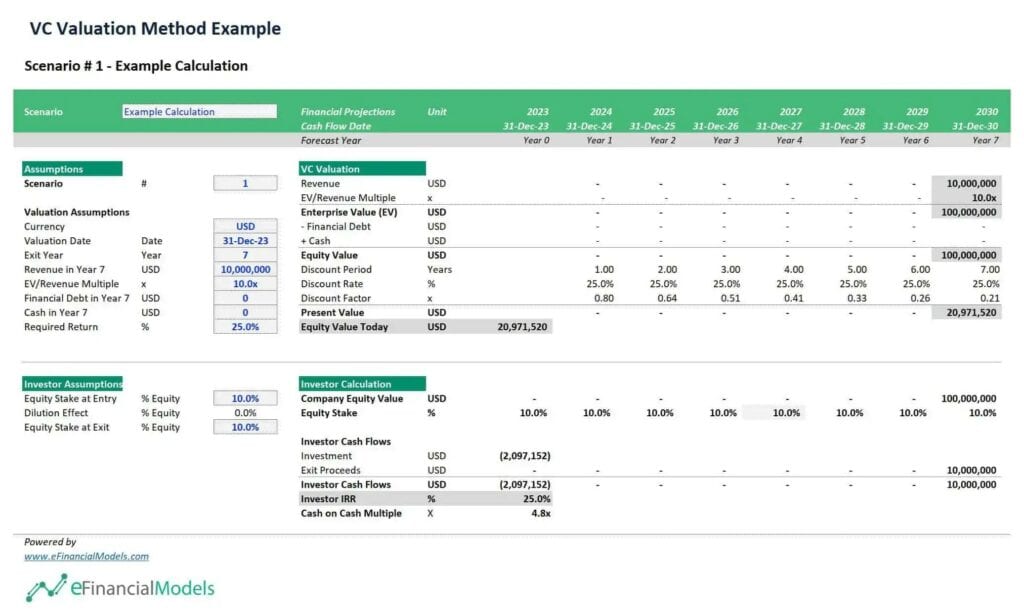
- Valuation Analysis: When conducting valuation analysis, a financial model is indispensable for understanding the true worth of a business. A financial model provides a structured way to forecast a company’s financial performance, taking into account revenue streams, operating expenses, capital investments, and other key financial variables. This allows analysts to make informed projections about the company’s future cash flows, profitability, and risks, which are critical to determining its intrinsic value. Financial models enable valuation methods like the VC Valuation Method, Discounted Cash Flow (DCF) analysis, precedent transactions, and comparable company analysis, making them essential for investors, business owners, and stakeholders aiming to assess the fair market value of a business for investment, acquisition, or fundraising purposes. Together, these models provide a robust framework to evaluate a company’s value from multiple perspectives.
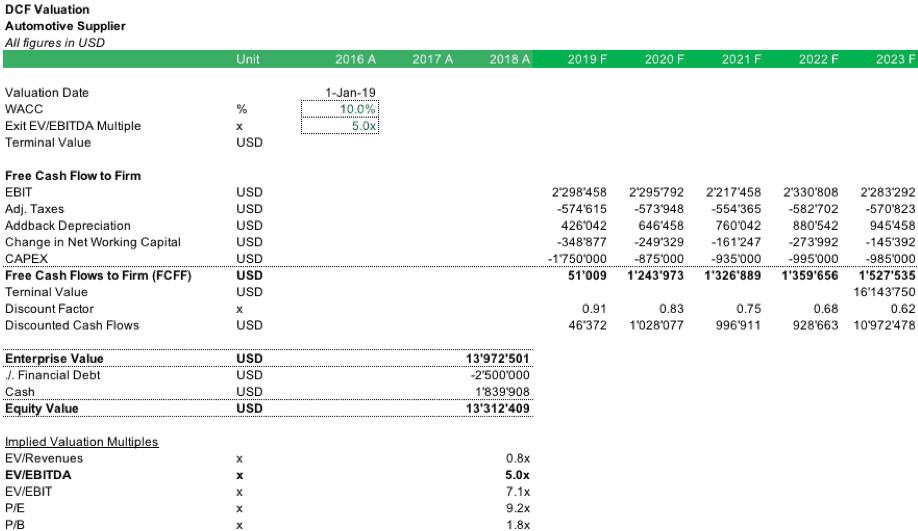
Discounted Cash Flow Model (Automotive Supplier)
- Budgeting and Forecasting: Financial models are essential for budgeting and forecasting because they provide a structured framework to quantify the economic impact of business decisions. By creating a detailed financial model, companies can project their revenues, expenses, cash flows, and profitability, allowing them to set realistic budgets and make informed strategic choices. These models help anticipate future financial performance, identify potential cash shortages, and prepare for economic uncertainties. Key models like the free cash flow model, DCF model, and break-even analysis help make informed decisions, evaluate risks, and test scenarios, forming a solid foundation for effective planning.
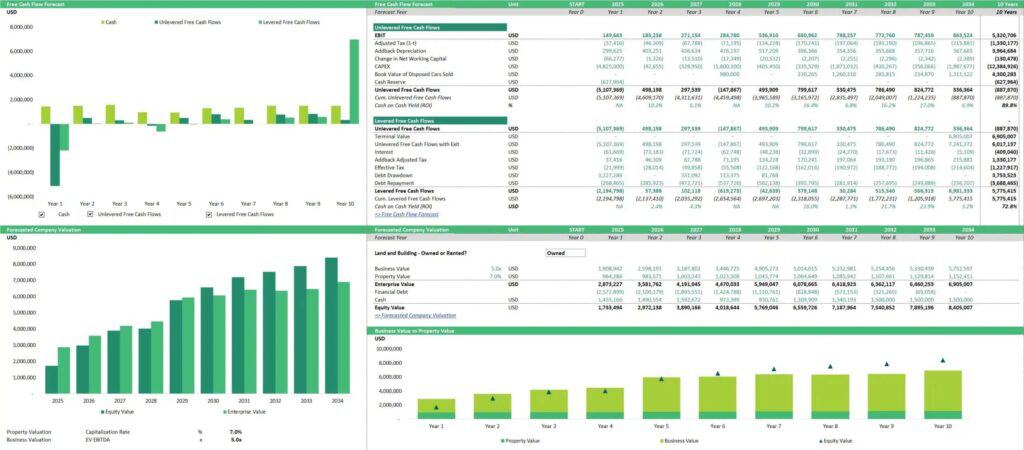
Sample Free Cash Flow Forecast (Car Rental Business)
- Financial Feasibility: Financial models are crucial when assessing financial feasibility because they provide a detailed, quantitative analysis of a project’s potential outcomes. By simulating different scenarios, financial models help evaluate whether a business venture or investment is viable and can generate sufficient returns. These models incorporate key elements like revenue, expenses, capital costs, and cash flows, enabling decision-makers to estimate profitability and understand the risks. Key models like the Projected Cash Flow Model, Break-even Analysis Model, and Discounted Cash Flow (DCF) Model help estimate profitability, liquidity, and the viability of a venture, offering a comprehensive view of its strengths and challenges.
- Assessing Investment Opportunities: A financial model is essential when assessing investment opportunities because it provides a structured framework to evaluate the potential risks and returns associated with an investment. By creating a detailed representation of a project’s financial performance, investors can gain insights into key metrics such as cash flow, profitability, and return on investment. Financial models help to project future scenarios, understand the impact of different variables, and make informed decisions by quantifying assumptions about the business environment. Key models like the Discounted Cash Flow (DCF), Comparative Company Analysis (CCA), and Leveraged Buyout (LBO) offer insights into profitability, valuation, and the impact of leverage, helping investors make informed, data-driven decisions.
- Cash Flow Management: When it comes to effective cash flow management, having a financial model is crucial for understanding the cash movement in and out of your business. Cash flow is the lifeline of any company. Without proper visibility into cash inflows and outflows, a business can quickly find itself in trouble—even if it is profitable on paper. A financial model allows you to forecast cash needs, make informed decisions on spending, and anticipate any potential shortfalls or surpluses in advance. Key models like the Cash Flow Forecast, Working Capital Analysis, and Scenario Analysis help forecast cash needs, assess efficiency, and prepare for unexpected changes, ensuring a stable financial state and informed decision-making. Together, these models help ensure your business maintains a healthy financial state and avoids liquidity issues.
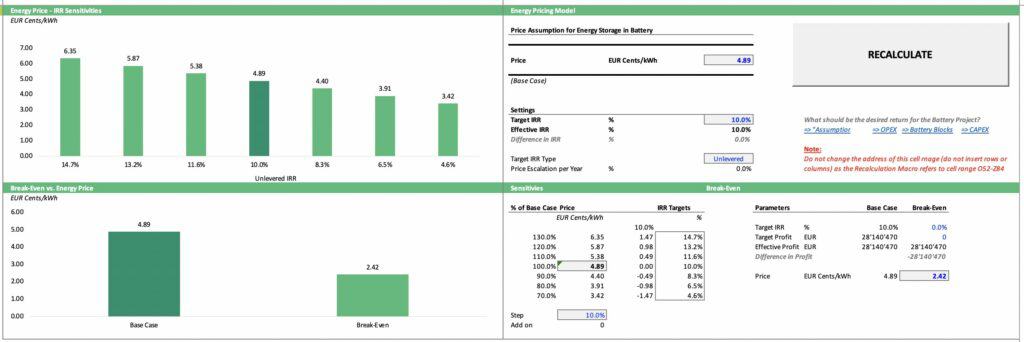
- Pricing Analysis: A financial model is essential for pricing analysis because it provides a structured framework to evaluate the impact of different pricing strategies on a company’s profitability and financial health. A financial model simulates various pricing scenarios and helps determine optimal price points that balance customer demand and maximize revenue. Moreover, it allows businesses to estimate how price changes affect metrics such as profit margins, cash flow, and sales volume, helping them make informed decisions that align with their financial goals. When conducting pricing analysis, several financial models are typically used to ensure a comprehensive approach. Models like Break-even Analysis, Price Sensitivity Analysis, and Profit Margin Analysis help determine optimal pricing, balance customer demand, and maximize revenue while aligning with financial goals. Together, these models offer a holistic view that guides effective pricing decisions.
- Mergers & Acquisitions (M&A): A financial model is essential in Mergers & Acquisitions (M&A) because it helps evaluate the transaction’s feasibility, risks, and potential returns. By projecting the financial performance of both the acquiring and target companies, financial models allow decision-makers to assess synergies, calculate cost savings, and determine whether the deal adds value. Moreover, M&A transactions often involve significant complexities such as valuation, deal structuring, and financing options, and a well-built financial model provides the quantitative foundation needed to make informed decisions and negotiate favorable terms. Typically, three main types of financial models are used in M&A transactions. The Merger Model analyzes the financial impact of merging two companies, including potential synergies and the accretion/dilution effect on earnings per share (EPS). The Discounted Cash Flow (DCF) Model determines the target company’s intrinsic value by projecting future cash flows and discounting them back to present value. Lastly, the Leveraged Buyout (LBO) Model is used in cases where the acquisition is primarily financed with debt, helping determine the feasibility of servicing the debt and generating returns for investors. Each of these models plays a vital role in evaluating the viability of the M&A deal, calculating the value of the target, and understanding the financial implications of the acquisition.
- Restructuring: When a company is undergoing restructuring, having a financial model is essential to navigate the complex changes effectively. It provides a clear view of the company’s financial health, helping decision-makers evaluate scenarios and determine the best path forward. Typically, during a restructuring process, three financial models are commonly used. The first is a Cash Flow Forecast model, which helps project the future cash position of the company and ensures it can meet its obligations during restructuring. The second is a Debt Restructuring model, which assists in evaluating different debt repayment schedules and refinancing options, allowing for negotiations with creditors. Lastly, a Valuation model is crucial, especially if an ownership change or asset sale is involved; it provides insight into the company’s worth under different restructuring scenarios. These models enable companies to make informed decisions that align with their restructuring objectives.
A financial model becomes essential whenever you need to make informed business decisions. Whether it’s assessing the feasibility of a project, valuing your company, understanding cash flow needs, or preparing for investor discussions, a financial model offers a structured way to quantify assumptions and project future outcomes. It serves as a roadmap, providing clarity in times of uncertainty and delivering insights that guide strategic moves. Ultimately, having a well-crafted financial model helps you confidently navigate the complexities of finance, turning abstract business plans into a clear, actionable framework.

Why Every Business Needs a Financial Model?
Regardless of size or industry, every business needs a financial model Excel template to quantify its vision, forecast revenue, and manage costs, cash flow, and profitability. A well-constructed model helps business owners and investors understand potential scenarios, assess risks, and evaluate growth opportunities by detailing key assumptions and projecting financial outcomes. A financial model Excel template is the backbone of a successful business, providing the clarity needed to make informed decisions and effectively plan for the future.
Assess the Feasibility of Business Decisions
Every business, regardless of its size or industry, needs a financial model to assess the feasibility of critical business decisions. A financial model is a roadmap that allows business owners to evaluate various scenarios and predict their potential outcomes. Entrepreneurs need a concrete basis to decide if it’s economically viable before diving into any major venture—such as expanding into a new market, launching a new product, or acquiring another company. Financial models help simulate these different scenarios, offering insights into these ventures’ profitability, cash flow, and overall sustainability. Without this analytical framework, businesses would be left making important decisions blindly, significantly increasing the risk of failure.
Additionally, financial models provide an objective foundation for evaluating what is economically beneficial. When a business is considering several strategic options, the financial model can show which path is the most profitable or presents the least risk, making decision-making more data-driven rather than based on intuition. The model offers a detailed view of expected revenues, costs, and financial risks, allowing owners to weigh their choices effectively. By doing so, companies can avoid pursuing initiatives that seem appealing at first glance but lack the financial fundamentals to support sustainable growth, thus ensuring that each decision is made with both short-term and long-term business health in mind. This clarity in decision-making reduces uncertainty and keeps business owners well-informed.
Attract Investors with Clear Financial Insights
A financial model to ensures stability and strategic growth. It is not just about the present, but about the future. It helps to project future revenues, expenses, and cash flows, providing an essential roadmap for the company’s financial health. By utilizing this tool, business owners can make informed decisions about resource allocation, understand the profitability of different scenarios, and evaluate their break-even points. This forward-looking approach allows businesses to stay ahead of risks, capitalize on opportunities, and ultimately navigate their path toward sustainability and growth.
When attracting investors, a well-crafted financial model is a must-have. Investors and lenders want transparency regarding the financial implications of a business plan before they commit any capital. A financial model helps articulate these aspects in detail, showcasing clear projections and key metrics like revenue growth, gross margin, and profitability. This detailed insight builds trust with potential investors by demonstrating the business’s understanding of its market, financial viability, and growth potential, ultimately helping to secure the investment needed to scale.
Forecast Future Performance
Every business needs a financial model to thrive and grow regardless of its size or industry. A financial model serves as a structured representation of a company’s economic future, enabling owners and managers to assess their current financial health, set achievable goals, and plan for the years ahead. It acts as a guiding framework that integrates revenue streams, expenses, capital requirements, and profitability into a comprehensive view, empowering decision-makers to make well-informed business choices. With an accurate financial model, businesses can also attract investors, as it provides a transparent view of how funds will be utilized and the returns that can be expected.
Moreover, financial modeling is essential for forecasting future performance. Through solid financial planning, businesses can anticipate future scenarios and prepare accordingly. A sophisticated financial model allows business owners to understand how different financial aspects, such as sales, costs, and cash flow, are interconnected. It enables a deeper analysis of how different variables impact the overall financial health of the company. This type of forecasting encourages proactive rather than reactive management, helping businesses navigate uncertainty and mitigate potential risks. As a result, businesses can be better equipped to handle market changes and seize growth opportunities confidently.
Identify Risks and Opportunities Early
A financial model is a strategic tool that provides insights into a company’s future financial health. By forecasting revenue, expenses, cash flows, and profitability, businesses can make informed decisions that align with their objectives. The model helps establish a clear path toward growth, guiding pricing, investments, and resource allocation decisions. Essentially, it acts as a map that transforms data into actionable plans, ensuring that well-analyzed financial projections back every move.
Moreover, a financial model is indispensable for identifying risks and opportunities early on. It allows business owners and managers to understand their company in terms of economic potential and the associated risks, enabling proactive measures. Analyzing different scenarios and their impact on the business highlights vulnerabilities such as potential cash flow shortages or the risk of underperforming revenue channels. At the same time, it reveals opportunities for growth, expansion, and optimization. This forward-looking approach can significantly improve the resilience of the business, allowing for adjustments that keep the company on a path to success while mitigating possible setbacks.
Optimize Cash Flow Management
Every business, regardless of size or industry, needs a financial model to plan for the future and manage its financial health. A financial model serves as a roadmap, outlining a company’s projected revenues, expenses, and profitability. By analyzing different scenarios and making realistic assumptions, a financial model helps business owners anticipate challenges, allocate resources efficiently, and identify growth opportunities. It also acts as a decision-making tool, providing valuable insights into how various factors—such as changes in pricing, sales volume, or costs—affect the business’s overall performance. Moreover, having a financial model is essential when presenting to potential investors or lenders, as it demonstrates the business’s financial viability.
A well-built financial model is crucial for optimizing cash flow management, a key aspect of maintaining a healthy business. By forecasting cash inflows and outflows, companies can ensure they have enough liquidity to meet their obligations, whether paying suppliers, managing payroll, or investing in growth opportunities. The financial model allows business owners to identify periods of cash shortages or surpluses and take proactive measures, such as adjusting payment terms or securing financing to bridge gaps. Effective cash flow management not only ensures the smooth operation of the business but also reduces financial stress and improves the ability to seize new opportunities when they arise.
Unlock Business Clarity and Confidence With a Financial Model!
A well-crafted financial model serves as the compass guiding your business through the complexities of growth and uncertainty. By helping you forecast revenues, assess costs, and predict cash flows, a financial model provides the clarity you need to navigate challenging decisions. With a reliable model in place, you gain insights critical for strategic planning, whether it’s allocating resources, entering new markets, or ensuring profitability. The right financial model turns ambiguity into certainty, allowing you to steer your business with confidence.
Embracing financial modeling isn’t just about crunching numbers—it’s about empowering yourself with a clearer picture of your business’s potential. From validating business ideas to preparing for investor discussions, the confidence you gain from well-supported projections can be a game changer. Don’t let uncertainty hold you back; take charge of your business’s future. Unlock the power of clarity and make informed decisions with a comprehensive financial model today!

















You might also like:
- 10 Tips to Develop a First Class Business Valuation Report
- 12 Funding Sources for Businesses and Startups
- 10 Main Elements of a Business Plan
- 5 Practical Tips to Help Raise Funds For Startups
- Financial Statements – Definition, Uses, Contents and Templates
- How to Prepare a Financial Feasibility Study?
- Financial Planning for Small Business Owners – Taking an SBA Loan
- How to Build a Capitalization Table
- Top 5 Tips For a Good Financial Due Diligence
- Financial Planning Retirement Tips
- Financial Model Templates Easy to Use
- Why Financial Forecasting Models Are Vital for Your Business
- Calculating Revenue Growth Rate: A Key Metric for Business Success
- How to Raise Series A Funding?
- Startup Financial Models
- Revenue Model Templates and their Characteristics
- Financial Modeling for Startups and Small Businesses
- Business Valuation Service
- 10-Step Financial Planning Checklist for Smart Executives
- Achieve Financial Success By Knowing Your Business Plan Model


