
0 ITEMS

How to Use a PV of Annuity Calculator
Table of Content
Understanding the present value of an annuity is key for evaluating the worth of regular payments over time.
- The present value of an annuity discounts future payments to their current worth using a specific interest rate.
- Different formulas apply for ordinary annuities and annuities due, based on payment timing.
- Fixed, variable, and equity-indexed annuities each have distinct features influencing their valuation.
- Calculating the present value helps in financial decisions such as investment analysis, loan evaluation, and retirement planning.
- Using a PV of annuity calculator simplifies these calculations and improves financial accuracy.
This article covers how to accurately determine annuity value and when to apply these calculations in real-world scenarios.
What is the Present Value of Annuity?
An annuity is a financial contract that provides regular payments to an individual over a specified period or for life in exchange for an initial investment. It involves two primary parties:
- The annuitant purchases the product in exchange for a steady income stream.
- The issuer assumes the risk of the investment and guarantees the payment stream. They are responsible for managing the investment and making periodic payments per the contract terms.
Annuities are often utilized to generate steady cash flow for a specified period or the annuitant’s lifetime.
The present value of an annuity refers to the sum of the current values of all future annuity payments. It’s calculated by discounting these future payments back to the present time, considering a specific interest rate or discount rate. This concept is crucial in finance as it compares the value of payments or cash flows at different times.
Types of Annuities
Understanding the types of annuities before learning how to calculate annuity value is crucial for several reasons. First, each kind has a distinct formula for calculating its present and future value. For example, the equity-indexed annuity definition offers a hybrid payout computation. Knowing the type of annuity helps in applying the correct formula and assumptions. Second, different annuities suit different investment goals and risk tolerances. Understanding these differences helps in accurate financial analysis and decision-making.
Here’s a detailed explanation of each category and type:
By Payment Time
- Annuity Due: Payments are made at the beginning of each period. An example of this might be rent payments, typically due at the start of the month.
- Ordinary Annuity: Payments are made at the end of each period. It is common in retirement accounts where you receive the payment at the end of a month or year.
By Payout Options
- Immediate Annuities: Payouts begin immediately after a lump sum investment. For example, an individual invests a lump sum upon retirement and receives monthly payments directly.
- Deferred Annuities: Payouts start at a future date after the investment period. For instance, a 50-year-old invests in an annuity but defers payments until reaching 65.
By Growth Potential
- Fixed Annuities: Guarantee regular payments to the annuitant for a specified period or life in exchange for an initial investment. They can either be contingent, for a lifetime, or specified. One good example is the annuitant receiving a guaranteed $1,000 monthly for life.
- Variable Annuities: How to calculate annuity value of the payout varies based on the performance of investments chosen by the annuitant. For instance, monthly payments fluctuate based on the performance of a portfolio of stocks and bonds.
- Equity-Indexed Annuities: The equity-indexed annuity definition is a hybrid of fixed and variable annuities, with payments linked to a stock market index. For example, payments increase with the rise of the S&P 500 index but have a guaranteed minimum. The equity-indexed annuity definition balances potential growth and protection against market downturns.
Each type of annuity offers distinct features catering to different financial needs and risk tolerances. For example, annuity due and ordinary annuity differ in the timing of payments, which is crucial for cash flow planning. Immediate and deferred annuities cater to different stages of life, whether primary income is needed or if it’s for future security. Lastly, the growth potential categories offer options from guaranteed stability of fixed annuities to higher potential with market exposure of the variable and equity-indexed annuity definition.


















































What is the Formula for the Present Value of an Annuity?
The formula for the present value of an annuity shows the discounted value of future payments using an interest rate to demonstrate the time value of money. We use a different formula for ordinary annuity and annuity due. Why? The critical difference between the two lies in the timing of payments. In an ordinary annuity, payments are made at the end of the period, while in an annuity due, payments are made at the beginning. Such a timing difference also affects the accumulation of interest. For an annuity due, the investment starts earning interest earlier than in an ordinary annuity.
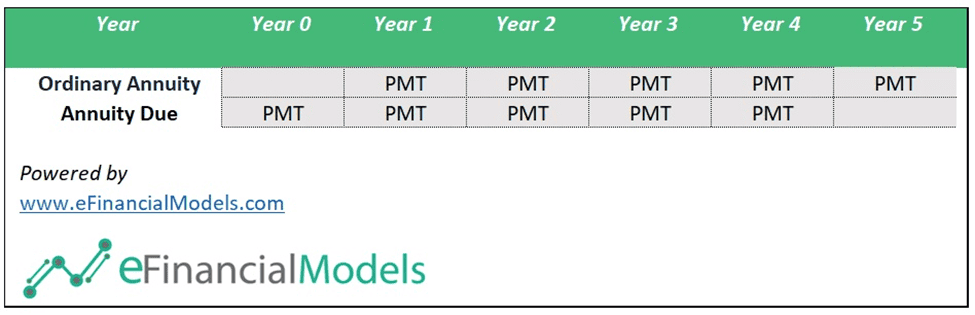
In an ordinary annuity, the first payment happens at the end of the first period. Payments continue at the end of each period—monthly, quarterly, or yearly. The final payment falls at the end of the annuity term. So, for a five-year annuity, the last payment is made at the end of Year 5. In contrast, an annuity due begins with a payment immediately—at the start of the first period. Using the same five-year example, the first payment occurs in Year 0. Payments then follow at the start of each period. The final payment is made at the beginning of the fifth year.
Ordinary Annuity
The standard formula for the present value of an annuity applies to an ordinary annuity. The standard formula for the present value of an annuity can be mathematically expressed as follows:
Ordinary Annuity
The standard formula for the present value of an annuity applies to an ordinary annuity. The standard formula for the present value of an annuity can be mathematically expressed as follows:
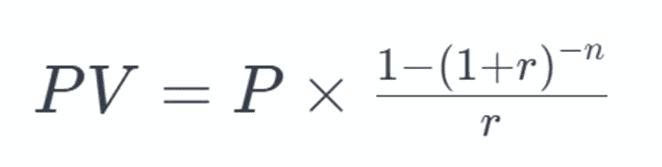
Where:
- PV = The Present Value of the Annuity
- P = Payment Amount Per Period
- r = Interest Rate Per Period
- n = Total Number of Periods
Annuity Due
For an annuity due, the formula is slightly modified as:
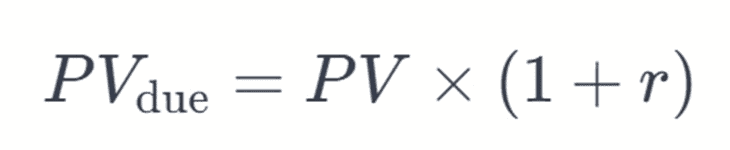
Where:
- PV = The Present Value of the Annuity
- r = Interest Rate Per Period
Steps to Calculate Annuity Value
- Determine the payment amount. It is the fixed amount paid each period.
- Determine the interest rate. It should be the period interest rate (e.g., annual). The discount rate or interest rate for an annuity varies based on the type (fixed or variable), market conditions, the issuing institution’s policies, and the annuity’s terms and duration.
- Determine the number of periods. It is the total number of payment periods.
- Apply the formula. Use the appropriate formula for the present value of an annuity.
- Adjust for Annuity Due (if applicable): Multiply the ordinary annuity PV by (1 + r).
Sample Calculation – Ordinary Annuity
Let’s assume an ordinary annuity with a yearly payment of $10,000, an annual interest rate of 5%, and a total duration of 10 years.
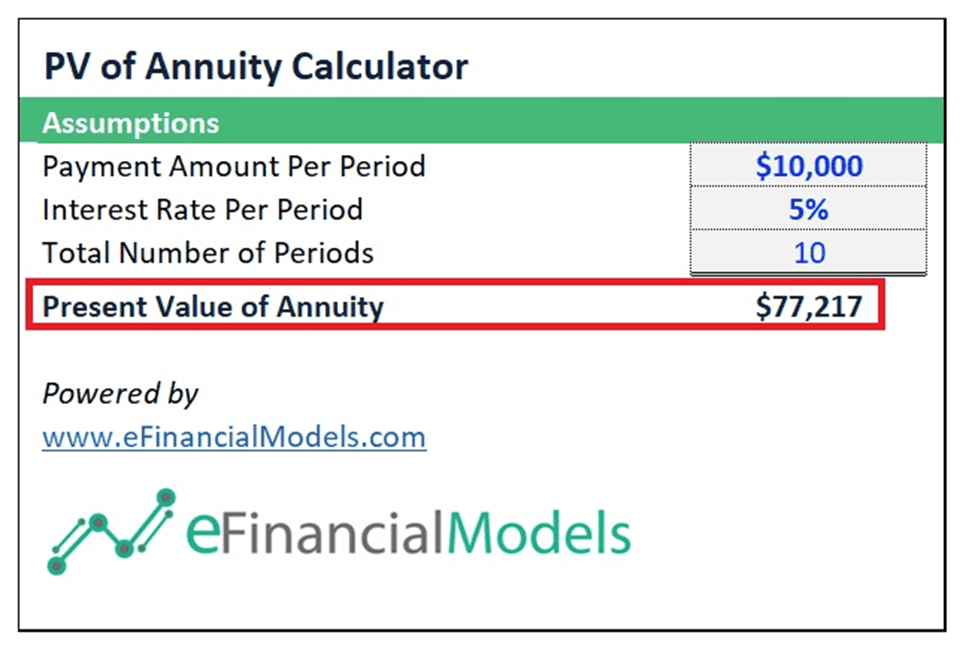
Using the ordinary annuity formula, we get a present value of $77,217. This means receiving $10,000 each year for 10 years at 5% interest is worth $77,217 today. The present value is lower than the total of all payments because future cash loses value over time. That’s due to the earning power of money through interest or returns.
Sample Calculation –Annuity Due
Now, let us adjust the calculation for the annuity due. Since this is an annuity due, the payments occur at the beginning of each period. Thus, the present value should be slightly higher than an ordinary annuity’s.
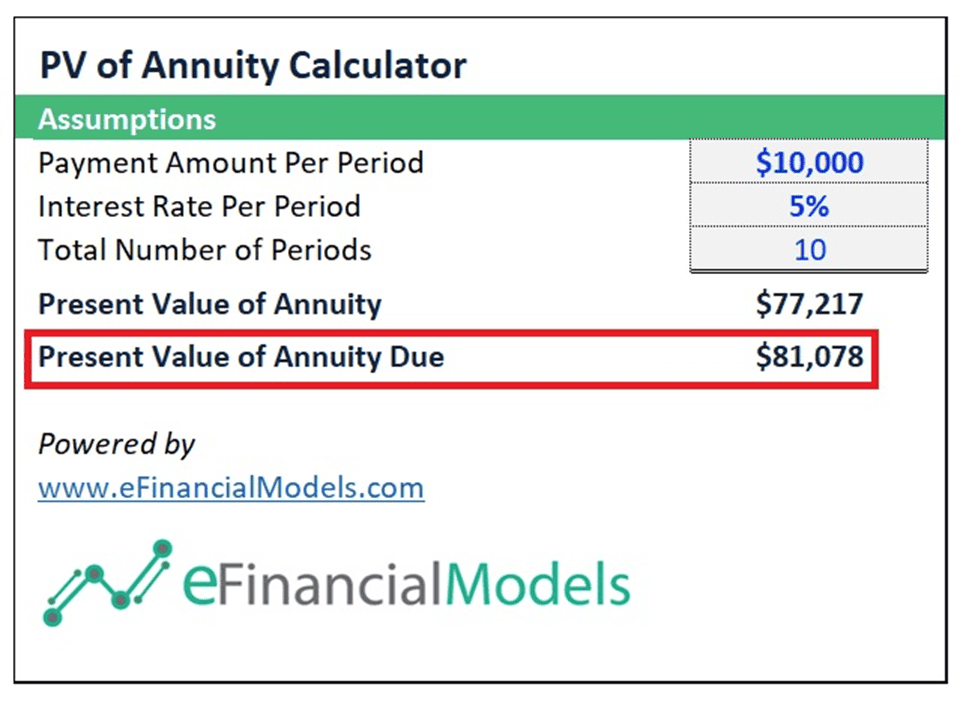
Using the annuity due formula, the present value is $81,078. Each payment happens one period earlier than in an ordinary annuity. That timing adds an extra period of interest to every payment. As a result, the total present value is higher.
When Should You Use the PV of Annuity Calculator?
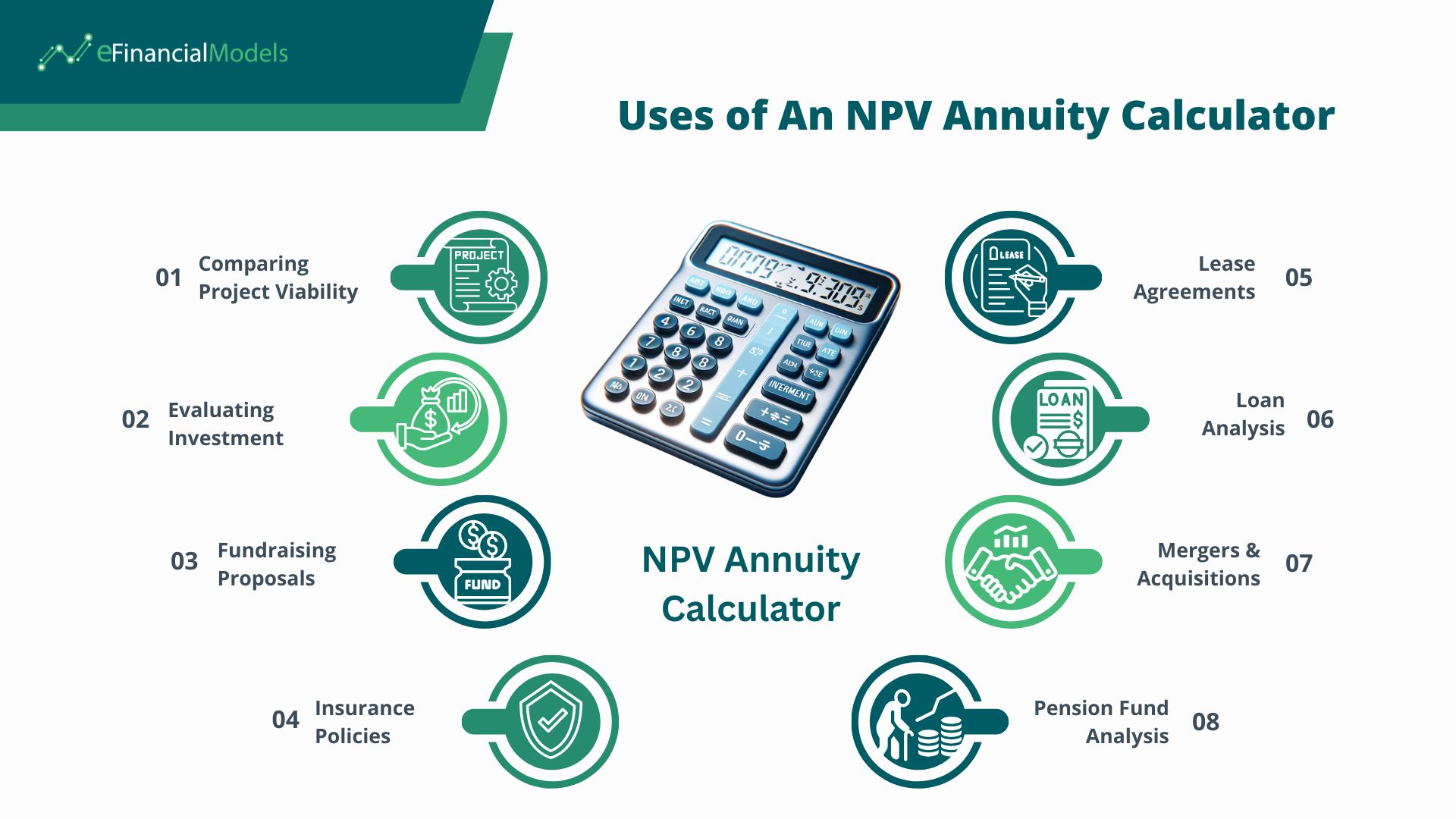
The Annuity Calculator is an essential tool, particularly relevant in scenarios where you’re dealing with a series of periodic payments (annuities) and need to determine their present value. Here are vital situations when using a Present Value of Annuity Calculator is advisable:
- Comparing Project Viability: In capital budgeting, where you’re comparing multiple projects or investments, the PV of Annuity Calculator can provide a clear picture of which project is more financially viable by considering the time value of money concept. Generally, it represents the most valuable investment in today’s terms.
- Evaluating Investment Opportunities: When assessing investment opportunities that promise regular returns over a period, such as bonds or rental properties, the Present Value of Annuity Calculator helps in determining the current worth of these future cash flows.
- Fundraising Proposals: When preparing fundraising proposals that involve regular paybacks or dividends, this tool can help present the present value of these future cash flows to potential investors.
- Insurance Policies: For certain types of insurance products that involve annuity payments, either as a premium or payout, the PV of Annuity Calculator can be used to understand the actual value of these payments.
- Lease Agreements: In real estate or equipment leasing, where regular lease payments are involved, the Present Value of Annuity Calculator helps determine the present value of these lease payments, aiding in decision-making on whether to lease or buy.
- Loan Analysis: For evaluating the costs and benefits of loans that involve equated monthly or annual installments, this tool can help understand the actual cost or value of these loan payments in today’s terms.
- Mergers and Acquisitions: In M&A scenarios, calculating the NPV of annuity streams from the target company can help in accurately valuing the company by considering its future income streams.
- Pension Fund Analysis: A PV of Annuity Calculator can help ascertain the current value of these future payouts for pension funds or retirement plans where regular payments are made over a period.
In each of these cases, the critical advantage of using a Present Value of Annuity Calculator is that it incorporates the time value of money concept, recognizing that a dollar today is worth more than a dollar in the future. It is a powerful tool for making informed financial decisions in dynamic financial and market environments.
Easily Calculate Annuity Value Using Our PV of Annuity Calculator
Discover the true value of your annuity investments with our PV of Annuity Calculator, a user-friendly tool designed for precise financial analysis. It simplifies the complex process of determining the Net Present Value (NPV) of annuities, enabling you to make informed decisions with confidence and ease. To use our PV of Annuity Calculator, start by entering your fixed payment amount per period. Next, type in the interest rate as a decimal—use 0.05 for 5%. Then, enter the total number of periods the annuity will cover. Once all fields are filled in, run the calculator to view the present value for both an ordinary annuity and an annuity due.
Step-By-Step Instruction:
- Enter the periodic payment amount. Input the fixed payment you receive or pay per period.
- Specify the interest rate in decimal form. For example, an interest rate of 5% should be written as .05.
- Set the number of periods. Indicate the total number of payment periods over the annuity's lifespan.
- Execute the calculation to calculate annuity value (Ordinary and Annuity Due).
Our PV of Annuity Calculator primarily focuses on determining the present value based on the periodic payment amount, the interest rate, and the number of periods. The current value is actually what the calculator aims to compute, making it an ideal tool when this information is not initially known.
Optimize Annuity Valuation Through Financial Modeling
In summary, mastering the Present Value of Annuity Calculator is pivotal for accurate financial planning and investment analysis. This tool empowers you to assess the present value of future annuity payments, considering the time value of money, to make informed decisions. It simplifies complex calculations, clarifying the profitability and feasibility of annuity-based investments.
Financial modeling plays a crucial role in building a PV of Annuity Calculator. By incorporating the specific parameters of the annuity, such as the periodic payment amount, the discount rate, and the duration of the annuity, a financial model can effectively discount these future cash flows to their present value.
The accuracy and sophistication of financial models and online calculators, such as those offered by eFinancialModels.com, are pivotal in ensuring that these calculations are reliable and insightful, guiding stakeholders in making informed financial decisions. Harness the power of advanced financial modeling and elevate your financial analysis to new heights!




















You might also like:
- 10 Best Practices in Financial Modeling
- How Does the Equity Accounting Method Work?
- 5 Steps to Create a Drop Down List Using Data Validation in Excel
- How to Calculate Net Present Value (NPV)?
- Understanding the Debt Service Coverage Ratio: An Essential Metric for Financial Analysis
- 10 Main Elements of a Business Plan
- Business Valuation
- How to Use Excel for Financial Analysis?
- Financial Planning for Small Business Owners - Taking an SBA Loan
- Understanding the Levelized Cost of Energy Formula
- A Step-By-Step Guide to the Merger and Acquisition Process
- Scenario Analysis
- How to Request for Custom Financial Models
- 5 Practical Tips to Help Raise Funds For Startups
- Renting vs. Owning: A Financial Perspective
- Financial Modeling for Startups and Small Businesses
- Intro to Discounted Cash Flow (DCF) Valuation
- 8 Steps to Build a Successful Budget Plan
- How to Prepare a Financial Feasibility Study?
- Financial Statements – Definition, Uses, Contents and Templates
Tags: Online Calculators