
0 ITEMS

MACRS (Modified Accelerated Cost Recovery) Depreciation Method Explained
Maximizing tax benefits through depreciation methods can significantly improve a business’s cash flow and profitability.
- Accelerated depreciation like MACRS front-loads deductions, providing early tax savings.
- MACRS helps capital-intensive businesses recover asset costs faster, boosting cash flow.
- Straight-line depreciation offers stable, predictable expenses, useful for long-term planning.
- Choosing between MACRS and straight-line depends on a company’s short-term needs versus long-term stability.
- Understanding asset classification and recovery periods is key to optimizing depreciation strategies.
This guide breaks down how to choose and apply depreciation methods for maximum tax efficiency.
Understanding Depreciation: A Brief Overview
Depreciation is the systematic allocation of the cost of a tangible asset over its useful life. This concept acknowledges that assets lose value over time due to wear and tear, obsolescence, or damage. For businesses, depreciation reflects the declining value of investments and influences the tax deductions they can claim each year. Therefore, appropriate depreciation is pivotal for accurate accounting and tax planning. Depreciation is not just a concept; it’s a significant force that shapes a company’s financial statements. It impacts both the balance sheet and the income statement, influencing profitability and net income. A comprehensive understanding of depreciation methods is not just a matter of compliance; it’s a necessity for businesses to present a true picture of their financial health.
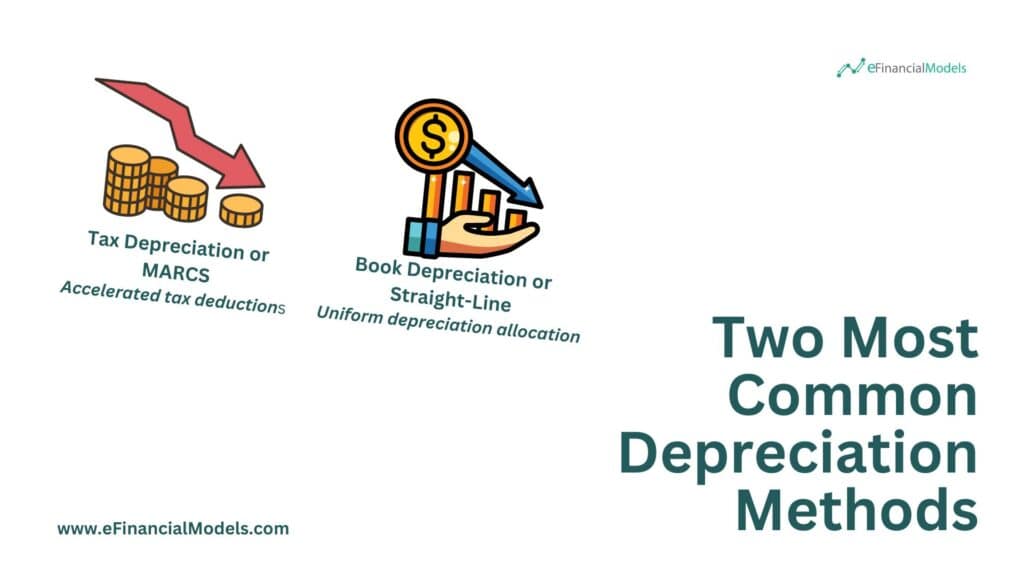
There are two ways to account for depreciation. These are book depreciation and tax depreciation.
- Book depreciation is used for financial reporting purposes and aims to reflect the asset’s consumption during its useful life. The straight-line depreciation method is commonly used for this purpose. It evenly spreads the expense across the asset’s lifespan, providing a consistent and predictable expense amount for each period. It follows accounting principles such as the Generally Accepted Accounting Principles (GAAP) or International Financial Reporting Standards (IFRS). Due to its simplicity and stable impact, the straight-line depreciation is often favored for financial reporting.
- Tax depreciation, on the other hand, adheres to Internal Revenue Service (IRS) guidelines and primarily reduces taxable income. The MACRS depreciation method falls under this category, emphasizing accelerated recovery for tax savings. The Modified Accelerated Cost Recovery System (MACRS) accelerates the depreciation expense by front-loading the deductions, allowing businesses to recover the asset’s cost faster, which can lower taxable income in the early years.
What is Modified Accelerated Cost Recovery System (MACRS)?
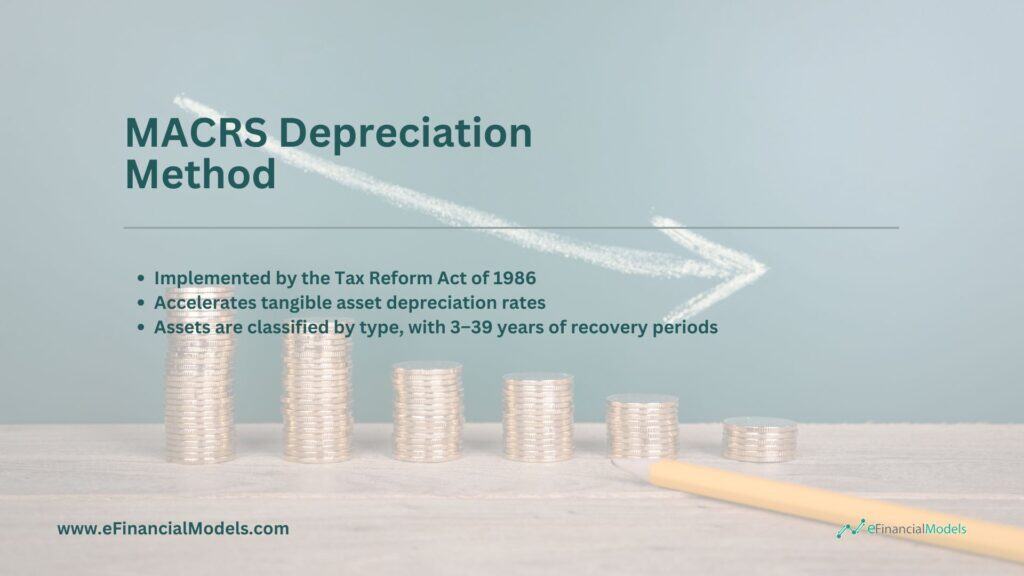
The Modified Accelerated Cost Recovery System (MACRS) was introduced as part of the Tax Reform Act of 1986 in the United States to replace the Asset Depreciation Range (ADR) system and earlier approaches, such as the Accelerated Cost Recovery System (ACRS). Before its introduction, U.S. tax authorities faced challenges with depreciation regulations that resulted in varying interpretations and potential tax advantages. The U.S. government helps businesses through the MACRS depreciation method by frontloading tax deductions, allowing them to free up cash flow and invest earlier rather than later. The Modified Accelerated Cost Recovery System (MACRS) standardized how assets are depreciated, providing a consistent, accelerated method to spread the cost of tangible assets over their useful life. It was primarily designed to encourage capital investment and simplify the rules, making it easier for businesses to account for depreciation expenses in their financial statements.
The Modified Accelerated Cost Recovery System (MACRS) is a tax depreciation system that allows businesses to recover the cost of tangible assets over a specified period, typically faster than under traditional methods like straight-line depreciation. It frontloads tax deductions, meaning a business can claim higher deductions in the earlier years of an asset’s life. The ability to defer tax liabilities is particularly beneficial for capital-intensive businesses. Sectors such as manufacturing, construction, and logistics—where machinery, equipment, and vehicles play a vital role—often see a significant financial advantage from MACRS depreciation methods. Unlike the straight-line method, which distributes depreciation evenly over an asset’s lifespan, MACRS depreciation methods allow firms to align tax deductions with the rapid decline in asset value, providing greater financial flexibility in the crucial early years. As such, it provides increased cash flow, which can be reinvested in the business for growth and expansion. By optimizing the timing of tax deductions, companies can improve short-term profitability and long-term financial planning.
Under MACRS, assets are categorized into different classes, each with its own predetermined recovery period, ranging from 3 to 39 years, depending on the property type. Businesses can then use the General Depreciation System (GDS) or the Alternative Depreciation System (ADS) within MACRS to determine the appropriate method for calculating annual depreciation.
Not all assets qualify for the Modified Accelerated Cost Recovery System (MACRS). The system is primarily designed for tangible, depreciable property used in business or for income production. Intangible assets, such as patents, copyrights, and land, are excluded from the MACRS depreciation method. While the MACRS method is specific to the United States and governed by the Internal Revenue Code, similar accelerated depreciation methods are used in other jurisdictions. However, they may vary in classification, recovery periods, and applicable tax benefits.
Two Primary MACRS Depreciation Methods
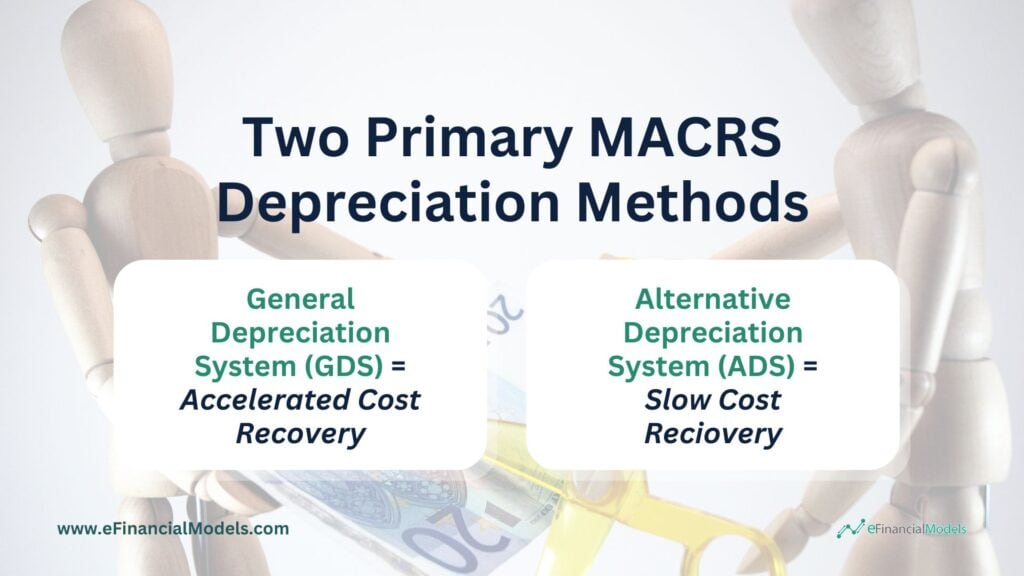
Two primary MACRS depreciation methods are the General Depreciation System (GDS) and the Alternative Depreciation System (ADS). Typically, taxpayers are required to utilize the GDS method; however, certain circumstances mandate the use of the ADS system or allow taxpayers to choose it.
General Depreciation System (GDS)
The General Depreciation System (GDS) is the primary method used under the Modified Accelerated Cost Recovery System (MACRS) for calculating the depreciation of most tangible assets in the United States. It allows businesses to depreciate assets over defined recovery periods that vary based on the asset’s class life, typically ranging from 3 to 39 years.
The General Depreciation System (GDS) employs an accelerated depreciation approach, such as the 200% or 150% declining balance method, to enable companies to recover the cost of assets more rapidly in the initial years of their useful life before switching to a straight-line method when it becomes more advantageous. This flexibility makes GDS particularly useful for businesses looking to maximize tax deductions early in an asset’s lifespan. The 200% declining balance method depreciates assets at twice the straight-line rate, resulting in a faster write-off in the early years compared to the 150% method, which applies a slower rate of 1.5 times the straight-line rate. While both accelerate depreciation, the 200% method offers greater upfront deductions, whereas the 150% method spreads depreciation more evenly over time.
Here’s a common list of assets where the General Depreciation System (GDS) is applicable:
| Asset Class | Examples | Recovery Period (in Years) |
| Automobiles and Light Trucks | Passenger vehicles and delivery trucks | 5 |
| Computers and Peripheral Equipment | Laptops, desktops, and servers | 5 |
| Office Furniture and Fixtures | Desks, chairs, file cabinets | 7 |
| Farm Buildings and Machinery | Barns, tractors, and irrigation systems | 7 – 10 |
| Heavy Equipment | Construction machinery like bulldozers and cranes | 7 |
| Manufacturing Equipment | Machines used for product assembly or processing | 7 |
| Office Machinery | Copiers, fax machines, and calculators | 5 |
| Telecommunications Equipment | Routers, switches, and communication tower | 7 |
| Non-Residential Real Property | Office buildings, retail shops | 39 |
| Residential Rental Property | Apartment buildings, rental homes | 27.5 |
Alternative Depreciation System (ADS)
The Alternative Depreciation System (ADS) is a depreciation method under the Modified Accelerated Cost Recovery System (MACRS) that utilizes a more conservative, straight-line approach to allocate the cost of an asset over a longer recovery period. Unlike the General Depreciation System (GDS), which typically accelerates depreciation, the Alternative Depreciation System (ADS) is used in specific situations where regulations or business choices require slower cost recovery, such as for certain tax-exempt organizations, properties used predominantly outside the U.S., or assets subject to the Alternative Minimum Tax (AMT).
The Alternative Depreciation System (ADS) also applies to assets with a mandated use in farming or those electing to minimize fluctuations in depreciation expense. This system offers less upfront depreciation, resulting in lower short-term deductions but providing a more consistent expense profile over the asset’s entire useful life.
Here’s a common list of assets where the Alternative Depreciation System (ADS) is applicable:
| Asset Class | Description |
| Alternative Minimum Tax (AMT) Property | Assets that require using ADS to calculate AMT adjustments. |
| Farming Equipment | Agricultural machinery and structures with specific ADS mandates. |
| Imported Property | Imported assets subject to specific recovery period requirements. |
| Intangible Assets | Patents, copyrights, and trademarks subject to special amortization rules. |
| Listed Property with Limited Business Use | Vehicles, computers, or other assets used less than 50% for business purposes. |
| Non- Residential Real Property | Office buildings or commercial real estate under special election or use conditions. |
| Property Used Predominantly Outside the U.S. | Equipment or buildings used in foreign operations. |
| Public Utility Property | Utility plants, pipelines, and similar assets under certain regulatory requirements. |
| Residential Rental Property | Rental homes when opted into ADS or if required by law. |
| Tax-Exempt Use Property | Assets owned by tax-exempt entities like non-profits or government agencies. |
The categories above reflect instances where the Alternative Depreciation System (ADS) is either required by the Internal Revenue Code or chosen to match financial strategy needs.




















































MACRS vs. Straight-Line Depreciation: Which Method Maximizes Tax Benefits?
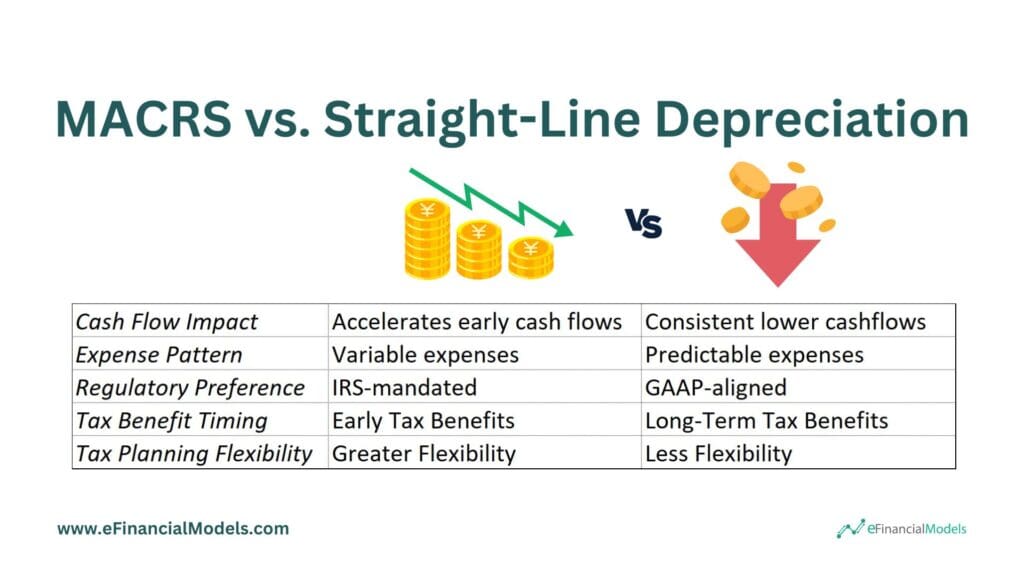
When comparing MACRS (Modified Accelerated Cost Recovery System) and Straight-Line Depreciation, the key difference lies in the timing of tax benefits. While both methods depreciate the asset over its useful life, MACRS allows for accelerated depreciation, resulting in larger deductions in the earlier years. This front-loading of deductions reduces taxable income faster, providing immediate tax savings that can be reinvested into the business.
- Cash Flow Impact: The MACRS and straight-line depreciation methods impact a business’s cash flow differently, primarily due to how they allocate depreciation expenses over the asset’s life. The MACRS depreciation method front-loads depreciation expenses, resulting in higher deductions in the initial years. It, in turn, lowers taxable income early on and reduces the immediate tax burden, leading to increased cash flow during the asset’s early years. In contrast, the straight-line depreciation method spreads the expense evenly over the asset’s useful life, resulting in smaller annual deductions and a more consistent impact on cash flow over time. For businesses seeking to maximize immediate cash flow, MACRS is often the preferred method.
- Expense Pattern: Straight-line depreciation offers a predictable and consistent expense pattern, which can simplify financial planning and budgeting. This stability appeals to businesses that value steady expenses for long-term planning or want to maintain stable profit margins over time. In contrast, MACRS introduces a more accelerated expense pattern, with larger deductions at the start and diminishing amounts in later years. This fluctuation can create variability in annual financial statements, making MACRS less suitable for firms seeking stability.
- Regulatory Preference: From a regulatory standpoint, MACRS and straight-line depreciation often depend on compliance requirements and specific industry regulations. For instance, MACRS is the standard method mandated by the IRS for most tangible property, as it aligns with federal tax rules. In contrast, straight-line depreciation is typically used for financial accounting to align with Generally Accepted Accounting Principles (GAAP).
- Tax Benefit Timing: The timing of tax benefits is critical when comparing these two methods. With MACRS, the accelerated depreciation schedule results in higher deductions in the early years, which means the tax benefits are realized sooner. This approach is particularly advantageous for businesses looking to recover investment costs quickly. Straight-line depreciation, however, distributes the tax benefits evenly throughout the asset’s useful life, leading to lower annual deductions but extending the tax benefit over a longer period. The decision hinges on a company’s strategic need for immediate tax relief versus long-term deduction management.
- Tax Planning Flexibility: Tax planning flexibility is another area where MACRS and straight-line depreciation differ significantly. MACRS provides greater flexibility for managing taxable income in the short term because it offers the ability to adjust taxable profits through increased depreciation expenses during high-earning years. This flexibility can be strategically used for tax planning to smooth income or offset other tax liabilities. On the other hand, Straight-Line Depreciation limits such flexibility due to its uniform allocation of expenses. Therefore, companies with fluctuating profitability or those involved in complex tax strategies may benefit more from using MACRS, while stable, long-term firms prefer straight-line for its simplicity and consistency.
In conclusion, the modified accelerated cost recovery system (MACRS) is a more advantageous depreciation method for businesses aiming to maximize cash flow and leverage tax benefits early in an asset’s life. Its accelerated depreciation schedule allows companies to reduce taxable income in the initial years, freeing up more capital for reinvestment or other business needs. While straight-line depreciation offers stability and predictability, MACRS provides superior tax planning flexibility, especially for firms with fluctuating profitability or those engaged in intricate tax strategies. Therefore, MACRS is the preferred choice for businesses seeking to optimize immediate tax relief and enhance early cash flow. However, it’s important to note that while MACRS offers a significant short-term advantage, it doesn’t eliminate the total tax obligation. Instead, it shifts the timing, providing higher deductions upfront but lower deductions in the later years compared to the even spread of straight-line depreciation.
Maximize Tax Efficiency with the MACRS Depreciation Method
The MACRS depreciation method is a powerful tool for businesses to enhance their profitability and cash flow management. By allowing companies to front-load depreciation expenses, MACRS provides significant tax savings in the early years of an asset’s life. This increased cash flow can be reinvested into growth opportunities, used to reduce debt, or allocated toward other strategic initiatives, ultimately boosting a company’s financial performance. Furthermore, businesses like Caterpillar Inc. have leveraged MACRS to quickly recover the costs of large capital investments, minimizing tax liabilities and optimizing returns on heavy machinery and equipment.
Implementing MACRS effectively requires a comprehensive understanding of asset classification, recovery periods, and the correct depreciation method—whether using the General Depreciation System (GDS) or the Alternative Depreciation System (ADS). Selecting the appropriate strategy reduces tax liabilities and aligns the depreciation schedule with the business’s financial goals. By mastering MACRS and incorporating it into strategic tax planning, companies can transform depreciation from a mere compliance requirement into a strategic financial advantage, ultimately leading to increased profitability and enhanced long-term success.
Financial modeling is essential for maximizing the tax benefits of MACRS because it allows businesses to evaluate the timing and impact of accelerated depreciation on cash flows and overall profitability. While MACRS can provide substantial tax savings upfront, these deductions taper off in later years, potentially leaving no depreciation shield if the business is sold or acquired mid-cycle, such as in year 6. This gap must be accounted for in the financial model, as it affects the business valuation by eliminating a tax advantage that would normally offset taxable income. By building a comprehensive financial model, you can compare MACRS to other methods like straight-line and accurately assess which option delivers the optimal tax benefit and valuation over the business’s lifecycle. Optimize Your Depreciation Strategy Today!








































You might also like:
- Understanding What is Yield to Maturity and Why It Matters
- How to Calculate Net Present Value (NPV)?
- Master the Free Cash Flow Formula for Smarter Financial Decisions
- Monthly Annuitant Calculator
- Financial Forecasting Models by eFinancialModels
- 10 Main Elements of a Business Plan
- 10 Tips to Develop a First Class Business Valuation Report
- How to Protect Confidential Information Through a Non-Disclosure Agreement
- 10 Ideas to Increase Average Revenue Per User
- Financial Modeling for Startups and Small Businesses
- How to Maximize Profits with Cost Per Click (CPC)
- How to Calculate SaaS Monthly Recurring Revenue?
- Financial Term & Abbreviations
- Investing Cash Flows
- Financial Ratios Analysis and Its Importance
- Funding & Investment Strategies for Entrepreneurs
- Cash Flow Analysis in Excel
- How to Prepare a Financial Feasibility Study?
- Real Estate Financial Modeling in Excel
- Financial Model Templates Easy to Use
Tags: financial modeling