
0 ITEMS

How to Maximize Profits with Cost Per Click (CPC)
CPC advertising is a key tool for driving targeted traffic while controlling costs, but understanding how it works is essential for optimization.
- CPC fluctuates based on keyword demand and competition, affecting overall ad spend.
- Bidding strategies and ad quality scores influence the actual cost per click and ad placement.
- The formula for CPC is simple: Total ad spend divided by the number of clicks.
- Monitoring CPC over time helps forecast digital marketing costs and refine campaign tactics.
- Applying best practices like keyword research, ad testing, and quality score improvements can boost ROI.
Getting familiar with these fundamentals helps businesses make smarter decisions and maximize their advertising investment.
Cost Per Click is a Dynamic Figure
Cost Per Click, or CPC, as the name suggests, refers to the cost an advertiser pays each time a user clicks on their ad. It is a fundamental concept in pay-per-click campaigns, where advertisers bid for ad placements on platforms like Google Ads, Bing Ads, Amazon, Facebook, and others. You place bids on keywords that are associated with your commodity or service.
It is also important to note that CPC is a dynamic figure influenced by market demand for specific keywords. As demand and competition increase, so does the CPC. If a keyword is in high demand (i.e., many advertisers want to show ads), its CPC will likely be higher. Because of the fluctuating nature of CPC, advertisers constantly have to research and identify keywords that are relevant to their business and have a relatively low CPC. It ensures that they get the best value for their advertising spend.
Furthermore, Online advertising platforms, like Google Ads, operate on a bidding system. Advertisers bid on keywords they want to target. If more advertisers bid on a particular keyword, the CPC for that keyword will rise. Think of it like an auction: the higher the price goes, the more people want an item. As the CPC for a keyword rises, it might become too expensive for some advertisers, especially if the cost of acquiring a customer (customer acquisition cost or CAC) becomes higher than the profit they make from that customer. When this happens, they might reduce their bids or stop bidding on that keyword altogether.
So, advertisers must balance targeting high-demand keywords (which might have a high CPC but can bring in more traffic) and targeting niche or less popular keywords (which might have a lower CPC but bring in less traffic). It’s a continuous game of optimization to ensure profitability.
Cost Per Click Calculation
Cost Per Click (CPC) advertising is a popular pay-per-click (PPC) campaign model that allows advertisers to display their ads on various online platforms, such as search engines, social media networks, and websites. The main principle of CPC advertising is that advertisers only pay when a user clicks on their ads, hence the name “pay-per-click.”
The Cost Per Click formula is straightforward. By dividing the whole cost of an advertisement by the overall click-through rate, one may determine the cost per click. Mathematically, the Cost Per Click formula is:
Cost Per Click = Total Ad Cost / Total Number of Clicks
Where:
- The Total Ad Cost refers to the amount spent on the advertising campaign
- The Total Number of Clicks represents the number of times users have clicked on the ad.
This simple formula serves as the foundation for evaluating the financial efficiency of your CPC campaign.
Sample Cost Per Click Calculation:
Let’s say you have an advertising campaign for your website where you’ve spent a total of $500 on ads, which resulted in 200 clicks from users who visited your website.
Given your numbers:
- Total Ad Cost = $500
- Total Number of Clicks = 200
Now you can plug these values into the formula:
CPC = $500 / 200 CPC = $2.50
So, in this example, the Cost Per Click (CPC) for your advertising campaign is $2.50. It means that, on average, you spent $2.50 for each click generated by your ads.










































CPC Impacts Customer Acquisition Costs
Like Customer Acquisition Cost (CAC), which calculates the cost of acquiring a single customer, Cost Per Click advertising focuses on the expense incurred for driving a single user engagement. The parallel between Cost Per Click advertising and CAC lies in their shared goal: cost optimization to generate advertisement revenues. By understanding the similarity between the two, businesses can better allocate their marketing budget for maximum return on investment rate. CAC is calculated as the total cost of acquiring a customer, which includes all marketing and advertising expenses. At the most basic level, CPC is a component of CAC. If your CPC rises and all other factors remain constant, your CAC will also increase.
In financial modeling, CPC often determines the expected customer acquisition costs. Customers’ acquisition costs matter for businesses that rely on paid ads to get traffic. Customer acquisition costs compose of two factors: click to get traffic and the conversion rate from visitors to paid users. CPC is often used as a cost assumption in financial models, and any change can have an impact when analyzing the feasibility of a business that relies on paid ads to get traffic, such as a new mobile app or SAAS business.
See the Example Below:
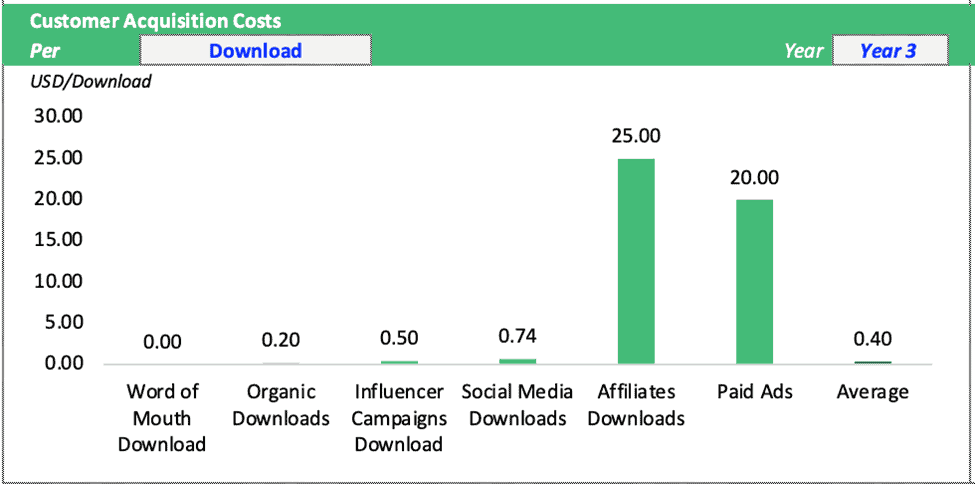
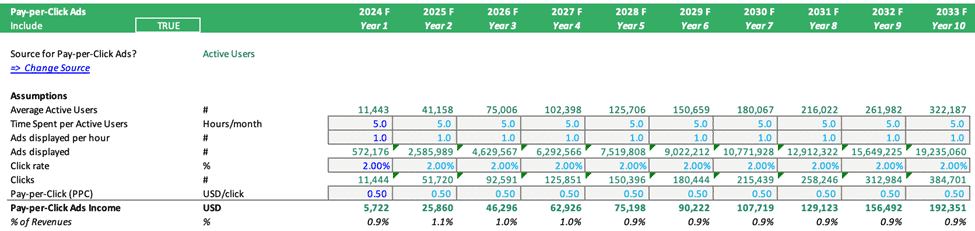
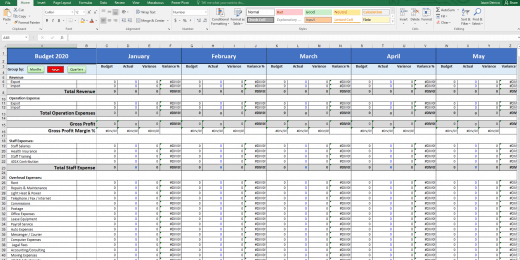
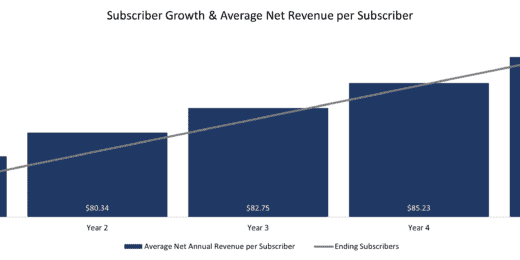
As you can see, CPC can vary over time. So, when building a financial model, we need to be prepared that CPC might change over the years, or at one point, the traffic source of using paid ads might become too expensive. CPC matters when forecasting costs in a financial model. The better researched and understood the assumptions, the better the quality of a financial model.
How Cost-Per-Click Advertising Works
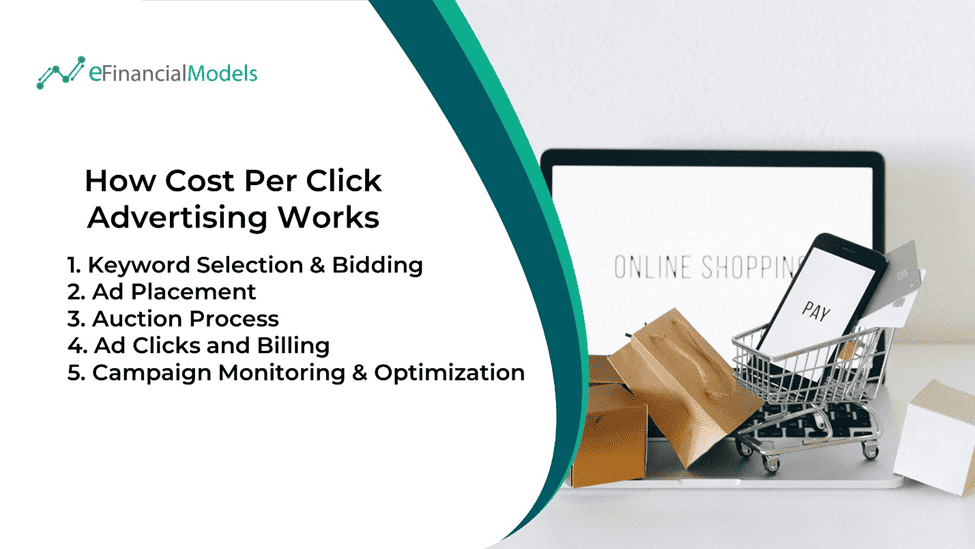
To better understand the Cost Per Click calculation, it is best to know how it works step-by-step.
Step 1 – Keyword Selection and Bidding
Advertisers start by selecting relevant keywords or phrases for their products or services. These keywords are what users might type into a search engine when looking for something specific. Advertisers then place bids on these keywords, indicating the maximum amount they’re willing to pay for a click on their ad when it appears in search results or other relevant placements.
Step 2 – Ad Placement
When a user enters a search query or visits a website that matches the keywords the advertiser has bid on, the advertising platform’s algorithm determines which ads to display. This decision is based on the ad quality score, bid amount, and other relevant metrics.
Advertisers not only bid on keywords but also need to create compelling and relevant ads. The ad’s relevance to the keywords and the user’s search intent significantly determines the ad’s quality score. A higher quality score can lead to better ad placement and lower costs per click.
Step 3 – Auction Process
An auction determines the ad positions when multiple advertisers target the same keywords. The auction considers the bid amounts and quality scores. The ad with the highest combination of bid and quality score might appear at the top, followed by others in descending order.
Step 4 – Ad Clicks and Billing
When users click on an advertiser’s ad, they are directed to its landing page. The advertiser is then charged for that click, and the cost is deducted from their advertising budget. The maximum bid amount does not solely determine the cost per click. Instead, it’s often influenced by the bid amounts of competing advertisers, the ad’s quality score, and the platform’s algorithms. The actual cost per click paid by the advertiser is often lower than their maximum bid.
Step 5 – Campaign Monitoring and Optimization
Advertisers continually monitor the performance of their Cost Per Click campaigns. They analyze metrics like click-through rate (CTR), conversion rate, and return on investment (ROI) to gauge the effectiveness of their ads. Based on the results, they may adjust their bids, refine their ad copy, and optimize their campaigns to achieve better results.
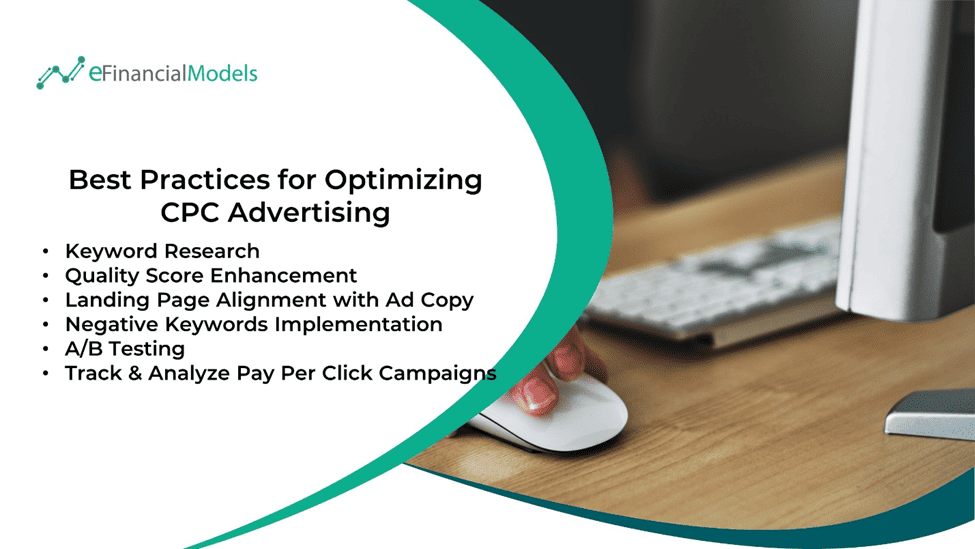
Best Practices for Optimizing CPC Advertising
Achieving a high return on investment rate from CPC advertising requires strategic optimization techniques. Here are some best practices to consider:
- Keyword Research: Thoroughly research and choose relevant keywords that align with your target audience’s search intent. Long-tail keywords often yield more focus on cost-optimization advertisement revenues.
- Quality Score Enhancement: Platforms like Google Ads assign a Quality Score to your ads based on factors like ad relevance, click-through rate (CTR), and landing page quality. Improving your Quality Score can lead to better ad placements and lower CPC.
- Landing Page Alignment with Ad Copy: Craft compelling ad copy that precisely reflects what the user will find on the landing page. A seamless transition from ad to landing page enhances user experience and conversions.
- Negative Keywords Implementation: Implement negative keywords to prevent your ads from appearing for irrelevant search queries, thus saving your budget for more qualified clicks.
- A/B Testing: Continuously test different ad variations to identify which elements resonate most with your audience. It includes testing headlines, ad text, images, and calls to action (CTA).
- Track and Analyze Pay-Per-Click Campaigns: Efficient tracking and analysis are essential to gauge the success of your Pay Per Click campaigns. One advanced method is financial modeling. It involves creating a detailed financial projection incorporating various financial metrics like average transaction value, CPC, conversion rate, and operating costs.






















































Key Take Aways on Cost Per Clicks
Optimizing Cost Per Click advertising is a multifaceted endeavor that involves understanding the fundamentals of CPC, implementing effective strategies, and employing advanced analytical methods like financial modeling.
Always remember that Cost Per Click (CPC) is not static. It varies depending on the keyword in question and the number of bidders interested. As market conditions, competition, and user behavior change, so can the CPC. Given the dynamic nature of CPC and its impact on business finances, businesses need to monitor their CPC and adjust their advertising strategies continuously. So, businesses must ensure that the cost of acquiring a customer (which includes CPC) is less than the lifetime profit they can derive from that customer. It might involve targeting different keywords, tweaking ad copy, or exploring other advertising platforms.
CPC plays a pivotal role in determining customer acquisition costs. If the CPC rises, businesses will spend more to acquire each customer. For businesses relying heavily on paid advertisements to drive traffic, CPC is often a critical assumption in their financial models. The accuracy and reliability of these models can be heavily influenced by how well the business understands and predicts CPC. An inaccurate assumption can lead to overestimations of future revenue or underestimating costs.
You might also like:
- 10 Tips to Develop a First Class Business Valuation Report
- 10 Main Elements of a Business Plan
- 12 Funding Sources for Businesses and Startups
- 10 Ideas to Increase Average Revenue Per User
- Financial Modeling for Startups and Small Businesses
- Financial Forecasting Models by eFinancialModels
- How to Maximize Profits with Cost Per Click (CPC)
- Financial Modeling for a Gold Mining Investment
- Growth Rate Calculator: Exploring the Benefits
- Leveraged vs. Unleveraged IRR: What You Need to Know
- Understanding the Debt Service Coverage Ratio: An Essential Metric for Financial Analysis
- Understanding What is Yield to Maturity and Why It Matters
- Invest Smart With a Surfboard Rental Business
- How to Do a Precedent Transaction Valuation ?
- Top 10 Mistakes in DCF Valuation Models
- How to Start a Distillery Business: What You Need to Know?
- Finding Fair Market Value: A Quick Guide to Real Estate Valuation
- Startups and Product Development: Financial Models for Success
- Free Costing Sheet for Garments
Tags: financial metrics