
0 ITEMS

Vitamins Subscription Box Financial Model Excel Template
The Vitamin Subscription Box Financial Model helps entrepreneurs, founders, consultants, analysts, and business owners turn a subscription-based supplement concept into a structured financial forecast. Instead of starting with a blank spreadsheet, users can work from a ready-to-use model designed around the economics of monthly vitamin boxes, including recurring subscription tiers, add-on sales, customer growth, retention, cost of goods sold, fulfillment costs, marketing spend, payroll, and operating expenses. It gives you a practical planning tool for estimating revenue potential, startup costs, cash flow, profitability, and long-term financial performance before launch, expansion, or fundraising. Built for business planning and funding preparation, this financial model template helps users document the assumptions investors and lenders often review first. You can model subscription pricing, customer acquisition, churn, average revenue per user, setup fees, inventory costs, packaging, shipping, team costs, and other key drivers that shape the financial outcome of a vitamin subscription box business. The template is fully editable, so you can adjust assumptions to reflect your own pricing strategy, product mix, launch timeline, supplier costs, marketing plan, and growth expectations. The model supports financial planning across multiple years, helping users review projected income statements, cash flow, balance sheet impacts, profitability, and break-even timing. It is useful for evaluating whether the business can generate enough recurring revenue to cover fixed and variable costs, fund operations, and scale sustainably. The included scenario planning and dashboards also make it easier to test different outcomes, compare conservative and growth cases, and understand how changes in revenue assumptions or expenses may affect cash needs and profit margins. This Vitamin Subscription Box Financial Model is especially useful for anyone preparing a business plan, investor pitch, loan application, internal budget, or strategic growth plan. It helps replace guesswork with structured decision-making by connecting commercial assumptions to financial outputs. Whether you are validating a new supplement subscription idea, refining an existing vitamin delivery service, or advising a client, the template gives you a professional framework for planning revenue, managing costs, analyzing profitability, reviewing break-even performance, and presenting the business case with more confidence.
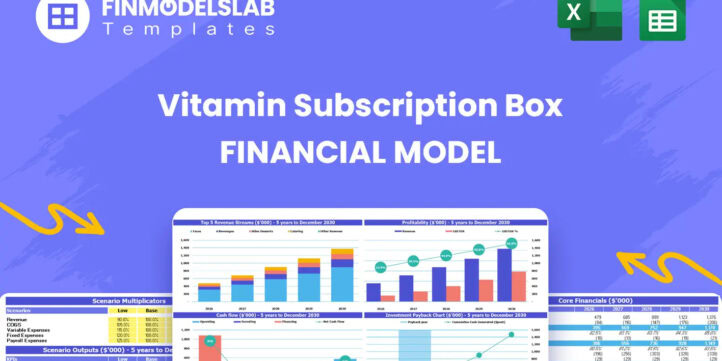


Financial Model Overview
The Vitamin Subscription Box Financial Model is a ready-to-use financial model template built for planning, launching, funding, and managing a subscription-based vitamin and supplement delivery business. It brings together the core financial drivers of the business model, including recurring monthly subscription revenue, customer acquisition, churn, tiered pricing, add-on sales, cost of goods sold, packaging, fulfillment, marketing, payroll, startup investment, and cash flow. For founders and business planners, this type of model is useful because a vitamin subscription box depends on recurring revenue economics, customer retention, upfront launch spending, and disciplined operating cost control. The template helps users organize assumptions, forecast financial statements, review profitability, understand funding needs, and communicate the business case to investors, lenders, partners, or internal stakeholders. It is designed to be editable and practical, so users can replace pre-filled assumptions with their own strategy and quickly see how changes affect revenue, profit, cash position, and growth potential.
All-in-One Dashboard
The all-in-one dashboard gives users a central view of the most important inputs and outputs in the Vitamin Subscription Box Financial Model. This section is designed to help founders, analysts, and stakeholders quickly understand the financial health of the business without searching through every worksheet. It may summarize revenue, gross margin, EBITDA, net income, cash balance, break-even timing, funding needs, customer growth, and other key outputs that matter for a subscription box business. It also connects with the main assumption areas, allowing users to review the impact of pricing, subscriber volume, churn, cost of goods sold, payroll, marketing spend, and operating expenses. For planning and decision-making, the dashboard is useful because it turns a complex forecast into a clearer management view. A vitamin subscription box has many moving parts, from recurring billing to fulfillment costs, so having core financial metrics in one place helps users monitor whether the business can scale profitably, maintain enough liquidity, and support investor or lender discussions with concise financial evidence.
Low, Base, and High Scenario Analysis
The low, base, and high scenario analysis component helps users test how the vitamin subscription box business may perform under different operating conditions. Instead of relying on a single forecast, users can compare a conservative case, a realistic base case, and a more optimistic growth case. Inputs may include customer acquisition rates, conversion rates, churn, average subscription price, customer acquisition cost, monthly marketing spend, supplier pricing, shipping costs, payroll timing, and retention improvements. The outputs help show how revenue, cash flow, profitability, and funding requirements change when assumptions move up or down. This is especially useful for a subscription model because small changes in churn, acquisition cost, or average revenue per user can have a major effect on long-term profitability. Scenario analysis supports better decision-making by helping users prepare for slower adoption, higher advertising costs, or stronger-than-expected growth. It also provides a more credible planning structure for investors and lenders, who often want to understand how resilient the business is if market conditions differ from the original plan.
Professional Charts
The professional charts component converts financial projections into visual reports that are easier to review, explain, and present. A vitamin subscription box forecast may include large amounts of data across revenue streams, customers, costs, margins, and cash flow, and charts help translate those figures into clear trends. This section may visualize revenue growth, customer base expansion, gross margin movement, EBITDA, net profit, operating expenses, cash balance, break-even progress, and scenario comparisons. These visuals are useful for business plans, investor decks, loan discussions, board updates, and internal planning meetings because they make the financial story more accessible. For example, a chart showing subscription revenue growth by year can help demonstrate the compounding effect of recurring customers, while a cash flow chart can show whether the business maintains enough cash to cover inventory, payroll, and marketing. By presenting outputs in a polished format, the model helps users communicate financial performance with more confidence and reduces the need to manually create charts from scratch.
ROE Components and DuPont Analysis
The ROE components and DuPont analysis section helps users understand what drives return on equity in the Vitamin Subscription Box Financial Model. Rather than only showing a final return figure, this component breaks performance into underlying drivers such as profit margin, asset efficiency, and financial leverage. Inputs may be drawn from the income statement, balance sheet, revenue forecast, cost structure, investment assumptions, and financing plan. The outputs help users see whether returns are being generated through stronger profitability, better use of assets, or changes in the capital structure. For a vitamin subscription box business, this is useful because growth can require spending on technology, website development, warehouse setup, inventory, customer acquisition, and working capital before returns fully materialize. DuPont-style analysis gives founders and investors a more detailed view of financial efficiency and helps identify which levers need improvement. If profitability is weak, the business may need better pricing or lower fulfillment costs. If asset efficiency is low, management may need to optimize inventory or operating processes. This section supports deeper financial review beyond basic revenue and profit totals.
Revenue Inputs
The revenue inputs component is where users define the assumptions that drive sales projections for the vitamin subscription box business. This section may include subscription tier pricing, customer acquisition by month, conversion rates, customer churn, upgrades from basic plans to premium plans, one-time setup fees, add-on purchases, average order value, customer lifetime assumptions, and timing of revenue growth. Because subscription businesses depend on recurring monthly revenue, the quality of the revenue inputs has a major effect on the entire forecast. Users can adjust pricing for different box tiers, estimate how many new subscribers are acquired through marketing campaigns, and model how retention or churn affects the active customer base over time. The outputs feed into revenue forecasts, cash flow, gross profit, and profitability analysis. This component is useful for testing whether a planned marketing budget can generate enough paying customers, whether premium tiers improve average revenue per user, and whether the business can reach sustainable scale. It also helps users document revenue assumptions clearly for business plans, pitch materials, and funding discussions.
Bank-Ready Reports
The bank-ready reports component organizes the financial outputs lenders, investors, and professional stakeholders typically expect to review. This may include projected income statements, cash flow statements, balance sheets, profitability summaries, debt capacity indicators, funding needs, and key financial metrics. For a vitamin subscription box startup or growth-stage business, these reports help show whether the company can generate enough revenue and cash flow to cover operating expenses, repay debt, fund inventory, support payroll, and continue investing in customer acquisition. The inputs are drawn from the full financial model, including revenue assumptions, startup costs, operating expenses, payroll, cost of goods sold, financing assumptions, and working capital needs. The outputs create a more structured financial package that can be used in loan applications, investor conversations, business plans, and internal reviews. This section is useful because it helps users present the business in a lender-friendly format rather than relying on disconnected spreadsheets. Clear reports make it easier to explain the business model, show the path to profitability, and support funding requests with organized financial projections.
Revenue Breakdown
The revenue breakdown component gives users a more detailed view of where sales are expected to come from within the vitamin subscription box business. Instead of showing only total revenue, this section may separate income by subscription tier, setup fees, premium plans, add-on sales, recurring transactions, or other revenue streams. Inputs can include plan pricing, subscriber counts, tier mix, upgrade rates, purchase frequency, add-on penetration, and customer retention assumptions. Outputs help users see which revenue streams contribute the most to total sales, which plans drive average revenue per user, and how the revenue mix changes as the business grows. This is especially useful for a subscription box company because profitability may depend not only on the number of customers but also on the quality of revenue. A larger share of premium subscribers or high-margin add-ons can improve gross margin and customer lifetime value, while heavy reliance on low-priced plans may require higher volume to cover fixed costs. The revenue breakdown supports pricing strategy, product packaging, marketing focus, and investor communication by showing the financial role of each revenue stream.
KPI Dashboard
The KPI dashboard component tracks the operating and financial metrics that matter most for a vitamin subscription box business. These may include active subscribers, new subscribers, churn rate, customer acquisition cost, customer lifetime value, average revenue per user, gross margin, contribution margin, marketing efficiency, recurring revenue, cash balance, EBITDA margin, and break-even progress. Inputs come from the customer forecast, revenue assumptions, expense planning, cost of goods sold, marketing budget, and financial statements. The outputs help users monitor whether the business is improving over time and whether the forecast supports sustainable growth. This component is useful because subscription businesses are driven by repeat customer behavior, not just one-time sales. A business may appear to grow revenue quickly but still struggle if churn is high, acquisition costs are excessive, or fulfillment margins are too low. By reviewing KPIs in one place, users can identify performance gaps, set realistic goals, compare assumptions against industry benchmarks, and make better decisions about pricing, retention programs, marketing spend, supplier negotiations, and operational improvements.
Break-Even Analysis
The break-even analysis component helps users estimate when the vitamin subscription box business can generate enough revenue to cover its fixed and variable costs. Inputs may include subscription pricing, active customer count, gross margin, cost of goods sold, packaging, shipping, fulfillment, marketing expenses, software, rent, salaries, professional fees, and other operating costs. The outputs may show the required number of subscribers, required monthly revenue, break-even date, and margin needed to reach profitability. This section is important because a subscription box business often invests in branding, website development, inventory, customer acquisition, and operations before cash generation becomes consistent. Knowing the break-even point helps users determine whether their launch plan is realistic and whether the business needs more funding, better margins, higher pricing, lower churn, or a more efficient acquisition strategy. It is also valuable for lenders and investors because it explains the timeline to self-sustaining operations. By using the break-even analysis, founders can evaluate different plans before committing capital and can focus on the actions most likely to shorten the path to profitability.
Startup Costs and Funding Requirements
The startup costs and funding requirements component helps users estimate the initial capital needed to launch or expand a vitamin subscription box business. This section may include website development, subscription management technology, product formulation support, branding, initial inventory, packaging materials, warehouse setup, equipment, licenses, legal fees, pre-launch marketing, deposits, software tools, working capital, and contingency reserves. Inputs can be edited to match the user’s business model, whether the company uses in-house fulfillment, outsourced logistics, custom supplement packs, or a curated box strategy. The outputs help identify total startup investment, timing of capital needs, and the amount of funding required before the business can rely on operating cash flow. This component is useful for financial planning because many subscription businesses underestimate the cash required before recurring revenue reaches meaningful scale. It also supports funding conversations by showing lenders, investors, or partners exactly how capital will be used. A clear startup cost and funding plan helps users avoid cash shortages, prioritize essential launch expenses, and build a more realistic roadmap for opening, marketing, and scaling the business.
File types:
Excel – Single-User: .xlsx
Excel – Multi-User: .xlsx
Similar ProductsOther customers were also interested in...


 HenrySheykin
Pharmacy Financial Model Excel Template
The Pharmacy Financial Model template helps entrepreneurs, pharmacy owners, consultants, analysts, a... Read more
Blood Bank Center Financial Model Excel Template
The Blood Bank Financial Model helps users turn a blood bank, blood collection facility, or blood ce... Read more

Chinese Medicine Center Financial Model Excel Temp...
The Traditional Chinese Medicine Clinic Financial Model helps entrepreneurs, clinic owners, consulta... Read more
Medicine Store Financial Model Excel Template
The Drugstore Financial Model helps entrepreneurs, pharmacy owners, consultants, analysts, and busin... Read more

 eFinancialModels
Pharma Biotech Valuation Model Template (Risk-Adju...
The Pharma Biotech Valuation Model Template calculates the risk-adjusted DCF Value of a Pharma or Bi... Read more

 Giorgos
Pharma Biotech Financial Model incl. Risk-Adjusted...
Financial Model analyzing a Biopharmaceutical Company using a Risk-Adjusted NPV Valuation Methodolog... Read more

Pharmacy Store – 5 Year Financial Model
Financial Model providing an advanced 5-year financial plan for a startup or operating Pharmacy Stor... Read more

Beauty Subscription Box Financial Model Excel Temp...
The Beauty Subscription Box Financial Model helps founders, entrepreneurs, consultants, analysts, an... Read more
Monthly Recurring Revenue SaaS Financial Model Exc...
The SaaS Business Financial Model helps founders, entrepreneurs, consultants, analysts, and business... Read more
SaaS Actuals Opt-In Financial Model Excel Template
The SaaS Business Financial Model helps founders, entrepreneurs, consultants, analysts, and business... Read more
You must log in to submit a review.