
0 ITEMS

Online Classes Subscription Financial Model Excel Template
The Online Class Subscription Financial Model helps entrepreneurs, founders, consultants, analysts, and business owners build a structured forecast for an e-learning membership or online course subscription business. Instead of starting from a blank spreadsheet, users can work from a ready-to-use financial model template designed around recurring revenue, subscription pricing, customer acquisition, conversion rates, churn, platform costs, content costs, payroll, and long-term profitability. It gives you a practical way to translate a business concept into financial projections that can support planning, budgeting, fundraising, and strategic decision-making. This template is especially useful for anyone preparing a business plan, investor presentation, lender package, internal budget, or launch roadmap for an online class platform. It helps organize the assumptions that drive the business, including revenue assumptions for different subscription tiers, one-time enterprise setup fees, marketing spend, customer acquisition cost, trial-to-paid conversion, startup costs, operating expenses, and staffing needs. By connecting these inputs to projected financial statements and key performance indicators, the model helps users see how subscriber growth, pricing, and costs may affect cash flow and profitability over time. The model is built to support financial planning for both early-stage startups and growing subscription education businesses. Users can adjust the assumptions to reflect their own pricing strategy, expected customer mix, growth plan, payroll structure, content production budget, hosting expenses, and funding needs. The model also helps evaluate important questions such as how much capital is required before launch, when the business may become cash flow positive, how long the initial runway may last, and what level of subscriber growth is needed to reach break-even analysis targets. With built-in projections, scenario planning, visual dashboards, investor-ready reporting, and editable inputs, the Online Class Subscription Financial Model makes it easier to evaluate opportunities before committing resources. It helps users compare low, base, and high cases, review revenue performance, track operating expenses, assess payroll impact, analyze profitability, and make better decisions with a clearer financial view. Whether you are launching a new online learning platform, expanding an existing course library, or preparing funding documents, this financial model template provides a professional framework for understanding the economics of a subscription-based education business.
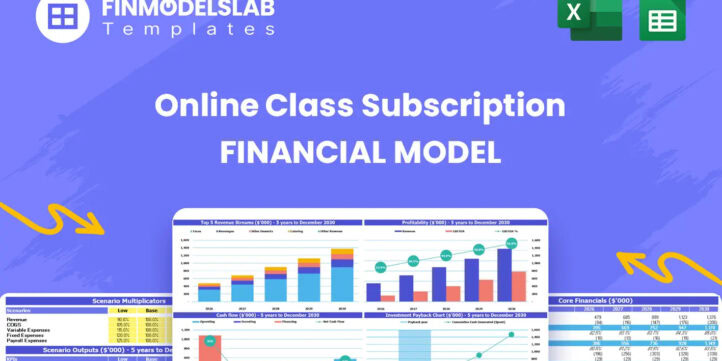


Online Class Subscription Financial Model Overview
The Online Class Subscription Financial Model is a ready-to-use financial model template built for entrepreneurs, founders, consultants, analysts, business owners, and planning teams working on an e-learning membership or digital course subscription business. It helps users forecast how a subscription-based online class platform may perform over time by connecting subscriber growth, pricing tiers, customer acquisition, conversion rates, churn assumptions, platform costs, content expenses, payroll, startup investment, cash flow, and profitability in one structured model. For an online class subscription business, small changes in acquisition cost, trial conversion, pricing mix, content delivery cost, or retention can have a major effect on financial performance. This template gives users a practical way to test those assumptions before launching, raising capital, hiring a team, or expanding the platform. It is designed to save time, reduce spreadsheet complexity, and provide a professional planning framework for business plans, investor discussions, lender conversations, internal budgeting, and strategic decision-making.
All-in-One Dashboard
The all-in-one dashboard brings the most important inputs and outputs into a single planning view, allowing users to understand the financial health of the Online Class Subscription Financial Model without manually searching through multiple worksheets. This component may include high-level assumptions such as subscription pricing, customer acquisition activity, conversion rates, churn, startup investment, operating expenses, and payroll drivers, alongside outputs such as revenue, EBITDA, net profit, cash position, and runway. For an online class subscription business, the dashboard is especially useful because recurring revenue performance depends on several connected variables, including marketing spend, new subscriber volume, upgrades, cancellations, and cost efficiency. By summarizing the model’s core assumptions and results in one place, this section helps users quickly review whether the business plan is financially realistic, whether the projected cash balance is sufficient, and whether the company is moving toward sustainable profitability. It also makes the template easier to present to investors, lenders, advisors, and internal stakeholders who need a clear summary before reviewing the detailed financial statements.
Low, Base, and High Scenario Analysis
The low, base, and high scenario analysis section helps users evaluate how the online class subscription business may perform under different operating conditions. This component allows assumptions such as marketing budget, customer acquisition cost, trial-to-paid conversion rate, subscription pricing, churn, enterprise adoption, payroll expansion, and operating costs to be tested across conservative, expected, and optimistic cases. For example, a low case may reflect slower subscriber growth, higher acquisition costs, or weaker conversion, while a high case may reflect stronger marketing performance, better retention, or more enterprise subscribers. The output helps users compare revenue, EBITDA, cash flow, funding needs, and profitability under each scenario, making it easier to understand risk and upside before making major commitments. This is valuable for decision-making because online subscription businesses often face uncertainty around customer behavior, content demand, and marketing efficiency. Scenario analysis gives founders and planners a more disciplined way to prepare contingency plans, set realistic investor expectations, and identify which assumptions have the greatest influence on the company’s long-term results.
Professional Charts
The professional charts section turns the financial model’s projections into visual reports that are easier to interpret, discuss, and present. This component may include charts for revenue growth, subscriber trends, cash balance, EBITDA, net profit, expense categories, customer acquisition performance, and other key metrics relevant to an online class subscription platform. Instead of relying only on rows of numbers, users can visualize how the business is expected to grow over time, where costs are concentrated, when profitability improves, and how cash flow changes throughout the forecast period. These charts are useful for pitch decks, board updates, management reviews, lender packages, and internal planning conversations because they make the story behind the numbers clearer. For a subscription education business, visualizing recurring revenue growth, margin expansion, and cash runway can help stakeholders understand whether the model is scalable and whether the planned investment is justified. The charts also support faster decision-making by highlighting trends, gaps, and performance changes that may not be obvious from the detailed worksheets alone.
ROE Components and DuPont Analysis
The ROE components and DuPont analysis section helps users understand what is driving return on equity in the Online Class Subscription Financial Model. Instead of looking only at a single profitability figure, this component breaks performance into the underlying drivers that influence shareholder returns, such as profit margin, asset efficiency, and financial leverage. For an online class subscription business, this type of analysis is useful because strong recurring revenue growth does not automatically translate into attractive returns if customer acquisition costs, content production expenses, platform investment, or overhead are too high. The section may use outputs from the income statement, balance sheet, and profitability forecast to show how revenue efficiency, cost control, capital structure, and investment levels affect overall return. This helps users evaluate whether the business is creating value as it scales and whether strategic changes could improve investor outcomes. It is particularly helpful for founders preparing funding discussions because it provides a more analytical view of return potential, going beyond simple revenue growth and showing how operational performance connects to investor-relevant financial metrics.
Revenue Inputs
The revenue inputs section is where users define the commercial assumptions that drive the subscription forecast. For an online class subscription business, this may include monthly subscription tiers such as basic access, professional learning plans, team or enterprise packages, and one-time setup fees for larger customers. It may also include marketing spend, customer acquisition cost, trial signups, trial-to-paid conversion rates, subscriber mix, plan upgrades, pricing changes, churn, and customer growth assumptions. These inputs are essential because revenue in a subscription model is not based on one-time sales alone. It depends on how many subscribers are acquired, how long they stay, which plan they choose, how often they upgrade, and how efficiently marketing spend converts into paying users. The template uses these assumptions to calculate recurring revenue, new customer revenue, enterprise setup revenue, and longer-term revenue growth. This section is valuable for planning because it allows users to test different pricing strategies, growth targets, and acquisition plans before committing budget, helping them understand whether the business can generate enough revenue to cover content costs, payroll, technology expenses, and future expansion.
Bank-Ready Reports
The bank-ready reports section produces structured financial outputs that can support lender conversations, investor reviews, business plan submissions, and professional stakeholder presentations. This component typically brings together key statements and summaries such as profit and loss projections, cash flow forecasts, balance sheet views, funding needs, repayment capacity, profitability metrics, and other lender-friendly financial outputs. For an online class subscription business, these reports are important because external stakeholders need to see more than a growth idea. They need evidence that the business can manage cash, cover operating expenses, reach profitability, and support any requested financing. The bank-ready reporting structure helps users present the business in a disciplined way, with assumptions connected to financial statements and performance indicators. It may show how startup costs, platform development, early marketing, payroll, hosting, content costs, and recurring subscription revenue translate into financial results. This makes the model useful not only for internal planning but also for preparing documents that demonstrate financial credibility, repayment visibility, and a clear path toward sustainable operations.
Revenue Breakdown
The revenue breakdown section gives users a detailed view of how income is generated across the different streams of the online class subscription business. This may include basic monthly subscriptions, premium learning subscriptions, team or enterprise subscriptions, one-time setup fees, and potential add-on revenue if the user chooses to customize the model further. By separating revenue streams, the template helps users understand which products or customer segments are responsible for growth, which plans contribute the most to recurring revenue, and how the subscriber mix affects average revenue per user. This is especially useful for subscription-based education businesses because the economics of a low-priced consumer plan can differ significantly from a higher-value enterprise package. The section can help users test whether the business should focus on volume through lower-priced plans, margin through professional tiers, or larger contract value through team subscriptions. It also supports better budgeting because different revenue streams may require different levels of marketing spend, content support, customer service, and platform resources. A clear revenue breakdown makes it easier to refine pricing, prioritize sales channels, and explain monetization strategy to investors and stakeholders.
KPI Dashboard
The KPI dashboard tracks the performance metrics that matter most for an online class subscription business and translates the financial forecast into operating indicators. This component may include metrics such as monthly recurring revenue, annual recurring revenue, customer acquisition cost, customer lifetime value, churn rate, conversion rate, subscriber growth, average revenue per user, gross margin, EBITDA margin, cash runway, and payback period. These KPIs are useful because subscription businesses require ongoing monitoring of both growth and efficiency. A company may be adding subscribers quickly but still struggle if acquisition costs are too high, churn is too large, or the payback period is too long. The KPI dashboard helps users evaluate whether the assumptions in the model are producing a healthy business profile and whether performance is improving over time. It can also support benchmarking against industry expectations, allowing users to compare their forecast with typical subscription or e-learning metrics. For planning and investor communication, this section provides a concise way to show how the business is performing operationally, not just financially, making it easier to identify strengths, weaknesses, and improvement opportunities.
Break-Even Analysis
The break-even analysis section helps users identify when the online class subscription business is expected to generate enough revenue to cover its costs. This component uses assumptions from the revenue forecast, operating expenses, payroll, direct costs, content royalties, hosting expenses, marketing spend, and fixed overhead to determine the point at which total income exceeds total expenses. For a subscription model, break-even is particularly important because early months often require significant investment in platform development, content production, marketing, and team building before the subscriber base is large enough to support the cost structure. The section helps users understand how many paying subscribers may be needed, how pricing impacts the timeline, and how changes in customer acquisition cost or churn can delay or accelerate profitability. It is useful for founders preparing business plans because break-even timing is one of the first questions investors, lenders, and internal stakeholders often ask. By showing the expected path to break-even, the model helps users set more realistic funding targets, manage burn rate, prioritize cost control, and make informed decisions about growth strategy.
Cash Flow Forecasting
The cash flow forecasting section helps users understand how money moves in and out of the business over the forecast period, with a focus on liquidity, runway, and funding requirements. This component may use inputs such as startup costs, platform development expenses, marketing spend, subscription revenue, enterprise setup fees, payroll, hosting costs, content costs, taxes, capital expenditures, and working capital assumptions to calculate monthly and annual cash balances. For an online class subscription business, cash flow planning is essential because revenue may build gradually while upfront costs can be significant. Even if the business is projected to become profitable, it may still need enough cash to cover the early operating period, customer acquisition campaigns, content development, software tools, and staffing before recurring revenue reaches scale. The cash flow forecast helps users anticipate shortfalls, estimate the required funding buffer, evaluate runway, and plan when additional capital may be needed. It is also useful for lenders and investors because it shows whether the business can maintain adequate liquidity while pursuing growth. By providing a forward-looking view of cash, this section supports better budgeting, safer expansion decisions, and more disciplined financial management.
File types:
Excel – Single-User: .xlsx
Excel – Multi-User: .xlsx
Similar ProductsOther customers were also interested in...

 HenrySheykin
SaaS Actuals Opt-In Financial Model Excel Template
The SaaS Business Financial Model helps founders, entrepreneurs, consultants, analysts, and business... Read more
Monthly Recurring Revenue SaaS Financial Model Exc...
The SaaS Business Financial Model helps founders, entrepreneurs, consultants, analysts, and business... Read more
SaaS Financial Model Excel Template
The SaaS Business Financial Model helps founders, entrepreneurs, consultants, analysts, and business... Read more
SaaS Application Freetrial Financial Model Excel T...
The SaaS Business Financial Model helps founders, entrepreneurs, consultants, analysts, and business... Read more
SaaS Freemium Financial Model Excel Template
The SaaS Business Financial Model helps founders, entrepreneurs, consultants, analysts, and business... Read more
CRM Software Financial Model Excel Template
The CRM Software Financial Model is a ready-to-use financial model template designed to help founder... Read more
Fresh Flowers Subscription Financial Model Excel T...
The Subscription Box Financial Model Template helps entrepreneurs, founders, analysts, consultants, ... Read more
Human Resource Software Financial Model Excel Temp...
The HR Software Financial Model Financial Model Template helps founders, business owners, consultant... Read more
Equipment Rental Subscription Financial Model Exce...
The Equipment Rental Subscription Financial Model helps users turn an equipment-as-a-service busines... Read more
Book Subscription Box Financial Model Excel Templa...
The Book Subscription Box Financial Model helps founders and planners turn a monthly book box idea i... Read more
You must log in to submit a review.