
0 ITEMS

What Does a Quick Return on Investment Calculation Tell You?

Understanding return on investment (ROI) is crucial for evaluating the profitability of business projects and investments.
- ROI measures how efficiently resources generate profits by comparing net gains to initial costs.
- Quick ROI calculations provide an instant snapshot of financial performance, helping prioritize projects.
- The basic formula involves dividing net profit by investment cost and expressing it as a percentage.
- ROI helps compare different opportunities, such as marketing campaigns or new product launches.
- Be aware of pitfalls like ignoring the time value of money or market fluctuations when using ROI for decision-making.
This article walks through how to perform ROI calculations accurately and avoid common mistakes.
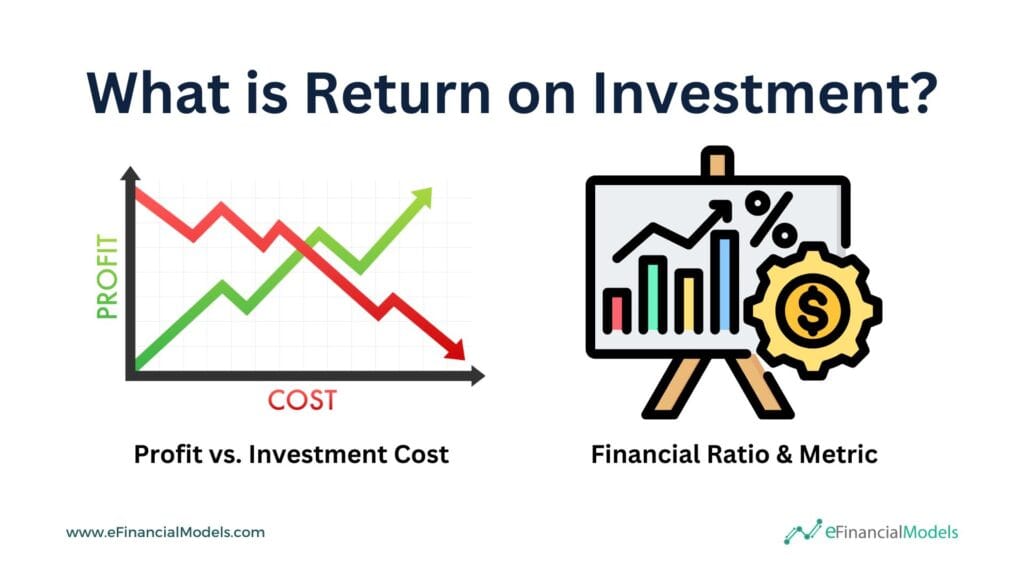
What is Return on Investment?
Return on Investment (ROI) measures how much profit an investment generates compared to its cost. It shows the efficiency of an investment by calculating the ratio of net income to the initial investment amount. Businesses and investors use ROI to compare opportunities and make smarter financial decisions. It’s a quick and clear way to assess whether the money spent delivers good returns. Think of it as asking, “For every dollar I spend, how many dollars do I get back?“
The return on investment calculation formula is a financial ratio expressed as a percentage that shows the net profit or loss generated by an investment. It explains how well an investment performs by comparing the money gained or lost to the initial amount invested. A positive ROI means a profit, while a negative ROI indicates a loss. Generally, a higher ROI means the investment was more profitable. It’s a simple way to evaluate the success of financial decisions and identify the best opportunities. It’s important to remember that ROI is not just a one-size-fits-all financial metric; it can be applied to various investments, whether real estate, stock purchases, or even time spent on a project. Understanding the basics of ROI allows you to quickly compare different investment opportunities on a level playing field, helping you make informed decisions. Moreover, grasping this concept will put you on the path to refining your investment strategies, ensuring that you allocate your resources to the ventures that promise the best returns.
The Return on Investment Calculation Formula Simplified
The return on investment calculation formula is a quick way to assess profitability. It is simple yet powerful. Divide the net profit by the initial investment cost and multiply by 100 to express it as a percentage.

Where:
- Net profit is the total earnings after subtracting all expenses, including materials, labor, and overhead. It shows how much money you actually make.
- Investment cost is the amount spent to start or maintain the investment, such as purchase price or operating costs.
Together, these elements measure profitability by comparing your earnings to your spending. Understanding both helps you make smarter financial choices. The return on investment calculation formula helps businesses measure the efficiency of their investments quickly. It can be a way to compare options, evaluate success, and make informed financial decisions. It’s a vital tool for understanding the value of every dollar spent.
Simple Example of Return on Investment Calculation
Here’s a simple example of return on investment calculation. Let’s say you spend $100 on a paid ad campaign. It brings in 2 subscribers, each with a customer lifetime value (gross profit) of $400. Together, they generate $800 in total gross profit. Using the ROI formula, your return is:

The simple example of return on investment calculation means your investment has grown eight times. However, you would need an ROI of 100% or $200 in returns to break even. This example shows how ROI helps measure campaign success and determine if it’s worth the cost.



























































The Benefits of Calculating Return on Investment
Calculating return on investment (ROI) provides valuable insight into the success of your financial choices. It helps you understand how effectively your resources generate profits, making it easier to evaluate the impact of your efforts. By focusing on ROI, you can identify what works and what doesn’t, guiding smarter decisions for future investments. Here is what a quick return on investment calculation tells you:
Indicates Profitability Levels
Calculating return on investment tells you how profitable an investment is by showing the percentage of gain or loss relative to its cost. It helps you measure the efficiency of your money at work. A higher ROI means the investment generates strong returns, while a lower ROI may signal underperformance. This simple metric allows you to compare opportunities and decide where to allocate resources for maximum impact. Understanding ROI keeps your financial decisions focused and ensures your efforts produce meaningful results.
Imagine spending $10,000 on a marketing campaign, which brings in $15,000 in additional revenue.
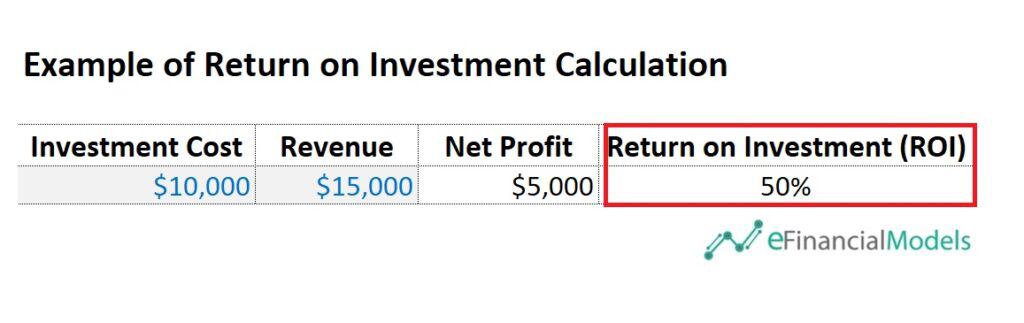
To calculate the ROI, we subtract the cost ($10,000) from the revenue ($15,000), which gives a profit of $5,000. Then, divide the profit by the cost ($5,000 ÷ $10,000) and multiply by 100 to get 50%. This means that the campaign delivered a 50% return on your investment. It shows the campaign effectively generated profits and helps you decide whether to use similar strategies in the future.
Evaluates Resource Efficiency
Calculating return on investment (ROI) shows how efficiently you use resources to generate profit. It compares the gains from an investment to the costs involved, giving you a clear percentage value. A high ROI means using your resources effectively, while a low ROI suggests room for improvement or better alternatives. By evaluating ROI, you can prioritize projects, cut waste, and focus on efforts that maximize results. It’s a simple way to measure the value created from your investments.
Suppose you invest $20,000 in energy-efficient equipment for your business, saving you $8,000 in utility costs annually.
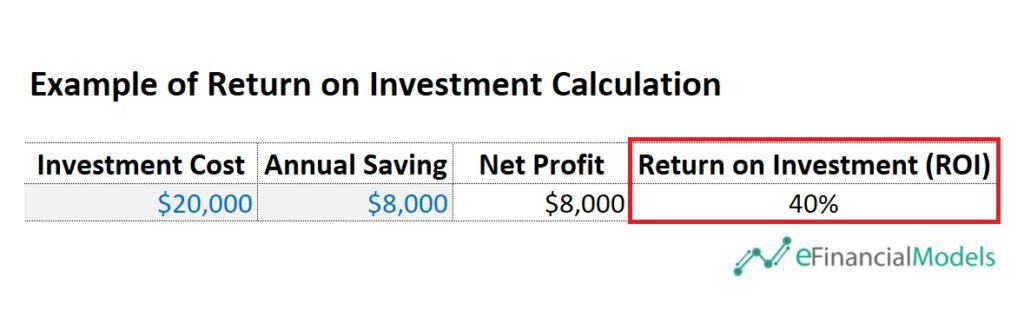
To calculate ROI, we divide the annual savings or net profit ($8,000) by the investment cost ($20,000) and multiply by 100, giving you 40%. This means your investment is returning 40% of its cost each year. It highlights how efficiently the equipment uses resources to save money, helping you justify the expense and plan for similar upgrades in the future.
Enables Investment Comparison
Calculating return on investment (ROI) helps you compare different investments by showing the best return. It simplifies decision-making by converting performance into a clear percentage. For example, if one project delivers a 20% ROI and another offers 10%, you can see which option generates more value for your money. Using ROI, you can prioritize investments, focus on the most profitable opportunities, and avoid wasting resources on low-performing ventures. It’s an essential tool for smarter financial choices.
Imagine you have $50,000 to invest and two options: a rental property or a stock portfolio. The rental property earns $7,000 annually after expenses, while the stock portfolio grows by $5,000 in a year.
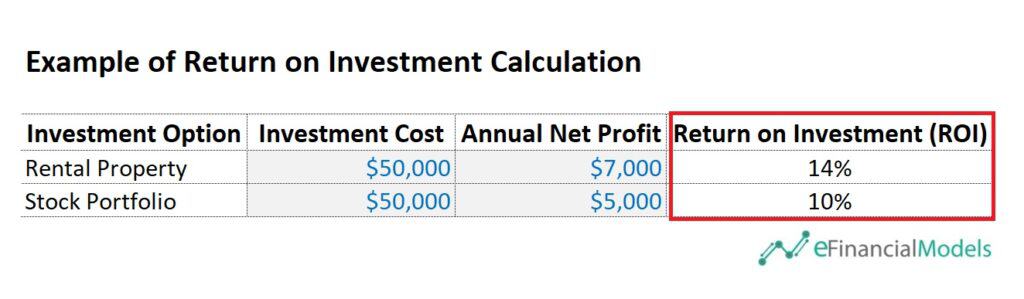
To calculate ROI, we divide the returns by the investment cost. The rental property’s ROI equals ($7,000 ÷ $50,000) x 100 or 14%, and the stock portfolio’s ROI equals ($5,000 ÷ $50,000) x 100 or 10%. This comparison shows the rental property is more profitable, helping you choose the better option for your money.
Amplifies Strategic Insights
Calculating return on investment (ROI) amplifies strategic insights by revealing how well an investment aligns with your goals. It shows if your efforts deliver the desired returns or need adjustment. ROI helps you identify high-performing areas, cut inefficiencies, and refine strategies for better outcomes. By focusing on ROI, you can make data-driven decisions, allocate resources wisely, and create a roadmap for sustainable growth. It turns raw numbers into actionable insights, making your strategies sharper and more effective.
Suppose your company launches two new products, each costing $30,000 to develop. Product A generates $50,000 in revenue, while Product B generates $35,000.
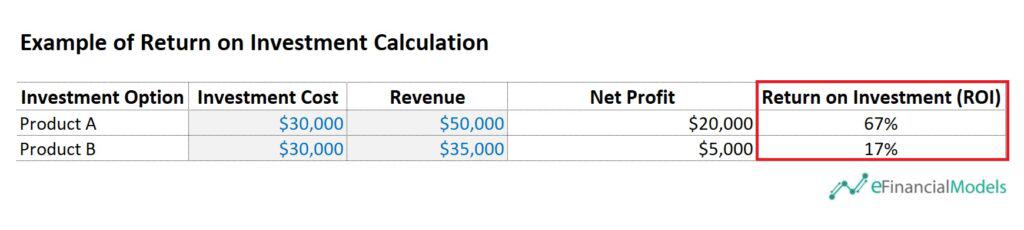
To calculate ROI, we subtract the cost from the revenue and divide it by the cost. Product A has a 67% and Product B has a 17% ROI. This insight helps you see which product delivers better returns, allowing you to focus future resources on similar high-performing initiatives.
Aids Quick Investment Decisions
Calculating return on investment (ROI) aids quick investment decisions by giving a clear snapshot of profitability. It simplifies complex data into a single percentage, making it easy to compare options. A high ROI shows a promising investment, while a low ROI signals caution. This quick analysis lets you decide where to allocate resources without delay. It’s an effective way to evaluate opportunities and act confidently, even in fast-paced situations.
Imagine you’re considering two marketing campaigns. Campaign A costs $5,000 and generates $10,000 in sales, while Campaign B costs $8,000 and generates $12,000.
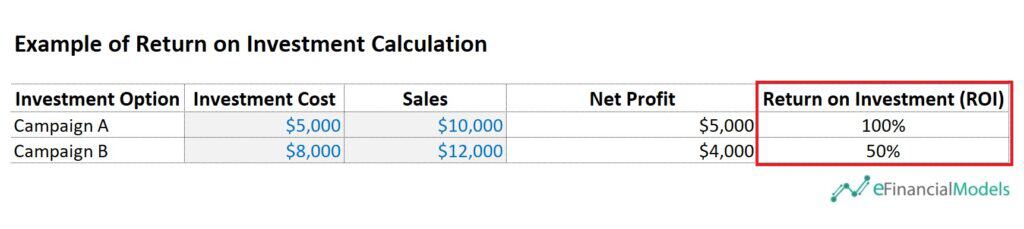
To calculate ROI, we subtract the cost from the sales, divide it by the cost, and multiply by 100. Campaign A has a 100% ROI, while Campaign B has a 50% ROI. This quick comparison shows Campaign A is more efficient, helping you choose the better option quickly.
Pitfalls of Quick ROI Calculations
The return on investment calculation formula is one of the most widely used metrics in financial analysis, thanks to its simplicity and apparent clarity. However, rushing to calculate ROI without delving deeper into the underlying assumptions can lead to flawed decision-making. Businesses focusing solely on quick ROI might undervalue strategic initiatives or dismiss long-term growth opportunities, ultimately jeopardizing sustainable success.
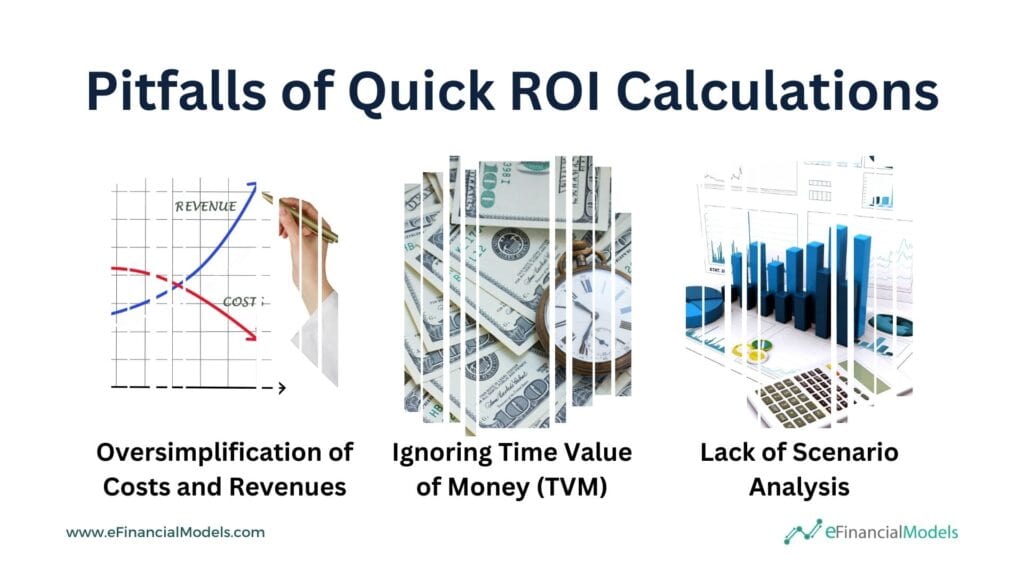
Oversimplifying costs and revenues is a common pitfall in quick ROI calculations. It happens when businesses underestimate hidden expenses or overestimate potential income. This can lead to inaccurate projections, causing flawed decision-making. For example, ignoring maintenance costs or market fluctuations skews the actual profitability of a project. Similarly, assuming consistent revenue growth without considering competition or customer behavior creates false optimism.
Ignoring the time value of money (TVM) is another major flaw of quick ROI calculations. It assumes that money today and money in the future have the same value, which is false. Inflation, opportunity costs, and investment risks reduce future money’s worth. This oversight can make long-term projects seem more profitable than they are.
Skipping scenario analysis is a critical mistake in quick ROI calculations. It overlooks how cost changes, revenues, or market conditions can impact results. This creates overly optimistic or inaccurate projections. For instance, failing to consider a sales dip or a rise in material costs can lead to poor investment decisions. Scenario analysis tests different outcomes, like best-case, worst-case, and average scenarios. Including this step helps businesses prepare for uncertainties and choose investments with confidence. It ensures decisions are based on realistic and well-rounded insights.
The best way to measure return on investment is through IRR and Cash on Cash Yield. These methods account for time, cash flow, and overall profitability, clearly showing an investment’s performance. IRR considers the time value of money, while Cash on Cash Yield focuses on actual returns compared to invested cash. Quick ROI calculations work best for short-term scenarios with simple cost structures and predictable revenues, such as evaluating marketing campaigns.
Maximize Insights with the Return on Investment Calculation in Excel
A quick return on investment calculation gives you clarity. It tells you what’s working and what’s not so that you can focus on the best opportunities. It highlights how well resources are utilized and helps compare different opportunities effectively. Simplifying complex financial data it sharpens strategic focus and supports confident decision-making. This tool empowers investors to identify high-value projects quickly and seize opportunities that align with their goals.

Leverage the power of return on investment calculation in Excel to enhance your ROI analysis and gain deeper insights into your investments. Its flexibility allows you to customize calculations, compare scenarios, and visualize outcomes easily. By using return on investment calculation in Excel, you can make informed decisions faster and refine your strategies to maximize profitability. Unlock smarter investment planning with this versatile tool.
































You might also like:
- 10 Main Elements of a Business Plan
- 10 Tips to Develop a First Class Business Valuation Report
- 12 Funding Sources for Businesses and Startups
- 5 Smart Ways To Manage Personal Finances In A Pandemic
- Financial Statements – Definition, Uses, Contents and Templates
- Foundations of Financial Modeling: A Practical Approach to Learning
- Understanding the Levelized Cost of Energy Formula
- How to Build a Capitalization Table
- How to Prepare a Financial Feasibility Study?
- How to Calculate Net Present Value (NPV)?
- Real Estate Valuation
- Financial Planning for Small Business Owners – Taking an SBA Loan
- Funding Sources for Startups
- Invest Smart With a Surfboard Rental Business
- Restaurant Business Valuation Models
- Real Estate Financial Modeling in Excel
- How Waze Mapped Its Way to Success?
- How to Optimize the Average Selling Price: Strategies for Higher Profits
- How to review a financial model?
- How to Calculate SaaS Monthly Recurring Revenue?
Tags: financial metrics