

0 ITEMS

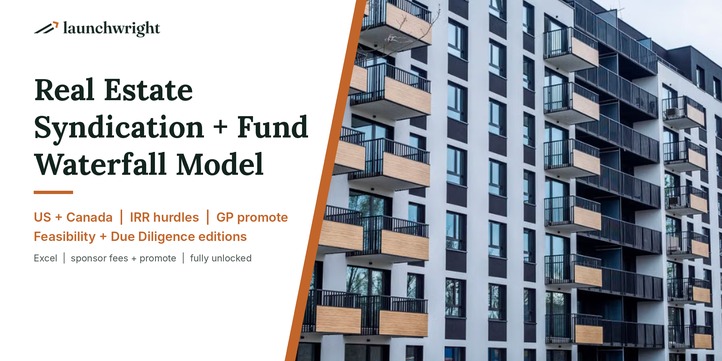
Real Estate Syndication and Fund Waterfall Financial Model: US and Canada Multifamily Apartment, Value-Add, Private Equity Distribution Waterfall, LP GP Promote, Preferred Return, IRR Hurdles, Carried Interest, Joint Venture
Quarterly Excel model of a value-add apartment syndication or fund: acquisition, debt, renovation, refinance and sale, then a tiered LP/GP distribution waterfall with IRR hurdles, catch-up, sponsor fees, GP co-investment and selling commissions. US (Dallas-Fort Worth) and Canada (Calgary, CMHC) presets. The Due Diligence Edition adds up to 10 properties, European and American waterfalls with clawback, Class A preferred equity and an investor tax estimate.
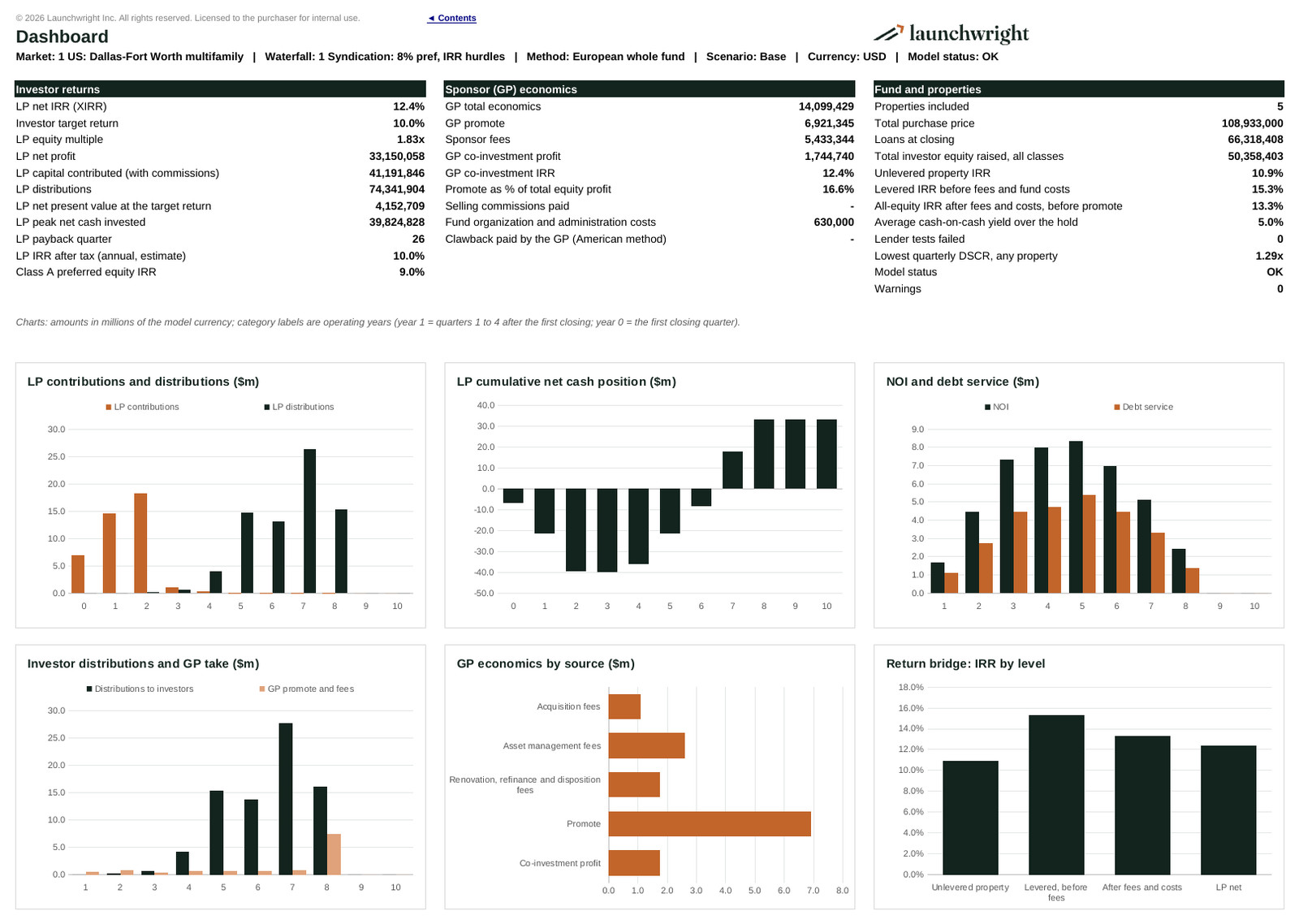
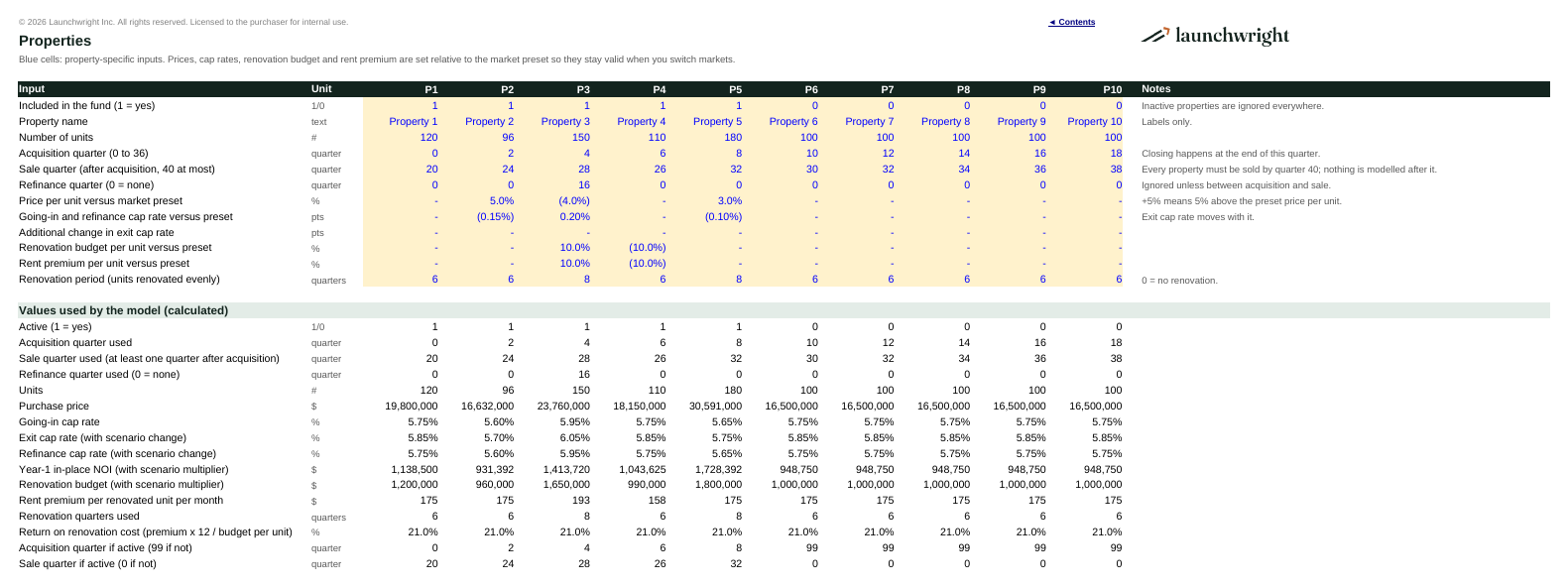
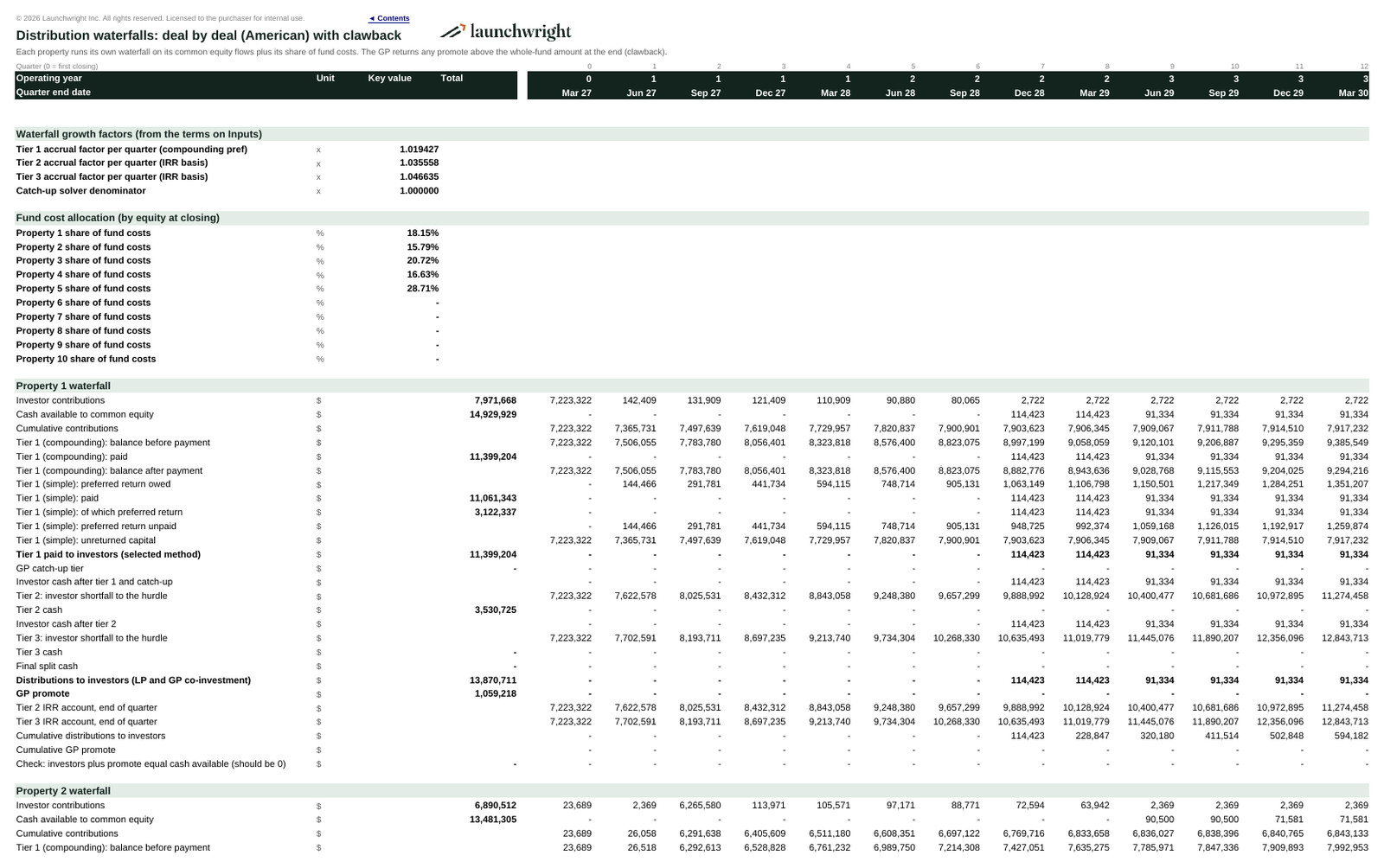

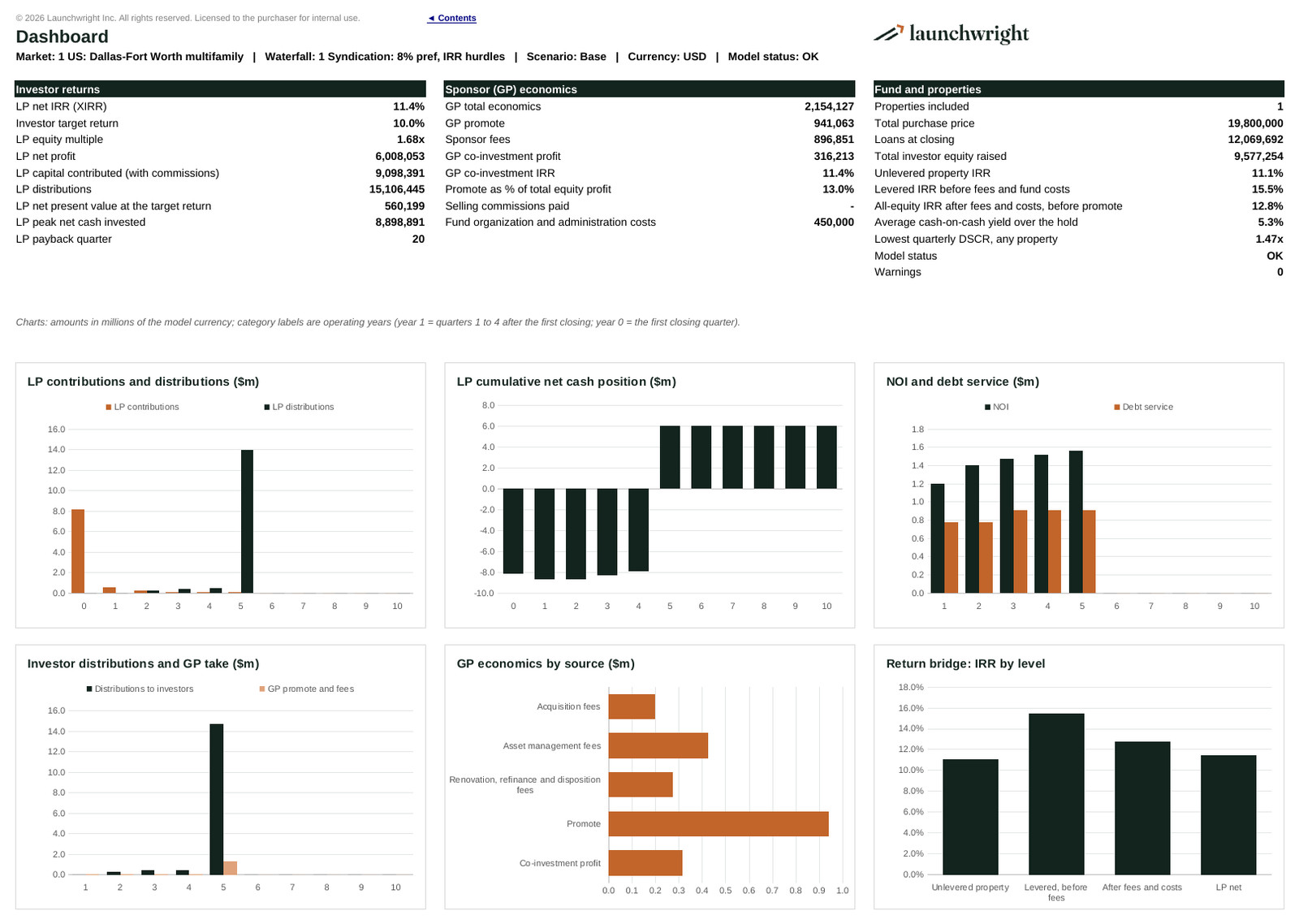
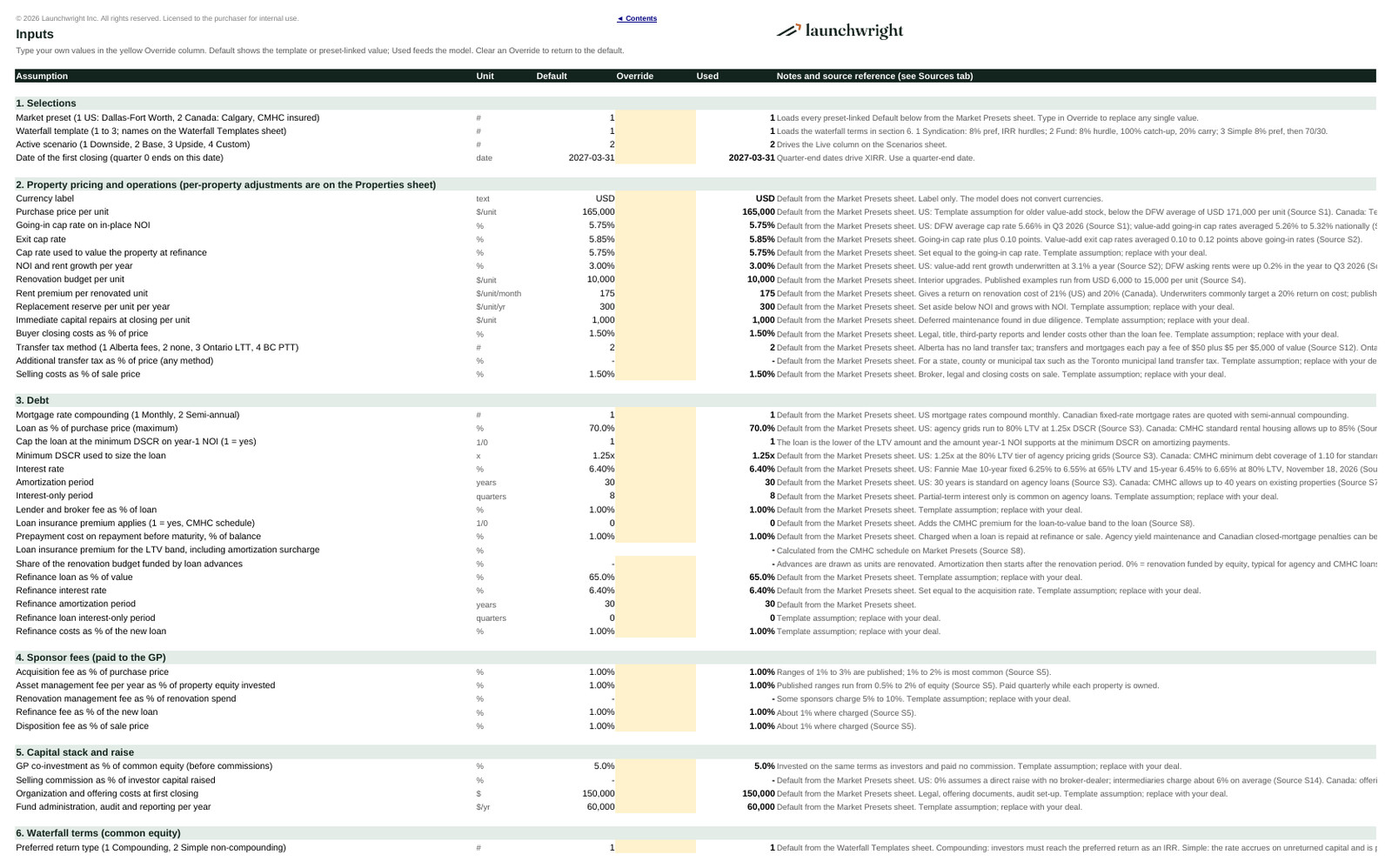
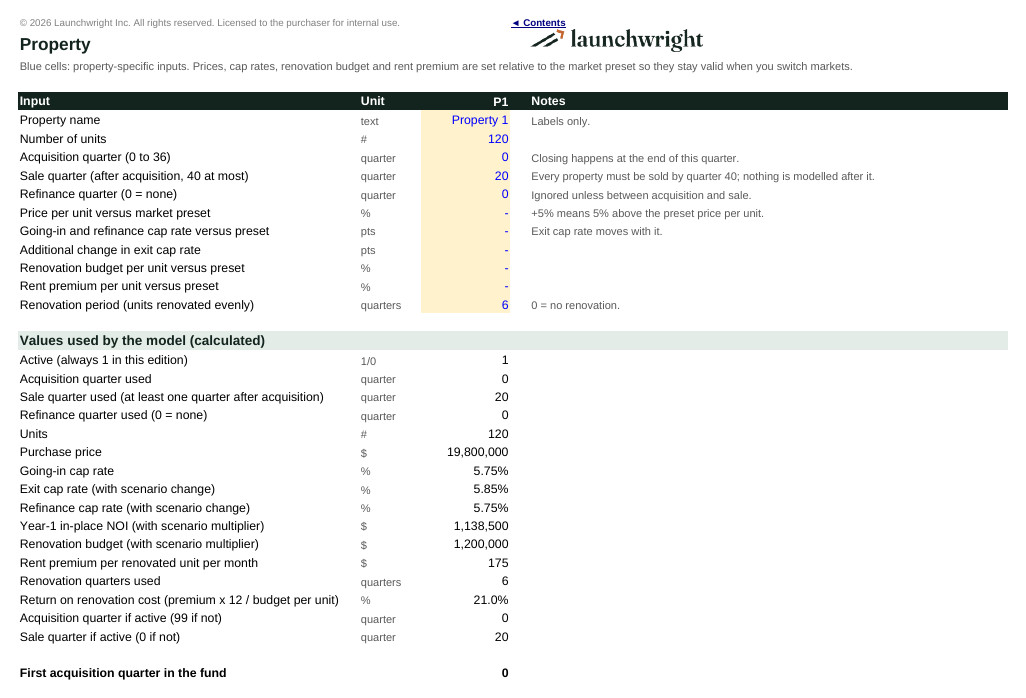
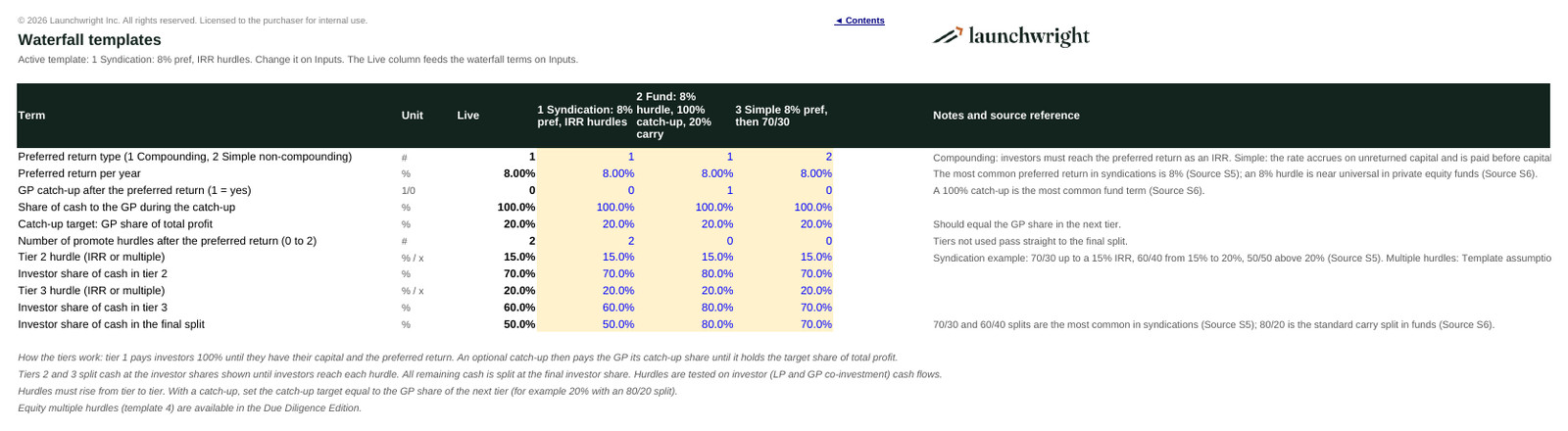
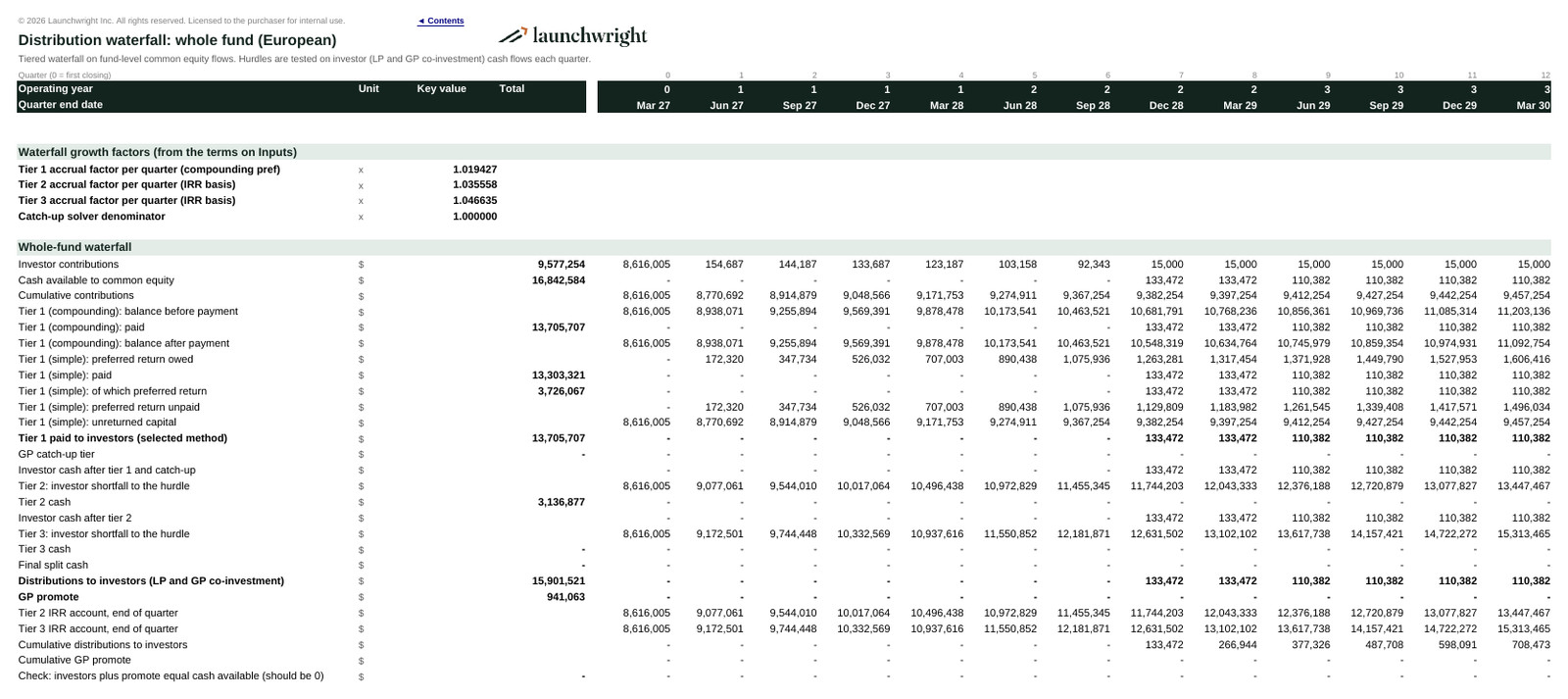

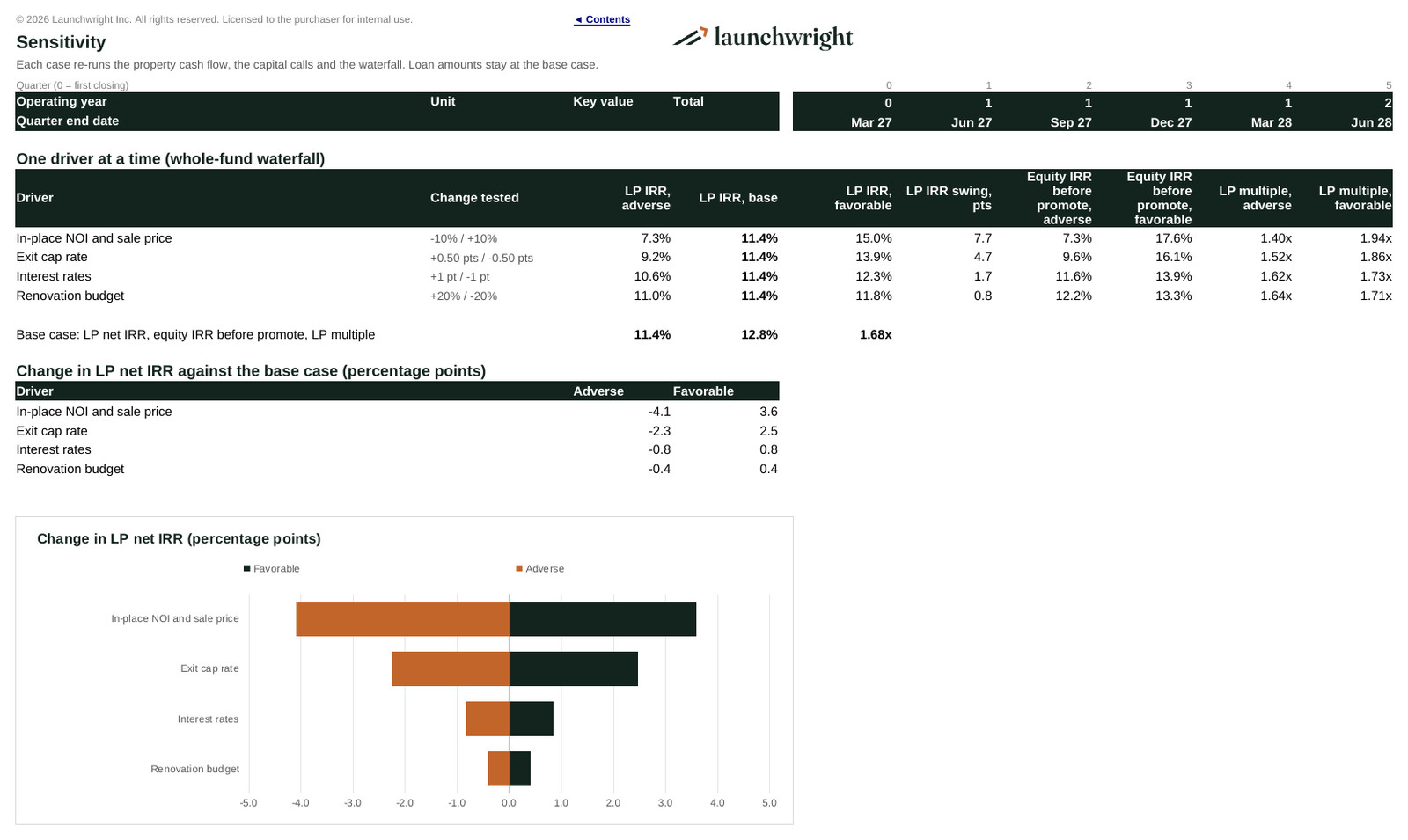
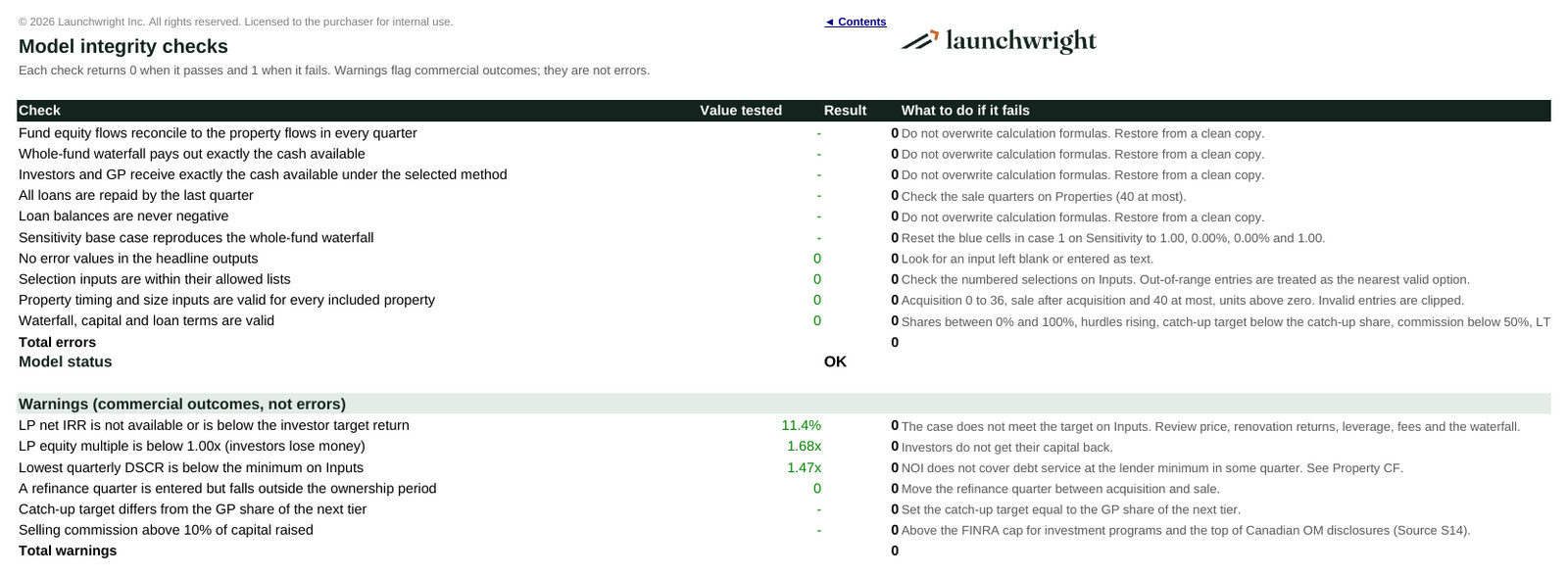
Four things this model gives you:
- Exactly what each LP and the GP receive, quarter by quarter, under the waterfall you actually offer.
- The full sponsor economics in one view: fees, promote and co-investment profit.
- A return bridge from the unlevered property IRR to the LP net IRR, so you see what leverage, fees and promote each cost.
- US and Canadian structures in one file, including CMHC-insured debt and offering memorandum selling commissions.
Who it is for: apartment syndicators raising LP capital for one building or a small fund, GP and LP joint venture partners negotiating promote terms, passive investors and their advisors checking what a sponsor’s waterfall really pays, and analysts who need an auditable LP and GP model fast. Use it to answer the questions investors and lenders ask: What does the LP net after fees and promote? What does the GP earn, and from where? Does the deal still clear the target return if the exit cap widens or rates rise? How much capital, and how many investors, does the raise need?
Most waterfall templates make you paste in cash flows from somewhere else, or underwrite properties but leave fees, commissions and taxes out of the waterfall. This model does both in one place. It underwrites each value-add apartment property, from purchase price and going-in cap rate through renovation, refinance and sale, and runs the cash through the distribution waterfall every quarter.
Property and debt engine
- Quarterly timeline of 40 quarters with XIRR on quarter-end dates and an annual summary, including cash-on-cash yield by year and the average over the hold.
- Value-add engine: renovation budget per unit, rent premium per renovated unit ramping in as units are finished, replacement reserves, and sale at forward NOI over the exit cap rate.
- Debt sized at the lower of LTV and a minimum DSCR, interest-only periods, renovation advances, lender fees, prepayment cost and a refinance that returns surplus cash.
- Canadian rules: semi-annual compounding on fixed mortgages, the CMHC multi-unit premium schedule by LTV band with the amortization surcharge, and closing cost formulas for Alberta land titles fees, Ontario land transfer tax and BC property transfer tax (including the additional tax above $3 million), plus an extra percentage for municipal or state taxes. The mortgage stress test (OSFI Guideline B-20) covers one- to four-unit homes, so it is correctly not applied to apartment buildings.
Waterfall and investor economics
- Preferred return compounding (as an IRR) or simple on unreturned capital, optional GP catch-up, up to two IRR hurdles and a final split.
- Templates: syndication with IRR hurdles (8% pref, 70/30 to 15%, 60/40 to 20%, then 50/50), fund style (8% hurdle, 100% catch-up, 80/20), and simple 8% pref then 70/30. The Due Diligence Edition adds equity multiple hurdles.
- Sponsor fees inside the cash flow: acquisition, asset management, renovation management, refinance and disposition.
- Selling commissions grossed up on LP capital, GP co-investment pari passu with LPs, and fund organization and administration costs.
Due Diligence Edition adds
- Up to 10 properties with their own timing, size, price, cap rate and renovation plan.
- European (whole-fund) and American (deal-by-deal) waterfalls, with the GP clawback against the whole-fund promote.
- Class A preferred equity at each property: fixed compounding return, current pay when cash allows, redemption from refinance and sale proceeds.
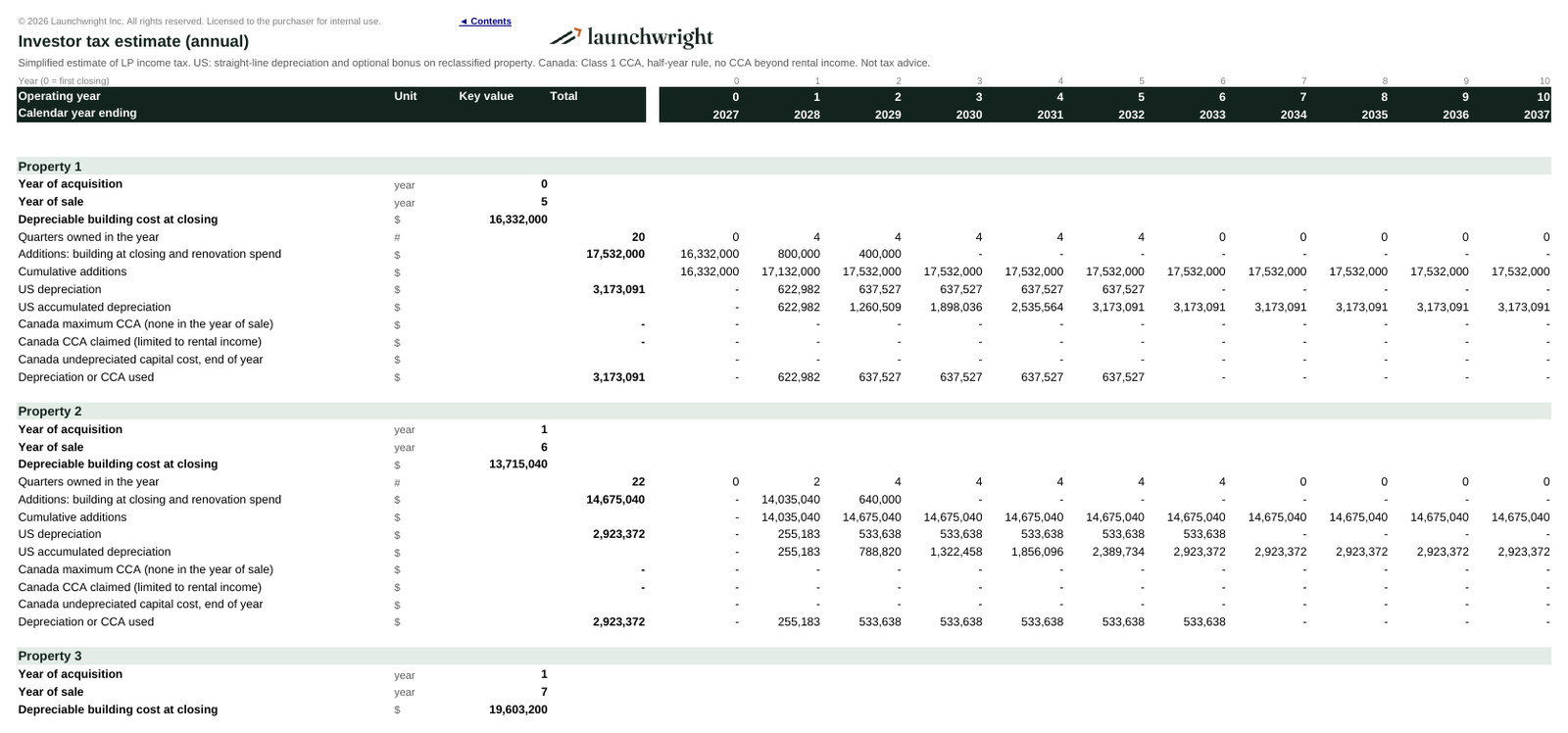
- Investor tax estimate: US 27.5-year depreciation with optional cost segregation and bonus, or Canadian Class 1 CCA with the half-year rule and rental loss restriction, and the LP IRR after tax.
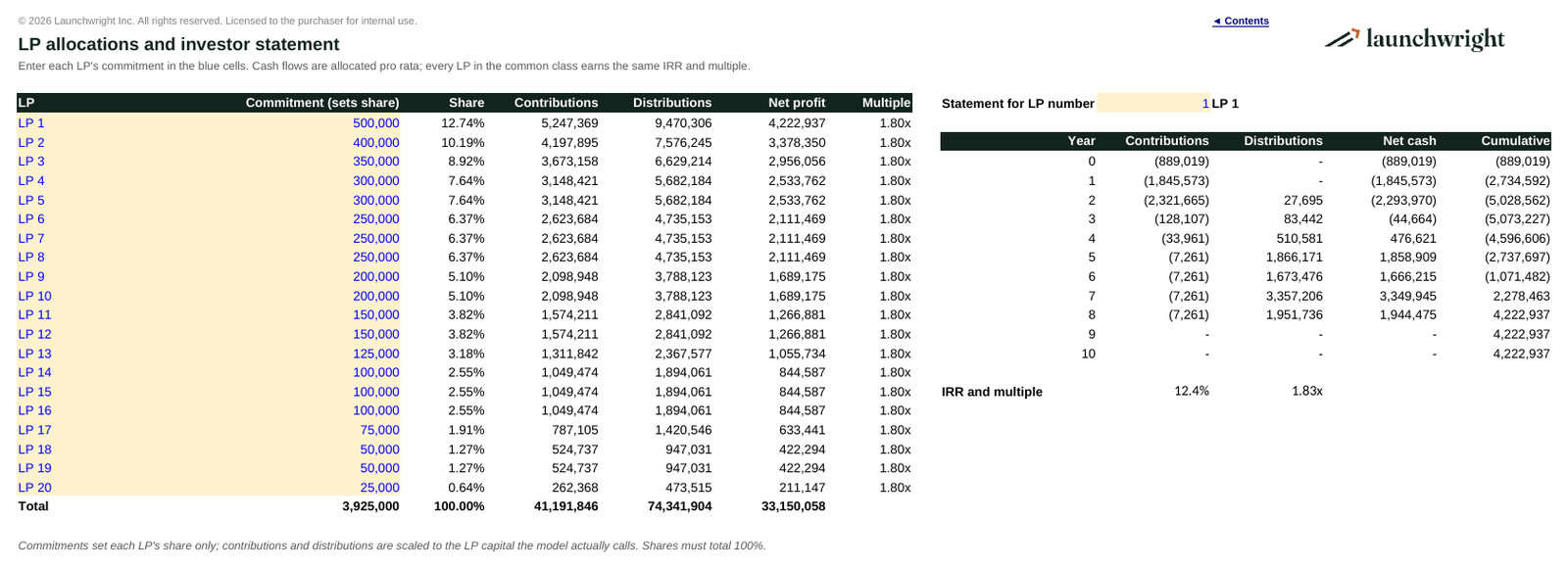
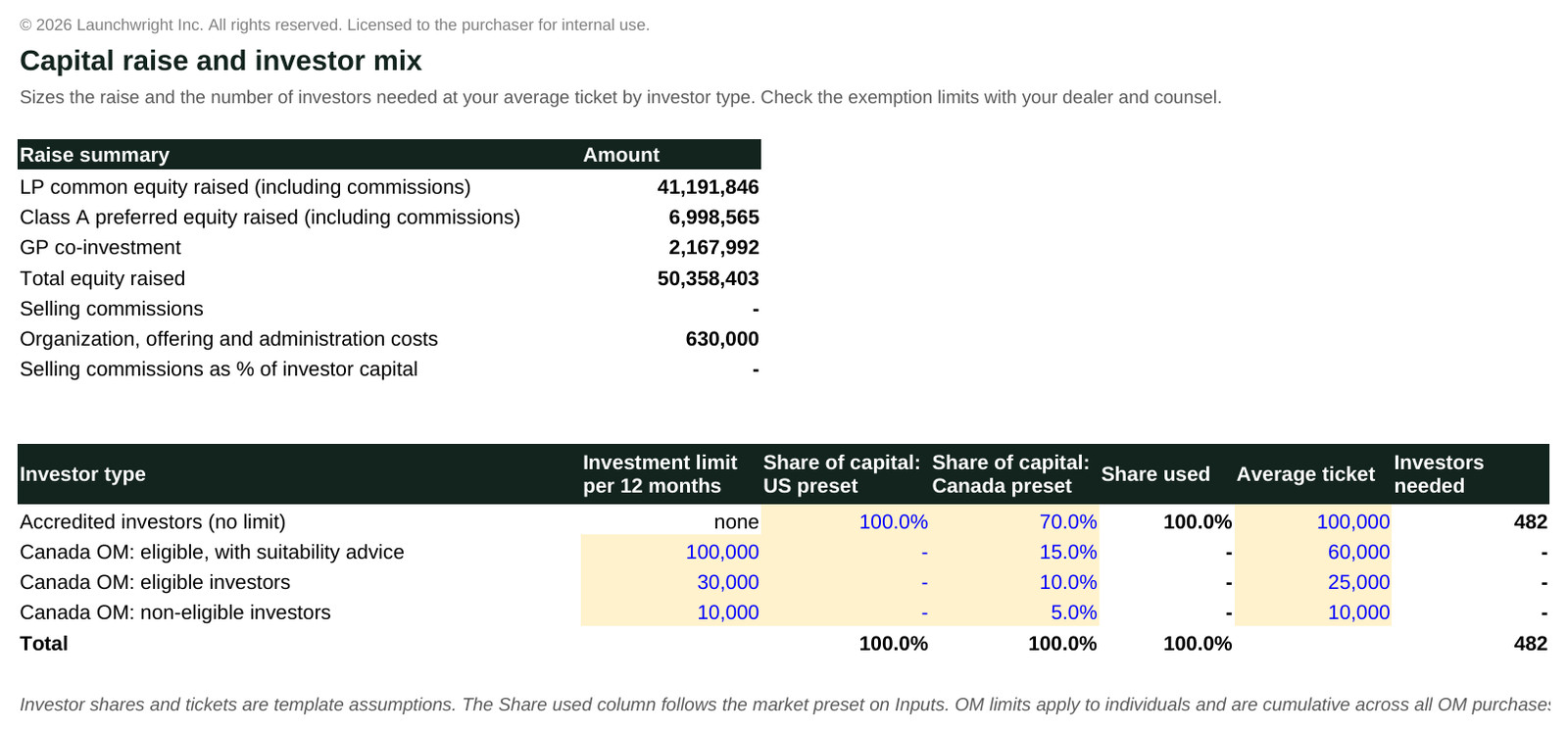
- Lender tests by property, a capital raise sheet that counts investors needed against Canadian offering memorandum limits, and allocations and statements for 20 LPs.
Easy to use
- One Inputs sheet: every row shows the default, your override and the value used, with its source reference. Clear an override to return to the default.
- Drop-down lists on every numbered selection: market, waterfall template, scenario, transfer tax method, rate compounding, preferred return type and number of hurdles, plus distribution method, hurdle basis and tax regime in the Due Diligence Edition. Invalid entries are blocked, and Checks flags any that get past.
- Downside, Base, Upside and Custom scenarios, a Dashboard with 7 charts, and Instructions, Glossary and Sources sheets.
Default base case
The Due Diligence Edition opens with five Dallas-Fort Worth apartment properties bought over two years for $108.9 million in total, with agency-style debt at 6.40% sized to a 1.25x DSCR and 15% Class A preferred equity. On those template assumptions the LP net IRR is 12.4% against a 10% target, with a 1.83x equity multiple and a 9.0% Class A return. The Feasibility Edition opens with one 120-unit property and shows an 11.4% LP net IRR. The Calgary preset shows 11.7% (Due Diligence) and 10.5% (Feasibility) against a 9% target. The Downside scenario loses money, as a lender would expect to see. Average cash-on-cash yield over the hold is 5.0% (Due Diligence) and 5.3% (Feasibility), lower in the renovation year and rising to about 6% as renovated rents come in. Every default is cited on one of 20 plain-text sources on the Sources sheet or labelled a template assumption.
Built to be trusted
No macros, no circular references, no external links, no hidden sheets and no locked cells. Every cash flow reconciles, and Checks confirms that the waterfall pays out exactly the cash available in every quarter. Inputs are blue on yellow and kept apart from calculations. The model uses long-standing Excel functions only.
This template is for planning and illustration. It is not investment, securities, tax, legal or lending advice. Waterfall results depend on the exact wording of your partnership agreement.
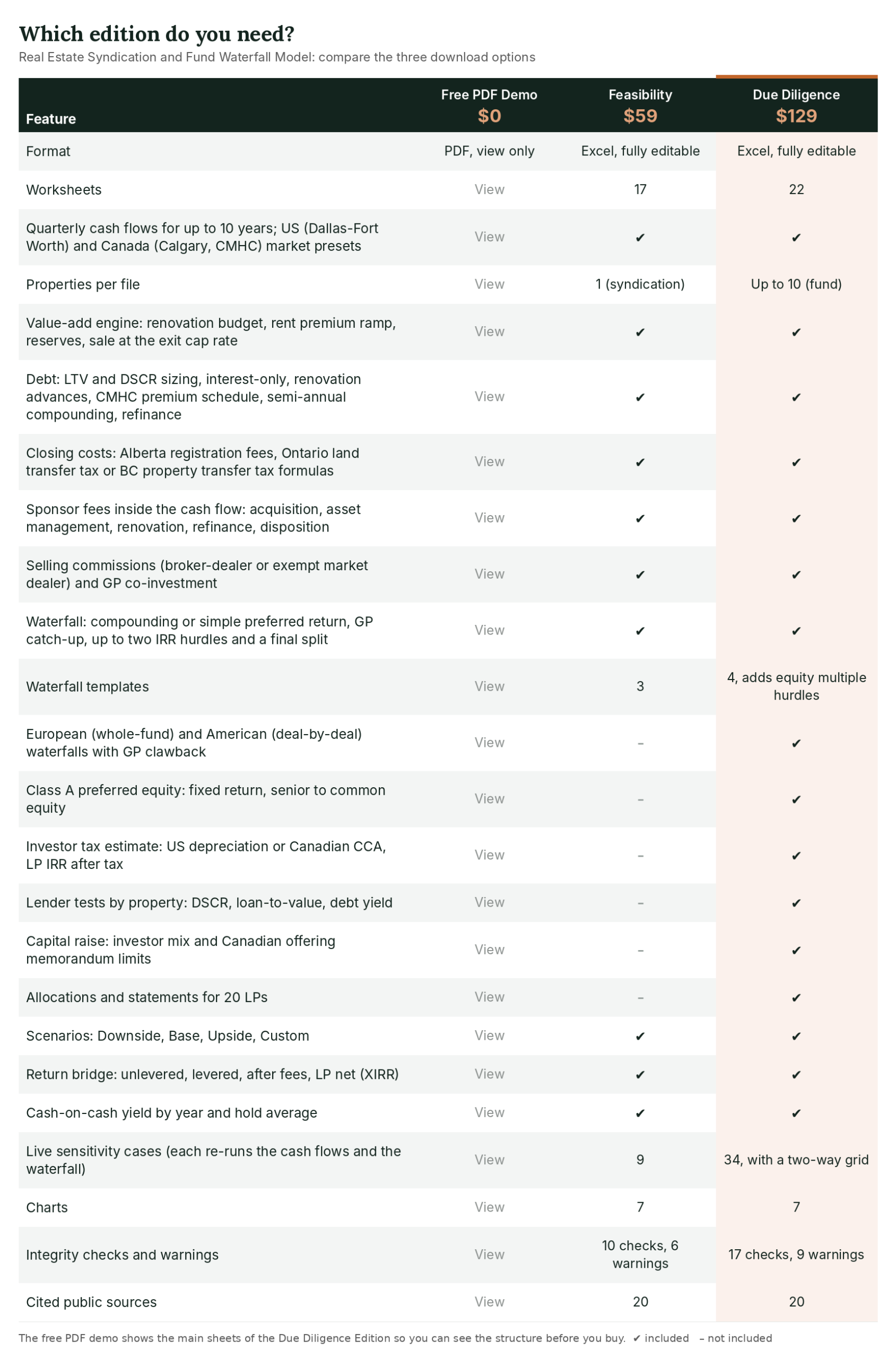
Which edition do you need?
FAQs
Which Excel version do I need? Desktop Excel for Windows or Mac. The file has no macros and uses long-standing functions such as XIRR, PMT and SUMIF. It has not been tested in Google Sheets.
Can I enter my own waterfall terms? Yes. Pick the closest template, then override any term on Inputs: preferred return type and rate, catch-up, hurdles and splits. You can also edit the template columns themselves.
Are hurdles tested on LP or fund returns? On investor cash flows: LP and GP co-investment together, after fees, fund costs and commissions. The GP co-investment receives the same return as LPs in every tier.
Can I model a single-asset syndication in the Due Diligence Edition? Yes. Set Included to 0 for every property except one.
Does it handle Canadian offering memorandum raises? It models dealer selling commissions, CMHC-insured debt and, in the Due Diligence Edition, counts the investors needed against the OM investment limits. It does not prepare an offering memorandum; confirm the rules with counsel and your dealer.
Is the tax sheet tax advice? No. It is a simplified estimate allocated by capital share. The simplifications are listed on the Tax sheet.
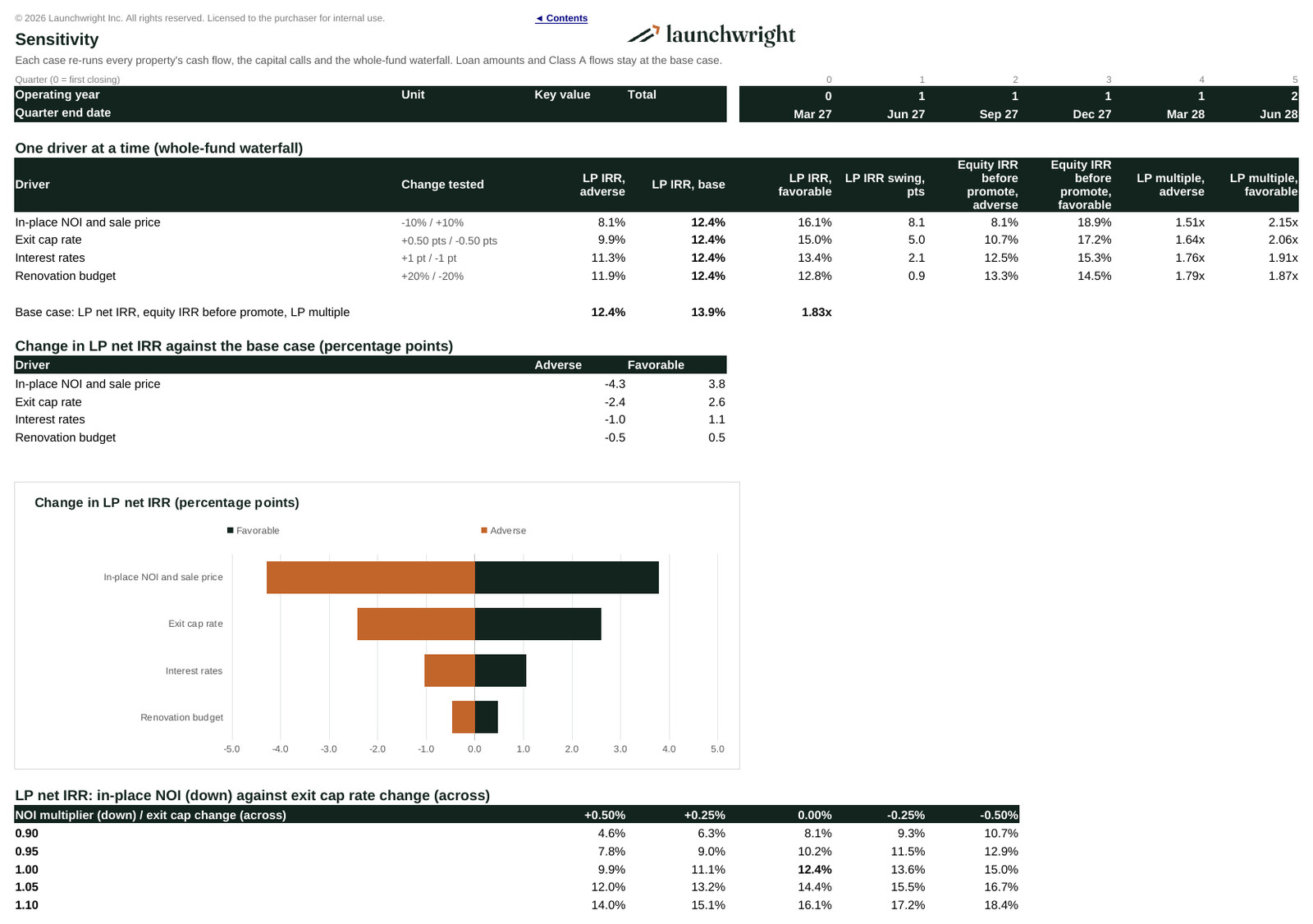
What does the sensitivity analysis change? In-place NOI, exit cap rate, interest rates and the renovation budget. Each case re-runs every property and the waterfall. Loan amounts, fees on equity and Class A flows stay at the base case, and the cases use the whole-fund waterfall.
Is the file locked? No. Every cell and formula is visible and editable.
Do you offer support? Questions about how the template works can be sent to [email protected]. Customization requests go through the eFinancialModels custom service.
Similar ProductsOther customers were also interested in...



 eFinancialModels
Electric Vehicle (EV) Charging Station Financial M...
With this comprehensive 5- or 10-year monthly tool, investors can assess the viability of setting up... Read more

Financial Model for Mobile App | Mobile App Busine...
The Mobile App Financial Plan Template in Excel allows you to develop financial projections when lau... Read more

 HenrySheykin
Food Truck Financial Model Excel Template
The Food Truck Financial Model helps entrepreneurs, founders, business owners, consultants, and anal... Read more

Green Hydrogen Production from Wind Energy Financi...
The Green Hydrogen from Wind Financial Model aims to comprehensively forecast a horizon of 40 years ... Read more

Simple Mutual Non-Disclosure Agreement Template
Protect your business secrets with ease using our Simple Mutual Non-Disclosure Agreement Template. S... Read more

Solar Energy Financial Model
The Solar Energy Financial Model Spreadsheet Template in Excel assists you in preparing a sophistica... Read more

 Peter Graf
The Customer-Centric Financial Model for Restauran...
Starting a restaurant without a financial plan is like driving a car blindfolded. You wouldn´t do i... Read more
You must log in to submit a review.