

0 ITEMS

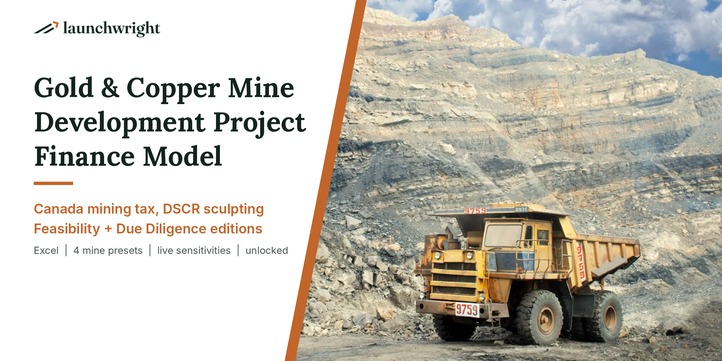
Gold & Copper Mine Development Financial Model: Open Pit & Underground Mining Project Finance, Feasibility, Valuation, DSCR Sculpting, Gold Streaming, Canada Mining Tax
Lender-ready Excel model for a gold, copper-gold or copper mine, from construction to closure: mine plan, smelter terms, itemized capital, debt sculpted to a target DSCR with DSRA and LLCR/PLCR, gold streaming, Canadian income and mining taxes (Ontario, Quebec, BC), the critical minerals credit and live sensitivities. Two editions and a free PDF demo.
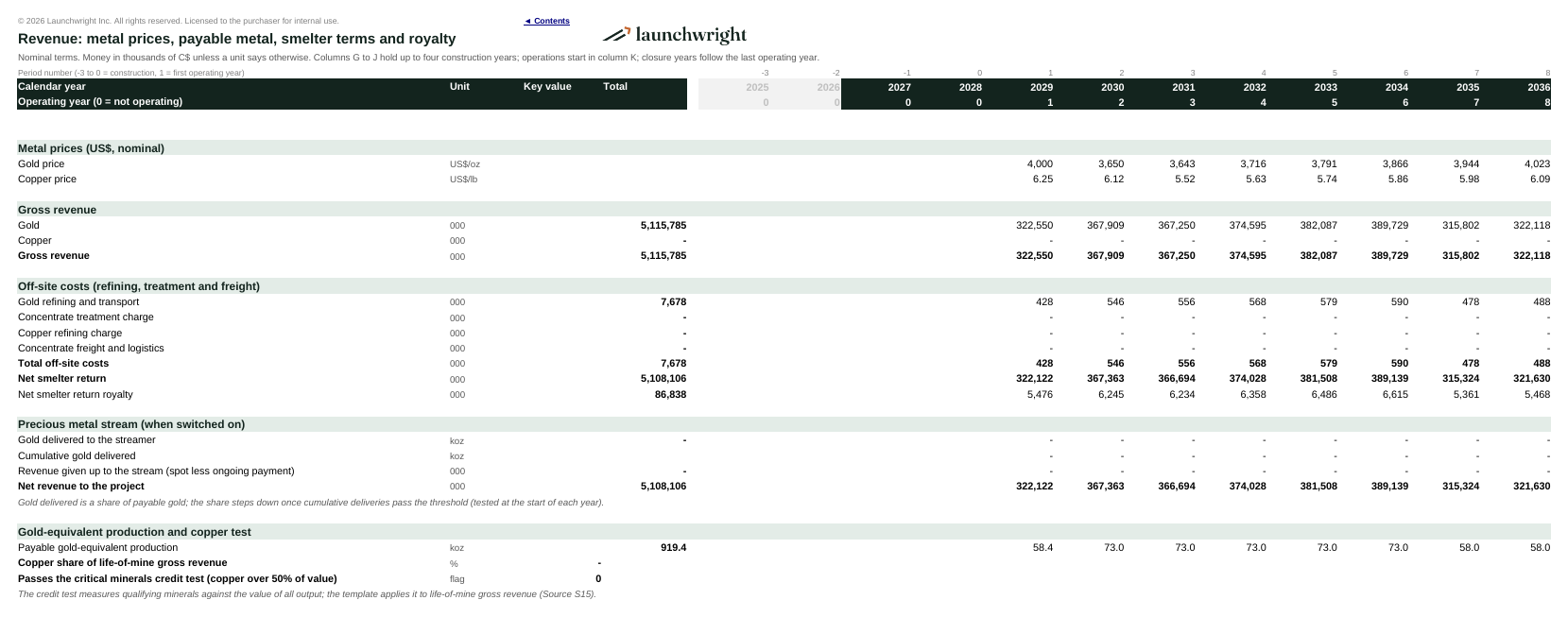
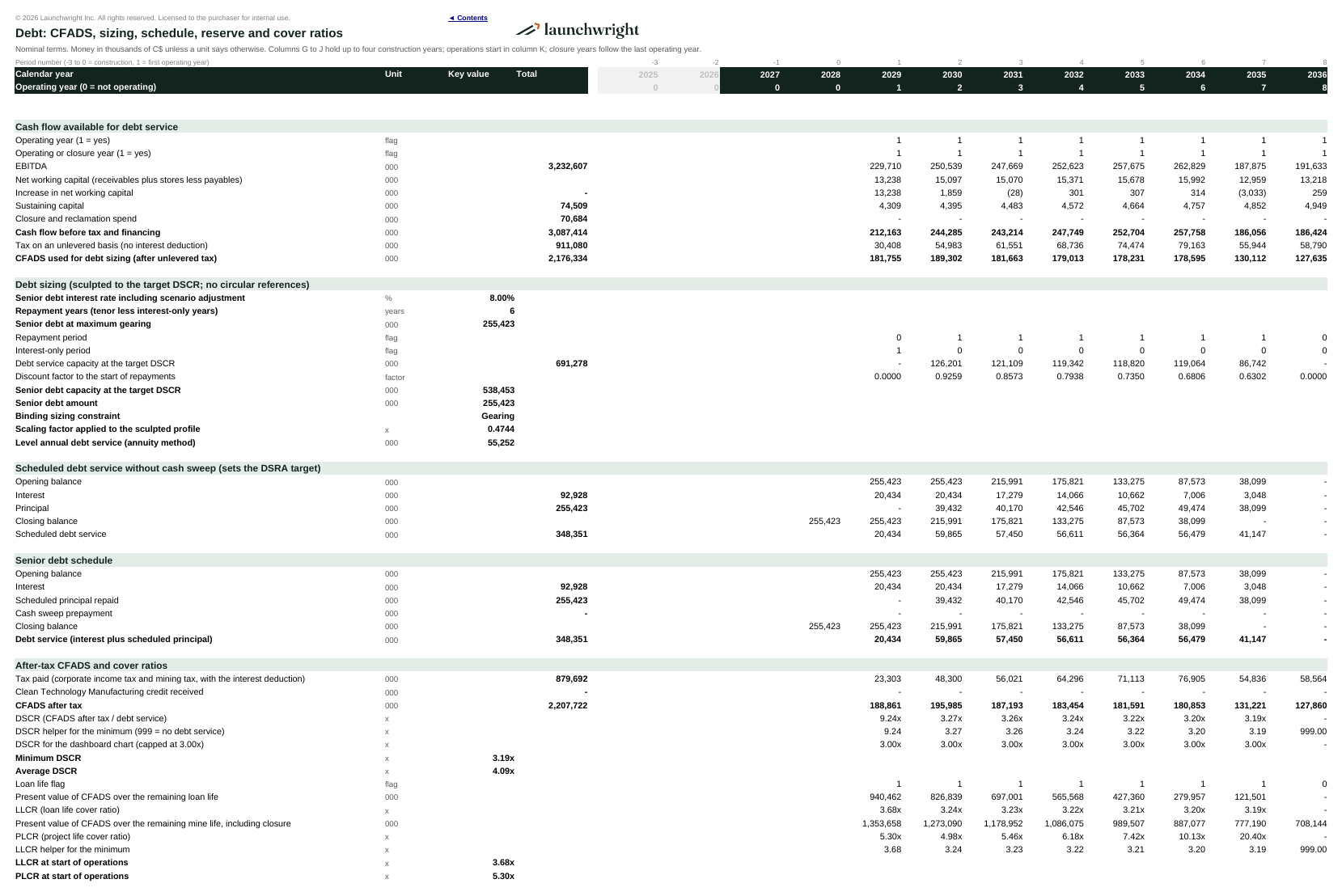
✓ Know whether your mine is financeable: senior debt sized to a target DSCR on after-tax cash flow, with a DSRA, lock-up, cash sweep, LLCR and PLCR, the way a lender tests it (Due Diligence Edition; the Feasibility Edition sizes debt at a set gearing).
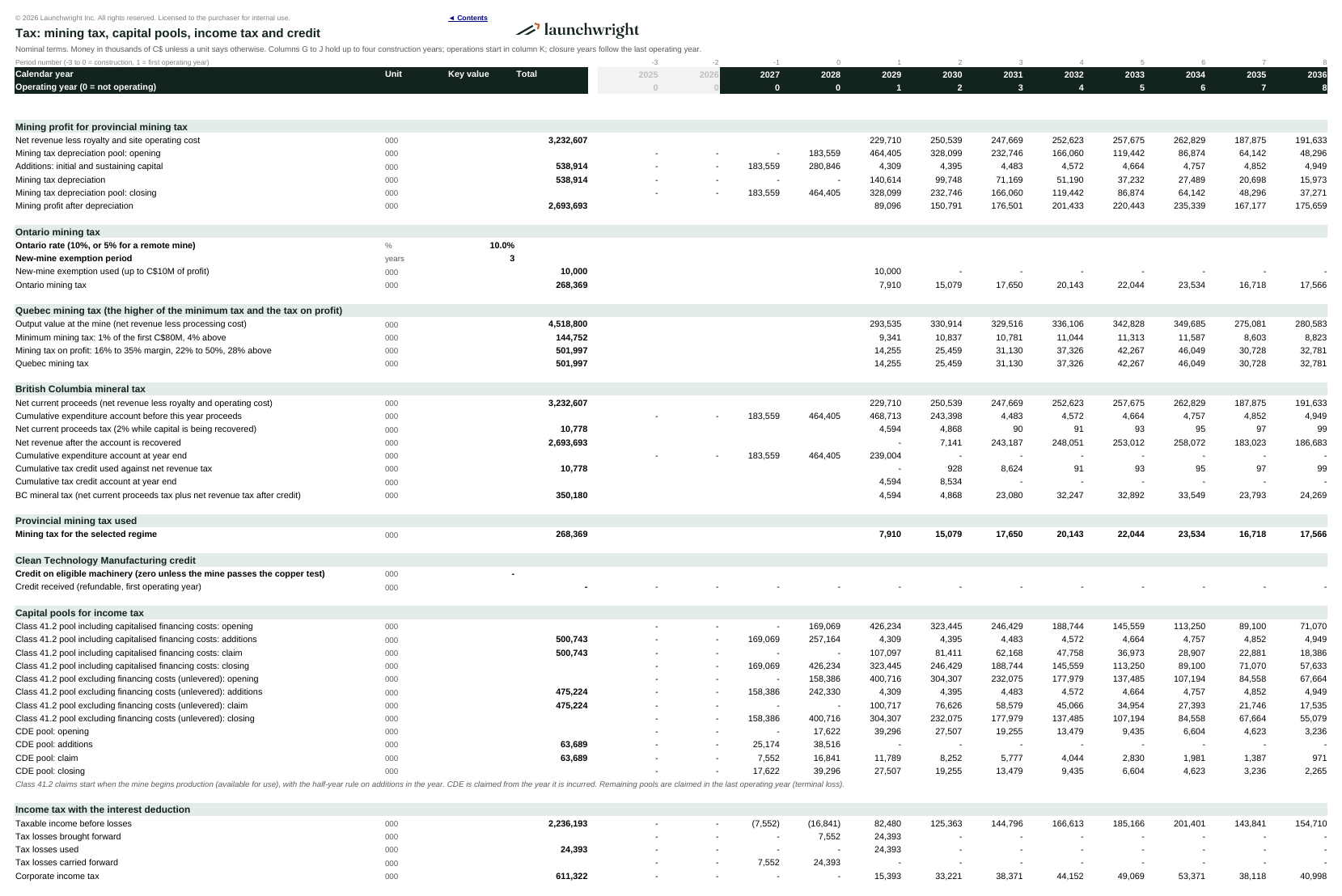
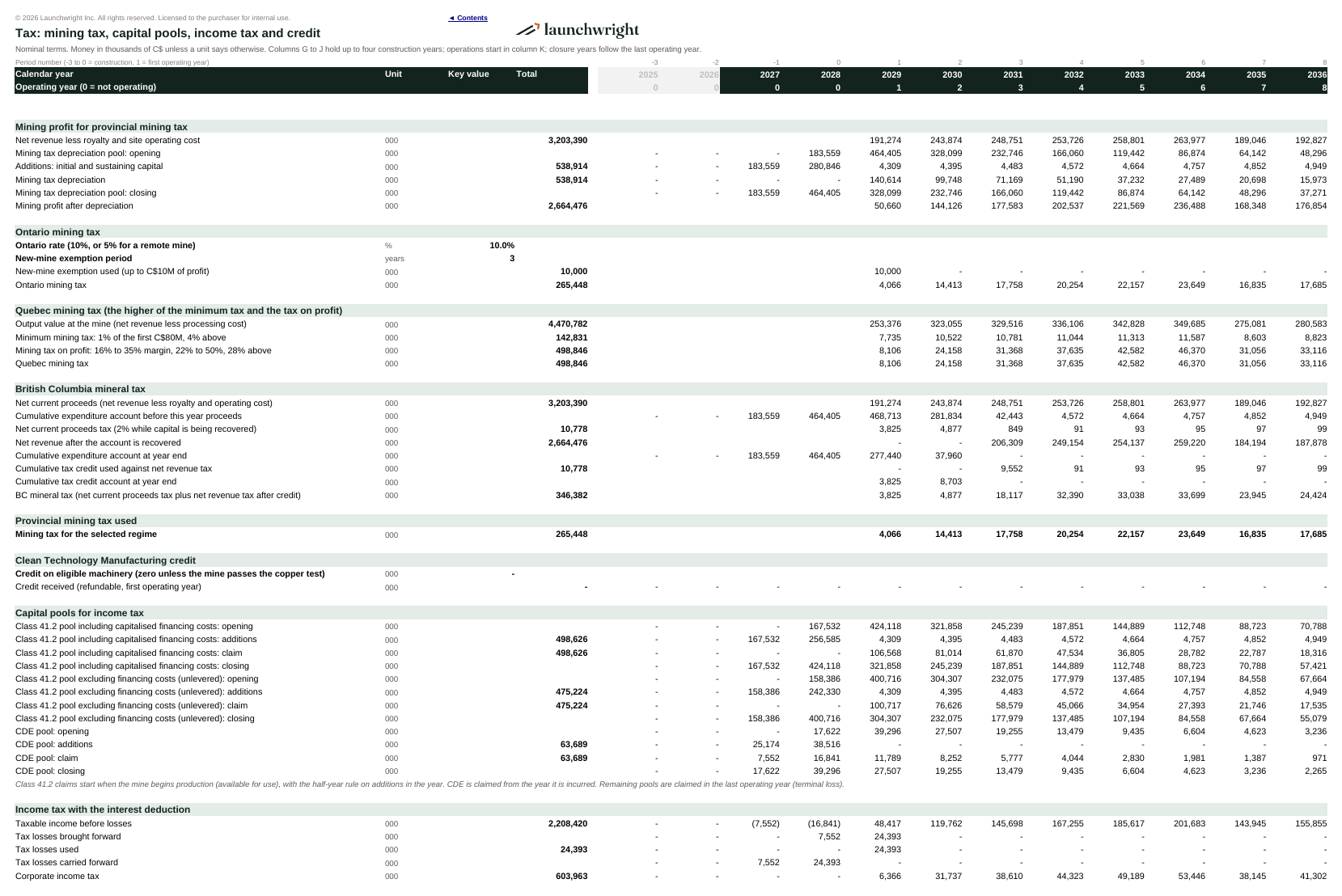
✓ Get the Canadian tax right: Class 41.2 and CDE pools, the Ontario, Quebec and British Columbia mining taxes, and the 30% critical minerals credit with its copper value test.
✓ Start from real studies, not a blank sheet: four cited presets for Ontario open-pit gold, toll-milled Quebec underground gold, a BC copper-gold porphyry and an international gold mine in US$.
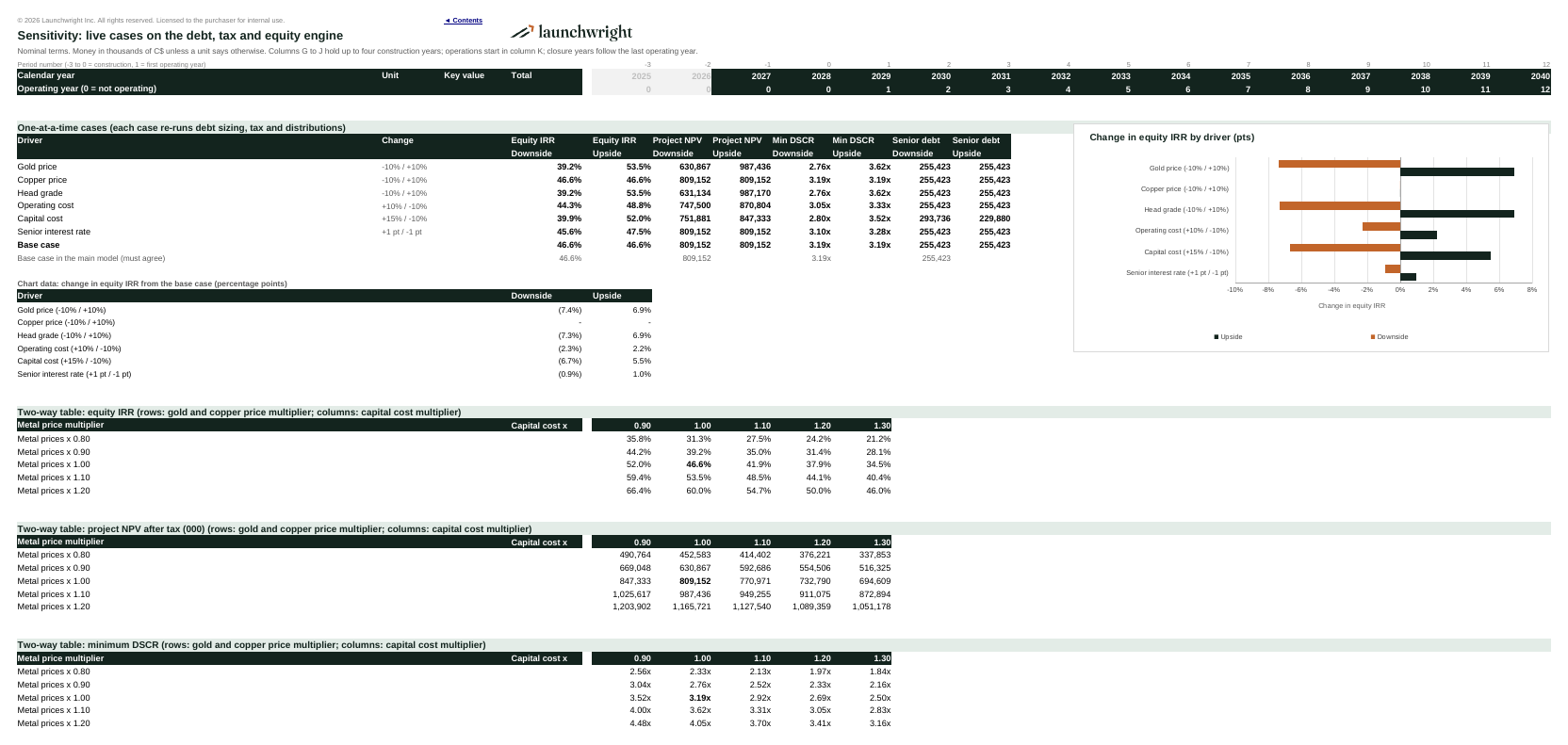
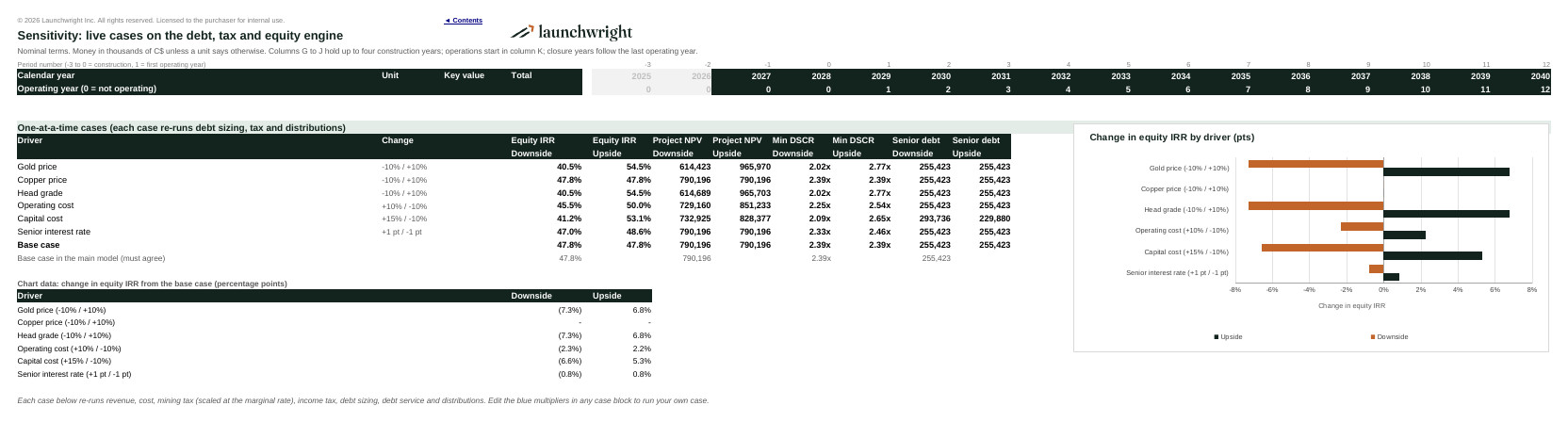
✓ See what moves value: up to 38 live sensitivity cases, a tornado chart and two-way tables of metal price against capital cost, each re-running debt, tax and equity returns.
Developing, financing or buying into a gold, copper-gold or copper mine? This Excel model takes you from the first year of construction to the end of closure: mine plan, payable metal and smelter terms, itemized capital, operating and closure cost, debt, tax, returns and the cover ratios a lender asks for. It handles open-pit and underground mines.
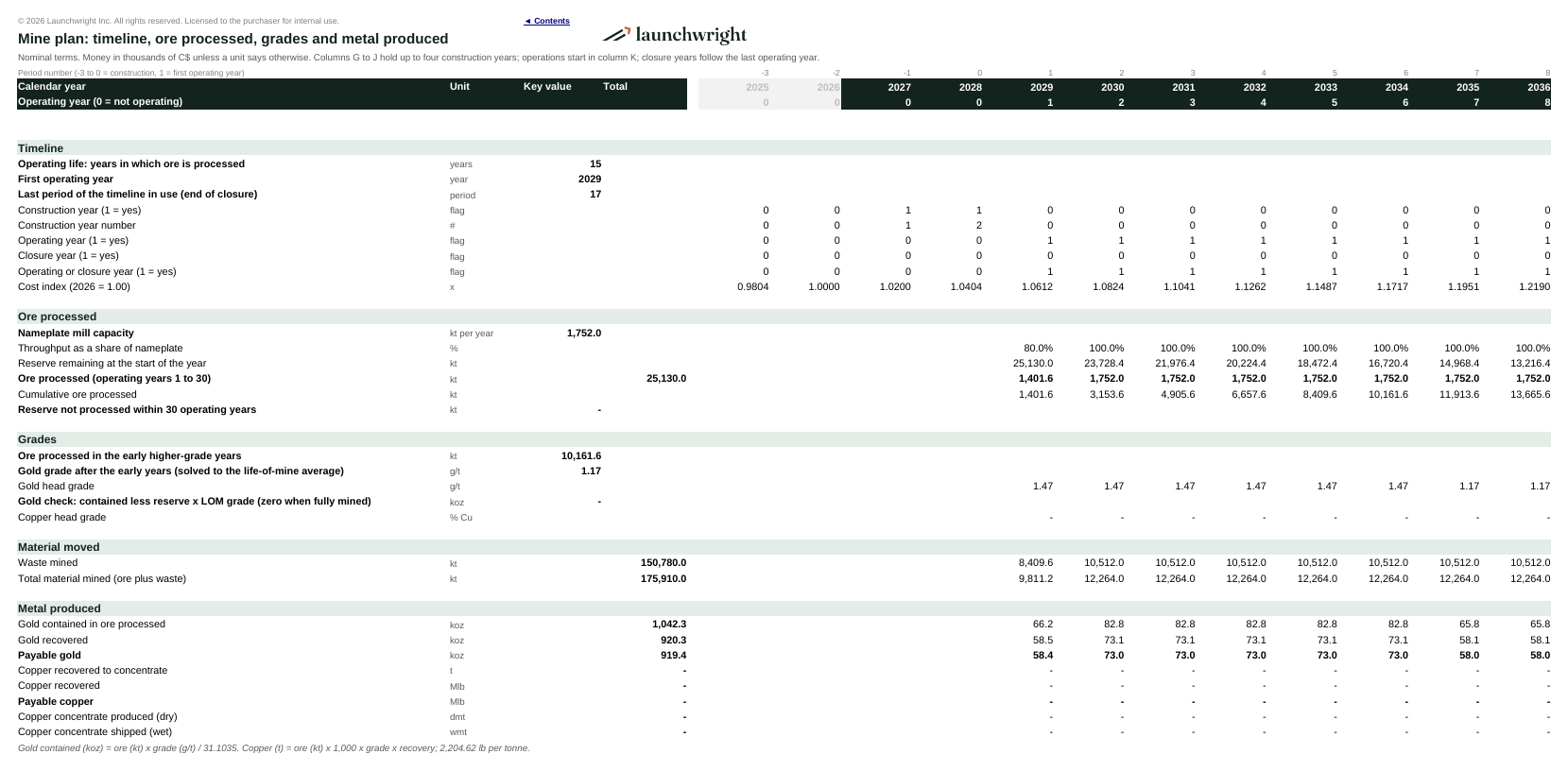
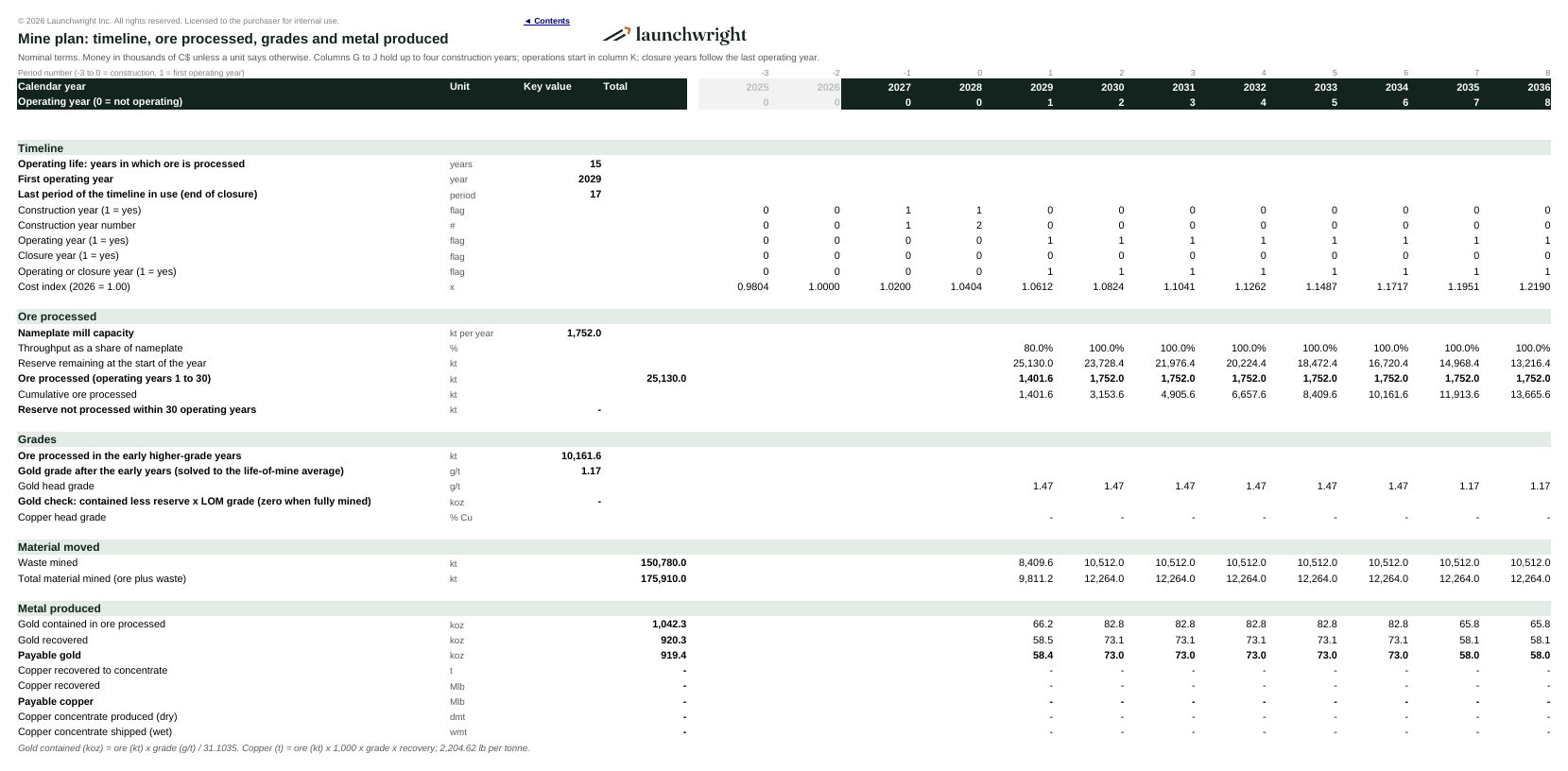
The mine plan runs ore through the mill at nameplate capacity with a ramp-up until the reserve is used up, which sets the mine life (up to 30 operating years). You can start with higher-grade years; later years are solved so the reserve still averages its life-of-mine grade. Gold and copper recovery, payables, refining and treatment charges, concentrate freight and an NSR royalty give net revenue. Costs are per tonne mined and per tonne milled, and the model reports AISC per ounce and C1 cost per pound.
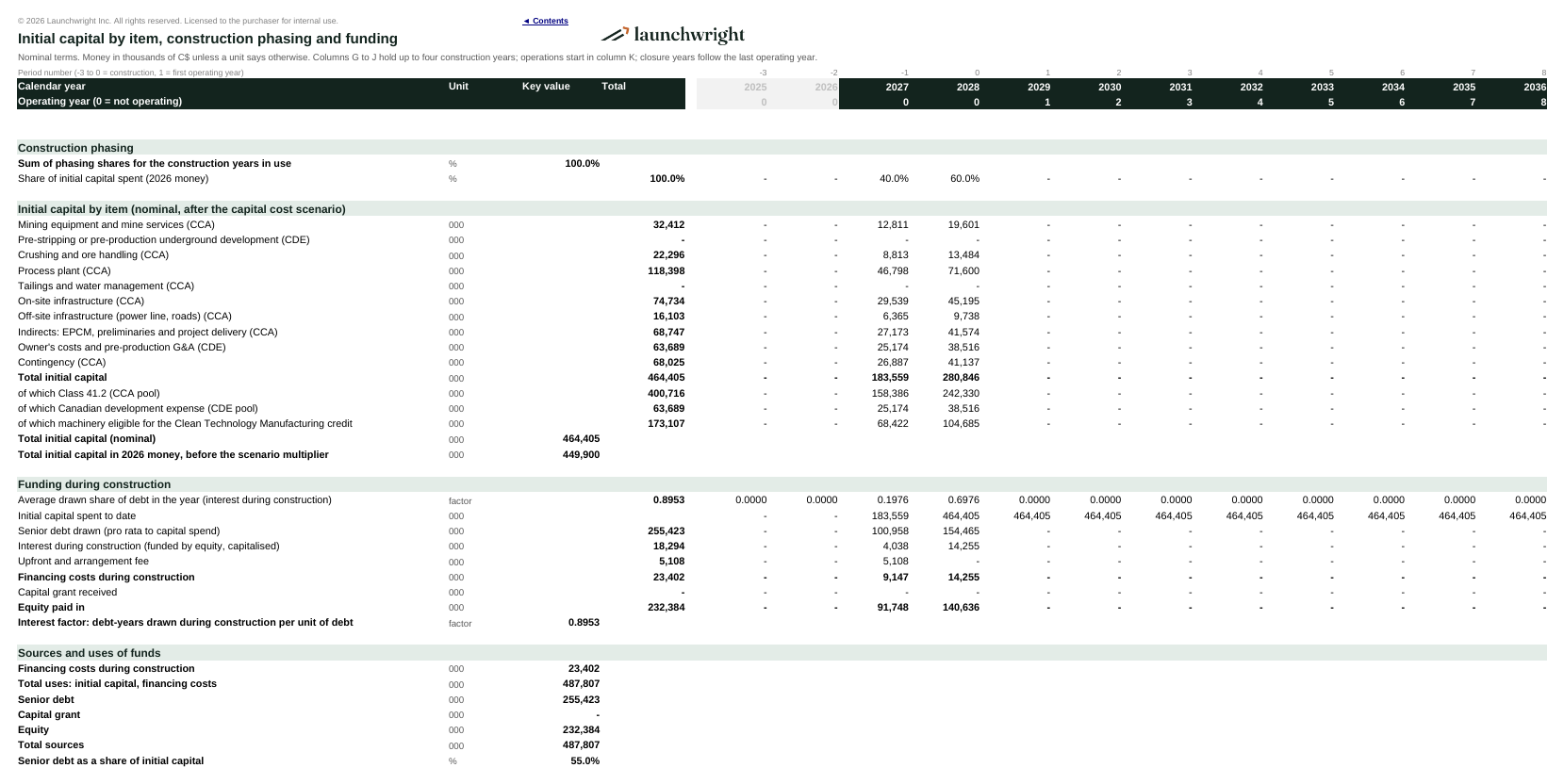
Capital is itemized into ten lines (mining fleet, pre-stripping or underground development, crushing, process plant, tailings, on-site and off-site infrastructure, indirects, owner’s costs and contingency), each tagged to its Canadian tax pool and phased over up to four construction years. Sustaining capital, closure cost and a closure cash reserve are included.
Why this model
Most mining templates on the market are generic business-plan models or simple project cash flows with a fixed loan. This model is built the way a mine financing is actually tested: debt sized on cash flow at a target DSCR with no circular references, a full reserve-account and covenant structure, provincial mining taxes that work differently in each province, and a federal critical minerals credit that only applies when copper is more than half the value of output. Every default is cited to a public study or forecast or labelled as a template assumption.
Two editions
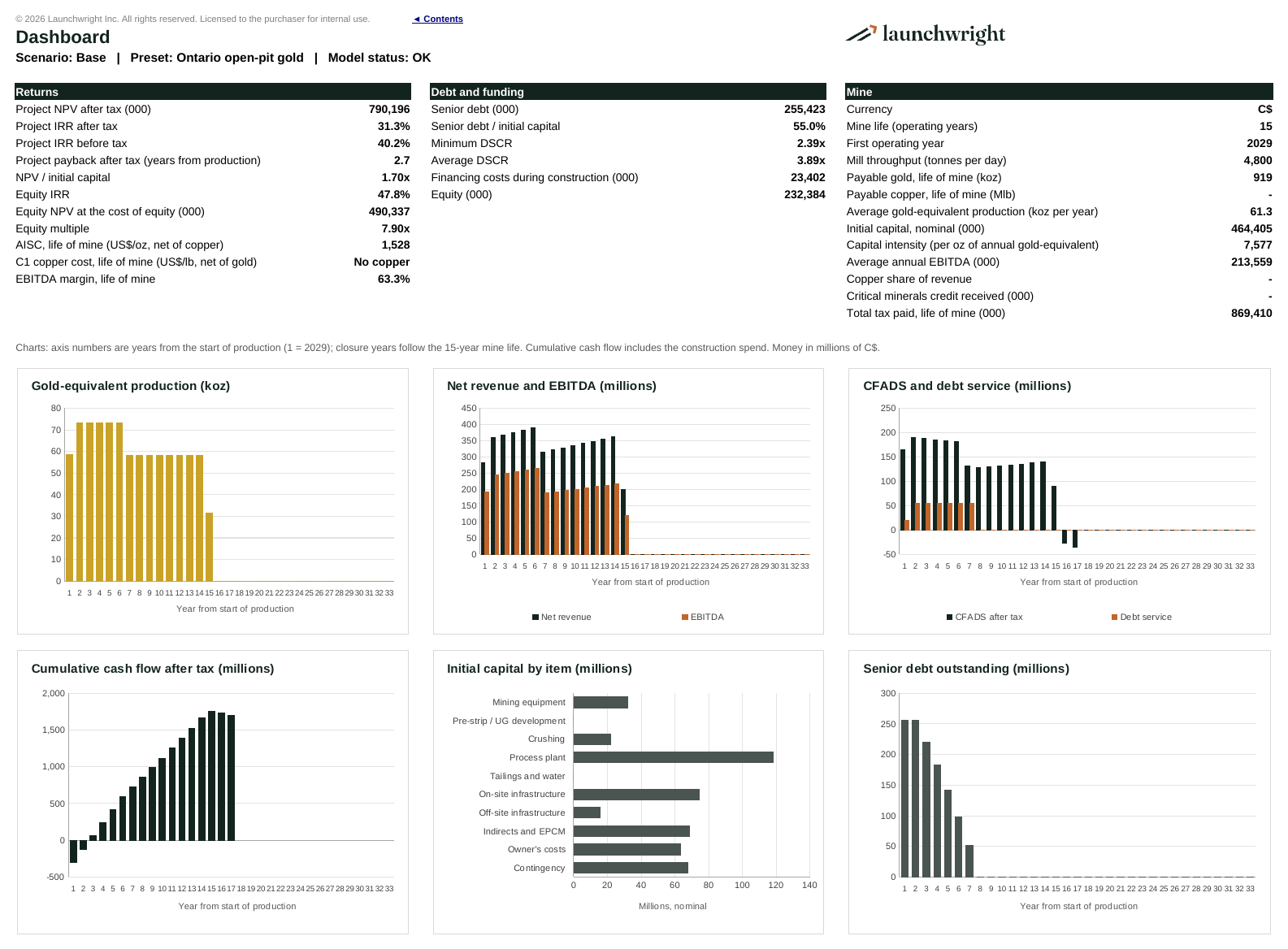
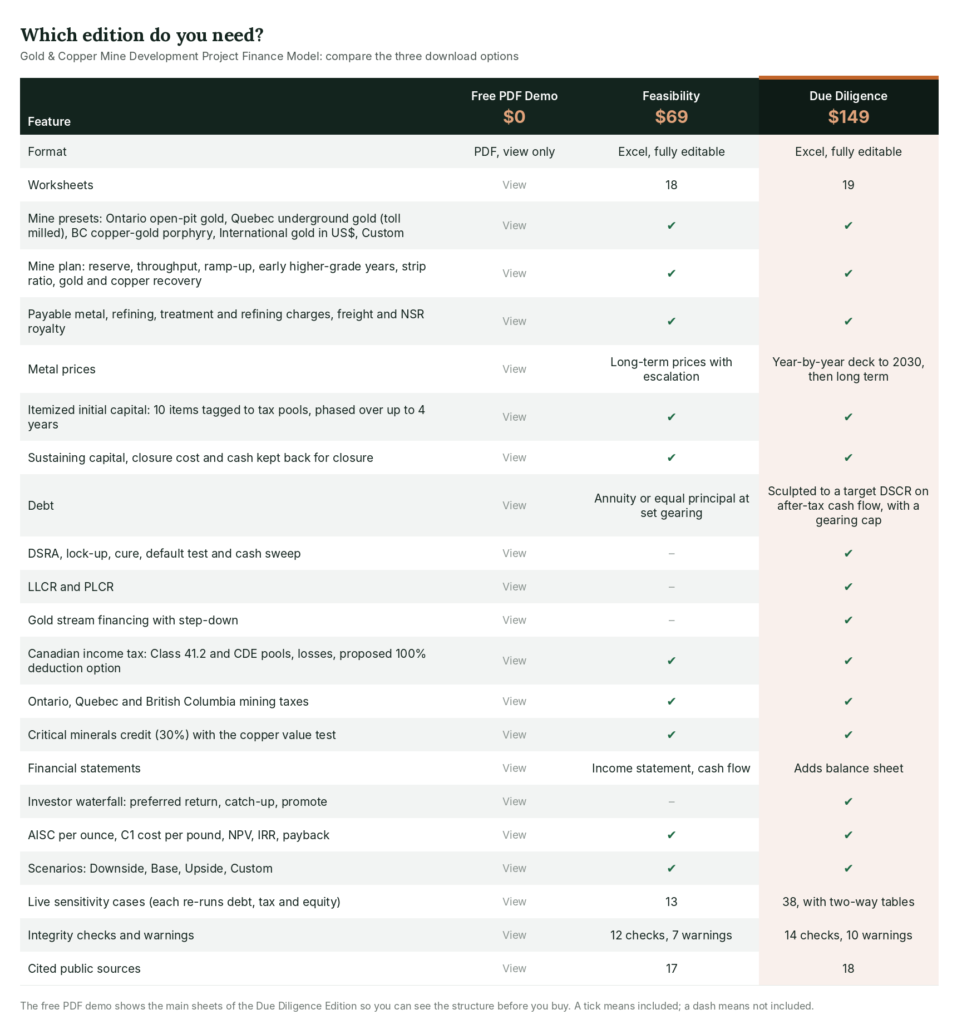
- Feasibility Edition: a fast annual model for screening. The four mine presets plus Custom, the full mine plan, payable metal and smelter terms, 10 itemized capital lines, sustaining and closure capital, senior debt at a set gearing (annuity or equal principal), Canadian income tax with Class 41.2 and CDE pools, the Ontario, Quebec and BC mining taxes, the critical minerals credit, an income statement and cash flow, four scenarios, 13 live sensitivity cases and a dashboard with six charts.
- Due Diligence Edition: everything in the Feasibility Edition, plus:
- a year-by-year metal price deck to 2030, then long-term prices with escalation
- senior debt sculpted to a target DSCR on after-tax CFADS with a gearing cap, plus annuity and equal-principal options and interest-only years
- a debt service reserve account, lock-up with a cure period, a default test, an optional cash sweep, LLCR and PLCR
- gold stream financing: upfront deposit, share of payable gold with a step-down threshold, and an ongoing payment as a share of spot
- a commitment fee and a reclamation surety bond fee
- three integrated statements with a balance check in every year
- an investor waterfall with preferred return, sponsor catch-up and promote, and LP and GP returns
- 38 live sensitivity cases, including three two-way tables of metal price against capital cost
Key outputs
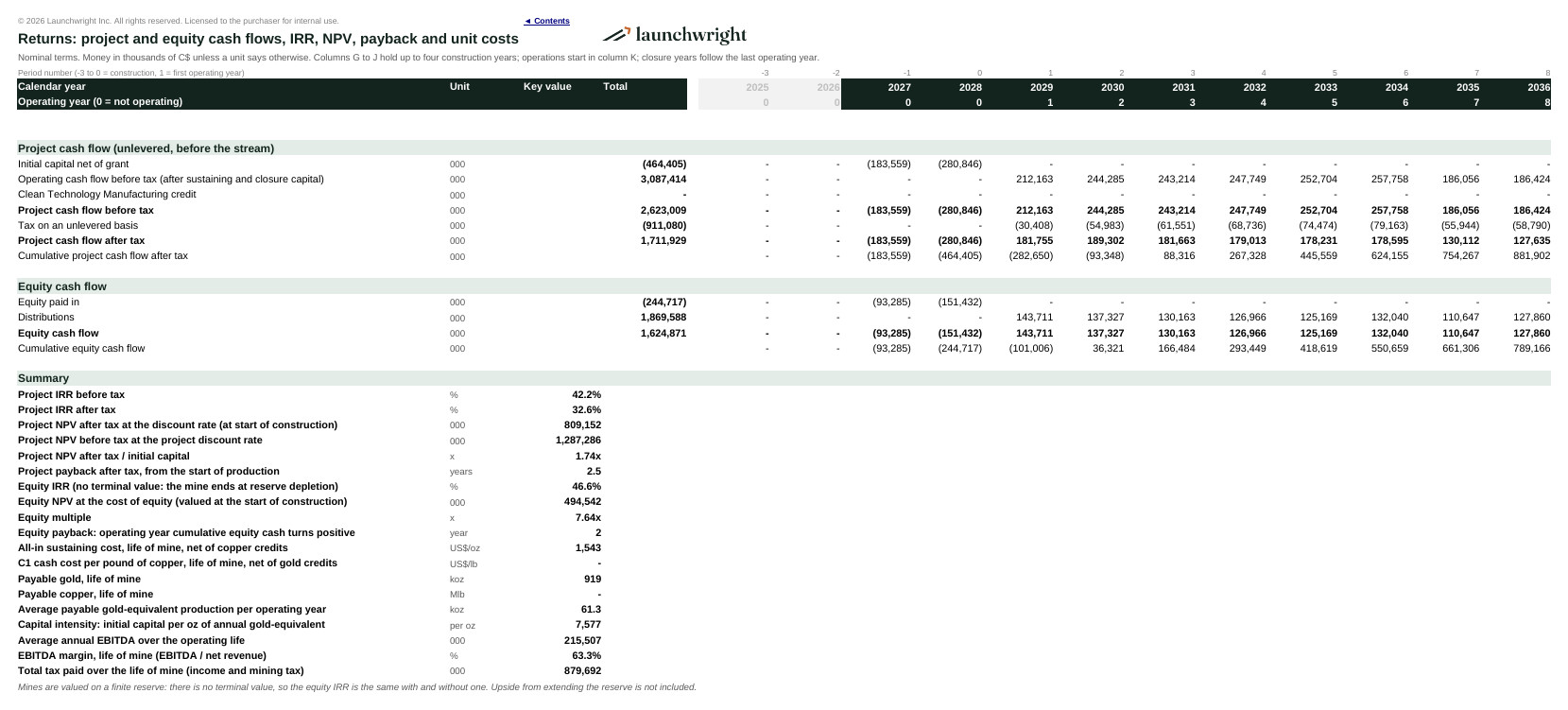
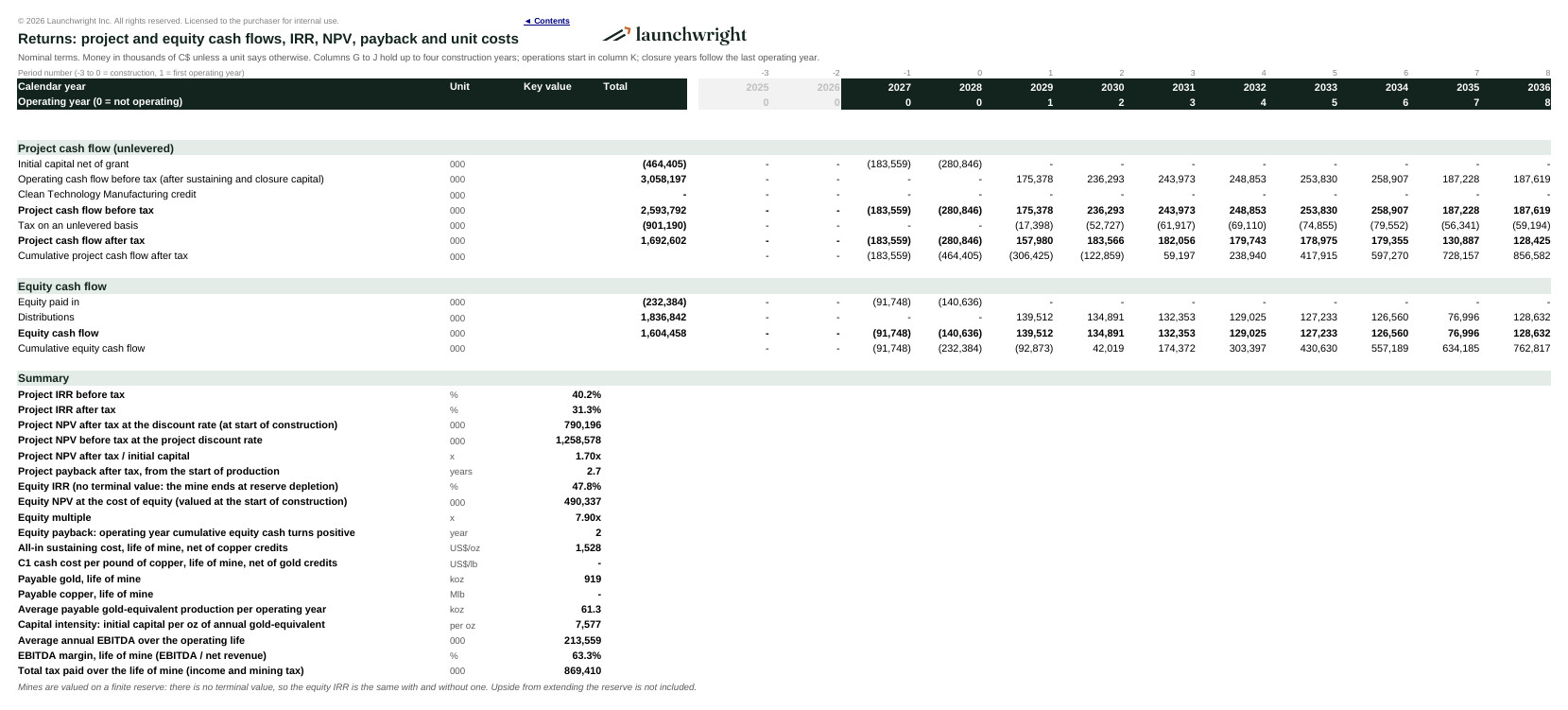
- Project NPV and IRR before and after tax, NPV to capital and payback from the start of production
- Equity IRR, NPV and multiple; LP and GP returns after the waterfall (Due Diligence Edition)
- AISC per ounce net of copper credits, C1 cost per pound net of gold credits, capital intensity and EBITDA margin
- Senior debt and binding constraint, minimum and average DSCR, LLCR and PLCR, DSRA and lock-up years (Due Diligence Edition)
- Sources and uses, including interest during construction, fees, grant, stream deposit and reserve funding
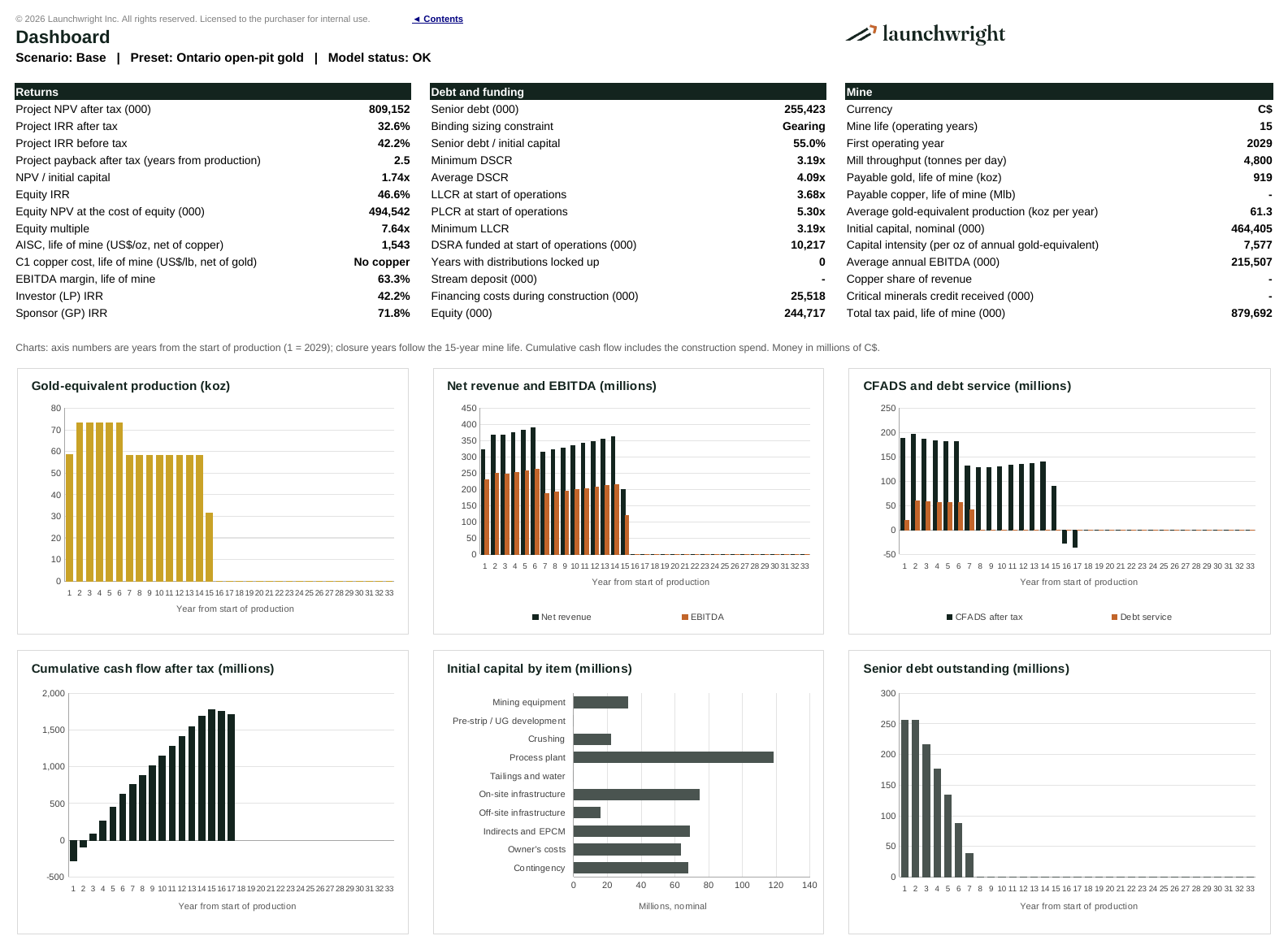
- Charts of gold-equivalent production, revenue and EBITDA, CFADS against debt service, cumulative cash flow, capital by item and debt outstanding
Built to modeling best practice
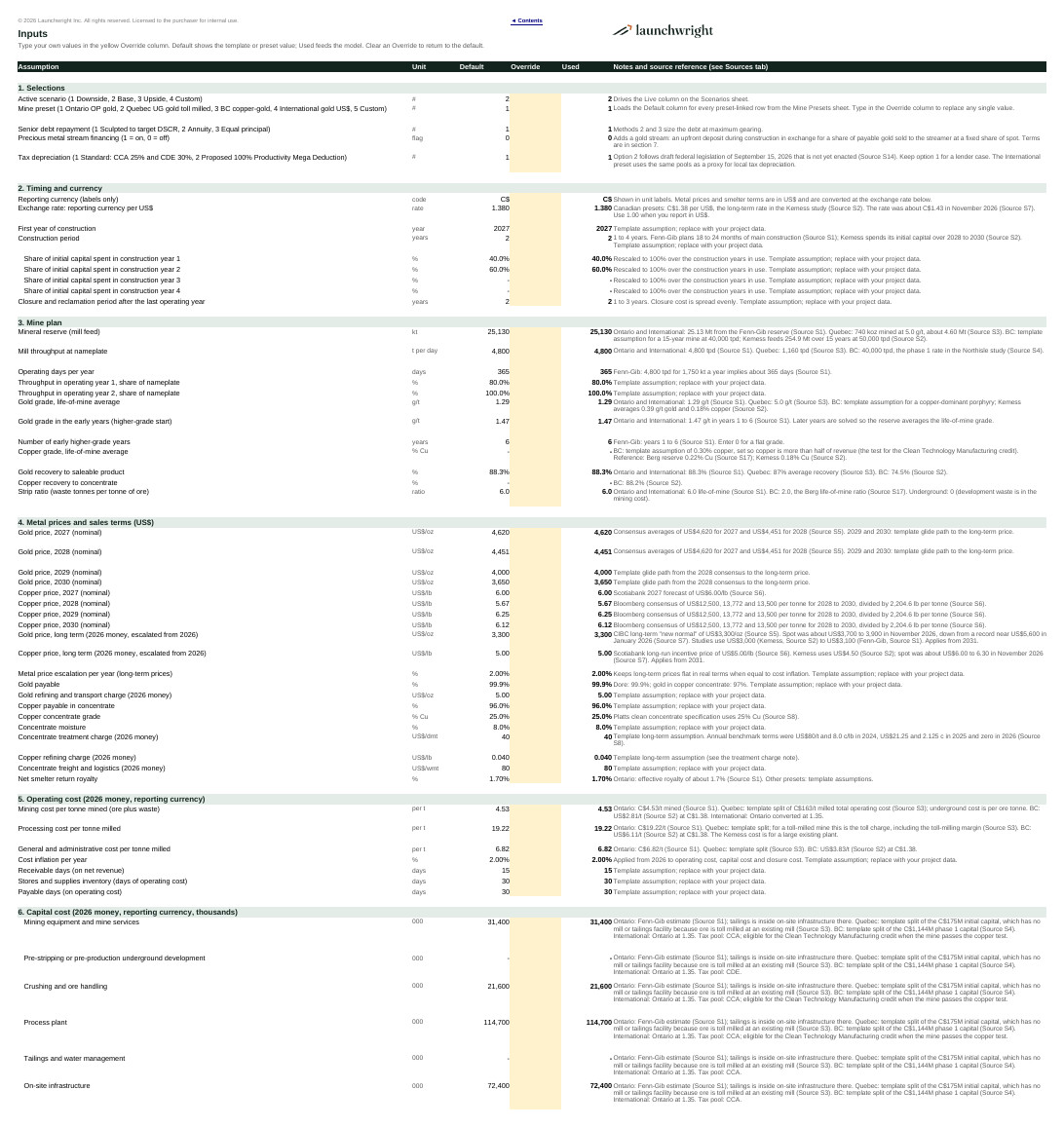
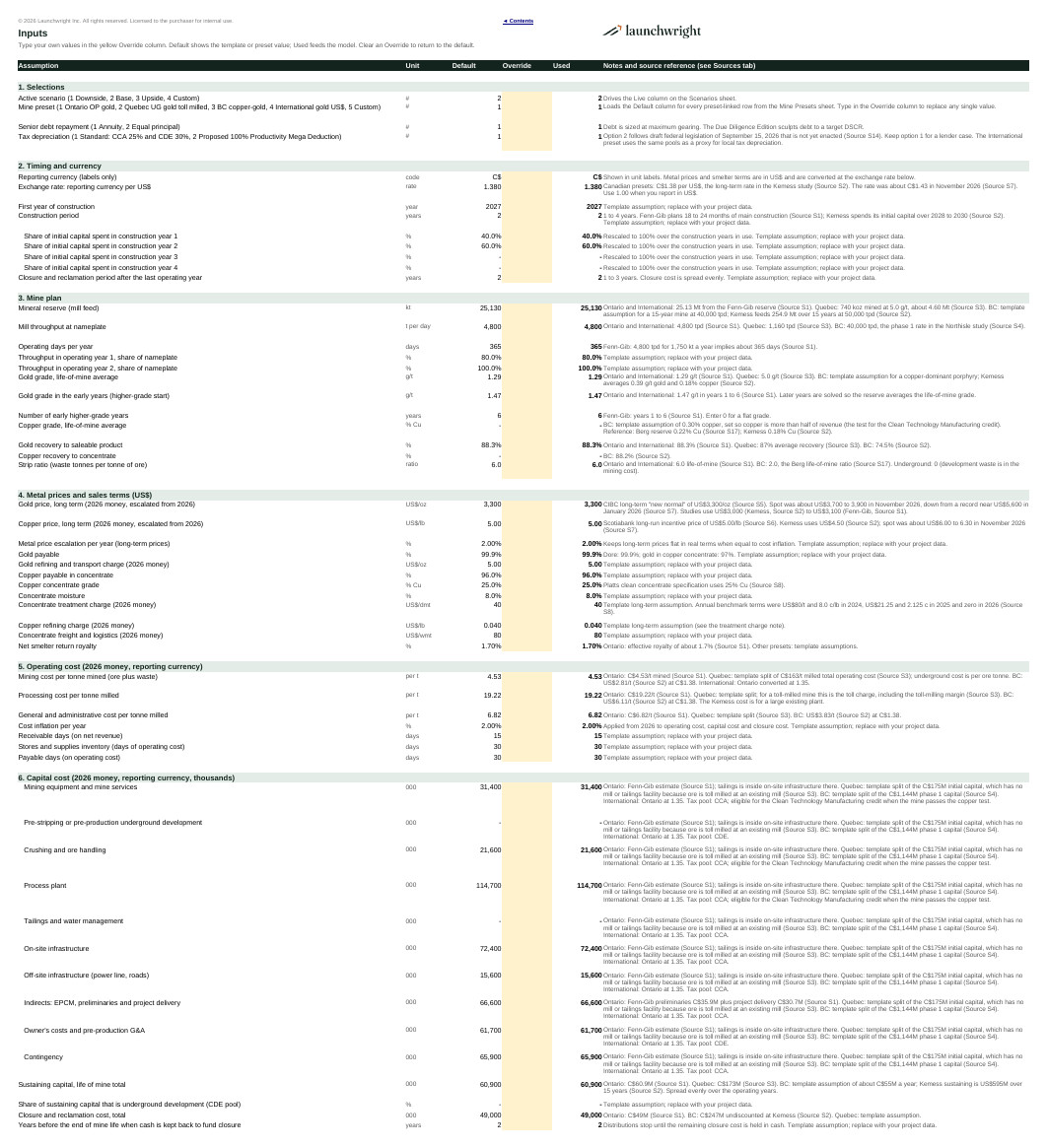
- Inputs, calculations and outputs on separate, colour-coded sheets; one Override column for your own values
- No macros, no circular references, no iterative calculation, no external links, no hidden or protected sheets
- A Checks sheet that confirms the statements balance, sources equal uses, debt is repaid, the reserve reconciles to its grade and the sensitivity engine reproduces the base case, plus commercial warnings
- Instructions, a glossary and a source list of public references (17 in the Feasibility Edition, 18 in the Due Diligence Edition)
Timeline
Annual periods: up to 4 construction years, up to 30 operating years and up to 3 closure years. Money in thousands of the reporting currency; metal prices in US$.
Default assumptions
The default case is a 4,800 tonne-per-day Ontario open-pit gold mine based on the published Fenn-Gib pre-feasibility study: a 25.1 Mt reserve at 1.29 g/t, 88.3% recovery and about C$450 million of initial capital in 2026 money. In the Due Diligence Edition, gold follows consensus forecasts to 2028 and a labelled template glide path through 2030, then a long-term US$3,300/oz (CIBC); the Feasibility Edition uses the long-term prices with escalation. Financing terms and several other inputs are template assumptions and are labelled as such. At these defaults the Due Diligence Edition shows an after-tax project NPV of about C$809 million at a 7% nominal discount rate, a project IRR of 32.6% after tax and an AISC of about US$1,543/oz in nominal terms. These results are illustrations, not a forecast; replace the defaults with your project data.
Compare the editions
What you get
- One Excel workbook (.xlsx) for the edition purchased
- A free PDF demo showing 18 pages from the Due Diligence Edition
Support
Questions about how the template works are answered by email at the address inside the file. For custom work, use the eFinancialModels custom service.
Frequently asked questions
Which Excel versions does it work in?
Excel 2010 or later on Windows or Mac. It uses only long-standing functions (IRR, NPV, SUMPRODUCT, INDEX and similar), with no macros, no dynamic arrays and no data tables. It was recalculated and tested in LibreOffice Calc as well. It has not been tested in Google Sheets.
Can I model a copper-only mine, or a mine outside Canada?
Yes. Set the gold grade to zero for a copper-only mine. For another country, use the International preset or the Custom column: set the currency and exchange rate, the income tax rate and royalty, and choose no provincial mining tax.
Does it handle silver, zinc or other by-products?
No. Gold and copper are modelled as separate metals. Other by-products are not modelled separately.
Can I model a toll-milled mine?
Yes. Set the process plant and tailings capital to zero and enter the toll charge as the processing cost per tonne. The Quebec preset is set up this way.
Is it a NI 43-101 technical report?
No. It is a financial model template. Defaults come from published studies and forecasts for illustration; your own technical study should supply the mine plan, costs and recoveries.
How is the debt sized, and are there circular references?
In the Due Diligence Edition, senior debt is the lower of the amount supported by after-tax cash flow at your target DSCR and your maximum gearing. Sizing uses tax on an unlevered basis and interest during construction is funded by equity, so there is no circular reference or iterative calculation. The Feasibility Edition sizes debt at the gearing you enter.
Which tax rules are included?
Federal and provincial income tax with Class 41.2 and CDE pools and loss carry-forward; the Ontario mining tax with the new-mine exemption; the Quebec minimum and progressive mining tax; the British Columbia net current proceeds and net revenue taxes; and the Clean Technology Manufacturing credit. An option applies the proposed 100% Productivity Mega Deduction, which is draft legislation. Tax rules are simplified and are not tax advice.
Are the default prices a forecast?
No. They are cited bank and consensus forecasts from November 2026 and template assumptions, for illustration. The base case uses a long-term gold price of US$3,300/oz, below the spot price at the time of writing. Replace them with your own price deck.
Is the file locked?
No. There are no locked cells, passwords, hidden sheets or macros. Every formula is visible.
What is the difference between the two editions?
The Feasibility Edition is for fast screening. The Due Diligence Edition adds the year-by-year price deck, sculpted debt, DSRA and covenants, the cash sweep, LLCR and PLCR, gold streaming, a balance sheet, the investor waterfall and the two-way sensitivity tables. See the comparison table.
Similar ProductsOther customers were also interested in...



 eFinancialModels
Electric Vehicle (EV) Charging Station Financial M...
With this comprehensive 5- or 10-year monthly tool, investors can assess the viability of setting up... Read more

Financial Model for Mobile App | Mobile App Busine...
The Mobile App Financial Plan Template in Excel allows you to develop financial projections when lau... Read more

 HenrySheykin
Food Truck Financial Model Excel Template
The Food Truck Financial Model helps entrepreneurs, founders, business owners, consultants, and anal... Read more

Green Hydrogen Production from Wind Energy Financi...
The Green Hydrogen from Wind Financial Model aims to comprehensively forecast a horizon of 40 years ... Read more

Simple Mutual Non-Disclosure Agreement Template
Protect your business secrets with ease using our Simple Mutual Non-Disclosure Agreement Template. S... Read more

Solar Energy Financial Model
The Solar Energy Financial Model Spreadsheet Template in Excel assists you in preparing a sophistica... Read more

 Peter Graf
The Customer-Centric Financial Model for Restauran...
Starting a restaurant without a financial plan is like driving a car blindfolded. You wouldn´t do i... Read more
You must log in to submit a review.