
0 ITEMS

eVTOL / Urban Air Mobility Financial Model – Fleet Deployment, Vertiport CapEx, Passenger Mile Revenue, Battery Replacement & Certification Cost
🚀 Premium eVTOL / Urban Air Mobility Financial Model A professional financial model built for eVTOL operators, urban air mobility companies, air taxi startups, aviation infrastructure developers, vertiport investors, mobility platforms, OEMs, operators, venture investors, strategic finance teams and transport analysts. This model helps forecast the complete economics of an eVTOL / air taxi business, including fleet deployment, certification milestone gates, vertiport infrastructure, passenger-mile revenue, battery degradation, replacement cycles, FAA/EASA certification cost amortization, OEM vs. operator business model scenarios and load factor break-even analysis. ✅ Fleet deployment schedule with certification milestone gates ✅ Vertiport build-out CapEx model ✅ Vertiport revenue-sharing waterfall ✅ Revenue per passenger mile vs. helicopter and ride-share comps ✅ Battery degradation and replacement cost cycle ✅ kWh per flight and battery cost logic ✅ FAA / EASA type certification cost amortization ✅ OEM vs. operator business model toggle ✅ Load factor sensitivity: 60% vs. 80% utilization ✅ Fleet P&L, cash flow, valuation, scenarios and dashboards ✅ KPI summary, sensitivity analysis and audit checks ⚡ Built for a fast-growing new sector where generic aviation, ride-share, transport or infrastructure models do not capture the unique economics of urban air mobility.
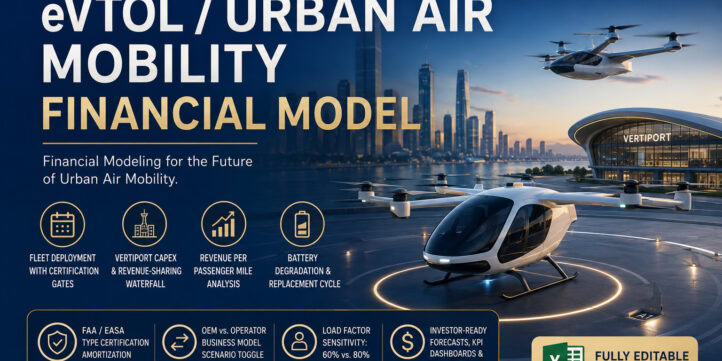


🚀 eVTOL / Urban Air Mobility Financial Model
This premium Excel financial model is built for one of the most exciting emerging mobility sectors: eVTOL and Urban Air Mobility.
Air taxi companies and eVTOL operators have a very different business model from traditional airlines, helicopter charter companies, ride-sharing platforms or ground transportation fleets.
An eVTOL business must evaluate:
- ✈️ Fleet deployment timing
- 🛂 Certification milestone gates
- 🏙️ Vertiport build-out CapEx
- 🤝 Vertiport revenue-sharing waterfall
- 📍 City launch and route economics
- 💺 Passenger-mile revenue
- 🚁 Helicopter and ride-share pricing comparisons
- 🔋 Battery degradation and replacement cycles
- ⚡ kWh per flight and energy cost
- 🏛️ FAA / EASA certification cost amortization
- 🔁 OEM vs. operator business model scenarios
- 📊 Load factor break-even sensitivity
- 💰 Cash flow, valuation and funding requirements
This workbook brings those key drivers into one structured, editable and decision-ready financial model.
What This Model Is Used For
This model helps users forecast, analyze and stress-test the economics of an eVTOL / urban air mobility business.
It can be used for:
✅ eVTOL business planning
✅ Air taxi startup forecasting
✅ Urban air mobility feasibility analysis
✅ Fleet deployment planning
✅ Certification milestone-based rollout modeling
✅ Vertiport infrastructure investment analysis
✅ Passenger-mile revenue benchmarking
✅ Route economics and utilization analysis
✅ Battery replacement cost planning
✅ FAA / EASA certification cost amortization
✅ OEM vs. operator scenario comparison
✅ Load factor break-even analysis
✅ Investor fundraising and valuation support
✅ Scenario and sensitivity analysis
This model is especially useful when a standard transportation, airline or ride-share model is not enough because eVTOL economics depend on certification timing, vertiport infrastructure, battery cycles, aircraft deployment and utilization.
Key Model Modules
✈️ 1. Fleet Deployment Schedule With Certification Gates
The model includes a fleet deployment schedule linked to certification milestones.
It helps users analyze:
- Aircraft rollout timing
- Certification-dependent deployment gates
- Fleet ramp-up by period
- Active aircraft count
- Delayed deployment scenarios
- Utilization impact from certification timing
- Revenue ramp-up linked to fleet availability
This is important because eVTOL companies cannot scale purely based on demand. Fleet deployment is heavily dependent on certification progress, aircraft availability and regulatory approval.
🏙️ 2. Vertiport Build-Out CapEx and Revenue-Sharing Waterfall
Urban air mobility requires physical infrastructure.
The model includes vertiport economics covering:
✅ Vertiport build-out CapEx
✅ Site-level infrastructure investment
✅ Revenue-sharing waterfall
✅ Operator share
✅ Vertiport owner share
✅ Infrastructure partner economics
✅ Launch city infrastructure requirements
✅ CapEx recovery and return impact
This helps users understand how vertiport infrastructure affects profitability and capital requirements.
💺 3. Revenue per Passenger Mile Analysis
The workbook includes revenue per passenger mile modeling and comparison logic.
Users can compare eVTOL economics against:
- Helicopter transport
- Ride-share alternatives
- Premium ground mobility
- Route-level passenger-mile pricing
- Average fare per trip
- Distance-based revenue
- Passenger volume and load factor
This helps users evaluate whether eVTOL pricing is competitive, premium, or positioned as a high-value time-saving mobility service.
🔋 4. Battery Degradation and Replacement Cost Cycle
Battery economics are a core part of eVTOL operations.
The model includes:
✅ Battery degradation assumptions
✅ kWh per flight
✅ Battery cycle life
✅ Replacement timing
✅ Battery replacement cost
✅ Cost per flight impact
✅ Energy usage assumptions
✅ Long-term operating cost impact
This is critical because battery replacement can materially affect unit economics, cash flow and maintenance planning.
🏛️ 5. FAA / EASA Type Certification Cost Amortization
Certification costs are a major investment for eVTOL companies.
The model includes an amortization schedule for:
- FAA type certification cost
- EASA type certification cost
- Certification-related development cost
- Amortization period
- Cost allocation over fleet life
- Impact on operating margin and profitability
This helps users avoid treating certification cost as a simple one-time expense with no long-term financial impact.
🔁 6. OEM vs. Operator Business Model Toggle
The workbook includes a scenario toggle to compare different eVTOL business models.
Included structures:
✅ OEM model
✅ Operator model
✅ OEM + operator hybrid scenario
This helps users compare whether the business is primarily manufacturing aircraft, operating flights, or combining both models.
The model can help answer:
- Which structure creates stronger margins?
- Which structure needs more CapEx?
- Which structure has higher operating risk?
- Which model is more scalable?
- Which business model produces better valuation outcomes?
📊 7. Load Factor Sensitivity: 60% vs. 80% Utilization
Load factor is one of the most important profitability drivers in air mobility.
The model includes load factor sensitivity to compare:
- 60% utilization / load factor
- 80% utilization / load factor
- Break-even passenger volume
- Revenue impact
- Cost absorption
- Margin expansion
- Fleet-level profitability
This helps users understand how much utilization is required for the business to become financially attractive.
Dashboards and Outputs
📊 The workbook includes professional dashboards and output sheets designed for decision-making.
Key outputs include:
✅ Cover
✅ Index
✅ How To Use
✅ Control Panel
✅ Fleet Deployment
✅ Certification Milestone Gates
✅ Vertiport CapEx
✅ Vertiport Revenue Waterfall
✅ Passenger Mile Revenue
✅ Helicopter / Ride-Share Comps
✅ Battery Degradation
✅ Battery Replacement Cycle
✅ FAA / EASA Certification Cost
✅ Certification Amortization
✅ OEM Scenario
✅ Operator Scenario
✅ Business Model Toggle
✅ Load Factor Sensitivity
✅ Fleet P&L
✅ Cash Flow Forecast
✅ Valuation
✅ Scenario Summary
✅ Sensitivity Analysis
✅ KPI Dashboard
✅ Executive Dashboard
✅ Audit Checks
✅ Disclaimer
✅ Glossary
How to Use the Model
1️⃣ Start with the Control Panel
Update assumptions for fleet size, aircraft cost, certification timing, passenger miles, pricing, vertiport CapEx, battery cost, utilization, operating cost and valuation.
2️⃣ Review Fleet Deployment
Analyze how certification milestone gates affect aircraft rollout and revenue timing.
3️⃣ Review Vertiport Economics
Evaluate infrastructure investment, revenue sharing and launch city requirements.
4️⃣ Analyze Passenger Mile Revenue
Compare eVTOL pricing against helicopter and ride-share benchmarks.
5️⃣ Review Battery Replacement Cycle
Analyze kWh per flight, battery degradation and future replacement cost burden.
6️⃣ Amortize Certification Costs
Review how FAA / EASA certification costs flow into long-term economics.
7️⃣ Compare Business Models
Use the OEM vs. operator toggle to review different commercialization strategies.
8️⃣ Stress-Test Load Factor
Review 60% vs. 80% utilization and break-even performance.
9️⃣ Use Dashboards and Valuation
Review KPIs, cash flow, profitability, scenario outputs and valuation.
🔟 Check the Audit Sheet
Use audit checks to review model integrity before using the outputs.
Who Should Buy This Model
This model is ideal for:
✅ eVTOL startups
✅ Urban air mobility companies
✅ Air taxi operators
✅ Aviation infrastructure developers
✅ Vertiport investors
✅ Mobility platforms
✅ OEM strategy teams
✅ Fleet operators
✅ Venture capital investors
✅ Transport analysts
✅ Infrastructure investors
✅ Corporate development teams
✅ Strategic finance teams
✅ Aviation consultants
✅ Smart city mobility planners
Why This Model Is Valuable
Most transportation models are designed for cars, taxis, ride-hailing, logistics, airlines or helicopters.
This model is different because it focuses specifically on eVTOL and urban air mobility economics.
It includes eVTOL-specific financial logic such as:
✈️ Certification-gated fleet deployment
🏙️ Vertiport CapEx and revenue sharing
💺 Revenue per passenger mile
🚁 Helicopter and ride-share comparison
🔋 Battery degradation and replacement cycles
🏛️ FAA / EASA certification amortization
🔁 OEM vs. operator business model scenarios
📊 Load factor break-even sensitivity
This makes the model useful for serious eVTOL business planning, investor review, feasibility analysis and strategic finance.
It helps answer practical questions such as:
- How fast can the fleet deploy after certification?
- How much vertiport CapEx is required?
- What revenue per passenger mile is needed?
- How does eVTOL pricing compare with helicopter and ride-share options?
- How much do battery replacement cycles affect cost?
- How should certification cost be amortized?
- Is the OEM model or operator model more attractive?
- What load factor is required to break even?
- Can the business become profitable at scale?
Similar ProductsOther customers were also interested in...


 eFinancialModels
Electric Vehicle (EV) Charging Station Financial M...
With this comprehensive 5- or 10-year monthly tool, investors can assess the viability of setting up... Read more

Financial Model for Mobile App | Mobile App Busine...
The Mobile App Financial Plan Template in Excel allows you to develop financial projections when lau... Read more

 HenrySheykin
Food Truck Financial Model Excel Template
The Food Truck Financial Model helps entrepreneurs, founders, business owners, consultants, and anal... Read more

Green Hydrogen Production from Wind Energy Financi...
The Green Hydrogen from Wind Financial Model aims to comprehensively forecast a horizon of 40 years ... Read more

Simple Mutual Non-Disclosure Agreement Template
Protect your business secrets with ease using our Simple Mutual Non-Disclosure Agreement Template. S... Read more

Solar Energy Financial Model
The Solar Energy Financial Model Spreadsheet Template in Excel assists you in preparing a sophistica... Read more

 Peter Graf
The Customer-Centric Financial Model for Restauran...
Starting a restaurant without a financial plan is like driving a car blindfolded. You wouldn´t do i... Read more
You must log in to submit a review.