
0 ITEMS

Tokenomics & Web3 Token Launch Financial Model – Vesting, FDV Dilution, Unlock Pressure, Treasury Burn, Staking Yield & DAO Governance
🔥 Premium Tokenomics & Web3 Token Launch Financial Model A professional financial model built for Web3 founders, protocol teams, DAOs, crypto projects, venture investors, token launch advisors, ecosystem funds, blockchain startups and token strategy consultants. This model helps users plan, forecast and stress-test the economics of a token launch before going to market. It covers the most important tokenomics questions: 🪙 How should token supply unlock over time? 🔐 How do cliff, linear and milestone vesting schedules affect circulating supply? 💰 Can protocol revenue support treasury burn? 📉 How much FDV dilution occurs across seed, public and ecosystem allocations? ⚠️ How much unlock pressure hits the market each quarter? 🎯 Is staking yield sustainable from real fee revenue or only emissions? 💧 Is liquidity pool depth sufficient, and what is the impermanent loss exposure? 🗳️ Is governance power too concentrated among insiders, investors or whales? Key modules include: ✅ Token supply schedule ✅ Cliff, linear and milestone vesting overlays ✅ Treasury burn rate vs. protocol revenue sufficiency model ✅ FDV dilution waterfall ✅ Seed, public, ecosystem, team and treasury allocation logic ✅ Unlock pressure indicator by quarter ✅ Staking yield sustainability model ✅ Emissions vs. protocol fee revenue comparison ✅ Liquidity pool depth model ✅ Impermanent loss exposure analysis ✅ DAO governance token concentration analysis ✅ Voting power distribution and control risk ✅ Scenario analysis, sensitivity tables, dashboards and audit checks 📊 Built for serious token launch planning where a simple cap table or token allocation spreadsheet is not enough.
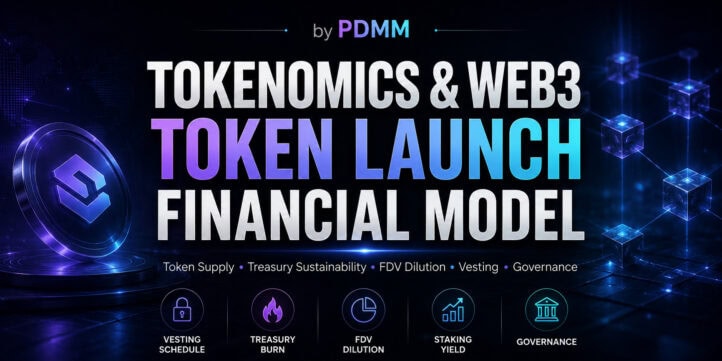


🔥 Tokenomics & Web3 Token Launch Financial Model
This premium financial model is built for Web3 projects, crypto protocols, DAOs, blockchain startups, token launch teams and investors that need to design and evaluate token economics before launch.
A token launch is not only about setting a token supply and allocation table.
A serious tokenomics model must analyze:
- 🪙 Token supply release over time
- 🔐 Cliff, linear and milestone vesting
- 💰 Treasury burn and protocol revenue sufficiency
- 📉 FDV dilution across investor and ecosystem allocations
- ⚠️ Unlock pressure hitting the market each quarter
- 🎯 Staking yield sustainability
- 💧 Liquidity pool depth and impermanent loss
- 🗳️ DAO governance concentration and voting power
- 📊 Scenario, sensitivity, valuation and dashboard outputs
This workbook brings those mechanics into one structured, editable and decision-ready Excel model.
What This Model Is Used For
This model helps users forecast, analyze and stress-test the economics of a Web3 token launch.
It can be used for:
✅ Token launch planning
✅ Web3 startup financial modeling
✅ Protocol tokenomics design
✅ Investor allocation analysis
✅ Vesting schedule planning
✅ FDV dilution analysis
✅ Treasury runway and burn analysis
✅ Protocol revenue sufficiency testing
✅ Unlock pressure analysis
✅ Staking yield sustainability review
✅ Liquidity pool planning
✅ Impermanent loss exposure analysis
✅ DAO governance concentration review
✅ Voting power distribution analysis
✅ Fundraising, investor discussions and internal strategy
The model is especially useful before launching a token, raising capital, finalizing token allocation, planning vesting schedules or presenting token economics to investors and stakeholders.
Key Model Modules
🪙 1. Token Supply Schedule
The model includes a token supply schedule that tracks how token supply evolves over time.
It helps users analyze:
- Total token supply
- Initial circulating supply
- Locked token supply
- Unlocked token supply
- Quarterly unlocks
- Circulating supply growth
- Fully diluted supply
- Allocation by stakeholder group
This helps founders and investors understand how supply enters the market after launch.
🔐 2. Cliff, Linear and Milestone Vesting Overlays
The workbook includes vesting logic for different stakeholder groups.
It can support:
✅ Cliff vesting
✅ Linear vesting
✅ Milestone-based vesting
✅ Investor unlocks
✅ Team unlocks
✅ Advisor unlocks
✅ Ecosystem release schedules
✅ Treasury release schedules
This is critical because vesting design directly affects circulating supply, investor confidence, market pressure and perceived fairness.
💰 3. Treasury Burn Rate vs. Protocol Revenue Sufficiency
The model includes a treasury sustainability engine.
It compares:
- Treasury balance
- Operating burn
- Ecosystem incentives
- Grant spending
- Protocol fee revenue
- Treasury runway
- Revenue sufficiency ratio
- Burn coverage by protocol activity
This helps users understand whether the treasury can survive on real protocol revenue or whether the project remains dependent on token sales, treasury drawdowns or emissions.
📉 4. FDV Dilution Waterfall
The workbook includes an FDV dilution waterfall across major allocation groups.
It helps analyze:
- Seed allocation
- Private allocation
- Public sale allocation
- Team allocation
- Advisor allocation
- Ecosystem allocation
- Treasury allocation
- Community rewards
- Fully diluted valuation impact
- Ownership dilution by round or stakeholder group
This allows founders and investors to understand how token ownership changes over time.
⚠️ 5. Unlock Pressure Indicator
One of the strongest features of this model is the unlock pressure indicator.
It tracks the percentage of supply entering the market each quarter.
The model helps users review:
✅ Quarterly unlock volume
✅ Unlocks as % of total supply
✅ Unlocks as % of circulating supply
✅ Potential sell pressure
✅ High-risk unlock periods
✅ Market pressure timing
✅ Investor and team unlock cliffs
This is useful because token price weakness often occurs when large unlocks hit the market without enough demand, liquidity or protocol revenue.
🎯 6. Staking Yield Sustainability Model
The model includes a staking yield sustainability module.
It compares staking rewards funded by:
- Token emissions
- Protocol fee revenue
- Treasury subsidies
- Real yield contribution
- Emission-funded APY
- Sustainable staking yield
- Reward coverage ratio
This helps users determine whether the advertised staking yield is supported by protocol economics or mainly by inflationary emissions.
💧 7. Liquidity Pool Depth and Impermanent Loss Exposure
The workbook includes a liquidity pool modeling section.
It helps users analyze:
✅ Liquidity pool depth
✅ Token-side liquidity
✅ Stablecoin / paired asset liquidity
✅ DEX pool assumptions
✅ Trading volume support
✅ Slippage risk
✅ Impermanent loss exposure
✅ Liquidity adequacy for launch
This is important because weak liquidity can create high volatility, poor execution, slippage and increased market instability after launch.
🗳️ 8. DAO Governance Token Concentration and Voting Power
The model includes governance concentration and voting-power analysis.
It helps users review:
- Token ownership concentration
- Insider allocation
- Investor voting power
- Team voting control
- Treasury influence
- DAO governance decentralization
- Whale concentration
- Voting power distribution
- Governance risk indicators
This is important because a token can appear decentralized but still have concentrated voting control among a few groups.
Dashboards and Outputs
📊 The workbook includes professional dashboards and output sections for decision-making.
Key outputs include:
✅ Cover
✅ Index
✅ How To Use
✅ Control Panel
✅ Token Supply Schedule
✅ Vesting Schedule
✅ Cliff / Linear Vesting
✅ Milestone Vesting
✅ Treasury Burn Analysis
✅ Protocol Revenue Sufficiency
✅ FDV Dilution Waterfall
✅ Unlock Pressure Indicator
✅ Staking Yield Sustainability
✅ Liquidity Pool Depth
✅ Impermanent Loss Exposure
✅ DAO Governance Analysis
✅ Voting Power Distribution
✅ Scenario Summary
✅ Sensitivity Analysis
✅ KPI Dashboard
✅ Executive Dashboard
✅ Audit Checks
✅ Disclaimer
✅ Glossary
How to Use the Model
1️⃣ Start with the Control Panel
Update token supply, allocation, vesting, revenue, burn, staking, liquidity and governance assumptions.
2️⃣ Review Token Supply and Vesting
Analyze how supply unlocks over time across different stakeholder groups.
3️⃣ Check Treasury Sustainability
Compare treasury burn with protocol revenue and assess runway risk.
4️⃣ Analyze FDV Dilution
Review dilution across seed, public, ecosystem, team and treasury allocations.
5️⃣ Monitor Unlock Pressure
Identify quarters where large unlocks may create market pressure.
6️⃣ Review Staking Yield
Check whether staking yield is funded by real protocol revenue or token emissions.
7️⃣ Analyze Liquidity Pool Depth
Review pool depth, slippage risk and impermanent loss exposure.
8️⃣ Review DAO Governance
Assess voting power concentration and governance decentralization risk.
9️⃣ Use Dashboards and Sensitivities
Review KPIs, scenarios, sensitivity outputs and dashboards.
🔟 Check the Audit Sheet
Review model integrity checks before relying on outputs.
Who Should Buy This Model
This model is ideal for:
✅ Web3 founders
✅ Token launch teams
✅ Crypto protocol teams
✅ DAO treasury teams
✅ Blockchain startups
✅ DeFi projects
✅ GameFi projects
✅ Web3 infrastructure startups
✅ Venture capital investors
✅ Crypto funds
✅ Tokenomics consultants
✅ Launch advisors
✅ Ecosystem funds
✅ Protocol strategists
✅ Governance analysts
Why This Model Is Valuable
Most token launch spreadsheets only show basic allocation percentages.
This model goes deeper by connecting:
🪙 Token supply
🔐 Vesting schedules
💰 Treasury sustainability
📉 FDV dilution
⚠️ Unlock pressure
🎯 Staking yield
💧 Liquidity depth
🗳️ Governance concentration
This makes the model useful for serious token launch planning, fundraising preparation, investor review and protocol sustainability analysis.
It helps answer practical questions such as:
- How much supply unlocks each quarter?
- When does market sell pressure become highest?
- Is staking APY sustainable?
- Can protocol revenue support treasury burn?
- How diluted are investors, founders and ecosystem participants?
- Is the liquidity pool deep enough for launch?
- How much impermanent loss exposure exists?
- Is governance voting power too concentrated?
- Does the token launch structure look sustainable?
Similar ProductsOther customers were also interested in...


 eFinancialModels
Electric Vehicle (EV) Charging Station Financial M...
With this comprehensive 5- or 10-year monthly tool, investors can assess the viability of setting up... Read more

Financial Model for Mobile App | Mobile App Busine...
The Mobile App Financial Plan Template in Excel allows you to develop financial projections when lau... Read more

 HenrySheykin
Food Truck Financial Model Excel Template
The Food Truck Financial Model helps entrepreneurs, founders, business owners, consultants, and anal... Read more

Green Hydrogen Production from Wind Energy Financi...
The Green Hydrogen from Wind Financial Model aims to comprehensively forecast a horizon of 40 years ... Read more

Simple Mutual Non-Disclosure Agreement Template
Protect your business secrets with ease using our Simple Mutual Non-Disclosure Agreement Template. S... Read more

Solar Energy Financial Model
The Solar Energy Financial Model Spreadsheet Template in Excel assists you in preparing a sophistica... Read more

 Peter Graf
The Customer-Centric Financial Model for Restauran...
Starting a restaurant without a financial plan is like driving a car blindfolded. You wouldn´t do i... Read more
You must log in to submit a review.