
0 ITEMS

Fintech
The fintech industry is changing how people manage money. It blends finance with technology to offer faster, smarter, and more convenient services. From mobile banking to digital wallets, fintech tools are replacing outdated systems. Startups and big firms compete to make financial services more accessible. With constant innovation, fintech keeps reshaping how the world spends, saves, borrows, and invests.
Fintech financial model templates help startups plan, pitch, and grow with confidence. These tools simplify complex calculations like user growth, transaction fees, and funding needs. Built for clarity, they give a clear view of cash flow, profits, and business value. Whether you're building a new bank or a lending platform, these templates save time and boost decision-making.


Why this study US consumer fintech is a ~US$67 billion…


🔥 Premium Tokenomics & Web3 Token Launch Financial Model A…

Evaluate a Buy Now Pay Later platform from transaction growth…

A 38-page investor and developer outlook on the UK data-centre…

A 30+ page US data center market study for 2026-2031:…

The Netherlands is Europe's most valuable — and most constrained…

A 27-page, chart-rich market study on building and developing data…

The Data Center Development Financial Model by PDMM is a…

A professional Excel-based IFRS 9 Expected Credit Loss model designed…

🚀 Premium Embedded Finance / Banking-as-a-Service Platform Financial Model. A…


This fully unlocked 5 Year, 12-tab institutional-grade Excel template is…

A professional Excel financial model suite for neo bank and…


If you plan to invest in or scale a data center,…


Visualize your company structure effortlessly with this Organizational Chart Excel…




Unlock financial clarity with our customizable 3-Statement Excel Template, designed…


Tailored for BNPL platform operators, fintech entrepreneurs, and financial analysts,…

Optimize your fintech payment business’s financial planning with our Fintech…


A comprehensive editable 20-year 3-statement, MS Excel spreadsheet for tracking…



A comprehensive editable, 3-statement MS Excel spreadsheet for tracking Fintech…



Financial Model presenting an advanced 5-year financial plan of a…

Financial Model presenting an advanced 5-year financial plan for a…

Financial Model presenting an advanced 5-year financial plan for a…

Financial Model providing an advanced 5-year financial plan for a…

Financial Model providing an advanced 5-year financial plan for a…


The Fintech Startup Financial Model helps founders, analysts, consultants, and…
Fintech Models to Win Investors

In 1998, PayPal revolutionized digital payments by making them simple and secure, eliminating the need for cash or checks. Years later, Chime advanced the model with mobile banking, offering no fees and faster paycheck access. Both embodied what is a fintech business, proving that technology could fix old banking problems. For entrepreneurs and investors, these success stories highlight how the right fintech model can transform bold ideas into winning investor pitches.
Fintech businesses grow fast, attract huge user bases, and earn slim profits from each transaction. This high-speed, low-margin model makes it tough to prove long-term value. A clear, well-structured financial model is key when raising funds. Investors want to see how the numbers work—how user growth, transaction volume, and revenue turn into real returns. Building that model isn’t easy. Fintech financial modeling demands precision, smart forecasting, and a strong grasp of the business engine behind the app.
This article covers:
- What is a fintech business?
- Top financial technology examples
- The financial technology companies in 2025
- Why fintech matters more than ever?
- How financial modeling can help a financial technology company?
What Is a Fintech Business?
What is a fintech business encompasses using technology to improve how people manage, send, and receive money. Fintech companies break down traditional financial services and rebuild them using modern tools. They cover everything from mobile banking to cryptocurrency and online lending. Fintech makes financial services faster, cheaper, and more accessible. These innovations are changing the way individuals and companies handle their finances.
What is a fintech business means offering digital solutions that solve financial problems. It blends software, data, and user-friendly platforms to deliver better banking, investing, or payment services. It focuses on specific needs like peer-to-peer lending or real-time payments. By doing so, they reach new customers and create niche markets previously underserved by big banks. These businesses stay aware of financial laws and often work with regulators to stay compliant while pushing innovation.

Top Financial Technology Examples
Our top financial technology examples change how we handle money. They blend finance and innovation to make services faster, easier, and more accessible. From sending payments to managing investments, fintech tools are now part of daily life. These advances are reshaping traditional banking and opening doors for new solutions.
- Blockchain & Cryptocurrencies: Blockchain is a digital ledger that records transactions securely and transparently. Cryptocurrencies like Bitcoin and Ethereum use blockchain to allow people to send money without banks. This technology removes intermediaries and reduces fraud. Well-known companies in this space include Coinbase, Binance, and Ripple.
- Crowdfunding Platforms: Crowdfunding platforms let individuals raise money from a large group of people online. Instead of seeking one big investor, you get help from many small backers. It's popular for startups and creative projects. Kickstarter, GoFundMe, and Indiegogo are leading names.
- Digital Banks (Neobanks): Neobanks are digital-only banks operate without physical branches. They offer services like savings, loans, and payments via mobile apps. These banks make banking faster, cheaper, and more convenient. Examples include Chime, Revolut, and N26.
- Insurtech Platforms: Insurtech platforms use technology to improve how insurance is sold, managed, and claimed. They simplify buying policies and speed up claim processing. Lemonade, Root Insurance, and Oscar Health are top players.
- Mobile Payment Apps: Mobile payment apps let users send and receive money using smartphones. These apps replace cash and cards with quick, secure digital payments. Big names include PayPal, Apple Pay, and Venmo.
- Peer-to-Peer (P2P) Lending Platforms: P2P lending platforms connect borrowers directly with individual lenders. These platforms cut out banks and often offer lower rates. They make lending more personal and accessible. Leading platforms include LendingClub, Prosper, and Upstart.
- Personal Finance Apps: Personal finance apps help users track spending, create budgets, and save money. These apps give people easy tools to control their finances. Popular choices include Mint, YNAB (You Need A Budget), and PocketGuard.
- RegTech Solutions: RegTech, or regulatory technology, helps businesses comply with financial laws using automation. It reduces risk and speeds up reporting. Companies like ComplyAdvantage, Trulioo, and Ascent are shaping this space.
- Robo-Advisors: Robo-advisors are automated platforms that manage investments with minimal human input. They use algorithms to build and balance portfolios based on user goals. Betterment, Wealthfront, and SoFi Invest are key players.
- Trading Apps: Trading apps let users buy and sell stocks, crypto, and other assets from their phones. These apps offer low fees and real-time market access. Robinhood, eToro, and Webull are among the most used platforms.

The Largest Financial Technology Companies in 2025
The largest financial technology companies are reshaping how the world manages money. These industry giants use innovation to improve payments, lending, investing, and more. Forbes recently named the largest financial technology companies of 2025 (according to funding), and they’re making waves worldwide.

As you can see in the table above, the world’s biggest fintech names are mostly rooted in the United States, with giants like Chime, Stripe, and Nava leading the charge. These companies reflect America’s continued dominance in digital finance, especially in personal finance, payments, and B2B banking categories. However, fintech innovation knows no borders. DataSnipper from the Netherlands and Relay from Canada prove that global players are rising fast, earning spots on Forbes’ coveted list. One standout is Increase, a payments firm based in Oregon, which appears to have $0 in reported funding. This suggests that it may be bootstrapped, newly launched, or simply undisclosed, yet still significant enough to make the list.
Why Financial Technology Companies Matter More Than Ever?
Over the past decade, financial technology companies have emerged as transformative players in the global economy. Once considered niche disruptors, fintechs are integral to how individuals and businesses access, manage, and grow their financial resources. These fast-growing companies often experience hyper-growth, rapidly scaling operations and user bases. Investors and founders need a dynamic, well-structured financial model to assess their value properly. It helps clarify the upside potential, highlight key risks, and prepare compelling forecasts for fundraising. Without it, understanding a fintech business's true worth and sustainability becomes nearly impossible. As technology continues to reshape every facet of our lives, the importance of financial technology companies has reached an all-time high.
- Catalysts for Economic Resilience and Growth: In times of crisis—like the COVID-19 pandemic—fintechs played a pivotal role by enabling digital commerce, contactless payments, and rapid disbursement of government aid. More broadly, they serve as essential infrastructure for modern economies by supporting e-commerce ecosystems, facilitating alternative finance (like crowdfunding), and driving capital formation. By constantly evolving to meet changing consumer behaviors and macroeconomic challenges, fintechs are proving to be disruptors, stabilizers, and accelerators of long-term economic resilience.
- Democratization of Financial Services: Financial technology companies are tearing down long-standing barriers to financial inclusion. Through digital platforms, mobile apps, and peer-to-peer systems, they offer access to banking, investing, lending, and insurance to populations that traditional financial institutions have often underserved—such as the unbanked, underbanked, or geographically isolated. This democratization empowers individuals and small businesses to participate in the economy, often for the first time, boosting financial literacy and enabling economic mobility on a global scale.
- Smarter, Faster Financial Transactions: Financial technology companies are revolutionizing how we interact with money, from real-time payments to algorithmic credit scoring. Their technologies reduce transaction costs, minimize human error, and optimize decision-making using big data and AI. Whether transferring funds across borders in seconds or getting a loan approved in minutes, fintech streamlines process that once took days or weeks. These innovations enhance user experience and enable businesses to scale faster, operate leaner, and respond dynamically to market demands.

How Financial Modeling Can Help a Financial Technology Company?
Financial modeling is crucial in the fintech landscape, where technological advancements and market dynamics are ever-evolving. Unlike traditional industries, fintech companies often experience rapid changes in customer preferences and regulatory frameworks. Therefore, a rigid financial model can quickly become obsolete. By incorporating flexibility into financial models, businesses can adapt to sudden market shifts, allowing them to make informed and timely decisions. A foundational element of this adaptability is scenario analysis, which equips financial planners to evaluate different business scenarios under varying market conditions. This proactive approach enhances risk management and fosters a culture of agility, allowing businesses to pivot when necessary.
Capital Raising
Fintech startups often struggle to attract investors without solid financial data. A clear financial model helps prove the business is viable and scalable. Without it, convincing others to fund your vision is tough. Investors expect solid financial projections before fundraising. A well-structured financial model demonstrates to venture capitalists or angel investors that the fintech startup understands its unit economics, has mapped out potential profitability, and knows its capital requirements. Solid financial models build trust fast. Pro forma statements show how the business earns, spends, and grows over time. Valuation models reveal what the company is worth and why. ROI projections help investors see what they stand to gain. Together, these tools prove that fintech is not just an idea—it’s a smart, scalable investment. They also streamline the due diligence process.

The financial analysis above is from our Blockbuster Product Fundraising Financial Model. It presents a compelling case for fintech fundraising by showcasing strong growth, improving efficiency, and solid returns. Sales growth accelerates rapidly, peaking at 107% in 2020 before stabilizing, while EBIT growth hits 112.5% in 2022, indicating scalable operations. Liquidity metrics like the quick ratio (rising to 15.9x by 2030) and current ratio (16.5x in 2030) show excellent short-term solvency. Leverage remains conservative with minimal debt, keeping Debt/EBITDA near zero. Return on Capital Employed (ROCE) will rise from negative values to over 40% in 2024, reflecting strong value creation. These figures highlight efficient capital use, financial discipline, and high investor return potential—essential traits for attracting fintech backers.
Profitability Analysis
Many fintechs burn cash fast without knowing when they’ll break even. Financial models help track costs, predict profits, and avoid blind spots. Without this clarity, sustainable growth stays out of reach. Fintech products often involve complex pricing structures (e.g., interchange fees, tiered subscriptions, freemium plans). Knowing which products make money helps fintechs focus on what works. Break-even pricing shows the lowest price they can charge without losing cash. Tracking how price changes affect churn and customer lifetime value (CLTV) keeps profits growing. These insights help set smart prices, boost margins, and build a stronger business. They are critical for revenue optimization and customer segmentation.

The monthly financial projections above are from our Paid Online Marketing Model, which provides a clear path to profitability and is vital for fintech analysis. The model shows consistent revenue growth—from $26,067 in month 1 to $57,333 by month 24—while keeping costs stable, especially marketing at $16,667 per month. Gross profit turns positive early, and profit after tax shifts from negative to positive by month 13. Contribution margin steadily climbs, with cumulative profit contribution reaching $87,858 by month 24. The payback period ends by month 16, proving the marketing strategy is efficient and ROI-focused. These figures signal a scalable, data-driven fintech growth engine with sustainable profitability.
Performance Monitoring
It’s hard to know what’s working without real-time insights. A good model shows key metrics in one place—revenue, churn, and customer growth. Without it, decision-making becomes guesswork. Once operational, financial modeling can help a financial technology company track key performance indicators (KPIs) such as average revenue per user (ARPU), customer acquisition cost (CAC), gross margin trends, monthly recurring revenue (MRR), and net revenue retention. These help leadership course-correct in real-time and stay accountable to growth metrics. Performance monitoring keeps a financial technology company on track by spotting issues early and measuring what drives growth. Financial modeling helps by tracking KPIs and giving clear insight for fast, smart decisions.
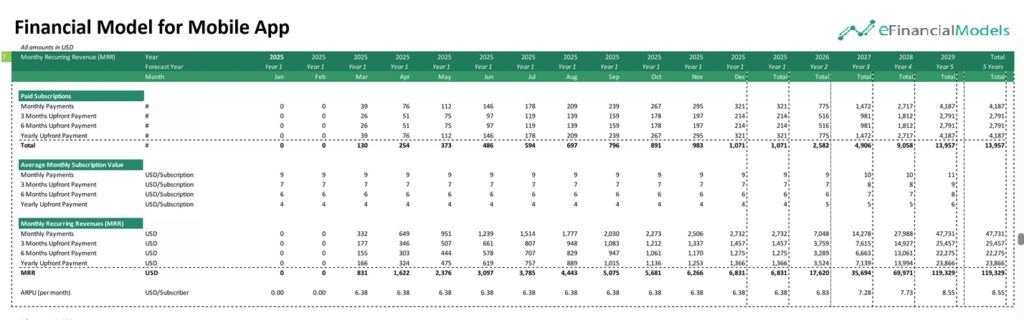
The monthly recurring revenue (MRR) above is from our financial model for mobile apps. It provides a strong tool for fintech performance monitoring by showing consistent, scalable income growth. MRR starts at $831 in March and climbs monthly to $6,081 by December of Year 1, then rises sharply to $23,285 by Year 5. This growth comes from an expanding subscriber base and tiered payment plans—monthly, quarterly, semiannual, and annual—contributing to revenue stability. The model’s ARPU increases from $6.38 to $8.55, providing stronger customer value. These figures help fintech teams track revenue health, forecast trends, and refine monetization strategies confidently.
Risk Management
Fintechs face regulatory, tech, and market risks. A model helps test different scenarios and prepare for worst-case outcomes. Without it, one wrong move can cause major losses. Given a financial technology company's highly regulated and volatile nature, modeling allows firms to stress-test their financials under various conditions. Financial modeling helps fintechs prepare for the unexpected. It shows how rule changes, rising costs, or security issues could hit profits. By testing different risk scenarios, businesses can plan ahead, cut surprises, and stay ready to act fast. Fintech companies can proactively manage risk by preparing for best, base, and worst-case scenarios.

This Excel-based scenario analysis example above is a powerful tool for fintech risk management because it clearly illustrates how a project’s financial outcomes shift under different assumptions. By comparing Net Present Value (NPV) and Internal Rate of Return (IRR) across best, base, and worst-case scenarios, decision-makers can visualize financial volatility and plan accordingly. In the best case, the project achieves a robust NPV of $2.86M and an impressive IRR of 58.7%, suggesting high profitability if all conditions are favorable. Even in the worst case, the project maintains a positive NPV of $739K and an IRR of 16.1%, demonstrating resilience. This range gives fintech teams a reliable framework to assess potential gains or losses, identify risks, and justify strategies based on quantitative valuation.
Strategic Planning
Scaling a fintech without a roadmap is risky. Financial models let startups forecast growth, plan hiring, and explore new markets. Without a clear plan, the company may grow in the wrong direction. Financial modeling provides a data-driven blueprint for growth. With accurate models, fintech firms can align goals with realistic financial outcomes. They help fintech founders and executives simulate different business scenarios—such as launching a new product, entering a new market, or altering pricing models. Furthermore, financial modeling gives fintechs a clear view of their worth. It helps set fair exit values and build solid deal terms. Businesses avoid surprises and protect value by testing how a deal affects shares and earnings. This makes exits, expansions, or mergers smoother and smarter.
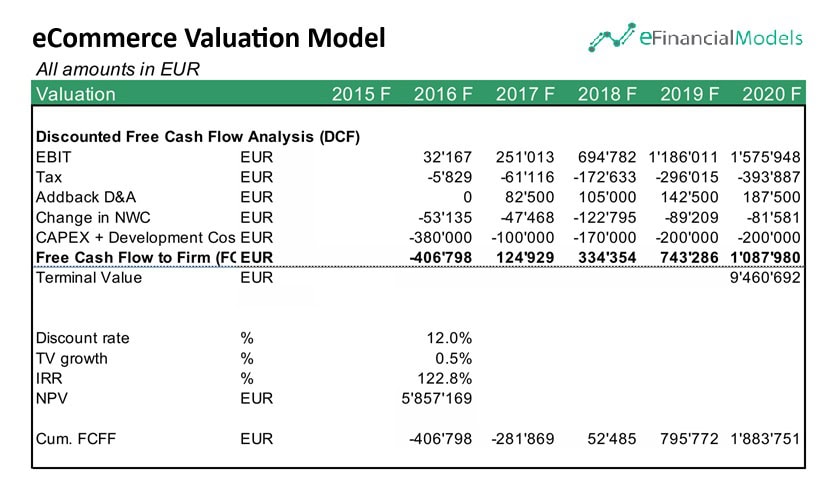
The eCommerce Valuation Model above supports fintech strategic planning by revealing strong value creation through future cash flows. The Free Cash Flow to Firm (FCFF) turned positive in 2017 and grew steadily, reaching €1.08M by 2020. With a terminal value of €9.46M and a high IRR of 122.8%, the model confirms strong investor appeal. The net present value (NPV) of €5.86M reflects solid long-term value, even at a 12% discount rate. Despite early losses, a positive cumulative FCFF of €1.88M by 2020 signals a profitable turnaround. These numbers guide decisions on scaling, fundraising, and ROI-focused fintech execution.
Power Up Fintech Growth Through Data-Driven Forecasting
Fintech businesses are transforming finance through technology, offering faster, smarter, and more inclusive services—from mobile apps and digital banks to blockchain and robo-advisors. Leading players like Stripe and Chime are reshaping global money flows in 2025, while newcomers rise fast with innovative tools. These companies matter more than ever, boosting financial access, speeding up transactions, and strengthening economic resilience. For startups, this creates vast opportunity—but also complexity. That’s where financial modeling helps: it clarifies strategy, tests assumptions, and supports smart decisions. With clear numbers and strategy, fintech startups can win investor trust and turn bold ideas into bankable success.

Power up your fintech growth with data-driven forecasting. Financial modeling gives you clear numbers to plan smart, act fast, and stay ahead. It helps you see where money flows, how costs scale, and what drives profit. With accurate forecasts, you can make bold moves with less risk. Whether raising capital or scaling up, modeling turns guesswork into strategy. Financial models are your blueprint for confident growth in fintech, where speed and precision matter.
Start modeling today to fuel your fintech growth!
You might also like:
- 10 Ideas to Increase Average Revenue Per User
- 10 Tips to Develop a First Class Business Valuation Report
- Financial Modeling for Startups and Small Businesses
- How to Calculate Annual Recurring (ARR) Revenue for Sustainable Growth
- Understanding the Debt Service Coverage Ratio: An Essential Metric for Financial Analysis
- Cash Flow Analysis in Excel
- Startup Model Templates in Excel that can help your Business Grow
- Commercial Real Estate Valuation Methods: Helping Investors in Taking Informed Decisions
- Financial Forecasting Models by eFinancialModels
- How Waze Mapped Its Way to Success?
- Funding Sources
- Business Plan Models - Using Business Models as Examples
- How to Use Inflation Projection to Your Advantage
- Why Should You Use Excel for Financial Modeling?
- Financial Projections Templates – The Easy Way
- How to Stay Ahead of the Curve in the Car Rental Industry
- Top 5 Risks of Wind Energy Parks
- Private Equity vs. Venture Capital: Which is Right for You
- Financial Business Plan for Nail Salon
- Investment