
0 ITEMS

Time-Weighted Return: A Better ROI Measure for Fund Managers
Table of Content

Understanding time-weighted return (TWR) helps investors measure portfolio performance accurately without the distortion caused by external cash flows.
- TWR breaks down the investment period into sub-periods at each cash flow to isolate investment performance from investor actions.
- It calculates growth rates for each segment and links them geometrically to show the true return.
- TWR is especially useful for comparing fund managers and investment strategies, regardless of cash inflows or outflows.
- The method neutralizes the effects of timing and size of deposits and withdrawals on overall performance.
- Mastering TWR enhances clear, unbiased evaluation of investment success over specific periods.
This article provides practical insights into calculating and applying TWR for smarter investment decisions.
What Is a Time-Weighted Return?
The time-weighted return (TWR) is a technique used to compute the returns on investments by compounding the returns of individual periods, with each period adjusted for its length. The total analysis period is segmented into consecutive sub-periods at each instance of a cash outflow within the total period. Typically, these sub-periods vary in size. The returns for the intervals between the external cash outflows are calculated by geometrically linking (compounding) the growth factors of all sub-periods. The growth factor for each sub-period is defined as one plus the return for that interval.
Also called the geometric mean return, TWR is particularly useful for evaluating the performance of investment portfolios that have experienced multiple cash flows, such as deposits and withdrawals, over a given period. This measure removes the effects of these external cash flows, focusing solely on the investment’s own returns. Therefore, the time-weighted return provides a clearer picture of a portfolio manager’s effectiveness by isolating the impact of investment decisions from investor actions. It is crucial to assess the true performance of the investment, independent of the timing and amount of additional capital inflows or outflows.
TWR is a crucial financial metric used to measure the performance of investments over a specified period, negating the effects of capital inflows and outflows. The method stands out from other return calculation strategies due to its unique approach to adjusting for cash outflows during the investment period. Cash outflows describe the total value movements into or out of a portfolio arising from transactions involving cash, securities, or other financial assets. These flows do not include an equivalent counter-transaction, as is the case with buying or selling activities, nor do they stem from the investment income of the portfolio, such as interest, coupons, or dividends.

How Does Time-Weighted Return Solve Cash Flow Issues?
When assessing an investment, external cash flows or outflows present a significant challenge. These outflows represent any money that exits the business, including operational expenses, capital expenditures, loan repayments, and even unexpected costs. A common problem with managing these cash flows is the unpredictability and variability, which can seriously affect an investment’s stability and profitability.
External cash flows or outflows can significantly complicate the performance measurement. For example, a large influx of additional investment might make a poorly performing investment appear more successful than it is, or significant withdrawals could make an otherwise stable investment seem volatile or unprofitable.
TWR solves the problem of external cash flows by focusing solely on the investment’s actual performance, independent of external cash movements. It accomplishes this by breaking down the investment period into sub-periods that begin and end with each cash flow. By calculating returns for these sub-periods and then geometrically linking them, TWR provides a fair measure of the investment’s true performance. It gives investors and fund managers a reliable metric to compare the intrinsic value of various investment opportunities, regardless of differing cash flow timings.
Time-Weighted Rate of Return vs. Internal Rate of Return
The time-weighted rate of return (TWRR) and the Internal Rate of Return (IRR) are two methodologies used to evaluate the performance of investment portfolios. Still, they serve different purposes and are affected by various factors.
TWRR, a precise measure, is used to gauge the performance of investment returns over a period independent of any external cash flows (like contributions or withdrawals). This method effectively removes the impact of the timing and amount of cash flows, focusing purely on the investment manager’s ability to generate returns. The approach makes a time-weighted rate of return especially useful for comparing the performance of fund managers or investments where the manager does not control the cash flows. On the other hand, IRR measures the profitability of potential investments and is highly sensitive to the timing and magnitude of each cash flow. The discount rate makes the net present value (NPV) of all cash flows (both positive and negative) from a particular project equal to zero. IRR is used widely in capital budgeting to estimate the profitability of investments and is particularly useful for evaluating the performance of individual investment portfolios or projects where cash flows vary significantly.
Application
The practical applications of Time-Weighted Rate of Return (TWRR) and Internal Rate of Return (IRR) highlight their distinct roles in financial analysis. TWRR is predominantly used in contexts where a portfolio manager’s performance needs to be assessed independently of investor activities, such as deposits and withdrawals. It makes TWRR especially valuable for institutional settings like pension funds and mutual funds, where it is crucial to compare the performance of different managers or funds on a level playing field. Conversely, IRR is extensively applied in project finance and project evaluation, where the specific timing and amount of each cash flow significantly influence the project’s or investment’s financial viability. For instance, in evaluating real estate investments or corporate finance projects, IRR helps determine the expected profitability and break-even points. It is a vital tool for investors who must understand how their investment decisions impact the overall return.
Purpose
The time-weighted rate of return (TWRR) and the internal rate of return (IRR) serve distinct purposes in investment analysis. TWRR is designed to evaluate the performance of fund managers or investment portfolios without being influenced by external cash flows, making it highly effective for comparing the performance of different funds over a period. It focuses solely on the returns generated by the investments themselves, disregarding the size or timing of deposits and withdrawals, which might otherwise skew the results. On the other hand, IRR is crucial for assessing the overall profitability of specific projects or individual investments, where the investor has direct control over the cash flows. It considers all cash inflows and outflows to calculate a single return rate that equates the present value of outflows to inflows, thereby offering a comprehensive measure of an investment’s efficiency from the investor’s viewpoint. This makes IRR particularly valuable for personal or project-specific financial decision-making, where each cash flow’s impact on the investment’s success is significant.
Reinvestment
Time-weighted rate of return (TWRR) and internal rate of return (IRR) differ primarily in how they handle reinvestment of returns. TWRR does not assume any reinvestment of intermediate cash flows, making it a measure of the performance of the underlying investment regardless of cash inflows or outflows. It breaks the investment period into segments based on cash flows. It calculates the return for each period, providing a clear view of the investment’s performance without considering what is done with the cash earned during the investment. In contrast, IRR assumes that all cash flows, such as dividends or interest, are reinvested at the same rate as the IRR itself. It makes IRR sensitive to the timing and size of cash flows, as it reflects the compounding effect of reinvestment at the calculated rate of return. As a result, IRR is a more holistic measure of an investment’s total return, assuming efficient reinvestment, while TWRR focuses solely on the investment’s performance, independent of reinvestment decisions.
Sensitivity to Cash Flow
Time-weighted rate of return (TWRR) is insensitive to cash flows because it separates the performance of the investment from the effects of money being added or withdrawn. It calculates the return based on the investment’s actual market performance during different periods without weighing how much was invested at any particular time. It makes TWRR ideal for comparing an investment manager’s performance, regardless of investor decisions to add or remove cash. On the other hand, the internal rate of return (IRR) is highly sensitive to cash flows because it measures the overall return considering both the investment’s performance and the exact amounts of money invested or withdrawn. The IRR calculation includes every cash inflow and outflow, making it a comprehensive measure of the investment’s profitability. Large cash flows, especially at key times, can significantly impact the IRR, as it considers the magnitude and timing of those cash flows when determining the final return.
Timing
Time-weighted rate of return (TWRR) and Internal Rate of Return (IRR) differ in how they handle the timing of cash flows. TWRR is neutral to timing because it focuses on the performance of the investment itself, without considering when money is added or withdrawn. It breaks the investment into segments based on each cash flow and calculates the return for each period separately. This makes it ideal for comparing investments without being affected by external cash flow events. In contrast, IRR is sensitive to the timing of cash flows. It looks at the entire investment, factoring in the exact times when money is added or taken out. Since IRR reflects the time value of money, earlier or later cash flows can significantly affect the overall return. This makes IRR useful when evaluating investments where the timing of contributions or withdrawals is a key factor in determining performance.






















































How to Calculate Time-Weighted Return?
It is essential for investors aiming to measure the performance of their investment portfolios over multiple periods, unaffected by external cash flows. Thus, a need to calculate time-weighted return (TWR) arises. The time-weighted return formula breaks down the investment period into sub-periods before and after each cash flow. This method ensures each segment’s return is calculated independently, clearly showing the investment’s true performance by focusing solely on the market’s impact.
Portfolio Return Formula
First, let’s delve into the straightforward portfolio return formula, which operates independently of external cash flows or outflows. The formula is as follows:

The above formula measures the percentage change in an investment portfolio’s value over time. It provides the total return as a fraction, which can be expressed as a percentage by multiplying by 100. Essentially, this formula helps investors understand how much their portfolio has grown or shrunk relative to the initial investment, reflecting their investment choices’ overall performance and effectiveness over that time frame.
Time-Weighted Return Formula
The need to calculate time-weighted return arises when external flows within the analyzed period are considered. By accounting for these external flows, performance measurement can be balanced. The time-weighted return formula is as follows:

The formula shows how to calculate time-weighted return by taking the difference between the final value of the portfolio and its initial value and then adding any cash flows that occurred during the period. This result is divided by the portfolio’s initial value plus any cash flows, essentially normalizing the return to account for any external investments or withdrawals. It accurately measures the portfolio manager’s performance, independent of any investor contributions or withdrawals. Furthermore, there is a need to calculate time-weighted return linking all the sub-periods. It is the net cash flow in or out of the portfolio during the whole investment period. The time-weighted return formula using geometric compounding is as follows:

Where:
- n= the number of sub-periods.
The final value in this time-weighted return formula shows the overall growth rate of the investment over the period, adjusted for any cash flows. The return can be annualized if the measurement period spans multiple years.
Practical Example on How to Calculate Time-Weighted Return
To illustrate the time-weighted return (TWR) formula provided, let’s consider a practical example with the following investment scenario:
- You have a portfolio initially valued at $10,000.
- You add an additional $2,000 to the portfolio three months into the year.
- At the end of the Year 1, the portfolio’s final value is $13,000.
- You add an additional $3,000 cash flow at the start of Year 2.
- At the end of the Year 2, the portfolio’s final value is $18,000.
Based on the above assumptions, let us first calculate time-weighted return in the first period or Year 1:
- Initial Value: $10,000
- Cash Flow: $0 (since the cash flow happens after this period)
- Assume Final Value before Cash Flow (at Month 3): $11,000
Applying the time-weighted return formula:

Now, let us calculate time-weighted return in the second period or Year 2:
- New Initial Value: $13,000
- Cash Flow: $3,000
- Assume Final Value at Year End: $18,000
Applying the time-weighted return formula:

Now, let us calculate the overall TWR for the investment period:

Thus, considering the timing and impact of cash flows, the time-weighted return over the two years is approximately 23.75%. This method shows the compound effect of each period’s performance, adjusted for cash flows.
What is a Good Time-Weighted Rate of Return?
A good time-weighted rate of return (TWR) depends on the investment’s context, including the asset class, capital requirements, market performance, and risk level during the same period. Generally, a “good” TWR should exceed the returns of relevant benchmarks or indices representing similar risk and investment types. For example, suppose a portfolio shows a TWR of 23.75% while the comparable market index (like the S&P 500) increased by only 10% over the same period. In that case, the portfolio has performed exceptionally well relative to the market. Conversely, if the market grew by 30%, the same TWR might suggest underperformance. Ultimately, the goodness of a TWR is measured against specific investment goals and market conditions.
Here’s a general overview of typical TWR benchmarks in some common industries:
- Consumer Goods: Consumer staples and discretionary funds might target TWRs that track indices like the S&P Consumer Sectors. These industries often aim for moderate stability with TWR benchmarks between 3-7% for staples and potentially higher (6-12%) for discretionary spending in a strong consumer market.
- Energy: Energy sector investments, including oil, gas, and renewable energy, might benchmark against the S&P Energy Sector Index. TWRs in this sector can be highly volatile, influenced by global oil prices and political factors, with benchmarks typically ranging from -5% to 15%.
- Financial Services: Financial sector funds, including banks and insurance companies, might align their TWR benchmarks with broader financial indices like the S&P Financials. Expected TWRs could range from 5% to 10%, depending on market conditions and regulatory impacts.
- Healthcare: Healthcare funds and biotechnology investments could align their TWR benchmarks with the S&P Health Care Sector Index. This sector can experience volatile returns, so benchmarks might range widely, from 8-15%, reflecting both the high risk and high potential of healthcare investments. This potential for high returns is a source of excitement for investors in this sector.
- Real Estate: Real estate investment trusts (REITs) and portfolios might target a TWR that aligns with the MSCI US REIT Index. Benchmarks for TWRs in this industry typically range between 4% and 9%, reflecting real estate investments’ stable but lower-growth nature. This stability provides a sense of security for investors in the real estate sector.
- Technology: The technology sector, with its rapid growth potential, often targets high TWRs. Benchmark TWRs could be aligned with tech-heavy indices like the NASDAQ-100, aiming for double-digit returns, usually exceeding 10-15% annually in a growth market. This potential for high returns is a source of optimism for investors in this sector.
- Utilities: Utility funds are generally considered low-risk and thus might aim for lower TWR benchmarks, typically in the range of 3-6%, aligned with utility indices like the Dow Jones Utility Average, reflecting the stable demand and regulatory environment of this sector.
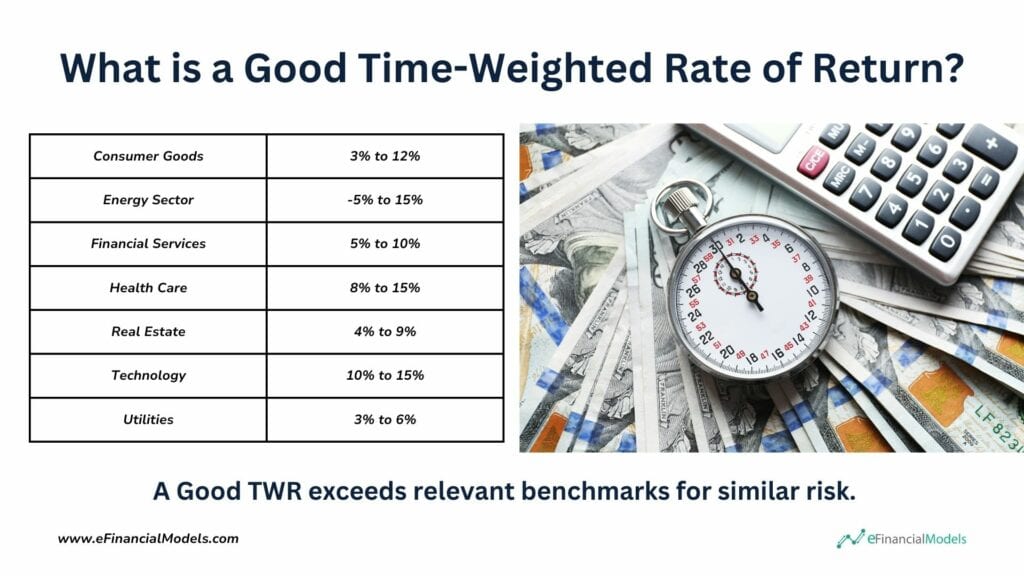
These benchmarks are indicative and can vary significantly based on specific fund management strategies, geographical focus, and economic conditions. Investors and managers use these benchmarks to gauge the effectiveness of their investment strategies relative to the overall market and industry-specific trends.
Applying Time-Weighted Return (TWR) in Effective Investment Analysis
TWR provides a clear, unbiased view of investment effectiveness, a role that is crucial in various investment scenarios. This precision makes TWR indispensable in scenarios ranging from mutual funds to private wealth management, where transparent and fair performance evaluation is key to sustaining investor trust and achieving financial objectives.
Here are some real-world examples that vividly illustrate the practicality of TWR, instilling confidence in its application:
- Individual Investment Accounts: For investors who make periodic contributions to their investment accounts, such as a monthly deposit into an IRA, TWR helps measure how the chosen investments are performing. It is particularly useful for evaluating the impact of investment decisions, such as buying or selling assets at specific times, without the distortions caused by the individual’s cash movements.
- Mutual Fund Performance: Mutual funds extensively use the time-weighted return formula to report performance. For instance, consider a mutual fund that experiences heavy investor withdrawals during a market downturn and substantial contributions during a market upturn. Using TWR prevents these cash flows from skewing the actual performance of the fund manager. It is because TWR calculates returns independently for each period before and after each cash flow, effectively neutralizing the impact of the timing and size of these cash flows.
- Pension Fund Management: Pension funds frequently have ongoing contributions and disbursements. So, it is crucial to calculate time-weighted return as it allows the pension fund managers to demonstrate the returns generated from their investment decisions alone, without the noise of regular pension contributions and benefit payments. This method offers the trustees a clear view of the fund manager’s effectiveness in asset management over time, irrespective of external cash flows.
- Performance Comparison Among Portfolio Managers: TWR enables an apples-to-apples comparison among portfolio managers or investment strategies, regardless of each portfolio’s various cash flow timings. Imagine two portfolio managers; one deals with high-net-worth individuals with sporadic large deposits and withdrawals, while the other manages a steady stream of small contributions from a larger pool of average investors. TWR levels the playing field by eliminating the influence of these differing cash flow patterns when comparing the managers’ performance.
Financial Modeling for Time-Weighted Return Analysis
Enhancing your understanding of time-weighted return (TWR) can significantly elevate your investment analysis skills. TWR measures the compound growth rate in a portfolio, effectively isolating the impact of external cash flows, such as withdrawals or additional investments. To calculate TWR, you break down the investment period into sub-periods at each cash flow point and compute the returns independently. These are then geometrically linked to represent the total return. This method provides a clear, unbiased view of manager performance and is invaluable in comparing the effectiveness of different investment strategies. By mastering TWR, investors can make more informed decisions, aligning investment choices with their financial goals and risk tolerance.
Financial modeling for time-weighted return (TWR) analysis offers a precise and reliable tool for investors looking to evaluate the performance of their investments independent of external cash flows. By applying TWR analysis through robust financial models, investors can accurately measure the compound growth rate of their portfolios over specific intervals, mitigating the effects of intermittent deposits or withdrawals. This approach is particularly valuable for assessing the effectiveness of fund managers and investment strategies, as it provides a pure indication of investment performance. Leveraging financial modeling to calculate TWR enhances transparency and enables investors to make more strategic decisions by clearly understanding the true return on their investments across various market conditions. Optimize your investments now!



















You might also like:
- 10 Tips to Develop a First Class Business Valuation Report
- 10 Main Elements of a Business Plan
- 10 Ideas to Increase Average Revenue Per User
- Understanding the Debt Service Coverage Ratio: An Essential Metric for Financial Analysis
- 5 Best Practices for Managing Days Receivables
- Financial Planning for Small Business Owners – Taking an SBA Loan
- How to Value a Business Using a Discounted Cash Flow Model
- Top 5 Risks of Wind Energy Parks
- Financial Ratios Analysis and Its Importance
- IRR vs NPV in the Context of Financial Decision-Making
- Real Estate Financial Modeling in Excel
- Commercial Real Estate Valuation Methods: Helping Investors in Taking Informed Decisions
- How to Prepare a Financial Feasibility Study?
- Fundraising Project Plan Template in Excel
- How to Secure Seed Financing?
- How to build a financial model for a mobile app?
- Understanding the Levelized Cost of Energy Formula
- Commercial Real Estate Investment Model
- How to Start a Distillery Business: What You Need to Know?
- Simple Fundraising Model
Tags: financial metrics, financial modeling, time-weighted return