
0 ITEMS

Top 5 Financial Risk Management Plan Strategies
Understanding how to manage financial risks is essential for maintaining business stability and growth.
- Risk management involves identifying threats like market fluctuations, credit issues, and operational errors to protect financial health.
- Key risks include credit risk from unpaid debt, liquidity risk from cash shortages, and market risk from interest and currency rate changes.
- Internal factors such as poor cash flow, weak financial policies, and operational inefficiencies directly influence risk levels.
- External risks stem from economic shifts, political changes, and industry-specific volatility that can impact investment returns and costs.
- Effective strategies include acceptance of low-impact risks, diversification of income streams, hedging against market fluctuations, and transferring risks via insurance.
A solid grasp of these principles helps build resilient financial plans capable of weathering uncertainties.
What Is Risk Management in Financial Planning?
Risk refers to the uncertainty or potential loss a business may face in achieving its financial goals. Companies can make informed decisions and develop strategies to mitigate potential negative impacts by identifying and managing risks. These include business risks, non-business risks, and financial risks. Business risks aim to increase shareholder value and profits. For instance, businesses promote new products with high-cost marketing risks, hoping to increase sales. Non-business risks arise from political and economic imbalances and are not within the control of firms. At the same time, financial risks refer to the business’s ability to manage debt and fulfill financial obligations.
Risk management in financial planning focuses on identifying, assessing, and mitigating financial risks. It involves identifying potential financial threats and taking steps to mitigate or prevent them. It helps people and businesses protect their money from losses caused by market changes, accidents, illness, or poor decisions. This includes utilizing tools such as insurance, savings, and diversified investments. Planning for the unexpected helps ensure financial goals stay on track and reduces stress during tough times.
What Are Financial Risks?
Financial risk refers to the potential loss of money resulting from poor investment decisions, economic fluctuations, or debt-related issues. It affects individuals, businesses, and governments, often leading to cash flow problems, defaults, or loss of investor confidence. Companies face this when they take on too much debt or are unable to meet their financial obligations. In contrast, governments may struggle with debt repayments or maintaining stable economic policies. To understand and prepare for these uncertainties, many rely on financial risk modeling, a method that uses data and assumptions to predict and manage potential losses.
- Credit Risk: Credit risk arises when borrowers fail to repay their debts on time. This creates losses for lenders and disrupts cash flow. A solid financial risk management plan checks creditworthiness before lending and sets limits to control exposure. Effective credit risk management strengthens trust and maintains financial stability.
- Liquidity Risk: Liquidity risk occurs when a company can’t convert its assets into cash quickly enough to meet its short-term obligations. This leads to missed payments or costly emergency loans. Risk management in financial planning ensures access to backup funds and closely tracks cash flow. Managing liquidity early can help avoid sudden financial stress.
- Market Risk: Market risk arises from fluctuations in interest rates, stock prices, or currency values that diminish investment returns. It affects both individual assets and entire portfolios. Financial risk modeling helps predict these shifts to prepare for potential losses. Active monitoring and diversification lower the impact of volatile markets.
- Operational Risk: Operational risk comes from system failures, errors, or fraud that harm daily business operations. It’s often overlooked but can cause serious damage. A financial risk management plan includes controls, audits, and backup systems to limit disruptions. Addressing this risk ensures smooth and secure operations.

What Factors Affect Risk Management in Financial Planning?
A financial risk management plan is a comprehensive strategy implemented by an organization to identify, assess, monitor, and mitigate potential financial risks that could adversely impact its operations, profitability, or financial stability. Internal and external factors may affect a financial risk management plan.
Internal factors refer to a company’s characteristics, decisions, and actions that can affect its financial risk management plan.
- Business volatility affects financial risk—unstable earnings or cash flow makes it harder to meet obligations during downturns.
- Capital structure matters—more debt means higher risk due to fixed repayment duties.
- Cash flow generation is key—weak profits or negative cash flow raise financial risk.
- Financial policies, such as high dividends or poor working capital management, can strain cash reserves and heighten risk.
- Management competency is crucial—poor financial planning or bad capital use increases risk exposure.
- Operational inefficiency drives up costs and lowers profits, raising financial risk.
External factors are influenced by overall economic conditions, financial markets, and specific industries, resulting in changes in risk levels for businesses and individuals.
- Economic conditions, such as GDP, inflation, and interest rates, influence profits, spending, and investment returns.
- Exchange rate fluctuations impact costs, profits, and the value of foreign investment in global trade.
- Industry-specific risks vary—consumer trends and technological shifts impact sectors such as energy, healthcare, and technology differently.
- Market volatility in stocks, bonds, or commodities can create financial risk for investors and businesses that are exposed.
- Natural disasters and climate-related events can disrupt industries such as farming, insurance, and real estate.
- Political and regulatory changes—from instability to new laws—can reshape business risks and financial outcomes.

What Strategies Build a Strong Financial Risk Management Plan?
Regardless of size or sector, managing financial risks is a top priority for every organization. A strong financial risk management plan helps shield a business from uncertainty. It prepares companies to respond quickly and confidently when trouble hits. The following strategies foster discipline in monitoring and adapting, enabling businesses to stay ahead of emerging threats. This approach highlights the importance of risk management in financial planning, where proactive thinking turns potential setbacks into manageable challenges.
Acceptance to Take Risk
Accepting risk means a business chooses to face a possible loss because the cost to prevent it is too high or the risk is minor. This strategy is sensible when the outcome won’t significantly harm the company. It shows confidence and readiness to manage issues as they come without overreacting or wasting resources. A business can accept risk by recognizing potential losses and choosing to move forward, as the benefits outweigh the costs. This strategy works when the impact is low or manageable. The company prepares for possible outcomes but doesn’t spend resources trying to eliminate the threat. It’s a confident, calculated move that reflects trust in its core operations.
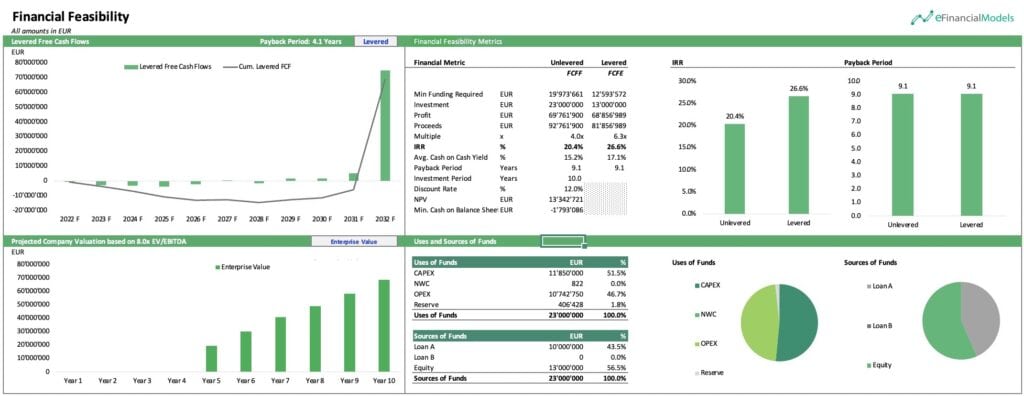
The above Manufacturing Startup Feasibility Model demonstrates the acceptance of taking risk as a core financial risk management strategy by projecting bold, debt-leveraged growth with high potential returns. Despite initial negative free cash flows, the model forecasts a strong turnaround with a steep rise in cash flow by Year 10, indicating a willingness to absorb early losses in pursuit of long-term gains. With a levered IRR of 26.6%, a payback period of just 4.1 years, and a significant 6.3x return multiple, the plan embraces risk through strategic leverage and ambitious capital investment. This proactive risk-taking—supported by confident projections, a defined funding mix (56.5% equity, 43.5% loan), and clear use of funds—shows the startup’s readiness to navigate volatility for higher reward.
Avoidance to Mitigate Risk
Avoiding risk means refraining from decisions or actions that could result in financial harm. A company might cancel a risky project or choose safer options to protect itself. This strategy is effective when the risk is substantial, and the potential damage outweighs the reward. To mitigate risk, a business can adjust its plans or decline opportunities that pose significant threats. It might stop a risky project, decline a deal, or exit a volatile market. This method is all about staying safe. When the risk is too high, the smartest option is to steer clear entirely.

The above Sensitivity Analysis from the Advanced DCF Valuation Model highlights the avoidance of mitigating risk by pinpointing the most volatile value drivers that could impact equity value—especially revenue and expenses. By running controlled scenarios with small, calculated input changes (such as ±10% for revenue and OPEX, ±1% for margins, discount rate, and growth), the model anticipates which risks have the greatest financial impact. This proactive approach avoids guesswork and demonstrates how even slight shifts in variables can significantly alter valuation—helping stakeholders avoid high-risk decisions and stay within safer financial assumptions.
Diversification to Reduce Risk
Diversifying helps a company lower its overall risk by spreading investments or operations across different areas. If one part fails, others can still succeed. This approach keeps the business stable and less exposed to one single loss. A business can reduce risk by diversifying its investments across different products, markets, or industries. If one area struggles, others may still perform well. This spreads out the risk and protects the entire business from a single major hit. It’s a smart way to build balance and stay steady.

The revenue breakdown above is from our Co-Packaging Production Business Financial Model. It helps reduce risk through diversification by clearly showing how revenue is spread across multiple product types, channels, and years. By not relying on a single income source, the business buffers itself against market volatility or shifting consumer preferences. Each revenue stream—be it face cream, shampoo, or body lotion—adds a layer of stability. The visual breakdown and metrics make it easy to identify which products drive growth and which can be scaled or adjusted, enabling smarter decisions and proactive risk management. This structure turns diversification into a practical financial risk management strategy.
Hedging for Risk Protection
Hedging involves protecting against losses by utilizing tools such as insurance, contracts, or financial instruments. For example, a company may lock in prices or rates to avoid surprises later. This helps control costs and mitigate the impact of market fluctuations. Hedging protects a business from loss by utilizing financial products to lock in prices or guard against significant price fluctuations. If one part fails, the hedge helps cover the damage. This adds a layer of safety to risk management in financial planning.
A bakery anticipates an increase in flour prices. It signs a contract to buy at today’s rate for the next six months. This hedge locks costs and avoids surprise expenses, helping the business stay on budget.
Risk Transfer
Risk transfer involves shifting the risk to another party, such as an insurer or a third party. The business pays a fee or premium to avoid the full impact of a loss. This strategy supports risk management in financial planning by providing a safety net if things go wrong. A business can transfer risk by shifting responsibility to someone else—often through insurance or outsourcing. This way, the company still moves forward, but someone else takes on the risk. It enables the business to focus on its core strengths without bearing every burden alone.
A good risk transfer scenario is a retail store that buys insurance for theft and fire. If damage occurs, the insurer pays. This risk transfer limits the company’s loss. It’s a smart way to handle risk management in financial planning without draining funds.
How Financial Risk Modeling Elevates Risk Management Success?
A strong financial risk management plan uses five key strategies to handle uncertainty. Acceptance means taking on manageable risks. Avoidance helps cut out threats early. Diversification spreads risk across assets. Hedging shields against losses. Risk transfer shifts the impact to others, such as insurers. Together, these tools strengthen risk management in financial planning. Backed by financial risk modeling, they give businesses clear, data-driven ways to stay steady and succeed.

Strong risk management isn’t just about reacting—it’s about anticipating and mitigating risks. With financial risk modeling, businesses can simulate future scenarios, identify potential threats, and refine their decision-making before trouble arises. This proactive approach transforms uncertainty into insight, enabling leaders to respond with precision rather than panic. Instead of playing catch-up, they stay a step ahead—turning risk into a competitive edge.
Financial risk modeling boosts risk management by turning raw data into clear, strategic insights. It utilizes tools such as scenario and sensitivity analyses to test “what-if” scenarios and plan for worst-case events. By focusing on fundamentals—such as cash flow trends, balance sheet health, and profit margins—risk managers can act proactively rather than reactively.
Financial risk modeling improves risk management by turning financial statements into powerful tools. It utilizes income statements, balance sheets, and cash flow reports to track trends, assess stability, and evaluate risk levels. By analyzing numbers over time, businesses can identify warning signs early and take prompt action. This sharp, numbers-based approach helps leaders avoid surprises, make smarter choices, and protect profits with confidence.



















































You might also like:
- 10 Main Elements of a Business Plan
- How to Calculate Net Present Value (NPV)?
- Understanding the Levelized Cost of Energy Formula
- Financial Planning for Small Business Owners – Taking an SBA Loan
- Financial Ratios Analysis and Its Importance
- Understanding Risk in Financial Planning to Protect Your Investments
- Developing a 5 Year Financial Projection Template
- 5 Best Practices for Managing Days Receivables
- How to Prepare a Financial Feasibility Study?
- How to Start a Distillery Business: What You Need to Know?
- Business Valuation
- Financial Statements – Definition, Uses, Contents and Templates
- Startup Financial Models
- Budgeting
- Understanding Debt Sizing & Project Finance Ratios
- How to Make Smart Decisions with 6 Key Financial Metrics?
- Online Businesses Financial Model Bundle
- Financial Modeling using Excel
- How to Raise Series A Funding?
- 12 Funding Sources for Businesses and Startups