
0 ITEMS

Beauty Subscription Box Financial Model Excel Template
The Beauty Subscription Box Financial Model helps founders, entrepreneurs, consultants, analysts, and business planners turn a beauty box concept into a structured financial forecast. Instead of relying on a rough spreadsheet or disconnected assumptions, users can work from a ready-to-use model designed around the economics of a recurring subscription business. It helps estimate subscriber growth, pricing tiers, add-on sales, revenue assumptions, startup costs, operating expenses, payroll, cash flow, profitability, and funding needs in one organized planning tool. This financial model template is especially useful for anyone preparing a beauty subscription box business plan, investor pitch, lender submission, internal budget, or expansion strategy. It connects the key drivers of the business, including customer acquisition cost, churn, subscription tiers, product sourcing costs, packaging, shipping, staffing, marketing spend, and cash reserves. By adjusting editable inputs, users can test how different assumptions affect revenue growth, gross margin, EBITDA, cash flow, and long-term profitability over a multi-year forecast period. The model is built to support practical decision-making before and after launch. Users can evaluate whether the business can support its operating expenses, how much capital may be required, when the venture may reach break-even, and which financial levers have the greatest impact on performance. It also helps compare low, base, and high outcomes so founders can plan for uncertainty, prepare contingency strategies, and communicate realistic financial expectations to stakeholders. Because the Beauty Subscription Box Financial Model is fully customizable and compatible with Excel and Google Sheets, it can be adapted for a new startup, an existing cosmetics subscription brand, or a broader e-commerce beauty business. It provides professional reports, visual dashboards, revenue views, cash flow forecasting, profitability analysis, and investor-ready outputs without requiring users to build a model from scratch. Whether the goal is to raise funding, validate the business idea, manage monthly performance, or improve strategic planning, this template gives users a clear financial framework for making better decisions.
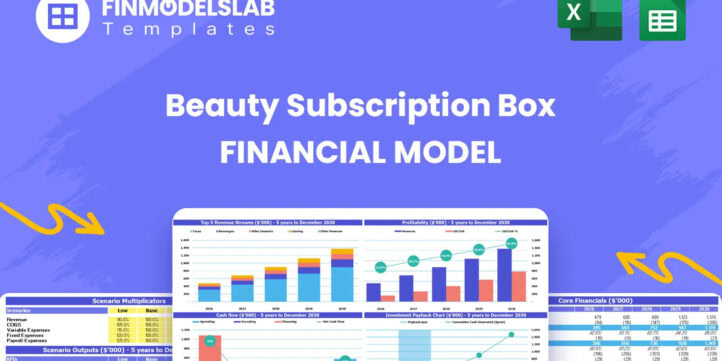


Financial Model Overview
The Beauty Subscription Box Financial Model is a ready-to-use financial model template designed for entrepreneurs, founders, consultants, analysts, and business owners planning or growing a recurring beauty box business. A beauty subscription box depends on several moving parts, including monthly subscribers, customer acquisition cost, churn, product sourcing, packaging, shipping, add-on sales, payroll, marketing, cash flow, and investor returns. This template brings those assumptions into one structured planning tool so users can forecast revenue, expenses, profitability, funding needs, and business performance over a multi-year period. It is useful for building a business plan, preparing a pitch deck, evaluating startup feasibility, planning expansion, or presenting financial projections to lenders, investors, partners, and internal decision-makers.
All-in-One Dashboard
The all-in-one dashboard gives users a centralized view of the most important inputs and outputs in the Beauty Subscription Box Financial Model. Instead of searching through separate tabs to understand the business, users can review core assumptions and headline results in one place, including subscriber growth, revenue, costs, cash position, profitability, and selected investor metrics. This section is useful because a subscription beauty business needs constant visibility into both commercial and financial drivers. Inputs may include pricing tiers, customer acquisition assumptions, operating cost drivers, staffing levels, and investment requirements, while outputs may include revenue forecasts, EBITDA, cash flow, returns, and other key performance indicators. For business planning, the dashboard acts as a quick command center that helps users see whether the model is aligned with their strategy, funding needs, and growth expectations before moving into more detailed analysis.
Low, Base, and High Scenario Analysis
The low, base, and high scenario analysis section allows users to evaluate how the beauty subscription box business may perform under different market conditions. A subscription model is sensitive to assumptions such as subscriber growth, churn, acquisition cost, pricing, product costs, shipping, and marketing efficiency, so it is important to understand more than one possible outcome. This component lets users compare conservative, expected, and optimistic cases to see how changes in key drivers affect revenue, profitability, cash flow, and capital requirements. For example, a low case may reflect slower subscriber acquisition or higher churn, while a high case may assume stronger marketing performance, better retention, or higher conversion into premium subscription tiers. This is valuable for decision-making because it helps founders prepare contingency plans, set realistic targets, and explain risks and opportunities to investors or lenders with more confidence.
Professional Charts
The professional charts section converts the model’s financial results into clear visual outputs that can be used for presentations, business plans, investor discussions, and internal reporting. Beauty subscription box businesses often need to communicate complex financial information, such as recurring revenue growth, subscriber trends, cash balance, expense categories, margins, and profitability, in a format that stakeholders can quickly understand. This component uses the model’s assumptions and forecast outputs to generate visual summaries that make patterns and trends easier to interpret. The charts may show revenue growth over time, changes in operating expenses, subscriber expansion, cash flow movement, and profit progression. This is useful because charts help users move beyond raw numbers and tell a more coherent financial story, especially when preparing materials for banks, investors, co-founders, advisors, or management teams.
ROE Components and DuPont Analysis
The ROE components section supports a deeper understanding of return on equity through DuPont-style analysis. For investors and founders, profitability alone does not always explain how efficiently the business is using capital. This component breaks return on equity into underlying drivers that may include profitability, asset efficiency, and financial leverage, helping users see what is actually contributing to shareholder returns. In a beauty subscription box business, this can be especially useful because growth may require upfront investment in inventory, technology, marketing, warehouse setup, and working capital. By connecting operating performance with capital efficiency, this section helps users understand whether returns are being generated by healthy margins, efficient use of assets, or the financing structure of the business. It is a valuable tool for evaluating long-term financial quality, presenting investor metrics, and identifying which levers can improve overall returns.
Revenue Inputs
The revenue inputs section is where users define the core commercial assumptions that drive the Beauty Subscription Box Financial Model. A beauty box business typically relies on recurring monthly subscriptions, often across multiple tiers, and may also generate revenue from add-on product purchases or upsells. This section may include pricing assumptions for basic, premium, and luxury plans, subscriber acquisition assumptions, marketing spend, customer acquisition cost, churn, retention, tier mix, and add-on purchase behavior. The outputs generated from these inputs feed directly into monthly recurring revenue, total sales, growth rates, and downstream profitability. This component is essential because revenue quality depends on the realism of the assumptions behind subscriber growth and customer behavior. By changing the inputs, users can test different go-to-market strategies, compare pricing models, estimate the effect of improved retention, and understand how marketing efficiency translates into recurring income.
Bank-Ready Reports
The bank-ready reports section organizes the forecast into professional financial outputs that can support lender discussions, funding applications, investor reviews, and business plan documentation. Beauty subscription businesses may require funding for platform development, inventory, warehouse setup, staffing, marketing, and working capital, so lenders and stakeholders need clear reports showing how the company expects to generate revenue, cover costs, and maintain liquidity. This component may include projected profit and loss statements, cash flow statements, balance sheet summaries, funding views, and key financial metrics. The reports help users communicate whether the business can meet obligations, manage burn rate, and sustain growth over the forecast period. This is especially useful for founders who need to present financial projections in a clean, structured, and credible format rather than relying on informal calculations or disconnected spreadsheets.
Revenue Breakdown
The revenue breakdown section gives users a detailed view of how total revenue is generated across different streams and customer segments. For a beauty subscription box, revenue is not only about total subscribers; it also depends on the mix of subscription tiers, monthly pricing, customer retention, upgrade behavior, and add-on product sales. This component helps users separate revenue by plan type, recurring subscription income, and supplementary sales so they can see which streams contribute most to growth and margin. Inputs may include tier pricing, subscriber allocation, add-on purchase rates, average order values, and volume assumptions. Outputs may include monthly revenue by stream, annual revenue summaries, percentage contribution by category, and growth patterns over time. This level of detail is useful for pricing decisions, product strategy, marketing priorities, and investor communication because it shows the logic behind the top-line forecast rather than only presenting a single revenue total.
KPI Dashboard
The KPI dashboard tracks the operational and financial metrics that matter most for a beauty subscription box business. Subscription models depend on performance indicators such as active subscribers, monthly recurring revenue, customer acquisition cost, customer lifetime value, churn, retention, gross margin, LTV to CAC ratio, cash balance, and profitability. This component helps users monitor those metrics in a clear format and compare them against planning targets or industry benchmarks where relevant. Inputs flow from the model’s revenue, cost, marketing, and operating assumptions, while outputs provide a concise view of business health and performance efficiency. This section is useful for ongoing management because it helps founders identify whether growth is profitable, whether acquisition spending is sustainable, whether retention needs improvement, and whether the business is moving toward its financial goals. It also supports stakeholder reporting by translating detailed forecasts into practical performance measures.
Startup Cost and CAPEX Planning
The startup cost and CAPEX planning section helps users estimate the upfront investment required to launch or scale a beauty subscription box business. Before recurring revenue begins to stabilize, founders may need capital for website and platform development, initial inventory, packaging materials, warehouse setup, branding, legal and licensing expenses, software tools, equipment, deposits, and pre-launch marketing. This component organizes those costs so users can understand how much funding may be required before the business becomes self-sustaining. Inputs may include one-time setup expenses, timing of purchases, depreciation assumptions, and working capital reserves, while outputs may include total startup funding needs, initial cash requirements, and the impact of capital spending on cash flow. This is useful for business planning and fundraising because it prevents founders from underestimating launch costs and helps create a more realistic budget for the early stages of the business.
Break-Even Analysis
The break-even analysis section helps users identify when the beauty subscription box business may generate enough revenue to cover its total costs. This is a critical planning milestone because subscription businesses often invest heavily in customer acquisition, inventory, fulfillment, and operations before reaching stable profitability. The component may use assumptions such as pricing, subscriber volume, gross margin, product costs, packaging, shipping, payroll, marketing, fixed overhead, and churn to calculate the point at which revenue equals expenses. Outputs may include break-even timing, required revenue, required subscriber volume, and the effect of changes in margin or acquisition efficiency. This section is useful for decision-making because it shows whether the business model can become financially sustainable within a reasonable timeframe. It also helps users evaluate pricing strategy, marketing intensity, cost control, and funding needs before committing additional capital.
Built for Beauty Subscription Box Planning
The Beauty Subscription Box Financial Model is designed around the specific financial logic of a recurring beauty and cosmetics subscription business. Unlike a generic spreadsheet, it reflects the importance of subscriber growth, tiered pricing, add-on product sales, customer acquisition cost, churn, product sourcing, packaging, shipping, and retention. Users can adapt the model for a new startup, a niche beauty box, a premium cosmetics subscription, a clean beauty concept, a skincare box, or an existing e-commerce brand adding a subscription offering. By connecting the commercial assumptions to financial statements and investor metrics, the template helps users evaluate the business from both an operational and financial perspective. This makes it a practical tool for feasibility analysis, launch planning, fundraising, performance tracking, and long-term strategy.
Customizable Assumptions
The template is fully customizable, allowing users to replace the pre-built assumptions with their own business strategy, market research, supplier quotes, pricing plan, staffing structure, and growth targets. Users can adjust pricing tiers, acquisition cost, churn, revenue mix, product cost assumptions, payroll, operating expenses, startup investments, funding inputs, and scenario drivers. This flexibility is important because beauty subscription box businesses can vary widely based on brand positioning, box frequency, product quality, fulfillment model, geographic market, and marketing channel mix. A founder targeting a premium luxury audience may have different margins and acquisition costs than a mass-market beauty box, and the model can be adapted accordingly. This makes the financial model useful as both a starting framework and an ongoing planning document.
Five-Year Financial Forecasting
The Beauty Subscription Box Financial Model supports long-term planning with multi-year projections that help users understand how the business may evolve over time. A five-year view is useful because subscription businesses often rely on compounding recurring revenue, retention improvements, supplier efficiencies, and operating scale to improve profitability. The model can help users forecast monthly and annual performance, showing how early decisions about pricing, marketing, staffing, and startup investment may affect future revenue, cash flow, and profit. It also supports conversations with investors and lenders who typically want to see not only the first year of operations but also the expected growth path and financial structure over a longer period.
Revenue and Customer Acquisition Planning
Customer acquisition is one of the most important drivers in a beauty subscription box business, and the financial model helps users connect marketing activity with subscriber growth and recurring revenue. By modeling customer acquisition cost, marketing spend, subscriber conversion, churn, and retention, users can estimate how efficiently the business can grow. This is especially useful for testing whether paid advertising, influencer campaigns, partnerships, organic channels, or referral strategies can support profitable growth. The model also helps users evaluate how changes in acquisition cost affect cash flow and payback periods. For founders preparing a pitch or operating plan, this creates a clearer link between marketing strategy and financial outcomes.
Cost of Goods Sold and Margin Planning
The model supports analysis of cost of goods sold, which is central to profitability for a beauty subscription box. Product sourcing, sample procurement, packaging, shipping materials, fulfillment, and variable delivery costs can significantly affect gross margin.
File types:
Excel – Single-User: .xlsx
Excel – Multi-User: .xlsx
Similar ProductsOther customers were also interested in...


 HenrySheykin
Vitamins Subscription Box Financial Model Excel Te...
The Vitamin Subscription Box Financial Model helps entrepreneurs, founders, consultants, analysts, a... Read more
Monthly Recurring Revenue SaaS Financial Model Exc...
The SaaS Business Financial Model helps founders, entrepreneurs, consultants, analysts, and business... Read more
SaaS Actuals Opt-In Financial Model Excel Template
The SaaS Business Financial Model helps founders, entrepreneurs, consultants, analysts, and business... Read more
SaaS Financial Model Excel Template
The SaaS Business Financial Model helps founders, entrepreneurs, consultants, analysts, and business... Read more
SaaS Freemium Financial Model Excel Template
The SaaS Business Financial Model helps founders, entrepreneurs, consultants, analysts, and business... Read more

House Cleaning Subscription Financial Model Excel ...
The Cleaning Service Financial Model helps entrepreneurs, founders, consultants, analysts, and busin... Read more
SaaS Application Freetrial Financial Model Excel T...
The SaaS Business Financial Model helps founders, entrepreneurs, consultants, analysts, and business... Read more

Online Classes Subscription Financial Model Excel ...
The Online Class Subscription Financial Model helps entrepreneurs, founders, consultants, analysts, ... Read more
CRM Software Financial Model Excel Template
The CRM Software Financial Model is a ready-to-use financial model template designed to help founder... Read more
Fresh Flowers Subscription Financial Model Excel T...
The Subscription Box Financial Model Template helps entrepreneurs, founders, analysts, consultants, ... Read more
You must log in to submit a review.