
0 ITEMS

Own or Rent Home: Personal Finance Tool
Should you buy your home or rent? This template looks at the pure financial impact of both scenarios and allows for every possible assumption configuration. The output is the present value cost of each option. Cheapest wins.


Video Overview:
Everyone has to live somewhere. The question is, what is your personal finance strategy? Do you want to save and buy a house, or do you just want to rent and invest the savings?
Determining which scenario is the cheapest will tell you the best possible financial plan. Unless your rate of return assumptions are extremely high, the present value of the cash flows will be negative. This model will show which one is the least negative (cheapest).
Sometimes there are other factors outside of finances that determine what you do. If you are looking to move around a lot and not deal with the hassle of buying / selling and just want to do 1-year leases, that is fine, and the financial aspect may not matter as much.
If all you care about is the money, then this financial model is going to help you the most. So, let’s get into the scenarios.
Option 1:
– Buy a house, make a down payment, incur ongoing expenses (property taxes/insurance/repairs/HOA/utilities)
– In this scenario, you have larger cash outlays but the mortgage won’t change as long as you have a fixed interest rate. You do have ongoing costs that rise over time.
– The upfront costs in this scenario are always going to be more than renting, and the monthly costs may or may not be cheaper than renting over time. It will depend on the assumptions you input.
Option 2:
– Rent a house and pay utilities.
– In this scenario, you have no large upfront costs, but the rent will go up over time. This monthly payment may be cheaper than the monthly costs of owning a home at first, but depending on the rent growth assumption, it may become more expensive on a monthly basis.
– The general idea here is that you can invest the money you would have had to use for the down payment into something else, and it will grow at a faster rate than the home appreciation price.
– Additionally, if your monthly rent is cheaper than the monthly costs of owning a home, then you can also invest that at some average annual rate of return.
These two scenarios are analyzed with and without investing any difference in cash flows. Also, the user can define if the investment earnings are re-invested or not. The template will show the total cost of both scenarios, discounted and non-discounted, for both investing and non-investing options.
I believe using the present value approach is the fairest way to look at the cash flow streams because that methodology represents the value of the home if it is sold at the end of the mortgage term vs. having an investment that is compounding over the same period and realized at the same time.
Keep in mind the outcome is going to be highly dependent on the assumptions you use.
You can end the analysis at any point in the future as the ‘term’ year will determine when all cash flows stop for all scenarios (for up to 30 years).
Similar ProductsOther customers were also interested in...


 anthony
The Realtors Quintessential ALL-IN-ONE Toolkit
Professional Realtors need a professional Toolkit which allows them to operate at a higher level. Th... Read more
Real Estate Financial Models Excel Template –...
One Excel file for this bundle of Valuation and Financial forecasting models. Storage Parks, Hotels,... Read more
 Jason Varner
Mixed-Use Real Estate Model: Leverage / JV Options
A general real estate model to plan all assumptions for up to 7 'uses' for a given property. Include... Read more

Scaling Multiple Rental Properties: Up to 100
Configure up to 100 rental property acquisitions and view the return on investment, IRR, and more ov... Read more
Real Estate Financial Model Bundle
This is a collection of financial model templates that provides the financial projections and valuat... Read more
 JILL LIU
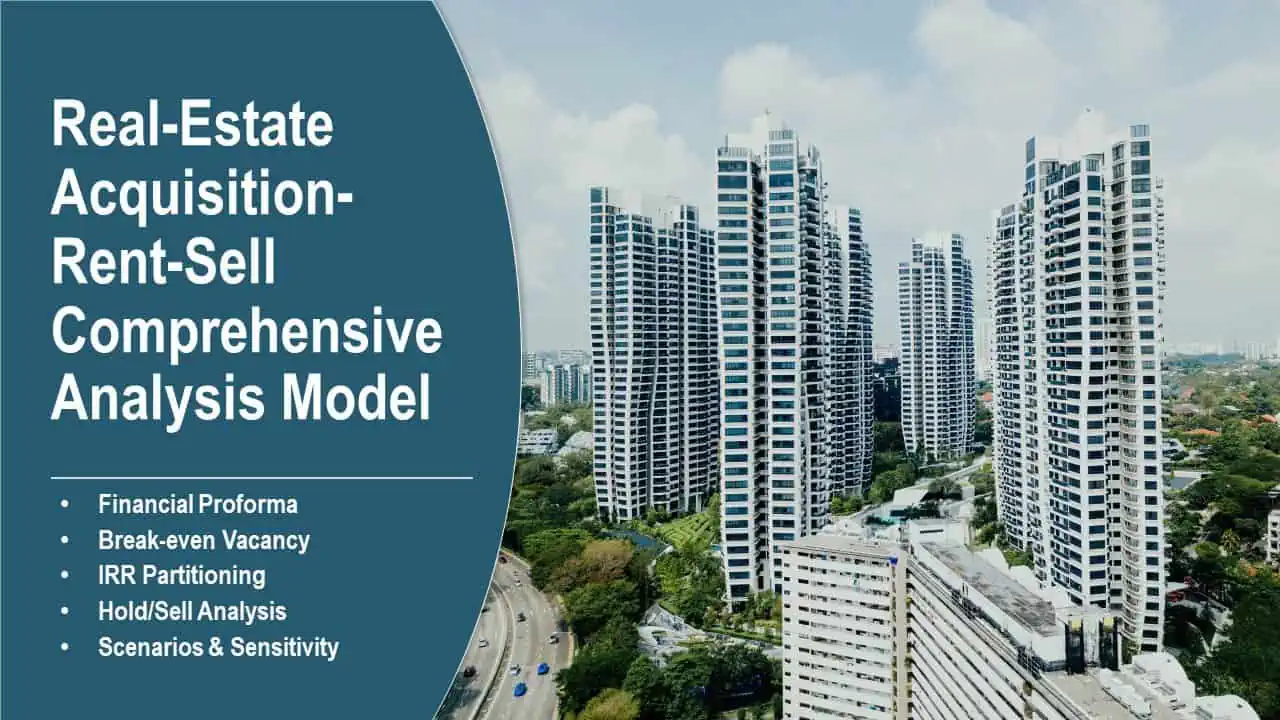
Real Estate Acquisition-Rent-Sell Comprehensive An...
An integrated, dynamic and ready-to-use Real Estate Acquisition-Rent-Sell Comprehensive Analysis Mod... Read more

Multifamily Acquisition-Rent-Sell Financial & ...
We are glad to present our new integrated, dynamic and ready-to-use Valuation & Analysis financial m... Read more

 Eastwich Advisors
Multifamily Rehab Model (Includes Investor Returns...
Introducing the Multifamily Rehab Flip Model with Investor Returns Waterfall - a comprehensive tool ... Read more

 Giorgos
Multi-Family Building Acquisition – 10 Year ...
Financial model presenting an investment scenario of a Multi-Family Building, from the acquisition o... Read more

Residential Building Development Model (Sale, Rent...
Financial model presenting a development scenario for a Residential Building with units available fo... Read more
You must log in to submit a review.