
0 ITEMS

Canada Multi-Unit Rental Financial Model: CMHC MLI Select Points, Premiums and Loan Sizing vs Conventional, Buy or Build, After-Tax IRR
Excel model for a 5 to 300 unit Canadian rental building, bought or built: CMHC MLI Select points, the July 2025 premium schedule, loan sizing on loan-to-value and debt coverage, semi-annual compounding, CCA, recapture and capital gains, compared with MLI Standard and a conventional mortgage after tax. Feasibility and Due Diligence editions, no macros, fully unlocked.
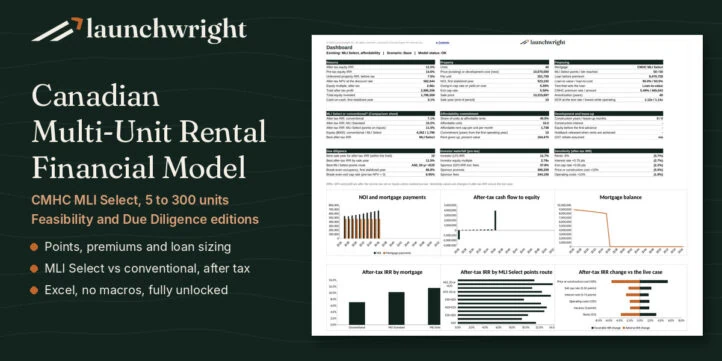
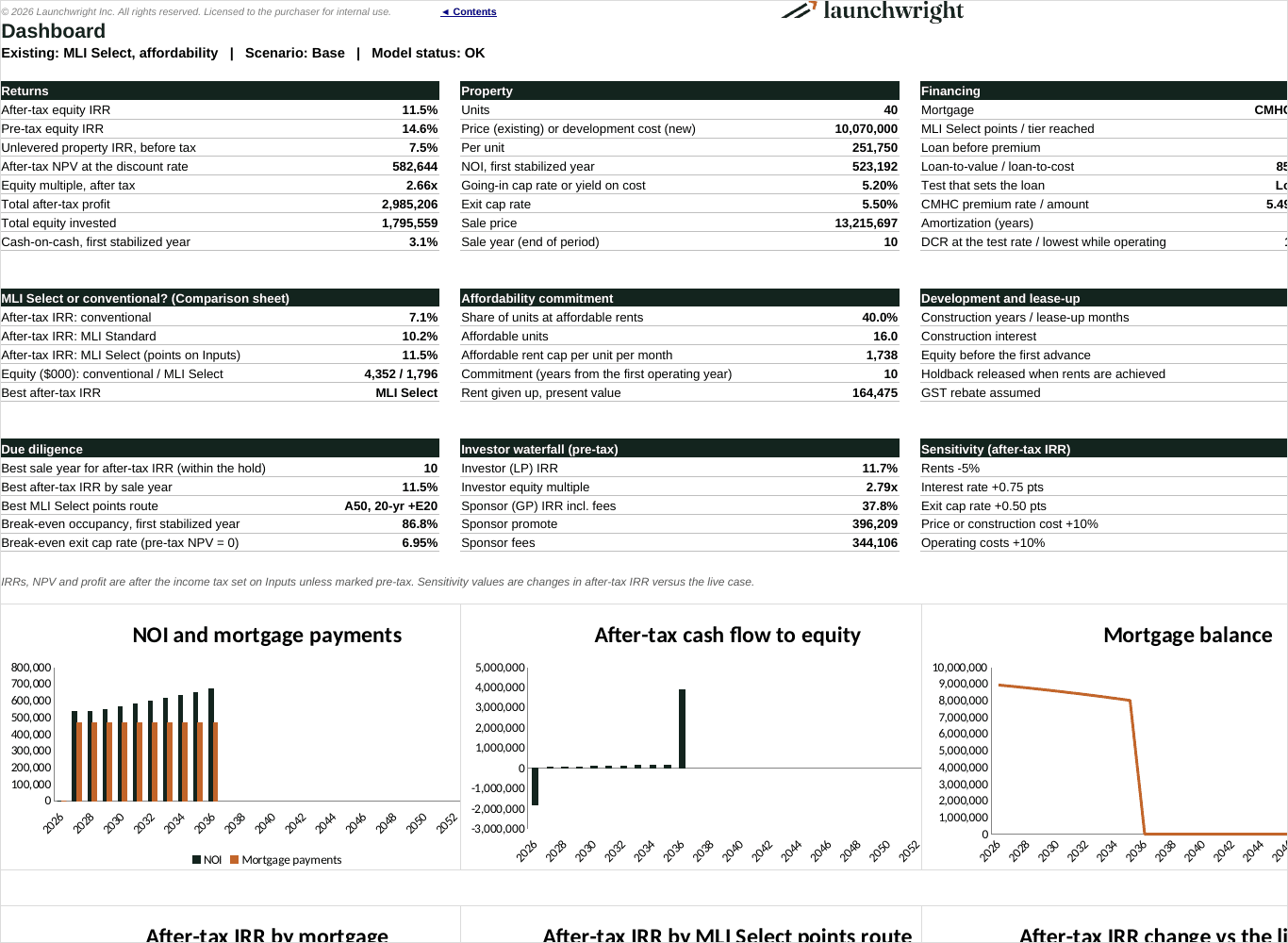
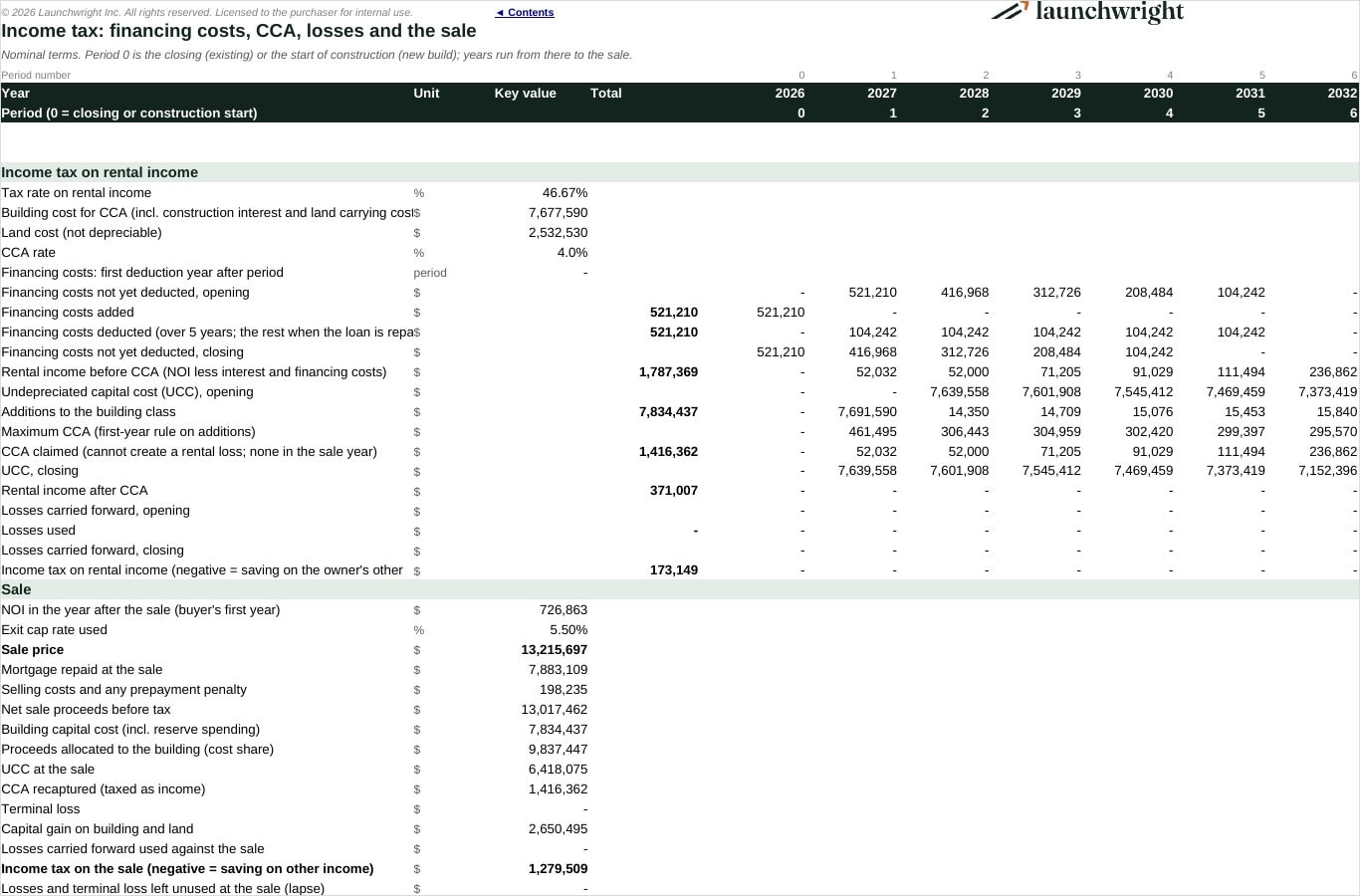
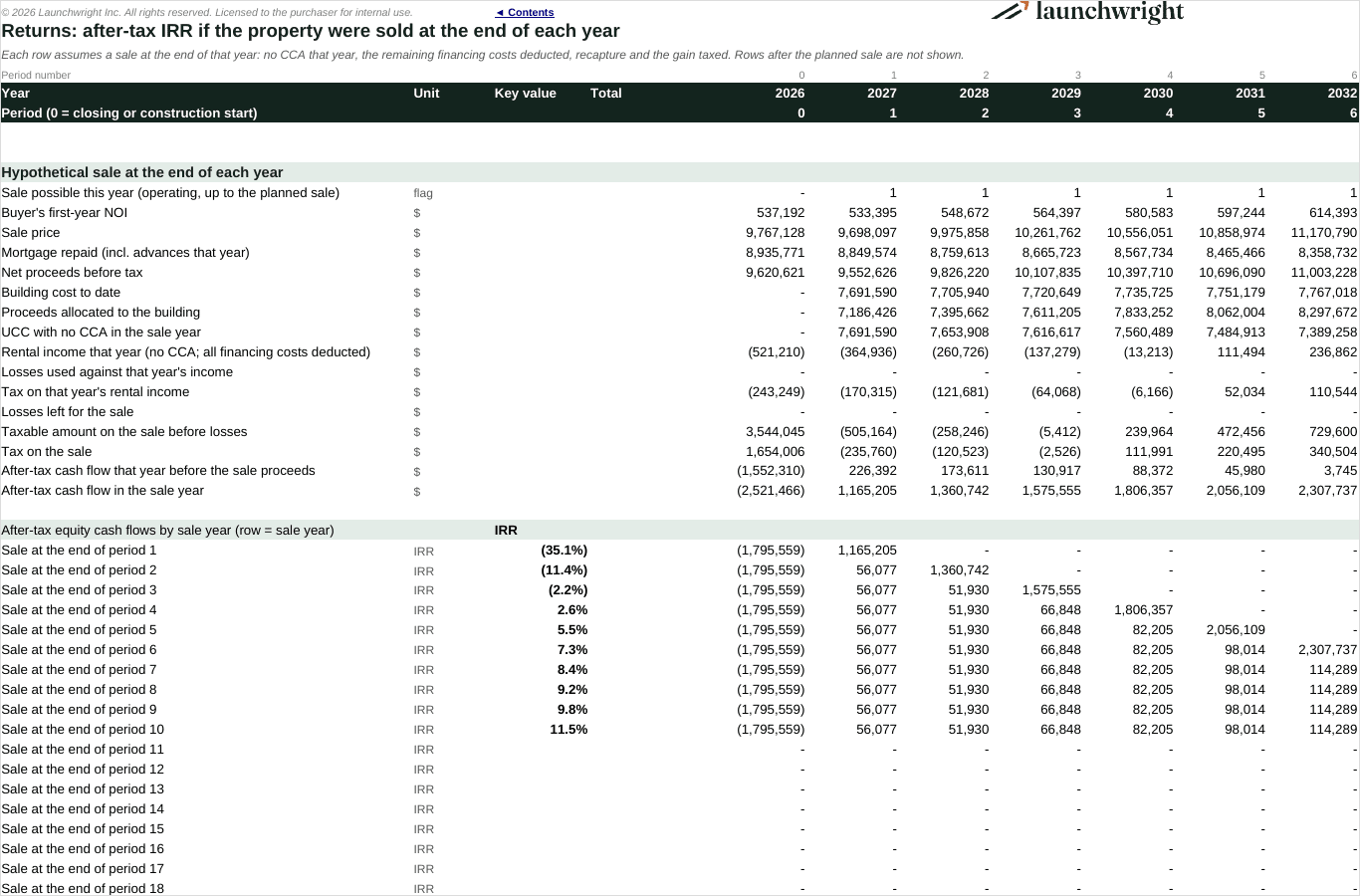
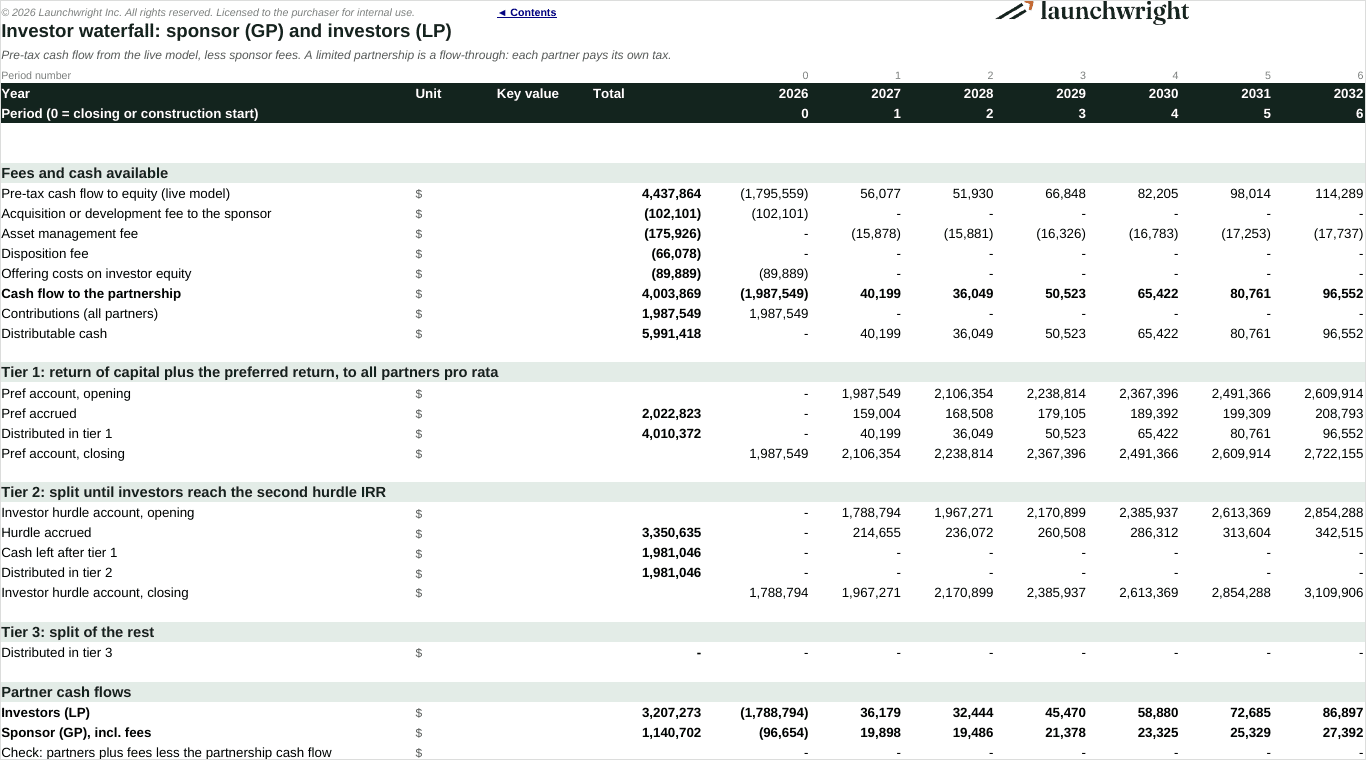
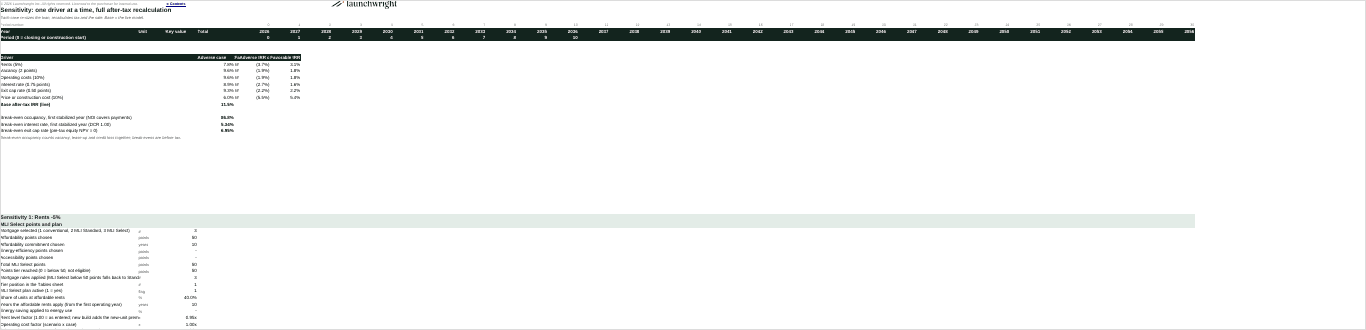
Thinking about CMHC MLI Select for an apartment building? It is the most generous multi-unit financing in Canada, with up to 95% loan-to-value, 50-year amortization and premium discounts of up to 30%. In exchange you commit to affordable rents, energy savings or accessibility. Whether that trade pays depends on your rents, your city’s median renter income, the province’s permitted rent increases and how the debt coverage test sizes your loan. Free online calculators tell you how much you can borrow from one year of NOI. This Excel model tells you whether you should, after tax, through the hold and on sale.
Why this model
It runs the same building three ways, with a conventional mortgage, CMHC MLI Standard and CMHC MLI Select, using one calculation engine, so the comparison is exact. It scores your points, applies the terms CMHC gives at 50, 70 and 100 points, prices the affordability commitment year by year, and shows which test sets the loan. Every default is a published Calgary benchmark or a CMHC, CRA or provincial rule, cited on a Sources tab, so you can see where each starting value comes from before you replace it.
CMHC MLI Select rules built in
- Points for affordability (50, 70, 100, plus 30 for a 20-year commitment), energy efficiency (20, 35, 50) and accessibility (20, 30), with the share of units each level requires for existing buildings and new construction
- Terms by tier: maximum loan-to-value or loan-to-cost, amortization up to 50 years, minimum debt coverage and recourse; below 50 points the model falls back to MLI Standard
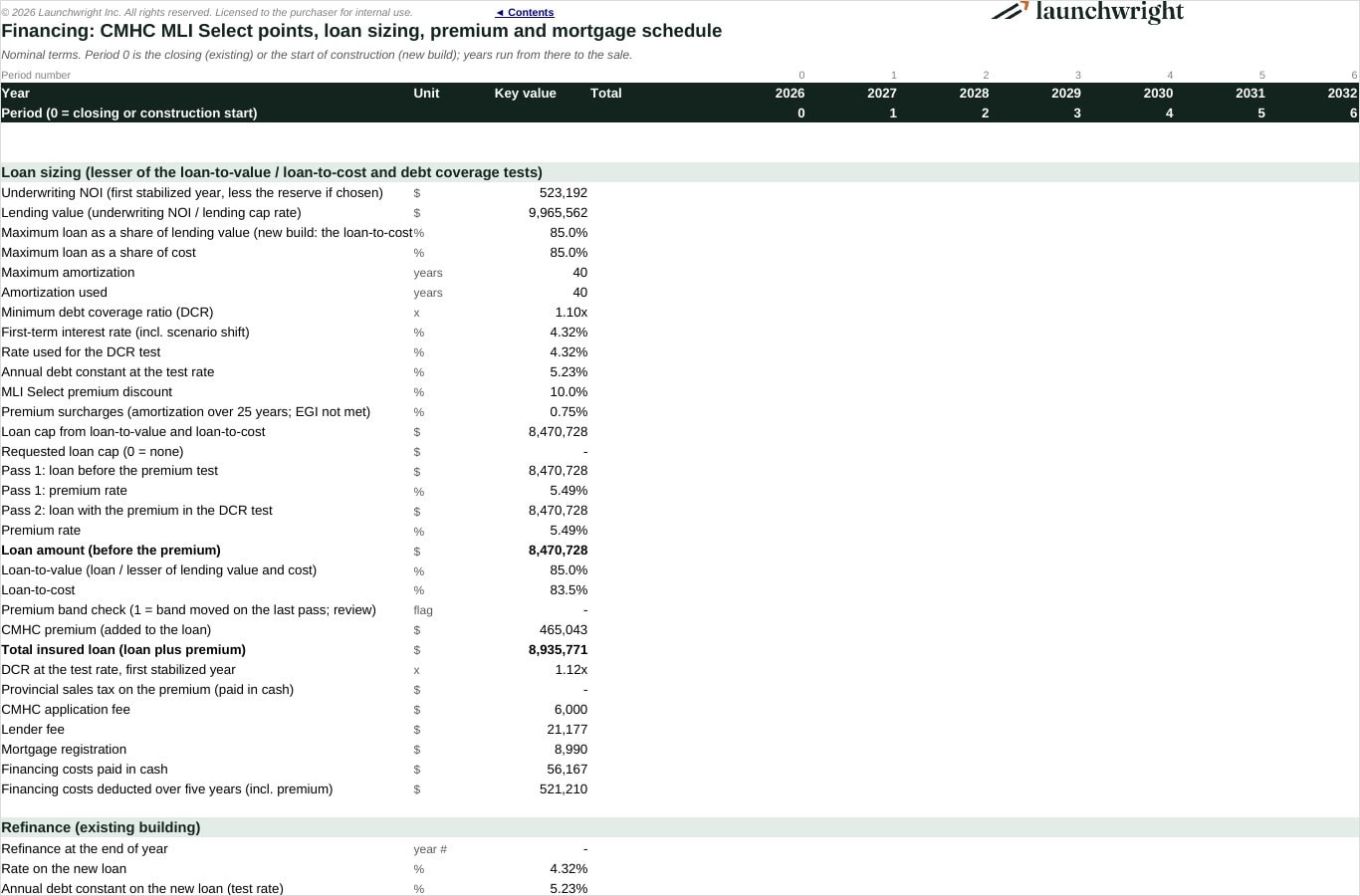
- CMHC’s premium schedule for applications from July 14, 2025: base rate by loan-to-value for construction or purchase, surcharges for amortization over 25 years, the 10%, 20% or 30% MLI Select discount, application fees and refinance credits
- Loan sizing as the lesser of loan-to-value on lending value, loan-to-cost and the debt coverage test at the higher of the contract and floor rate, with the premium included; the binding test is named
- Affordable rents capped at 30% of median renter income from CMHC’s table, with permitted annual increases (Alberta’s 2027 figure is 0.1%), returning to market when the commitment ends
- Monthly payments with semi-annual compounding as the Interest Act requires, term renewals and an optional refinance
Buy existing or build new
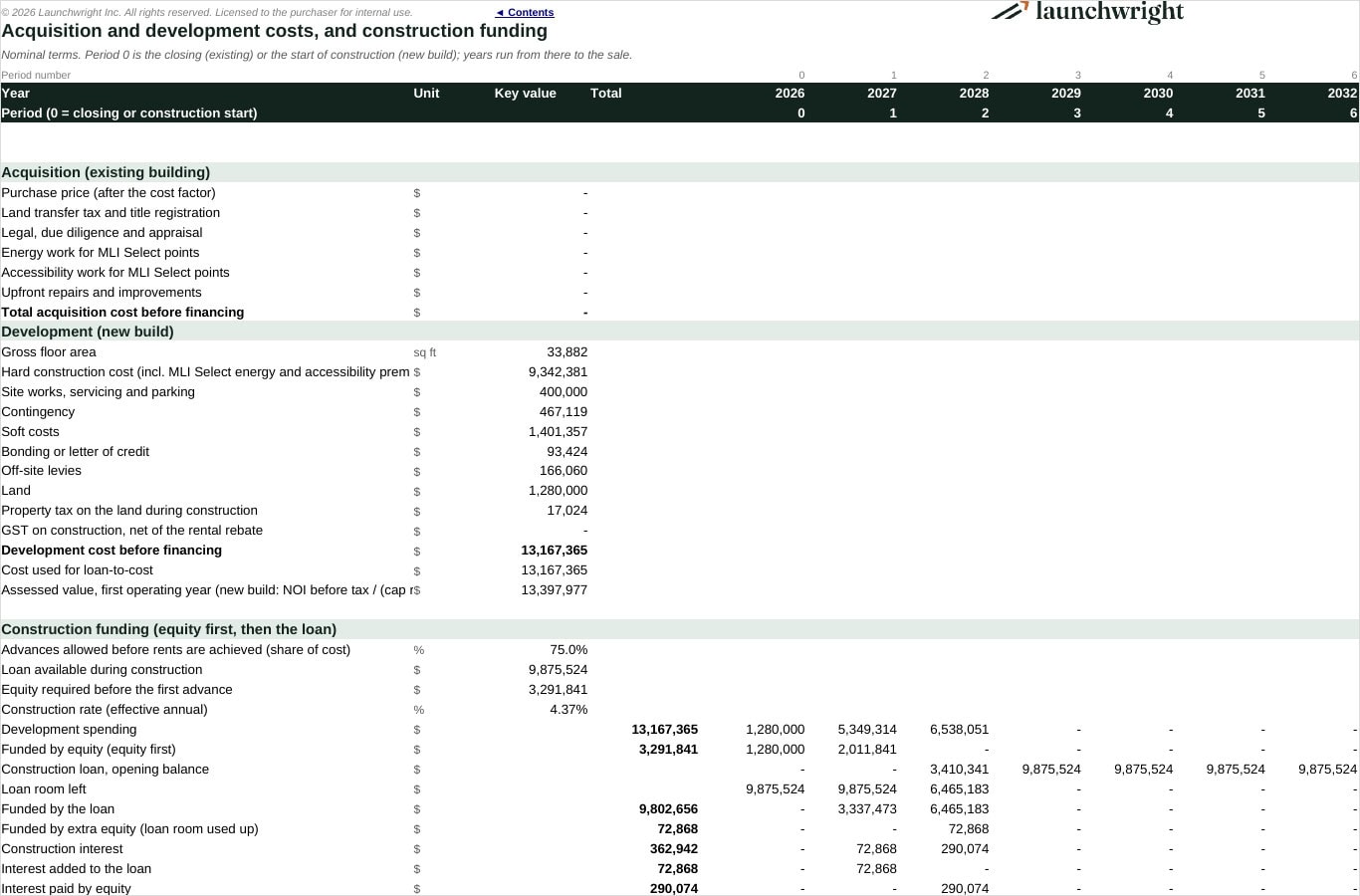
For an existing building: purchase price, land transfer tax and title fees for every province, upfront repairs and the cost of energy or accessibility work for the points. For a new build: hard costs from the Altus cost guide, soft costs, contingency, bonding, Calgary off-site levies, the 100% GST rental rebate, construction funded equity first, capitalized interest, CMHC’s rental-achievement holdback and the Advice 268 advance cap, a lease-up ramp and property tax on an income-approach assessment.
Canadian tax built in
- Corporate investment income at Alberta’s 46.7%, an active business rate, an individual rate or a pre-tax view
- CCA Class 1 at 4%, or 10% for eligible new purpose-built rentals, with the first-year enhancement; CCA never creates a rental loss; losses carried forward or used against other income
- Financing costs and the CMHC premium deducted over five years; construction interest and land carrying costs added to the building cost
- Recapture, terminal loss and capital gains at the 50% inclusion rate on sale
Two editions
- Feasibility Edition: annual model up to 30 years, 5 to 300 units in up to 8 unit types, existing or new build, the full points, premium, loan sizing, construction and tax logic, the three-way mortgage comparison, deal structures, an income statement, cash flow and balance sheet, after-tax IRR, NPV, cash-on-cash, yield on cost, DCR, a dashboard and integrity checks.
- Due Diligence Edition: everything in the Feasibility Edition, plus:
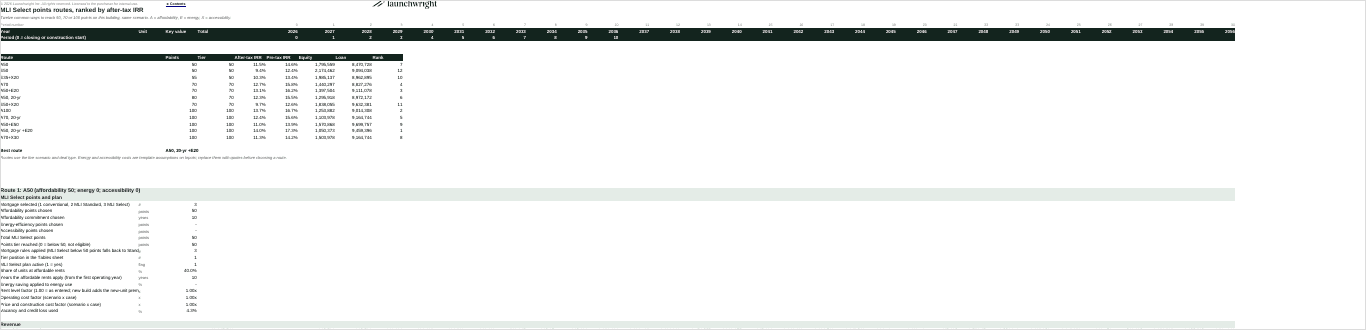
- twelve MLI Select points routes ranked by after-tax IRR, to find the cheapest way to 50, 70 or 100 points
- four editable market scenarios (Downside, Base, Upside, Custom)
- CMHC’s rental-achievement holdback and the Advice 268 advance cap on construction loans
- term renewals at a different rate and a refinance that resizes the loan with the premium credit
- after-tax IRR for every possible sale year
- twelve live sensitivity cases, each fully recalculated after tax, with a tornado chart, break-even occupancy, break-even interest rate and break-even exit cap rate
- an LP/GP investor waterfall with a compounding preferred return, a second hurdle, promote splits, sponsor fees and offering costs
Key outputs
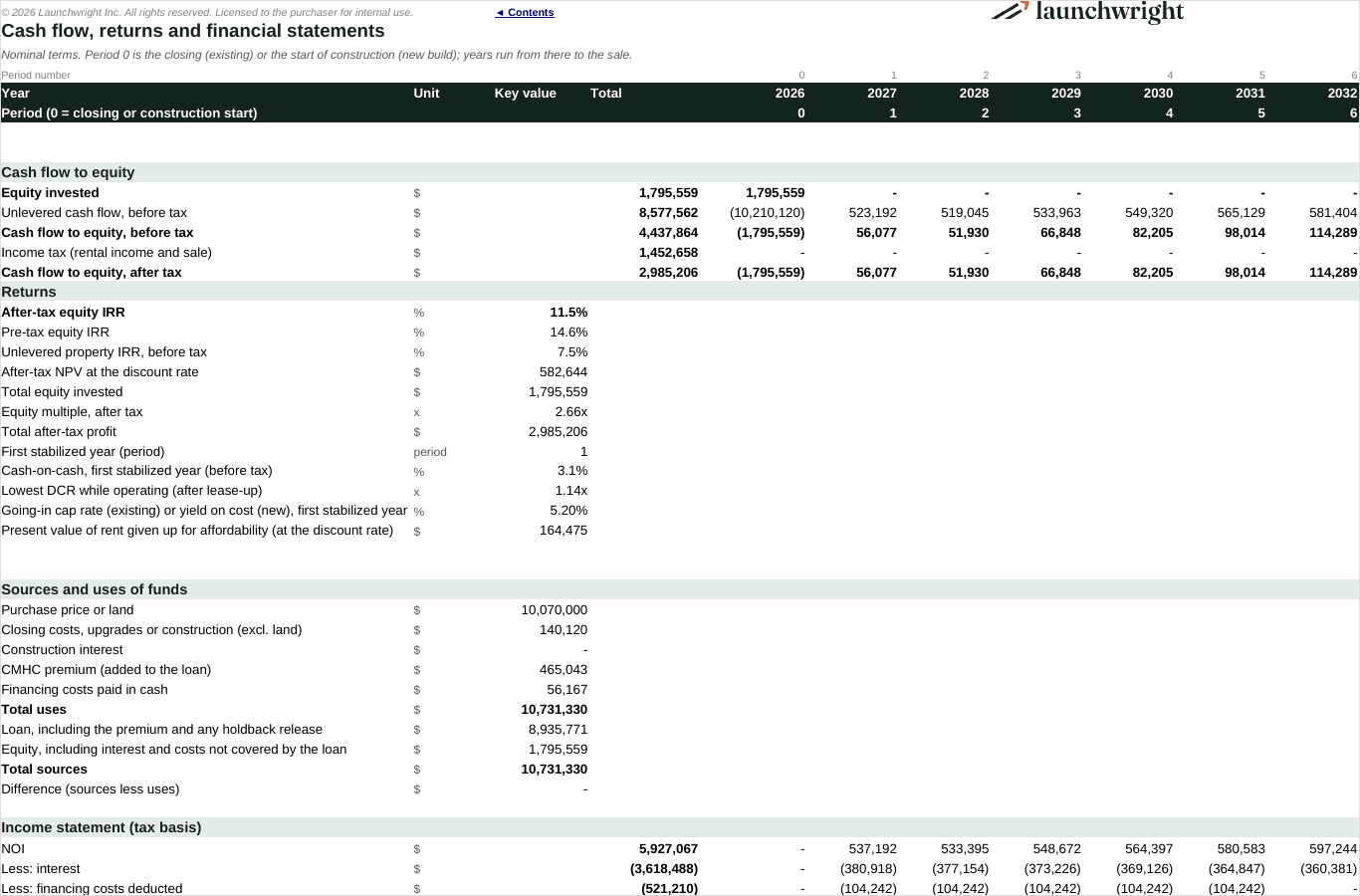
- After-tax and pre-tax equity IRR, unlevered IRR, NPV, equity multiple and total profit
- Loan amount, loan-to-value, loan-to-cost, the test that sets the loan, premium rate and amount, amortization and debt coverage
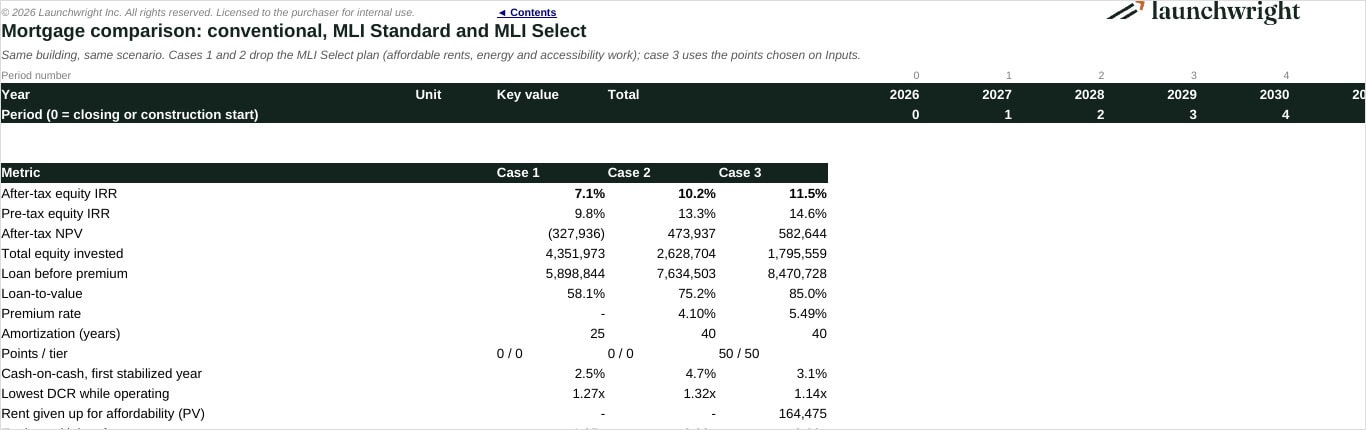
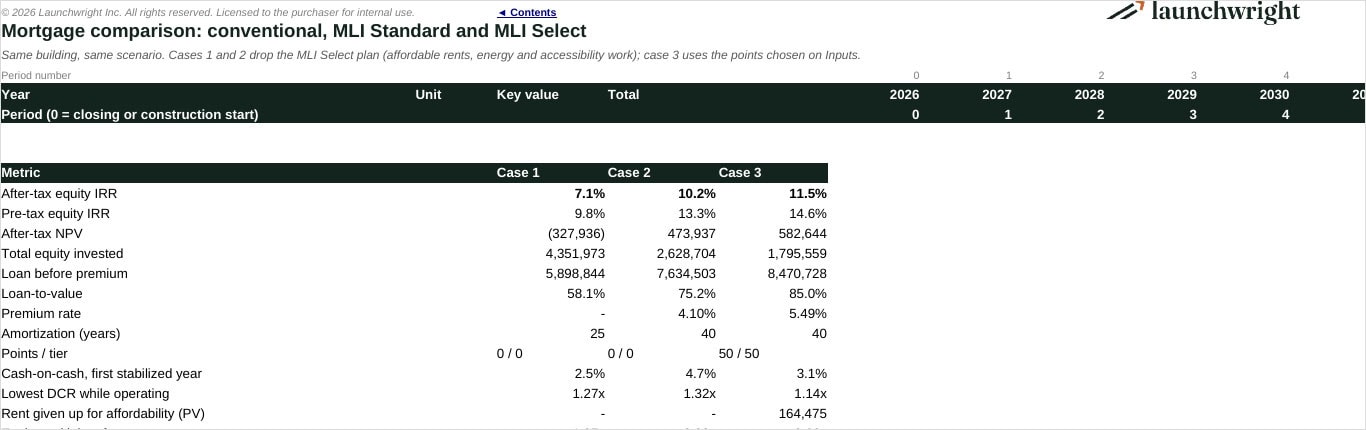
- Side-by-side results for conventional, MLI Standard and MLI Select on the same building, and the present value of rent given up for affordability
- Sources and uses, development cost and yield on cost, construction interest, holdback release and equity required
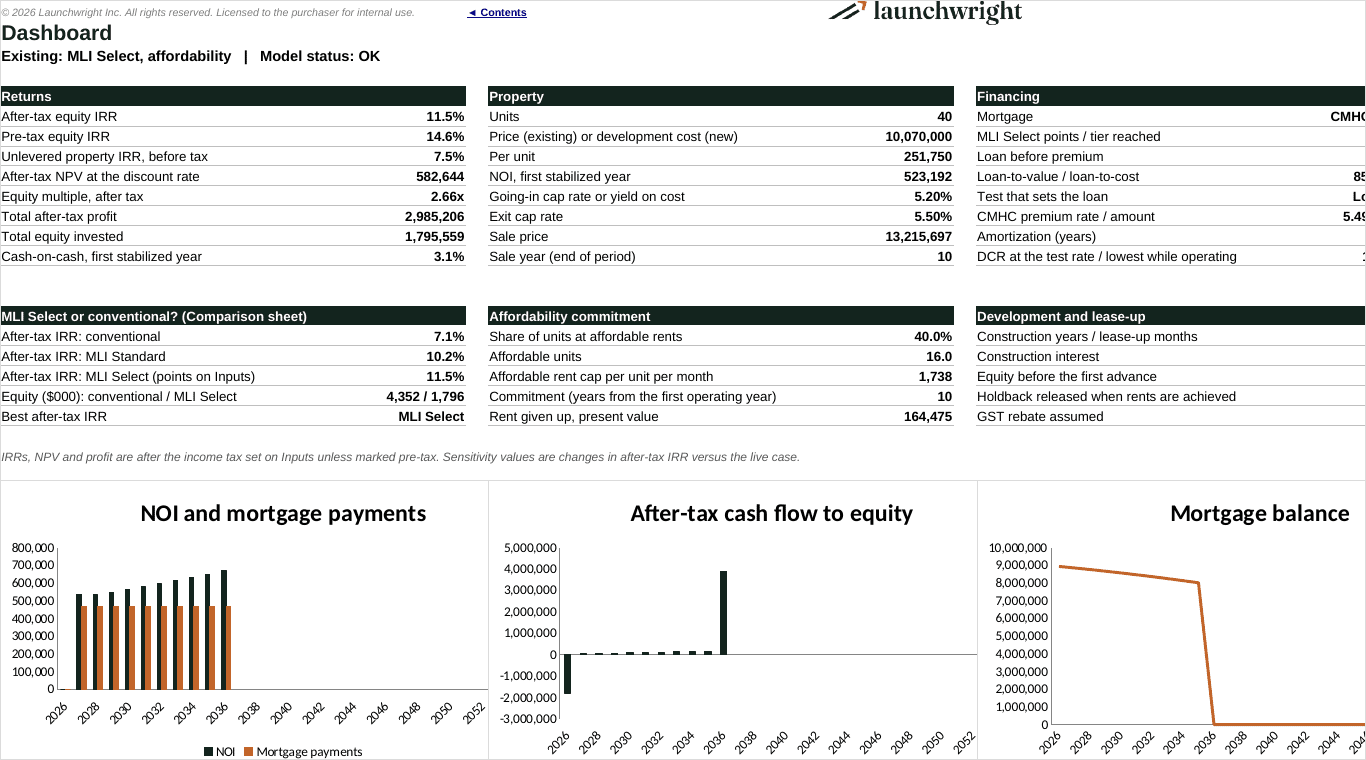
- Dashboard charts: NOI against mortgage payments, after-tax cash flow, mortgage balance, IRR by mortgage, IRR by points route, sensitivity tornado and IRR by sale year
Built to modeling best practice
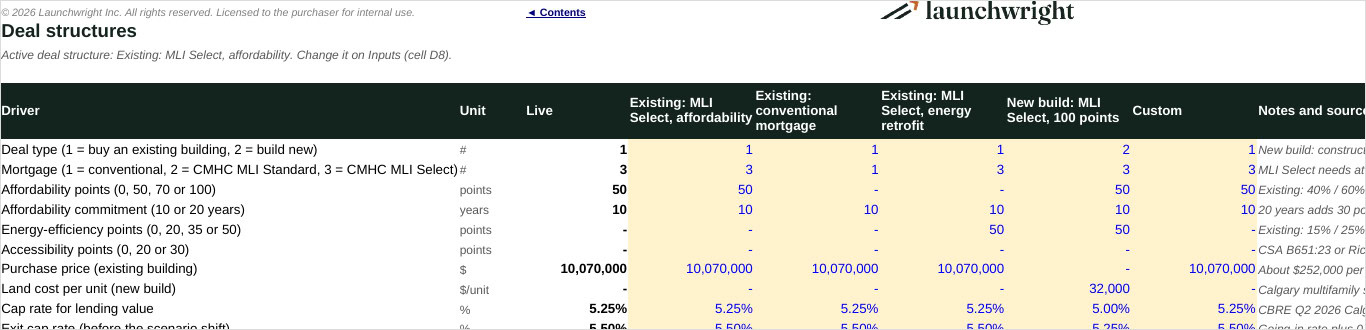
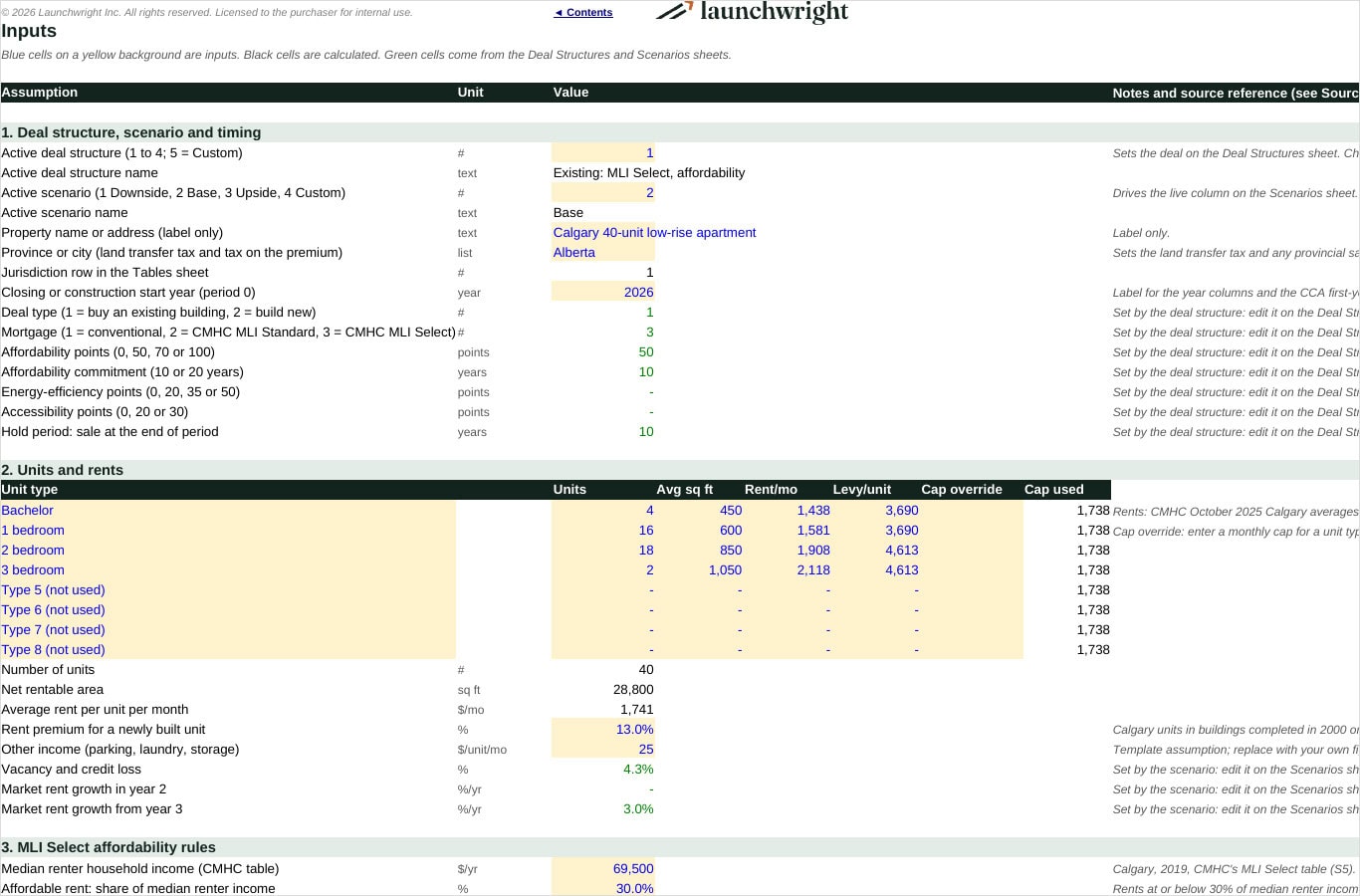
- Inputs, calculations and outputs on separate sheets; color-coded inputs (blue on yellow), formulas (black) and links from deal structures and scenarios (green)
- One formula per row across 31 annual columns; CMHC rules and tax constants on a Tables sheet, so a rule change is one edit; no macros, no circular references, no hidden or protected sheets, no external links
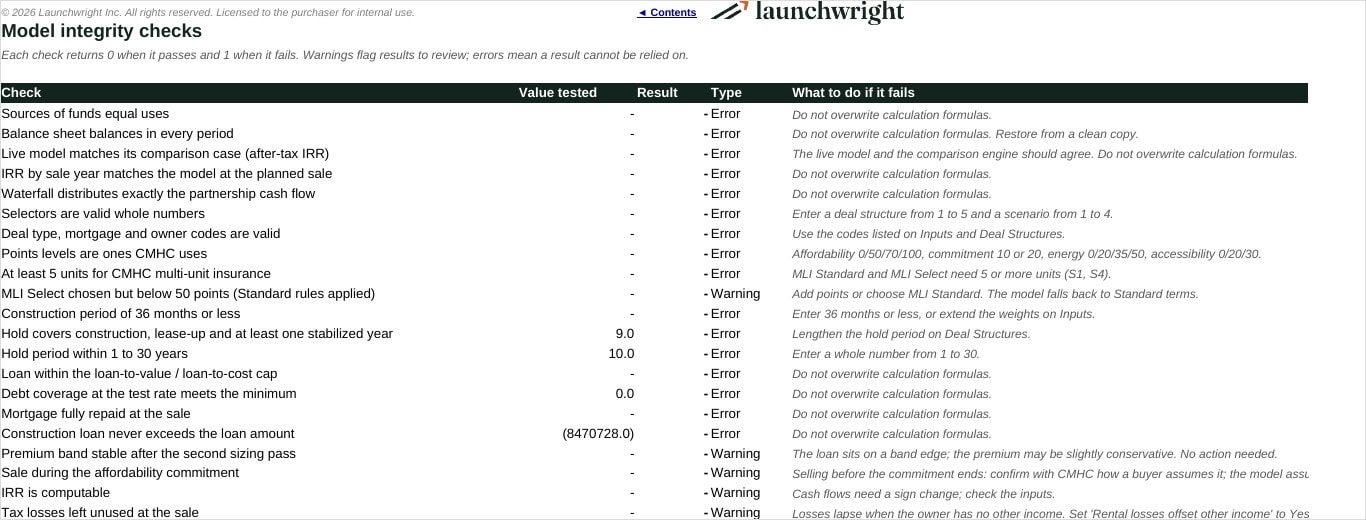
- Checks sheet confirms the balance sheet balances, sources equal uses, the mortgage is repaid, the loan meets every cap, the live model matches the comparison engine and IRR by sale year agrees with the model, and warns on points below 50, a sale inside the affordability commitment or unused tax losses
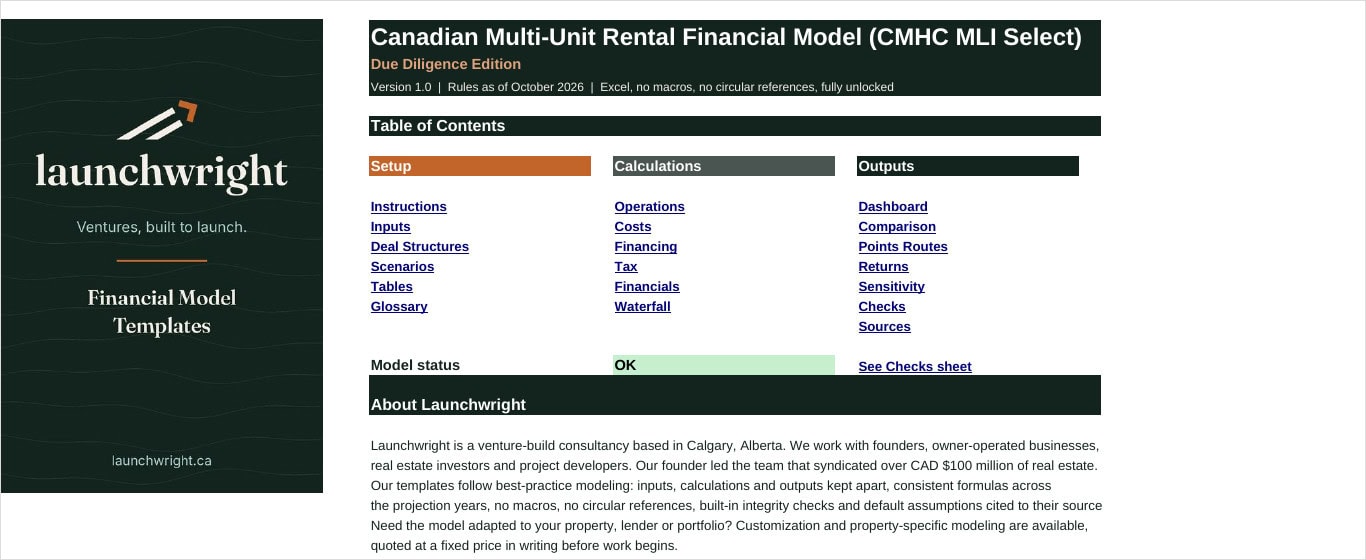
- Contents sheet with links, step-by-step instructions, a glossary and a full source list
Default assumptions
Defaults describe a 40-unit Calgary low-rise bought for $10,070,000 ($251,750 per unit), a 5.50% going-in cap rate on its as-is NOI from CBRE’s Calgary Class B range, with CMHC’s October 2025 Calgary rents, long-run Calgary rent growth and vacancy from CMHC’s data back to 1990, Calgary’s 2026 tax rate, operating costs benchmarked to Boardwalk REIT and an insured rate of 4.32% (the 5-year Government of Canada yield of 3.54% plus a published 55 to 100 basis-point spread). Owned by a corporation taxed at 46.7%, the MLI Select case at 50 affordability points earns an after-tax IRR of 11.5% (14.6% before tax) on equity of $1,795,559, against 10.2% with MLI Standard on $2,628,704 and 7.1% with a conventional mortgage on $4,351,973. The best of the twelve points routes on this building is A50, 20-yr +E20 at 14.0% after tax. The new-build structure prices a 40-unit wood-frame building from Turner & Townsend’s Calgary costs, published soft-cost and land benchmarks and CMHC’s rents for newer buildings: $13,167,365 in total, a 5.1% yield on cost and an after-tax IRR of 8.9% with 100 MLI Select points from affordability and energy, against 5.7% with conventional debt. The Downside scenario stresses rents, vacancy, rates, costs and the exit cap rate together. Replace the defaults with your own quotes, rent roll and lender terms.
What you get
- One Excel workbook (.xlsx) for the edition purchased, built only with functions available since Excel 2010 (no dynamic arrays, no macros)
- A free PDF demo showing the main sheets of the Due Diligence Edition
Support and customization
Questions about how the template works are answered by email. Launchwright can also adapt the model to your building, lender, CMHC application or investor offering, quoted at a fixed price in writing before work begins. Contact details are inside the model.
Important
This template is for planning and illustration. CMHC decides eligibility, lending value, points and premiums on each application, and its rules change often; the rules in this version are as published in October 2026. It is not investment, tax, legal or mortgage advice. Confirm the rules with your lender, CMHC and your accountant.
Similar ProductsOther customers were also interested in...



 eFinancialModels
Electric Vehicle (EV) Charging Station Financial M...
With this comprehensive 5- or 10-year monthly tool, investors can assess the viability of setting up... Read more

Financial Model for Mobile App | Mobile App Busine...
The Mobile App Financial Plan Template in Excel allows you to develop financial projections when lau... Read more

 HenrySheykin
Food Truck Financial Model Excel Template
The Food Truck Financial Model helps entrepreneurs, founders, business owners, consultants, and anal... Read more

Green Hydrogen Production from Wind Energy Financi...
The Green Hydrogen from Wind Financial Model aims to comprehensively forecast a horizon of 40 years ... Read more

Simple Mutual Non-Disclosure Agreement Template
Protect your business secrets with ease using our Simple Mutual Non-Disclosure Agreement Template. S... Read more

Solar Energy Financial Model
The Solar Energy Financial Model Spreadsheet Template in Excel assists you in preparing a sophistica... Read more

 Peter Graf
The Customer-Centric Financial Model for Restauran...
Starting a restaurant without a financial plan is like driving a car blindfolded. You wouldn´t do i... Read more
You must log in to submit a review.