0 ITEMS

Franchise Due Diligence: How to Check If Numbers Are Realistic

A franchise’s numbers are realistic when every earnings claim traces to written substantiation, matches what existing franchisees report, and still covers loan payments after a sales haircut. This checklist tests the claims against Federal Trade Commission rules, Small Business Administration eligibility and loan-term rules, and International Franchise Association guidance, with a worked example and five litigation and enforcement cases.
Key Takeaways
- US federal rules require the disclosure document at least 14 calendar days before signing, and any earnings claim needs a reasonable basis.
- An average in Item 19 can hide weak outlets, so buyers should ask which outlets the average covers and call existing franchisees.
- In the illustrative worked example, the pitch case reaches 2.32x coverage against an assumed 1.25x minimum, while the buyer-tested case reaches only 0.64x.
- Five cases from 2015 to 2026 show enforcement over earnings and disclosure failures, while one court enforced disclaimers against a buyer who relied on earnings claims.
- An SBA directory listing is not an endorsement, so independent legal and accounting review remains the last gate before signing.
Start with the Rule: Item 19 Needs a Reasonable Basis
The rules below are US federal and state rules; buyers elsewhere should ask local franchise counsel which regime applies. The Federal Trade Commission (FTC) Franchise Rule requires the franchisor to furnish its Franchise Disclosure Document (FDD) at least 14 calendar days before the buyer signs a binding agreement or makes any payment, according to the FTC compliance guide. The 14 days is the earliest point at which signing or payment may happen, not a deadline to hurry toward. Any financial performance claim, which the FDD places in Item 19, needs a “reasonable basis,” and buyers have a legal right to written substantiation, according to the FTC franchise fundamentals guidance from July 2023.
The same FTC guidance warns that “a hope or a hunch isn’t enough” and that calculating earnings by averages can let a few highly successful outlets hide weak ones. A 2024 FTC Issue Spotlight relayed unverified franchisee comments: one said the FDD indicated a “41% profit margin” while “81% of owners are profiting less than $2,500 a month or losing money,” and another reported a build-out that “totaled $535,000” against a listed $270,000 to $350,000 (FTC Issue Spotlight, 2024).
Step-by-Step: Validate Franchisor Numbers Using FTC, SBA and IFA Guidance
- Confirm timing and registration. The 14 days begin the day after delivery, so the earliest signing or payment date is the fifteenth day, per the compliance guide above. State rules vary: the New York Attorney General requires registration before any sale in or from New York, and a state securities administrators’ table lists which states have authority to regulate franchises or business opportunities.
- Read what Item 19 actually covers. Check the outlets included, the period, and whether it reports revenue, costs or profit. In the 2024 Annual Franchise Development Report, a self-reported survey of 120 brands, 86 percent said they provide financial performance claims and 53 percent disclosed profitability, according to Franchising.com.
- Ask for written substantiation. Request the support behind every earnings claim in writing, and treat a refusal as a finding rather than an inconvenience.
- Call existing franchisees. The International Franchise Association (IFA) advises buyers to ask current owners whether, with today’s knowledge, they would still invest, in its due diligence steps.
- Rebuild the unit economics. Compare the Item 7 investment table with local build-out quotes, read the Item 20 outlet closures and the audited Item 21 statements, then replace the pitch’s costs with local rent, wages and an owner salary and apply a sales haircut sized from the gap between Item 19 and what franchisees report; the worked example below applies only a haircut and an owner wage.
- Test the loan. The Small Business Administration (SBA) requires a brand to appear in its Franchise Directory for SBA financing, and states that a listing does not ensure the success of the business. Under SBA 7(a) terms, equipment loans and working capital, meaning the cash that funds daily operations, run up to 10 years, and real estate loans up to 25 years. The lender, not the SBA, sets the coverage minimum, so compute the debt service coverage ratio (DSCR) against that minimum. This article uses a simplified DSCR, meaning earnings before interest, taxes, depreciation and amortization (EBITDA) divided by annual loan payments, although lenders may use cash flow after tax instead; the debt service coverage models at eFinancialModels show the layout.
- Close with independent review. A franchise attorney and an accountant should read the FDD before any signature (see the financial due diligence resources).
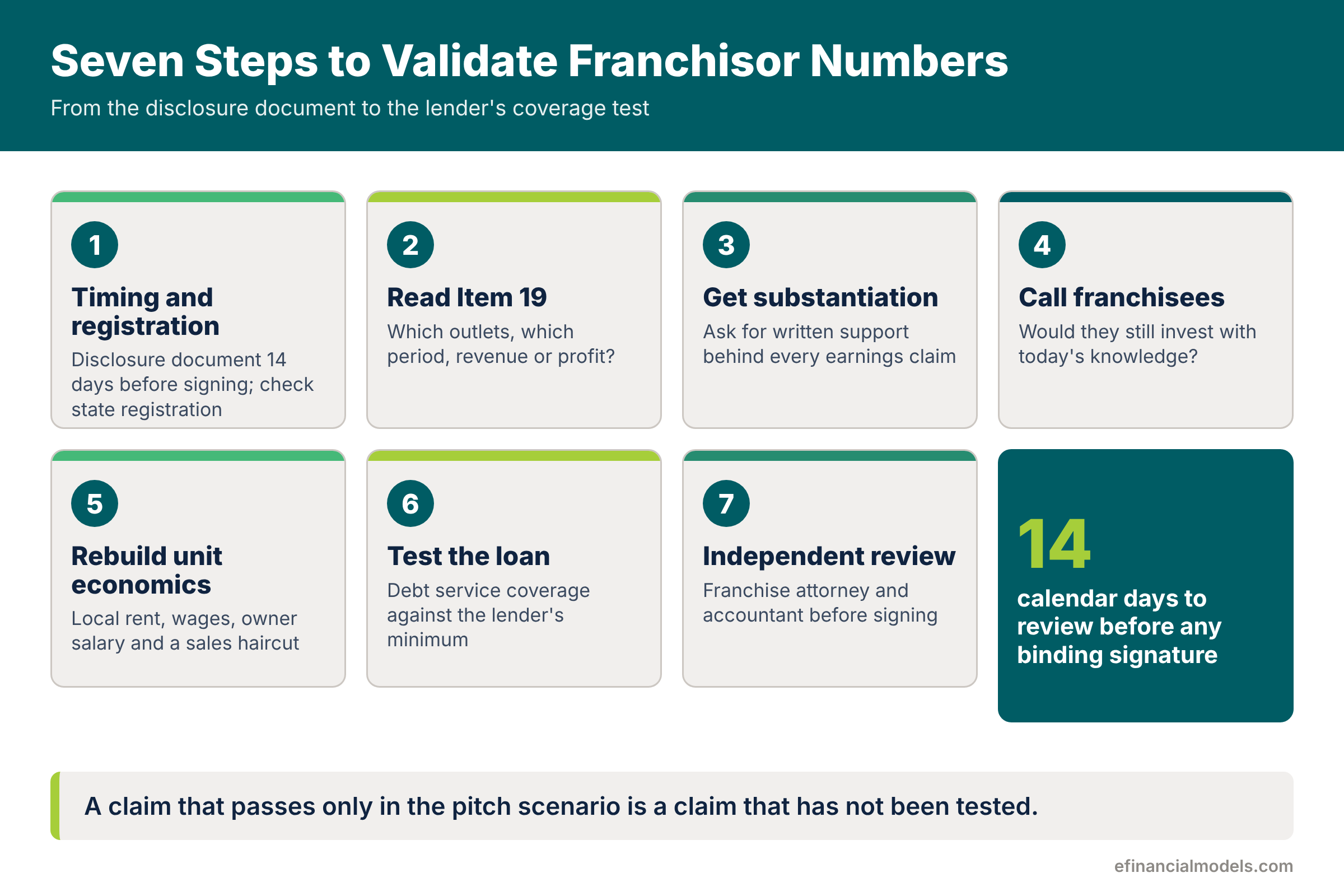
The seven validation steps in order, drawn by eFinancialModels from the federal, SBA and IFA sources cited above.
Worked Example: Pitch Case Versus Buyer-Tested Case
The example below is illustrative, with all amounts in US dollars. Assume a fictional Example Café franchise whose Item 19 pitch reports average annual sales of 900,000. Assume a total investment of 600,000 (the Item 7 estimate, held constant), funded by a 70 percent loan of 420,000 at 10.5 percent over 10 years with annual payments. Assume costs of goods at 30 percent, labor at 27 percent, royalty at 6 percent and brand fund at 2 percent of sales, plus fixed occupancy of 72,000 and other operating costs of 81,000. Annual debt service then equals 69,828.
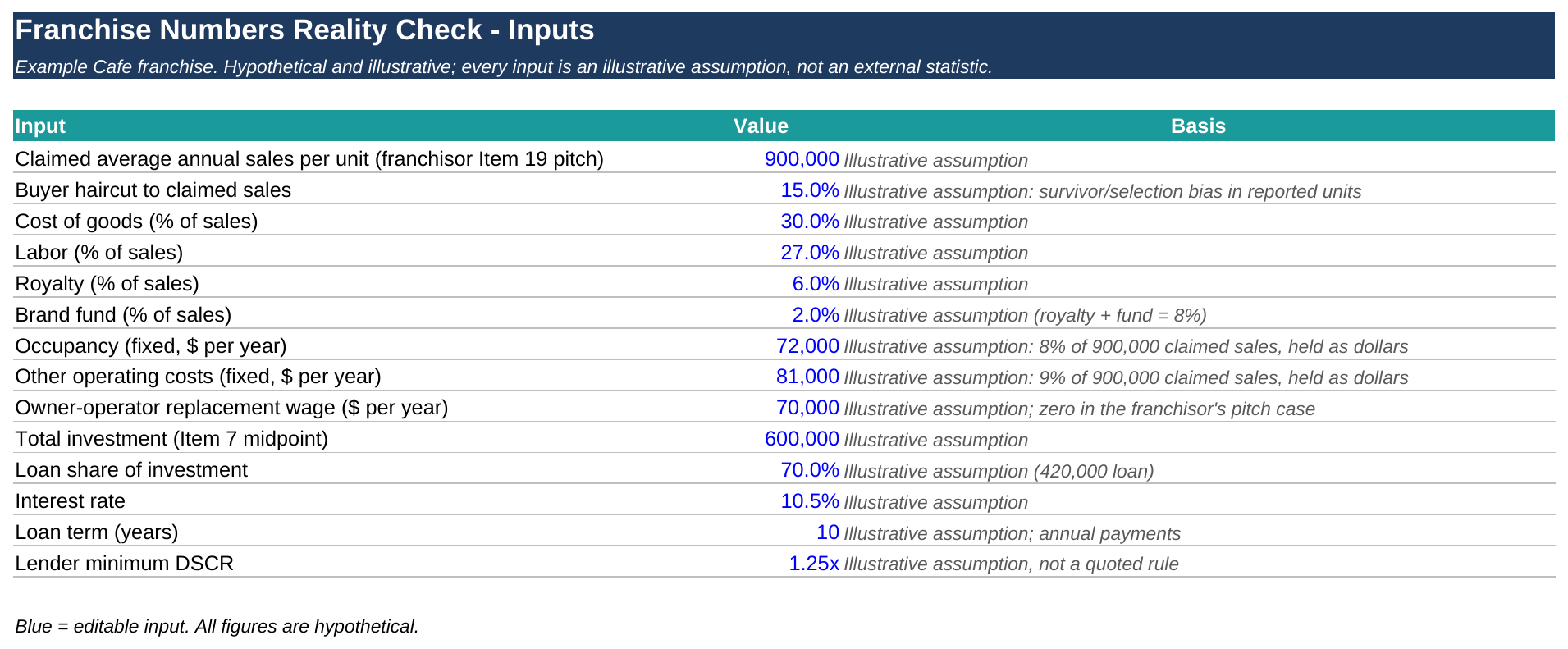
Every number the model uses sits on one sheet, so a buyer can change an assumption and watch the verdict move.
The pitch case leaves no owner salary and uses the full 900,000. EBITDA equals 162,000, giving a DSCR of 2.32x. A rough screening payback, meaning investment divided by annual EBITDA, comes to 3.7 years; it ignores tax, debt service and working capital, so a full payback test uses after-tax cash flow. The buyer-tested case applies an illustrative 15 percent haircut, because Item 19 averages can leave out closed units and overstate typical sales, so sales fall to 765,000, and adds a 70,000 owner wage.
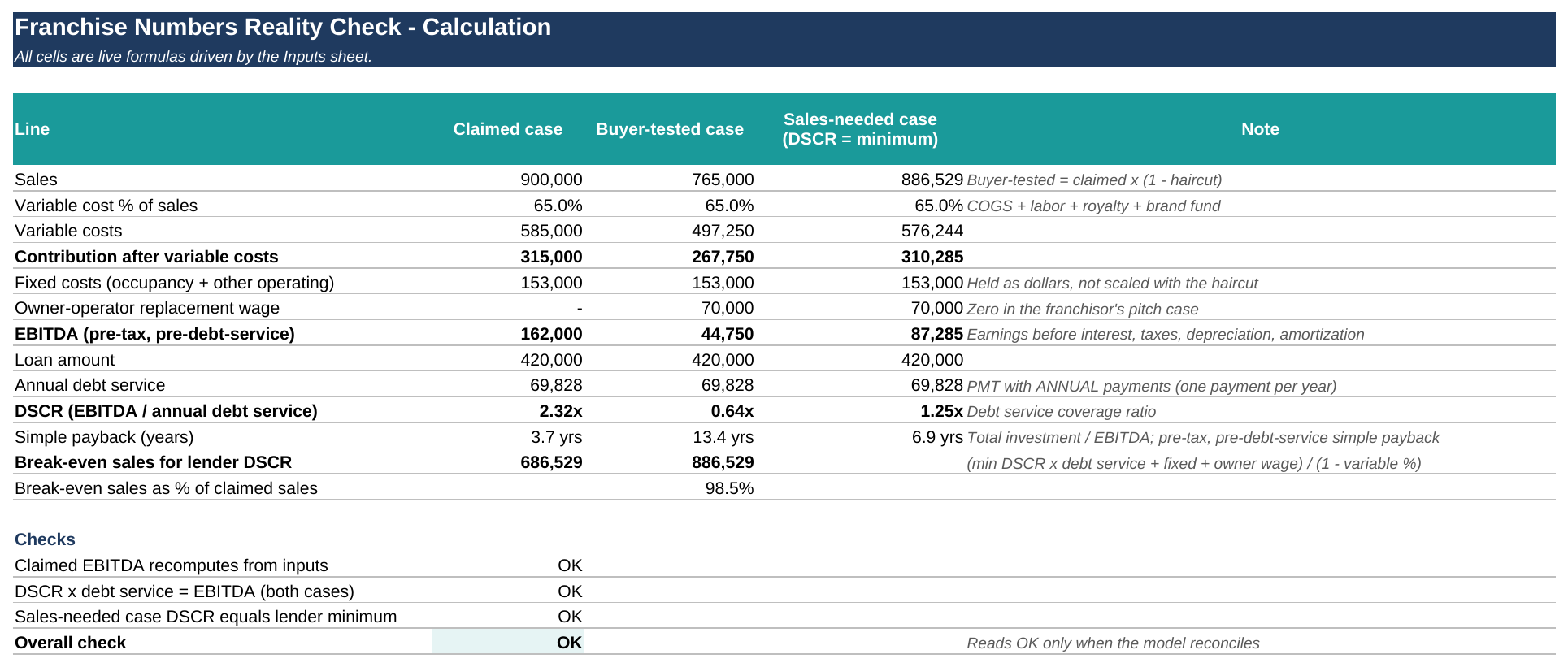
The claimed and buyer-tested columns differ only by the sales haircut and the owner wage, which turns a comfortable coverage ratio into a failing one.
Buyer-tested EBITDA drops to 44,750, DSCR to 0.64x and the same rough screening payback to 13.4 years. Against an assumed lender minimum of 1.25x, the pitch case passes and the buyer-tested case fails. Sales must reach 886,529 for the loan to clear that bar, which is 98.5 percent of the claim. That figure equals 1.25 times debt service of 69,828, plus fixed costs of 153,000 and the 70,000 owner wage, divided by the 35 percent of sales left after variable costs.
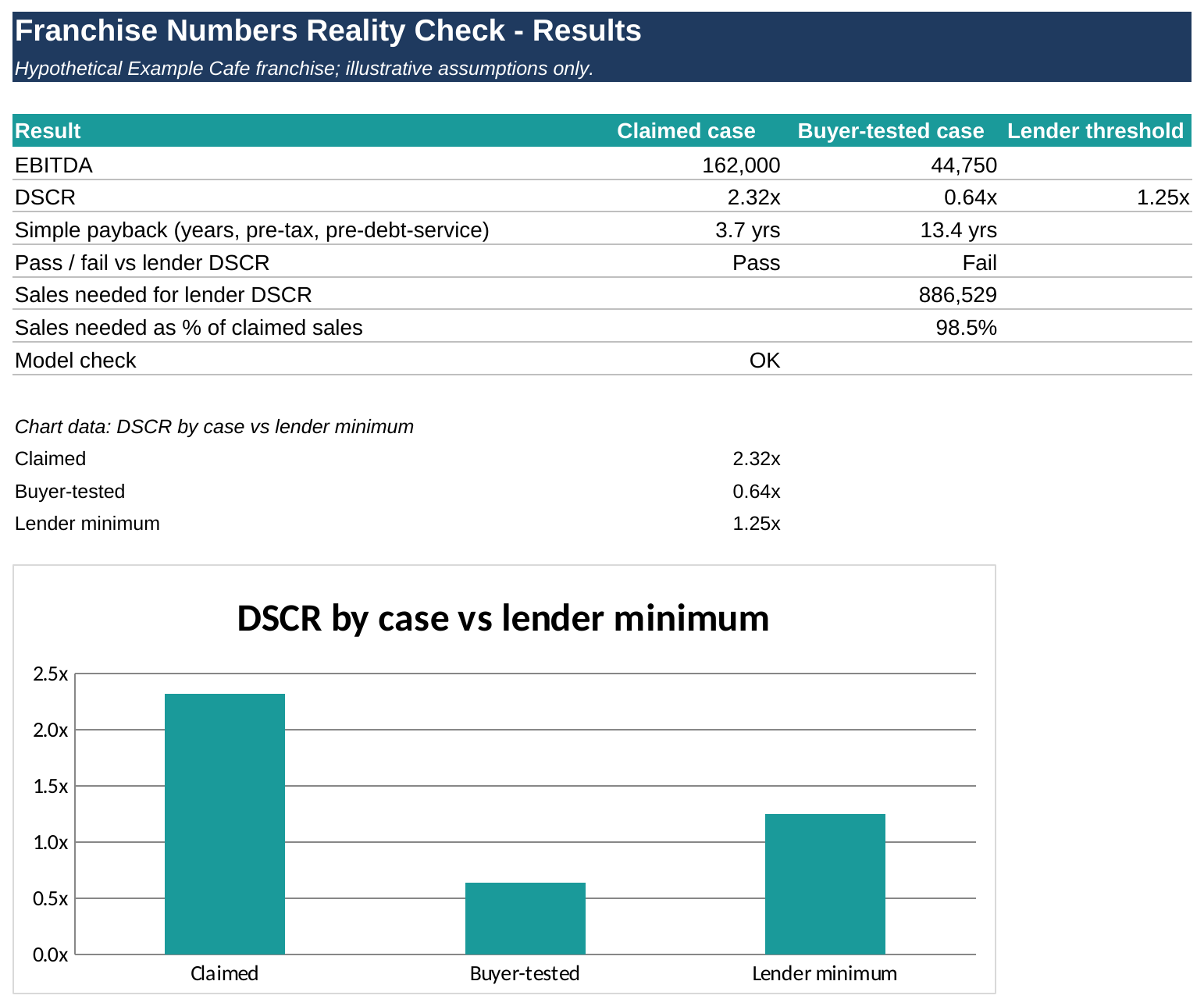
Against a 1.25x lender minimum, only the franchisor’s pitch case passes, and the sales needed to pass are about 98.5% of the claim.
The claim only works if the unit hits almost the entire advertised average.
Five Enforcement and Court Cases: What Went Wrong with the Numbers
- United States v. Burgerim Group USA (2024). In a case the FTC brought over Franchise Rule violations, a federal court in California entered a default judgment on 19 January 2024, including a $7.75 million civil penalty, calculated per franchise sale. The FTC alleged disclosure failures that included financial performance representations missing from, or contradicting, its disclosure document.
- FTC v. Premier Franchising Group (2026). The FTC alleged the franchisor lacked a reasonable basis to know whether studio earnings were representative. Proposed settlements announced in October 2026 total $1.85 million for franchisees and take effect only on court approval.
- Smash Franchise Partners, Washington (2024). The state’s Department of Financial Institutions alleged that an Item 19 net profit of $730,780.76 for August 2017 to August 2018 included undisclosed revenue streams and used a favorable time frame instead of the regular accounting period. The respondents neither admitted nor denied the finding and paid $8,350 in costs.
- Nufinishpro, California (2025). A March 2025 consent order found the franchisor provided an inflated financial performance representation contrary to its FDD, imposing a $25,000 penalty and a duty to disclose the order in future FDDs.
- Legacy Academy v. Mamilove (Georgia, 2015). A franchisee alleged false earnings claims in a 2001 pre-contract pitch, which projected net income of $260,000 for year one and $440,000 for year two. The Georgia Supreme Court reversed in part, holding that disclaimer and merger clauses in the contract barred reliance, and remanded for a new trial.
Regulators act after the fact, so a buyer should verify claims in writing against the FDD first.
Frequently Asked Questions
What coverage ratio should a franchise loan clear?
Each lender sets its own minimum, so the 1.25x used in the example is an assumption rather than a rule. Ask the lender for its written threshold, then run the buyer-tested case against it with a cushion for a slow first year. A ratio that passes only in the pitch scenario signals that the loan depends on the franchisor being right about everything. Seasonal brands may need a larger cushion because monthly cash flow swings widely.
What if the franchise has no Item 19 at all?
A franchisor may elect not to make financial performance claims at all, and the FTC compliance guide says that when it does, the Franchise Rule requires disclosures and substantiation. Any figure a salesperson quotes outside the disclosure document is therefore a warning sign. Build a bottom-up forecast from local quotes and franchisee interviews instead, and expect lenders to scrutinize it harder because no disclosed benchmark supports the projections.
What should a buyer do if the franchisor will not substantiate a claim?
Request the refusal in writing and hold off signing or paying until the answer arrives. If the claim appears outside the disclosure document, keep a copy and raise it with a franchise attorney, who can judge whether to report it to a state regulator or the FTC. Written answers also create the record that regulators and courts weigh later. Never sign on the strength of a number nobody will support.
Who should review the documents before signing?
A franchise attorney should read the agreement, the disclaimers and any renewal or transfer terms, while an accountant should rebuild the unit economics and the loan test. Bring the FDD, the franchisee contact list from Item 20, the lender’s term sheet and your own model. Two independent reviewers catch different errors, so engage both before any signature. Fee quotes should be gathered up front, because a modest review cost is small against the investment at risk.
How should the first year be modeled?
Mature-unit averages hide the ramp-up period. Model year one at lower sales than the Item 19 average, keep fixed costs at full level, and fund the gap from a working capital reserve in the budget. If the loan only works with no ramp-up, the structure is too tight, and a smaller loan or a lower purchase price is the safer correction. Seasonality matters too, since a café earning most sales in winter needs a different monthly reserve than a summer business.
Conclusion
Realistic franchise numbers survive four tests: written substantiation, franchisee confirmation, a haircut on sales, and a lender’s coverage threshold. Buyers can test the payback side of an offer with the eFinancialModels Payback Period Calculator, an Excel template that measures the time required to recover the total investment and shows cumulative yearly cash flows, and can browse the Franchise Model collection for unit-level models. The results then go to a franchise attorney and accountant before any signature.