
0 ITEMS

Direct Air Capture Financial Model – Carbon Removal Credits, MRV, Offtake, Storage & Project Finance
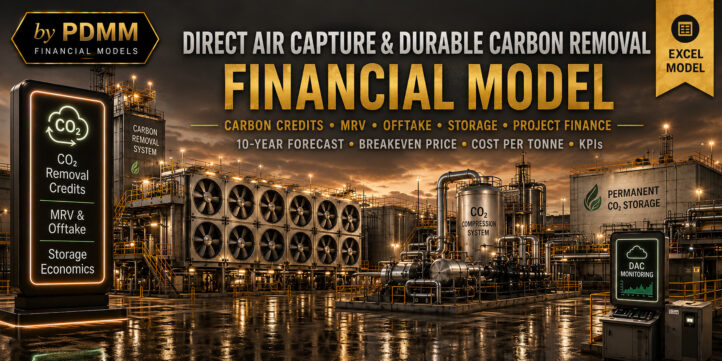
A professional Direct Air Capture financial model built for durable carbon removal credit projects, offtake contracts, MRV costs, storage economics, credit delivery risk, and project finance analysis. This model helps users forecast CO₂ capture capacity, carbon credit revenue, storage costs, energy demand, operating expenses, financing structure, tax credits, grants, DSCR, IRR, NPV, payback, and minimum breakeven credit price. Includes separate Lite and Pro versions, dashboards, KPIs, scenario analysis, sensitivity tables, charts, sparklines, validation checks, and a carbon credit breakeven calculator. Designed for DAC developers, carbon removal project sponsors, investors, climate-tech startups, infrastructure funds, lenders, consultants, and carbon credit buyers evaluating durable carbon removal economics.


![Spreadsheet titled 'Capacity & Operations' showing yearly metrics from 2026 to 2035, including modules, capacity, and trend data, plus a 'Check' column with OK statuses.] ,](https://www.efinancialmodels.com/wp-content/uploads/edd/2026/05/Screenshot-1778.png "Screenshot 1778 | eFinancialModels")


🌍 Direct Air Capture Financial Model – Carbon Removal Credits, MRV, Offtake, Storage & Project Finance
This professional Excel financial model is designed specifically for Direct Air Capture (DAC) and durable carbon removal credit projects. It is not a generic carbon capture template. The model focuses on the real economics that matter most for DAC projects: credit revenue, offtake contracts, MRV cost, geological or mineral storage cost, energy consumption, delivery risk, cost per tonne removed, and project finance returns.
The model is built for investors, developers, project sponsors, climate-tech startups, infrastructure funds, lenders, consultants, and carbon credit buyers who need to evaluate the financial feasibility of a DAC project.
🔑 Key Features
✅ CO₂ Capture Capacity Forecast
Model annual tonnes captured, utilization, downtime, capacity ramp-up, degradation, and delivered tonnes.
✅ Carbon Removal Credit Revenue
Forecast contracted offtake revenue, spot credit sales, weighted average credit price, under-delivery risk, and carbon credit revenue mix.
✅ MRV Cost Module
Includes measurement, reporting, verification, registry, monitoring, certification, and compliance costs on a per-tonne basis.
✅ Storage & Transport Economics
Analyze transport, compression, injection, geological storage, mineralization, storage monitoring, and permanence reserve costs.
✅ Energy Consumption Analysis
Calculate electricity consumption, heat requirement, renewable power cost, energy intensity, and energy cost per tonne removed.
✅ Capex & Opex Forecasting
Includes DAC units, fans, sorbents or solvents, compression, site infrastructure, storage connection, maintenance, labor, insurance, G&A, and replacement costs.
✅ Credit Delivery Risk
Model under-delivery penalties, reversal reserve, permanence buffer, contract shortfalls, and delivered credit adjustments.
✅ Project Finance Module
Includes grants, tax credits, advance market commitments, debt financing, equity funding, interest, repayment, DSCR, LLCR, and investor returns.
✅ Carbon Credit Breakeven Calculator
A dedicated calculator estimates the minimum carbon removal credit price required to achieve the target IRR.
✅ Dashboards, Charts & KPIs
Includes professional dashboards with IRR, NPV, DSCR, cost per tonne removed, credit price breakeven, tonnes delivered, revenue mix, cash flow, debt service, and sensitivity analysis.
📊 What the Model Helps You Analyze
• Is the DAC project financially feasible?
• What carbon credit price is required to reach the target IRR?
• How much revenue comes from offtake contracts vs spot credit sales?
• What is the full cost per tonne of durable CO₂ removal?
• How sensitive is the project to energy cost, MRV cost, storage cost, capex, and credit price?
• Can the project support debt financing?
• What is the expected DSCR, NPV, IRR, payback period, and equity return?
• How do grants, tax credits, and advance market commitments impact project economics?
📁 Included Versions
⭐ Lite Version
A streamlined model for quick feasibility analysis, high-level project screening, pricing, operating assumptions, key outputs, and investor overview.
🚀 Pro Version
A more detailed institutional-grade version with expanded project finance, debt schedule, risk analysis, scenario controls, advanced dashboards, sensitivity outputs, and deeper operating logic.
🧩 Best Way to Use This Template
1️⃣ Start from the Inputs / Assumptions sheets.
2️⃣ Enter DAC capacity, ramp-up, uptime, capex, energy cost, MRV cost, storage cost, and credit pricing.
3️⃣ Select the scenario case for downside, base case, or upside.
4️⃣ Review the dashboards, financial statements, debt metrics, and valuation outputs.
5️⃣ Use the breakeven calculator to estimate the minimum carbon credit price required to meet the target IRR.
6️⃣ Use sensitivity tables to understand the biggest drivers of value and risk.
🎯 Why You Need This Model
DAC projects are capital-intensive, energy-sensitive, and highly dependent on carbon credit revenue quality. A simple generic renewable energy or infrastructure model is not enough. This template gives users a focused DAC-specific financial framework to evaluate durable carbon removal economics, contract structures, storage costs, MRV expenses, financing requirements, and investor returns.
This model is ideal for preparing internal investment analysis, fundraising materials, lender discussions, project finance screening, carbon credit pricing analysis, offtake negotiation support, and climate infrastructure feasibility studies.
Similar ProductsOther customers were also interested in...


 eFinancialModels
Electric Vehicle (EV) Charging Station Financial M...
With this comprehensive 5- or 10-year monthly tool, investors can assess the viability of setting up... Read more

Financial Model for Mobile App | Mobile App Busine...
The Mobile App Financial Plan Template in Excel allows you to develop financial projections when lau... Read more

 HenrySheykin
Food Truck Financial Model Excel Template
The Food Truck Financial Model helps entrepreneurs, founders, business owners, consultants, and anal... Read more

Green Hydrogen Production from Wind Energy Financi...
The Green Hydrogen from Wind Financial Model aims to comprehensively forecast a horizon of 40 years ... Read more

Simple Mutual Non-Disclosure Agreement Template
Protect your business secrets with ease using our Simple Mutual Non-Disclosure Agreement Template. S... Read more

Solar Energy Financial Model
The Solar Energy Financial Model Spreadsheet Template in Excel assists you in preparing a sophistica... Read more

 Peter Graf
The Customer-Centric Financial Model for Restauran...
Starting a restaurant without a financial plan is like driving a car blindfolded. You wouldn´t do i... Read more
You must log in to submit a review.