
0 ITEMS

Capitalized Earnings
Capitalized earnings help you estimate a company’s value based on steady profits. Instead of guessing what the business is worth, this method divides your average earnings by a rate that reflects risk. It’s a clear, fast way to turn income into value—especially for stable businesses with predictable cash flow.
Capitalized earnings financial model templates do the math for you. Just plug in your figures, and the template calculates the business value based on your earnings and capitalization rate. These tools save time, boost accuracy, and easily show investors a clean valuation backed by logic.
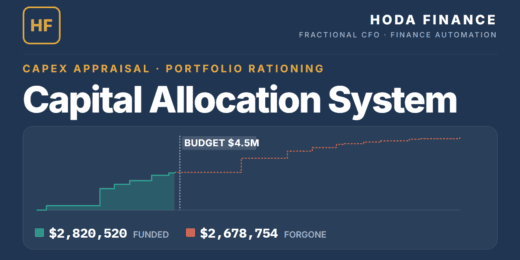

A 26-tab capital allocation system: 20 projects over 25 years,…


A professional PFAS Water Treatment & Remediation Financial Model created…

Direct Air Capture Financial Model – Carbon Removal Credits, MRV, Offtake, Storage & Project Finance
A professional Direct Air Capture financial model built for durable…


A ready-to-use Excel Solar Farm + BESS Financial Model Template…
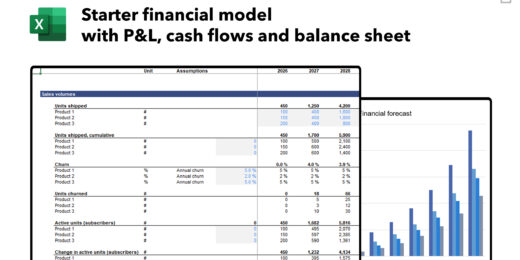

The quickest way to build a rock-solid financial model for…


This comprehensive, fully integrated financial model evaluates the feasibility, operational…


The Rental Property Financial Model template helps evaluate rental property…

A premium capital budgeting model bundle for 10-year forecasting, valuation,…

A dynamic, ready-to-use Excel template designed for AI, GenAI, and…

A dynamic, ready-to-use Excel template for Orchard & Crop Farming…

A dynamic, ready-to-use Excel template for Vertical Farming and Hydroponic…

Ready to plug payback and returns template for your financial…


For Hotel or Guesthouse businesses, this comprehensive Excel Valuation &…

Unlock the Power of Clarity and Confidence in Your Business…


2025 One-Page Compact 3-Statement Financial Model – all core reports…

Unlock funding success with this dynamic Biogas Financial Model Excel…

Download this ready-to-use Renewable Energy Financial Model—expertly built by an…

A dynamic, ready-to-use Excel template for Battery Energy Storage System…

This dynamic Early Stage Startup SaaS Financial Model, built by…

Supercharge your self storage business planning with this dynamic, ready-to-use…

A professional, ready-to-use Excel financial model tailored for agrotech startups…

The Professional Services Financial Plan Excel Template is a comprehensive…

A professional Excel financial model tailored for Padel Clubs to…

This Crypto Trading Platform - App Financial Model is designed…

This Startup Manufacturing Financial Model is a dynamic and fully…

This Automobile Manufacturing Financial Model is a robust and dynamic…

Optimize your drone manufacturing startup’s financial planning with our Drone…

The Consulting Firm Financial Model Template is a comprehensive Excel…


Unlock financial clarity with our customizable 3-Statement Excel Template, designed…

The Medical Clinic Financial Model Template is a comprehensive Excel…


Optimize your fintech payment business’s financial planning with our Fintech…


This comprehensive financial model provides a sophisticated analytical framework for…

This comprehensive Excel model provides sophisticated analysis tools for evaluating…

Elevate your Biotech or Pharma startup with our Excel-based Biotech…


A comprehensive editable 20-year 3-statement, MS Excel spreadsheet for tracking…

A comprehensive editable, 20-year 3-statement MS Excel spreadsheet for tracking…

A comprehensive editable 20 Year 3-Statement, MS Excel spreadsheet for…

A very comprehensive, editable 20-year MS Excel spreadsheet for tracking…

Comprehensive editable, 5-year 3-statement MS Excel spreadsheets for tracking a…

Comprehensive editable, MS Excel spreadsheets for tracking Paper Products Manufacturer…
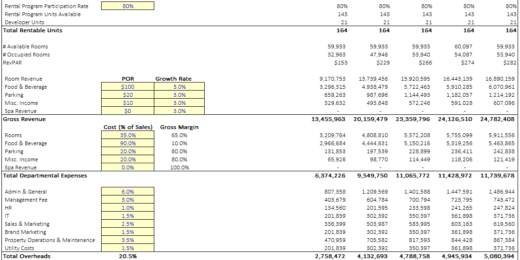
The Condo-Hotel Operating Financial Model is an essential tool for…

Streamline your coffee shop startup's financial planning with our Coffee…

Very comprehensive editable, 5-year 3 statement MS Excel spreadsheets for…

Very comprehensive editable Financial models for tracking CNC Component Manufacturer…
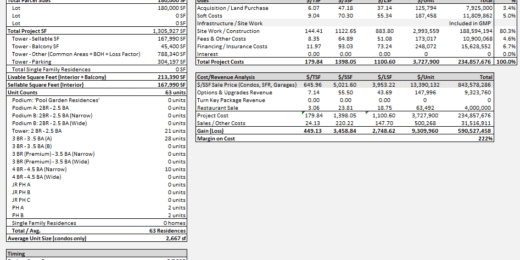
The CRE Development Model is your ultimate tool for in-depth…


With our Property Flip Calculator tool, you have all the…
Transform Your Short-Term Rental Strategy with Airbnb EasyROI Airbnb EasyROI…
Cashflow Analyzer Pro with Deal Instant Analyzer from AssetAFC.com, is…

Our Semiconductor Manufacturer Financial Model is a powerful tool designed…




A comprehensive editable MS Excel spreadsheet for tracking Grocery Store…

Our comprehensive financial model for infrastructure construction projects offers detailed…

This model projects monthly future cash flows from the acquisition…

Our Solar Power Plant Financial Model is a comprehensive tool…

Maximize your real estate investment potential with our Private Equity…

Empower your manufacturing business with our advanced financial model. Tailored…

Introducing our Solar Project Finance Model – a comprehensive tool…
Step-by-Step Guide to the Capitalized Earnings Method

Want to know what your business is really worth? The capitalized earnings method offers a simple way to estimate the value of your business. Unlike guesswork or market buzz, this approach focuses on capitalizing your normalized profits based on actual results. It gives investors and entrepreneurs a clear, no-fluff way to value a company. This method can reveal the true financial picture if you're buying, selling a company or you just need a quick valuation. However, this valuation method has several important limitations and its key to understand when it makes sense to apply this method and when not.
This step-by-step guide helps you to understand how to apply the capitalized earnings method by following five simple steps:
- Historic Financial Analysis
- Estimate Normalized Earnings
- Select an Appropriate Discount Rate
- Capitalize the Earnings
- Calculate the Equity Value

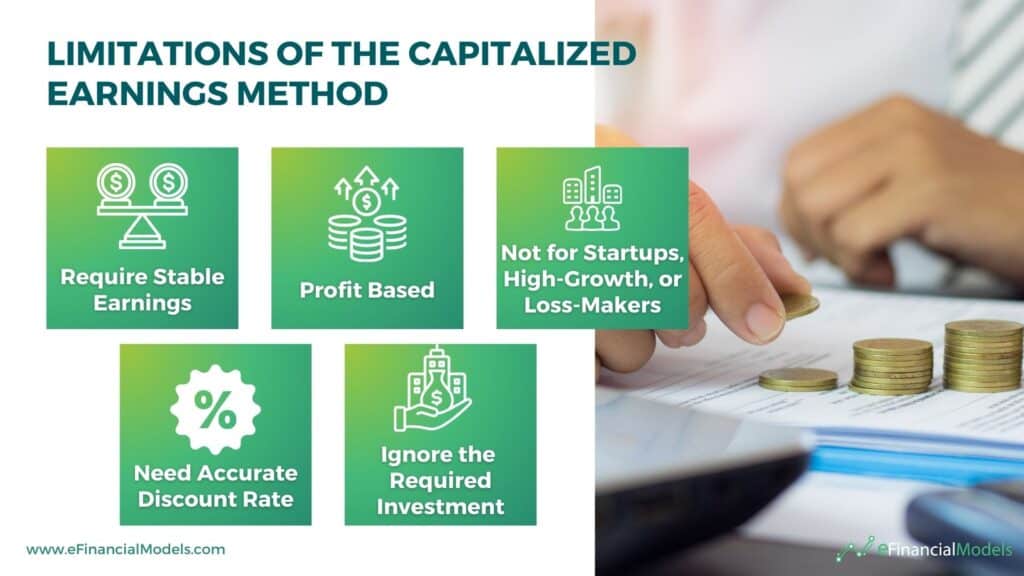
The important limitations to keep an eye on when using this method are:
- It requires stable earnings
- The calculation is profit-based, not on cash flows.
- It is not applicable to startups, high-growth, or loss-making firms
- It needs accurate discount rate estimation.
- It ignores the required investment.
Read on to uncover how this simple yet powerful method can shape smarter business decisions!
Understanding the Capitalized Earnings Method
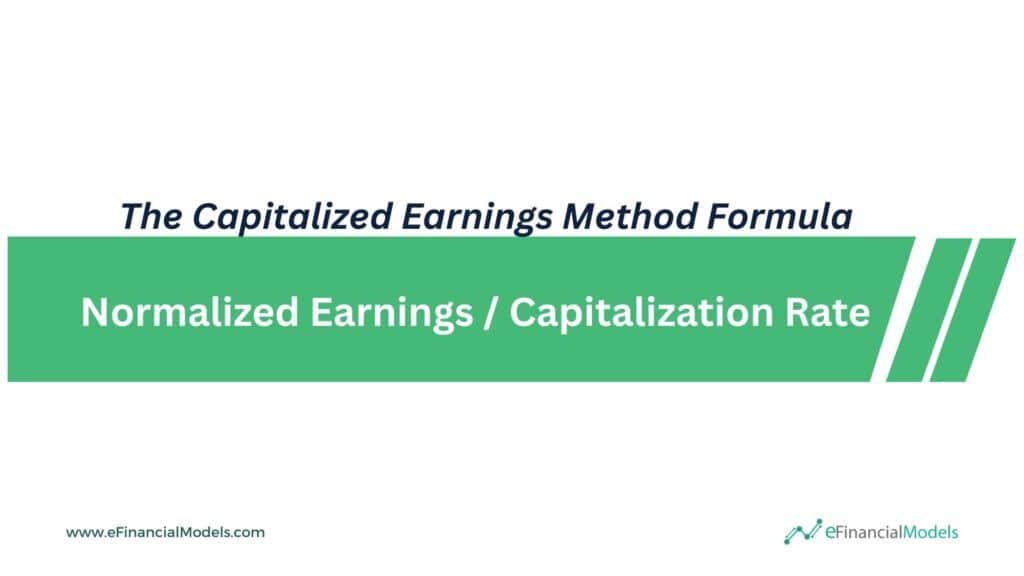
The Capitalized Earnings Method is an income approach in business valuation. It estimates a company's value based on its expected earnings. It divides the normalized earnings by a capitalization rate, which reflects the risk and expected return. It helps investors see how much they should pay today to receive future income from the business.Capitalized earnings valuation follows five simple steps.
- Historical Financial Analysis: Gather the company's past financial statements, usually over 3 to 5 years. Focus on the income statement to check revenue, expenses, and profit trends. Clean the data by removing one-time items. This step helps spot performance patterns. We do it to understand how the business made money and whether the profits are stable. It sets the base for accurate future estimates.
- Estimate Normalized Earnings: Adjust the company's historical profits to reflect typical, ongoing performance. Remove non-recurring income, unusual expenses, and owner's perks. Aim for earnings before interest and taxes (EBIT). This shows what the business earns from operations without debt or tax effects. It gives a clearer picture of real, repeatable earnings. It is essential to note that the capitalized earnings valuation requires normalized earnings to reflect true ongoing income.
- Select an Appropriate Discount Rate: Choose a discount rate that reflects the business's risk and industry. Use the company's cost of capital or required return for investors. Higher risk means a higher discount rate. This rate turns future earnings into present value. We use it to reflect the time value of money and the chance of risk. Choosing a discount rate that reflects the business's risk and industry ensures a more accurate capitalization rate for business valuation, aligning the valuation with expected returns and market realities.
- Capitalize the Earnings: Divide the normalized EBIT by the chosen discount rate. This gives the enterprise value based on its ability to generate future profits. We capitalize earnings to arrive at enterprise value because it converts a stream of expected future profits into a single present value, reflecting the worth of the entire business based on its ability to generate income. It's a fast way to estimate value from steady earnings.
- Calculate the Equity Value: Subtract net debt (total debt minus cash) from the capitalized value to get equity value. This step adjusts for how the business is financed. Enterprise value includes both debt and equity. But buyers care about equity—what's left after paying off debt. This tells owners or investors what their share is worth.
How to Adjust Normalized Earnings
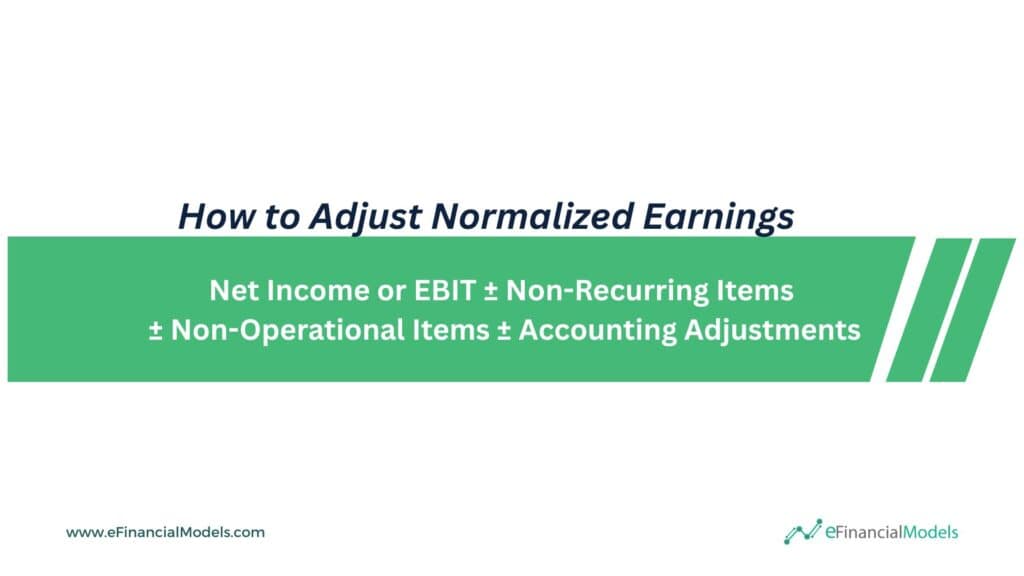
Normalized earnings are a company's profits adjusted to remove unusual, one-time, or non-operating items. This adjustment gives a clearer picture of what the business typically earns in a normal year. This way, the earnings used to calculate business value reflect regular operations, not rare events. Adjusting normalized earnings involves modifying a company's reported earnings to remove non-recurring, unusual, or non-operational items. This helps provide a clearer picture of the company's sustainable profitability.- Begin with the reported net income or earnings before interest and taxes (EBIT), depending on your analysis. This is your baseline before making any adjustments. Net income is used to assess overall profitability, and EBIT is used to evaluate core operating performance.
- Look for one-time events that are not expected to happen regularly. These non-recurring items should be removed because they don't reflect the company's usual business operations. These may include gains/losses on asset sales, impairments (goodwill, intangible assets), litigation settlements, natural disaster impacts, restructuring costs, etc.
- Exclude income or expenses unrelated to the core business, such as interest income (if not part of core operations), investment income, or foreign exchange gains/losses. Exclude non-operational items to focus solely on earnings generated from the company’s core business activities.
- Normalize for accounting anomalies, including changes in accounting policies, unusual depreciation methods, and one-off tax credits or charges. These are made to ensure earnings are consistent with peers or over time.
Note: If you value a private company, you must add owner-specific expenses like excessive owner's salary or perks and non-essential travel or personal expenses. This is common in valuations to reflect what a professional manager would cost. If the company is in a cyclical industry, consider smoothing earnings over several years to remove seasonal or economic fluctuations.
How to Determine the Capitalization Rate for Business Valuation
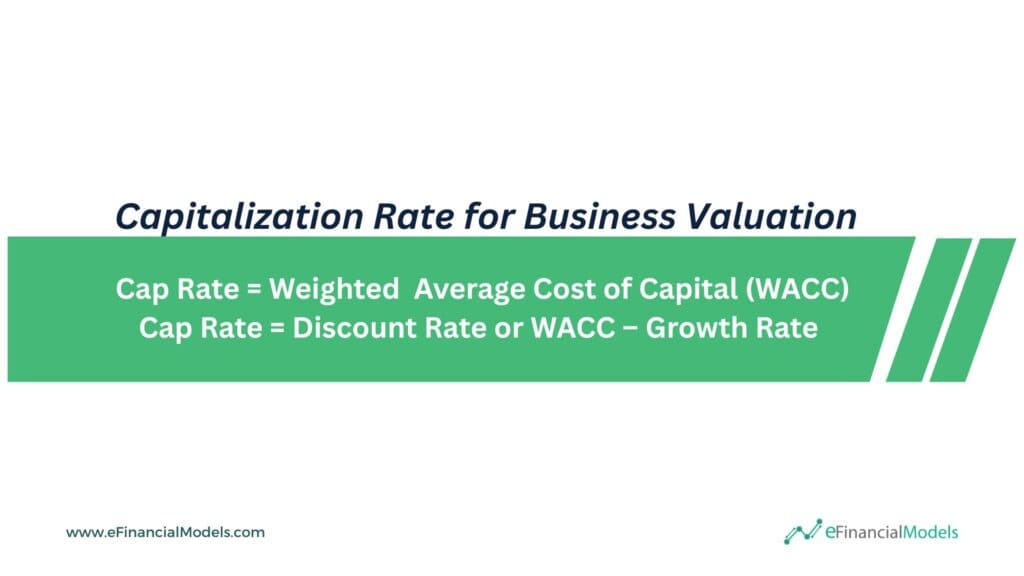
The capitalization rate in business valuation shows how much risk investors take and the expected return on investment. It helps turn future income into its net present value (NPV). A higher cap rate means more risk and higher expected returns, while a lower cap rate signals lower risk and steadier income. This rate gives a quick way to judge how attractive an investment is. In short, it connects a company's income with its value based on market expectations.The Weighted Average Cost of Capital (WACC) offers a reliable way to estimate the capitalization rate for business valuation. Since WACC reflects the average return debt and equity investors require, it helps capture the company's overall financing cost. Using WACC, we align the valuation with market-based expectations and risk levels. This makes it a strong and widely accepted choice of capitalization rate for business valuation.
If the company is expected to grow steadily, even at a modest pace, we can adjust the capitalization rate for business valuation to reflect that growth. We subtract the company's growth rate from the discount rate to do this. This adjustment helps create a more accurate picture of the company's value by factoring in future earnings potential. In simple terms, the formula is discount rate minus growth rate or WACC minus growth rate. This method is commonly used when projecting long-term growth in business valuations.
Finding Business Value Through the Capitalized Earnings Method
The capitalized earnings method helps you find a business’s value by focusing on its future earnings potential. It takes the company’s normalized earnings—adjusted to remove unusual or non-recurring items—and divides that figure by a capitalization rate. This cap rate reflects the risk of the business and the expected return. A lower risk means a lower cap rate and a higher value. This method works best for stable businesses with predictable profits. It shows what the business is worth today based on its ability to generate income over time. Here are some examples of finding business value through the capitalized earnings method:
The table above illustrates a business valuation using our Simple Capitalized Earnings Business Valuation Model. The valuation begins by normalizing EBIT from 2020–2022, averaging $38,667 after adjustments; applying a 20% tax rate yields $30,933 in profit, which is capitalized using a 12% discount rate and 1% growth rate to arrive at an Enterprise Value of $281,853—equal to the final Equity Value due to offsetting debt, cash, and asset adjustments. After accounting for debt, cash, and non-operating assets, we calculate equity value from enterprise value to determine the actual worth attributable to shareholders. Overall, this analysis suggests that the business is moderately profitable with an improving EBIT trend, and operational efficiency is improving, as reflected in the rising EBIT margin (from 2.7% in 2020 to 13.4% in 2022).
When Capitalized Earnings Fails—and Fixes
The Capitalized Earnings Method is popular for valuing businesses but often breaks down in real-world use. This approach works best when earnings are stable and predictable. However, many businesses don't fit that mold. When it fails, it's critical to know why—and how to fix or replace it with better valuation tools.- Requires Stable Earnings: Capitalized earnings assume that past earnings will continue. However, the method misfires if a business has unpredictable or seasonal profits. Sharp swings in income make the result unreliable. A better option for such firms may be scenario-based or discounted cash flow models.
- Profit Based, Not Cash Flow: This method focuses on accounting profits, not actual cash flows. Accounting choices can distort profits, while cash tells the real story. Capitalized earnings might be undervalued if a business is asset-light or reinvests heavily. Cash-flow-based models give a clearer picture.
- Not Applicable for Startups, High-Growth, or Loss-Making Firms: Startups often have no profits yet, and high-growth companies reinvest earnings or show early losses. This makes Capitalized Earnings unusable. These firms need models that value future growth potential—like DCF or revenue multiples.
- Needs Accurate Discount Rate Estimation: Valuation accuracy hinges on the discount rate. If it’s too high or low, the result skews badly. Estimating the right rate requires skill and market insight. A flawed discount rate can lead to serious over- or undervaluation.
- Ignores the Required Investment: Capitalized earnings overlook how much capital is needed to sustain or grow the business. A company may show healthy profits but require constant reinvestment. Ignoring this paints an overly rosy picture. If large capital expenditures (CAPEX) are needed, calculate the capitalized earnings value first, then subtract the required investment. You can also raise the discount rate to reflect the added risk.
When to Use Capitalized Earnings?
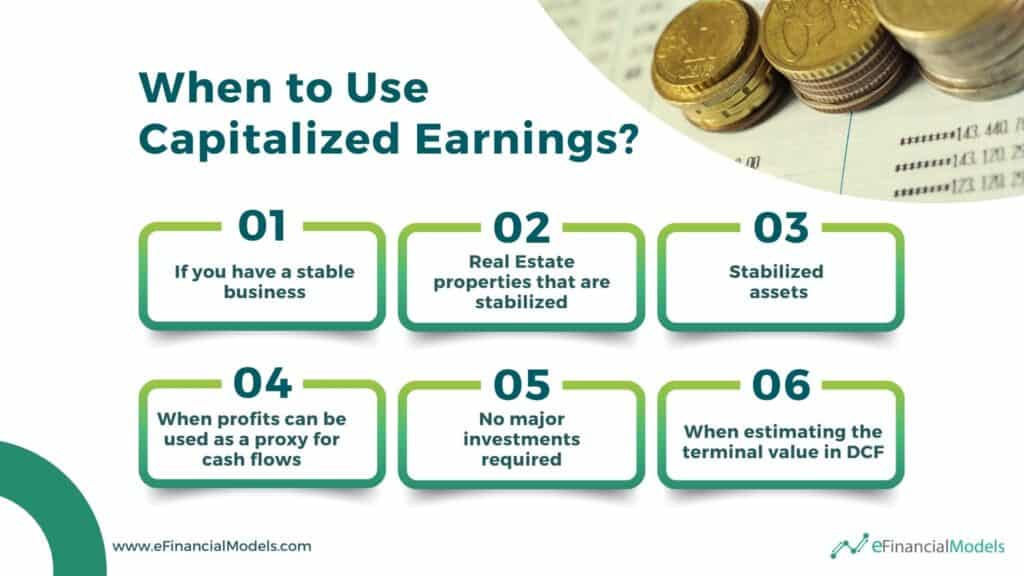
The Capitalized Earnings Method is especially helpful when the company has stable earnings, and you want a quick way to turn those profits into a present value. It helps investors, buyers, or business owners see what the company might be worth if those profits continue.The Capitalized Earnings Method works best in the following scenarios:
- If you have a stable business: Use capitalized earnings when your business earns steady profits year after year. You can convert those profits into a business value without overcomplicating the process.
- Real estate properties that are stabilized: When a property is fully rented and generating steady income, capitalized earnings can help value it. The stable rent acts like a predictable profit stream. This makes estimating the property's worth easy based on those earnings.
- Stabilized assets: This method is a strong fit for any asset that consistently produces income. It assumes the income will continue at similar levels. That makes it easier to value the asset without needing detailed forecasts.
- When profits can be used as a proxy for cash flows: Sometimes, profits closely match cash flow. In these cases, using earnings to estimate value works well. It simplifies things and still gives a reliable result.
- No major investments are required: Capitalized earnings are useful if your business or asset doesn't need big upgrades or repairs soon. This means the current earnings are sustainable and can reflect the asset's value.
- When estimating the terminal value in DCF: Capitalized earnings help estimate terminal value in a DCF when future profits are stable. It provides a quick way to capture long-term value. This works well when the final forecast year reflects a steady state.
Leveraging Financial Models to Refine the Capitalized Earnings Method
The Capitalized Earnings Method offers a structured approach to valuing a business based on its ability to generate sustainable earnings. This method begins with a historical financial analysis to establish a solid foundation, followed by estimating normalized earnings that reflect typical performance. An appropriate discount rate is then selected to account for money's risk and time value. The next step is capitalizing the earnings into a present value using the chosen rate. Finally, the equity value is calculated, giving stakeholders a clear, data-driven valuation metric. This step-by-step process is especially useful for stable, mature businesses with predictable income streams.Using financial models makes the capitalized earnings method clearer, faster, and more accurate. These tools help you adjust earnings, apply the right cap rate, and see the value instantly. You skip the manual math and focus on smart decisions. With the right model, you show investors a solid, logic-based valuation. It's a simple way to turn good data into real insights.
Start using a financial model today to confidently unlock your business's true value!
You might also like:
- 10 Tips to Develop a First Class Business Valuation Report
- 12 BUSINESS VALUATION METHODS
- Finding a Valuation Model for Your Business
- How to Valuate a Business Using a Discounted Cash Flow Model
- How to Prepare a Financial Feasibility Study?
- Business Valuation
- Valuation Services
- Financial Model - Valuation of Tax Loss Carryforwards
- 10 Main Elements of a Business Plan
- Financial Planning for Small Business Owners - Taking an SBA Loan
- How to Build a Capitalization Table
- Financial Ratios Analysis and Its Importance
- Asset Management
- Financial Projections Templates – The Easy Way
- Understanding What is Yield to Maturity and Why It Matters
- Financial Statements – Definition, Uses, Contents and Templates
- Business Valuation Service
- Revenue Model Templates and their Characteristics
- How to Make Smart Decisions with 6 Key Financial Metrics?
- Commercial Real Estate Valuation Methods: Helping Investors in Taking Informed Decisions