
0 ITEMS

Capital Allocation & Capex Appraisal Model (Excel + Google Sheets) | 20 Projects · WACC Builder · Risk-Adjusted Hurdles · MACRS · Portfolio Rationing
A 26-tab capital allocation system: 20 projects over 25 years, WACC built from CAPM, risk-adjusted hurdles, MACRS and Section 179, capital rationing under a budget, real options, tornado and a Python Monte Carlo toolkit. No macros.
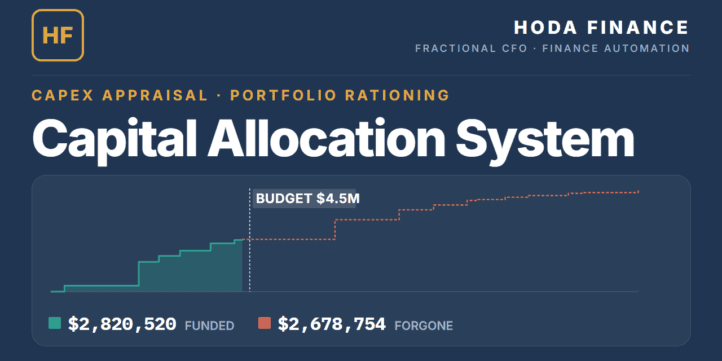


The Capital Allocation System is a self-contained capital-budgeting and portfolio-rationing model for FP&A leads, financial controllers and fractional CFOs who run an annual capital cycle. It is built for the situation every capex process actually faces: more worthwhile projects than budget. Enter up to twenty projects as drivers — capex, revenue, growth, cost ratios, depreciation method, salvage, working capital — and the model produces after-tax free cash flow over twenty-five years, the full appraisal suite for each project against its own risk-adjusted hurdle, and then the allocation itself: who is funded, who is deferred, and what deferring them costs in forgone NPV.
**Method**
The cost of capital is built rather than assumed: CAPM cost of equity with an unlevered beta relevered to the target capital structure via the Hamada relation, after-tax cost of debt, weighted at target rather than book. Each project’s hurdle is that WACC plus an explicit premium for its risk class, overridable per project. Free cash flow is EBIT × (1 − tax) + depreciation − change in working capital, with after-tax salvage and working-capital release in the final year. Depreciation supports straight line, double declining balance and MACRS GDS half-year (classes 3, 5, 7, 10, 15 and 20, derived from the documented method and checked against the published IRS percentages), with Section 179 and bonus depreciation applied first and salvage taxed on the gain over written-down book value. Loss carryforward is modelled explicitly rather than assumed away. Ranking under a budget constraint is by profitability index — NPV per unit of capital — which is the correct order when capital rather than opportunity is binding; mutually exclusive options are grouped so only the stronger competes.
**What is included**
Twenty-six tabs: WACC Builder, Risk & Hurdles, Project Register, Driver Inputs, Depreciation Tables and Engine, FCF Engine, Cash Flows, Metrics, Portfolio Optimizer, Portfolio by Category, DCF Workings, Sensitivity, Real Options, Lease vs Buy, Monte Carlo, Comparison & Ranking, Executive Summary, Capex Memo, Post-Investment Review, AI Prompts, Dashboard, Audit & Checks and Glossary. Nine charts including an NPV waterfall and a cumulative value frontier. Fifteen built-in integrity checks. Twelve AI prompts wired to live project and portfolio briefs. A methodology manual of eighteen sections with four worked cases, and a Capital Cycle Book presenting a complete fictional cycle with a mapping table that ties every stated figure to a workbook cell. A Python toolkit ships alongside – four command-line tools plus the shared engine they import: Monte Carlo risk analysis, an exact 0/1 knapsack optimiser that reports when the greedy ranking leaves value on the table, batch CSV appraisal, and an independent self-check that rebuilds the workbook’s numbers in a separate engine.
**Verification**
12,042 formula cells, recomputed in a live Excel engine with zero error cells across twenty-six tabs and across twelve scenario × project combinations. 6,203 of those cells — the MACRS tables, the depreciation engine, the full cash-flow chain including loss carryforward and after-tax salvage, every headline metric and the portfolio selection itself — were independently rebuilt from raw drivers in numpy_financial and scipy, with zero mismatches. The golden case reproduces a published worked example exactly. Every figure quoted in this description is recomputed from the shipped file.
**Scope**
Projects are appraised on their own cash flows and are not consolidated into a three-statement model, so financing and covenant consequences of the whole programme are out of scope. Capex is a single Year-0 outlay; phased spend uses the manual cash-flow row. Single currency, no FX translation. Section 179, bonus depreciation and MACRS are US federal concepts included for convenience — set them to zero outside the US and verify against current IRS rules.
ABOUT THE AUTHOR
Built by Hoda Elmorshidy — Financial Controller & Fractional CFO, in senior finance since 2017: IFRS reporting, FP&A, finance automation, Quantitative Analysis, Financial Modeling, and UAE VAT & Corporate Tax. Practitioner-grade tools, not generic templates.
DISCLAIMER
This template is an analytical and educational tool, not professional accounting, tax, financial or legal advice, and its use creates no professional relationship. Verify all figures before use in any decision. Appraisal outputs depend entirely on the cash-flow, tax-rate and cost-of-capital estimates you enter. Discounted cash flow measures incremental cash created; it is not the right authority on mandatory or compliance spend. Real-option values are a transparent two-state decision tree, not an option-pricing model. Section 179, bonus depreciation and MACRS are US federal concepts — verify against current IRS rules and set them to zero outside the US. The MACRS tables in the workbook are derived from the documented GDS half-year method and reconcile to IRS Publication 946, Appendix A, Table A-1 to within 0.01 of a percentage point (the IRS publishes rounded percentages; the workbook carries the unrounded method values), checked as of August 2026 – for a filing, use the IRS table verbatim and confirm the current position. The sample company “Meridale Industries” and all twenty project submissions are fictional. Liability is limited as set out in the licence terms below.
LICENSE & LIABILITY
LICENSE GRANT: Single-user licence. One person may use the file for their own or their employer’s internal decisions. No resale, redistribution, sublicensing, or repackaging of the file or its templates.
AS IS: Provided “as is” without warranty of any kind, express or implied, including merchantability or fitness for a particular purpose.
LIMITATION OF LIABILITY: To the maximum extent permitted by law, total liability for any claim arising from this product is limited to the amount you paid for it. Not liable for indirect, incidental, or consequential losses.
NON-WAIVABLE RIGHTS: Nothing here limits rights that cannot be excluded under the consumer-protection law of your jurisdiction.
GOVERNING LAW: This purchase is governed by the terms of the platform you bought it on (e.g. Etsy, Gumroad) and by the consumer-protection law of your own country of residence. Where those permit, the limitations above apply to the maximum extent allowed.
Past or sample results are not indicative.
Similar ProductsOther customers were also interested in...



 eFinancialModels
Electric Vehicle (EV) Charging Station Financial M...
With this comprehensive 5- or 10-year monthly tool, investors can assess the viability of setting up... Read more

Financial Model for Mobile App | Mobile App Busine...
The Mobile App Financial Plan Template in Excel allows you to develop financial projections when lau... Read more

 HenrySheykin
Food Truck Financial Model Excel Template
The Food Truck Financial Model helps entrepreneurs, founders, business owners, consultants, and anal... Read more

Green Hydrogen Production from Wind Energy Financi...
The Green Hydrogen from Wind Financial Model aims to comprehensively forecast a horizon of 40 years ... Read more

Simple Mutual Non-Disclosure Agreement Template
Protect your business secrets with ease using our Simple Mutual Non-Disclosure Agreement Template. S... Read more

Solar Energy Financial Model
The Solar Energy Financial Model Spreadsheet Template in Excel assists you in preparing a sophistica... Read more

 Peter Graf
The Customer-Centric Financial Model for Restauran...
Starting a restaurant without a financial plan is like driving a car blindfolded. You wouldn´t do i... Read more
You must log in to submit a review.