
0 ITEMS

Wedding Planner Agency Financial Model Excel Template
The Wedding Planning Agency Financial Model helps users turn a wedding planning business idea into a structured, editable financial forecast. Instead of relying on a generic spreadsheet, this template is built around the real drivers of a wedding planning agency, including planning fees, deposits, client volume, service packages, vendor-related costs, startup spend, staffing, and ongoing operating expenses. It gives founders and planners a practical way to estimate how much capital is needed, how revenue may grow, how expenses will behave, and when the business can become profitable. This financial model template is designed for entrepreneurs, wedding planners, consultants, analysts, business owners, and anyone preparing a business plan, lender package, or investor presentation. It supports financial planning by connecting revenue assumptions with cost structure, payroll, marketing spend, cash flow, and profitability over a multi-year forecast period. Users can adjust assumptions such as customer acquisition cost, billable hours, service pricing, staffing levels, office costs, and vendor-related expenses to reflect their local market, positioning, and growth strategy. The template helps users review important business questions before launching or expanding a wedding planning agency. It can support decisions about pricing full-service planning, partial planning, day-of coordination, and hourly consultation services; determining how much to spend on marketing; estimating startup costs; and planning the team needed to deliver events at scale. By organizing assumptions into a connected model, it allows users to see the financial impact of changes instead of making isolated estimates. Built for both planning and presentation, the Wedding Planning Agency Financial Model includes financial projections, cash flow forecasting, profitability analysis, break-even analysis, investor-focused metrics, and visual reporting. It is fully customizable and compatible with Excel and Google Sheets, making it useful for solo founders, advisory teams, and consultants working with clients. Whether you are validating a new wedding planning concept, preparing funding documents, or improving decision-making for an existing agency, this template provides a ready-to-use framework for understanding revenue potential, funding needs, operating risk, and long-term financial performance.
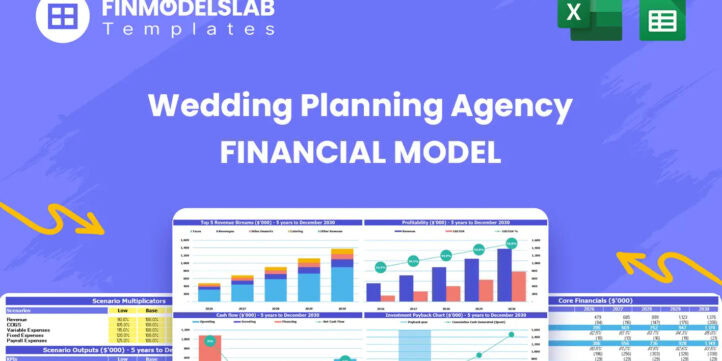


Financial Model Overview
The Wedding Planning Agency Financial Model is a ready-to-use financial model template designed to help entrepreneurs, wedding planners, consultants, analysts, and business owners forecast the financial performance of a wedding planning agency. It is built around the way this type of business actually generates revenue and manages costs, including planning packages, deposits, event volume, billable hours, customer acquisition costs, vendor-related expenses, payroll, startup investment, and ongoing overhead. Instead of starting with a blank spreadsheet, users can work from a structured model that connects assumptions to financial statements, cash flow, profitability, investor metrics, and decision-making outputs. The model is useful for launching a new agency, expanding an existing wedding planning business, preparing a lender or investor presentation, or building a detailed business plan supported by realistic financial projections.
All-in-One Dashboard
The all-in-one dashboard gives users a central view of the most important inputs and outputs in the Wedding Planning Agency Financial Model. This component is designed to summarize the financial plan in a clear, practical format so users can quickly understand the projected health of the business without reviewing every worksheet in detail. It may include inputs such as pricing assumptions, client volume, marketing spend, customer acquisition cost, staffing levels, startup investment, and operating expense assumptions, while displaying outputs such as revenue, gross profit, EBITDA, net income, cash balance, funding need, and return metrics. For a wedding planning agency, this is especially useful because many business decisions are connected, such as whether higher marketing spend generates enough new clients to support additional planners, office costs, and vendor coordination expenses. The dashboard allows founders and stakeholders to review the big picture, identify potential issues, and make faster decisions about pricing, growth, hiring, and capital planning.
Low, Base, and High Scenario Analysis
The low, base, and high scenario analysis component helps users test how the wedding planning agency may perform under different business conditions. A base case can reflect the most realistic plan, while a low case may assume slower client acquisition, lower average package prices, higher customer acquisition costs, or more conservative billable hours. A high case may reflect stronger demand, improved pricing, higher conversion rates, or more efficient marketing performance. This section is valuable because wedding planning revenue can vary based on seasonality, local competition, brand reputation, and the timing of client bookings. By adjusting key drivers such as marketing budget, customer acquisition cost, service mix, planning hours, and average client spend, users can see how revenue, margins, cash flow, and profitability change across scenarios. This supports more resilient planning by helping founders prepare contingency plans, understand downside risk, and communicate upside potential to investors, lenders, or internal decision-makers.
Professional Charts
The professional charts component converts the model’s financial data into presentation-ready visuals that make the forecast easier to understand. These charts may show revenue growth, expense trends, EBITDA, cash flow, net income, margins, client growth, service mix, or funding performance over time. For a wedding planning agency, visual reporting is useful because stakeholders often need to understand how the business scales from early client acquisition to a more established agency with recurring referrals, larger packages, and a stronger event pipeline. Instead of presenting only rows of financial data, the model helps users communicate the financial story through clear graphs and trend views. This can be especially helpful when preparing pitch decks, lender discussions, partner meetings, or internal strategy reviews. Professional charts also make it easier to spot trends, such as whether revenue growth is being supported by healthy margins, whether expenses are rising too quickly, or whether cash reserves remain adequate as the agency expands.
ROE Components and DuPont Analysis
The ROE components and DuPont analysis section helps users understand what is driving return on equity in the wedding planning agency financial forecast. Rather than showing only a final return figure, this component breaks performance into underlying drivers such as profitability, asset efficiency, and financial leverage. Inputs may include net income, equity investment, total assets, revenue, expense structure, and balance sheet assumptions, while outputs may include return on equity and the factors contributing to that return. For an investor-backed wedding planning agency or a founder evaluating capital efficiency, this analysis can be especially useful because it shows whether returns are being created through strong margins, efficient use of resources, or increased leverage. A wedding planning agency may not require heavy physical assets compared with some businesses, so understanding how marketing efficiency, service pricing, staffing productivity, and expense control affect equity returns can support better strategic decisions. This component also adds credibility to funding discussions by giving stakeholders a more analytical view of financial performance.
Revenue Inputs
The revenue inputs component is one of the most important areas of the Wedding Planning Agency Financial Model because it allows users to define how the agency earns money. Inputs may include the number of new clients, marketing spend, customer acquisition cost, conversion assumptions, service categories, billable hours, package pricing, hourly rates, deposits, and expected timing of revenue recognition. For a wedding planning agency, revenue may come from full-service planning, partial planning, day-of coordination, hourly consultation, add-on services, or premium event management packages. This section helps users move beyond a simple revenue estimate by connecting commercial assumptions to actual service delivery. For example, a user can test how many clients are generated from a marketing budget, how those clients are distributed across service types, and how pricing or planning hours affect total sales. This makes the forecast more practical for business planning, because founders can evaluate whether their service packages, sales targets, and marketing assumptions are realistic and profitable.
Bank-Ready Reports
The bank-ready reports component organizes the financial forecast into lender-friendly outputs that can support funding applications, loan discussions, and business plan submissions. This section may include projected profit and loss statements, cash flow statements, balance sheets, debt schedules, funding requirements, and summaries of key assumptions. For a wedding planning agency seeking startup funding or expansion capital, clear financial reporting is essential because lenders want to understand revenue potential, cost structure, repayment capacity, cash flow timing, and the amount of capital required before the business becomes self-sustaining. This component helps users present the model in a professional format instead of sending disconnected calculations or informal estimates. It can also support conversations with banks, grant providers, small business advisors, or investors by showing how revenue, operating expenses, payroll, startup costs, and financing assumptions connect over time. The result is a more credible financial package that is easier for stakeholders to review and evaluate.
Revenue Breakdown
The revenue breakdown component provides a detailed view of revenue streams so users can see exactly where the wedding planning agency’s income is expected to come from. Instead of looking only at total revenue, this section separates revenue by service category, such as full-service planning, partial planning, day-of coordination, hourly consultation, or other custom packages. Inputs may include price per service, number of clients, billable hours, average package value, utilization assumptions, and service mix percentages. Outputs may show monthly and annual revenue by category, contribution of each service line, and how revenue composition changes over the forecast period. This is useful for decision-making because different wedding planning services have different margins, staffing requirements, sales cycles, and client expectations. A full-service planning package may generate higher revenue but require more planner hours, while day-of coordination may be easier to scale but produce lower average revenue per client. The revenue breakdown helps users identify the most valuable services, refine pricing, and build a more balanced growth strategy.
KPI Dashboard
The KPI dashboard component tracks the performance metrics that matter most to a wedding planning agency. These may include total clients, new clients, average revenue per client, customer acquisition cost, marketing efficiency, gross margin, EBITDA margin, cash balance, break-even timing, planner productivity, and revenue growth. This section helps users monitor whether the business is performing in line with its assumptions and where adjustments may be needed. For example, if customer acquisition cost rises above the planned level, the model can show the impact on profitability and cash flow. If average revenue per client improves through premium packages or bundled services, users can see how that affects margins and long-term returns. The KPI dashboard is valuable for founders, managers, and advisors because it turns detailed financial data into practical operating insights. It can also support monthly performance reviews, investor updates, and internal decision-making by keeping attention on the metrics that influence growth, liquidity, and profitability.
Startup and Operating Cost Planning
The startup and operating cost planning component helps users estimate the capital required to launch and run a wedding planning agency. Startup costs may include office leasehold improvements, furniture and decor, computer equipment, planning software, branding, legal setup, licenses, website development, initial marketing materials, deposits, and working capital reserves. Operating costs may include rent, subscriptions, advertising, insurance, payroll, contractor payments, travel, event supplies, professional services, and administrative expenses. This section is useful because many wedding planning businesses underestimate the cash needed before revenue becomes predictable. By separating one-time startup costs from recurring operating expenses, the model helps users understand how much funding may be required at launch and how costs will behave as the agency grows. It also supports budgeting and cost control by showing which expenses are fixed, which are variable, and which scale with client volume. For funding preparation, this component helps justify the amount of capital requested and demonstrates that the business has considered the practical costs of opening and operating.
Break-Even and Funding Requirements Analysis
The break-even and funding requirements analysis component helps users determine when the wedding planning agency can cover its costs and how much capital may be needed before that point. Inputs may include startup costs, monthly operating expenses, payroll, marketing spend, service pricing, gross margin, client volume, deposits, and working capital assumptions. Outputs may include the break-even month, revenue needed to break even, minimum cash balance, cumulative funding need, and the timing of capital requirements. This is particularly important for a wedding planning agency because revenue may be affected by booking cycles, seasonality, and upfront deposits, while expenses such as marketing, staff, software, and office costs may occur before clients are fully billed. The analysis helps founders understand how quickly the business must convert leads into paying clients and whether the planned marketing budget, pricing, and cost structure can support a sustainable path to profitability. It is also useful for investors and lenders because it shows the relationship between launch investment, operating risk, cash flow, and the point at which the business becomes financially self-supporting.
File types:
Excel – Single-User: .xlsx
Excel – Multi-User: .xlsx
Similar ProductsOther customers were also interested in...

 HenrySheykin
Attorney Employment Agency Financial Model Excel T...
The Recruiting Agency Financial Model helps founders, agency owners, consultants, and analysts build... Read more
Law Firm Financial Model Excel Template
The Law Firm Financial Model Template helps users turn a legal practice concept into a structured fi... Read more
Business Brokerage Financial Model Excel Template
The Business Brokerage Financial Model helps entrepreneurs, brokerage owners, consultants, analysts,... Read more
Call Center Financial Model Excel Template
The Call Center Financial Model helps users build a structured financial forecast for launching, man... Read more
Architecture Firm Financial Model Excel Template
The Architectural Firm Financial Model Template helps founders, architecture practice owners, consul... Read more
Financial Advisors Agency Financial Model Excel Te...
The Financial Advisor Financial Model is a ready-to-use financial model template built for planning,... Read more
Notary Financial Model Excel Template
The Notary Service Financial Model helps entrepreneurs, business owners, consultants, analysts, and ... Read more
Legal Services Financial Model Excel Template
The Legal Services Financial Model Financial Model Template helps entrepreneurs, law firm founders, ... Read more
Event Planner Financial Model Excel Template
The Event Planner Financial Model helps users turn an event planning business idea into a structured... Read more
Corporate Trainer Financial Model Excel Template
The Corporate Training Financial Model helps users turn a professional development or corporate lear... Read more
You must log in to submit a review.