
0 ITEMS

Notary Financial Model Excel Template
The Notary Service Financial Model helps entrepreneurs, business owners, consultants, analysts, and founders turn a notary business idea into a structured five-year financial forecast. Instead of starting from a blank spreadsheet, users can work from a ready-to-use model designed around the realities of a notary service, including standard notary acts, mobile appointments, remote online notarization, and business package revenue. The template gives you a practical way to organize financial planning assumptions, estimate revenue potential, calculate startup costs, forecast operating expenses, and understand the capital required to launch or grow the business. This financial model template is useful for anyone preparing a business plan, funding request, lender package, investor presentation, or internal operating budget. It connects core assumptions such as customer acquisition, pricing, service mix, staffing, payroll, marketing spend, fixed costs, and variable expenses to projected financial performance. As the user updates inputs, the model helps generate a clearer view of revenue growth, profitability, cash flow, and long-term sustainability, making it easier to evaluate whether the business can support its cost structure and reach financial goals. The template is designed to support realistic decision-making. Users can test different assumptions, review low, base, and high scenarios, and understand how changes in customer volume, acquisition cost, pricing, or staffing affect results. This is especially important for notary services, where profitability may depend on balancing high-volume standard services with higher-value mobile, remote, or recurring business clients. The model helps users identify cash gaps, plan working capital needs, manage payroll and expenses, and assess when the company may become profitable. With automated calculations, professional formatting, and editable inputs, the Notary Service Financial Model saves time while giving users a more credible financial planning foundation. It can support startup launch planning, expansion analysis, investor discussions, loan applications, and ongoing performance reviews. By bringing revenue assumptions, startup investment, operating costs, cash flow forecasting, profitability analysis, and break-even analysis into one organized template, it helps users make more informed decisions before committing capital, hiring staff, or scaling the business.
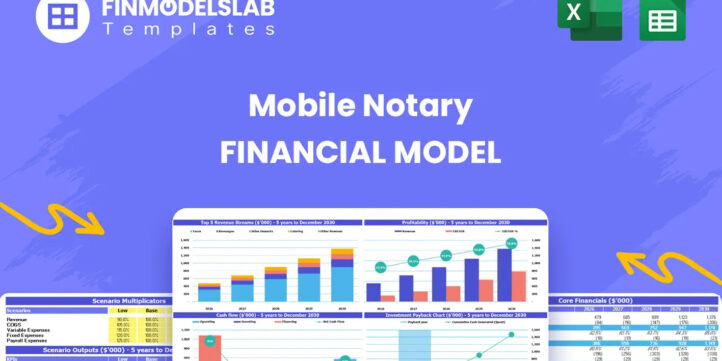


Financial Model Overview
The Notary Service Financial Model is a ready-to-use financial model template built to help users plan, forecast, and evaluate a notary service business with a structured five-year outlook. It is designed for entrepreneurs launching a notary office, mobile notary providers expanding their services, consultants preparing client financials, analysts building funding documents, and business owners who need a clearer view of revenue, costs, cash flow, and profitability. A notary service can include several different income streams, such as standard notary acts, mobile notary appointments, remote online notarization, and business packages for recurring clients. This template brings those assumptions into one organized model so users can replace guesswork with a practical financial planning process. By entering key assumptions into editable input areas, users can generate connected outputs such as financial summaries, scenario results, charts, revenue forecasts, bank-ready reports, KPI views, and profitability indicators. The model is useful for planning startup capital, explaining the business case to lenders or investors, comparing operating strategies, and making better decisions before hiring, marketing, purchasing systems, or expanding service capacity.
All-in-One Dashboard
The all-in-one dashboard gives users a centralized view of the most important inputs and outputs in the Notary Service Financial Model. Instead of moving through disconnected spreadsheets, the dashboard brings core assumptions, financial results, and headline metrics into one accessible area. Users can review inputs such as forecast period assumptions, customer growth, pricing, cost structure, payroll expectations, and financing assumptions, while also monitoring outputs such as revenue, profit, cash balance, EBITDA, and other key indicators. For a notary service, this is especially useful because operational performance depends on several moving parts, including client acquisition, service mix, travel-related costs, staff utilization, and adoption of remote online notarization. The dashboard helps users quickly understand how these assumptions flow through the forecast and affect overall performance. It can also support stakeholder communication because it gives investors, lenders, founders, or advisors a concise snapshot of the business without requiring them to inspect every detail of the model. For internal planning, the dashboard works as a decision-making hub, allowing users to adjust assumptions and immediately see how the forecast changes. This makes it easier to evaluate whether the business is on a sustainable path, whether additional funding may be needed, and whether the operating plan is realistic under current assumptions.
Low, Base, and High Scenario Analysis
The low, base, and high scenario analysis section helps users evaluate how the notary service may perform under different business conditions. The base case can represent the most likely plan, while the low case can reflect more conservative assumptions such as slower customer growth, higher customer acquisition costs, lower conversion to business packages, or delayed adoption of remote online notarization. The high case can be used to test stronger performance, such as improved marketing efficiency, faster recurring client growth, higher pricing, or better utilization of mobile notary capacity. This component is valuable because a financial forecast should not rely on only one version of the future. A notary business may face changing demand, local competition, regulatory requirements, travel constraints, technology adoption challenges, and seasonal variation in client needs. Scenario analysis helps users understand which assumptions have the greatest impact on cash flow, profitability, payback timing, and funding requirements. It also makes the model more useful for investor and lender discussions because stakeholders often want to know what happens if the plan underperforms or if growth exceeds expectations. By comparing scenarios, users can estimate minimum cash needs, set realistic operating targets, develop contingency plans, and identify the most important levers for improving results. This makes the template more than a static forecast; it becomes a planning tool for risk management and strategic decision-making.
Professional Charts
The professional charts section converts financial model outputs into visual reports that are easier to interpret, present, and discuss. Charts can help users display revenue growth, profitability trends, cash flow movement, expense composition, scenario comparisons, and key performance indicators over the five-year forecast period. For a notary service, visual reporting is useful because the business may have a long ramp-up period, multiple revenue streams, and different cost categories that change as the company grows. A chart can quickly show whether revenue is increasing fast enough to cover staffing, rent, software, insurance, marketing, travel reimbursements, and other operating expenses. It can also highlight the timing of cash pressure, profitability improvement, or the shift toward higher-value services such as business packages and remote online notarization. These visuals are helpful for founders who need to understand the story behind the numbers, but they are also valuable for investor decks, loan applications, board updates, and consultant reports. Professional charts make the forecast more presentation-ready and reduce the effort required to explain financial performance to non-financial stakeholders. Because the model is editable, users can update assumptions and let the visual outputs reflect the revised forecast. This supports faster planning cycles, clearer communication, and better decision-making when comparing growth strategies or funding needs.
ROE Components and DuPont Analysis
The ROE components and DuPont analysis section helps users examine the drivers behind return on equity rather than looking only at a single headline return figure. DuPont analysis breaks return performance into underlying components, such as profitability, asset efficiency, and leverage, helping users understand why equity returns are improving, declining, or remaining under pressure. For a notary service, this type of analysis is useful because the business may require upfront investment in office setup, technology, document management systems, website development, insurance, and working capital before it reaches a mature revenue level. If the model shows a weak or delayed return, DuPont-style analysis can help users identify whether the issue is low margin, insufficient revenue volume, underused assets, high fixed costs, or an inefficient capital structure. The section can support investor discussions by showing not only what the expected return is, but what operational and financial factors are influencing that return. Inputs connected to this analysis may include net income, revenue, assets, equity, liabilities, and financing assumptions. Outputs can help users evaluate whether pricing, customer acquisition, service mix, staffing, or capital investment plans need to be adjusted. This makes the model more useful for strategic planning because it encourages users to look beyond simple profit figures and understand the deeper financial mechanics that shape long-term value creation.
Revenue Inputs
The revenue inputs section is where users define the commercial assumptions that drive the notary service forecast. This component may include assumptions for customer acquisition, marketing spend, customer acquisition cost, service pricing, customer volume, service mix, recurring business clients, annual price increases, and the adoption rate of remote online notarization. For a notary service, revenue is rarely generated from one simple source. Standard notary acts may provide frequent transactions, mobile notary services may command higher fees due to travel and convenience, remote online notarization may offer scalable technology-driven revenue, and business packages may create higher-value recurring relationships. The revenue inputs section helps users model these differences in a structured way. By adjusting assumptions, users can estimate how many customers are needed to support the business, how average revenue per customer changes over time, and how the mix of services affects margins and growth. This section is particularly useful for testing marketing plans because acquisition cost and conversion rates can materially affect profitability. It also helps founders and advisors identify which revenue streams deserve more attention. If business packages or remote online notarization improve the long-term forecast, the user can build a sales strategy around those higher-impact areas. The output of this section feeds the revenue forecast, profitability analysis, cash flow projections, and investor-ready summaries, making it one of the most important planning areas in the template.
Bank-Ready Financial Reports
The bank-ready financial reports section provides structured financial outputs that can support lender reviews, investor conversations, business plans, and internal management reporting. These reports typically include connected financial statements such as the profit and loss statement, cash flow forecast, and balance sheet, along with supporting schedules that explain how the forecast is built. For a notary service seeking a loan, line of credit, or startup funding, professional reporting is important because lenders and investors need to understand revenue assumptions, operating expenses, payroll, capital requirements, debt service capacity, and cash flow stability. This component helps users present the business in a clear and organized format rather than relying on informal estimates. Inputs from revenue assumptions, startup costs, payroll, fixed expenses, variable costs, financing, taxes, and working capital flow into reports that show expected performance over time. These outputs can help answer key funding questions, such as how much capital is needed, when the business may become cash-flow positive, whether the company can cover obligations, and how profitability develops across the forecast period. Bank-ready reporting is also useful after launch because it creates a framework for comparing actual performance against the forecast. Users can refine assumptions, update projections, and maintain a more disciplined financial planning process as the notary service grows.
Revenue Breakdown
The revenue breakdown section gives users a detailed view of how each revenue stream contributes to total sales. Rather than showing one combined revenue number, this component separates income by service category, allowing users to understand the role of standard notary acts, mobile notary services, remote online notarization, business packages, and any additional service lines the user chooses to add. This is important because each service type may have different pricing, demand patterns, delivery costs, capacity constraints, and margin profiles. Standard notary work may generate consistent transaction volume but lower revenue per appointment, while mobile services may produce higher fees but also require travel time and reimbursements. Remote online notarization may scale more efficiently but depend on technology adoption, platform costs, and regulatory acceptance. Business packages may offer recurring revenue and stronger client retention, but may require sales effort and relationship management. The revenue breakdown helps users see whether the business is overly dependent on lower-margin work or whether the model is moving toward higher-value services over time. It also supports better marketing and staffing decisions because the user can identify which revenue streams justify additional investment. Outputs from this section can help founders explain the business model to stakeholders, refine pricing strategies, evaluate service expansion, and build a more credible revenue forecast for planning and funding purposes.
KPI Dashboard
The KPI dashboard helps users monitor performance metrics that matter for a notary service business. While financial statements show the overall financial result, key performance indicators help explain what is driving that result. This section may track metrics such as customer acquisition cost, customer count, revenue per customer, service mix, EBITDA, gross margin, net profit margin, cash balance, payback period, return metrics, and other performance benchmarks. For a notary service, these KPIs are useful because profitability can be sensitive to marketing efficiency, recurring client growth, employee productivity, pricing, and cost control. If customer acquisition cost rises faster than expected, the business may need more funding or a different marketing strategy. If average revenue per customer improves because more clients purchase business packages or remote online notarization services, the path to profitability may accelerate. The KPI dashboard makes these patterns easier to see and helps users identify performance issues before they become serious cash flow problems. It is also useful for stakeholder updates because investors, lenders, and advisors often prefer concise metrics that summarize the health of the business. By comparing KPIs against internal targets or industry benchmarks, users can evaluate whether their plan is realistic and whether operational changes are needed. This component turns the model into a management tool that supports ongoing performance review, not just initial business planning.
Break-Even Analysis
The break-even analysis section helps users estimate when the notary service may reach the point where revenue covers operating costs. This is a critical planning component because many service businesses require time to build customer volume, develop referral channels, hire staff, invest in technology, and establish a reliable base of recurring clients. The break-even analysis may use inputs such as pricing, customer volume, service mix, gross margin, payroll, rent, insurance, software, marketing expenses, travel costs, and other fixed and variable expenses. Outputs can include the break-even month, required revenue level, required customer volume, and the gap between current forecast performance and profitability. For a notary service, this analysis helps users understand whether the planned marketing budget, staffing structure, and pricing strategy are sufficient to reach sustainability within an acceptable timeframe. It can also show how specific changes may accelerate or delay profitability, such as lowering customer acquisition cost, increasing business package sales, reducing travel-related expenses, increasing prices, or delaying non-essential hires. T
Similar ProductsOther customers were also interested in...








 HenrySheykin
Architecture Firm Financial Model Excel Template
The Architectural Firm Financial Model Template helps founders, architecture practice owners, consul... Read more
Financial Advisors Agency Financial Model Excel Te...
The Financial Advisor Financial Model is a ready-to-use financial model template built for planning,... Read more
Travel Agency Financial Model Excel Template
The Travel Agency Financial Model helps entrepreneurs, founders, consultants, analysts, and business... Read more
Life Coaching Financial Model Excel Template
The Life Coaching Financial Model helps coaches, entrepreneurs, consultants, founders, and business ... Read more
Bookkeeping Agency Financial Model Excel Template
The Accounting Firm Financial Model Template helps founders, practice owners, consultants, analysts,... Read more
 Giorgos
Interior Design Firm – 5 Year Financial Model
5-year financial model for an interior design firm providing revenue forecasts, cost analysis, and i... Read more
Accounting Firm – 10 Year Financial Model
10-year financial model for an accounting firm providing forecasts, profitability analysis, and insi... Read more
Law Firm – 10 Year Financial Model
10-year financial model for a law firm providing forecasts, profitability analysis, and insights to ... Read more
 eFinancialModels
Fiduciary Service Business Financial Planning
The Fiduciary Service Business Financial Model aims to plan the financial feasibility and profitabil... Read more
 ECF Consultancy
Startup Business Plan – Consulting Firm
If you dream to start a Consulting Firm Business, the template is the first step in making your drea... Read more
You must log in to submit a review.