
0 ITEMS

Canada Laneway House, Garden Suite and Backyard Suite (ADU) Financial Model: CMHC Suite Refinance, HELOC, After-Tax ROI
Excel model for building a laneway house, garden suite, coach house or backyard suite on a Canadian lot: construction budget by city, CMHC insured suite refinance or HELOC, rent or family use, and after-tax returns with the deemed disposition, CCA and tax credits. Two editions, no macros, fully unlocked.
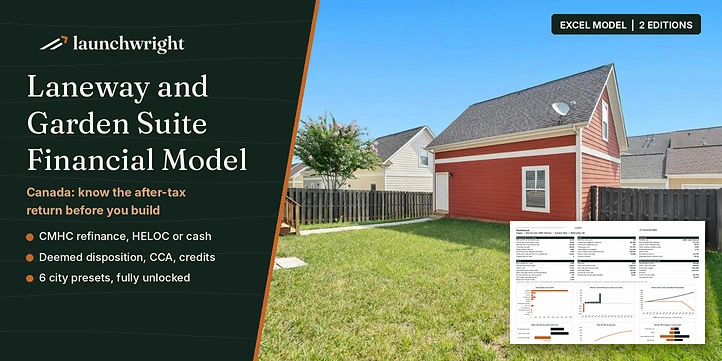
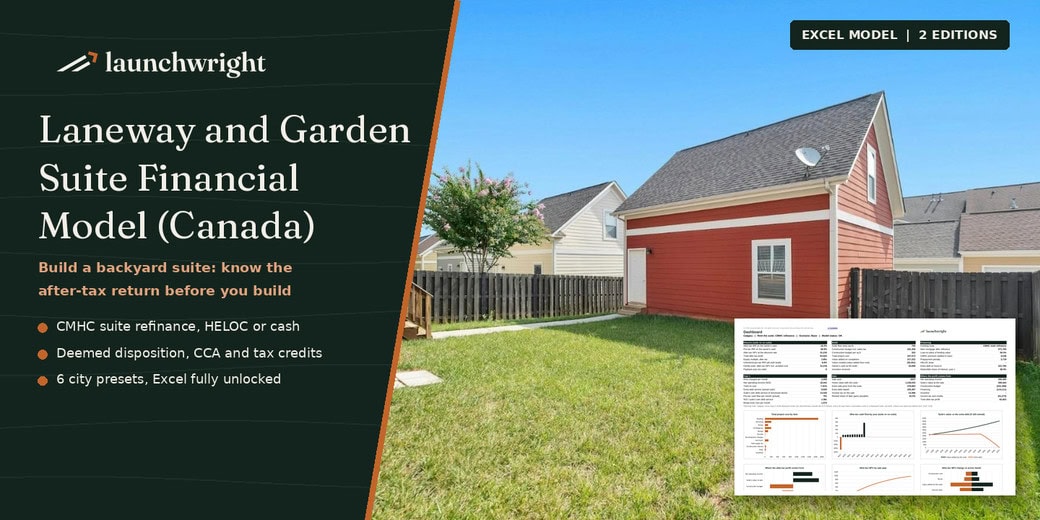
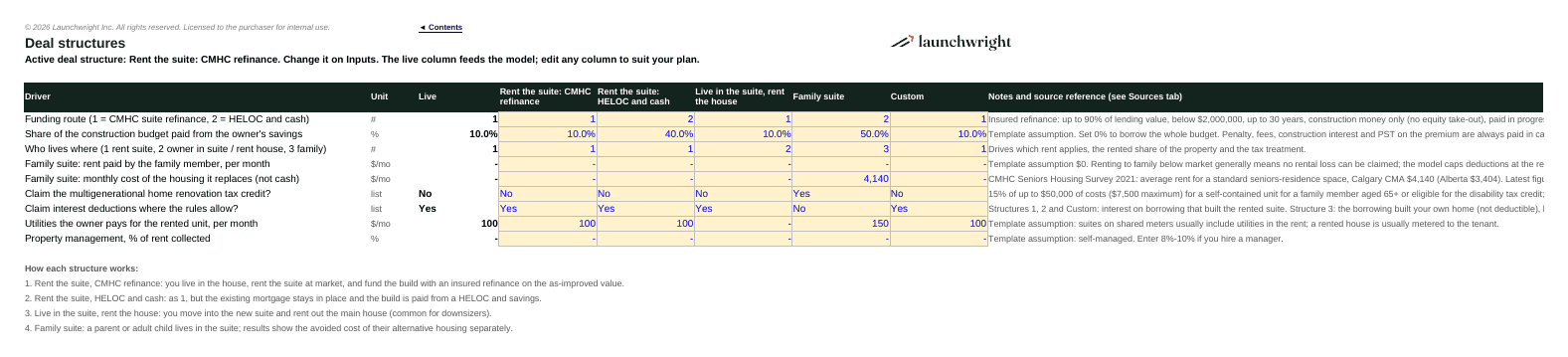
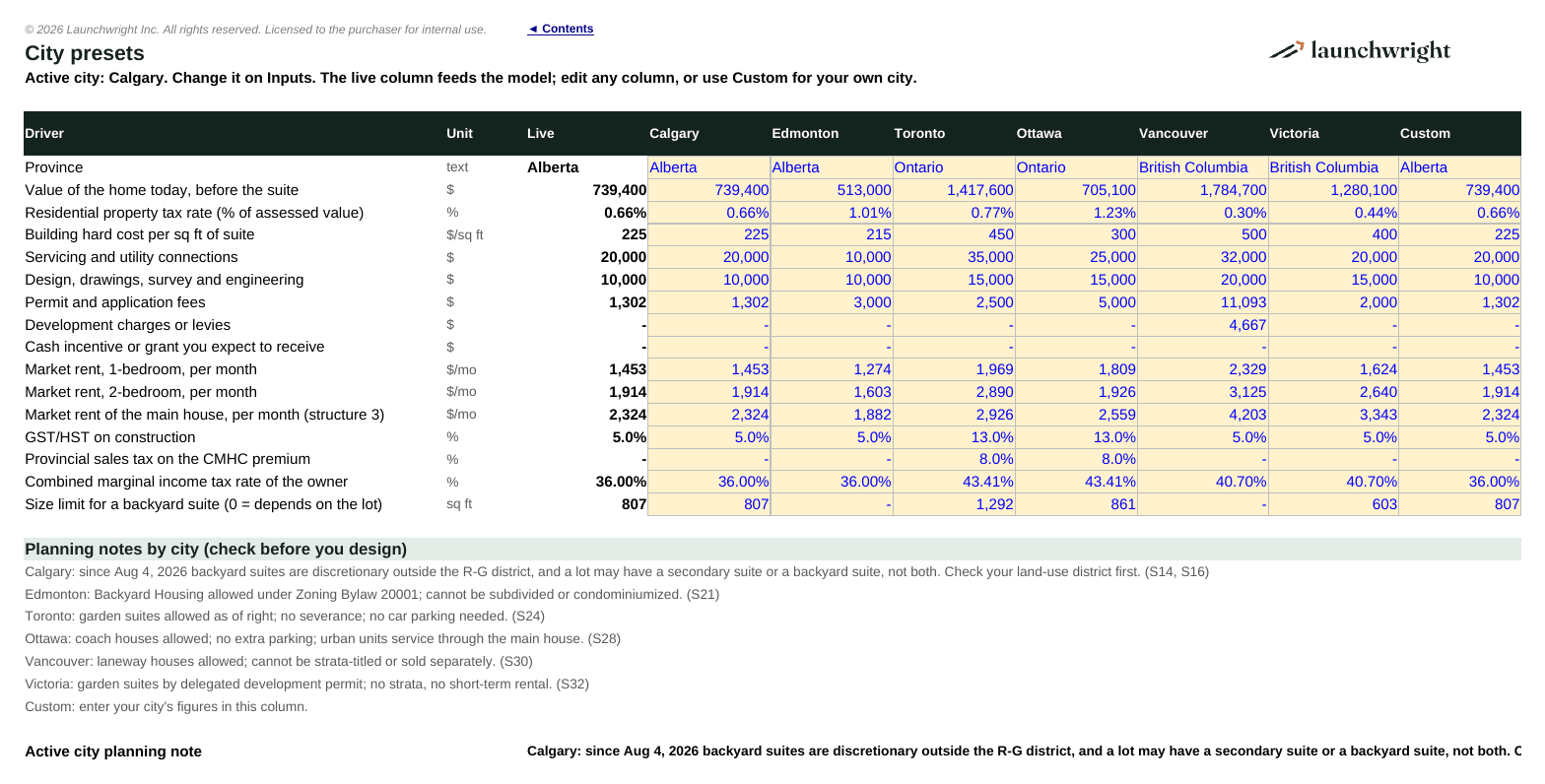
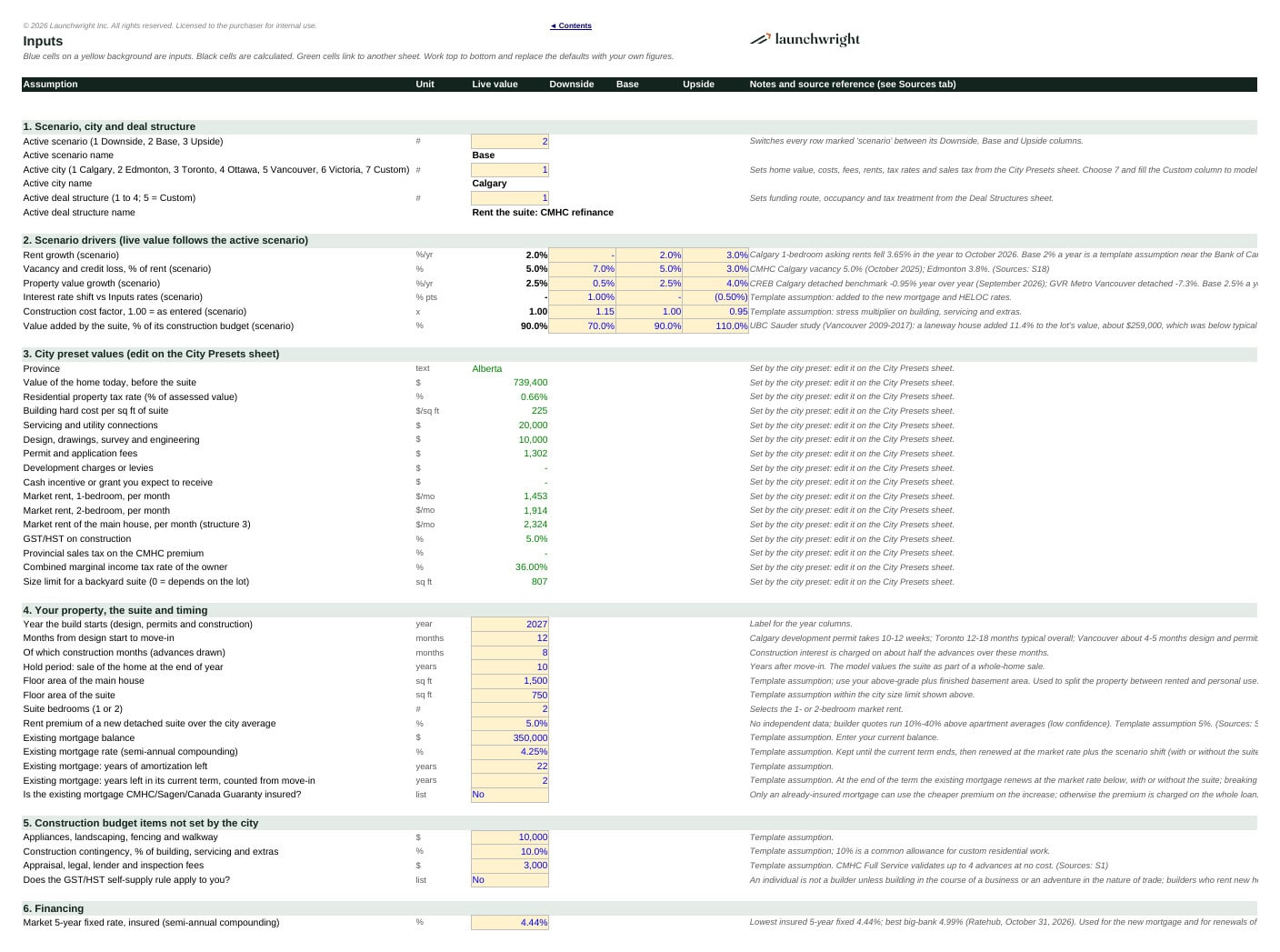
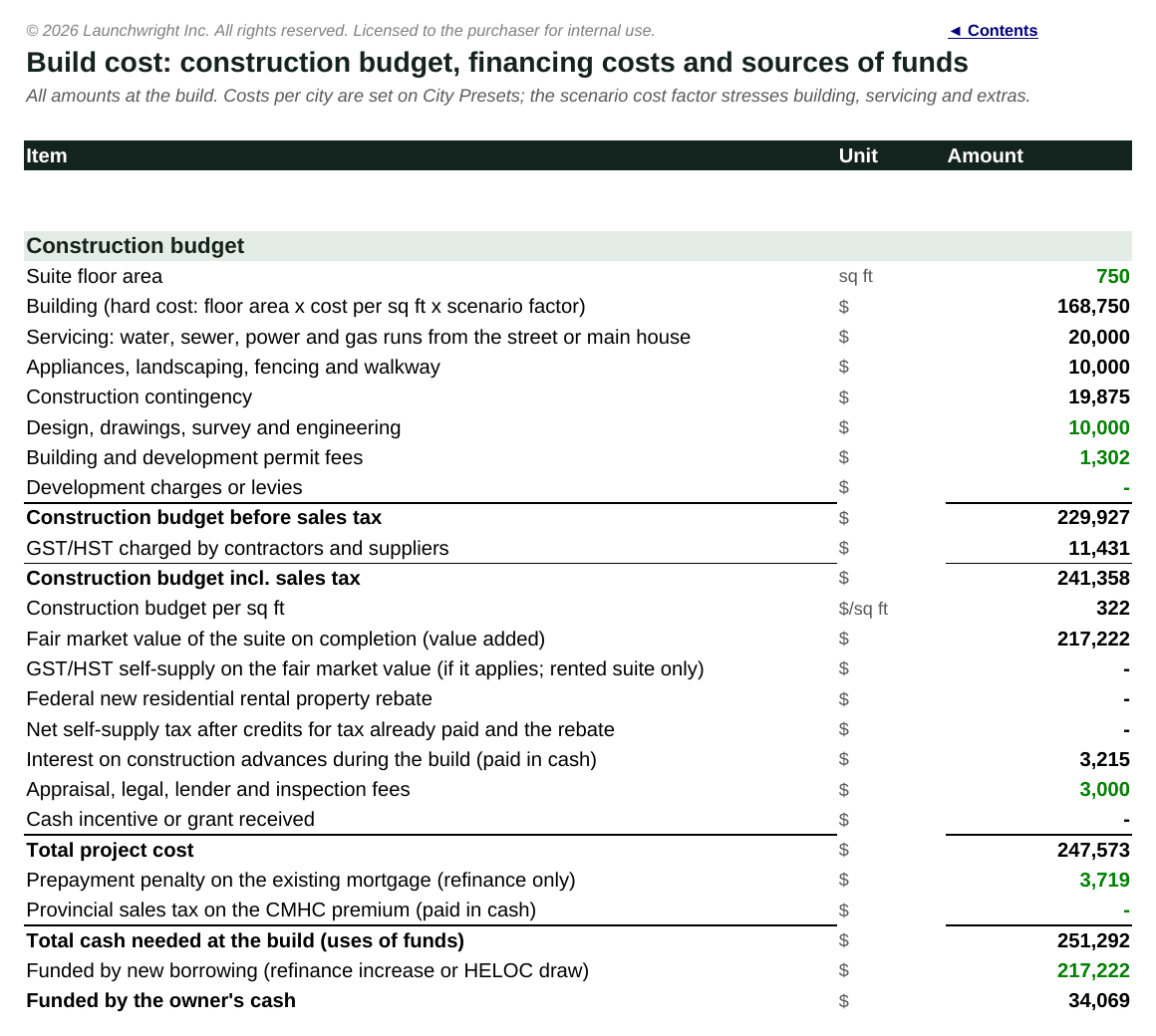
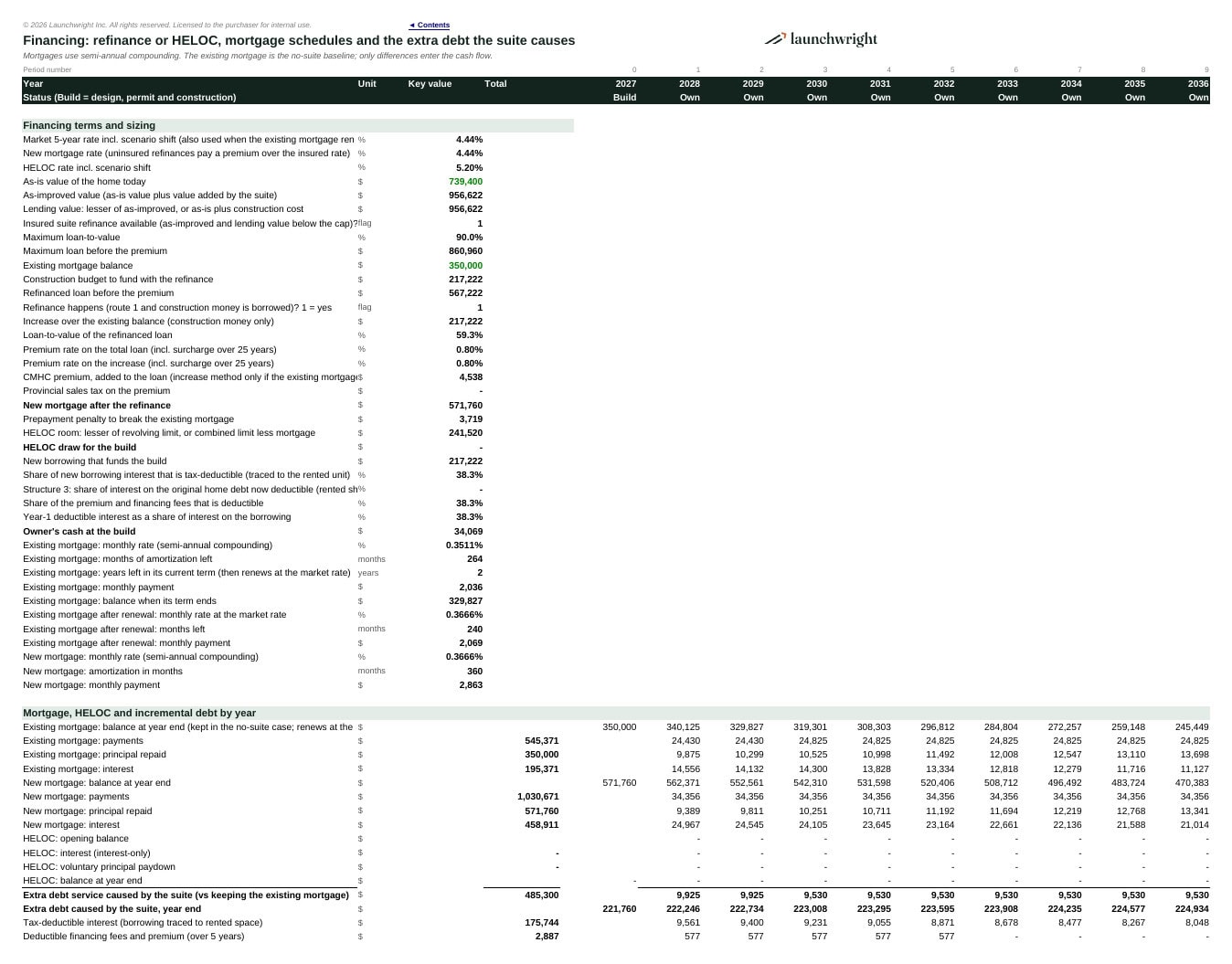
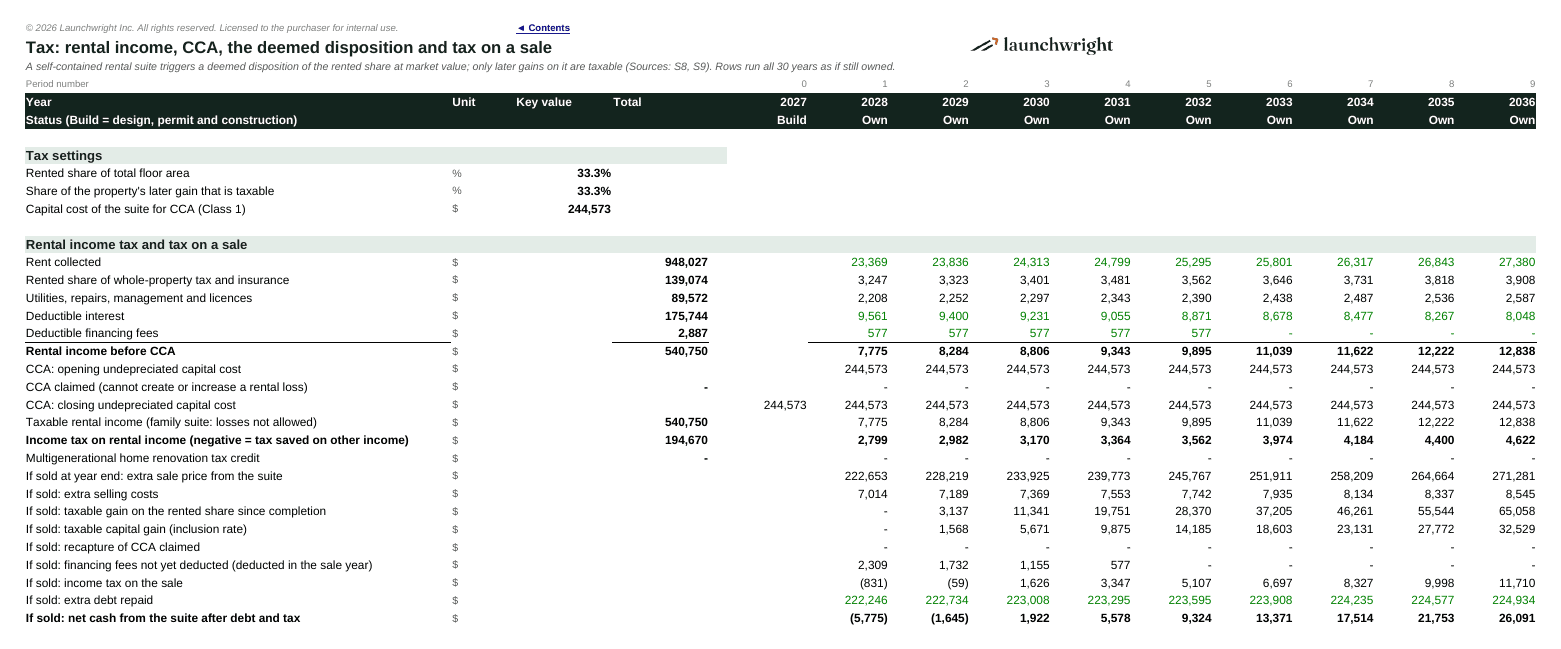
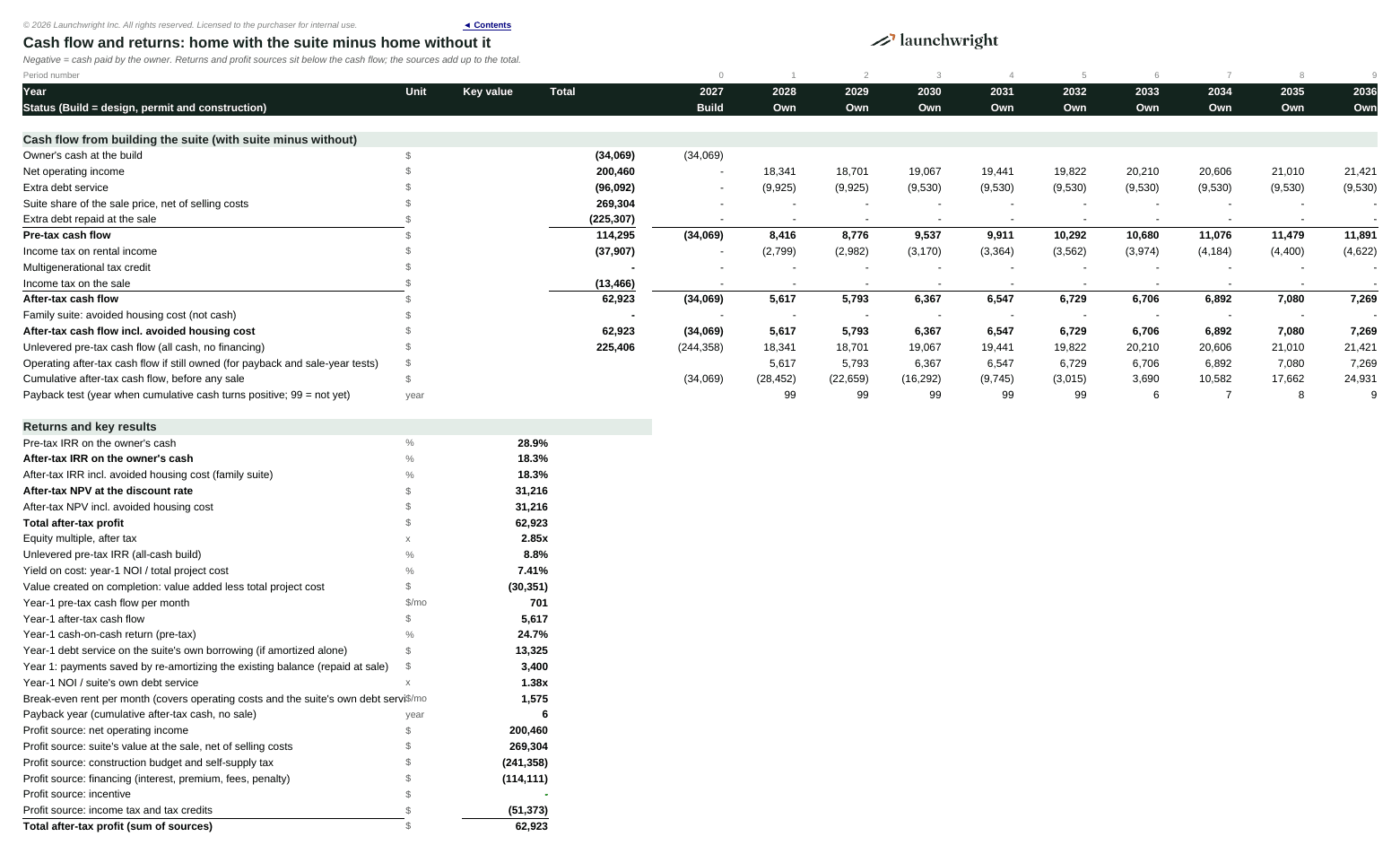
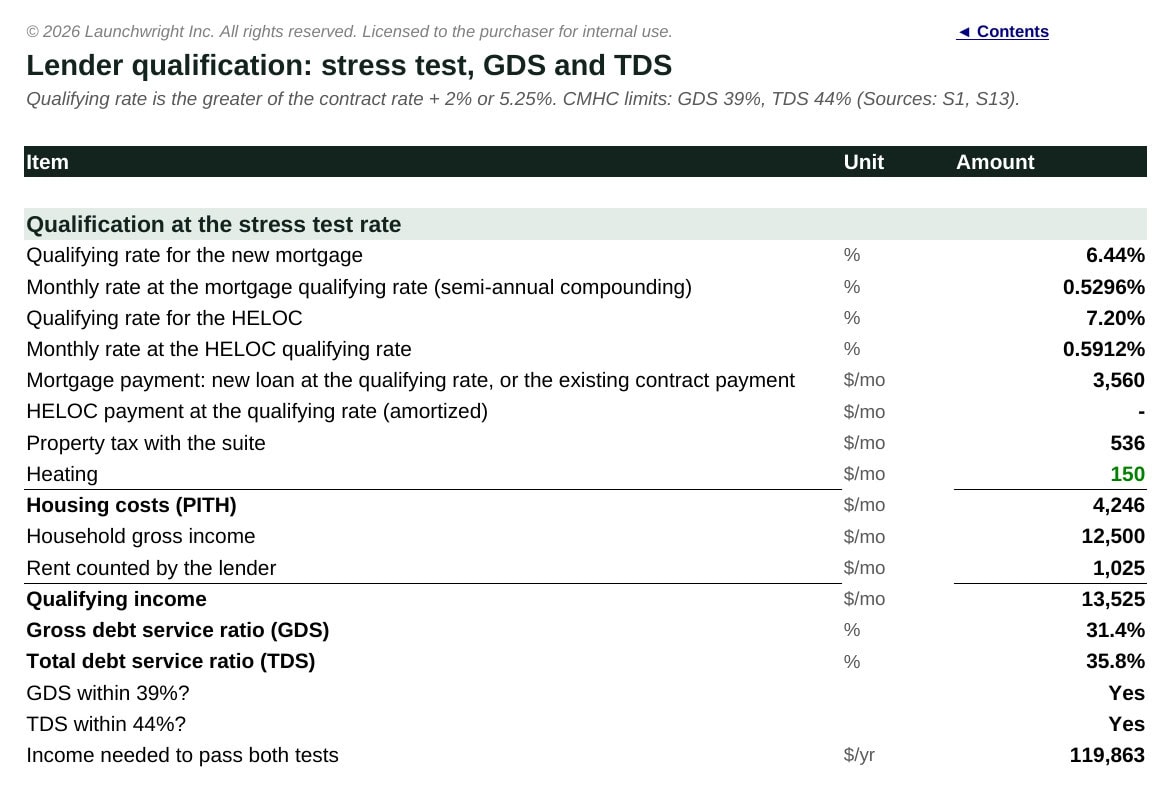
Thinking about a laneway house, garden suite, coach house or backyard suite? The build costs a quarter of a million dollars or more, and the real questions are Canadian: can you fund it with CMHC’s insured refinance for adding a suite, or is a HELOC cheaper; what does refinancing your existing mortgage really cost; how much tax will you pay on the rent and, years later, on the sale; and is the suite worth what it costs? Generic ADU calculators are American, ignore your existing mortgage and stop at a simple payback. This Excel model answers those questions year by year, after tax, by comparing your home with the suite against your home without it.
Why this model
Everything is incremental: only the cash that changes because you build counts. If you refinance, the new mortgage replaces the old one, so the model charges you the difference in payments, the prepayment penalty and the CMHC premium, not the whole mortgage. Every default is a published figure or a Canadian rule, cited on a Sources tab, and the gaps are labelled as template assumptions so you know what to replace.
Canadian rules built in
- CMHC insured refinance to add a suite: up to 90% of the lending value (the lesser of the as-improved value or the as-is value plus cost), below $2,000,000, up to 30 years, construction money only; above the cap the model switches to an 80% uninsured refinance
- CMHC premium on the whole loan, or the lower of the total-loan and increase methods when your existing mortgage is already insured, with the 0.20% surcharge over 25 years and Ontario PST on the premium; uninsured refinances above the $2,000,000 cap carry a rate premium
- HELOC alternative sized to the 65% revolving and 80% combined limits, with interest-only payments
- Semi-annual mortgage compounding for both the existing and the new mortgage, and the prepayment penalty for breaking the existing one
- Interest deductible only on borrowing traced to a rented unit, financing fees over five years, and CCA Class 1 that cannot create a rental loss
- The deemed disposition when part of your home becomes a rental: gains before completion stay tax-free, later gains on the rented share are taxed at the 50% inclusion rate, with CCA recapture
- GST/HST self-supply as a switch, with the federal new residential rental property rebate; the multigenerational home renovation tax credit for a family suite
Four deal structures, six cities, three scenarios
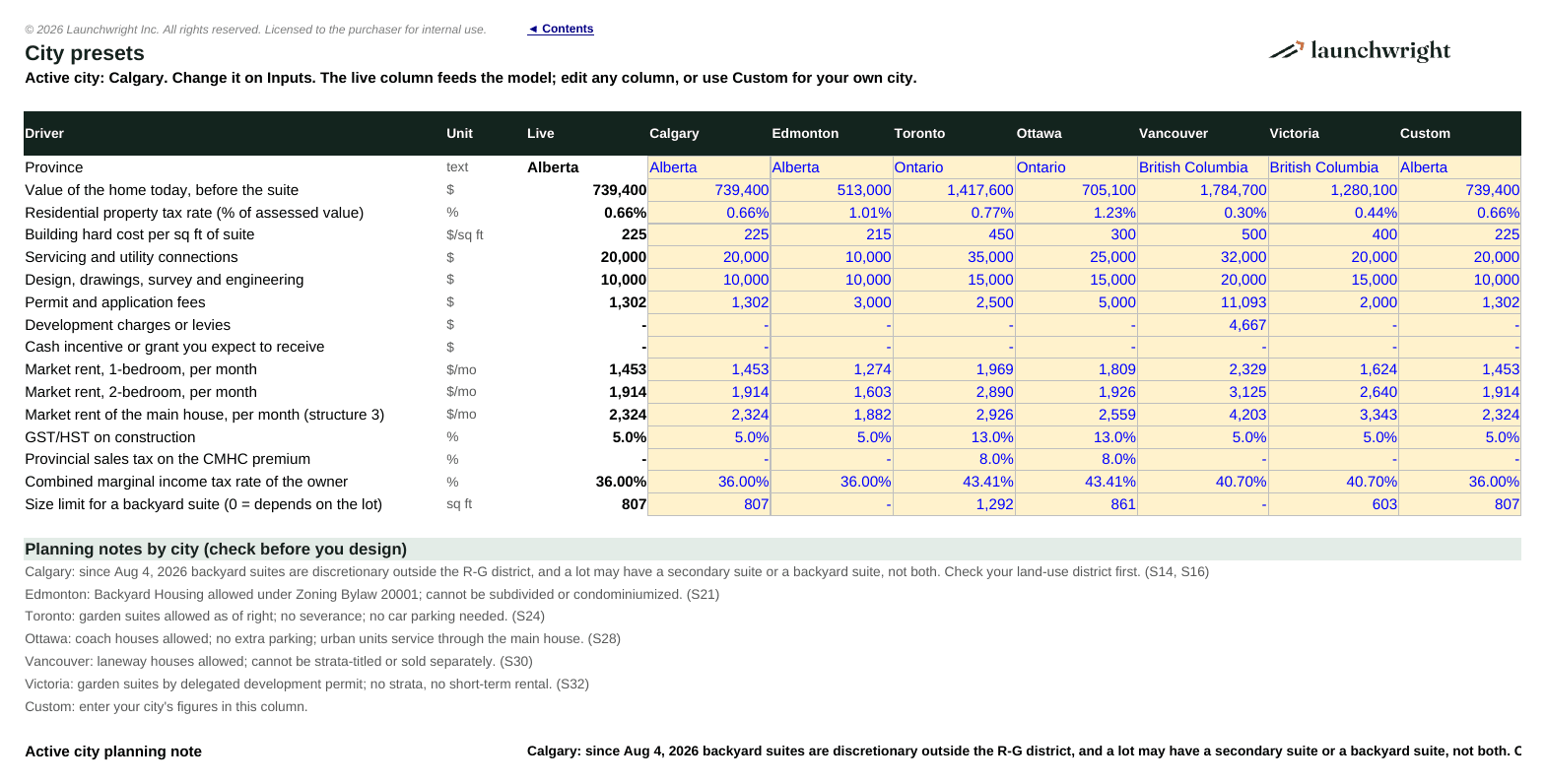
Switch between: renting the suite with a CMHC refinance; renting the suite with a HELOC and savings; moving into the suite and renting the main house; and a family suite for a parent or adult child, which also shows the avoided cost of their other housing. Presets cover Calgary, Edmonton, Toronto, Ottawa, Vancouver and Victoria (home values, build costs, servicing, permit fees, development charges, rents, property tax, sales tax and tax rates), plus a Custom column. Each runs in Downside, Base and Upside markets.
Two editions
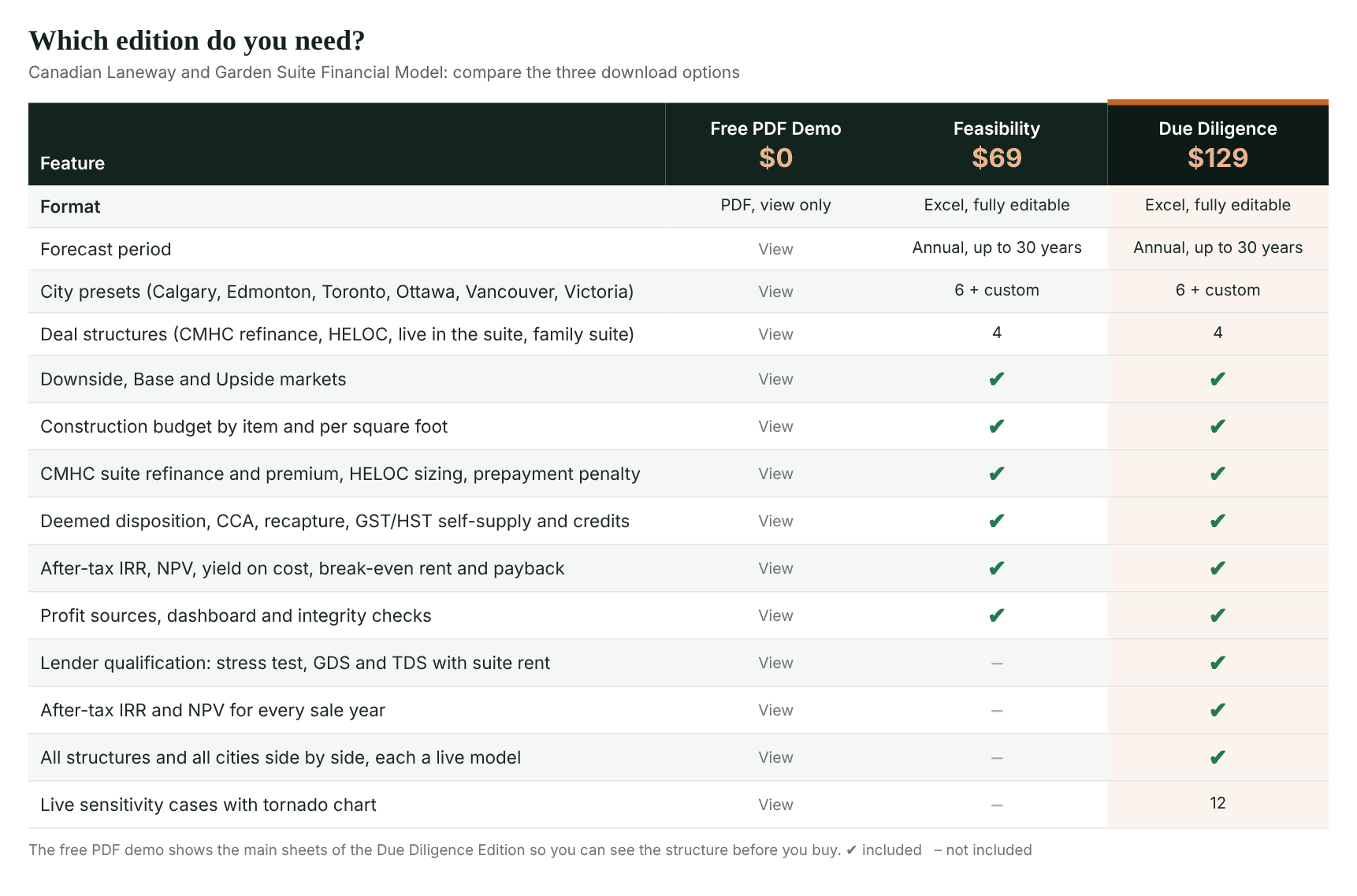
- Feasibility Edition: annual model to 30 years with the construction budget, financing, operations, tax and incremental cash flow, all four structures, six city presets, scenarios, after-tax IRR, NPV, yield on cost, value created, break-even rent, payback, profit sources, a dashboard and integrity checks.
- Due Diligence Edition: everything in the Feasibility Edition, plus:
- lender qualification with the stress test, GDS and TDS including the suite rent
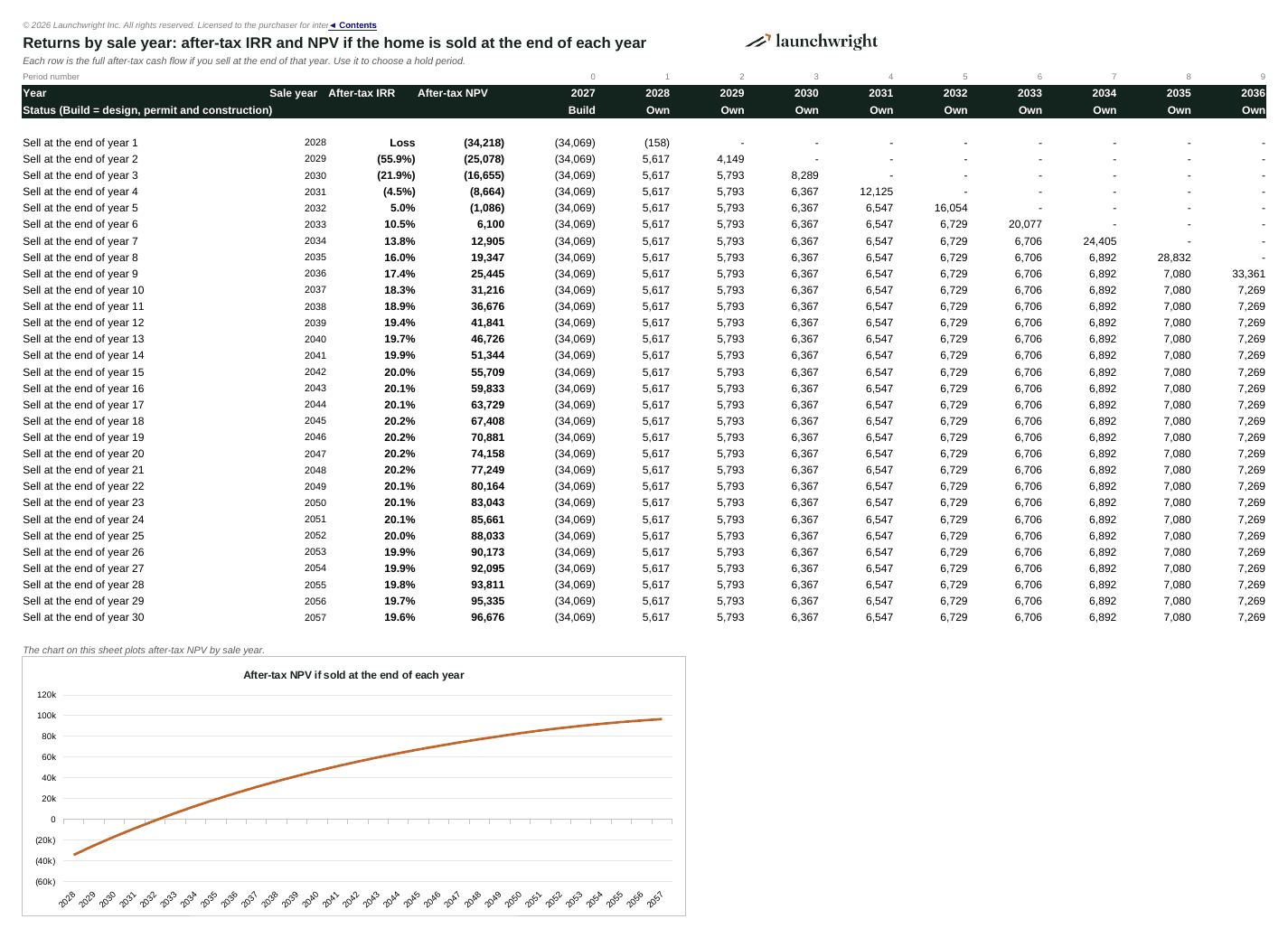
- after-tax IRR and NPV for every possible sale year
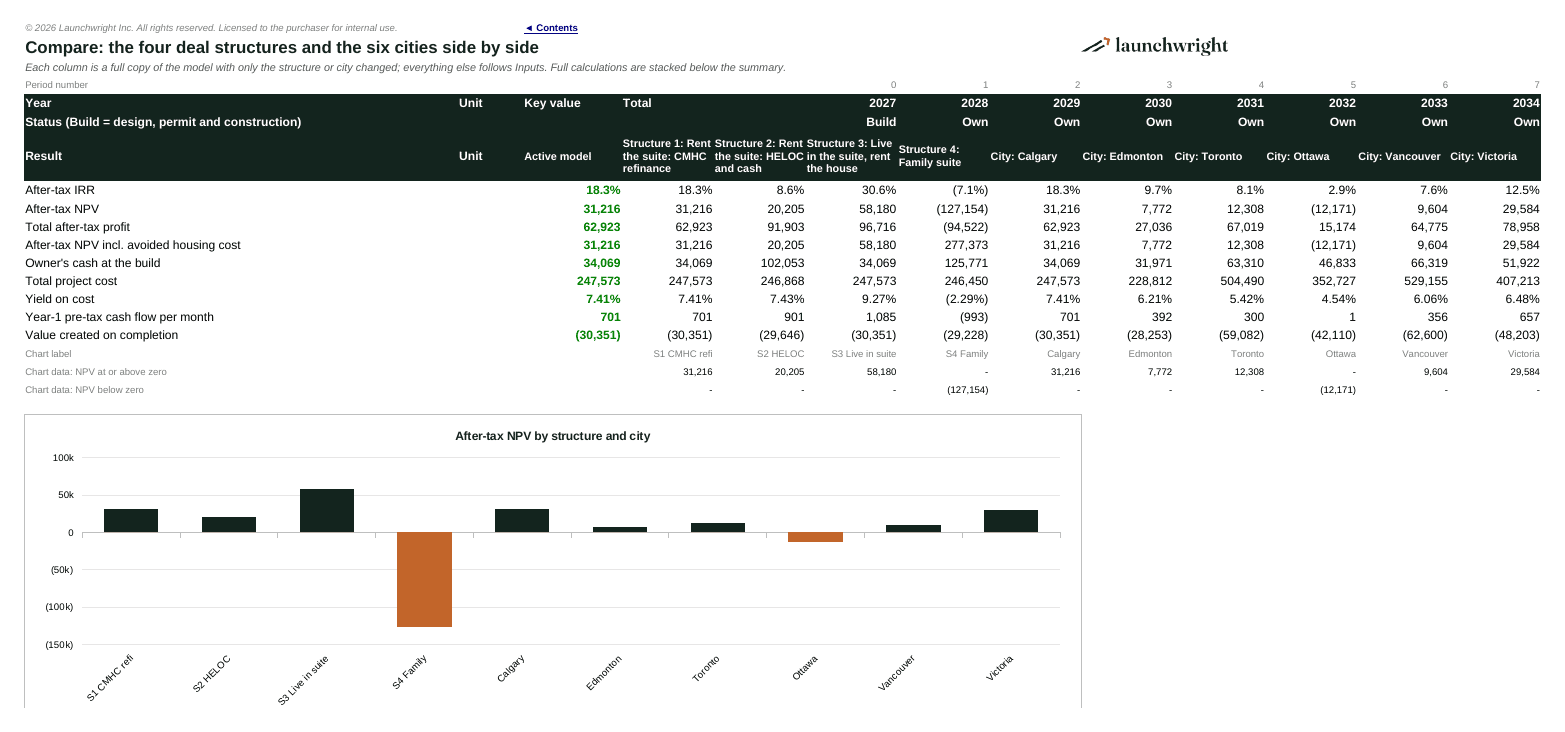
- all four structures and all six cities side by side, each a full live copy of the model
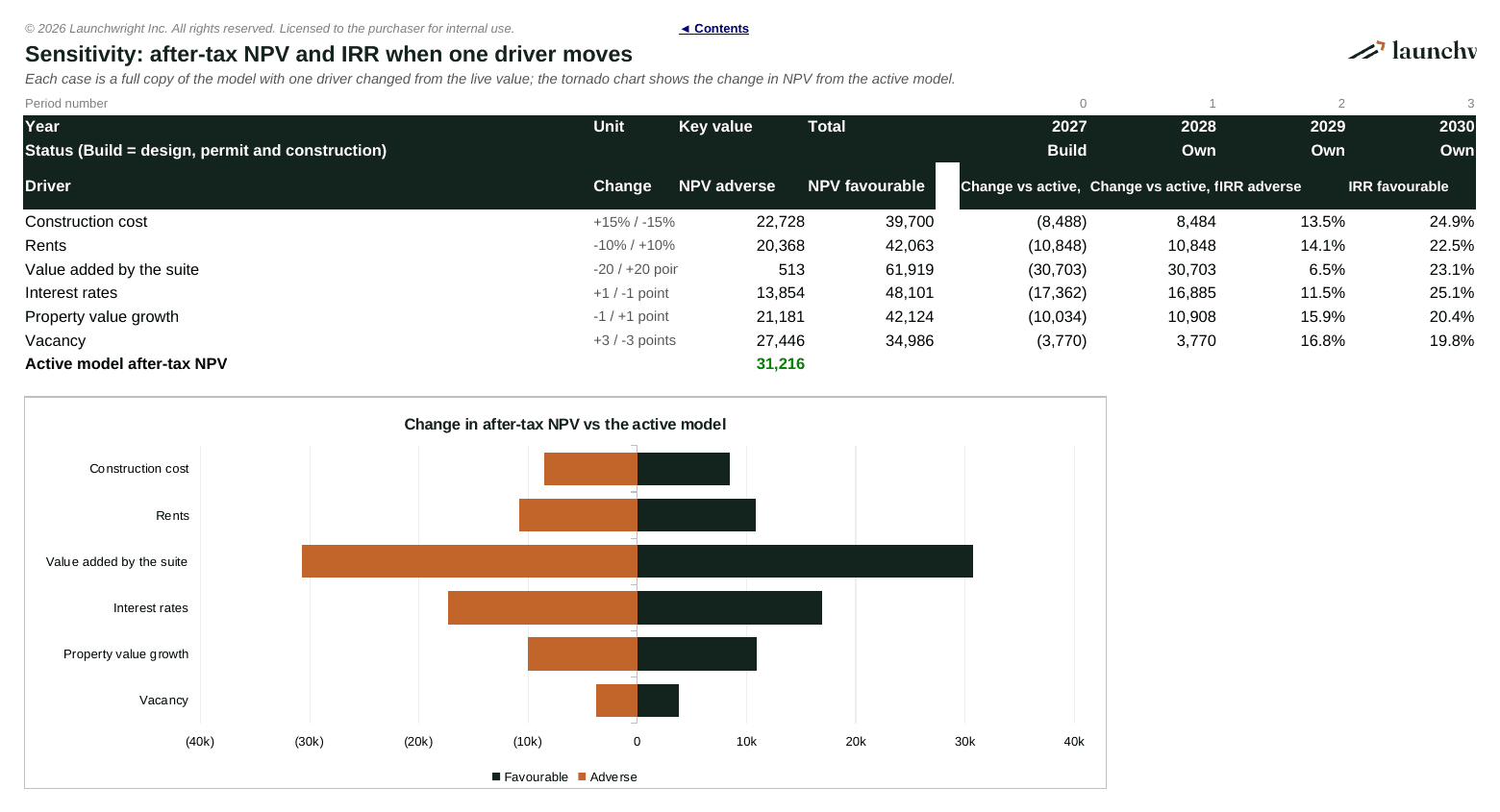
- twelve live sensitivity cases with a tornado chart
Key outputs
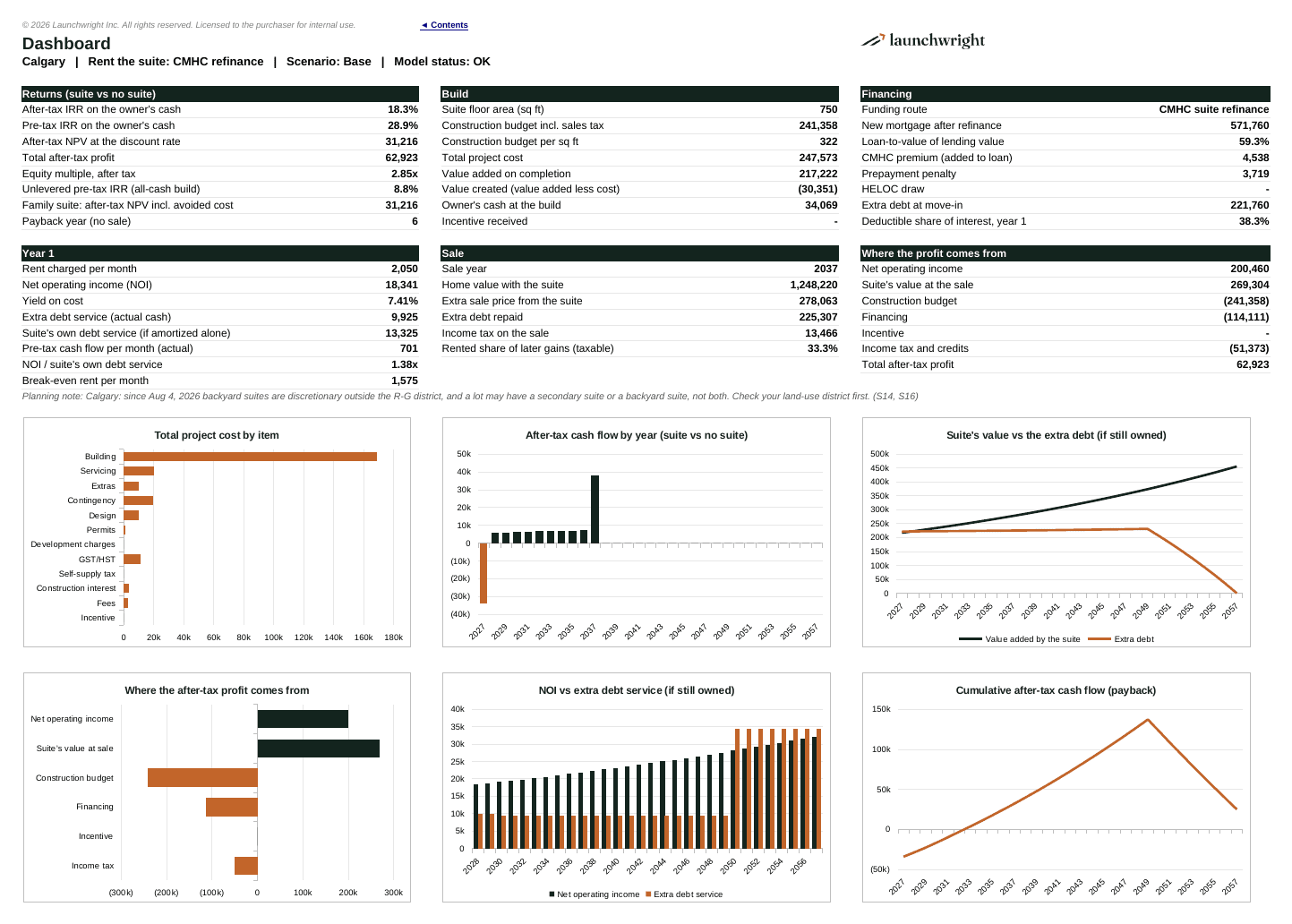
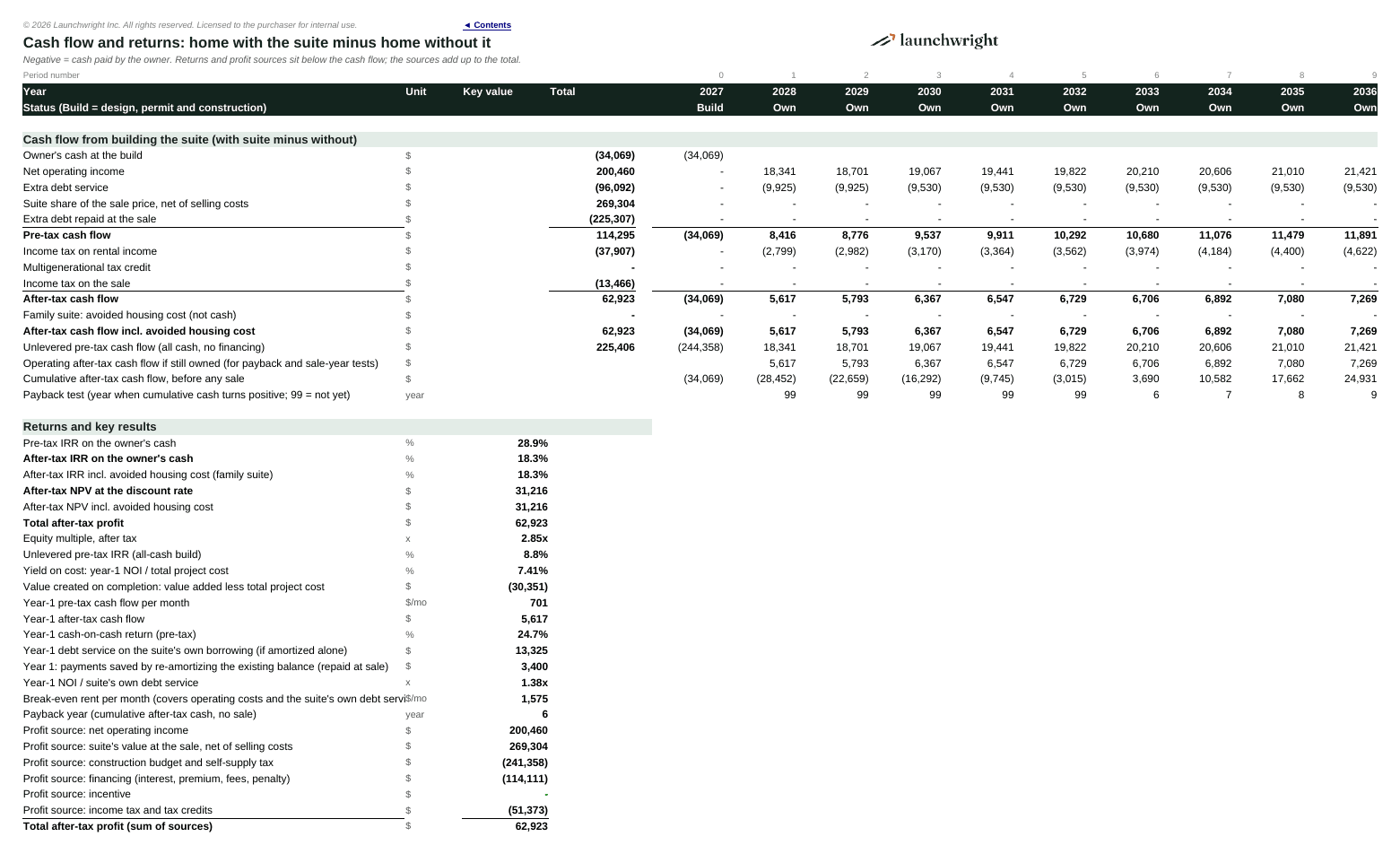
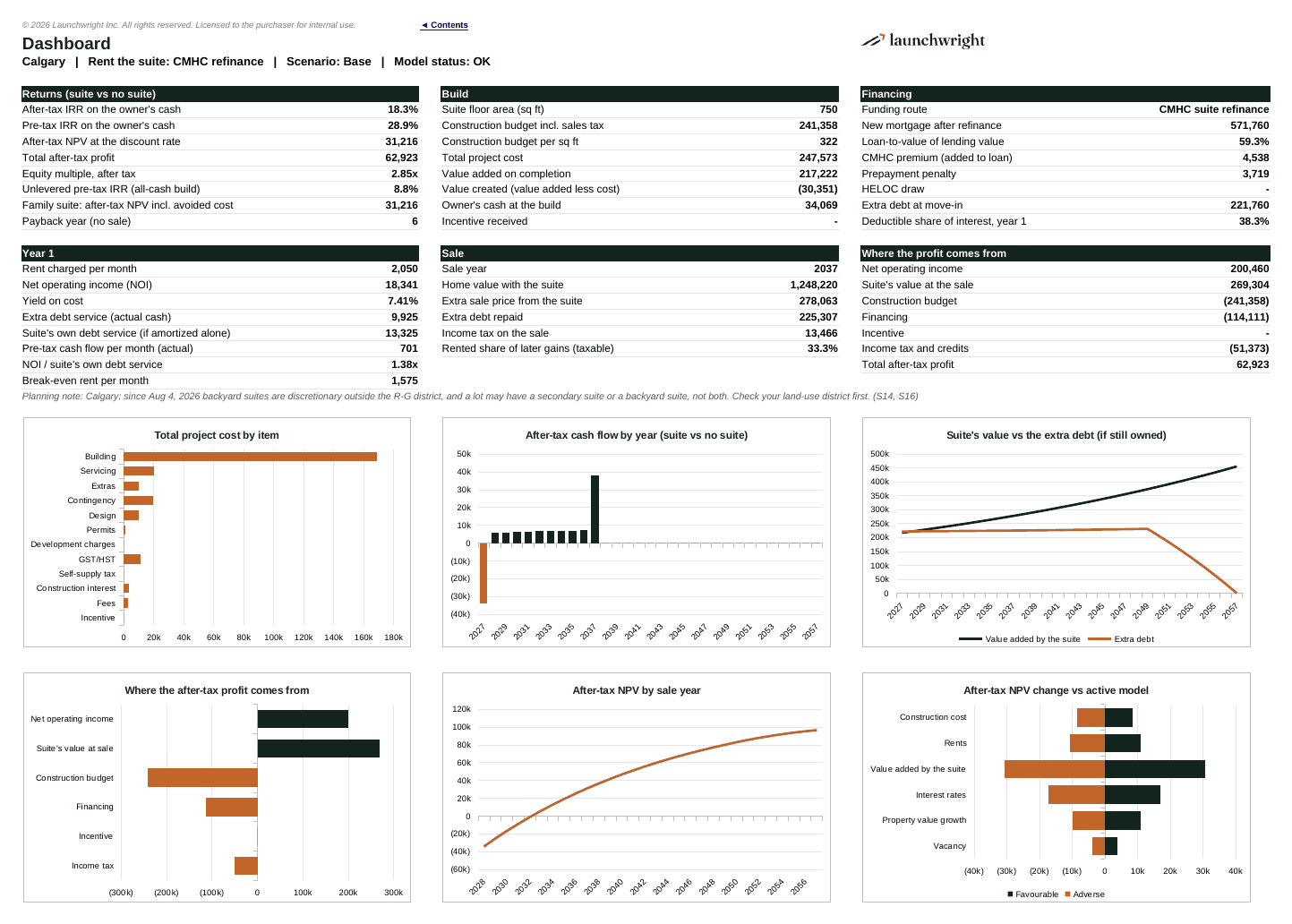
- After-tax and pre-tax IRR on your cash, after-tax NPV, equity multiple, total profit and unlevered IRR
- Construction budget per square foot, total project cost, value added and value created on completion, owner’s cash at the build
- Year-1 rent, NOI, yield on cost, extra debt service, monthly cash flow, debt coverage and break-even rent
- Where the profit comes from: rent, the suite’s value at sale, construction, financing, incentives and tax
- Dashboard charts: project cost by item, after-tax cash flow by year, suite value against the extra debt, profit sources
Built to modeling best practice
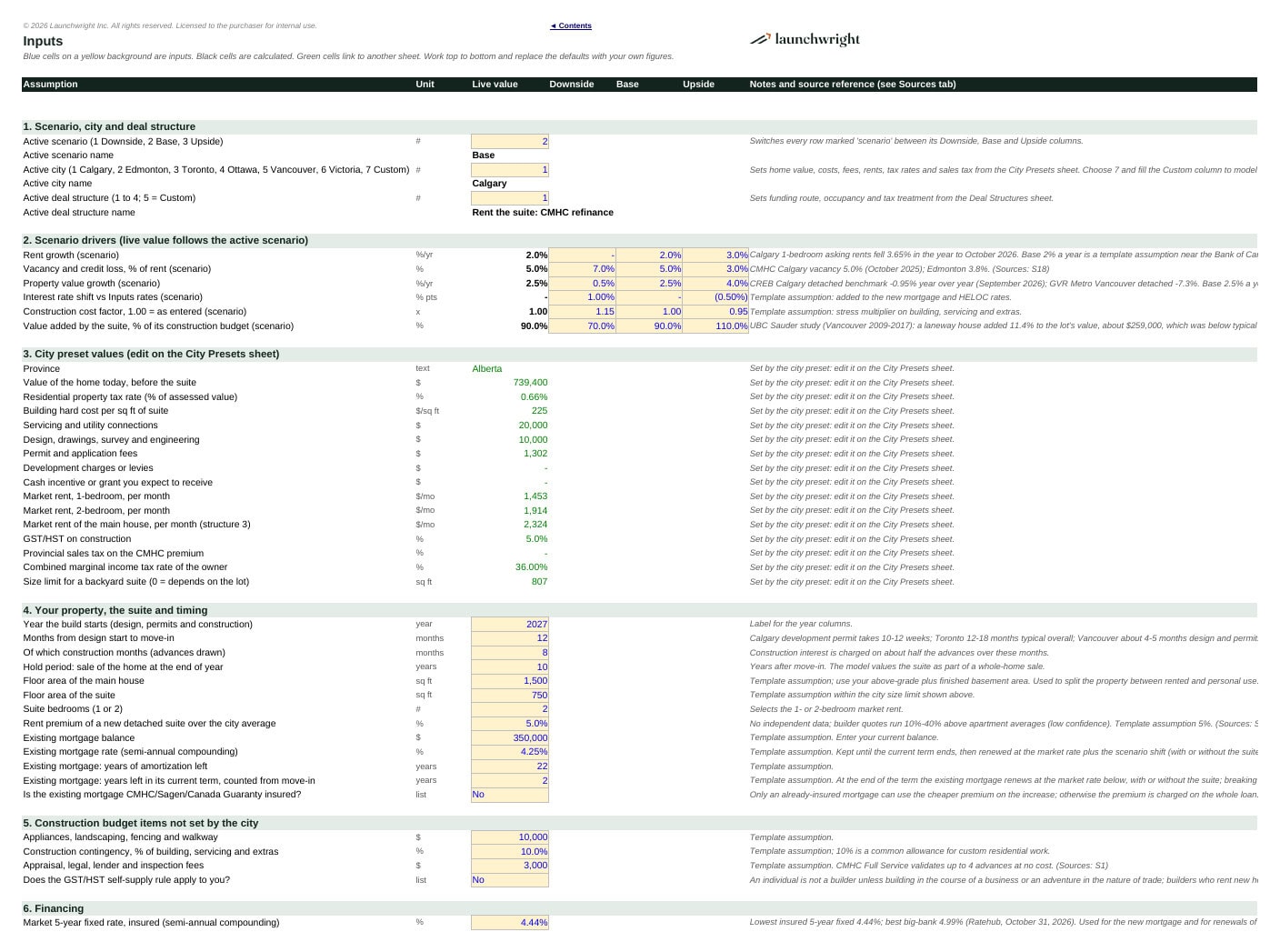
- Inputs, calculations and outputs on separate sheets; inputs blue on yellow, formulas black, cross-sheet links green
- One formula per row for years 1 to 30; no macros, no circular references, no hidden or protected sheets, no external links
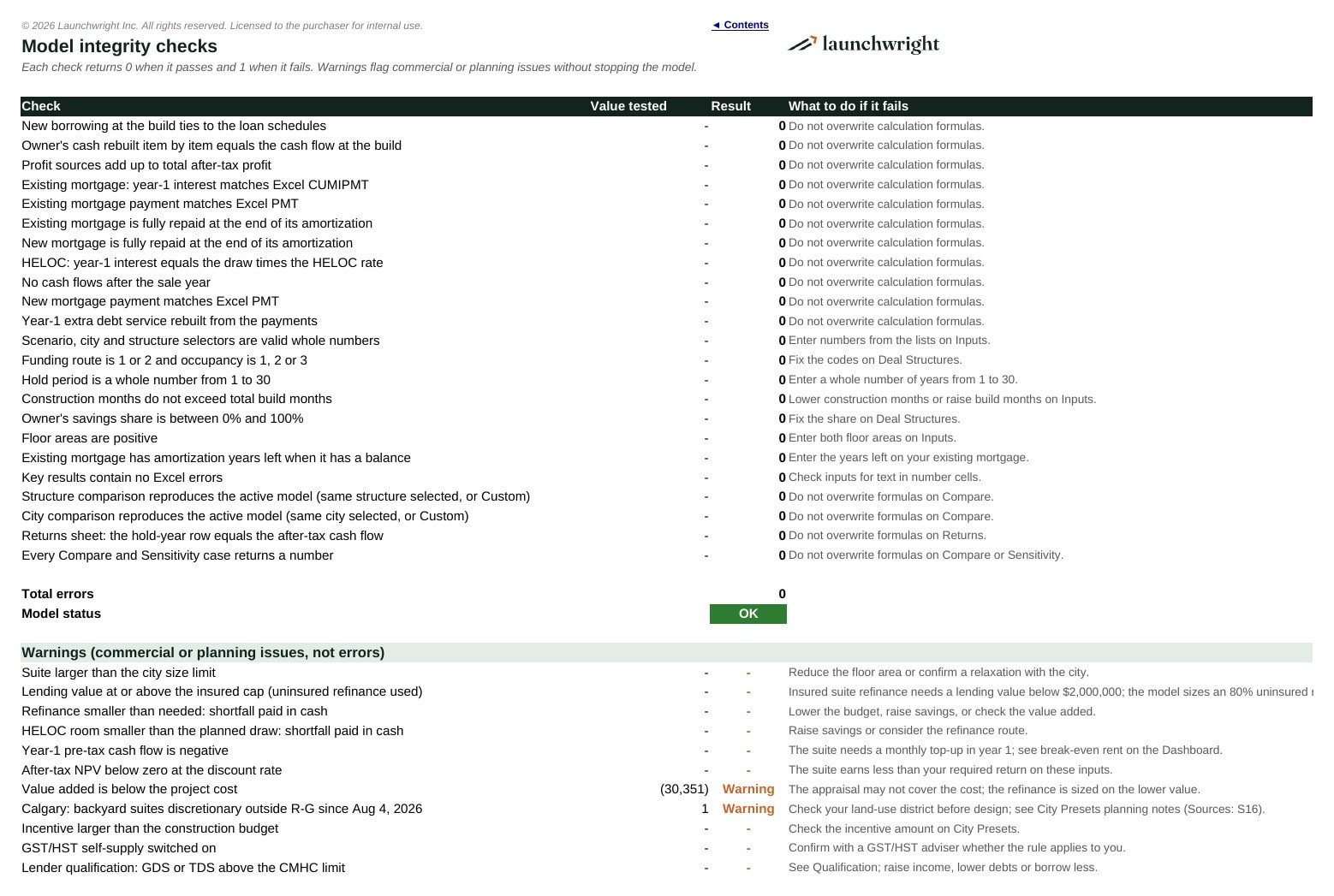
- Checks sheet rebuilds the owner’s cash item by item, cross-checks the mortgages against Excel’s PMT and CUMIPMT, confirms every loan is fully repaid and no cash flows remain after the sale, ties profit sources to the total and validates selectors; it warns about city size limits, the insured-loan cap, negative cash flow and Calgary’s zoning change
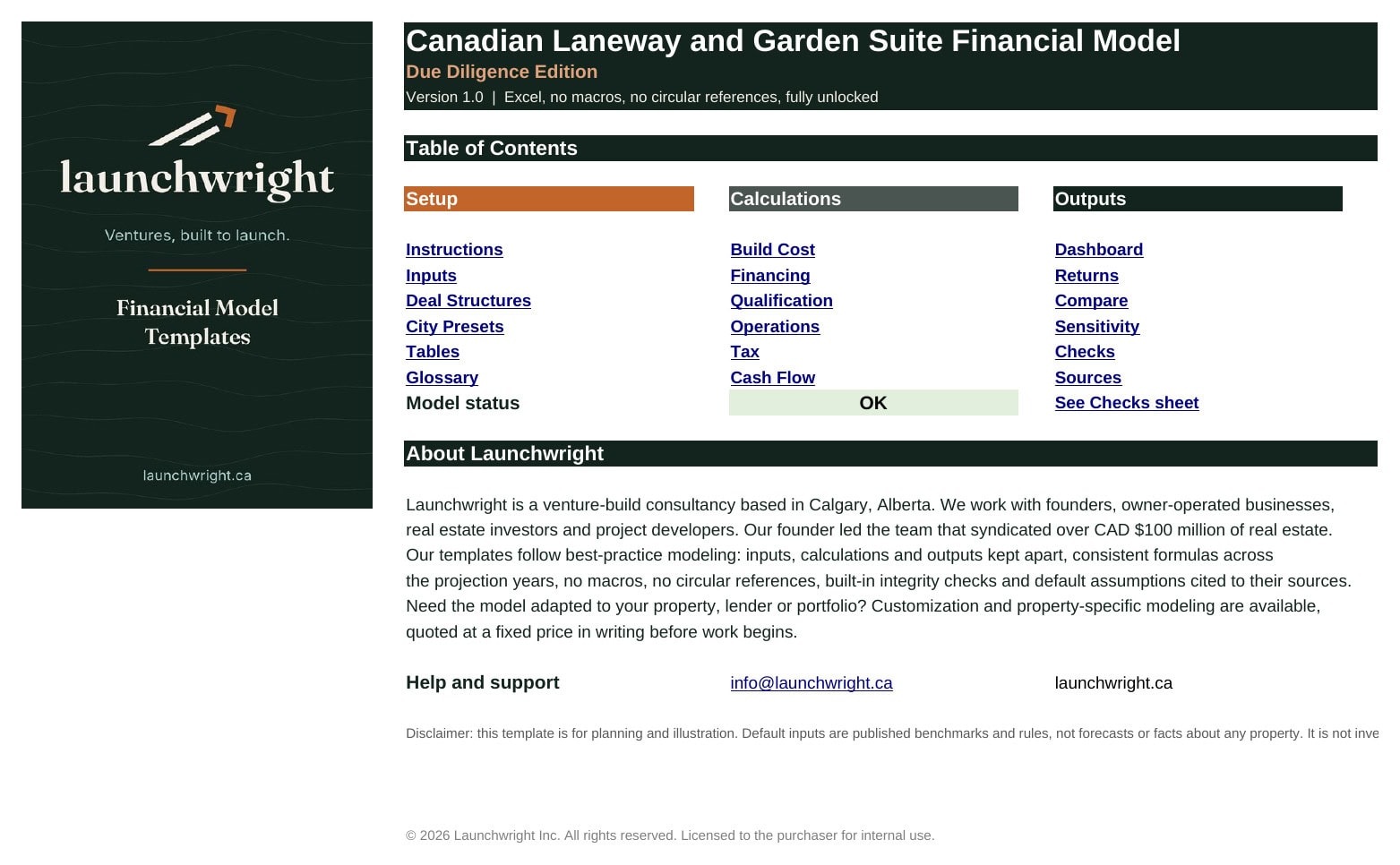
- Contents sheet with links, step-by-step instructions, a glossary and a full source list
Default assumptions
Defaults describe a 750 sq ft two-bedroom backyard suite behind a Calgary detached home at the CREB benchmark of $739,400 (September 2026), with a $350,000 existing mortgage, Calgary permit fees, a 2-bedroom rent from CMHC data plus a 5% new-build premium, Calgary property tax and October 2026 mortgage and prime rates. The construction budget comes to $241,358, or $322 per sq ft. With the CMHC refinance on a home whose existing mortgage is not insured, year-1 pre-tax cash flow is $701 a month, the yield on cost is 7.4%, NOI covers the suite’s own debt service 1.38 times and the after-tax IRR on the owner’s cash is 18.3% over a 10-year hold. The suite is assumed to add 90% of its cost to the home’s value, so value created on completion is -$30,351: the profit comes from rent and leverage, not from an instant appraisal gain. With the same plan, Ottawa shows a negative after-tax NPV at the defaults, which is the honest picture there. Replace the defaults with your builder’s quote, your mortgage statement and an appraisal.
Compare the editions
The free PDF demo, the Feasibility Edition ($69) and the Due Diligence Edition ($129) side by side:
What you get
- One Excel workbook (.xlsx) for the edition purchased, built only with functions available since Excel 2010 (no dynamic arrays, no macros)
- A free PDF demo showing the main sheets of the Due Diligence Edition
Support and customization
Questions about how the template works are answered by email. Launchwright can also adapt the model to your property, lender or portfolio, quoted at a fixed price in writing before work begins. Contact details are inside the model.
Important
This template is for planning and illustration. It is not investment, tax, legal, planning or mortgage advice. Zoning, incentives, tax and insurance rules change; confirm them with your city, accountant and lender.
Similar ProductsOther customers were also interested in...



 eFinancialModels
Electric Vehicle (EV) Charging Station Financial M...
With this comprehensive 5- or 10-year monthly tool, investors can assess the viability of setting up... Read more

Financial Model for Mobile App | Mobile App Busine...
The Mobile App Financial Plan Template in Excel allows you to develop financial projections when lau... Read more

 HenrySheykin
Food Truck Financial Model Excel Template
The Food Truck Financial Model helps entrepreneurs, founders, business owners, consultants, and anal... Read more

Green Hydrogen Production from Wind Energy Financi...
The Green Hydrogen from Wind Financial Model aims to comprehensively forecast a horizon of 40 years ... Read more

Simple Mutual Non-Disclosure Agreement Template
Protect your business secrets with ease using our Simple Mutual Non-Disclosure Agreement Template. S... Read more

Solar Energy Financial Model
The Solar Energy Financial Model Spreadsheet Template in Excel assists you in preparing a sophistica... Read more

 Peter Graf
The Customer-Centric Financial Model for Restauran...
Starting a restaurant without a financial plan is like driving a car blindfolded. You wouldn´t do i... Read more
You must log in to submit a review.