

0 ITEMS

Manufacturing Plant Financial Model (Greenfield Factory Feasibility): Bill of Materials, Line Capacity, Project Finance, Sculpted Debt, DSCR, DSRA, LLCR, Canada and US
Excel model for a new manufacturing plant in any industry. It costs each product from its bill of materials, tests demand against the machine-hours on each production line, itemizes the capital cost, draws funding month by month through construction and returns IRR, DSCR, break-even and financial statements for up to 20 operating years. The Due Diligence Edition adds debt sculpted to a target DSCR, a DSRA, a lock-up test, LLCR and PLCR.
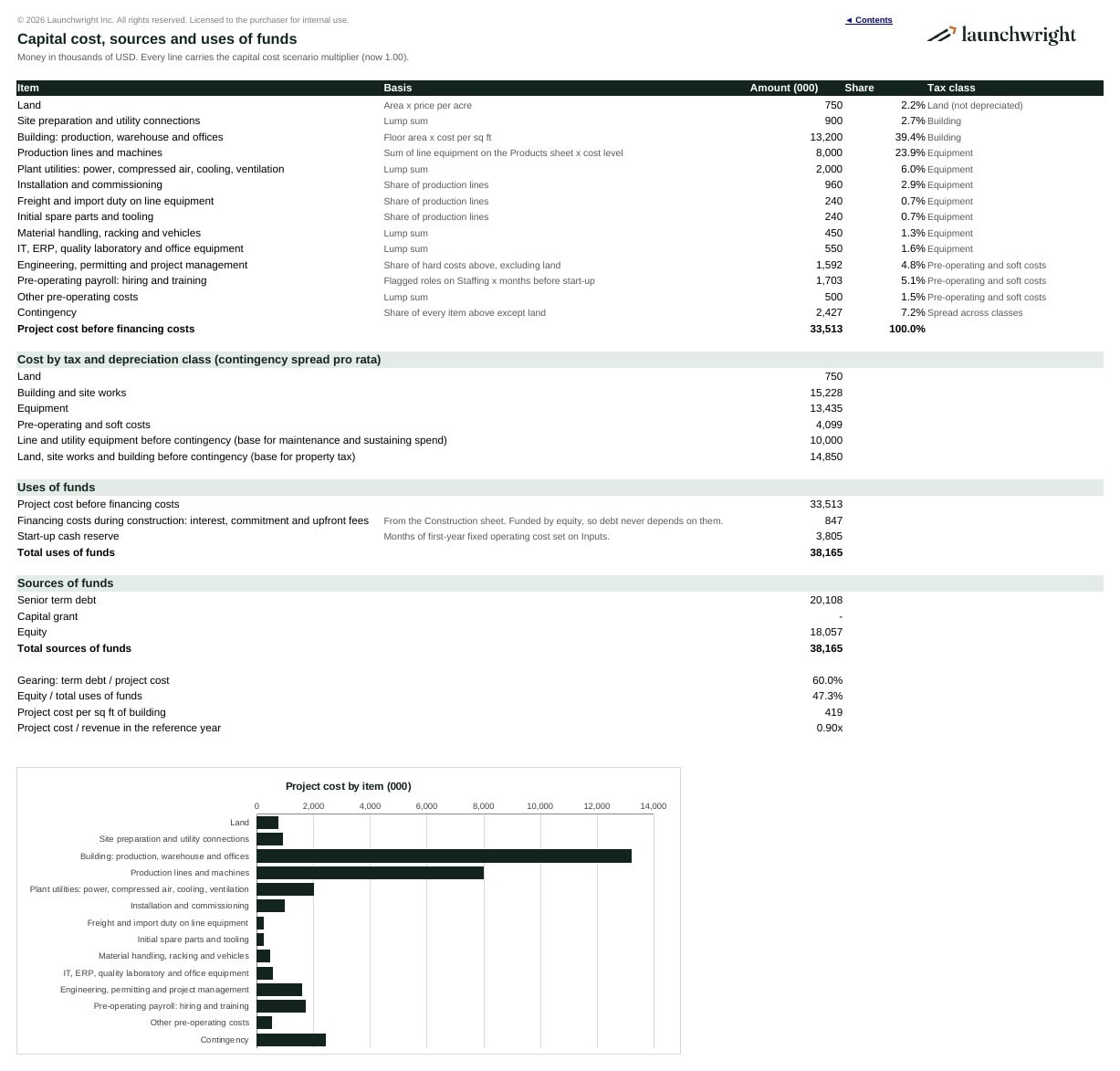
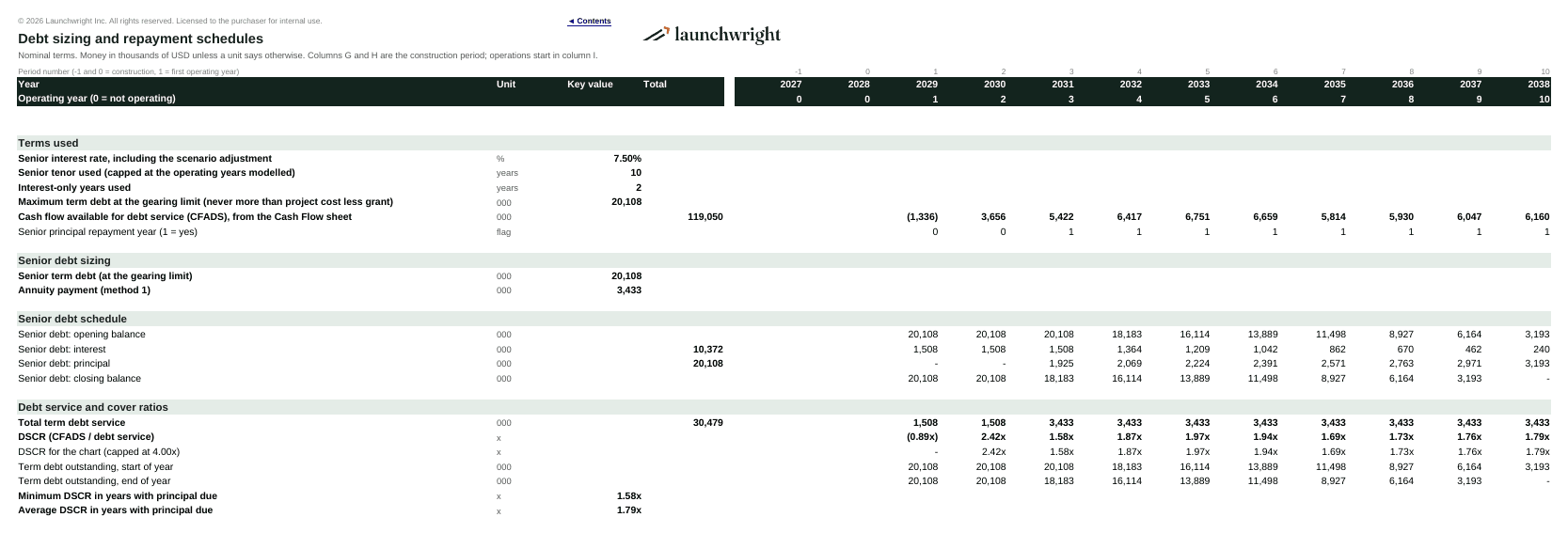
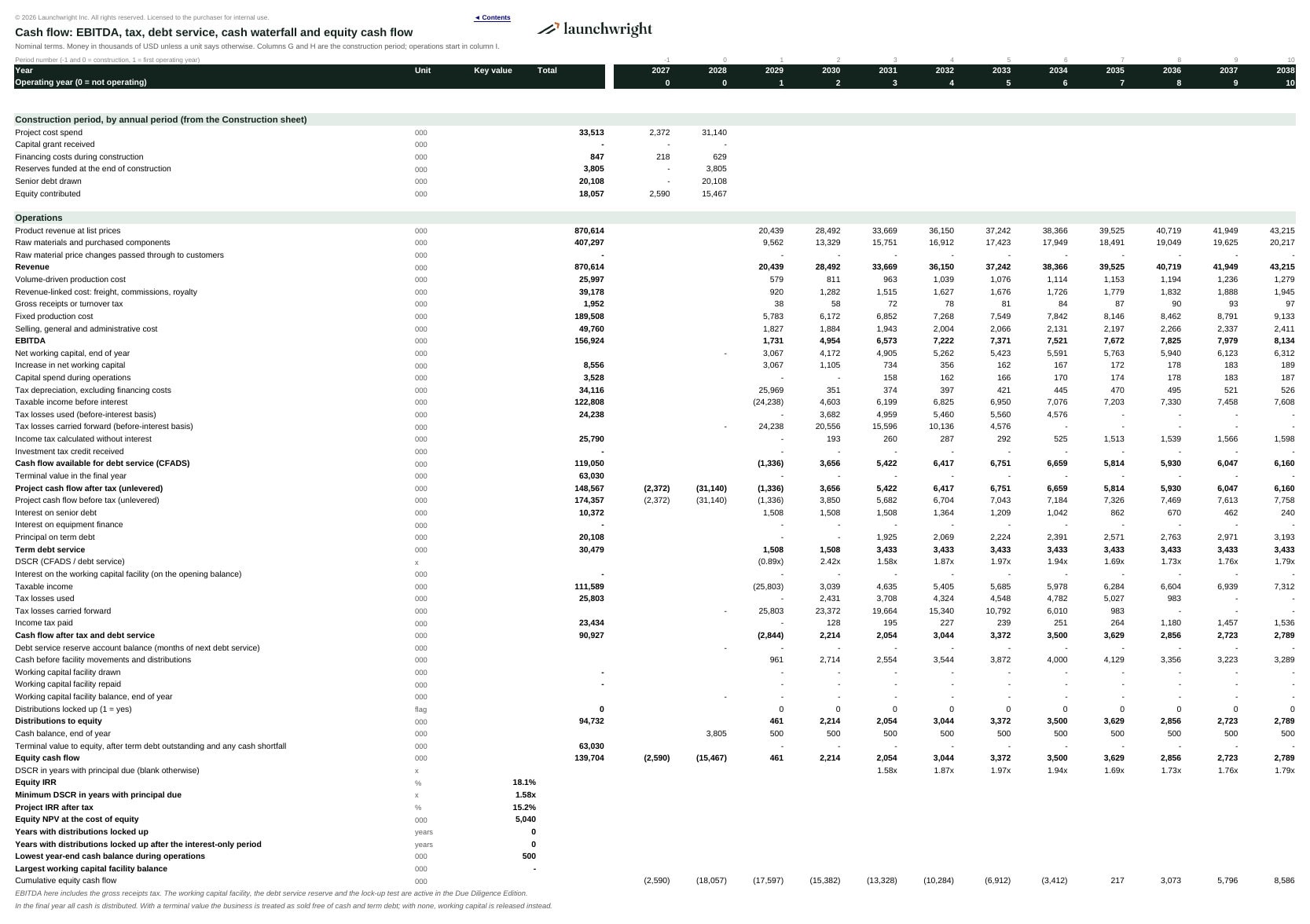
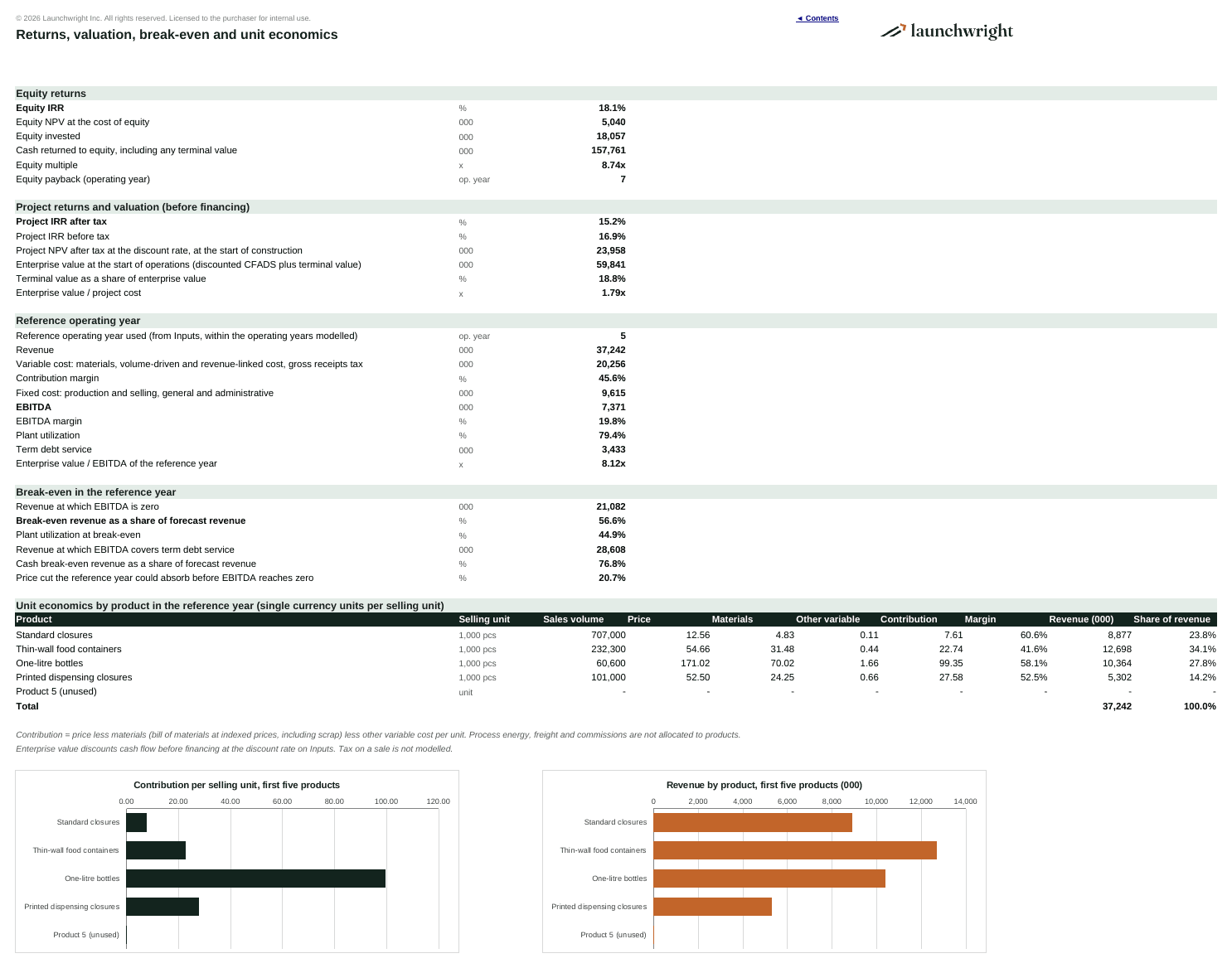
Most factory templates start from a revenue guess and a single capital cost number. A lender or investor starts somewhere else: what goes into each unit, how many units the machines can make, what the plant costs line by line, and whether cash flow covers the loan in the years when the plant is still filling up. This model is built in that order.
What the model does
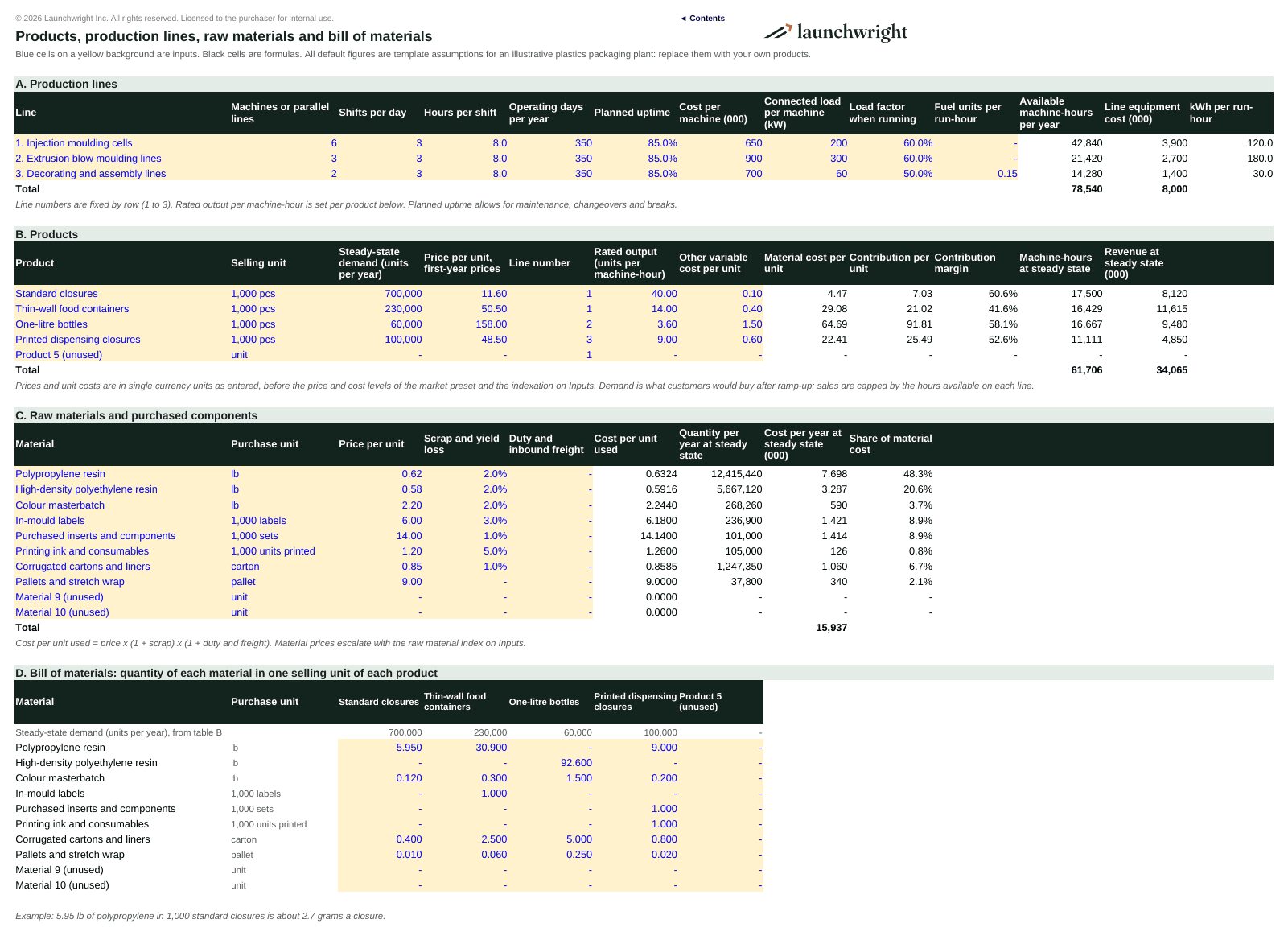
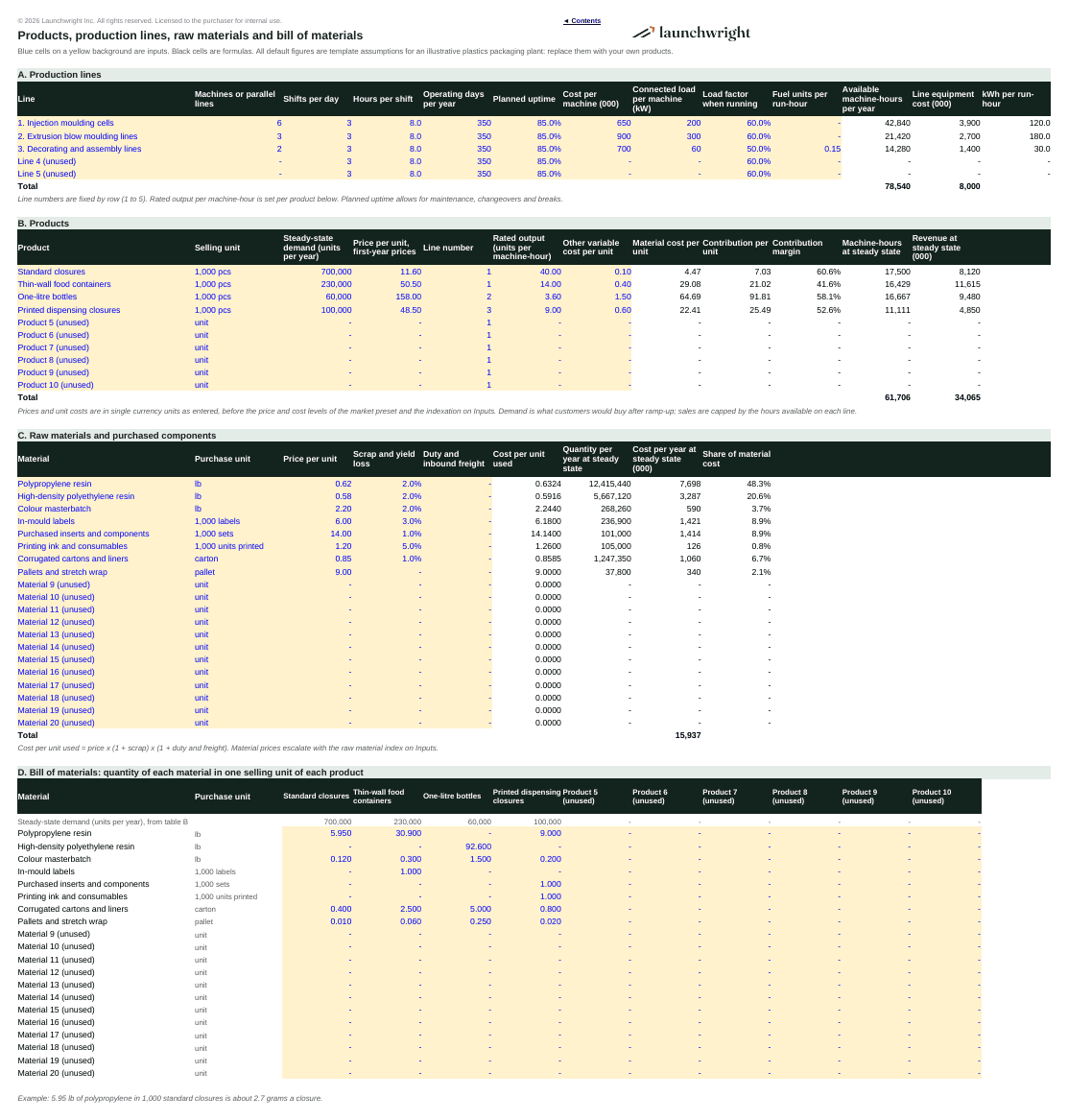
- Products and bill of materials: enter each product, its price, and the quantity of every raw material and purchased component in one unit. Scrap and import duty are built into the material cost.
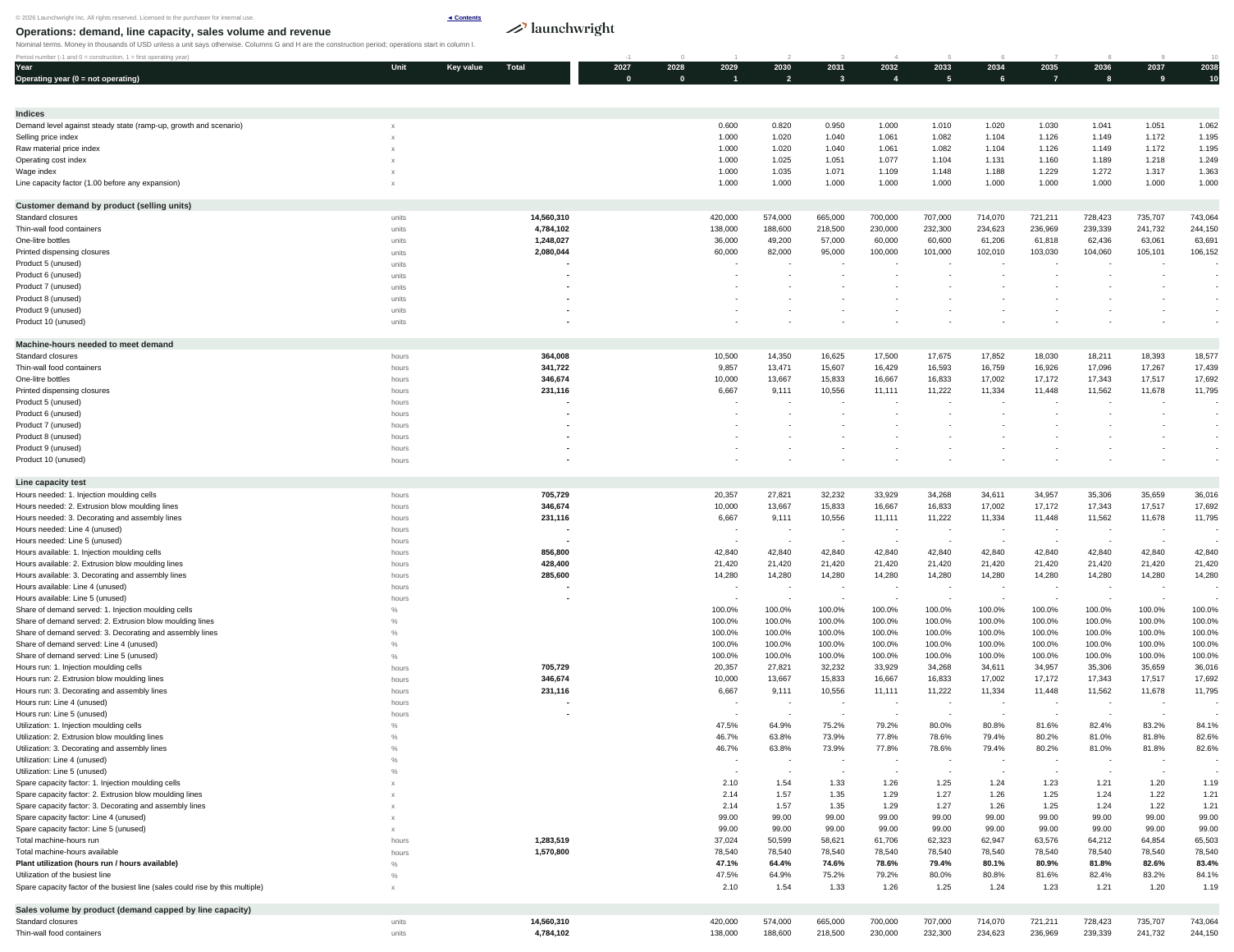
- Line capacity: each production line has machines, shifts, hours, operating days and planned uptime. The model compares machine-hours needed with hours available every year and cuts sales when a line runs out of hours.
- Staffing plan by role, split into direct labour (which follows plant utilization down to a floor), plant overhead and selling, general and administrative staff.
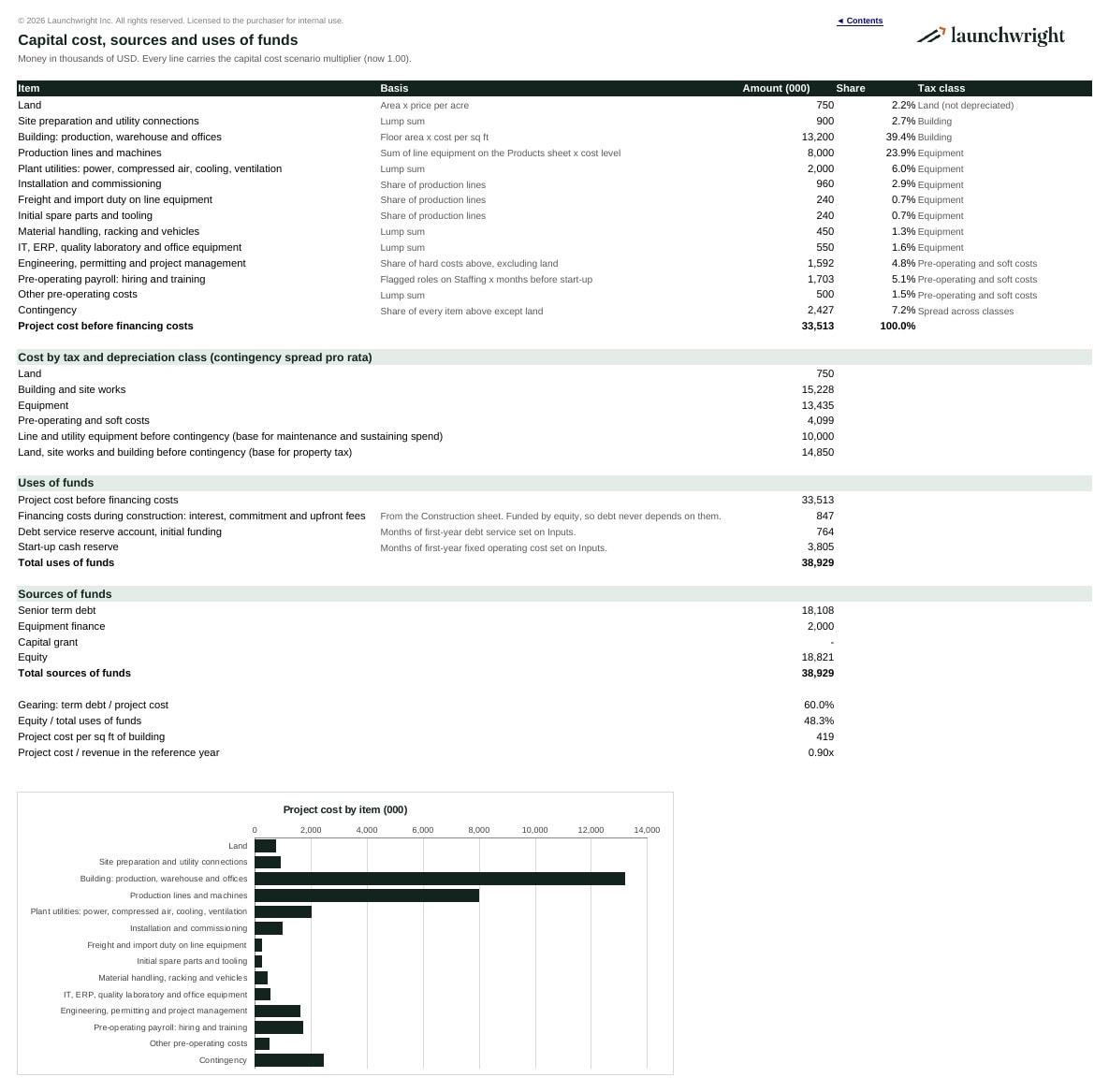
- Itemized capital cost in 14 lines: land, site works, building, production lines, plant utilities, installation, freight and duty, spares, vehicles, IT, engineering, pre-operating payroll, other pre-operating costs and contingency.
- Monthly construction for up to 24 months with an even or S-curve spend profile, equity-first or pro rata funding, interest during construction, commitment and upfront fees.
- Operating costs built from drivers: process electricity and fuel by machine-hour, maintenance, property tax with abatement, insurance, freight, commissions and a gross receipts tax.
- Tax: first-year expensing, MACRS 7-year, straight line or declining balance, loss carry-forward with a usage limit, tax holiday, investment tax credit and capital grant.
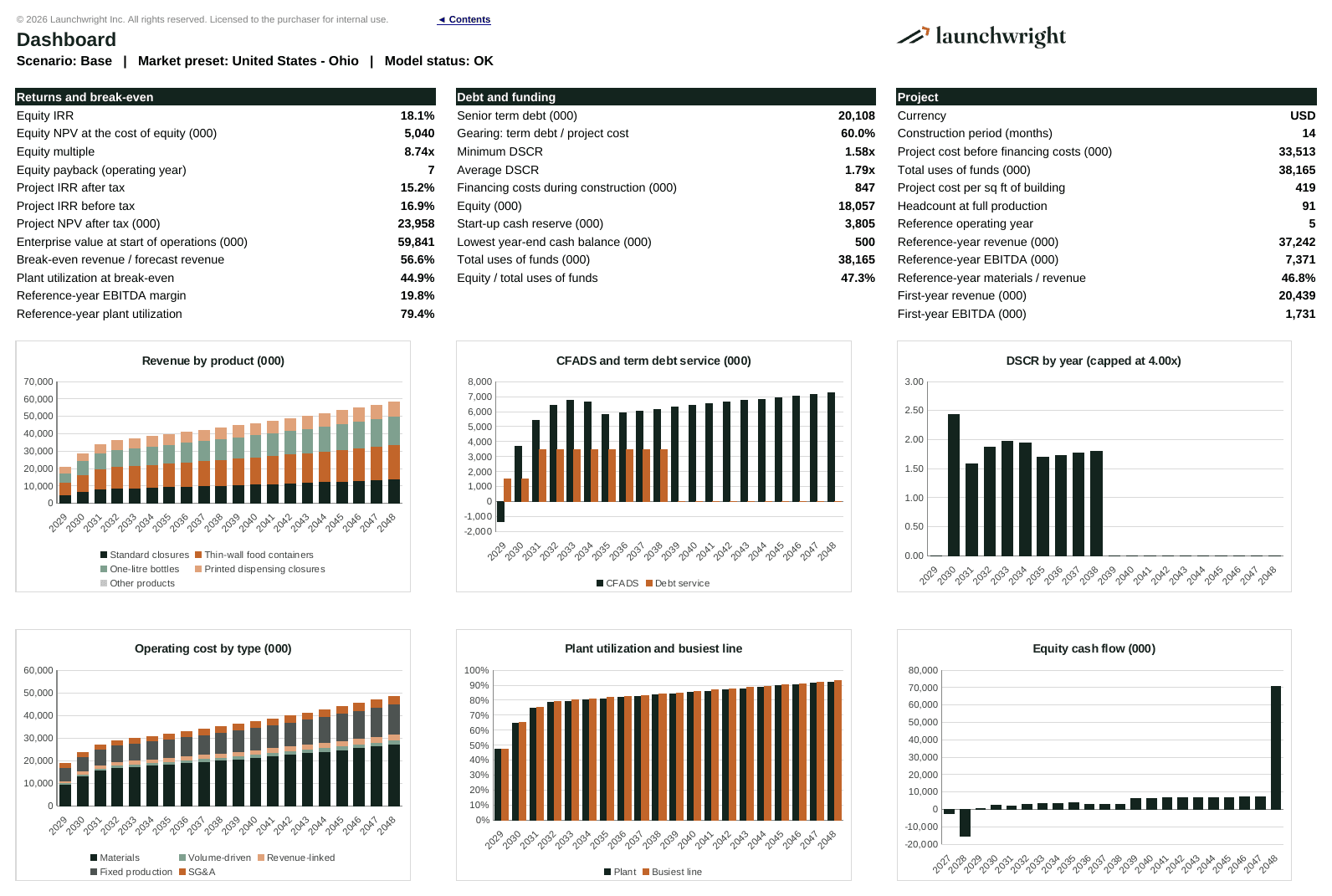
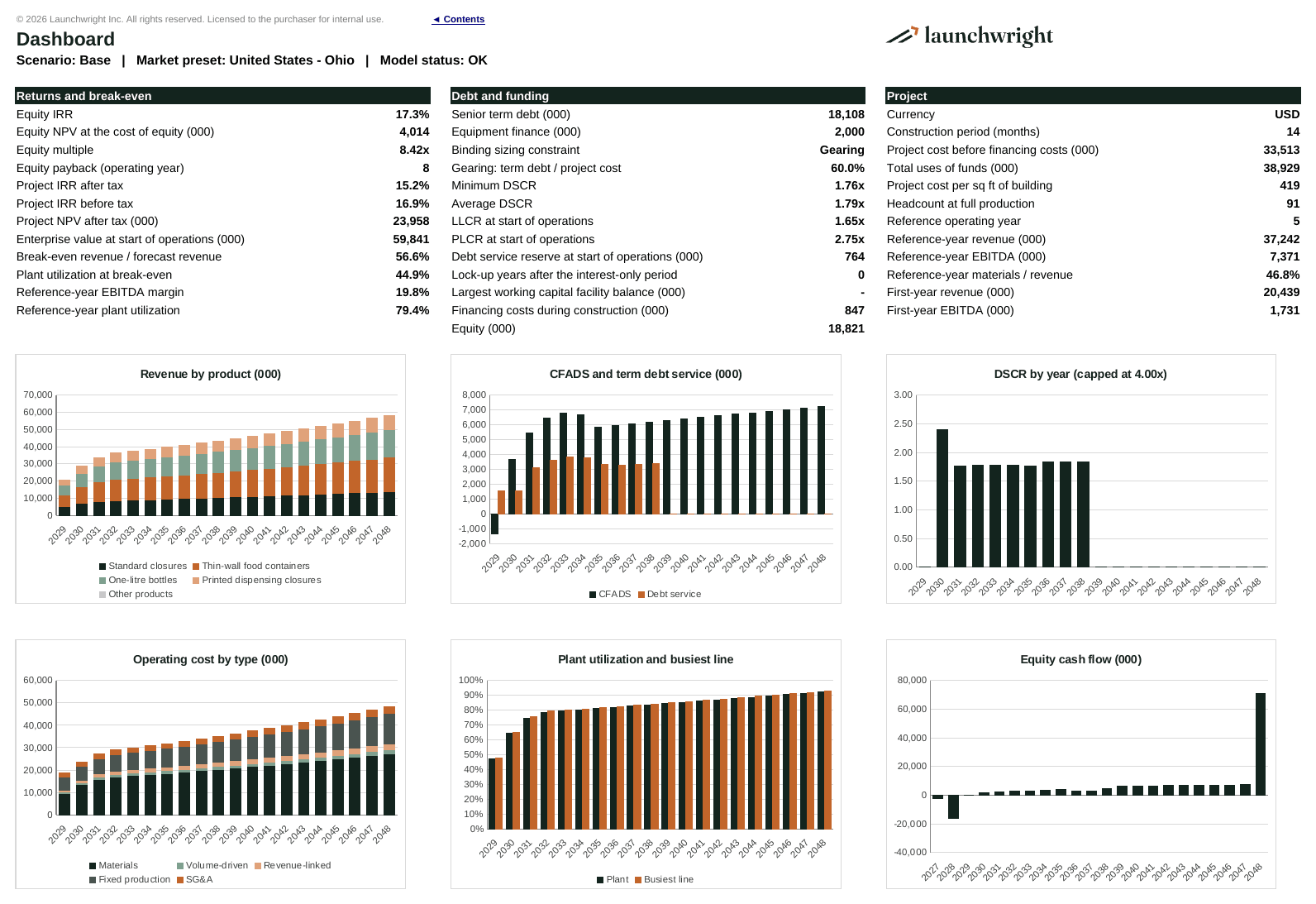
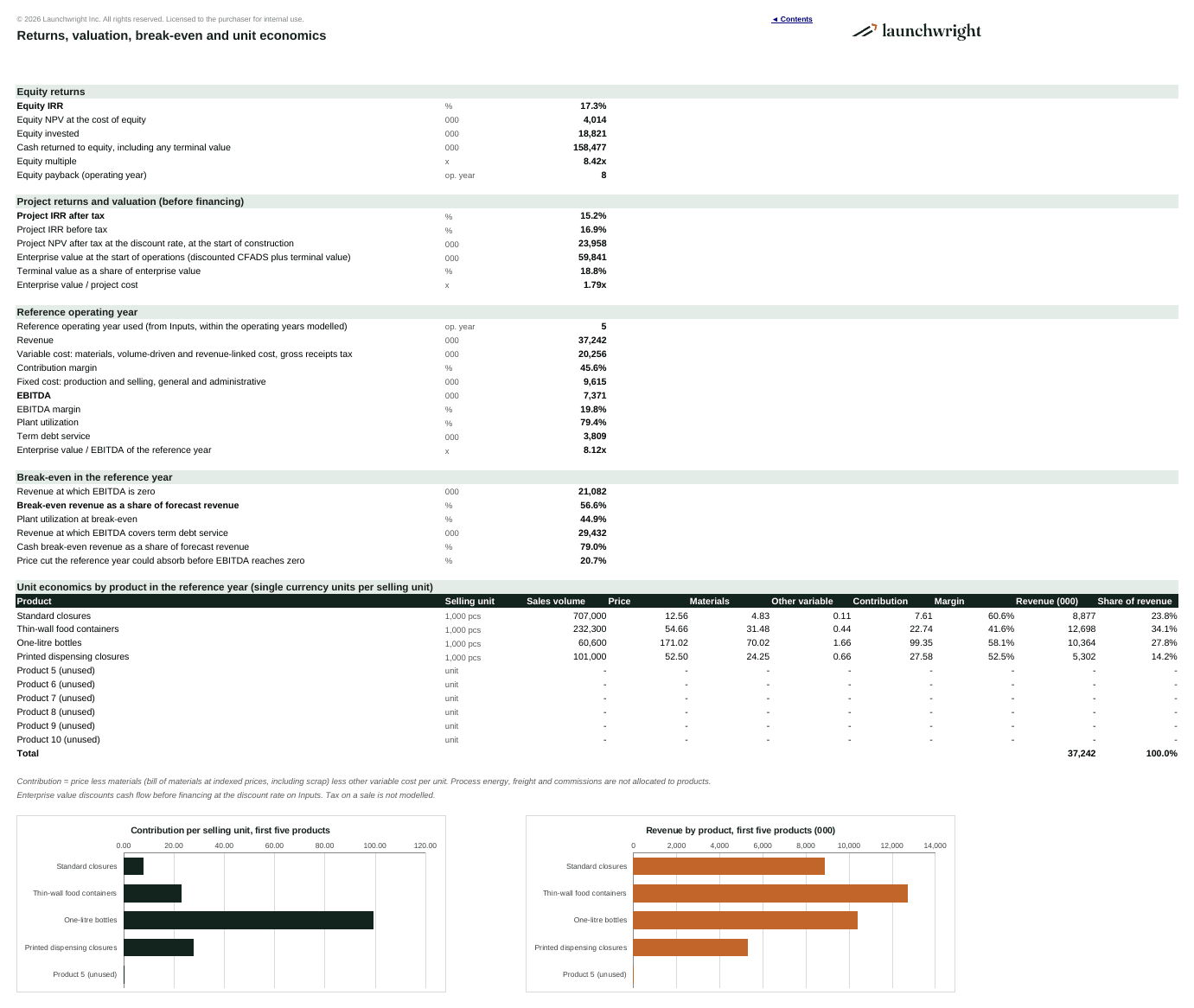
- Returns: equity IRR, project IRR before and after tax, NPV, enterprise value, payback, break-even revenue and utilization, and contribution per unit for every product.
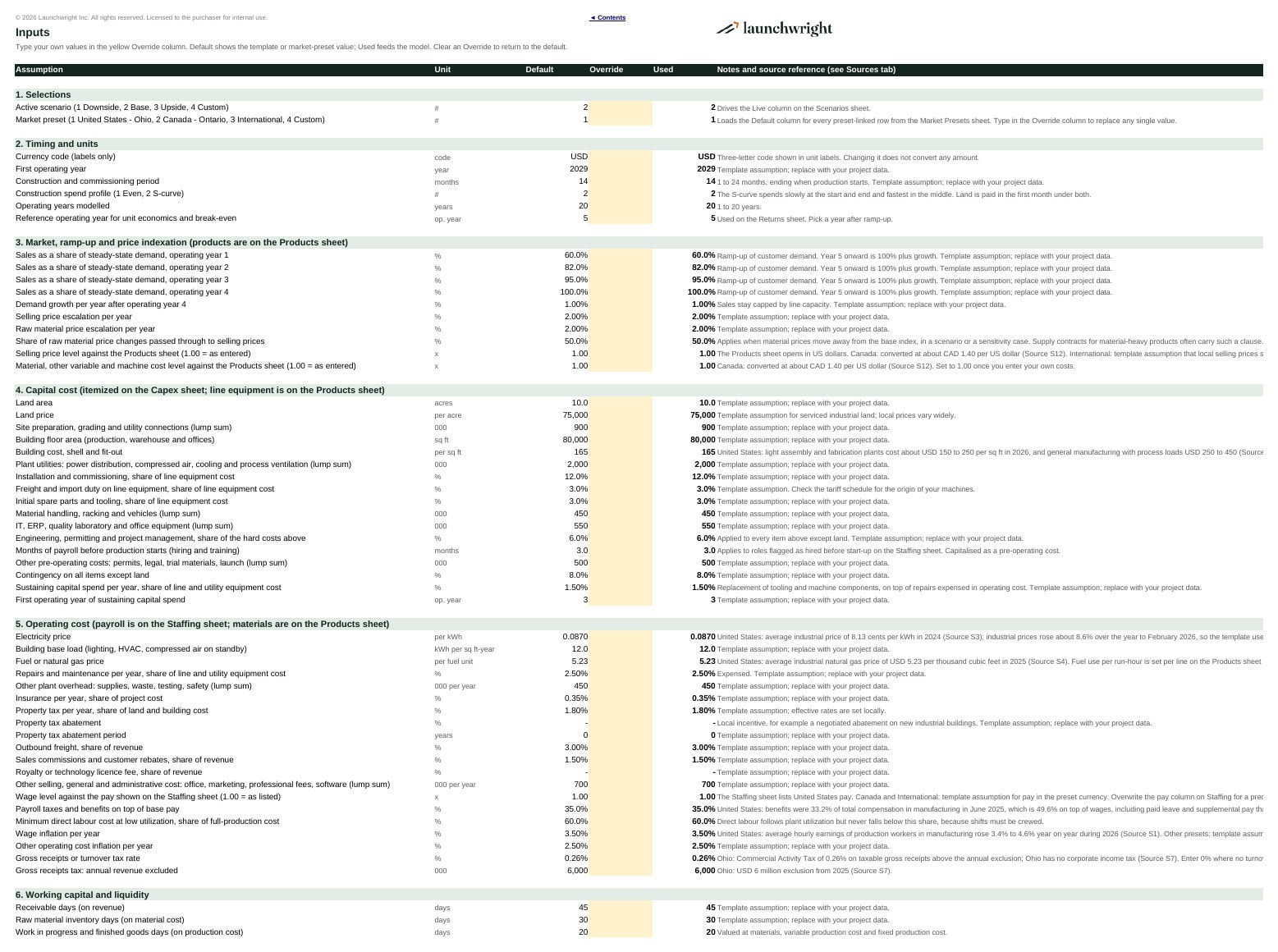
- Market presets for the United States (Ohio), Canada (Ontario) and a generic international case, each editable, plus Downside, Base, Upside and Custom scenarios.
- Raw material pass-through: set the share of a material price change that your contracts pass on to customers, and scenarios and sensitivity cases apply it.
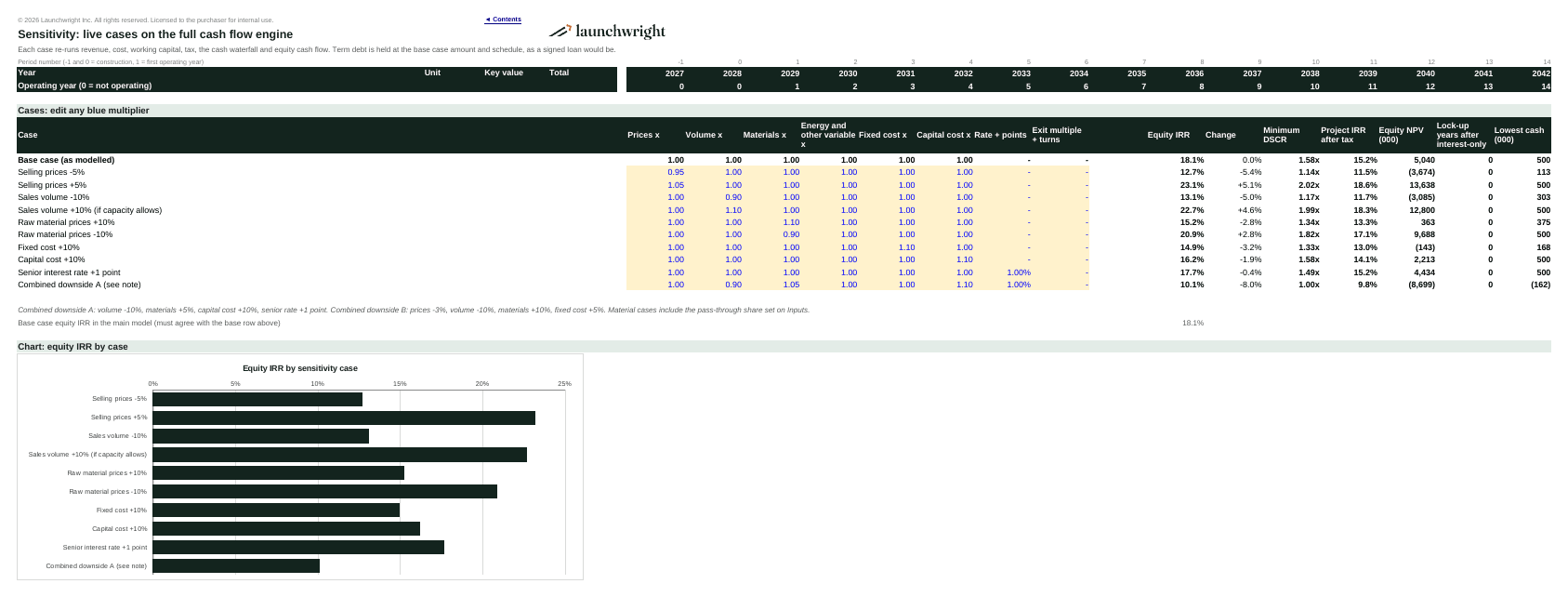
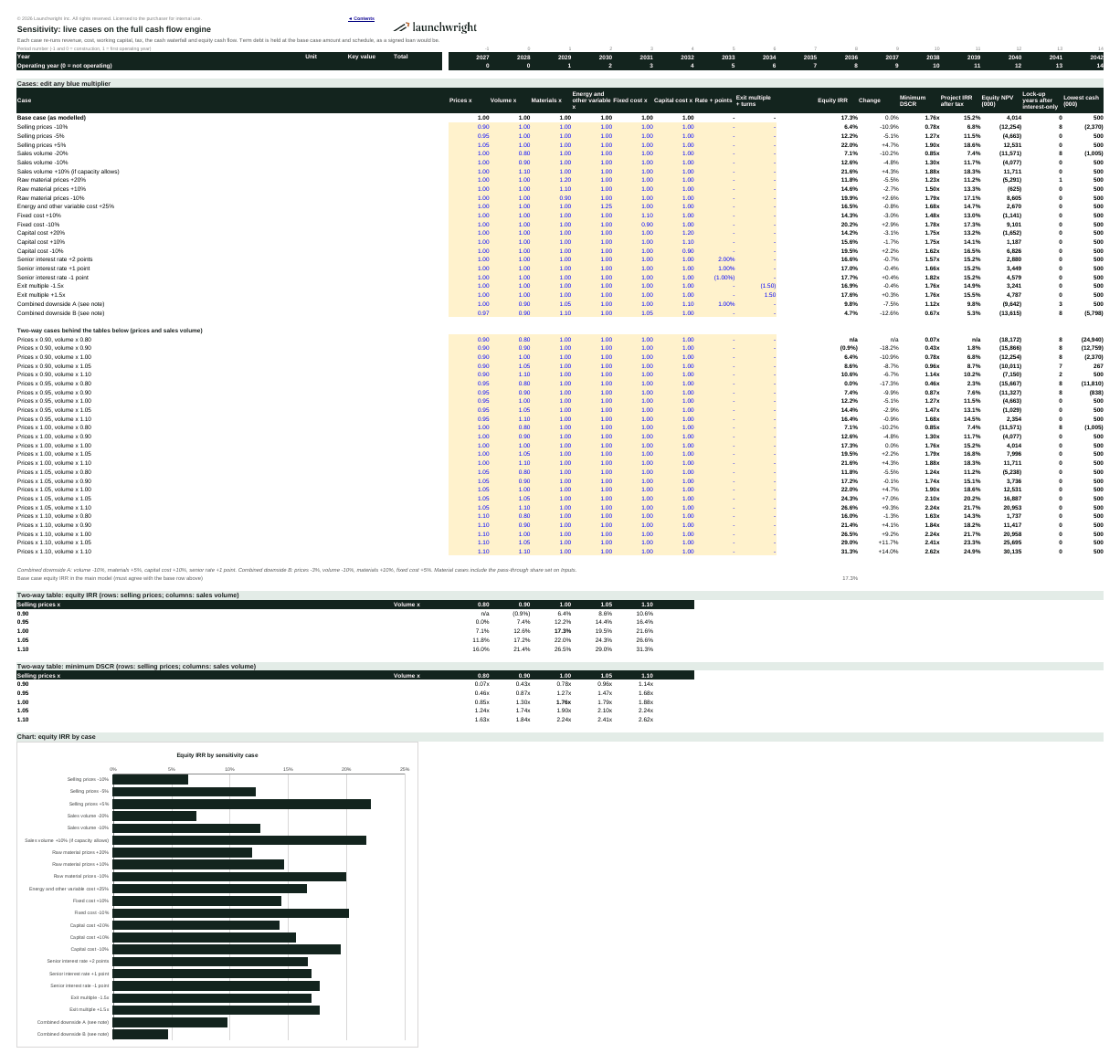
- Live sensitivity cases that re-run revenue, cost, working capital, tax and the cash waterfall, with term debt held at the base case amount.
- Integrity checks, warnings, a Sources sheet with 12 cited public sources and a glossary.
Due Diligence Edition adds
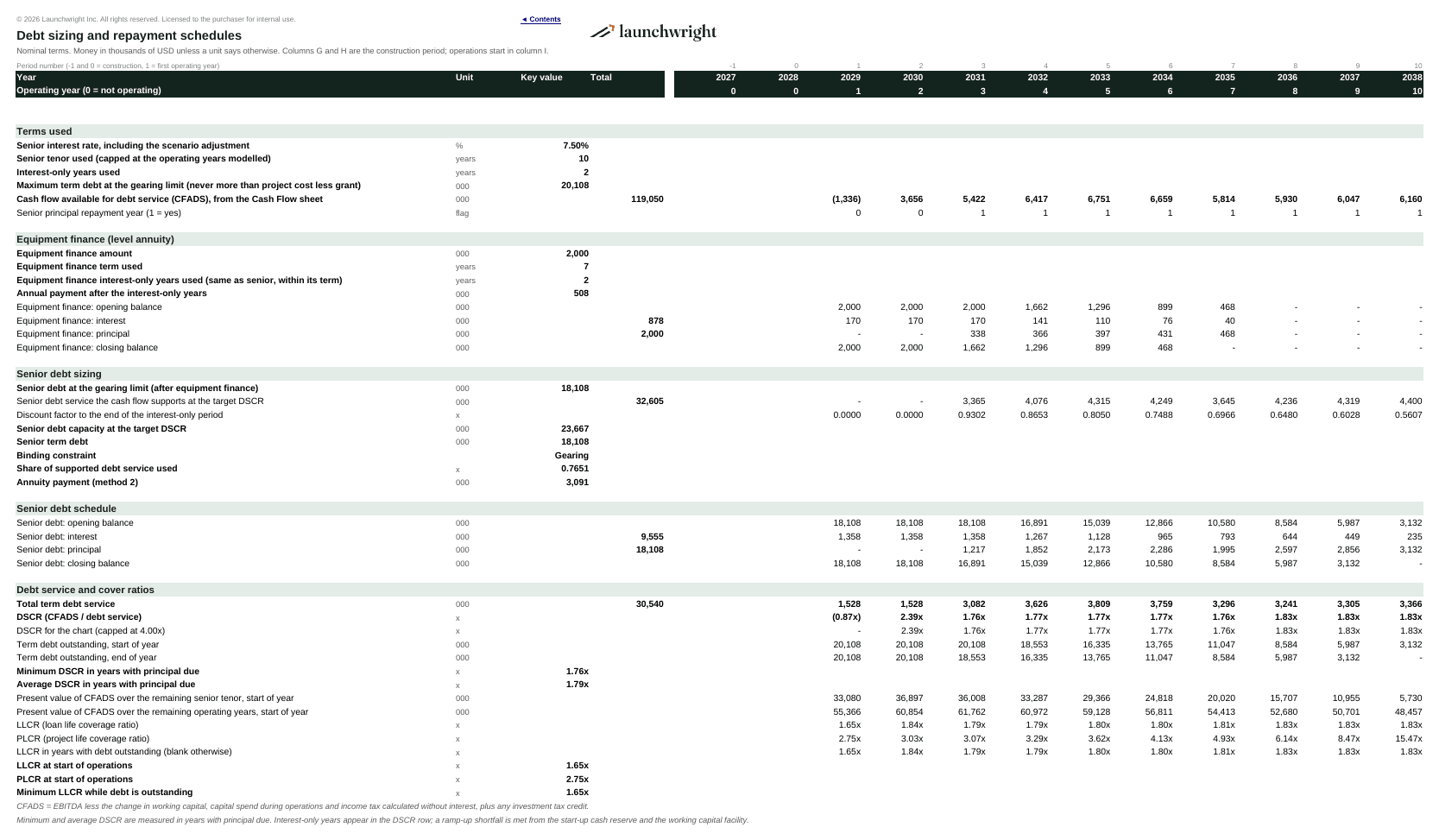
- Senior debt sculpted to a target DSCR and sized at the lower of the DSCR capacity and maximum gearing, with interest-only years.
- An equipment finance tranche, a working capital facility, a debt service reserve account and a distribution lock-up test.
- LLCR and PLCR by year.
- An optional capacity expansion phase.
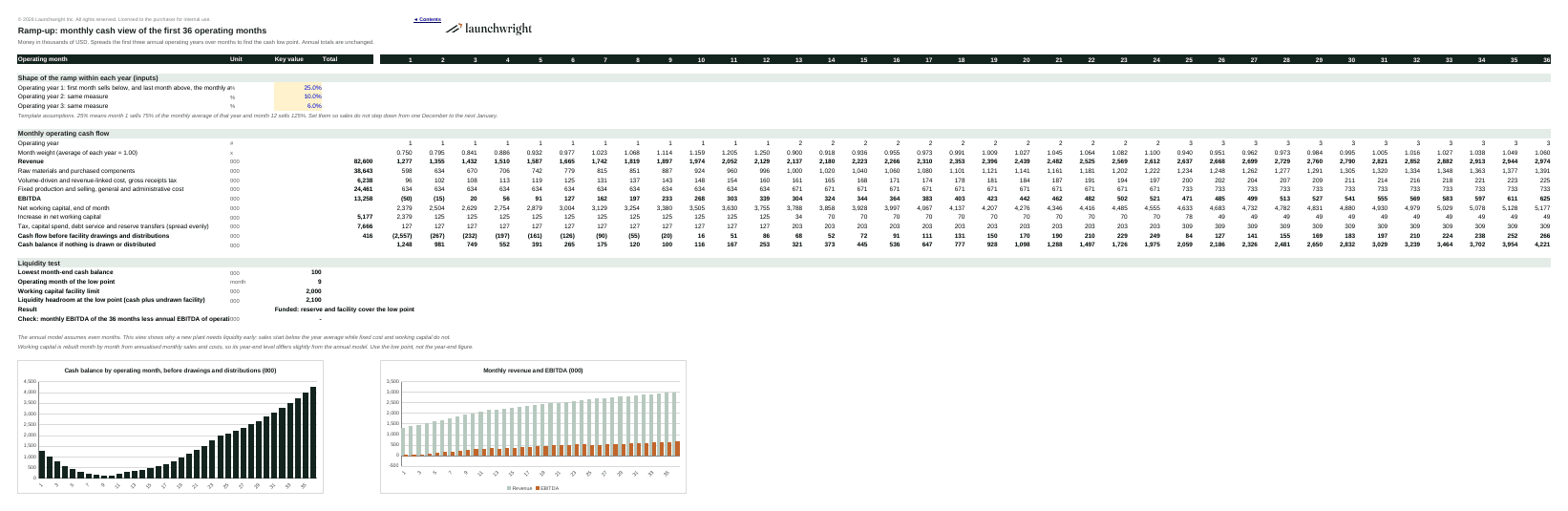
- A monthly cash view of the first 36 operating months that shows the cash low point annual columns hide.
- A balance sheet that balances in every period, alongside the income statement and cash flow statement.
- 47 sensitivity cases, including two-way tables of selling prices against sales volume for equity IRR and minimum DSCR.
Default base case
The file opens with an illustrative plastics packaging plant in Ohio: four products on three production lines, 91 staff and a project cost of about $33.5 million. On those template assumptions the Due Diligence Edition shows an equity IRR of 17.3%, a project IRR after tax of 15.2%, a minimum DSCR of 1.76x in repayment years and break-even at 57% of forecast revenue in operating year 5. Product prices, material prices, equipment costs and most pay figures are template assumptions, not market data. Wages, benefits, energy prices, building cost, tax rules, the prime rate and the exit multiple benchmark are cited to public sources. The 20% EBITDA margin of the sample plant sits between the 16.9% closures segment margin and the 22.6% group margin AptarGroup reported for the second quarter of 2025. Replace the defaults with quotes for your own project.
Built to be trusted
No macros, no circular references, no external links, no hidden sheets and no locked cells. Interest during construction is funded by equity and debt is sized on cash flow before interest, so the model never needs iterative calculation. Inputs are blue on yellow and kept apart from calculations and outputs. It uses long-standing Excel functions only: no dynamic arrays and no add-ins. Every headline output was reproduced by an independent recalculation outside Excel before release.
This template is for planning and illustration. It is not investment, tax, legal or engineering advice. Tax rules and incentives change; confirm them with a tax adviser.
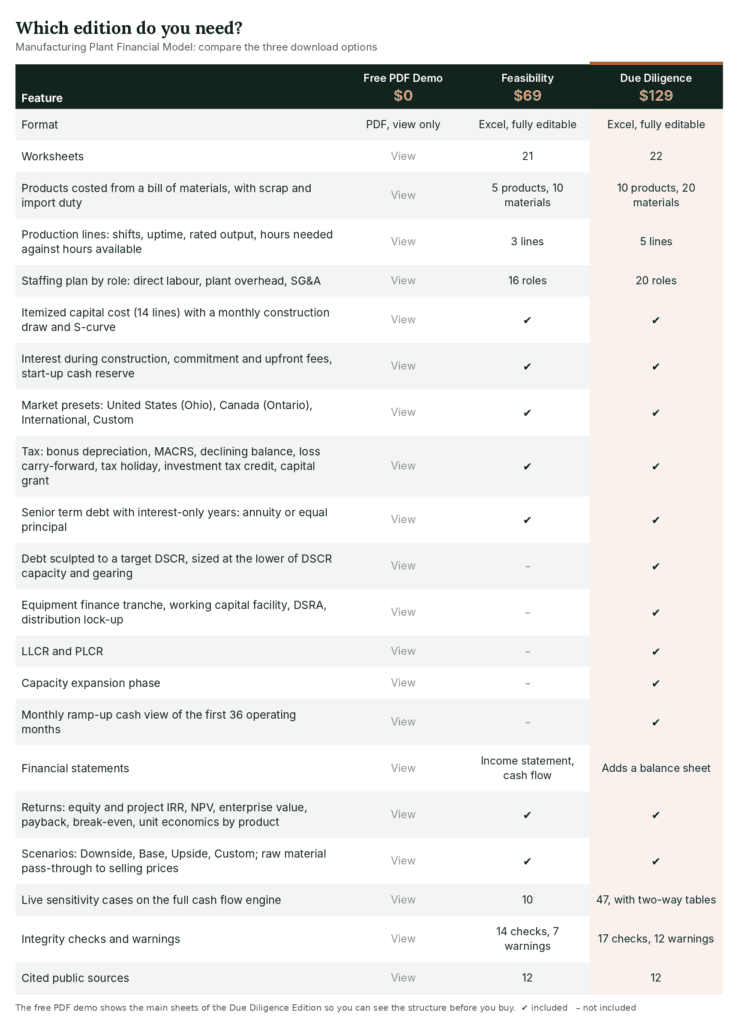
Which edition do you need?
FAQs
Which industries does it fit? Any plant that turns materials into products on machines or lines: plastics, packaging, food, building materials, metal parts, chemicals, textiles. You define the products, materials and lines.
Which Excel version do I need? Desktop Excel for Windows or Mac, 2010 or later. The file has no macros and uses long-standing functions only. It has not been tested in Google Sheets.
Can I use it outside the United States and Canada? Yes. Choose the International or Custom preset, set the currency code, tax rate, depreciation method, import duty and interest rate, and enter your own prices and pay. The currency code changes labels only. Each preset carries a price level and a cost level that convert the sample plant; set both to 1.00 once you enter your own figures.
How is debt sized? In the Feasibility Edition at a gearing limit you set. In the Due Diligence Edition at the lower of that limit and the amount the cash flow supports at your target DSCR.
Why is DSCR measured only in repayment years? A new plant often cannot cover interest from cash flow while it ramps up. The model shows DSCR for every year, tests the minimum in years with principal due, and funds the ramp-up from a start-up cash reserve that is part of the uses of funds.
What does the sensitivity analysis hold constant? Term debt stays at the base case amount and schedule, as a signed loan would. A capital cost overrun is funded by equity. A volume upside is capped at the spare capacity of the busiest line.
Does it model several plants or phases? One plant and one construction phase. The Due Diligence Edition adds one expansion that raises the capacity of every line in a year you choose.
Is the file locked? No. Every cell and formula is visible and editable.
Do you offer support? Questions about how the template works can be sent via the Contact Author button or Chat Support. Customization requests go through the eFinancialModels custom service.
Similar ProductsOther customers were also interested in...


 eFinancialModels
Electric Vehicle (EV) Charging Station Financial M...
With this comprehensive 5- or 10-year monthly tool, investors can assess the viability of setting up... Read more

Financial Model for Mobile App | Mobile App Busine...
The Mobile App Financial Plan Template in Excel allows you to develop financial projections when lau... Read more

 HenrySheykin
Food Truck Financial Model Excel Template
The Food Truck Financial Model helps entrepreneurs, founders, business owners, consultants, and anal... Read more

Green Hydrogen Production from Wind Energy Financi...
The Green Hydrogen from Wind Financial Model aims to comprehensively forecast a horizon of 40 years ... Read more

Simple Mutual Non-Disclosure Agreement Template
Protect your business secrets with ease using our Simple Mutual Non-Disclosure Agreement Template. S... Read more

Solar Energy Financial Model
The Solar Energy Financial Model Spreadsheet Template in Excel assists you in preparing a sophistica... Read more

 Peter Graf
The Customer-Centric Financial Model for Restauran...
Starting a restaurant without a financial plan is like driving a car blindfolded. You wouldn´t do i... Read more
You must log in to submit a review.