
0 ITEMS

Amazon KDP and Etsy Self-Publishing Financial Model: Print on Demand Book Imprint, Kindle Unlimited, Etsy Digital Products, Ads ACoS
Monthly 5-year Excel model for a self-publishing imprint on Amazon KDP and Etsy: title cohorts with launch and backlist decay, KDP royalty bands and printing cost by page count, trim and ink, Kindle Unlimited page reads, Etsy fees and Offsite Ads, ads by CPC and conversion, payment lags, tax, three statements, owner IRR and catalogue value.

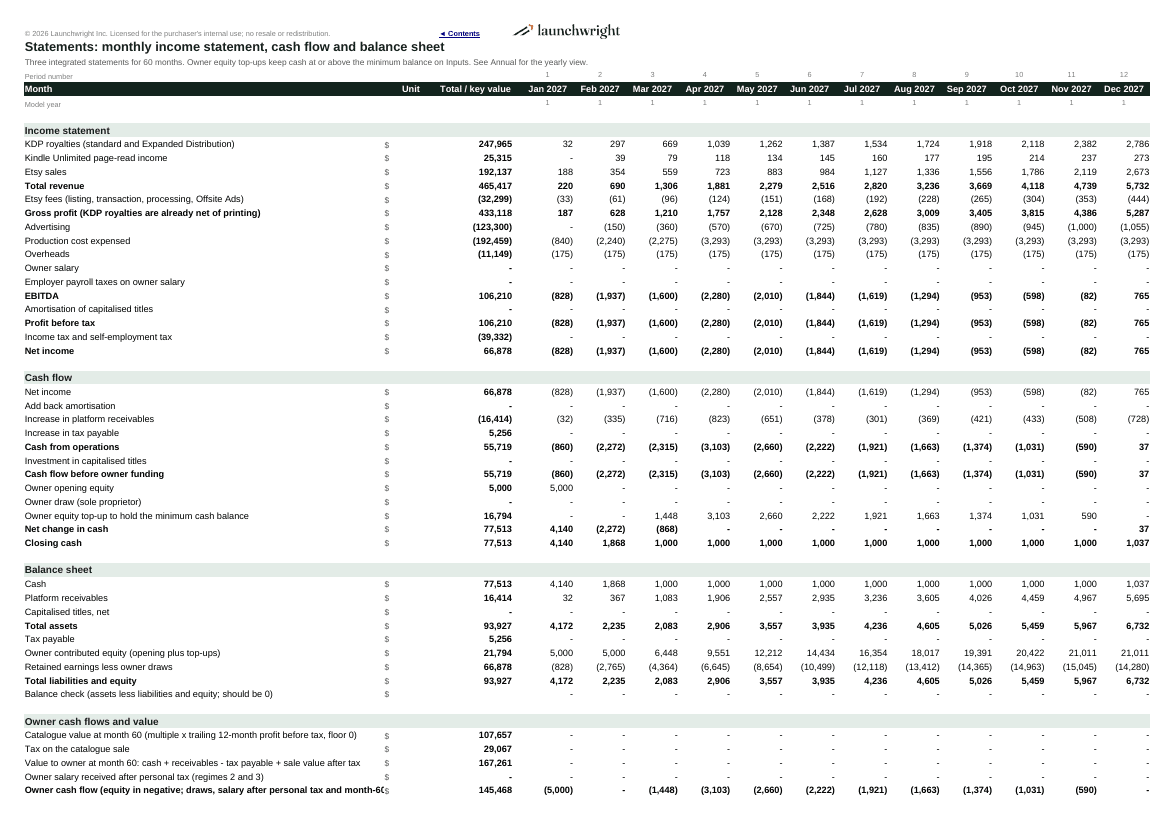
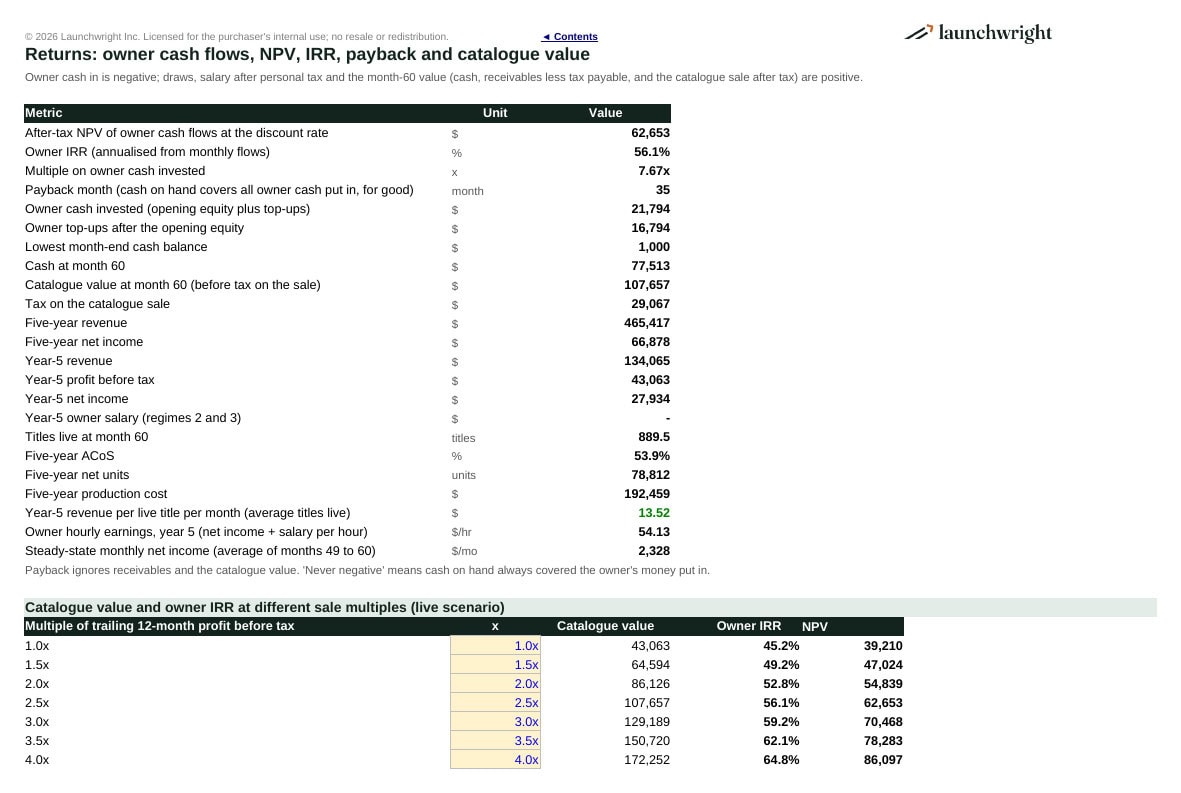
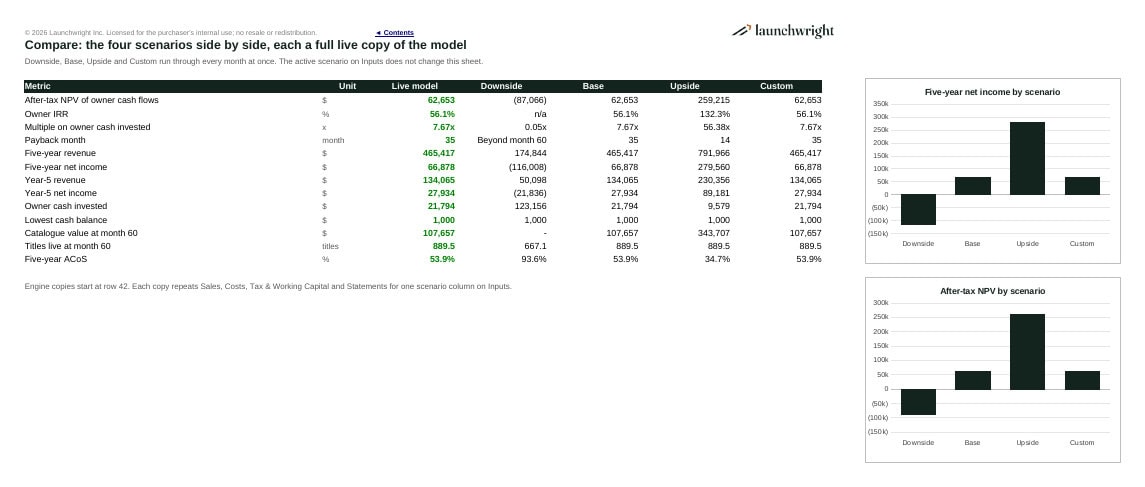
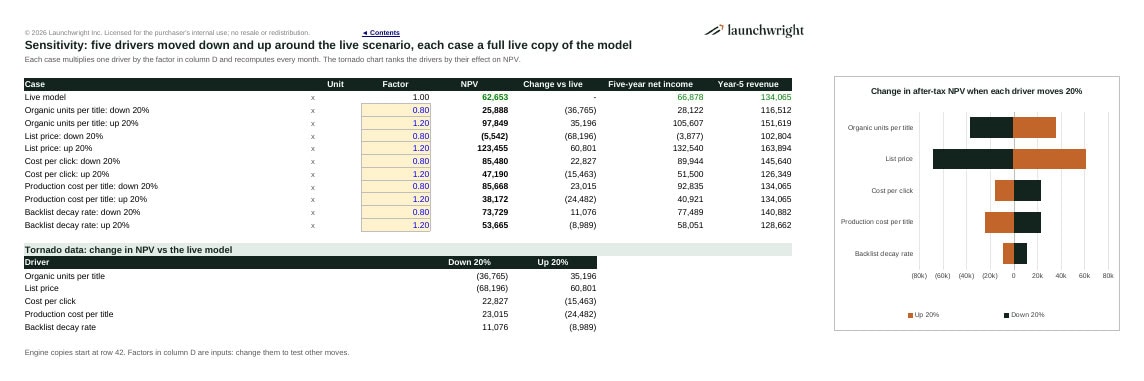
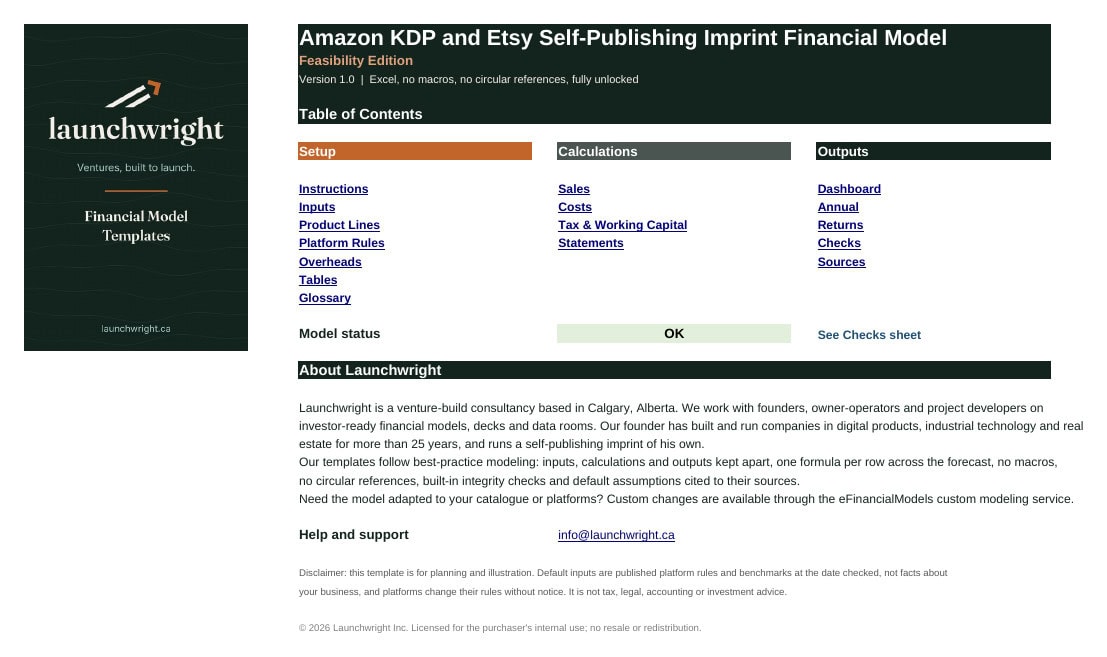
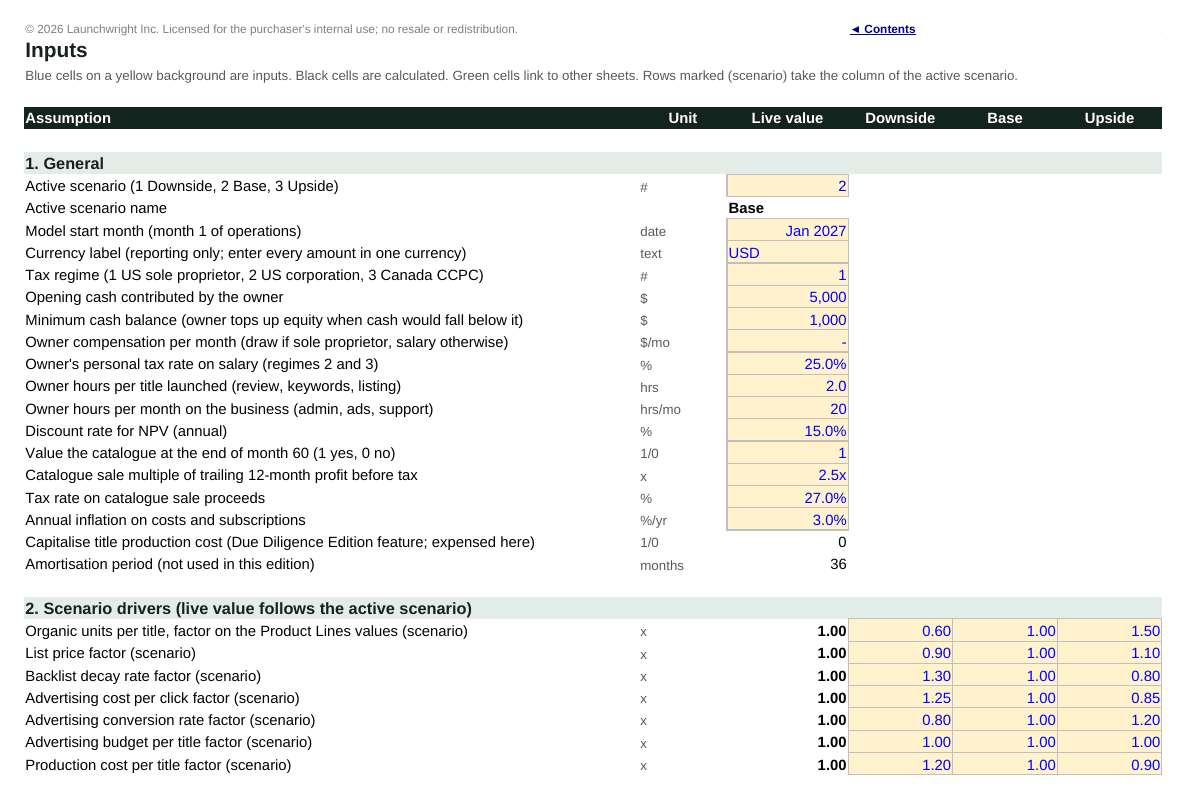
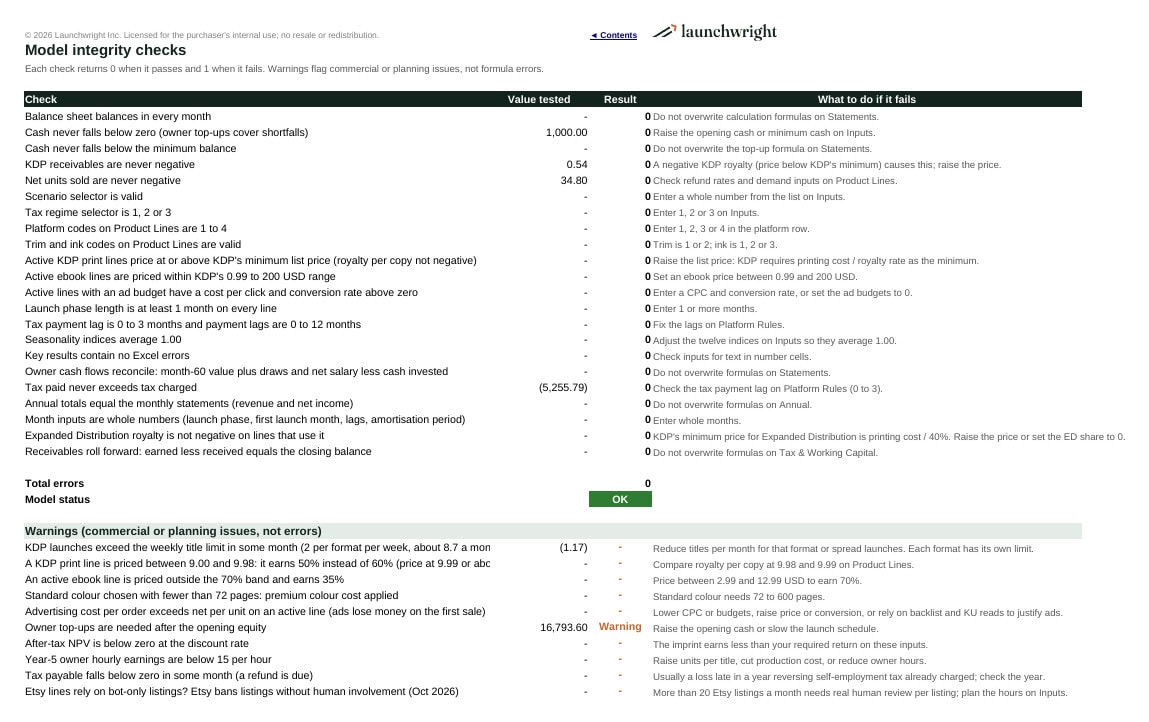
Thinking of building a publishing imprint on Amazon KDP and Etsy? Print on demand means no inventory and no advances, but it does not mean no risk. Royalties depend on price bands and printing cost, most titles sell a few copies a month, ads can cost more than a sale earns, and Amazon pays two months after the sale. This model answers the questions that decide whether a catalogue makes money: how many titles you need, what each one earns as it ages, how much advertising it can carry, when cash turns positive, and what the catalogue is worth after five years.
Built for KDP and Etsy, not a generic store
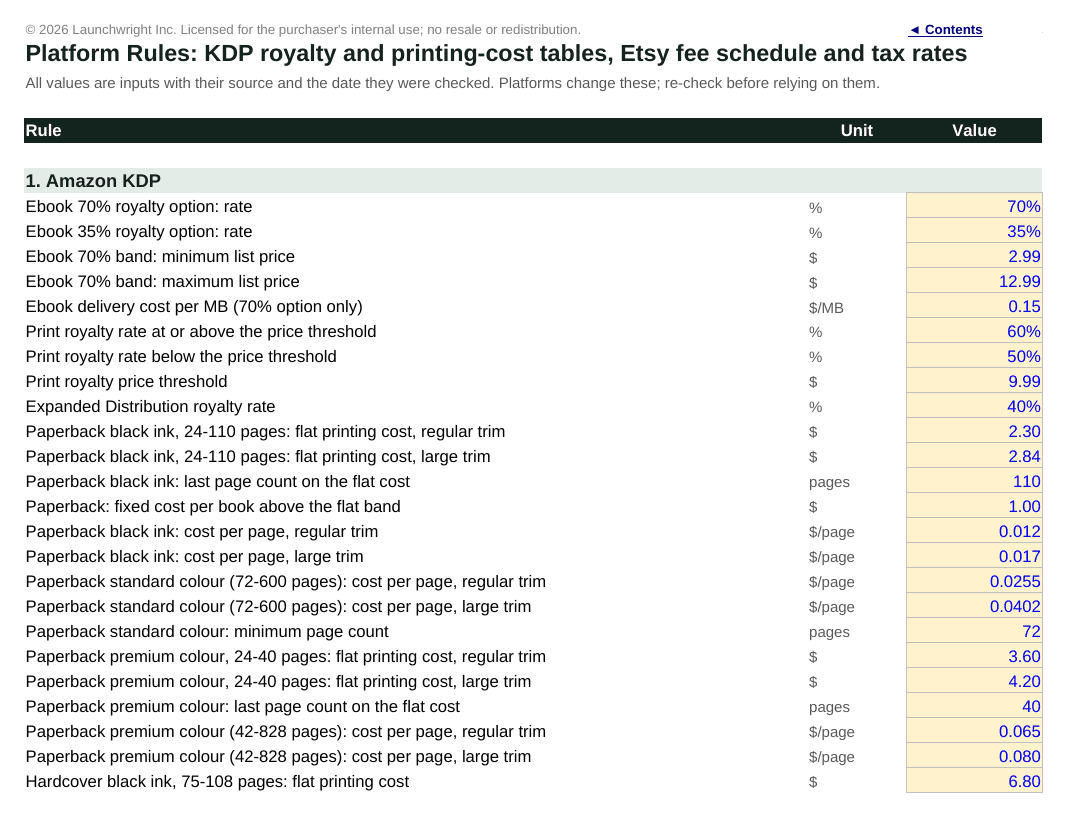
- KDP ebook royalties: 70% of price less the 0.15 USD per MB delivery cost inside the 2.99 to 12.99 USD band (widened in July 2026), 35% outside it
- KDP paperback and hardcover royalties: 60% at 9.99 USD and above, 50% below (since June 2025), less a printing cost built from page count, trim size and ink, using KDP’s published Amazon.com tables, including the flat cost for short books
- Expanded Distribution at 40% and paid 90 days after month end
- Kindle Unlimited page reads: borrows per sale, share of pages read and the KENP rate
- Etsy digital downloads: listing fees and four-month renewals, the 6.5% transaction fee, payment processing, regulatory and currency fees, and Offsite Ads at 15%, switching to 12% for life once trailing sales reach 10,000 USD
- KDP’s new limit of two new titles per format per week and Etsy’s October 2026 ban on bot-only listings, both flagged on the Checks sheet
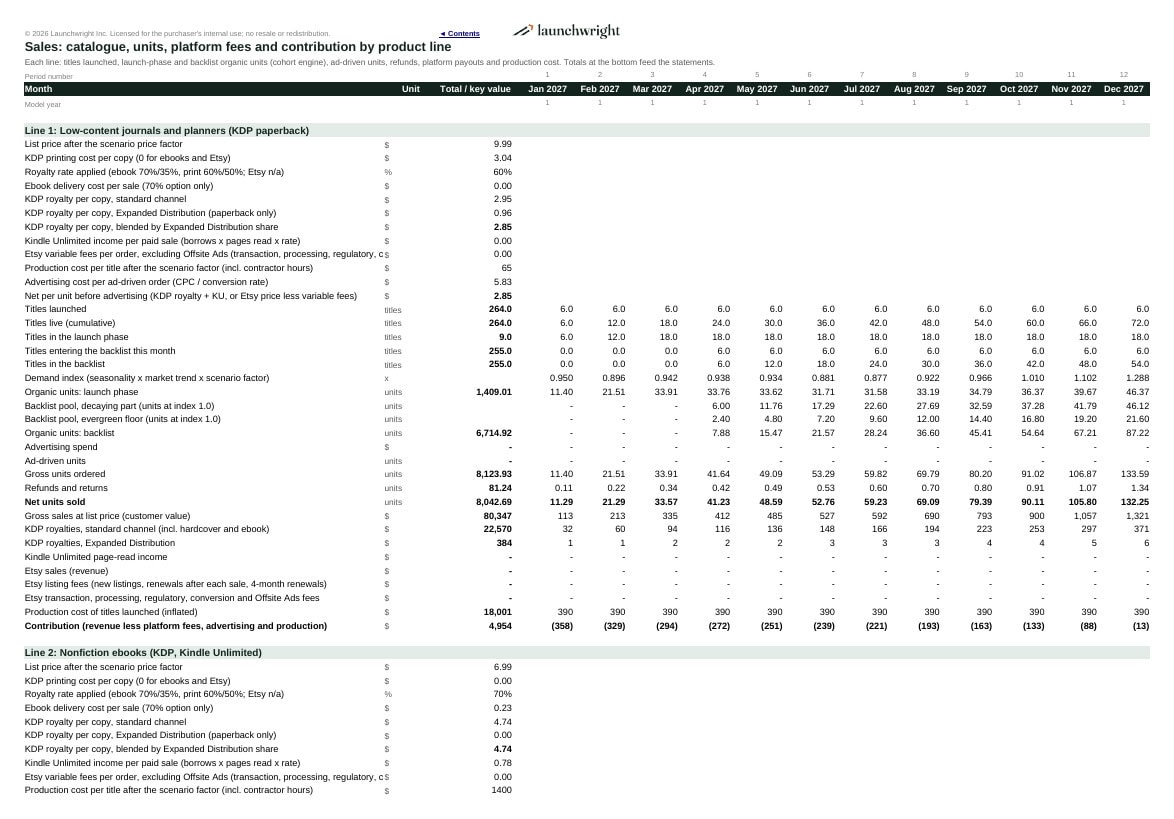
A title cohort engine
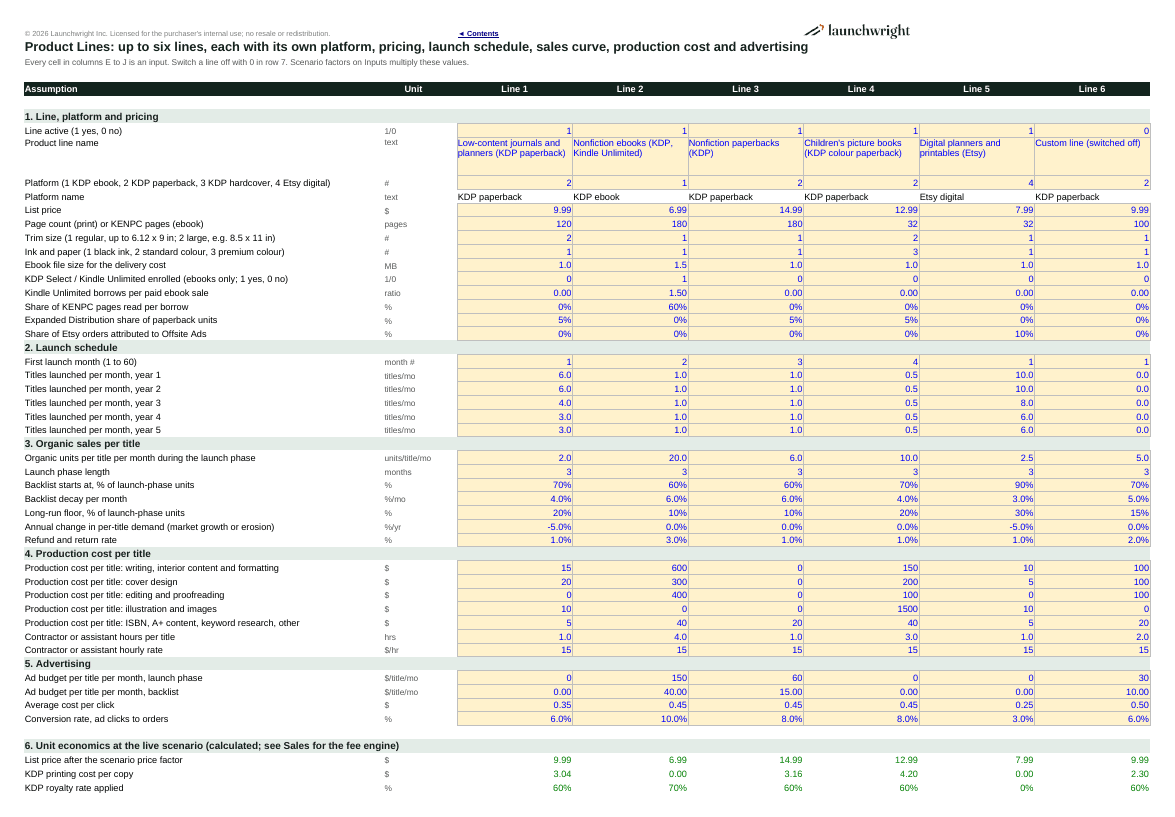
Every month’s new titles are tracked as they age: launch-phase sales, a step down into the backlist, monthly decay towards an evergreen floor, seasonality, a market trend and the scenario factor. Ads add units from spend, cost per click and conversion. Six product lines, each with its own platform, price, pages, launch schedule, sales curve, production cost per title and ad budget. The unit economics table shows royalty per copy, printing cost and break-even ACoS for every line before you commit a dollar.
Two editions
- Feasibility Edition ($49): monthly model for 60 months with annual summary, six product lines, the full KDP and Etsy fee engine, Downside, Base and Upside scenarios, three statements, owner returns, dashboard and integrity checks.
- Due Diligence Edition ($79): everything in the Feasibility Edition, plus a Custom scenario, all four scenarios side by side as live copies of the model, ten live sensitivity cases with a tornado chart, the option to capitalise and amortise title production cost, and owner IRR and NPV at seven catalogue sale multiples.
Edition comparison
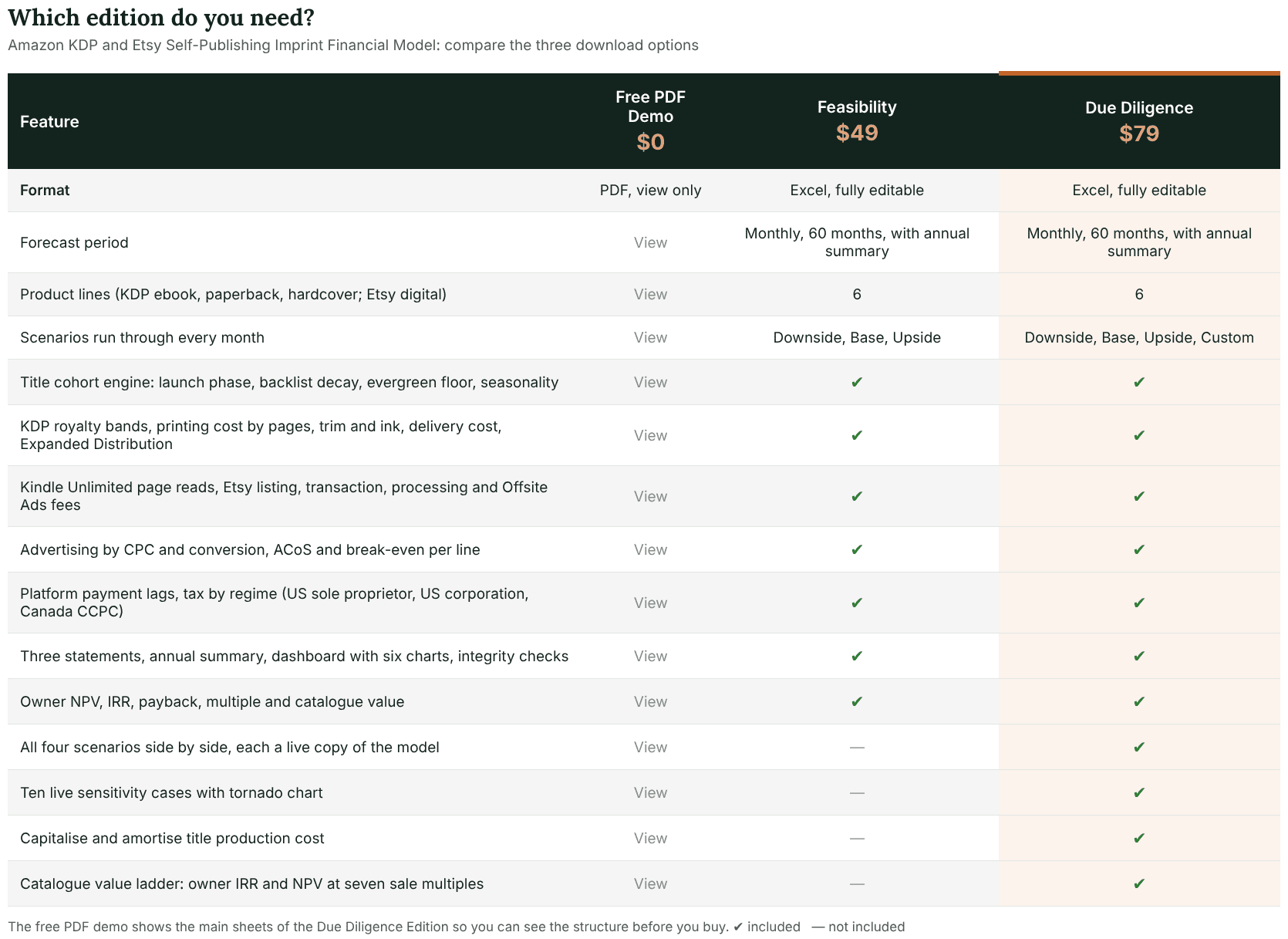
Free PDF Demo ($0): a view-only PDF of the main sheets of the Due Diligence Edition.
Both Excel editions (Feasibility $49 and Due Diligence $79), fully editable:
- Monthly forecast for 60 months with annual summary
- Six product lines (KDP ebook, paperback, hardcover; Etsy digital)
- Title cohort engine: launch phase, backlist decay, evergreen floor, seasonality
- KDP royalty bands, printing cost by pages, trim and ink, delivery cost, Expanded Distribution
- Kindle Unlimited page reads, Etsy listing, transaction, processing and Offsite Ads fees
- Advertising by CPC and conversion, ACoS and break-even per line
- Platform payment lags, tax by regime (US sole proprietor, US corporation, Canada CCPC)
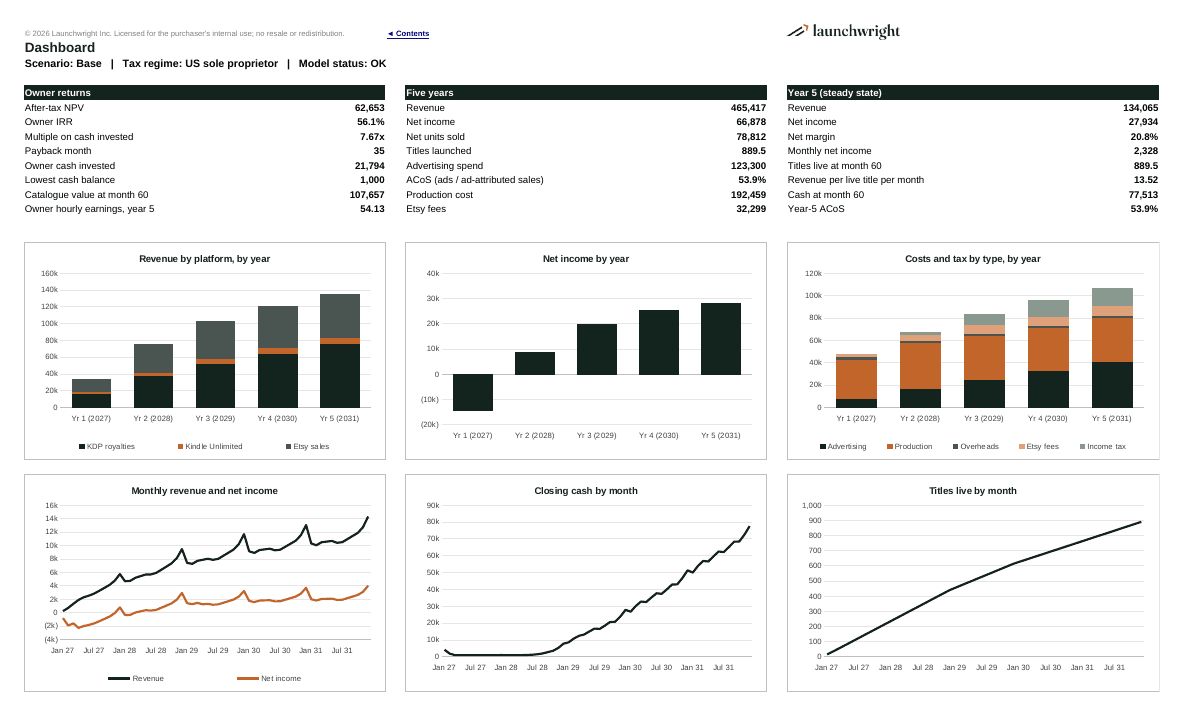
- Three statements, annual summary, dashboard with six charts, integrity checks
- Owner NPV, IRR, payback, multiple and catalogue value
- Scenarios run through every month: Downside, Base and Upside (Feasibility); plus Custom (Due Diligence)
Due Diligence Edition only:
- All four scenarios side by side, each a live copy of the model
- Ten live sensitivity cases with tornado chart
- Capitalise and amortise title production cost
- Catalogue value ladder: owner IRR and NPV at seven sale multiples
Key outputs
- Owner NPV, IRR, payback month, multiple on cash invested, cash invested and lowest cash balance, after tax and including salary or draws
- Revenue by platform (KDP royalties, Kindle Unlimited, Etsy), net income, margin, ACoS and revenue per live title
- Monthly income statement, cash flow and balance sheet with platform receivables, tax payable and owner equity top-ups
- Catalogue value at month 60 from a multiple of trailing 12-month profit before tax, with tax on the sale deducted
- Owner hourly earnings, so you can see whether the imprint pays for your time
- Dashboard charts: revenue by platform, net income, costs and tax by type, monthly revenue and net income, cash, and titles live
Tax and cash, done properly
Choose a US sole proprietor (income tax after the half-SE and 20% QBI deductions, plus self-employment tax on each year’s profit), a US corporation, or a Canadian CCPC at the 11% Alberta small business rate with employer payroll taxes on salary. Losses carry forward, each quarter’s tax is paid after a lag you set, and owner pay is a draw or a salary depending on the structure. Owner equity top-ups keep cash at your minimum balance, so the model tells you how much money you need to start.
Default assumptions
Defaults describe a new imprint launching about 18 titles a month across five lines: low-content journals, Kindle Unlimited nonfiction ebooks and their paperbacks, colour children’s picture books and Etsy digital planners. Platform rates come from KDP and Etsy help pages checked on November 5, 2026; production costs from Reedsy’s published cost guides; ad benchmarks and the catalogue multiple from public sources listed on the Sources tab. Advertising is switched on only for the nonfiction lines, because at journal, picture-book and printable prices an ad-driven order costs more than it earns. On these defaults the Base case reaches about 27,934 USD of year-5 net income (2,328 USD a month) from 890 live titles, with owner cash invested of 21,794 USD, payback in month 35, an owner IRR of 56% and an after-tax NPV of 62,653 USD at a 15% discount rate. The Downside case loses money. That is deliberate: most self-published titles sell little, and the model is built to show it. Replace the defaults with your own figures.
Simplifications
Advertising response is linear (every dollar buys the same clicks and conversion, with no diminishing returns). Tax uses one rate per structure and ignores the US 80% limit on losses carried forward. Both are stated in the workbook’s Instructions.
Built to modeling best practice
- Inputs, calculations and outputs on separate, colour-coded sheets; inputs blue on yellow, formulas black, cross-sheet links green
- One formula per row across 60 months; no macros, no circular references, no hidden or protected sheets, no external links
- Checks sheet confirms the balance sheet balances every month, receivables and tax roll forward, annual totals tie to the months, cash never falls below the minimum and every input is valid, plus warnings for KDP’s title limit, the 9.99 USD royalty cliff and ads that lose money
- Contents sheet with links, step-by-step instructions, a glossary and a full source list
What you get
- One Excel workbook (.xlsx) for the edition purchased, built only with functions available since Excel 2010 (no dynamic arrays, no macros)
- A free PDF demo showing the main sheets of the Due Diligence Edition
Support
Questions about how the template works are answered by email so feel free to contact via the Contact Author button or the support chat. For changes to the model, use the eFinancialModels custom modeling service.
Important
This template is for planning and illustration. It is not tax, legal, accounting or investment advice. Amazon and Etsy change royalty rates, fees and title limits without notice; re-check the Platform Rules sheet before relying on the results.
FAQs
Do I need to already be publishing?
No. Start with zero titles and a launch schedule, or enter an existing catalogue as titles launched in month 1 with their current sales per title.
Does it handle the June 2025 paperback royalty change and the July 2026 ebook band?
Yes. Print royalties switch between 60% and 50% at the 9.99 USD threshold and ebooks earn 70% only between 2.99 and 12.99 USD. Every rate is an input on Platform Rules, so you can update it when Amazon changes it again.
Can I model only KDP, or only Etsy?
Yes. Switch any of the six product lines on or off and set each line’s platform: KDP ebook, KDP paperback, KDP hardcover or Etsy digital download.
How are advertising costs modelled?
Each line has an ad budget per title in the launch phase and in the backlist, a cost per click and a conversion rate. Ad-driven units equal spend divided by CPC times conversion. The model reports ACoS and warns when an ad-driven order costs more than it earns.
Why does the base case only earn a few thousand a month after five years?
Because that is what the published evidence supports for a new imprint: most self-published titles sell very few copies. The defaults are conservative on purpose. Change units per title, prices and costs to test your own plan.
How is the catalogue valued?
At month 60 the model applies your sale multiple (default 2.5x) to trailing 12-month profit before tax, deducts tax on the sale at the rate you set, and adds the result to the owner’s final cash flow with cash, receivables and unpaid tax. Switch it off to see returns from operations alone.
Is it for the US or Canada?
Defaults use Amazon.com and Etsy US rates in USD. Tax can be a US sole proprietor, a US corporation or a Canadian CCPC at the Alberta small business rate. To model another marketplace, change the currency label and re-enter the rates on Platform Rules.
Does it work in Google Sheets?
It is built and tested for Microsoft Excel (2010 or later). It has not been tested in Google Sheets.
Can you customise it for my catalogue?
Questions about the template are answered via support. Custom changes are available through the eFinancialModels custom modeling service.
Similar ProductsOther customers were also interested in...



 eFinancialModels
Electric Vehicle (EV) Charging Station Financial M...
With this comprehensive 5- or 10-year monthly tool, investors can assess the viability of setting up... Read more

Financial Model for Mobile App | Mobile App Busine...
The Mobile App Financial Plan Template in Excel allows you to develop financial projections when lau... Read more

 HenrySheykin
Food Truck Financial Model Excel Template
The Food Truck Financial Model helps entrepreneurs, founders, business owners, consultants, and anal... Read more

Green Hydrogen Production from Wind Energy Financi...
The Green Hydrogen from Wind Financial Model aims to comprehensively forecast a horizon of 40 years ... Read more

Simple Mutual Non-Disclosure Agreement Template
Protect your business secrets with ease using our Simple Mutual Non-Disclosure Agreement Template. S... Read more

Solar Energy Financial Model
The Solar Energy Financial Model Spreadsheet Template in Excel assists you in preparing a sophistica... Read more

 Peter Graf
The Customer-Centric Financial Model for Restauran...
Starting a restaurant without a financial plan is like driving a car blindfolded. You wouldn´t do i... Read more
You must log in to submit a review.