
0 ITEMS

IFRS 9 Expected Credit Loss Model – Premium ECL Calculator with PD, LGD, EAD, Staging, Scenario Weighting & Dashboards
A professional Excel-based IFRS 9 Expected Credit Loss model designed to calculate impairment allowances using PD, LGD, EAD, staging, macroeconomic scenarios, stress testing, sensitivity analysis, validation checks, and dashboard reporting. This model helps banks, NBFCs, lenders, finance teams, auditors, consultants, and credit risk professionals assess credit risk exposure, classify assets into IFRS 9 stages, calculate 12-month and lifetime ECL, and present impairment results in a clear and structured format.
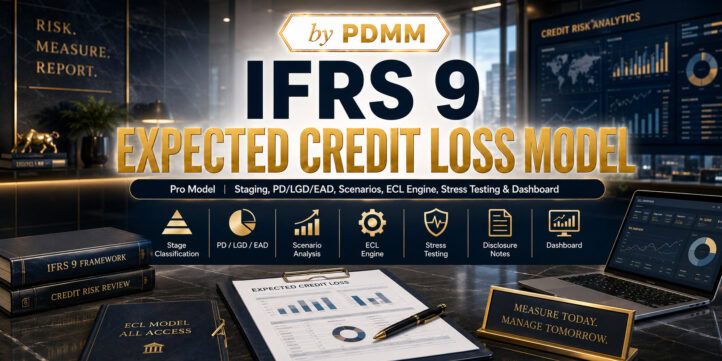


📌 IFRS 9 Expected Credit Loss Premium Model
This premium Excel template is designed to help users calculate, analyze, and present Expected Credit Losses under IFRS 9 in a structured, transparent, and professional format.
It is suitable for banks, NBFCs, microfinance institutions, lending businesses, credit risk teams, finance departments, auditors, consultants, and professionals involved in IFRS reporting, impairment analysis, and credit portfolio monitoring.
The model follows the core IFRS 9 ECL approach:
Expected Credit Loss = Probability of Default × Loss Given Default × Exposure at Default
It allows users to assess credit losses using borrower-level or facility-level inputs and convert those assumptions into stage-wise and probability-weighted ECL outputs.
✅ What This Model Is Used For
This model can be used for:
• IFRS 9 impairment calculation.
• Expected Credit Loss analysis.
• Loan portfolio risk assessment.
• Stage 1, Stage 2, and Stage 3 classification.
• PD, LGD, and EAD-based credit loss modelling.
• Forward-looking macroeconomic scenario analysis.
• Stress testing and sensitivity analysis.
• Credit risk dashboard reporting.
• ECL roll-forward and movement analysis.
• Audit support and financial reporting preparation.
🔍 How the Model Works
Users begin by entering portfolio-level or exposure-level data such as borrower details, product type, outstanding exposure, undrawn limits, credit rating, industry, geography, collateral value, days past due, watchlist status, forbearance indicator, maturity, and other risk factors.
The model then applies IFRS 9 staging logic to classify exposures into:
• Stage 1 – Performing assets with 12-month ECL.
• Stage 2 – Assets with significant increase in credit risk and lifetime ECL.
• Stage 3 – Credit-impaired or defaulted assets with lifetime ECL.
Once staging is completed, the model calculates ECL using PD, LGD, and EAD assumptions. It also includes credit conversion factors for undrawn commitments, collateral recovery logic, macroeconomic overlays, and scenario probability weighting.
The model supports Base, Adverse, and Severe scenarios, allowing users to reflect forward-looking economic conditions in the final impairment allowance.
📊 Key Features
• Portfolio input and exposure-level data structure.
• IFRS 9 staging logic.
• PD assumption and term structure module.
• LGD and collateral recovery analysis.
• EAD and credit conversion factor calculation.
• Forward-looking macroeconomic overlay.
• Base, Adverse, and Severe scenario weighting.
• Probability-weighted ECL calculation.
• Stage-wise ECL reporting.
• Sensitivity analysis and stress testing.
• Vintage analysis and staging migration.
• ECL roll-forward schedule.
• Dashboard and visual summary outputs.
• Disclosure note support.
• Audit trail and validation checks.
• Fully editable Excel workbook.
📈 Dashboard and Reporting
The dashboard provides a clear summary of the credit portfolio and impairment results. It highlights total exposure, total ECL, coverage ratio, weighted average PD, weighted average LGD, macro impact, stage-wise ECL, top exposures by ECL, portfolio risk heatmap, and ECL trends.
This makes the model useful for finance teams, credit committees, auditors, management reporting, and IFRS 9 impairment review.
🎯 Why You Need This Model
Building an IFRS 9 ECL model from scratch can be time-consuming and technically complex. This template gives users a ready-made structure that can be adapted to their own loan book, assumptions, reporting currency, product types, rating methodology, and internal credit risk policy.
It helps users save time, improve consistency, support audit review, and communicate impairment results in a professional format.
👤 Best Suited For
• Banks and lending institutions.
• NBFCs and microfinance institutions.
• Credit risk professionals.
• Finance and reporting teams.
• IFRS consultants.
• External and internal auditors.
• Financial analysts.
• Portfolio risk managers.
• Accounting and advisory firms.
⚠️ Not Ideally Suited For
• Businesses with no lending, receivables, or credit exposure.
• Users looking for a regulatory capital model instead of an accounting impairment model.
• Users seeking automated integration with banking core systems.
• Users requiring a fully customized model without making any edits.
Document Benefits
- Provides a structured IFRS 9 ECL framework using PD, LGD, EAD, staging, macro scenarios, and probability-weighted credit loss calculations.
- Helps finance, credit risk, audit, and reporting teams analyze impairment allowances with dashboards, stress testing, and validation checks.
- Saves time by providing a fully editable Excel model that can be customized for different loan portfolios, assumptions, and reporting periods.
Objectives of the Downloadable Best Practice
To provide a practical Excel-based IFRS 9 Expected Credit Loss model that helps users calculate, analyze, review, and present impairment allowances using PD, LGD, EAD, staging, macroeconomic scenarios, and credit risk dashboards.
Conditions Where This Downloadable Best Practice Applies Best
This model applies best where an organization has loans, receivables, credit facilities, undrawn commitments, or other financial assets requiring IFRS 9 impairment assessment. It is especially useful for banks, NBFCs, lending businesses, credit risk teams, finance departments, auditors, and IFRS reporting professionals.
Conditions Where This Downloadable Best Practice Does Not Apply Ideally
This model does not apply ideally where the business has no credit exposure or where the user requires a fully automated system-integrated IFRS 9 engine. It is also not intended to replace professional accounting judgment, entity-specific IFRS policy decisions, or regulatory capital models.
Similar ProductsOther customers were also interested in...



 eFinancialModels
Electric Vehicle (EV) Charging Station Financial M...
With this comprehensive 5- or 10-year monthly tool, investors can assess the viability of setting up... Read more

Financial Model for Mobile App | Mobile App Busine...
The Mobile App Financial Plan Template in Excel allows you to develop financial projections when lau... Read more

 HenrySheykin
Food Truck Financial Model Excel Template
The Food Truck Financial Model helps entrepreneurs, founders, business owners, consultants, and anal... Read more

Green Hydrogen Production from Wind Energy Financi...
The Green Hydrogen from Wind Financial Model aims to comprehensively forecast a horizon of 40 years ... Read more

Simple Mutual Non-Disclosure Agreement Template
Protect your business secrets with ease using our Simple Mutual Non-Disclosure Agreement Template. S... Read more

Solar Energy Financial Model
The Solar Energy Financial Model Spreadsheet Template in Excel assists you in preparing a sophistica... Read more

 Peter Graf
The Customer-Centric Financial Model for Restauran...
Starting a restaurant without a financial plan is like driving a car blindfolded. You wouldn´t do i... Read more
You must log in to submit a review.