
0 ITEMS

The 3 Best Valuation Methods for Mergers and Acquisitions

When Disney acquired Pixar for $7.4 billion in 2006, it was more than just a business deal—it was a masterclass in strategic mergers and acquisitions valuation. During that time, Disney’s traditional animation approach had lost its dominance. The acquisition helped Disney Animation regain its status as a powerhouse, leading to hits like Frozen and Moana. On the other side, Disney’s vast distribution network and marketing machine helped further amplify the success of Pixar films.
Unlike many high-profile acquisitions that fail to deliver expected synergies, this merger transformed Disney’s animation division and generated billions in box office and merchandising revenue. But what made the deal so successful? And how did Disney determine Pixar’s true value? Valuing mergers and acquisitions (M&A) requires a combination of financial modeling, strategic foresight, and an understanding of synergies that go beyond the numbers. This article explores what are mergers and acquisitions, the key valuation methods used in M&A, why some deals create immense value, and what separates the winners from the failures.
What are Mergers and Acquisitions?
Mergers and acquisitions (M&A) refers to combining two companies into one. It involves bringing two companies together to form a single entity. This can happen when businesses merge as equals or when one company takes over another. What are mergers and acquisitions involve deals to boost profits, enter new markets, gain a competitive edge, and grow faster. The process involves financial, legal, and strategic planning to ensure success. While M&A can bring big benefits, it also comes with risks like integration challenges and cultural clashes.
A merger happens when companies of similar stature form a single business. This can help them grow, increase market power, or reduce costs. There are different types of mergers based on business goals.
- A horizontal merger happens between competitors in the same industry.
- A vertical merger joins companies at different stages of the supply chain. A conglomerate merger combines businesses from unrelated industries.
- A market extension merger brings together companies selling similar products in different locations.
- A product extension merger unites firms offering related products in the same market.
An acquisition happens when a larger company buys another, typically a smaller one, to gain control. Businesses use acquisitions to enter new markets, gain assets, or grow. There are different types of acquisitions.
- A friendly acquisition occurs when both companies agree on the deal.
- A hostile acquisition happens when the target company resists the takeover.
- A leveraged buyout (LBO) uses borrowed money to buy a company, often by private equity firms.
- A reverse takeover lets a private company go public by acquiring a public firm.

5 Top Reasons for Mergers and Acquisitions
- Synergies & Cost Savings: One of the reasons for mergers and acquisitions is to boost efficiency and cut costs. Combining operations eliminates duplicate expenses, increases buying power, and streamlines processes. The goal is to achieve a stronger, more profitable company than either could alone.
- Market Expansion & Growth: Another one of the top reasons for mergers and acquisitions is to enter new markets quickly. Instead of building a presence from scratch, companies acquire firms with established customer bases, distribution channels, and brand recognition. This strategy strengthens market position, speeds growth, and expands revenue streams in different regions or industries.
- Diversification of Products & Services: Businesses merge to reduce risk and create stability. By expanding their product lines or services, they avoid reliance on a single revenue source. This helps them navigate industry downturns and changing customer preferences. A broader portfolio makes them more resilient and adaptable in a shifting market.
- Competitive Advantage & Dominance: Acquiring competitors strengthens market control. Larger companies gain pricing power, brand influence, and a stronger foothold against rivals. One of the top reasons for mergers and acquisitions is to reduce competition, increase market share, and create barriers for new entrants. The result is a dominant industry player with more leverage over customers and suppliers.
- Access to New Technology & Talent: Mergers provide companies with cutting-edge innovations and skilled employees. Instead of developing technology in-house, they acquire firms with proven advancements. This accelerates product development and enhances competitive edge. Additionally, they gain expert teams, boosting knowledge, creativity, and execution speed.






















































Mergers and Acquisitions Valuation: The Top 3 Methods Explained
The appropriate mergers and acquisitions valuation method is critical to making the right deal. Buyers want fair prices, while sellers seek maximum value. The challenge lies in determining what a business is truly worth. Various financial techniques help investors assess value, weighing future earnings, market conditions, and assets. A solid mergers and acquisitions valuation approach reduces risk and supports better negotiations, ensuring both sides make informed decisions.
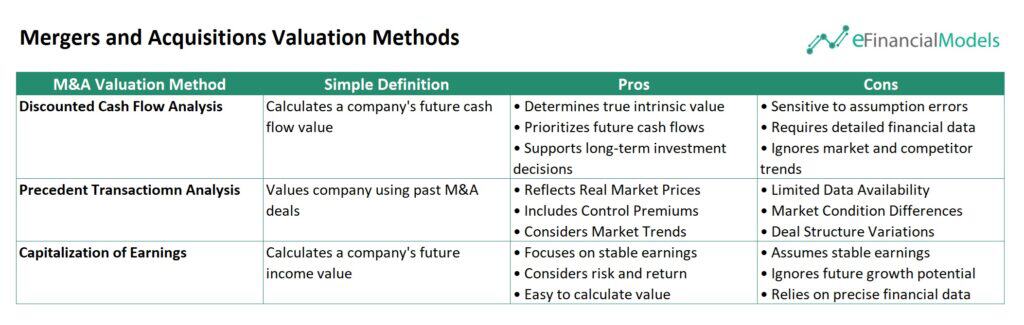
Discounted Cash Flow Analysis (DCF)
Discounted Cash Flow (DCF) Analysis is one of the most common mergers and acquisitions valuation methods. It determines the present value of a target company based on its expected future cash flows. The process involves estimating future free cash flows and then discounting them back to their net present value using an appropriate discount rate, typically the weighted average cost of capital (WACC). This approach helps buyers assess whether a company’s intrinsic value justifies the purchase price.
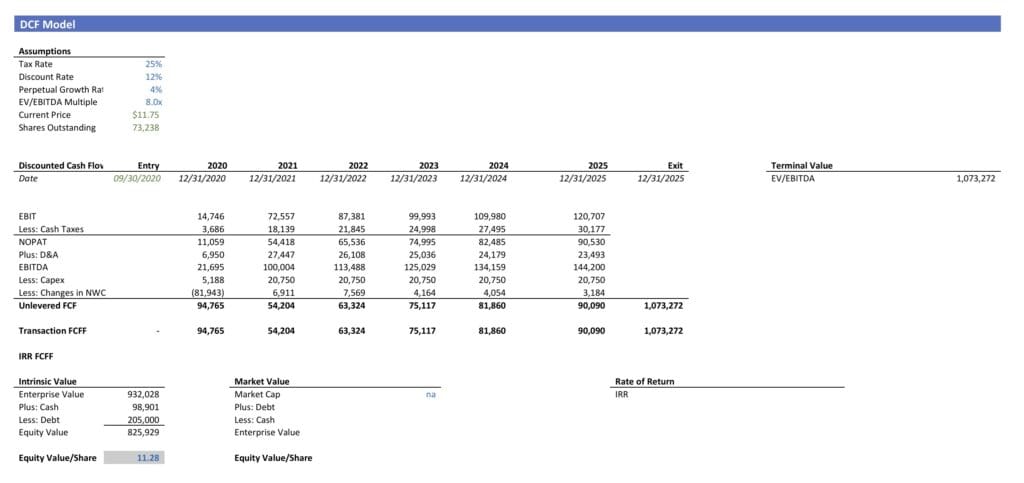
The Mergers & Acquisitions (M&A) Model above uses the Discounted cash flow analysis to calculate a company’s intrinsic value by estimating future unlevered free cash flows (FCF) and discounting them to present value using a 12% discount rate. It accounts for earnings before interest and taxes (EBIT), depreciation, amortization, capital expenditures, and net working capital changes to determine cash flow potential. The terminal value is derived using an EV/EBITDA multiple of 8x, adding long-term worth. The analysis then sums the enterprise value, adjusts for cash and debt, and divides by shares outstanding to find the equity value per share ($11.28). This process helps buyers assess if the target company is worth its price in an M&A deal.
Pros:
A DCF analysis helps buyers in mergers and acquisitions (M&A) see a company’s true worth based on future earnings. It values a business on its own cash flow, not just market trends. This makes it useful for long-term investments. DCF also allows detailed adjustments for risks, growth, and industry changes.
DCF method can also best quantify the value of expected synergies as those can be added to the future free cash flows.
Cons:
A DCF analysis relies on future predictions, making it sensitive to small errors in assumptions. Inaccurate growth rates or discount rates can lead to misleading valuations. The method also requires detailed financial data, which may not always be available. DCF ignores market conditions and competitor pricing, which can impact a company’s actual value. Since it involves complex calculations, it may be time-consuming and difficult for some investors to apply effectively.
Precedent Transaction Analysis
Precedent Transaction Analysis values a company by comparing it to similar businesses sold in past M&A deals. It looks at actual transaction prices to gauge market value. Analysts review valuation multiples like EV/EBITDA to find pricing trends. It helps buyers and sellers set fair prices based on historical data.
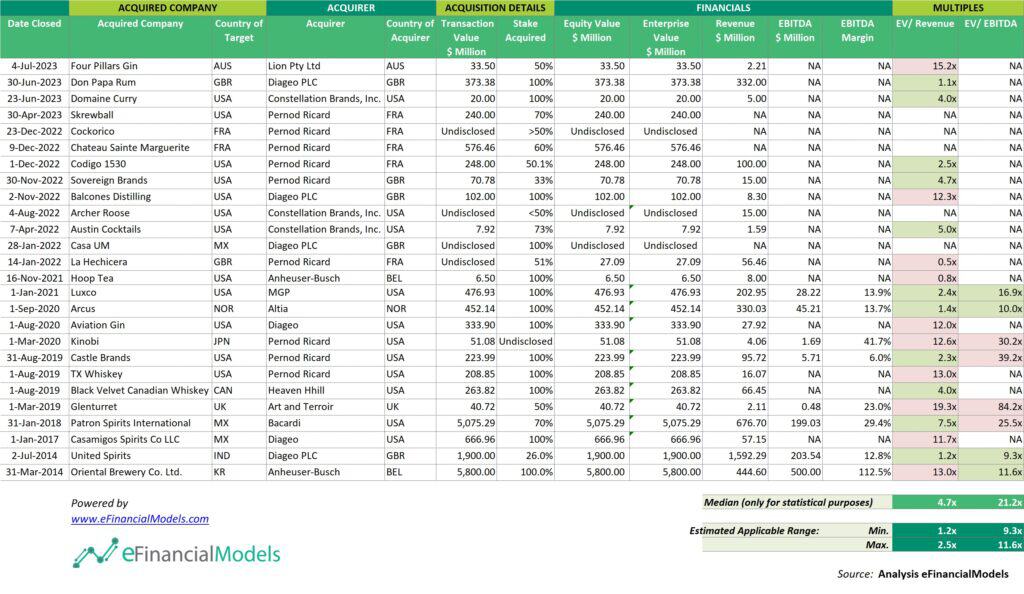
The Precedent Transaction Analysis Example above helps determine acquisition prices by analyzing past deals in the distillery industry. It looks at key metrics like transaction value, revenue, EBITDA, and valuation multiples (EV/Revenue and EV/EBITDA). Buyers use these benchmarks to estimate a fair price for a new acquisition. For example, the estimated range in the table suggests typical EV/Revenue multiples fall between 1.2x and 2.5x, while EV/EBITDA ranges from 9.3x to 21.6x. If a target company has $100M in revenue, its likely acquisition price could range from $120M to $250M based on revenue multiples.
Pros:
Precedent Transaction Analysis helps businesses estimate a company’s value by comparing past deals in the same industry. First, it reflects real market prices, showing what buyers recently paid for similar companies. Second, it includes control premiums, capturing the value of full ownership rather than just a minority stake. Third, it considers market trends, adjusting for industry shifts and investor sentiment. This method provides a practical benchmark, but deal terms and market conditions must be analyzed for accuracy.
Cons:
Precedent Transaction Analysis has key drawbacks in mergers and acquisitions valuation. First, deal data may be outdated or hard to find, making comparisons unreliable. Second, market conditions vary, so past prices may not reflect current trends. Third, deal structures differ, with unique terms affecting valuations. These factors make it essential to adjust for differences and use other methods for a complete valuation.
Capitalization of Earnings
The capitalization of earnings values a business based on its expected future profits. It divides the company’s stable earnings by a capitalization rate, which reflects risk and expected return. This mergers and acquisitions valuation method works best for firms with predictable earnings. Buyers and investors use it in mergers and acquisitions to estimate a company’s fair value. A lower capitalization rate increases valuation, while a higher rate lowers it. This approach helps determine if an acquisition price makes financial sense.
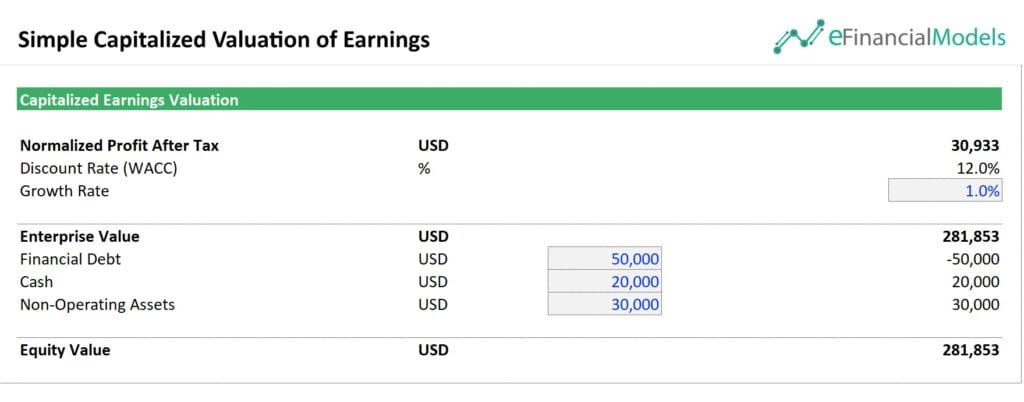
The above chart is from our Simple Capitalized Earnings Business Valuation Model. It uses the capitalized earnings valuation to determine the Enterprise Value (EV) based on the company’s normalized profit after tax and expected growth. Using a discount rate (WACC) of 12% and a growth rate of 1%, the model capitalizes earnings to derive an EV of $281,853. Adjustments are made by subtracting financial debt ($50,000) and adding cash ($20,000) and non-operating assets ($30,000) to determine the final Equity Value of $281,853. This valuation helps buyers and sellers in mergers and acquisitions by providing a clear estimate of the company’s worth.
Pros:
Capitalization of Earnings offers three key benefits in mergers and acquisitions. First, it provides a simple, clear valuation by focusing on a company’s stable earnings and risk level. Second, it helps buyers and investors make quick comparisons between businesses with steady cash flow. Third, it avoids short-term market fluctuations, making it a reliable tool for long-term valuation. These advantages make it a practical choice for assessing well-established companies with predictable profits.
Cons:
The capitalization of the earnings method has key drawbacks in mergers and acquisitions valuation. It assumes stable earnings and growth, which may not reflect real-world volatility. It ignores future growth potentials, making it less reliable for dynamic businesses. This method relies heavily on accurate discount rates—small errors can skew valuation significantly. It also overlooks non-financial factors like brand strength, competitive position, or future risks. This approach fails to capture true value for companies with irregular profits or rapid growth, leading to mispriced deals in mergers and acquisitions.
How Financial Modeling Enhances M&A Valuation Accuracy
Valuing mergers and acquisitions requires a clear approach to measuring a company’s worth. Discounted Cash Flow (DCF) estimates future earnings and discounts them to present value. Capitalization of Earnings assesses profits relative to risk. Precedent Transaction Analysis compares past deals in the same industry. Each method offers unique insights, helping buyers and sellers make informed decisions. Businesses can negotiate better deals and maximize investment returns using the right valuation technique.
Financial modeling is essential for precise M&A valuations. It helps buyers determine how much to bid by forecasting future cash flows, profitability, and risks. A solid model provides a clear financial picture, making it easier to justify offers. It also serves as a negotiation tool by analyzing different scenarios and their impact on value. Buyers and sellers can assess best- and worst-case outcomes, ensuring informed decisions. With a well-built financial model, businesses can approach M&A deals with confidence, reducing risks and maximizing value. For a practical solution, explore the Mergers and Acquisitions (M&A) Financial Model Template from eFinancialModels to guide your deal-making process.
Accurate business valuation requires in-depth financial analysis and a solid financial model. At eFinancialModels, we provide expert valuation services tailored to your needs. We use proven methods to assess a company’s worth, factoring in revenue, costs, and potential synergies. Quantifying synergies is crucial, as they impact the final valuation and deal success. With years of experience valuing companies across industries, we offer a flexible and professional service to help you make informed decisions. Let us handle the complexities of valuation so you can focus on securing the best deal. Get started with our business valuation service today!













You might also like:
- 10 Tips to Develop a First Class Business Valuation Report
- 12 BUSINESS VALUATION METHODS
- Financial Valuation Services
- How to Do a Precedent Transaction Valuation ?
- Understanding the Debt Service Coverage Ratio: An Essential Metric for Financial Analysis
- Valuation Services
- Finding Fair Market Value: A Quick Guide to Real Estate Valuation
- Five Easy Steps to Perform a DCF Valuation
- 10 Main Elements of a Business Plan
- Mobilizing VCs: Pre-Money and Post-Money Valuation: What You Need to Know
- How to Calculate Net Present Value (NPV)?
- Valuation
- Financial Modeling for Startups and Small Businesses
- How are Valuation Multiples Determined
- Steps to Securing Series C Financing
- Business Valuation
- Top 10 Mistakes in DCF Valuation Models
- Valuation Models for Private Equity
- Cost Valuation Model for Renewable Energy
- Discounted Cash Flow Valuation Model: Free Excel Template
Tags: business valuation